PUMDET 2023 Question Paper Applied Economics
Finished viewing? Save it for later —
Download PUMDET 2023 Question Paper Applied Economics (PDF · 12 pages)About PUMDET 2023 Question Paper Applied Economics
PUMDET 2023 Question Paper Applied Economics is available here for free download. Published by WBJEEB for PUMDET, this question paper can be viewed online or downloaded as a PDF (12 pages). Candidates preparing for PUMDET can use PUMDET 2023 Question Paper Applied Economics to understand the exam pattern, the type of questions asked, and the overall difficulty level.
Frequently Asked Questions
How can I download PUMDET 2023 Question Paper Applied Economics?
Open this page and click the Download button to save PUMDET 2023 Question Paper Applied Economics as a PDF. It is completely free on AglaSem Docs.
Is PUMDET 2023 Question Paper Applied Economics free to download?
Yes. PUMDET 2023 Question Paper Applied Economics can be viewed online and downloaded as a PDF free of cost on AglaSem Docs.
How many pages does PUMDET 2023 Question Paper Applied Economics have?
PUMDET 2023 Question Paper Applied Economics contains 12 pages, which you can read online or download together as a single PDF.
Where can I find more PUMDET study material?
You can find more PUMDET question papers, sample papers, syllabus, and answer keys on AglaSem Docs.
PUMDET 2023 Question Paper Applied Economics – Text
Read the full text of this question paper below — useful to quickly search, copy and reference the content online without downloading the PDF.
📄 View text version (12 pages)
Page 1
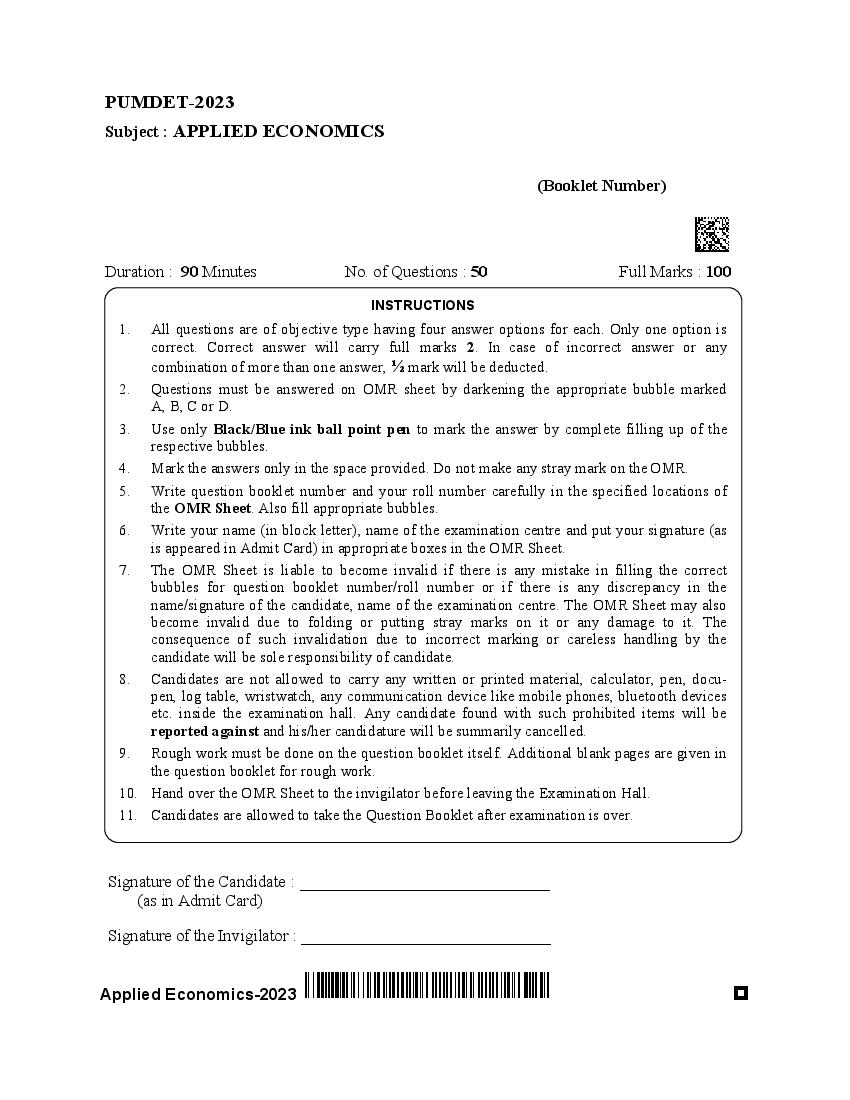
(Booklet Number)
Duration : 90 Minutes No. of Questions : 50 Full Marks : 100
INSTRUCTIONS
1. All questions are of objective type having four answer options for each. Only one option is
correct. Correct answer will carry full marks 2. In case of incorrect answer or any
combination of more than one answer, ½ mark will be deducted.
2. Questions must be answered on OMR sheet by darkening the appropriate bubble marked
A, B, C or D.
3. Use only Black/Blue ink ball point pen to mark the answer by complete filling up of the
respective bubbles.
4. Mark the answers only in the space provided. Do not make any stray mark on the OMR.
5. Write question booklet number and your roll number carefully in the specified locations of
the OMR Sheet. Also fill appropriate bubbles.
6. Write your name (in block letter), name of the examination centre and put your signature (as
is appeared in Admit Card) in appropriate boxes in the OMR Sheet.
7. The OMR Sheet is liable to become invalid if there is any mistake in filling the correct
bubbles for question booklet number/roll number or if there is any discrepancy in the
name/signature of the candidate, name of the examination centre. The OMR Sheet may also
become invalid due to folding or putting stray marks on it or any damage to it. The
consequence of such invalidation due to incorrect marking or careless handling by the
candidate will be sole responsibility of candidate.
8. Candidates are not allowed to carry any written or printed material, calculator, pen, docu-
pen, log table, wristwatch, any communication device like mobile phones, bluetooth devices
etc. inside the examination hall. Any candidate found with such prohibited items will be
reported against and his/her candidature will be summarily cancelled.
9. Rough work must be done on the question booklet itself. Additional blank pages are given in
the question booklet for rough work.
10. Hand over the OMR Sheet to the invigilator before leaving the Examination Hall.
11. Candidates are allowed to take the Question Booklet after examination is over.
Signature of the Candidate : ______________________________
(as in Admit Card)
Signature of the Invigilator : ______________________________
Applied Economics-2023
Page 2
Applied Economics 2
Page 3
Cc q 3 10q 2 17q 66 .
If the market price is 5, the profit maximizing output is
(A) 6 (B) 4
(C) 3 (D) 2
2. An increase in output due to an increase in demand in a perfectly competitive and
constant cost industry which is in the long-run equilibrium, will result from:
(A) New firms only (B) Existing firms only
(C) Both new and existing firms (D) Any of the above
3. The market demand and the cost functions in a duopoly market are q = (100 – P) 2,
C1 = 5q1 and C2 = 0.5q22. The Stacklbeng solution for q1 when firm 1 is the leader is
given by
1 1
(A) q1 = 93 (B) q1 = 90
3 3
(C) q1 = 89 (D) q1 = 95
4. A demand function is given as
X1 Ap1 p2 M , where p1 and p2 are prices and M is money income.
The relation between α, β and γ is
(A) + + = 1 (B) + + > 0
(C) + + < 0 (D) + + = 0
5. When two firms are engaged in (Bertrand) price competition (with equal unit costs)
(A) their outputs will be lower and prices higher than if they engaged in (Cournot)
quantity competition.
(B) their outputs will be higher and prices lower than if they engaged in (Cournot)
quantity competition.
(C) their outputs will be higher than Cournot quantity competition but nothing can be
said about price.
(D) their price will be lower than Cournot quantity competition but nothing can be said
about outputs.
Applied Economics 3
Page 4
Firm-II d e f
Firm-I
a 4, 2 13, 6 1, 3
b 3, 10 0, 0 15, 2
c 12, 14 4, 11 5, 4
(A) b, d (B) b, f
(C) c, e (D) (a, e) and (c, d)
7. In a monopsonistic labour market, a profit maximizing monopolist would pay a wage rate
(A) Equal to the marginal revenue product
(B) Greater than the marginal revenue product
(C) Less than the marginal revenue product
(D) Any one of the above is possible
8. In the model of consumer behaviour with two goods, the Slutsky equation is given by
X i X i X X i X i X
(A) – X j i (B) – Xi i
p j p j M p j p j M
v v
X i X i X X i X i X
(C) – X j i (D) – p i i
p i p i v M p i p i v M
9. Suppose two firms are competing in quantity in the market. The market demand function
is P = 9 – Q where Q = q1 + q2. The marginal costs of the production are zero. The fixed
cost of production is f ≥ 0. If f = 0 then
(A) There exists a unique Cournot Nash equilibrium.
(B) There are two Cournot Nash equilibria.
(C) There are three Cournot Nash equilibria.
(D) There does not exist any Cournot Nash equilibrium.
Applied Economics 4
Page 5
(i) u(x, y) = xy
(ii) v(x, y) = x2y2 + ln(x) + ln(y)
Which of the following are true ?
(a) v(x, y) is a positive monotonic transformation of u(x, y).
(b) In case of both u(x, y) and v(x, y), the utility maximizing choices remain same.
(c) Both utility functions achieve same maximum values.
(A) Both (a) and (b) (B) Both (a) and (c)
(C) Both (b) and (c) (D) All (a), (b) and (c)
1
For the production function y = K x (1 – ) x2 , if ρ = 1 then the isoquants
11.
1
become
(A) L – shaped (B) Straight lines
(C) Strictly Convex (D) Strictly Concave
12. Suppose that the consumer faces the demand D(p) = 20 – 2p. At price = 4, the consumer
surplus will be
(A) 16 (B) 20
(C) 36 (D) 30
13. Which of the following is true for a sub-game perfect Nash equilibrium ?
(A) It induces a Nash equilibrium in every subgame of the game.
(B) It induces Dominant strategies in at least one subgame of the game.
(C) Both (A) and (B)
(D) None of the above
14. Which of the following assumptions is not satisfied by the lexicographic ordering ?
(A) Completeness (B) Reflexivity
(C) Transitivity (D) Continuity
Applied Economics 5
Page 6
The monopolist charges a price of ` 60 per unit of output. What will be her marginal cost
at this level of output ?
(A) 24 (B) 135
(C) 45 (D) 54
16. The market equilibria fail to be Pareto optimal in the presence of
(A) Externalities (B) Market power
(C) Asymmetric information (D) All of these
17. Consider a two good economy where y is a numeraire good.
U(x, y) = x + 2y
Px + y = 100
If, P = 2, then find the optimal bundle.
(A) (50, 50) (B) (0, 50)
(C) (0, 100) (D) (100, 0)
18. In the IS-LM model, when is the IS curve vertical ?
(A) Consumption is interest inelastic.
(B) Consumption is a positive function of interest rate.
(C) Investment is a positive function of income.
(D) Investment is interest inelastic.
19. Consider a closed controlled economy with unlimited supplies of labour in which the
incremental capital-output ratio is 4 and the rate of population growth is 1.5% per annum.
If the economy wants to attain a growth rate of per capita income of 6% per annum, what
must be the savings rate (in percent) in the economy ?
(A) 24 (B) 27.5
(C) 30 (D) 36
Applied Economics 6
Page 7
in a year are less than their respective recorded costs, then which of the following
statements is necessarily true ?
(A) The total purchases of intermediates by firms were more than their total sales.
(B) At least some firms must have made accounting errors.
(C) The economy’s GDP of that year was negative.
(D) Neither of the above
21. In the AD-AS model, the level of aggregate demand can influence the level of output
(A) If and only if the price level is constant.
(B) If and only if aggregate supply is not invariant with changes in the price level.
(C) If and only if aggregate supply has a positive relationship with the price level.
(D) If and only if aggregate supply is invariant with changes in the price level.
22. “At current prices, the gross fixed capital formation of the public sector has increased by
23.5% from 6.4 lakh crore in 2011-12 to 7.9 lakh crore in 2012-13, that of private
corporate sector by 0.8% from 8.5 lakh crore in 2011-12 to 8.6 lakh crore in 2012-13, and
the household sector by 3.9% from 13.7 lakh crore in 2011-12 to 14.3 lakh crore in 2012-
13”. The government expenditure to GDP ratio in 2012-13 would then approximately be
(A) 15% (B) 20%
(C) 25% (D) 30%
23. When the central bank seeks to keep the interest rate at a target level
(A) fiscal policy is ineffective.
(B) fiscal policy is fully effective.
(C) fiscal policy is only partially effective.
(D) fiscal policy variables become endogenous.
24. Policy Trilemma refers to
(A) Fixed exchange range, independent monetary policy and perfect capital mobility
(B) Flexible exchange rate, independent monetary policy and imperfect capital mobility
(C) Fixed exchange rate, independent fiscal policy and perfect capital mobility
(D) Flexible exchange rate, independent fiscal policy and imperfect capital mobility
Applied Economics 7
Page 8
(A) Economy is forever changing
(B) Minimum wage laws persist
(C) Unions exercises their bargaining power
(D) Existence of efficiency wages
26. The J – curve effect of the depreciation of the exchange rate indicates trade balance to
(A) Improve in the short-run (B) Worsen in the short-run
(C) Worsen in the long-run (D) None of the above
27. In IS-LM framework with an external sector, the IS equation includes
(A) Capital account balance (B) Net export term
(C) Money supply function (D) Economic growth equation
28. Suppose the government increases expenditure by ` 1,000 crore in the budget and
finances it by raising taxes by ` 1,000 crore so that the government budget remains
balanced. Then which of the following is true ?
(A) GDP will remain the same as before.
(B) GDP will rise by ` 1,000 crore.
(C) GDP will rise by less than ` 1,000 crore.
(D) GDP will fall by ` 1,000 crore.
29. Tobin’s q theory suggests that it is profitable for a firm to invest if Tobin’s q is
(A) Greater than unity (B) Less than unity
(C) Greater than zero (D) Less than zero
30. National income is equal to
(A) GDP at factor cost (B) NNP at factor cost
(C) GNP at factor cost (D) All of the above
Applied Economics 8
Page 9
economy is ` 8,000 crores, the velocity of money is
(A) 1.25 (B) 2
(C) 18 (D) 0.8
32. In a binomial distribution, the sum of mean (μ) and variance (σ 2) is 15 and product of
mean and variance is 54. Then the number of observations is equal to
(A) 27 (B) 30
(C) 24 (D) 33
33. What would be the consequence for the OLS estimator if heteroscedasticity is present in a
regression model but ignored
(A) it will be biased (B) it will be inconsistent
(C) it will be inefficient (D) all of (A), (B) and (C) are true
34. The probability that a family chosen randomly for a sample survey owns a television is
0.86, owns a mobile is 0.35 and owns both a television set and a mobile is 0.29. What is
the probability that such a family will own either a television set or a mobile ?
(A) 0.80 (B) 0.96
(C) 0.92 (D) 0.88
35. If everyone in a country had the same level of income, the value of the Gini coefficient
would be
(A) 0 (B) 0.5
(C) 1 (D) infinity
36. The covid database gives covid data from March 2020 to date. Which of the following
will be most appropriate to analyse this data ?
(A) Mean (B) Variance
(C) Moving average (D) Correlation analysis
37. If the mean and mode of a moderately skew distribution is 4.5 and 5, find the median.
(A) 4.75 (B) 1.33
(C) 4.25 (D) 4.67
Applied Economics 9
Page 10
(A) to estimate the change in y for a one-unit change in x.
(B) to determine if any x-values are outliers.
(C) to determine if any y-values are outliers.
(D) to determine if a change in x causes a change in y.
39. A type 1 error occurs when one
(A) fails to reject a false null hypothesis (B) rejects a true null hypothesis
(C) rejects a false alternative hypothesis (D) accepts a true alternative hypothesis
40. Two events A and B will be independent if
(A) A and B are mutually exclusive (B) P(A' B') = [1 – P(A)] [1 – P(B)]
(C) P(A) = P(B) (D) P(A) + P(B) = 1
41. A firm produces mobile phones in three plants A, B and C with daily production of 500,
1000 and 2000 units respectively. It is known that the fractions of defective items in the
plants are 0.005, 0.008 and 0.01. A phone is selected at random from a day’s total
production and is found to be defective. What is the probability that it came from the first
plant ?
(A) 0.25 (B) 8/40
(C) 8/35 (D) 5/61
42. If the mean and variance of the binomial distribution are 2 and 4/3 respectively, find the
probability of obtaining exactly two successes.
(A) 16/81 (B) 6/81
(C) 256/729 (D) 80/243
43. The violation of the assumption of constant variance of the residual is known as
(A) homoscedasticity (B) heteroscedasticity
(C) multicollinearity (D) autocorrelation
Applied Economics 10
Page 11
(A) the strength of the relationship between x and y
(B) the expected x value when y is zero
(C) the expected y value when x is zero
(D) a popular parameter
45. A parameter is :
(A) a sample characteristic (B) a population characteristic
(C) unknown (D) normally distributed
46. What test should be used to check if the mean of a sample is equal to some specific
value, when standard deviation is known ?
(A) z test (B) t test
(C) F test (D) 2 test
47. The Durbin – Watson test statistic ‘d’ has a range of
(A) [0, 4] (B) [–2, 2]
(C) [–1, 1] (D) [–4, 4]
48. Let us consider two random variables X and Y such that E[X] = 0, E[Y] = 0, E[XY] = 5.
The minimum value of var [X + Y] is
(A) 5 (B) 0
(C) 1 (D) 10
49. The GDP of a country is growing at 5%, its population growth rate is 2% and income
elasticity for food is 0.5. The growth rate of food demand is
(A) 5% (B) 2.5%
(C) 2% (D) 3.5%
50. The Lewis model of growth in a dual economy tells that the growth rate of the money
wage in the modern sector is
(A) Zero (B) Constant
(C) Equal to rate of inflation (D) Equal to the growth rate of labour
____________
Applied Economics 11
Page 12
Applied Economics 12
Document Details
| Board / Org | WBJEEB |
| Exam | PUMDET |
| Type | Question Paper |
| Pages | 12 |
| Updated | 22 Jul 2026 |