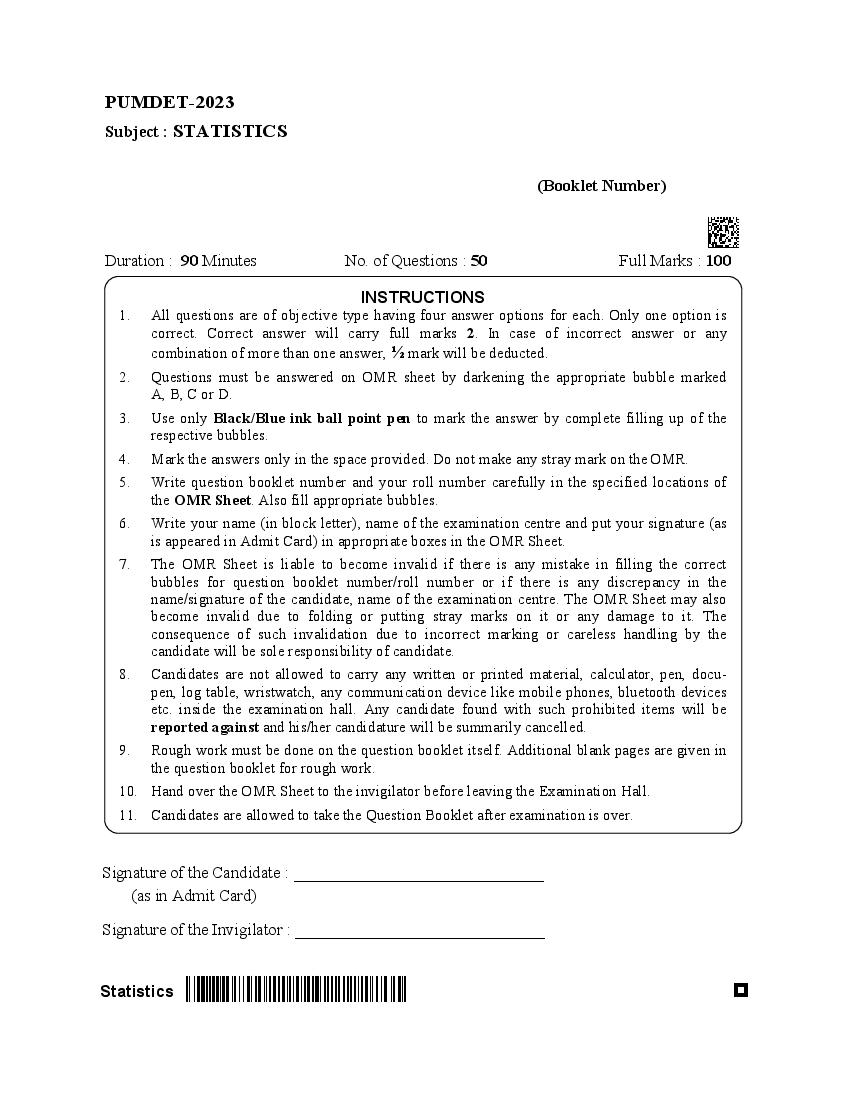
PUMDET 2023 Question Paper Statistics
Finished viewing? Save it for later —
Download PUMDET 2023 Question Paper Statistics (PDF · 12 pages)About PUMDET 2023 Question Paper Statistics
PUMDET 2023 Question Paper Statistics is available here for free download. Published by WBJEEB for PUMDET, this question paper can be viewed online or downloaded as a PDF (12 pages). Candidates preparing for PUMDET can use PUMDET 2023 Question Paper Statistics to understand the exam pattern, the type of questions asked, and the overall difficulty level.
Frequently Asked Questions
How can I download PUMDET 2023 Question Paper Statistics?
Open this page and click the Download button to save PUMDET 2023 Question Paper Statistics as a PDF. It is completely free on AglaSem Docs.
Is PUMDET 2023 Question Paper Statistics free to download?
Yes. PUMDET 2023 Question Paper Statistics can be viewed online and downloaded as a PDF free of cost on AglaSem Docs.
How many pages does PUMDET 2023 Question Paper Statistics have?
PUMDET 2023 Question Paper Statistics contains 12 pages, which you can read online or download together as a single PDF.
Where can I find more PUMDET study material?
You can find more PUMDET question papers, sample papers, syllabus, and answer keys on AglaSem Docs.
PUMDET 2023 Question Paper Statistics – Text
Read the full text of this question paper below — useful to quickly search, copy and reference the content online without downloading the PDF.
📄 View text version (12 pages)
Page 1
(Booklet Number)
Duration : 90 Minutes No. of Questions : 50 Full Marks : 100
INSTRUCTIONS
1. All questions are of objective type having four answer options for each. Only one option is
correct. Correct answer will carry full marks 2. In case of incorrect answer or any
combination of more than one answer, ½ mark will be deducted.
2. Questions must be answered on OMR sheet by darkening the appropriate bubble marked
A, B, C or D.
3. Use only Black/Blue ink ball point pen to mark the answer by complete filling up of the
respective bubbles.
4. Mark the answers only in the space provided. Do not make any stray mark on the OMR.
5. Write question booklet number and your roll number carefully in the specified locations of
the OMR Sheet. Also fill appropriate bubbles.
6. Write your name (in block letter), name of the examination centre and put your signature (as
is appeared in Admit Card) in appropriate boxes in the OMR Sheet.
7. The OMR Sheet is liable to become invalid if there is any mistake in filling the correct
bubbles for question booklet number/roll number or if there is any discrepancy in the
name/signature of the candidate, name of the examination centre. The OMR Sheet may also
become invalid due to folding or putting stray marks on it or any damage to it. The
consequence of such invalidation due to incorrect marking or careless handling by the
candidate will be sole responsibility of candidate.
8. Candidates are not allowed to carry any written or printed material, calculator, pen, docu-
pen, log table, wristwatch, any communication device like mobile phones, bluetooth devices
etc. inside the examination hall. Any candidate found with such prohibited items will be
reported against and his/her candidature will be summarily cancelled.
9. Rough work must be done on the question booklet itself. Additional blank pages are given in
the question booklet for rough work.
10. Hand over the OMR Sheet to the invigilator before leaving the Examination Hall.
11. Candidates are allowed to take the Question Booklet after examination is over.
Signature of the Candidate : ______________________________
(as in Admit Card)
Signature of the Invigilator : ______________________________
Statistics
Page 2
Statistics 2
Page 3
Which of the following statements is correct ?
(A) b is an interior point of A but not a
(B) a is an interior point of A but not b
(C) Both a and b are interior points of A
(D) None of these two points are interior points of A
2. The series
1
n 2
n 1
(A) converges to 2 (B) converges to 1
(C) is divergent (D) converges to 2
3. The value of
2 2 2 2
xyzw
1 1 1 1 x y z w dx dy dz dw
is
1
(A) 1 (B)
3
1 1
(C) (D)
4 2
4. For t > 0, the value of the integral
e
tx 2
dx
0
is
2
(A) (B)
t 2t
1
(C) (D)
t 2 t
5. For every positive integer n ≥ 1, define dn = number of divisors / factors of n, e.g., for
n = 8, there are 4 factors, namely, 1, 2, 4, 8 so d8 = 4. Then the radius of convergence of the
power series d x is
n
n
n 0
(A) 0 (B) 1
(C) 2 (D) infinity
Statistics 3
Page 4
3
Then lim P U1 U 2 ....... U n n
n
4
(A) does not exist (B) exists and equals 1
1
(C) exists and equals (D) exists and equals 0
2
7. Suppose X n : n 1 is a sequence of independent Uniform (0, 1) random variables. Let
Yn min X1 ,......, X n . Then nYn converges in distribution to
(A) a N(0, 1) random variable
(B) a N(0, 2) random variable
(C) an exponential random variable with mean 1
(D) an exponential random variable with mean 2
8. Let X be a random variable which is symmetric about zero. Let F be the cumulative
distribution function of X. Which of the following statements is always true ?
(A) F(x) + F(–x) = 1 x
(B) F(x) + F(–x) = 0 x
(C) F(x) + F(–x) = 1 + P[X = x] x
(D) F(x) + F(–x) = 1 – P[X = – x] x
9. From 10 pairs of shoes in a cupboard, 4 shoes are chosen at random. The probability of
selecting at least one of the pairs is
97 95
(A) (B)
323 323
224 99
(C) (D)
323 323
10. For any two events A and B, define P A Bc , P A B and P A c . Then
which of the following relations always holds ?
1
(A) 2 + 2 + 2 = 1 (B) 2 + 2 + 2 <
3
1 1
(C) 2 + 2 + 2 = (D) 2 + 2 + 2 >
3 3
11. Suppose X has an exponential density with mean θ > 0. Define Y as follows :
Y = k if k ≤ X < k + 1, k = 0, 1, 2, …….. Then the distribution of Y is
(A) binomial (B) Poisson
(C) geometric (D) hypergeometric
Statistics 4
Page 5
independently and randomly from the set {1, 2, 3} with equal probabilities. Then the
probability that the equation has both roots real, equals
2 1
(A) (B)
3 2
7 2
(C) (D)
9 9
13. Suppose (X1, X2) follows a bivariate normal distribution with
E X1 E X 2 0, Var X1 Var X 2 2 and Cov (X1, X2) = −1. If
1 x y 2/2
x
2
ee dy,
dy, then P [X1 – X2 > 6] is equal to
(A) (–1) (B) (–3)
(C) ( 6 ) (D) ( 6 )
14. Suppose X1, X2 and X3 are i. i. d. random variables each having a Bernoulli distribution
1 X1 0
with probability . Consider the 2 × 2 matrix A . Then P (A is invertible)
2 X2 X3
equals
(A) 0.20 (B) 0.15
(C) 0.25 (D) 0.75
15. From the 6 letters A, B, C, D, E and F, 3 letters are chosen at random with replacement.
What is the probability that either the word BAD or the word CAD can be formed from the
chosen letters ?
1 1
(A) (B)
72 36
1 1
(C) (D)
18 126
16. Suppose X1, X2, …., Xn are i. i. d. Bernoulli(p) random variables, i.e. P(X1 = 1) = p and
n
P(X1 = 0) = 1 – p, 0 < p < 1. Let Y X i and Z = max (X1, X2, …., Xn). Then
i 1
and Z ~ Bernoulli 1 p
(A) Y ~ Bernoulli p n n
(B) Y ~ Bernoulli 1 p and Z ~ Bernoulli 1 p
n n
(C) Y ~ Bernoulli 1 p and Z ~ Bernoulli p
n n
(D) Y ~ Bernoulli (p ) and Z ~ Bernoulli 1 1 p
n n
Statistics 5
Page 6
0 if x 0
x 1
Fx if 0 x 1
2
1 if 1 x
Then P 3 X is
1
2
1 3
(A) (B)
2 4
1
(C) 0 (D)
6
2 1 3 4 5
18. Let B
0 1 1 2 3
Then rank B B is
T
(A) 2 (B) 5
(C) 1 (D) 3
19.
Let A a ij be an n × n real matrix. Then which of the following is NOT true?
(A) If A is invertible, tr A T A 0
(B) If tr A T A 0 , then A is invertible
(C) If tr A T A n 2 , then a ij 1 for some i, j
(D) If tr A T A 0 , then A is the zero matrix
20. The inverse of the matrix
1 1 1 1
2 2 2 2
1
1
0 0
2 2
A
1 1
2
0
6 6 6
1 1 1 3
12 12 12 12
(A) does not exist (B) is AT
(C) is (AT)2 (D) is A2
Statistics 6
Page 7
variables. Which of the following is NOT a sufficient statistic for p ?
(A) (X1, X1 + X2, X1 + X2 + 2X3) (B) (X1, X1 + X2, X3)
(C) (X1 + X3, X1 + X2 + 2X3) (D) X1 + 17X2 + X3
22. Let X1, X2, …., Xn be a random sample from Uniform (θ, θ + 1). Then which of the
following is NOT an MLE of θ ?
X 1 X n 1 X 1 X n 12X 1 3X n 3 2X 1 3X n 3
(A)A A B (B)B
2 2 5 5
X 1 X n 1 X 1 X n 1 3X 1 2X n 2 3X 1 2X n 2
(C)C C D (D)D
2 2 5 5
23. Let Y1, Y2, Y3 and Y4 be uncorrelated random variables with common unknown variance
2 and expectations given by
E Y1 1 2 3 E Y2 ,
E Y3 1 2 E Y4 ,
where 1, 2 and 3 are unknown parameters. Define
1 1
e1 Y1 Y2 and e2 Y3 Y4 . An unbiased estimator of 2 is
2 2
1 2 1 2
(A) (e1 e2 2 ) (B) (e1 e 22 )
2 2
1 2 1 2
(C) (e1 e2 2 ) (D) (e1 e 22 )
4 4
24. Let X and Y follow 2-distributions with the same degrees of freedom, independently.
X
Then E is
XY
1 1
(A) (B)
4 2
3
(C) (D) 1
4
25. Let X1, X2, …., X10 be a random sample from Normal (0, 1). Let N be the number of X i’s
less than or equal to 0. Then Var(N) is
(A) 10 (B) 5
(C) 2.5 (D) 1.25
Statistics 7
Page 8
(A) 0 (B) 1
(C) 2 (D) 3
n
27. ~ N(, 1) . Let X 1 / n X i . Then Var E X1 X 2 | X is
Let X1 , X 2 , ., X n iid
i 1
1 2
(A) (B)
n n
3 4
(C) (D)
n n
28. Let X1 , X 2 , ., X10 iid
~ Cauchy (0, 1). Let Ri be the rank of Xi for i = 1, 2, 3, …., 10.
Then
(A) E(R10 – R1) = 0 (B) E(R10 – R1) = 9
10
(C) E(R10 – R1) = (D) E(R10 – R1) does not exist
29. Consider the problem of testing
H0 : X ~ Poisson (2) vs. H1 : X ~ Exp (2).
We reject H0 against H1 based on a single observation x if and only if x is not a non-
negative integer. Then
(A) P(Type -I error) = 0.5 and P(Type -II error) = 0.5
(B) P(Type -I error) = 0 and P(Type -II error) = 0
(C) P(Type -I error) = 0 and P(Type -II error) = 0.5
(D) P(Type -I error) = 1 and P(Type -II error) = 0.5
30. Let x1 3, x 2 4, x 3 3.5, x 4 2.5 be the observed values of a random sample from the
probability density function
1 1 θ
x
f x | θ e e x , x 0, θ 0. Then the method of moment estimate of θ is
2 θ
(A) 3.5 (B) 4
(C) 5.5 (D) 6.5
31. Suppose X1, X2, ., Xn are independent random variables and Xk ~ N(0, k2), k = 1, 2, …, n
where 2 is unknown. The maximum likelihood estimator for 2 is
1 n 1 n
(A)
n k 1
Xk2 (B)
n k 1
Xk Xn
2
1 n Xk2 n n
(C)
n k 1 k
(D) Xk2 k
k 1 k 1
Statistics 8
Page 9
1 2 0
2 5 0 . Then which of the following pairs of random variables are NOT
0 0 2
independent ?
X1 X 2
(A) X2 and X3 (B) and X 3
2
5 X X3
(C) X2 and X2 – X1 – X3 (D) X1 and 2
2 2
33. Let the random variable ‘X’ have binomial distribution with parameters 3 and θ. A test of
3 1
hypothesis H 0 : against H1 : rejects H0 iff X ≤ 1. Then the test has
4 4
5 27 5 18
(A) size = , power = (B) size = , power =
32 32 32 32
15 27 1 31
(C) size = , power = (D) size = , power =
32 32 32 32
34. The name of the header file to which puts () belongs is
(A) math.h (B) stdio.h
(C) iomanip.h (D) stdlib.h
35. Let X1 and X2 be independently and identically distributed as normal with mean θ and
variance unity. Then E X | X1 1 will be
1 1
(A) (B)
2 2
(C) (D)
2 2
36. The diagnostic rating scale based on a mammogram to detect breast cancer as definitely
normal, probably normal equivocal, probably abnormal, definitely abnormal uses
(A) Ratio scale (B) Interval scale
(C) Nominal scale (D) Ordinal scale
37. For a given bivariate data set (xi, yi), i = 1, 2, …, n; the squared correlation coefficient (r2)
between x2 and y is found to be 1. Which of the following statement is most appropriate ?
(A) In the (x, y) scatter diagram, all points lie on a straight line.
(B) In the (x, y) scatter diagram, all points lie on a curve y = x 2.
(C) In the (x, y) scatter diagram, all points lie on a curve y = a + bx 2, a > 0, b > 0.
(D) In the (x, y) scatter diagram, all points lie on a curve y = a + bx 2, a and b are any real
numbers.
Statistics 9
Page 10
by 0.9 and do not scale x. The new intercept and slope estimates will be respectively
(A) 10, 3 (B) 9, 3
(C) 9, 2.7 (D) 11.11, 3.33
39. The data on annual income is summarised in the following frequency distribution table :
Annual Income (in ’000 `) 80 - 100 100-120 120-140 140-160 160-180
No. of families 5 10 15 10 5
The value of m3 (third order central moment) comes out as
(A) 2.25 (B) 0
(C) – 2.25 (D) 1
40. For a set of 8 observations if 3 and 23 are the minimum and maximum values respectively,
then the minimum and maximum possible values of the variance are respectively
(A) 25 and 100 (B) 50 and 150
(C) 20 and 80 (D) 50 and 80
41. Suppose a finite population consists of N units numbered 1, 2, ….., N. Two units are drawn
using SRSWOR and let (X, Y) be the numbers of the sampled units. If Z = min (X, Y),
then E(Z) is
N 1 N
(A) (B)
6 6
N ( N 1) N 1
(C) (D)
6 6
42. Consider the following model
(y1, y2, y3, y4)T = (1, 1, 1, 0)T 1 + (1, 1, 0, 1)T 2 + (e1, e2, e3, e4)T,
(e1, e2, e3, e4)T ~ N4(0, 2I4)
Then among the following, which is most preferable for deriving a confidence interval for
1 2 ?
(A) y3 – y4 (B) y3 – y4 + y1 – y2
(C) y1 – 2y2 + y3 (D) y1 – y2
43. In a 22 factorial experiment the main effect A is given by
1 1
(A) {(ab) (a ) (b) (1)} (B) {(ab) (a ) (b) (1) }
2 2
1 1
(C) {(ab) (a ) (b) (1)} (D) {(ab) (a) (b) (1)}
2 2
Statistics 10
Page 11
order of the design is
(A) 3 × 3 (B) 4 × 4
(C) 5 × 5 (D) 6 × 6
45. In a randomized block design with 4 blocks and 5 treatments having one missing value, the
error degrees of freedom will be
(A) 12 (B) 11
(C) 10 (D) 9
46. A simple random sample of size 3 is drawn with replacement from a population of size
N (> 7). The probability that the sample contains exactly 2 distinct units is
(A) 1/N2 (B) (N – 1) (N – 2)/N2
(C) 3(N – 1)/N2 (D) (N – 1)/N
47. Which of the following is NOT a division of the Central Statistics Office (CSO) ?
(A) National Accounts Division (B) Demography Division
(C) Social Statistics Division (D) Economic Statistics Division
48. Given that the Total Fertility Rate (TFR) is 2620 per thousand and sex-ratio at birth is 1
male to 1 female, then the Gross Reproduction Rate (GRR) will be
(A) 1.000 (B) 1.310
(C) 2.620 (D) 5.240
49. How many moving average values are feasible when 3-year moving averages are calculated
from the values for the years 2010 to 2022 ?
(A) 10 (B) 11
(C) 12 (D) 13
50. If μ and σ are the process mean and standard deviation respectively, then the control limits
+3 are known as
(A) modified control limits (B) natural control limits
(C) specified control limits (D) artificial control limits
_______________
Statistics 11
Page 12
Statistics 12
Document Details
| Board / Org | WBJEEB |
| Exam | PUMDET |
| Type | Question Paper |
| Pages | 12 |
| Updated | 22 Jul 2026 |