ISC Class 12 Specimen Paper 2021 Maths
Finished viewing? Save it for later —
Download ISC Class 12 Specimen Paper 2021 Maths (PDF · 8 pages)About ISC Class 12 Specimen Paper 2021 Maths
ISC Class 12 Specimen Paper 2021 Maths is available here for free download. Published by CISCE for Class 12, this sample paper can be viewed online or downloaded as a PDF (8 pages). Candidates preparing for Class 12 can use ISC Class 12 Specimen Paper 2021 Maths to understand the exam pattern, the type of questions asked, and the overall difficulty level.
Frequently Asked Questions
How can I download ISC Class 12 Specimen Paper 2021 Maths?
Open this page and click the Download button to save ISC Class 12 Specimen Paper 2021 Maths as a PDF. It is completely free on AglaSem Docs.
Is ISC Class 12 Specimen Paper 2021 Maths free to download?
Yes. ISC Class 12 Specimen Paper 2021 Maths can be viewed online and downloaded as a PDF free of cost on AglaSem Docs.
How many pages does ISC Class 12 Specimen Paper 2021 Maths have?
ISC Class 12 Specimen Paper 2021 Maths contains 8 pages, which you can read online or download together as a single PDF.
Where can I find more Class 12 study material?
You can find more Class 12 question papers, sample papers, syllabus, and answer keys on AglaSem Docs.
ISC Class 12 Specimen Paper 2021 Maths – Text
Read the full text of this sample paper below — useful to quickly search, copy and reference the content online without downloading the PDF.
📄 View text version (8 pages)
Page 1
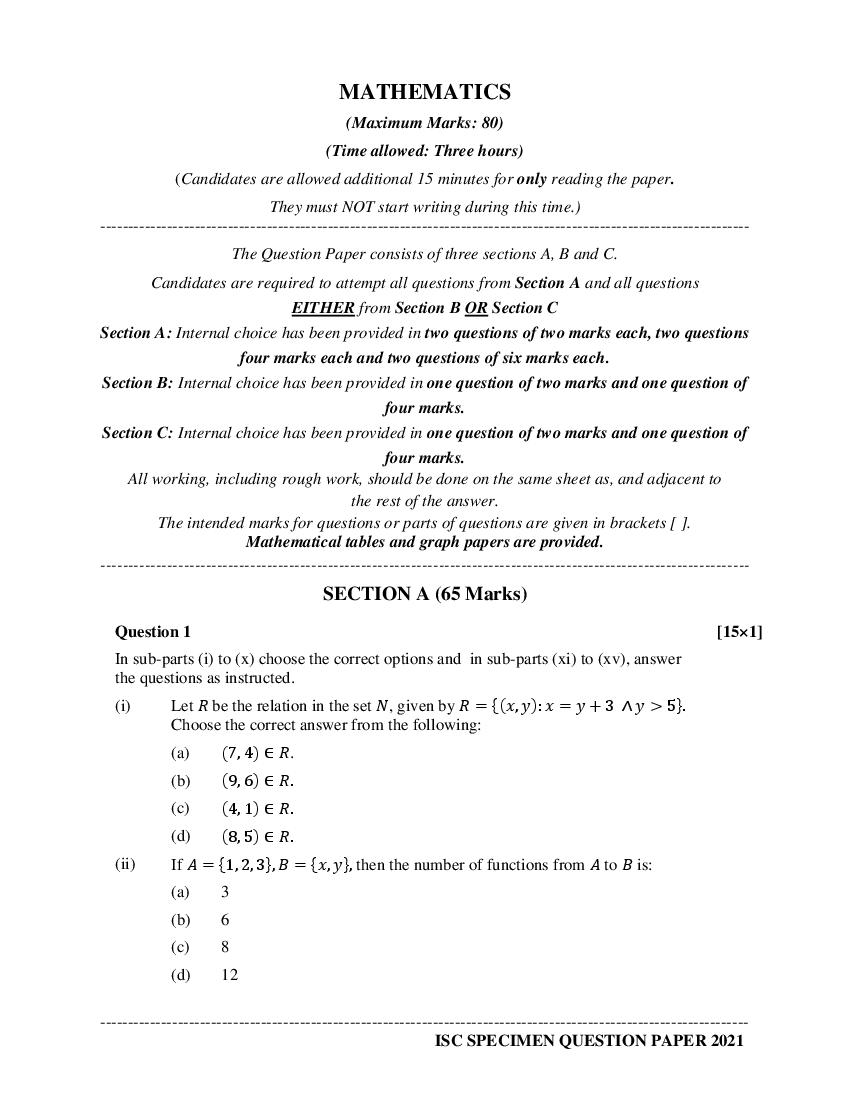
(Maximum Marks: 80)
(Time allowed: Three hours)
(Candidates are allowed additional 15 minutes for only reading the paper.
They must NOT start writing during this time.)
The Question Paper consists of three sections A, B and C.
Candidates are required to attempt all questions from Section A and all questions
EITHER from Section B OR Section C
Section A: Internal choice has been provided in two questions of two marks each, two questions
four marks each and two questions of six marks each.
Section B: Internal choice has been provided in one question of two marks and one question of
four marks.
Section C: Internal choice has been provided in one question of two marks and one question of
four marks.
All working, including rough work, should be done on the same sheet as, and adjacent to
the rest of the answer.
The intended marks for questions or parts of questions are given in brackets [ ].
Mathematical tables and graph papers are provided.
SECTION A (65 Marks)
Question 1 [15×1]
In sub-parts (i) to (x) choose the correct options and in sub-parts (xi) to (xv), answer
the questions as instructed.
(i) Let 𝑅 be the relation in the set 𝑁, given by 𝑅 = {(𝑥, 𝑦): 𝑥 = 𝑦 + 3 ∧ 𝑦 > 5}.
Choose the correct answer from the following:
(a) (7, 4) ∈ 𝑅.
(b) (9, 6) ∈ 𝑅.
(c) (4, 1) ∈ 𝑅.
(d) (8, 5) ∈ 𝑅.
(ii) If 𝐴 = {1, 2, 3}, 𝐵 = {𝑥, 𝑦}, then the number of functions from 𝐴 to 𝐵 is:
(a) 3
(b) 6
(c) 8
(d) 12
Page 2
(iii) Simpified value of sin [ 2 − sin−1 (− 2 )] is :
(a) 1
2
(b) 1
√2
(c) √3
2
(d) √3
−
2
(iv) Which of the following statements is correct:
(a) Determinanant is number associated to a matrix.
(b) Determinant is a square matrix.
(c) Determinant is a number associated to a square matrix.
(d) None of the above.
0 1
(v) If 𝐴 = ( ), then 𝐴2 is equal to:
1 0
(a) 0 1
( )
1 0
(b) 1 0
( )
0 1
(c) 1 0
( )
1 0
(d) 0 0
( )
1 1
(vi) 1 2
For what value of 𝑘 inverse does not exist for the matrix [ ]:
𝑘 6
(a) 0
(b) 3
(c) 6
(d) 2
(vii) Identify from the given options the slope of the normal to the curve 𝑥 2 + 3𝑦 +
𝑦 2 = 5 at (1,1):
(a) 2
−5
(b) 5
2
(c) 2
5
(d) 5
−2
2
Page 3
(a) −1 < 𝑥 < 1
(b) −1 ≤ 𝑥 ≤ 1
(c) 1≤𝑥<∞
(d) −∞ < 𝑥 < −1
(ix) The function 𝑓(𝑥) = sin 𝑥 + cos 𝑥, 𝑥 ∈ (0, 𝜋⁄2); Maximum value of the 𝑓(𝑥)
is:
(a) 1
(b) 2
(c) 1⁄
√2
(d) √2
4 7
(x) If 𝑃(𝐴) = 5 and 𝑃(𝐴 ∩ 𝐵) = 10, then the value of 𝑃(𝐵⁄𝐴) is :
(a) 1
8
(b) 4
7
(c) 5
7
(d) 7
8
(xi) Write total number of functions from set A to set B, where 𝐴 = {1, 2, 3}, 𝐵 =
{𝑝, 𝑞, 𝑟, 𝑠}.
(xii) If A is square matrix of order 3 , with |A| = 4, then write the value of |−2𝐴| .
(xiii) Find the sum of order and degree of the differential equation:
2 3
𝑑𝑦 5 𝑑3 𝑦 𝑑2𝑦
( ) + 3𝑥𝑦 ( 3 ) + 𝑦 2 ( 2 ) = 0
𝑑𝑥 𝑑𝑥 𝑑𝑥
(xiv) 𝐴 and 𝐵 appeared for an interview for two vacancies. The probability of 𝐴’s
4 1
selection is 5 and 𝐵’s selection is 3. Find the probability that none of them will
be selected.
(xv) If A and B are independent events such that 𝑃(𝐴) = 1⁄4 and 𝑃(𝐵) = 2⁄3.
Find 𝑃(𝐴 ∩ 𝐵).
-------------------------------------------------------------------------------------------------------------------
3
Page 4
(a) Differentiate the function with reference to 𝑥:
1 − cos 𝑥
𝑓(𝑥) = cos −1 (√ )
2
OR
𝑑𝑦
(b) Find , if 𝑥 = 𝑎𝑡 2 and 𝑦 = 2𝑎𝑡.
𝑑𝑥
Question 3 [2]
Show that the function 𝑓: 𝑁 → 𝑁, defined by 𝑓(𝑥) = 5𝑥 − 3, ∀𝑥 ∈ 𝑁, is one-one function
but not onto function.
Question 4 [2]
8 −4
x x
Using L’Hospital’s Rule, evaluate: lim
x→0 4x
Question 5 [2]
sec2 𝑥
(a) Evaluate: ∫ 𝑑𝑥
cosec2 𝑥
OR
3
𝜋
sin 2𝑥
(b) Evaluate: 2
0
∫ 3 3 𝑑𝑥
sin2 𝑥+cos2 𝑥
Question 6 [2]
𝑑𝑦
Solve 𝑑𝑥 = 1 − 𝑥𝑦 + 𝑦 − 𝑥
Question 7 [4]
1 𝜋 1 4
Prove that 𝑡𝑎𝑛−1 = − 𝑐𝑜𝑠 −1 ( ).
2 4 2 5
Question 8 [4]
1 𝑑2𝑦 𝑑𝑦
If 𝑥 = 𝑡𝑎𝑛 ( 𝑙𝑜𝑔 𝑦) , 𝑝𝑟𝑜𝑣𝑒 𝑡ℎ𝑎𝑡 (1 + 𝑥 2 ) + (2𝑥 − 𝑎) =0
𝑎 𝑑𝑥 2 𝑑𝑥
4
Page 5
3
(a) Evaluate: x + 3 dx
−6
OR
x tan x
(b) Evaluate: 0 dx
sec x + tan x
Question 10 [4]
(a) Bag A contains 4 white balls and 3 black balls, while Bag B contains 3 white balls
and 5 black balls. Two balls are drawn from Bag A and placed in Bag B. Then, what
is the probability of drawing a white ball from Bag B?
OR
A word consists of 10 different alphabets, in which there are 4 consonants and 6 vowels.
(b)
Four alphabets are chosen at random. What is the probability that more than one vowel
is selected?
Question 11 [6]
(a) Using matrices, solve the following system of equations:
2𝑥 − 3𝑦 + 5𝑧 = 11, 3𝑥 + 2𝑦 – 4𝑧 = −5 and 𝑥 + 𝑦 – 2𝑧 = – 3
OR
3 4
0 15
(b) Solve the matrix equation: 𝐴 (−1 2) = ( ).
1 −2
2 1
Question 12 [6]
(a) Evaluate: ∫ 𝑡𝑎𝑛−1 √𝑥 𝑑𝑥
OR
𝜋
2 cos 𝑥
(b) Evaluate: ∫ 𝜋 𝑑𝑥
− 1+𝑒 𝑥
2
Question 13 [6]
A cone is inscribed in a sphere of radius 12 cm. If the volume of the cone is maximum, find
its height.
-------------------------------------------------------------------------------------------------------------------
5
Page 6
Given three identical Boxes A, B and C, Box A contains 2 gold and 1 silver coin, Box B
contains 1 gold and 2 silver coins and Box C contains 3 silver coins. A person chooses a Box
at random and takes out a coin. If the coin drawn is of silver, find the probability that it has
been drawn from the Box which has the remaining two coins also of silver.
SECTION B (15 Marks)
Question 15 [5×1]
In sub-parts (i) and (ii) choose the correct options and in sub-parts (iii) to (v), answer the
questions as instructed.
(i) If the vectors 𝑎𝑖̂ + 3𝑗̂ − 2𝑘̂ and 3𝑖̂ − 4𝑗̂ + 𝑏𝑘̂ are collinear, then (𝑎, 𝑏) =
(a) 9 8
( , )
4 3
(b) 9 8
(− 4 , 3)
(c) 9 8
(4 , − 3)
(d) 9 8
(− , − )
4 3
(ii) The intercepts made by the plane 3𝑥 − 2𝑦 + 4𝑧 = 12 on the coordinate axes are:
(a) 6, −4, 3
(b) 4, −6, 3
(c) 2, −3, 4
(d) 1 1 1
,−6, 3
4
(iii) Find the angle between the vectors 𝑎⃗ = 6𝑖̂ + 2𝑗̂ + 3𝑘̂, 𝑏⃗⃗ = 2𝑖̂ − 9𝑗̂ + 6𝑘̂.
(iv) Find the unit vector parallel to the vector: 3𝑖̂ + 6𝑗̂ − 2𝑘̂
(v) Find the equation of the plane passing through (−2, 1, 3) and perpendicular to the
line having direction ratios < 3, 1, 5 > .
Question 16 [2]
(a) If 𝑎⃗, and 𝑏⃗⃗ are perpendicular vectors, |𝑎⃗ + 𝑏⃗⃗| = 13 and 𝑎⃗ = 5, find the value of |𝑏⃗⃗|.
OR
(b) Find 𝜆 if the scalar projection of 𝑎⃗ = 𝜆𝑖̂ + 𝑗̂ + 4𝑘̂ on 𝑏⃗⃗ = 2𝑖̂ + 6𝑗̂ + 3𝑘̂ is 4 units.
6
Page 7
(a) Find the distance of the point 𝐴(3, 4, 4) from the point, where the line joining points
𝑃(3, −4, −5) and 𝑄(2, −3, 1) intersects the plane 2𝑥 + 𝑦 + 𝑧 = 7.
OR
(b) Find the equation of the lines passing through the point (2, 1, 3) and perpendicular to
x −1 y − 2 z − 3 x y z
the lines = = and = =
1 2 3 −3 2 5
Question 18 [4]
Sketch the graph of 𝑦 = |𝑥 + 4|. Using integration, find the area of the region bounded
by the curve 𝑦 = |𝑥 + 4| and 𝑥 = −6 𝑎𝑛𝑑 𝑥 = 0.
SECTION C (15 Marks)
Question 19 [5×1]
In sub-parts (i) and (ii) choose the correct options and in sub-parts (iii) to (v), answer the
questions as instructed.
(i) The demand function of a monopolist is given by 𝑥 = 100 – 4𝑝. The quantity at
which MR = 0 will be:
(a) 25
(b) 10
(c) 50
(d) 30
(ii) If the lines of regression are parallel to coordinate axes, then the coefficient of
correlation is:
(a) 1
(b) 0
(c) −1
(d) ½
(iii) Find the marginal cost function (MC), if the cost function is :
𝑥3
𝐶(𝑥) = + 5𝑥 2 − 16𝑥 + 2.
3
(iv) If revenue function 𝑅(𝑥) = 3𝑥 3 + 8𝑥 − 2, find the average revenue function.
1
(v) If 𝜎𝑥 = 3, 𝜎𝑦 = 4 and 𝑏𝑥𝑦 = 3, then find the value of correlation coefficient (𝑟).
-------------------------------------------------------------------------------------------------------------------
7
Page 8
(a) A company produces a commodity with ₹ 24,000 as fixed cost. The variable cost
estimated to be 25% of the total revenue received on selling the product, is at the
rate of ₹ 8 per unit. Find the break-even point.
OR
3 2
(b) The total cost function for a production is given by C ( x) = x − 7 x + 27.
4
Find the number of units produced for which M.C. = A.C.
(M.C.= Marginal Cost and A.C. = Average Cost.)
Question 21 [4]
Find the equation of the regression line of y on x, if the observations (x, y) are as
follows:
(1, 4), (2, 8), (3, 2), (4, 12), (5, 10), (6, 14), (7, 16), (8, 6), (9, 18)
Also, find the estimated value of y when x = 14.
Question 22 [4]
(a) A carpenter has 90, 80 and 50 running feet respectively of teak wood, plywood and
rosewood which is used to produce product A and product B. Each unit of product
A requires 2, 1 and 1 running feet and each unit of product B requires 1, 2 and 1
running feet of teak wood, plywood and rosewood respectively. If product A is sold
for ₹ 48 per unit and product B is sold for ₹ 40 per unit, how many units of product
A and product B should be produced and sold by the carpenter, in order to obtain
the maximum gross income? Formulate the above as a Linear Programming
Problem and solve it, indicating clearly the feasible region in the graph.
OR
(b) A farm is engaged in breeding hens. The hens are fed products A and B grown in
the farm which contains nutrients P, Q and R. One kilogram of product A contains
36 units, 3 units and 20 units of nutrients P, Q and R respectively, whereas one
kilogram of product B contains 6 units, 12 units and 10 units of nutrients P, Q and
R respectively. The minimum requirement of nutrients P, Q and R for a hen is
108, 36 and 100 units respectively. Product A costs ₹ 20 per kilogram and product
B costs ₹ 40 per kilogram. Using linear programming, find the number of
kilograms of products A and B to be produced to minimize the total cost.Identify
the feasible region from the rough sketch.
(NOTE: The total weightage of each Unit covered in the question paper shall be as specified in
the syllabus, covering all the chapters of each Unit. The weightage of each question
in the Question Paper shall be as indicated in this Specimen Paper. However, the
number of MCQs given in Question Nos. 1, 15 and 19 may vary from year to year.)
8
Document Details
| Board / Org | CISCE |
| Exam | Class 12 |
| Type | Sample Paper |
| Pages | 8 |
| Language | english |
| Updated | 09 Jun 2026 |