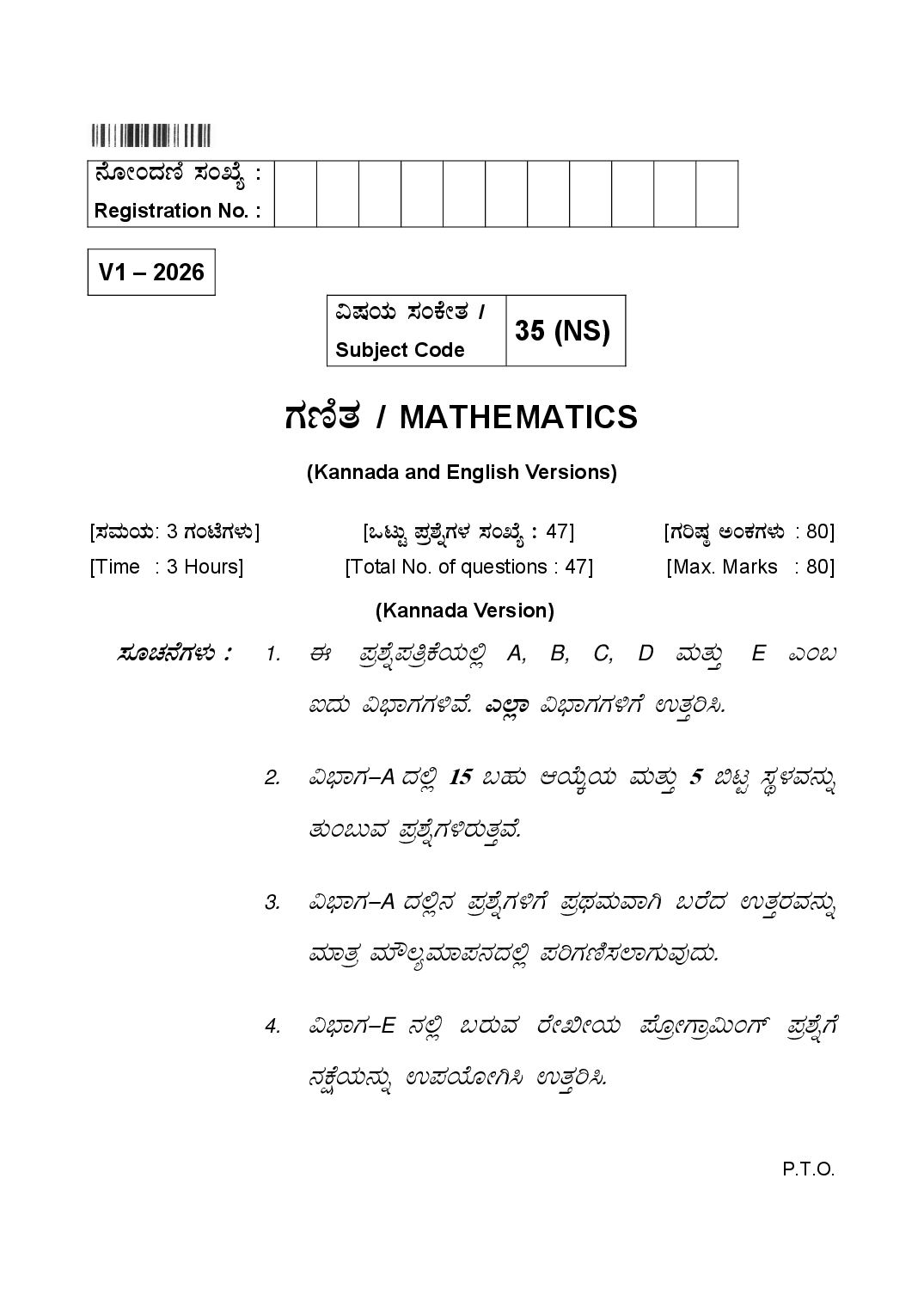
Karnataka 2nd PUC Question Paper 2026 Mathematics
Finished viewing? Save it for later —
Download Karnataka 2nd PUC Question Paper 2026 Mathematics (PDF · 21 pages)About Karnataka 2nd PUC Question Paper 2026 Mathematics
Karnataka 2nd PUC Question Paper 2026 Mathematics is available here for free download. Published by Karnataka Board for Class 12, this question paper can be viewed online or downloaded as a PDF (21 pages). Candidates preparing for Class 12 can use Karnataka 2nd PUC Question Paper 2026 Mathematics to understand the exam pattern, the type of questions asked, and the overall difficulty level.
Frequently Asked Questions
How can I download Karnataka 2nd PUC Question Paper 2026 Mathematics?
Open this page and click the Download button to save Karnataka 2nd PUC Question Paper 2026 Mathematics as a PDF. It is completely free on AglaSem Docs.
Is Karnataka 2nd PUC Question Paper 2026 Mathematics free to download?
Yes. Karnataka 2nd PUC Question Paper 2026 Mathematics can be viewed online and downloaded as a PDF free of cost on AglaSem Docs.
How many pages does Karnataka 2nd PUC Question Paper 2026 Mathematics have?
Karnataka 2nd PUC Question Paper 2026 Mathematics contains 21 pages, which you can read online or download together as a single PDF.
Where can I find more Class 12 study material?
You can find more Class 12 question papers, sample papers, syllabus, and answer keys on AglaSem Docs.
Karnataka 2nd PUC Question Paper 2026 Mathematics – Text
Read the full text of this question paper below — useful to quickly search, copy and reference the content online without downloading the PDF.
📄 View text version (21 pages)
Page 1
Registration No. :
V1 – 2026
«µÀAiÀÄ ¸ÀAPÉÃvÀ /
35 (NS)
Subject Code
UÀtÂvÀ / MATHEMATICS
(Kannada and English Versions)
[¸ÀªÀÄAiÀÄ: 3 UÀAmÉUÀ¼ÀÄ] [MlÄÖ ¥Àæ±ÉßUÀ¼À ¸ÀASÉå : 47] [UÀjµÀ× CAPÀUÀ¼ÀÄ : 80]
[Time : 3 Hours] [Total No. of questions : 47] [Max. Marks : 80]
(Kannada Version)
¸ÀÆZÀ£ÉUÀ¼ÀÄ : 1. F ¥Àæ±ÉߥÀwæPÉAiÀÄ°è A, B, C, D ªÀÄvÀÄÛ E JA§
LzÀÄ «¨sÁUÀUÀ½ªÉ. J¯èÁ «¨sÁUÀUÀ½UÉ GvÀÛj¹.
2. «¨sÁUÀ-A zÀ°è 15 §ºÀÄ DAiÉÄÌAiÀÄ ªÀÄvÀÄÛ 5 ©lÖ ¸ÀܼÀªÀ£ÀÄß
vÀÄA§ÄªÀ ¥Àæ±ÉßUÀ½gÀÄvÀÛªÉ.
3. «¨sÁUÀ-A zÀ°è£À ¥Àæ±ÉßUÀ½UÉ ¥ÀæxÀªÀĪÁV §gÉzÀ GvÀÛgÀªÀ£ÀÄß
ªÀiÁvÀæ ªÀiË®åªÀiÁ¥À£ÀzÀ°è ¥ÀjUÀt¸À¯ÁUÀĪÀÅzÀÄ.
4. «¨sÁUÀ-E £À°è §gÀĪÀ gÉÃTÃAiÀÄ ¥ÉÆæÃUÁæ«ÄAUï ¥Àæ±ÉßUÉ
£ÀPÉëAiÀÄ£ÀÄß G¥ÀAiÉÆÃV¹ GvÀÛj¹.
P.T.O.
Page 2
«¨sÁUÀ- A
I. F PɼÀV£À J¯Áè §ºÀÄ DAiÉÄÌ ¥Àæ±ÉßUÀ½UÉ GvÀÛj¹. (15 × 1 = 15)
1) UÀt {1, 2, 3} £À°è R = {(1, 1), (2, 2)} JA§ ¸ÀA§AzsÀªÀ£ÀÄß
ªÁåSÁ夹zÁUÀ R
a) ¸ÀªÀiÁAUÀvÀ DzÀgÉ ªÁºÀPÀªÀ®è
b) ªÁºÀPÀ DzÀgÉ ¸ÀªÀiÁAUÀvÀªÀ®è
c) ¸ÀªÀiÁAUÀvÀ ªÀÄvÀÄÛ ªÁºÀPÀ
d) ¸ÀªÀiÁAUÀvÀªÀÇ C®è ºÁUÀÆ ªÁºÀPÀªÀÇ C®è
2) tan −1 x £À PÉëÃvÀæªÀÅ
a) −π , π b) (0, π )
2 2
c) [−1, 1] d) ( −∞, ∞ )
3) MAzÀÄ PÉÆñÀzÀ°è 13 CA±ÀUÀ½zÀÝgÉ DUÀ ¸ÁzsÀåªÁUÀ§ºÀÄzÁzÀ ¨ÉÃgÉ ¨ÉÃgÉ
zÀeÉðAiÀÄ MlÄÖ PÉÆñÀUÀ¼À ¸ÀASÉåAiÀÄÄ
a) 1 b) 2
c) 3 d) 4
5 0
4) PÉÆñÀ A = DzÀ°è adj A £À ¨É¯ÉAiÀÄÄ
0 5
a) 25 b) 5
c) 0 d) 1
Page 3
5) sin −1 x £À ¤µÀà£ÀߪÀÅ C¹ÛvÀézÀ°ègÀĪÀ CAvÀgÁ¼À
a) [−1, 1] b) (−1, 1)
c) d) −π , π
R
2 2
dy
6) x − y = π DzÁUÀ
dx
a) π b) −π
c) 1 d) −1
7) f ( x ) = x , x ∈ R £À PÀ¤µÀ× ¨É¯ÉAiÀÄÄ
a) 0 b) 1
c) 2 d) C¹ÛvÀézÀ°ègÀĪÀÅ¢®è
8) ºÉýPÉ I : CAvÀgÁ¼À (0, ∞) £À°è GvÀà£Àß f ( x ) = x 2 QëÃt¸ÀÄvÀÛzÉ.
dy
ºÉýPÉ II : < 0 DzÁUÀ AiÀiÁªÀÅzÉà GvÀà£Àß y = f ( x ) QëÃt¸ÀÄvÀÛzÉ.
dx
F PɼÀV£ÀªÀÅUÀ¼À°è AiÀiÁªÀÅzÀÄ ¸ÀjAiÀiÁVzÉ?
a) ºÉýPÉ I ªÀÄvÀÄÛ ºÉýPÉ II JgÀqÀÆ ¸ÀjAiÀiÁVzÉ
b) ºÉýPÉ I ªÀÄvÀÄÛ ºÉýPÉ II JgÀqÀÆ vÀ¥ÁàVzÉ
c) ºÉýPÉ I ¸ÀjAiÀiÁVzÉ ªÀÄvÀÄÛ ºÉýPÉ II vÀ¥ÁàVzÉ
d) ºÉýPÉ I vÀ¥ÁàVzÉ ªÀÄvÀÄÛ ºÉýPÉ II ¸ÀjAiÀiÁVzÉ
1
9) x UÉ C£ÀÄUÀÄtªÁV , x > 1 £À ¥Àæw CªÀPÀ®£ÀªÀÅ
2
x x −1
a) sin −1 x + c b) cos −1 x + c
c) − cosec−1 x + c d) cot −1 x + c
Page 4
π
2
sin x dx £À ¨É¯ÉAiÀÄÄ
7
10)
−π
2
a) 1 b) 0
c) –1 d) 7
→
11) a MAzÀÄ ±ÀÆ£ÀåªÀ®èzÀ ¸À¢±À ªÀÄvÀÄÛ CzÀgÀ ¥ÀjªÀiÁt a DVzÉ ªÀÄvÀÄÛ λ ,
→
MAzÀÄ ±ÀÆ£ÀåªÀ®èzÀ C¢±À. λ a KPÀ ¸À¢±ÀªÁzÀgÉ
a) λ =1 b) λ = −1
1
c) a= λ d) a=
λ
12) P (2, 3, 4) ªÀÄvÀÄÛ Q ( 4, 1, − 2) ©AzÀÄUÀ¼À£ÀÄß ¸ÉÃj¸ÀĪÀ gÉÃSÉAiÀÄ
ªÀÄzsÀå ©AzÀÄ«£À ¸ÁÜ£À ¸À¢±À
a) 3iˆ + 2 ˆj + kˆ b) 3iˆ + 2 jˆ − kˆ
c) iˆ − jˆ − 3kˆ d) − iˆ + ˆj + 3kˆ
13) x-CPëÀzÀ ¢±Á¥ÀæªÀiÁtUÀ¼ÀÄ
a) 0, k , 0 b) 0, 0, k
c) k , 0, 0 d) k, k, k
Page 5
14) MAzÀÄ eÉÆvÉ zÁ¼ÀUÀ¼À£ÀÄß GgÀĽ¹zÁUÀ ¥ÀæwAiÉÆAzÀÄ zÁ¼ÀzÀ ªÉÄïÉ
¸ÀªÀÄ C«¨sÁdå ¸ÀASÉåAiÀÄ£ÀÄß ¥ÀqÉAiÀÄĪÀ ¸ÀA¨sÀªÀ¤ÃAiÀÄvÉ.
1 1
a) b)
36 6
1 1
c) d)
18 4
15) A ªÀÄvÀÄÛ B ¸ÀévÀAvÀæ WÀl£ÉUÀ¼ÁVzÀÄÝ P ( A) = 0.3 ªÀÄvÀÄÛ P (B ) = 0.4 DVzÀÝgÉ
P ( A ∩ B ) £À ¨É¯ÉAiÀÄÄ
a) 1.2 b) 0.12
3
c) 0.7 d)
4
II. DªÀgÀtzÀ°è PÉÆnÖgÀĪÀ DAiÉÄÌUÀ½AzÀ ¸ÀÆPÀÛªÁzÀ GvÀÛgÀªÀ£ÀÄß Dj¹
©lÖ ¸ÀܼÀ vÀÄA©j. (5 × 1 = 5)
[0, 3, –1, 2, –2, 1]
16) x = 0 £À°è x UÉ C£ÀÄUÀÄtªÁV x £À JqÀ ¤µÀà£ÀߪÀÅ ______________.
17) CAvÀgÁ¼À [−1, 1] £À°è f ( x ) = x 3 £À £Àw¥ÀjªÀvÀð£À ©AzÀĪÀÅ __________.
d 2y
dy
18) CªÀPÀ®£À ¸À«ÄÃPÀgÀt 2x 2 2
−3
+ y = 0 £À zÀeÉð ªÀÄvÀÄÛ ¥ÀæªÀiÁt
dx dx
PÀæªÀĪÁV m ªÀÄvÀÄÛ n DVzÀÝgÉ m + n = ______________.
19) iˆ ⋅ iˆ + ˆj ⋅ ˆj £À ¨É¯ÉAiÀÄÄ ______________.
20) F JA§ÄzÀÄ S JA§ ªÉÇåêÀÄ ªÀiÁzÀjAiÀÄ WÀl£É DVzÀÝ°è P (S | F ) =
_________.
Page 6
«¨sÁUÀ – B
III. F PɼÀV£À AiÀiÁªÀÅzÁzÀgÀÆ DgÀÄ ¥Àæ±ÉßUÀ½UÉ GvÀÛj¹. (6 × 2 = 12)
1 − cos x
21) tan −1 , 0 < x < π £ÀÄß ¸ÀgÀ¼ÀgÀÆ¥ÀzÀ°è §gɬÄj.
1 + cos x
22) ¤zsÁðgÀPÀUÀ¼À£ÀÄß §¼À¹PÉÆAqÀÄ (1, 2) ªÀÄvÀÄÛ (3, 6) ©AzÀÄUÀ½AzÀ GAmÁzÀ
¸ÀgÀ¼ÀgÉÃSÉAiÀÄ ¸À«ÄÃPÀgÀtªÀ£ÀÄß PÀAqÀÄ»r¬Äj.
dy
23) x = sin t ªÀÄvÀÄÛ y = cos 2t DzÀgÉ £ÀÄß PÀAqÀÄ»r¬Äj.
dx
24) MAzÀÄ ªÀÈvÀÛzÀ wædåªÀÅ ¥Àæw ¸ÉPÉArUÉ 0.7 cm zÀgÀzÀ°è ºÉZÀÄÑwÛzÉ. ºÁUÁzÀgÉ
CzÀgÀ ¸ÀÄvÀÛ¼ÀvÉAiÀÄ ºÉZÀѼÀzÀ zÀgÀªÀ£ÀÄß PÀAqÀÄ»r¬Äj.
1
25) x + x log x dx £ÀÄß PÀAqÀÄ»r¬Äj.
dy 1 + y 2
26) = CªÀPÀ®£À ¸À«ÄÃPÀgÀtzÀ ¸ÁªÀiÁ£Àå ¥ÀjºÁgÀªÀ£ÀÄß
dx 1 + x 2
PÀAqÀÄ»r¬Äj.
→ →
27) b = iˆ + 2 ˆj + kˆ
¸À¢±ÀzÀ ªÉÄÃ¯É a = 2iˆ + 3 jˆ + 2kˆ ¸À¢±ÀzÀ ¨ÁUÀÄ«PÉAiÀÄ£ÀÄß
PÀAqÀÄ»r¬Äj.
28) PɼÀV£À gÉÃSÉUÀ¼À £ÀqÀÄ«£À PÉÆãÀªÀ£ÀÄß PÀAqÀÄ»r¬Äj.
x −5 y −2 z −3
= = ªÀÄvÀÄÛ x = y = z .
4 1 8 2 2 1
29) MAzÀÄ PÀÄlÄA§ªÀÅ JgÀqÀÄ ªÀÄPÀ̼À£ÀÄß ºÉÆA¢zÉ. CªÀj§âgÀ°è PÀ¤µÀ× ¥ÀPëÀ
M§â ¨Á®PÀ£ÁVgÀÄvÁÛ£É JAzÀÄ PÉÆmÁÖUÀ JgÀqÀÆ ªÀÄPÀ̼ÀÄ ¨Á®PÀgÁVgÀĪÀ
¸ÀA¨sÀªÀ¤ÃAiÀÄvÉ JµÀÄÖ?
Page 7
«¨sÁUÀ – C
IV. F PɼÀV£À AiÀiÁªÀÅzÁzÀgÀÆ DgÀÄ ¥Àæ±ÉßUÀ½UÉ GvÀÛj¹. (6 × 3 = 18)
30) T JA§ÄzÀÄ MAzÀÄ ¸ÀªÀÄvÀ®zÀ°ègÀĪÀ J¯èÁ wæ¨sÀÄdUÀ¼À UÀtªÁVzÀÄÝ
R = {(T1, T2 ) : T1 JA§ÄzÀÄ T2 UÉ ¸ÀªÀð¸ÀªÀĪÁVzÉ} JA§ ¸ÀA§AzsÀªÀ£ÀÄß
PÉÆmÁÖUÀ R JA§ÄzÀÄ MAzÀÄ ¸ÀªÀÄvÀé ¸ÀA§AzsÀªÁVzÉ JAzÀÄ vÉÆÃj¹.
1
31) 3 cos −1 x = cos −1( 4 x 3 − 3 x ), x ∈ , 1 JAzÀÄ ¸Á¢ü¹.
2
1 5
32) JA§ PÉÆñÀªÀ£ÀÄß ¸ÀªÀiÁAUÀ ªÀÄvÀÄÛ C¸ÀªÀiÁAUÀ PÉÆñÀUÀ¼À
− 1 2
ªÉÆvÀÛªÉAzÀÄ ¸ÀàµÀÖ¥Àr¹.
33) x UÉ C£ÀÄUÀÄtªÁV x sin x , x > 0 £ÀÄß ¤µÀà£ÀßUÉƽ¹.
34) [1, 5] CAvÀgÁ¼ÀzÀ°è f ( x ) = 2 x 3 − 15 x 2 + 36 x + 1 GvÀà£ÀßzÀ ¸ÀA¥ÀÇtð
UÀjµÀ× ªÀÄvÀÄÛ PÀ¤µÀ× ¨É¯ÉUÀ¼À£ÀÄß PÀAqÀÄ»r¬Äj.
1
35) ( x + 1) ( x + 2) dx £ÀÄß PÀAqÀÄ»r¬Äj.
36) A(1, 1, 1), B (1, 2, 3) ªÀÄvÀÄÛ C (2, 3, 1) MAzÀÄ wæPÉÆãÀzÀ ±ÀÈAUÀUÀ¼ÁzÀgÉ CzÀgÀ
«¹ÛÃtðªÀ£ÀÄß PÀAqÀÄ»r¬Äj.
→
37) zÀvÀÛ ¸À¢±À b UÉ ¸ÀªÀiÁ£ÁAvÀgÀªÁV ºÁUÀÆ zÀvÀÛ ©AzÀÄ A ªÀÄÆ®PÀ
ºÁzÀĺÉÆÃUÀĪÀ gÉÃSÉAiÉÆAzÀgÀ ¸À«ÄÃPÀgÀtªÀ£ÀÄß ¥Àæw¥Á¢¹.
38) aî I, 3 PÉA¥ÀÅ ªÀÄvÀÄÛ 4 PÀ¥ÀÄà ºÁUÉà aî II, 5 PÉA¥ÀÅ ªÀÄvÀÄÛ 6 PÀ¥ÀÄà
ZÉAqÀÄUÀ¼À£ÀÄß ºÉÆA¢ªÉ. MAzÀÄ ZÉAqÀ£ÀÄß aîUÀ¼ÉÆAzÀjAzÀ
AiÀiÁzÀÈaÒPÀªÁV vÉUÉAiÀįÁUÀĪÀÅzÀÄ ªÀÄvÀÄÛ CzÀÄ PÉA¥ÀÅ §tÚzÁÝVgÀĪÀÅzÀÄ.
ºÁUÁzÀgÉ CzÀÄ aî II jAzÀ ¥ÀqÉ¢zÉ JA§ÄzÀgÀ ¸ÀA¨sÀªÀ¤ÃAiÀÄvÉ JµÀÄÖ?
Page 8
«¨sÁUÀ – D
V. F PɼÀV£À AiÀiÁªÀÅzÁzÀgÀÆ £Á®ÄÌ ¥Àæ±ÉßUÀ½UÉ GvÀÛj¹. (4 × 5 = 20)
39) f : R → R JA§ GvÀà£ÀߪÀ£ÀÄß f ( x ) = 4x + 3 JAzÀÄ ªÁåSÁ夸À¯ÁVzÉ.
f «¯ÉÆëÄvÀ DVgÀÄvÀÛzÉ JAzÀÄ ¤gÀƦ¹. f £À «¯ÉÆêÀĪÀ£ÀÄß §gɬÄj.
1
40) A = − 4 ªÀÄvÀÄÛ B = [− 1 2 1] DzÀgÉ ( AB )′ = B′A′ C£ÀÄß ¥Àj²Ã°¹.
3
41) F PɼÀV£À ¸ÀgÀ¼À ¸À«ÄÃPÀgÀtUÀ¼À ¥ÀjºÁgÀªÀ£ÀÄß PÉÆñÀ«zsÁ£À¢AzÀ
PÀAqÀÄ»r¬Äj.
3 x − 2y + 3z = 8
2x + y − z = 1
4 x − 3 y + 2z = 4
d 2y dy
42) y = A e mx + B e nx DzÀgÉ 2
− (m + n ) + mny = 0 JAzÀÄ ¸Á¢ü¹.
dx dx
1
43) ‘x’ UÉ C£ÀÄUÀÄtªÁV £ÀÄß C£ÀÄPÀ°¹ ªÀÄvÀÄÛ CzÀgÀ ¸ÀºÁAiÀÄ¢AzÀ
a − x2
2
1
25 − x 2 dx £ÀÄß PÀAqÀÄ»r¬Äj.
44) y = sin x ªÀPÀægÉÃSÉ, x = 0 ªÀÄvÀÄÛ x = 2π ¸ÀgÀ¼ÀgÉÃSÉUÀ½AzÀ DªÀÈvÀªÁVgÀĪÀ
PÉëÃvÀæ¥sÀ®ªÀ£ÀÄß PÀAqÀÄ»r¬Äj.
dy
45) x + 2y = x 2 ( x ≠ 0) CªÀPÀ®£À ¸À«ÄÃPÀgÀtzÀ ¸ÁªÀiÁ£Àå ¥ÀjºÁgÀªÀ£ÀÄß
dx
PÀAqÀÄ»r¬Äj.
Page 9
«¨sÁUÀ – E
VI. F PɼÀV£À ¥Àæ±ÉßUÀ½UÉ GvÀÛj¹.
a a
46) f ( x ) dx = f (a − x ) dx JAzÀÄ ¸Á¢ü¹ ªÀÄvÀÄÛ EzÀ£ÀÄß G¥ÀAiÉÆÃV¹
0 0
π
2
sin x
sin x + cos x dx £À ¨É¯ÉAiÀÄ£ÀÄß PÀAqÀÄ»r¬Äj. (6)
0
CxÀªÁ
PɼÀV£À gÉÃTÃAiÀÄ ¥ÉÆæÃUÁæ å«ÄAUï ¸ÀªÀĸÉåAiÀÄ£ÀÄß £ÀPÁëvÀäPÀªÁV ©r¹.
x + y ≤ 60,
25 x + 5 y ≤ 500,
x ≥ 0, y ≥ 0
¤§AzsÀ£ÉUÉƼÀ¥ÀlÄÖ Z = 250 x + 75 y GvÀà£ÀßzÀ UÀjµÀ× ¨É¯ÉAiÀÄ£ÀÄß
PÀAqÀÄ»r¬Äj.
2 3
47) A = JA§ PÉÆñÀªÀÅ A2 − 4A + I = O ¸À«ÄÃPÀgÀtªÀ£ÀÄß
1 2
vÀȦÛUÉƽ¸ÀĪÀÅzÀÄ JAzÀÄ vÉÆÃj¹. E°è I JA§ÄzÀÄ 2 × 2 zÀeÉðAiÀÄ
KPÀªÀiÁ£À PÉÆñÀªÁVzÀÄÝ ªÀÄvÀÄÛ O JA§ÄzÀÄ 2 × 2 zÀeÉðAiÀÄ
±ÀÆ£ÀåPÉÆñÀªÁVzÉ. F ¸À«ÄÃPÀgÀtªÀ£ÀÄß G¥ÀAiÉÆÃV¹ A−1 C£ÀÄß
PÀAqÀÄ»r¬Äj. (4)
CxÀªÁ
5, x ≤2
f ( x ) = ax + b, 2 < x < 10
21, x ≥ 10
GvÀà£ÀߪÀÅ C«aÒ£ÀߪÁzÀgÉ a ªÀÄvÀÄÛ b UÀ¼À ¨É¯ÉAiÀÄ£ÀÄß PÀAqÀÄ»r¬Äj.
––––––––––––––––
Page 10
(English Version)
Instructions : 1. The question paper has five Parts namely A, B, C, D
and E. Answer all the parts.
2. PART-A has 15 Multiple choice questions and 5 Fill in the
blank questions.
3. For PART-A questions, only the first written answers
will be considered for evaluation.
4. Use the graph sheet provided to you for the question on
linear programming problem in PART-E.
PART – A
I. Answer all the multiple choice questions. (15 × 1 = 15)
1) If a relation R in the set {1, 2, 3} be defined by R = {(1, 1),(2, 2)} then R is
a) symmetric but not transitive
b) transitive but not symmetric
c) symmetric and transitive
d) neither symmetric nor transitive
2) The domain of tan −1 x is
a) −π , π b) (0, π )
2 2
c) [−1, 1] d) ( −∞, ∞ )
3) A matrix has 13 elements. The number of possible different orders it can
have
a) 1 b) 2
c) 3 d) 4
Page 11
5 0
4) For the matrix A = the value of adj A
0 5
a) 25 b) 5
c) 0 d) 1
5) The derivative of sin −1 x exists in the interval
a) [−1, 1] b) (−1, 1)
c) d) −π , π
R
2 2
dy
6) If x − y = π then
dx
a) π b) −π
c) 1 d) −1
7) The minimum value of f ( x ) = x , x ∈ R
a) 0 b) 1
c) 2 d) does not exist
8) Statement I : The function f ( x ) = x 2 is decreasing in the interval (0, ∞ ) .
dy
Statement II : Any function y = f (x ) is decreasing if < 0.
dx
Which of the following is correct?
a) Both the Statements I and II are true
b) Both the Statements I and II are false
c) Statement I is true and Statement II is false
d) Statement I is false and Statement II is true
Page 12
1
9) The antiderivative of , x > 1 with respect to x
2
x x −1
a) sin −1 x + c b) cos −1 x + c
c) − cosec −1x + c d) cot −1 x + c
π
2
sin x dx
7
10) The value of
−π
2
a) 1 b) 0
c) –1 d) 7
→
11) If a is a nonzero vector of magnitude a and λ , a nonzero scalar then
→
λ a is a unit vector if
a) λ =1 b) λ = −1
1
c) a= λ d) a=
λ
12) The position vector of the midpoint of the line joining the points
P (2, 3, 4) and Q ( 4, 1, − 2)
a) 3iˆ + 2 ˆj + kˆ b) 3iˆ + 2 ˆj − kˆ
c) iˆ − ˆj − 3kˆ d) − iˆ + ˆj + 3kˆ
13) The direction ratios of x-axis are
a) 0, k , 0 b) 0, 0, k
c) k , 0, 0 d) k, k, k
Page 13
14) The probability of obtaining an even prime number on each die when a
pair of dice is rolled
1 1
a) b)
36 6
1 1
c) d)
18 4
15) If A and B are independent events with P ( A) = 0.3 and P (B ) = 0.4 then
P ( A ∩ B)
a) 1.2 b) 0.12
3
c) 0.7 d)
4
II. Fill in the blanks by choosing the appropriate answer from those given in the
bracket. (5 × 1 = 5)
[0, 3, –1, 2, –2, 1]
16) The left hand derivative of x with respect to x at x = 0 is __________.
17) The point of inflection of the function f ( x ) = x 3 in the interval [−1, 1] is
__________.
18) If m and n are respectively the order and degree of the differential
d 2y dy
equation 2 x 2 2
−3 + y = 0 then m + n = __________.
dx dx
19) The value of iˆ ⋅ iˆ + ˆj ⋅ ˆj = __________.
20) If F is an event of a sample space S then P (S | F ) = _________.
Page 14
PART – B
III. Answer any six of the following questions. (6 × 2 = 12)
1 − cos x
21) Write tan −1 , 0 < x < π in simplest form.
1 + cos x
22) Find the equation of line joining (1, 2) and (3, 6) using determinants.
dy
23) Find if x = sin t and y = cos 2t .
dx
24) The radius of a circle is increasing at the rate of 0.7 cm/s. Find the rate of
increase of its circumference.
1
25) Find dx .
x + x log x
dy 1 + y 2
26) Find the general solution of the differential equation = .
dx 1 + x 2
→
27) Find the projection of the vector a = 2iˆ + 3 ˆj + 2kˆ on the vector
→
b = iˆ + 2 jˆ + kˆ .
x −5 y −2 z −3 x y z
28) Find the angle between the lines = = and = = .
4 1 8 2 2 1
29) A family has two children. What is the probability that both the children
are boys given that atleast one of them is a boy?
Page 15
PART – C
IV. Answer any six of the following questions. (6 × 3 = 18)
30) Let T be the set of all triangles with R a relation in T given by
R = {(T1, T2 ) : T1 is congruent to T2 } . Show that R is an equivalence
relation.
1
31) Prove that 3 cos −1 x = cos −1( 4 x 3 − 3 x ), x ∈ , 1 .
2
1 5
32) Express the matrix as the sum of a symmetric and a
− 1 2
skewsymmetric matrix.
33) Differentiate x sin x , x > 0 with respect to x.
34) Find the absolute maximum and minimum values of a function f given by
f ( x ) = 2 x 3 − 15 x 2 + 36 x + 1 on the interval [1, 5] .
1
35) Find dx .
( x + 1) ( x + 2)
36) Find the area of triangle having the points A(1, 1, 1), B (1, 2, 3) and
C (2, 3, 1) as its vertices.
Page 16
37) Derive the equation of a line in space passing through a given point A and
→
parallel to a given vector b in vector form.
38) Bag I contains 3 red and 4 black balls while another bag II contains 5 red
and 6 black balls. One ball is drawn at random from one of the bags and
it is found to be red. Find the probability that it was drawn from bag II.
PART – D
V. Answer any four of the following questions. (4 × 5 = 20)
39) Consider the function f : R → R given by f ( x ) = 4 x + 3 . Show that f is
invertible and write the inverse of f.
1
40) If A = − 4 and B = [− 1 2 1], verify that ( AB )′ = B′A′ .
3
41) Solve the following system of equations using matrix method :
3 x − 2y + 3z = 8
2x + y − z = 1
4 x − 3 y + 2z = 4
d 2y dy
42) If y = A e mx + B e nx show that − ( m + n ) + mny = 0 .
dx 2 dx
Page 17
1 1
43) Find the integral of 22
with respect to ‘x’ and hence find dx .
a −x 25 − x 2
44) Find the area bounded by the curve y = sin x between x = 0 and x = 2π .
dy
45) Find the general solution of the differential equation x + 2y = x 2 ( x ≠ 0) .
dx
PART – E
VI. Answer the following questions.
a a
46) Prove that f ( x ) dx = f (a − x ) dx and hence evaluate
0 0
π
2
sin x
sin x + cos x dx . (6)
0
OR
Solve the following Linear Programming Problem graphically :
Maximise Z = 250 x + 75 y
Subject to the constraints
x + y ≤ 60,
25 x + 5 y ≤ 500,
x ≥ 0, y ≥ 0
Page 18
2 3
47) Show that the matrix A = satisfies the equation A 2 − 4 A + I = O .
1 2
Where I is 2 × 2 identity matrix and O is 2 × 2 zero matrix and hence find
A −1 . (4)
OR
Find the values of a and b such that the function defined by
5, x ≤2
f ( x ) = ax + b, 2 < x < 10
21, x ≥ 10
is continuous.
————————
Page 19
Page 20
Page 21
Subject Name : MATHEMATICS Subject Code : 35 (NS)
Registration No. of the candidate : ————————————
Invigilator’s Signature
Document Details
| Board / Org | Karnataka Board |
| Exam | Class 12 |
| Type | Question Paper |
| Pages | 21 |
| Language | english |
| Updated | 24 Sep 2026 |