Karnataka 2nd PUC Question Paper 2026 Physics
Finished viewing? Save it for later —
Download Karnataka 2nd PUC Question Paper 2026 Physics (PDF · 20 pages)About Karnataka 2nd PUC Question Paper 2026 Physics
Karnataka 2nd PUC Question Paper 2026 Physics is available here for free download. Published by Karnataka Board for Class 12, this question paper can be viewed online or downloaded as a PDF (20 pages). Candidates preparing for Class 12 can use Karnataka 2nd PUC Question Paper 2026 Physics to understand the exam pattern, the type of questions asked, and the overall difficulty level.
Frequently Asked Questions
How can I download Karnataka 2nd PUC Question Paper 2026 Physics?
Open this page and click the Download button to save Karnataka 2nd PUC Question Paper 2026 Physics as a PDF. It is completely free on AglaSem Docs.
Is Karnataka 2nd PUC Question Paper 2026 Physics free to download?
Yes. Karnataka 2nd PUC Question Paper 2026 Physics can be viewed online and downloaded as a PDF free of cost on AglaSem Docs.
How many pages does Karnataka 2nd PUC Question Paper 2026 Physics have?
Karnataka 2nd PUC Question Paper 2026 Physics contains 20 pages, which you can read online or download together as a single PDF.
Where can I find more Class 12 study material?
You can find more Class 12 question papers, sample papers, syllabus, and answer keys on AglaSem Docs.
Karnataka 2nd PUC Question Paper 2026 Physics – Text
Read the full text of this question paper below — useful to quickly search, copy and reference the content online without downloading the PDF.
📄 View text version (20 pages)
Page 1
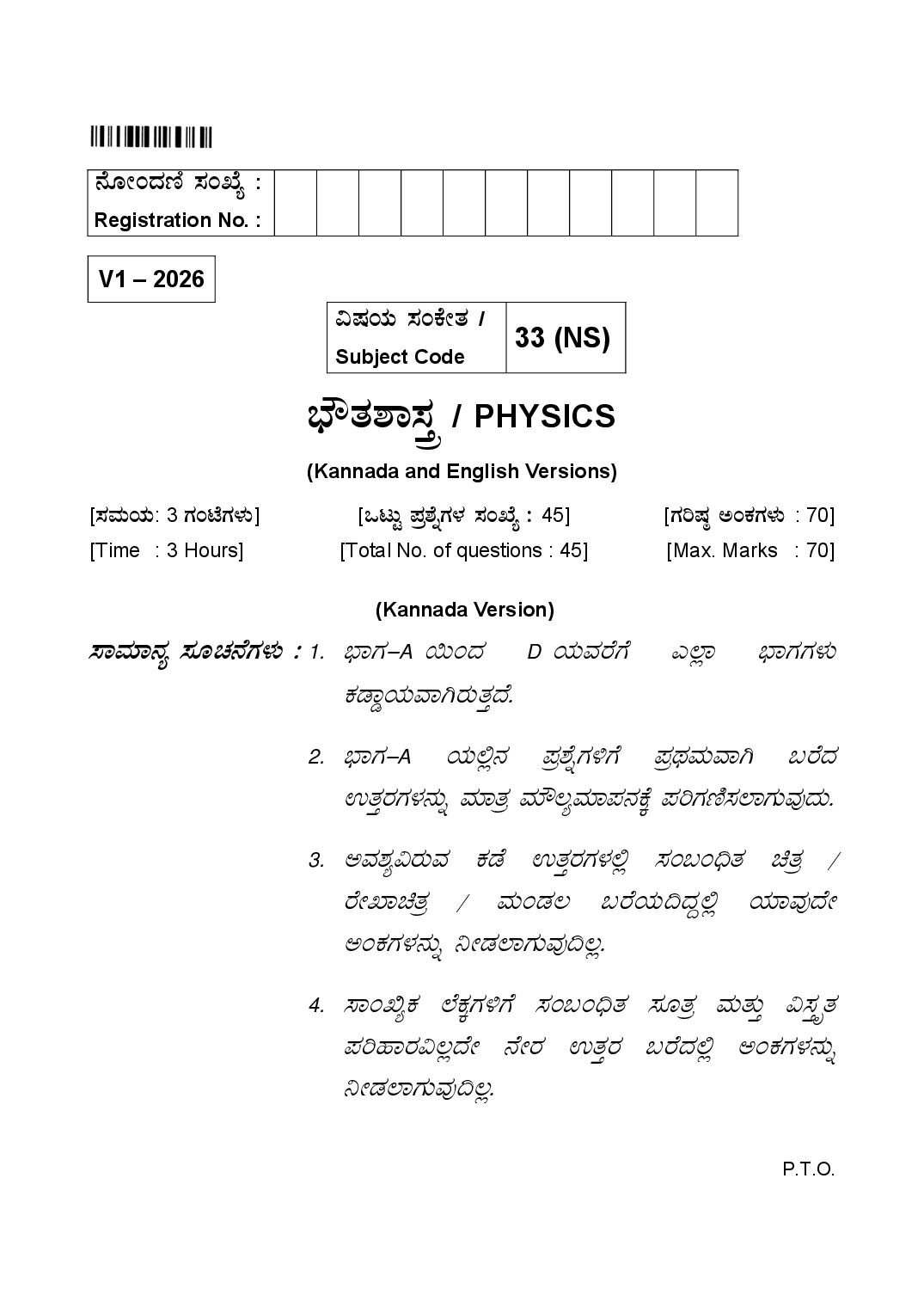
Registration No. :
V1 – 2026
«µÀAiÀÄ ¸ÀAPÉÃvÀ /
33 (NS)
Subject Code
¨sËvÀ±Á¸ÀÛç / PHYSICS
(Kannada and English Versions)
[¸ÀªÀÄAiÀÄ: 3 UÀAmÉUÀ¼ÀÄ] [MlÄÖ ¥Àæ±ÉßUÀ¼À ¸ÀASÉå : 45] [UÀjµÀ× CAPÀUÀ¼ÀÄ : 70]
[Time : 3 Hours] [Total No. of questions : 45] [Max. Marks : 70]
(Kannada Version)
¸ÁªÀiÁ£Àå ¸ÀÆZÀ£ÉUÀ¼ÀÄ : 1. ¨sÁUÀ-A ¬ÄAzÀ D AiÀĪÀgÉUÉ J¯èÁ ¨sÁUÀUÀ¼ÀÄ
PÀqÁØAiÀĪÁVgÀÄvÀÛzÉ.
2. ¨sÁUÀ-A AiÀÄ°è£À ¥Àæ±ÉßUÀ½UÉ ¥ÀæxÀªÀĪÁV §gÉzÀ
GvÀÛgÀUÀ¼À£ÀÄß ªÀiÁvÀæ ªÀiË®åªÀiÁ¥À£ÀPÉÌ ¥ÀjUÀt¸À¯ÁUÀĪÀÅzÀÄ.
3. CªÀ±åÀ «gÀĪÀ PÀqÉ GvÀÛgÀUÀ¼À°è ¸ÀA§A¢üvÀ avÀæ /
gÉÃSÁavÀæ / ªÀÄAqÀ® §gÉAiÀÄ¢zÀÝ°è AiÀiÁªÀÅzÉÃ
CAPÀUÀ¼À£ÀÄß ¤ÃqÀ¯ÁUÀĪÀÅ¢®è.
4. ¸ÁATåPÀ ¯ÉPÀÌUÀ½UÉ ¸ÀA§A¢üvÀ ¸ÀÆvÀæ ªÀÄvÀÄÛ «¸ÀÛøvÀ
¥ÀjºÁgÀ«®èzÉà £ÉÃgÀ GvÀÛgÀ §gÉzÀ°è CAPÀUÀ¼À£ÀÄß
¤ÃqÀ¯ÁUÀĪÀÅ¢®è.
P.T.O.
Page 2
¨sÁUÀ - A
I. F PɼÀV£À J¯èÁ ¥Àæ±ÉßUÀ½UÉ PÉÆnÖgÀĪÀ £Á®ÄÌ DAiÉÄÌUÀ½AzÀ ¸ÀjAiÀiÁzÀ
GvÀÛgÀªÀ£ÀÄß DAiÀÄÄÝ §gɬÄj : (15 × 1 = 15)
1) MAzÀÄ PÁAiÀĪÀÅ F PɼÀV£À AiÀiÁªÀ «zÀÄåzÁªÉñÀªÀ£ÀÄß ºÉÆA¢gÀ®Ä
¸ÁzsÀå«®è?
a) 2e b) 3e
c) 3.5 e d) –4e
2) MAzÀÄ ©AzÀÄ DªÉñÀzÀ ¸ÀªÀÄ«¨sÀªÀ ªÉÄïÉäöÊUÀ¼ÀÄ :
a) ¸ÀPÀQëÃAiÀÄ ¹°AqÀgïUÀ¼À ªÉÄïÉäöÊUÀ¼ÁVgÀÄvÀÛªÉ
b) ¸ÀªÀiÁ£ÁAvÀgÀªÁzÀ ¸ÀªÀÄvÀ® ªÉÄïÉäöÊUÀ¼ÁVgÀÄvÀÛªÉ
c) ©AzÀÄ DªÉñÀªÀÅ PÉÃAzÀæ ©AzÀÄ«£À°ègÀĪÀ ¸ÀPÉÃA¢æÃAiÀÄ
UÉÆüÀUÀ¼ÁVgÀÄvÀÛªÉ
d) ©AzÀÄ DªÉñÀªÀÅ PÉÃAzÀæ ©AzÀÄ«£À°ègÀzÀ UÉÆüÀUÀ¼ÁVgÀÄvÀÛªÉ
3) ¸ÀªÀÄvÉÆðvÀ ¹ÜwAiÀÄ°è£À MAzÀÄ «íÃmï¸ÀÖ£ï ¸ÉÃvÀĪÉUÉ ¸ÀA§AzsÀ¥ÀlÖAvÉ
F PɼÀV£À ºÉýPÉUÀ¼À£ÀÄß UÀªÀĤ¹.
ºÉýPÉ-I : UÁå®é£ÉÆëÄÃlgï ªÀÄÆ®PÀ ¥ÀæªÀ»¸ÀÄwÛgÀĪÀ «zÀÄåvÀàçªÁºÀªÀÅ
±ÀÆ£ÀåªÁVgÀÄvÀÛzÉ.
ºÉýPÉ-II : ªÀÄAqÀ®zÀ°è£À UÁå®é£ÉÆëÄÃlgï ºÁUÀÆ PÉÆñÀzÀ
¸ÁÜ£ÀUÀ¼À£ÀÄß CzÀ®Ä §zÀ¯Á¬Ä¹zÀgÉ UÁå®é£ÉÆëÄÃlgï
ªÀÄÆ®PÀ ¥ÀæªÀ»¸ÀĪÀ «zÀÄåvÀàçªÁºÀªÀÅ ±ÀÆ£ÀåªÁVgÀÄvÀÛzÉ.
ªÉÄð£À JgÀqÀÄ ºÉýPÉUÀ¼À°è :
a) ºÉýPÉ-I ªÀiÁvÀæ ¸ÀjAiÀiÁVzÉ
b) ºÉýPÉ-II ªÀiÁvÀæ ¸ÀjAiÀiÁVzÉ
c) JgÀqÀÆ ºÉýPÉUÀ¼ÀÄ vÀ¥ÁàVªÉ
d) JgÀqÀÆ ºÉýPÉUÀ¼ÀÄ ¸ÀjAiÀiÁVªÉ
Page 3
4) KPÀgÀÆ¥À PÁAvÀPÉëÃvÀæPÉÌ ®A§ªÁV MAzÀÄ «zÀÄåzÁªÉñÀªÀÅ ZÀ°¸ÀÄwÛzÁÝUÀ,
CzÀÄ ZÀ°¸ÀĪÀ ¥ÀxÀªÀÅ :
a) ªÀÈvÁÛPÁgÀªÁVgÀÄvÀÛzÉ b) ¸ÀgÀ¼ÀgÉÃSÉAiÀiÁVgÀÄvÀÛzÉ
c) ¸ÀÄgÀĽAiÀiÁPÁgÀzÀ°ègÀÄvÀÛzÉ d) ¢ÃWÀðªÀÈvÁÛPÁgÀzÀ°ègÀÄvÀÛzÉ
→
5) m PÁAwÃAiÀÄ ªÀĺÀvÀéªÀżÀî MAzÀÄ PÁAwÃAiÀÄ ¢ézsÀÄæªÀªÀ£ÀÄß KPÀgÀÆ¥À
→ → →
PÁAvÀPÉëÃvÀæ B zÀ°è m ªÀÄvÀÄÛ B UÀ¼À £ÀqÀÄ«£À PÀÉÆãÀªÀÅ θ EgÀĪÀAvÉ
Ej¸À¯ÁVzÉ. PÁAwÃAiÀÄ ¢ézsÀÄæªÀªÀÅ CvÀåAvÀ ¹ÜgÀ ¸ÁÜ£ÀzÀ°èzÀÝgÉ
a) θ = 0 b) θ = 90
c) θ = 180 d) θ = 45
6) J.¹. «zÀÄåvïd£ÀPÀªÀÅ PÁAiÀÄð¤ªÀð»¸ÀĪÀ vÀvÀé :
a) ¥ÀgÀ¸ÀàgÀ ¥ÉæÃgÀPÀvÉ
b) ¸ÀĽ «zÀÄåvï¥ÀæªÁºÀ
c) ¸ÀéAiÀÄA ¥ÉæÃgÀPÀvÉ
d) «zÀÄåvïPÁAwÃAiÀÄ ¥ÉæÃgÀuÉ
7) ¸ÀgÀt LCR ªÀÄAqÀ®zÀ «zÀÄåvï ¸ÁªÀÄxÁåðA±ÀªÀÅ UÀjµÀתÁzÁUÀ :
a) X L = XC b) XC = 0
c) X L > XC d) X L < XC
8) ¸ÁÜ£À¥À®èl «zÀÄåvÀàçªÁºÀªÀÅ GAmÁUÀĪÀÅzÀÄ :
a) KPÀgÀÆ¥ÀzÀ «zÀÄåvïPÉëÃvÀæ¢AzÀ
b) KPÀgÀÆ¥ÀzÀ PÁAvÀPÉëÃvÀæ¢AzÀ
c) §zÀ¯ÁUÀÄwÛgÀĪÀ «zÀÄåvïPÉëÃvÀæ¢AzÀ
d) §zÀ¯ÁUÀÄwÛgÀĪÀ PÁAvÀPÉëÃvÀæ¢AzÀ
Page 4
9) ¨É¼ÀQ£À ¥ÀÆuÁðAvÀjPÀ ¥Àæw¥sÀ®£ÀªÁUÀ®Ä :
a) ¨É¼ÀPÀÄ «gÀ¼À ªÀiÁzsÀåªÀÄ¢AzÀ ¸ÁAzÀæ ªÀiÁzsÀåªÀÄPÉÌ ZÀ°¸ÀÄwÛgÀ¨ÉÃPÀÄ
b) ¨É¼ÀPÀÄ ¸ÁAzÀæ ªÀiÁzsÀåªÀÄ¢AzÀ «gÀ¼À ªÀiÁzsÀåªÀÄPÉÌ ZÀ°¸ÀÄwÛgÀ¨ÉÃPÀÄ
c) ¨É¼ÀPÀÄ ®A§zÀ ¢QÌ£À°è D¥ÁvÀªÁUÀ¨ÉÃPÀÄ
d) D¥ÁvÀ PÉÆãÀªÀÅ 90º DVgÀ¨ÉÃPÀÄ
10) ¥ÀlÖPÀzÀ PÀ¤µÀ× «ZÀ®£Á PÉÆãÀªÀÅ PɼÀV£À AiÀiÁªÀÅzÀgÀ ªÉÄïÉ
CªÀ®A©vÀªÁVzÉ?
(i) ¥ÀlÖPÀzÀ ªÀ¸ÀÄÛ«£À ªÀQæèsÀªÀ£ÁAPÀ
(ii) ¸ÀÄvÀÛ°£À ªÀiÁzsÀåªÀÄzÀ ªÀQæèsÀªÀ£ÁAPÀ
(iii) ¥ÀlÖPÀzÀ ªÀQæèsÀªÀ£Á PÉÆãÀ
a) DAiÉÄÌ (i) ªÀiÁvÀæ b) DAiÉÄÌ (ii) ªÀiÁvÀæ
c) DAiÉÄÌ (iii) ªÀiÁvÀæ d) J¯Áè (i), (ii) ªÀÄvÀÄÛ (iii)
11) ºÉÊUÀ£ï vÀvÀézÀ ¥ÀæPÁgÀ, ¢éwÃAiÀÄPÀ vÀgÀAUÀUÀ¼À dªÀªÀÅ :
a) vÀgÀAUÀ dªÀzÀ JgÀqÀÄ ¥ÀmÁÖVgÀÄvÀÛzÉ
b) ¸ÉÆ£ÉßAiÀiÁVgÀÄvÀÛzÉ
c) vÀgÀAUÀ dªÀzÀµÉÖà EgÀÄvÀÛzÉ
d) C£ÀAvÀªÁVgÀÄvÀÛzÉ
12) α -PÀt, ¥ÉÆæÃmÁ£ÀÄ, J¯ÉPÁÖç£ÀÄ ºÁUÀÆ £ÀÆåmÁæ£ÀÄ MAzÉà ªÉÃUÀzÀ°è
ZÀ°¸ÀÄwÛªÉ. ºÁVzÀÝgÉ CvÀåAvÀ GzÀÝzÀ r ¨ÁæVè vÀgÀAUÀzÀÆgÀªÀ£ÀÄß
ºÉÆA¢gÀĪÀ PÀtªÀÅ :
a) ¥ÉÆæÃmÁ£ÀÄ b) J¯ÉPÁÖç£ÀÄ
c) £ÀÆåmÁæ£ÀÄ d) α -PÀt
Page 5
13) ºÉÊqÉÆæÃd£ï ¥ÀgÀªÀiÁtÄ«£À £ÀÆåQèAiÀĹì£À ¸ÀÄvÀÛ ¥Àj¨sÀæ«Ä¸ÀÄwÛgÀĪÀ MAzÀÄ
J¯ÉPÁÖ礣À ZÀ®£Á ±ÀQÛAiÀÄÄ K, «¨sÀªÀ ±ÀQÛAiÀÄÄ U ºÁUÀÆ MlÄÖ ±ÀQÛAiÀÄÄ
E DVzÀÝ°è F PɼÀV£À AiÀiÁªÀ DAiÉÄÌAiÀÄÄ ¸ÀjAiÀiÁVzÉ?
a) K > 0, U > 0, E > 0 b) K > 0, U < 0, E < 0
c) K > 0, U > 0, E < 0 d) K < 0, U < 0, E < 0
14) L¸ÉÆèÁgïUÀ½UÉ MAzÀÄ GzÁºÀgÀuÉ :
2
a) 1H ªÀÄvÀÄÛ 13 H b) 2
1H ªÀÄvÀÄÛ 24 He
198
c) 80 Hg ªÀÄvÀÄÛ 197
79 Au d) 3
1H ªÀÄvÀÄÛ 32 He
15) PɼÀV£À AiÀiÁªÀ eÉÆÃrAiÀÄÄ ªÀÄÆ®zsÁvÀÄ CgɪÁºÀPÀUÀ¼ÀÄ?
a) ¹°PÁ£ï ªÀÄvÀÄÛ C®Æå«Ä¤AiÀÄA
b) ¹°PÁ£ï ªÀÄvÀÄÛ dªÉÄÃð¤AiÀÄA
c) dªÉÄÃð¤AiÀÄA ªÀÄvÀÄÛ PÁåräAiÀÄA
d) C®Æå«Ä¤AiÀÄA ªÀÄvÀÄÛ PÁåräAiÀÄA
II. F PɼÀV£À J¯èÁ ¥Àæ±ÉßUÀ½UÉ ©lÖ ¸ÀܼÀªÀ£ÀÄß PÉÆnÖgÀĪÀ DAiÉÄÌUÀ½AzÀ
¸ÀÆPÀÛ GvÀÛgÀªÀ£ÀÄß DAiÀÄÄÝ ¨sÀwð ªÀiÁrj : (5 × 1 = 5)
(¥sÉÆÃmÁ£ÀÄUÀ¼ÀÄ, «ªÀvÀð£É, zsÀÄæ«ÃAiÀÄvÉ, KPÀzsÀÄæªÀUÀ¼ÀÄ, MAzÀQÌAvÀ ºÉZÀÄÑ,
MAzÀQÌAvÀ PÀrªÉÄ)
16) UÁ¸À£À PÁAwÃAiÀÄ ¤AiÀĪÀĪÀÅ PÁAwÃAiÀÄ _______________ C¹ÛvÀézÀ°è®è
JA§ÄzÀ£ÀÄß ¥Àæw©A©¸ÀÄvÀÛzÉ.
17) ¯ÉAd£À ¤AiÀĪÀĪÀÅ ¥ÉæÃjvÀ «zÀÄåvïZÁ®PÀ §®zÀ ______________ C£ÀÄß
¤ÃqÀÄvÀÛzÉ.
Page 6
18) E½PÉ ¥ÀjªÀvÀðPÀzÀ°è ¥ÀæzsÁ£À «zÀÄåvÀàçªÁºÀ ªÀÄvÀÄÛ ¢éwÃAiÀÄPÀ
«zÀÄåvÀàçªÁºÀUÀ¼À C£ÀÄ¥ÁvÀªÀÅ _______________ DVgÀÄvÀÛzÉ.
19) ªÀÄƯÉUÀ¼À°è ¨ÁV eÁå«ÄwÃAiÀÄ £ÉgÀ½£À eÁUÀPÉÌ ¨É¼ÀPÀÄ ¥ÀæªÉò¸ÀĪÀÅzÀ£ÀÄß
_______________ J£ÀÄßvÁÛgÉ.
20) zÀæªÀåzÉÆA¢V£À ¥ÀgÀ¸ÀàgÀ ¥ÀæQæAiÉÄAiÀÄ°è, «QgÀtªÀÅ ——————————
JAzÀÄ PÀgÉAiÀÄ®àqÀĪÀ ±ÀQÛAiÀÄ WÀlPÀUÀ½AzÀ ªÀiÁqÀ®ànÖzÉAiÉÄA§AvÉ
ªÀwð¸ÀÄvÀÛzÉ.
¨sÁUÀ - B
III. F PɼÀV£ÀªÀÅUÀ¼À°è AiÀiÁªÀÅzÁzÀgÀÆ LzÀÄ ¥Àæ±ÉßUÀ½UÉ GvÀÛj¹ : (5 × 2 = 10)
21) «zÀÄåvïPÉëÃwæÃAiÀÄ gÉÃSÉUÀ¼À JgÀqÀÄ UÀÄt®PÀëtUÀ¼À£ÀÄß §gɬÄj.
22) ¹ÜgÀ «zÀÄåvïPÀªÀZÀ JAzÀgÉãÀÄ? CzÀgÀ MAzÀÄ G¥ÀAiÉÆÃUÀªÀ£ÀÄß
£ÀªÀÄÆ¢¹.
23) CgɪÁºÀPÀzÀ GµÀÚvÉAiÀÄ£ÀÄß ºÉaѹzÁUÀ CzÀgÀ gÉÆÃzsÀvÉAiÀÄÄ ºÉÃUÉ
§zÀ¯ÁUÀÄvÀÛzÉ? ºÁUÀÆ F §zÀ¯ÁªÀuÉAiÀÄ£ÀÄß £ÀPÉëAiÀÄ ªÀÄÆ®PÀ vÉÆÃj¹.
24) MAzÀÄ vɼÄÀ ªÁzÀ GzÀÝzÀ £ÉÃgÀ vÀAwAiÀÄÄ 5 A «zÀÄåvÀàçªÁºÀª£
À ÄÀ ß ºÉÆA¢zÉ.
EzÀjAzÀ 0.25 m zÀÆgÀzÀ°è GAmÁUÀĪÀ PÁAwÃAiÀÄ PÉëÃvÀæzÀ
¥ÀjªÀiÁtªÀ£ÀÄß PÀAqÀÄ»r¬Äj. ( μ0 = 4π × 10 −7 Hm−1 )
Page 7
25) MAzÀÄ KPÀgÀƦ PÁAvÀPÉëÃvÀæPÉÌ ®A§ªÁV ZÀ°¸ÀÄwÛgÀĪÀ MAzÀÄ £ÉÃgÀªÁzÀ
ªÁºÀPÀzÀ°è ¥ÉæÃgÀuÉAiÀiÁUÀĪÀ «zÀÄåvïZÁ®PÀ §®PÉÌ UÀtÂvÉÆÃQÛAiÀÄ£ÀÄß
§gɬÄj. ¸ÀAPÉÃvÀUÀ¼À£ÀÄß «ªÀj¹.
26) F PɼÀV£ÀªÀÅUÀ¼À°è G¥ÀAiÉÆÃV¸À¯ÁUÀĪÀ «zÀÄåvÁÌAwÃAiÀÄ C¯ÉUÀ¼À£ÀÄß
ºÉ¸Àj¹ :
i) «ªÀiÁ£ÀUÀ¼À gÁqÁgï ªÀåªÀ¸ÉÜ
ii) ¯ÉøÀgï C¹¸ÉÖqï PÀtÂÚ£À ±À¸ÀÛçQæAiÉÄ (LASIK)
27) vÁqÀt ZÀgÀªÀ£ÀÄß ªÁåSÁ夹. vÁqÀt ZÀgÀªÀÅ ±ÀÆ£ÀåªÁVzÁÝUÀ α − PÀtzÀ
ZÀzÀÄgÀÄ«PÉAiÀÄ PÉÆãÀªÀÅ J¶ÖgÀÄvÀÛzÉ?
28) p-§UÉ ªÀÄvÀÄÛ n-§UÉAiÀÄ CgɪÁºÀPÀUÀ¼À £ÀqÀÄ«£À JgÀqÀÄ ªÀåvÁå¸ÀUÀ¼À£ÀÄß
¥ÀnÖ ªÀiÁr.
¨sÁUÀ - C
IV. F PɼÀV£ÀªÀÅUÀ¼À°è AiÀiÁªÀÅzÁzÀgÀÆ LzÀÄ ¥Àæ±ÉßUÀ½UÉ GvÀÛj¹ : (5 × 3 = 15)
29) PÀÆ®A§£À ¤AiÀĪÀĪÀ£ÀÄß ¸À¢±À gÀÆ¥ÀzÀ°è §gÉzÀÄ ¸ÀAPÉÃvÀUÀ¼À£ÀÄß «ªÀj¹.
«zÀÄåzÁªÉñÀzÀ SI ªÀÄÆ®ªÀiÁ£ÀªÀ£ÀÄß ªÁåSÁ夹.
30) zsÁgÀPÀ JAzÀgÉãÀÄ? ¸ÀªÀiÁAvÀgÀ ¥sÀ®PÀ zsÁgÀPÀzÀ zsÁgÀPÀvÉAiÀÄÄ
CªÀ®A©¸ÀĪÀ AiÀiÁªÀÅzÁzÀgÀÆ JgÀqÀÄ CA±ÀUÀ¼À£ÀÄß §gɬÄj.
Page 8
31) MAzÀÄ UÁå®é£ÉÆëÄÃlgï C£ÀÄß ªÉÇïïÖ«ÄÃlgï DV ¥ÀjªÀwð¸ÀĪÀ
«zsÁ£ÀªÀ£ÀÄß ªÀÄAqÀ® avÀæzÀ ¸ÀºÁAiÀÄzÉÆA¢UÉ «ªÀj¹.
32) qÀAiÀiÁPÁAwÃAiÀÄ ºÁUÀÆ ¥sÉgÉÆÃPÁAwÃAiÀÄ ªÀ¸ÀÄÛUÀ¼À £ÀqÀÄ«£À
ªÀåvÁå¸ÀUÀ¼À£ÀÄß ¥ÀnÖ ªÀiÁr.
33) ¥ÉæÃgÀPÀ ¸ÀÄgÀĽAiÀÄ°è ¸ÀAUÀæºÀªÁUÀĪÀ ±ÀQÛUÉ UÀtÂvÉÆÃQÛAiÀÄ£ÀÄß ¥ÀqɬÄj.
34) MAzÀÄ ªÀQæèsÀªÀ£À zÀÆgÀzÀ±ÀðPÀzÀ ªÀ¸ÀÄÛ ªÀĸÀÆgÀzÀ ¸ÀAUÀªÀÄ zÀÆgÀªÀÅ
144 cm ªÀÄvÀÄÛ zÀÆgÀzÀ±ÀðPÀzÀ PÉƼÀªÉAiÀÄ GzÀݪÀÅ 150 cm DVªÉ.
zÀÆgÀzÀ±ÀðPÀ¢AzÁUÀĪÀ ªÀzsÀð£Á ¸ÁªÀÄxÀåðªÀ£ÀÄß PÀAqÀÄ»r¬Äj.
35) zÀÄåw«zÀÄåvï ¥ÀjuÁªÀÄzÀ ¥ÁæAiÉÆÃVPÀ CªÀ¯ÉÆÃPÀ£ÀUÀ¼À£ÀÄß §gɬÄj.
36) ¥Àæw £ÀÆåQèAiÀiÁ£ï£À §AzsÀPÀ ±ÀQÛ ªÀÄvÀÄÛ gÁ² ¸ÀASÉåAiÀÄ £ÀqÀÄ«£À
D¯ÉÃRzÀ CªÀ¯ÉÆÃPÀ£ÀUÀ½AzÀ UÀªÀĤ¸À§ºÀÄzÁzÀ ªÀÄÆgÀÄ ¤tðAiÀÄUÀ¼À£ÀÄß
¥ÀnÖ ªÀiÁr.
¨sÁUÀ - D
V. F PɼÀV£ÀªÀÅUÀ¼À°è AiÀiÁªÀÅzÁzÀgÀÆ ªÀÄÆgÀÄ ¥Àæ±ÉßUÀ½UÉ GvÀÛj¹ : (3 × 5 = 15)
37) UÁ¸À£À ¤AiÀĪÀĪÀ£ÀÄß G¥ÀAiÉÆÃV¹ KPÀgÀÆ¥À «zÀÄåzÁªÉòvÀªÁzÀ C£ÀAvÀ
GzÀÝzÀ £ÉÃgÀ vÀAw¬ÄAzÀ MAzÀÄ ©AzÀÄ«£À°è GAmÁUÀĪÀ «zÀÄåvïPÉëÃvÀæzÀ
UÀtÂvÉÆÃQÛAiÀÄ£ÀÄß ªÀÅåvÀàwÛ¹.
38) «©ü£Àß «zÀÄåvïZÁ®PÀ §® ªÀÄvÀÄÛ «©ü£Àß DAvÀjPÀ gÉÆÃzsÀªÀżÀî
JgÀqÀÄ PÉÆñÀUÀ¼À ¸ÀgÀt §AzsÀzÀ ¸ÀªÀiÁ£À «zÀÄåvïZÁ®PÀ §® ºÁUÀÆ
¸ÀªÀiÁ£À DAvÀjPÀ gÉÆÃzsÀUÀ¼À UÀtÂvÉÆÃQÛUÀ¼À£ÀÄß ¥ÀqɬÄj.
Page 9
39) «zÀÄåvÀàçªÁºÀ ºÉÆA¢gÀĪÀ ªÀÈvÁÛPÁgÀzÀ PÀÄtÂPÉAiÀÄ CPÀëzÀ ªÉÄð£À MAzÀÄ
©AzÀÄ«£À°è£À PÁAvÀPÉëÃvÀæzÀ ¥ÀjªÀiÁtPÉÌ ¸À«ÄÃPÀgÀtªÀ£ÀÄß ¤µÀàwÛ¹.
40) MAzÀÄ ¤ªÀÄß zÀ¥ÀðtzÀ zÀ¥Àðt ¸ÀÆvÀæ 1 + 1 = 1 C£ÀÄß ¤µÀàwÛ¹.
v u f
41) CzsÀð C¯É ¢¶ÖPÁgÀPÀ JAzÀgÉãÀÄ? ªÀÄAqÀ® avÀæzÉÆA¢UÉ MAzÀÄ
CgɪÁºÀPÀ qÀAiÉÆÃqÀÄ CzsÀð C¯É ¢¶ÖPÁgÀPÀªÁV PÁAiÀÄð¤ªÀð»¸ÀĪÀ
«zsÁ£ÀªÀ£ÀÄß «ªÀj¹. ¨sÀÄPÀÛ ºÁUÀÆ ¤UÀðvÀ vÀgÀAUÀ gÀÆ¥ÀUÀ¼À£ÀÄß awæ¹.
VI. F PɼÀV£ÀªÀÅUÀ¼À°è AiÀiÁªÀÅzÁzÀgÀÆ JgÀqÀÄ ¥Àæ±ÉßUÀ½UÉ GvÀÛj¹ : (2 × 5 = 10)
42) 5 × 10 −8 C ªÀÄvÀÄÛ − 3 × 10 −8 C DªÉñÀ«gÀĪÀ JgÀqÀÄ «zÀÄåzÁªÉñÀUÀ¼À£ÀÄß
16 cm CAvÀgÀzÀ°è ¤ªÁðvÀzÀ°è Ej¸À¯ÁVzÉ. D JgÀqÀÄ «zÀÄåzÁªÉñÀUÀ¼À
ªÀÄÆ®PÀ ºÁzÀÄ ºÉÆÃUÀĪÀ gÉÃSÉAiÀÄ ªÉÄÃ¯É «¨sÀªÀªÀÅ ±ÀÆ£ÀåªÁUÀĪÀ
¸ÁÜ£ÀUÀ¼À£ÀÄß PÀAqÀÄ»r¬Äj.
43) 0.5 m GzÀÝ ºÁUÀÆ 0.2 × 10⁻⁶ m2 CqÀØPÉÆAiÀÄÛ «¹ÛÃtð«gÀĪÀ MAzÀÄ
vÀAwAiÀÄ°è ¸ÀªÀÄgÀƦ «zÀÄåvï ¥ÀæªÀ»¹zÁUÀ ©qÀÄUÀqÉAiÀiÁUÀĪÀ
¸ÁªÀÄxÀåðªÀÅ 10 W DVzÉ. F PɼÀV£À ¥ÀjªÀiÁtUÀ¼À£ÀÄß ¯ÉQ̹ : (vÀAwAiÀÄ
ªÀ¸ÀÄÛ«£À gÉÆÃzsÀvÉAiÀÄ£ÀÄß 1 × 10 −6 Ωm JAzÀÄ ¤ÃqÀ¯ÁVzÉ)
i) vÀAwAiÀÄ gÉÆÃzsÀ ;
ii) vÀAwAiÀÄ ªÀÄÆ®PÀ ¥ÀæªÀ»¸ÀÄwÛgÀĪÀ «zÀÄåvÀàçªÁºÀ ;
iii) vÀAwAiÀÄ°ègÀĪÀ «zÀÄåvÀàçªÁºÀ ¸ÁAzÀævÉ.
Page 10
44) MAzÀÄ ¥ÉæÃgÀPÀ ºÁUÀÆ MAzÀÄ gÉÆÃzsÀªÀ£ÀÄß 200 V, 50 Hz J.¹.
DPÀgÀzÉÆA¢UÉ ¸ÀgÀtÂAiÀÄ°è eÉÆÃr¸À¯ÁVzÉ. ªÀÄAqÀ®zÀ°è£À «zÀÄåvÀàçªÁºÀªÀÅ
2 A DVzÀÄÝ «¨sÀªÀªÀÅ «zÀÄåvÀàçªÁºÀQÌAvÀ π £ÀµÀÄÖ ªÀÄÄA¢zÉ. ¥ÉæÃgÀPÀzÀ
3
¥ÉæÃgÀPÀvÉAiÀÄ£ÀÄß PÀAqÀÄ»r¬Äj.
45) 500 nm ªÀÄvÀÄÛ 600 nm vÀgÀAUÀzÀÆgÀ ºÉÆA¢gÀĪÀ MAzÀÄ QgÀt
¥ÀÄAdªÀ£ÀÄß AiÀÄAUÀ£À ¢é ¹Ã¼ÀÄUÀAr ¥ÀæAiÉÆÃUÀzÀ°è ªÀåwPÀgÀt ¦üæAeïUÀ¼À£ÀÄß
¥ÀqÉAiÀÄ®Ä G¥ÀAiÉÆÃV¸À¯ÁVzÉ. ¹Ã¼ÀÄUÀArUÀ¼À £ÀqÀÄ«£À zÀÆgÀ 1 mm
DVzÉ ªÀÄvÀÄÛ ¥ÀgÀzÉAiÀÄ£ÀÄß ¹Ã¼ÀÄUÀArUÀ½AzÀ 1.2 m zÀÆgÀzÀ°è
Ej¸À¯ÁVzÉ.
i) PÉÃAzÀæ ¥ÀæRgÀ ©AzÀÄ ªÀÄvÀÄÛ JgÀqÀÄ vÀgÀAUÁAvÀgÀUÀ¼À PÁAwAiÀÄÄvÀ
¦üæAeïUÀ¼ÀÄ ¸ÀA¢ü¸ÀĪÀ ©AzÀÄ«£À £ÀqÀÄ«£À PÀ¤µÀÖ zÀÆgÀªÀ£ÀÄß
PÀAqÀÄ»r¬Äj.
ii) ªÉÆzÀ®£Éà vÀgÀAUÁAvÀgÀzÀ ªÀÄÆgÀ£Éà PÁAwgÀ»vÀ ¦üæAeï ºÁUÀÆ
PÉÃAzÀæ ¥ÀæRgÀ ©AzÀÄ«£À £ÀqÀÄ«£À zÀÆgÀªÀ£ÀÄß PÀAqÀÄ»r¬Äj.
—————————
Page 11
(English Version)
General Instructions : 1. All Parts from A to D are compulsory.
2. For Part – A questions, only the first written
answers will be considered for evaluation.
3. Answers without relevant diagram / figure / circuit
wherever necessary will not carry any marks.
4. Direct answers to numerical problems without
relevant formula and detailed solutions will not
carry any marks.
PART – A
I. Pick the correct option among the four given options for all of the following
questions : (15 × 1 = 15)
1) Which one of the following charge cannot exist on a body?
a) 2e b) 3e
c) 3.5 e d) –4e
2) The equipotential surfaces of an isolated point charge are :
a) Coaxial cylindrical surfaces
b) Plane surfaces parallel to each other
c) Concentric spherical surfaces centred at the charge
d) Spherical surfaces but not centred on the charge
Page 12
3) Consider the following statements about a balanced Wheatstone’s bridge.
Statement-I : The current through the galvanometer is zero.
Statement-II : If the positions of the galvanometer and the battery
are interchanged in the circuit, the current in the
galvanometer will be zero.
Among the above two statements :
a) Only Statement-I is true
b) Only Statement-II is true
c) Both the Statements are wrong
d) Both the Statements are true
4) The path traced by a charged particle moving perpendicular to a uniform
magnetic field is :
a) circle b) straight line
c) helix d) ellipse
→
5) A magnetic dipole of magnetic moment m is placed in a uniform
→ → →
magnetic field B such that the angle between m and B is θ . If the
magnetic dipole is in stable equilibrium position, then :
a) θ = 0 b) θ = 90
c) θ = 180 d) θ = 45
6) The working principle of an A.C. generator is :
a) mutual induction b) eddy currents
c) self induction d) electromagnetic induction
Page 13
7) Power factor of a series LCR circuit is maximum when :
a) X L = XC b) XC = 0
c) X L > XC d) X L < XC
8) Displacement current is produced due to :
a) Constant electric field
b) Constant magnetic field
c) Changing electric field
d) Changing magnetic field
9) For total internal reflection of light :
a) light should be travelling from rarer medium to denser medium
b) light should be travelling from denser medium to rarer medium
c) light should be incident along the normal
d) angle of incidence should be equal to 90°
10) The angle of minimum deviation of a prism depends on :
(i) refractive index of the material of the prism
(ii) refractive index of surrounding medium
(iii) refracting angle of the prism
a) Only option (i)
b) Only option (ii)
c) Only option (iii)
d) All (i), (ii) and (iii)
Page 14
11) According to Huygen’s principle, speed of the secondary wavelets is :
a) twice that of the wave b) zero
c) same as that of the wave d) infinite
12) An α -particle, a proton, an electron and a neutron are moving with the
same velocity. Then the particle having longest de Broglie wavelength is :
a) proton b) electron
c) neutron d) α -particle
13) Let K be the kinetic energy, U be the potential energy and E be the total
energy of an electron revolving around the nucleus in a hydrogen atom,
then which of the following is correct?
a) K > 0, U > 0, E > 0
b) K > 0, U < 0, E < 0
c) K > 0, U > 0, E < 0
d) K < 0, U < 0, E < 0
14) An example for isobars is :
2 3
a) 1 H and 1 H
2 4
b) 1 H and 2 He
198 197
c) 80 Hg and 79 Au
3 3
d) 1 H and 2 He
15) Which of the following pairs are elemental semiconductors?
a) Silicon and aluminium b) Silicon and germanium
c) Germanium and cadmium d) Aluminium and cadmium
Page 15
II. Fill in the blanks by choosing appropriate answer from the given options for
all the following questions : (5 × 1 = 5)
(photons, diffraction, polarity, monopoles, greater than unity, less than unity)
16) According to Gauss’s law in magnetism, magnetic __________ are not
known to exist.
17) Lenz’s law gives the __________ of induced emf.
18) For a step-down transformer, the ratio of primary current to secondary
current is __________.
19) The bending of light around the corners and entering into the geometric
shadow region is called __________.
20) In interaction with matter, light behaves as if it is made up of packets of
energy called __________.
PART – B
III. Answer any five of the following questions : (5 × 2 = 10)
21) Write any two properties of electric field lines.
22) What is electrostatic shielding? Mention one use of it.
23) How does the resistivity of a semiconductor vary if its temperature is
increased? Also show the variation graphically.
Page 16
24) A thin long straight wire carries a current of 5 A. Calculate the magnitude
of the magnetic field at a distance of 0.25 m from the wire.
(μ = 4π × 10 Hm )
0
−7 −1
25) Write the expression for the motional emf induced in a straight conductor
moving perpendicular to a uniform magnetic field. Explain the terms.
26) Name the electromagnetic waves used in :
i) the radar systems of aircrafts.
ii) the laser assisted eye surgery (LASIK).
27) Define impact parameter. What is the angle of scattering of an α -particle
for zero impact parameter?
28) List out two differences between p-type and n-type semiconductors.
PART – C
IV. Answer any five of the following questions : (5 × 3 = 15)
29) Give Coulomb’s law in vector form and explain the terms. Define SI unit of
charge.
30) What is a capacitor? Mention any two factors on which capacitance of a
parallel plate capacitor depends.
31) With the help of a circuit diagram, explain how to convert a galvanometer
into a voltmeter.
32) Differentiate between diamagnetic and ferromagnetic materials.
Page 17
33) Obtain the expression for energy stored in an inductor.
34) A refracting telescope has an objective lens of focal length 144 cm and
the length of the tube is 150 cm. Calculate the magnification due to the
telescope.
35) Write the experimental observations of photoelectric effect.
36) List three conclusions drawn from observations of binding energy per
nucleon versus mass number curve.
PART – D
V. Answer any three of the following questions : (3 × 5 = 15)
37) Arrive at the expression for the electric field at a point due to an infinitely
long uniformly charged straight wire using Gauss’s law.
38) Obtain the expression for equivalent emf and equivalent internal
resistance of two cells of different emfs and different internal resistances
connected in series.
39) Derive the expression for the magnitude of the magnetic field at a point
on the axis of a circular loop carrying current.
1 1 1
40) Derive mirror equation + = for a concave mirror.
v u f
41) What is half wave rectifier? Describe with a circuit diagram, the working
of a semiconductor diode as a half wave rectifier. Draw input and output
waveforms.
Page 18
VI. Answer any two of the following questions : (2 × 5 = 10)
42) Two charges 5 × 10 −8 C and − 3 × 10 −8 C are located 16 cm apart in
vacuum. Find the positions along the line passing through the
two charges at which the electric potential is zero.
43) The power dissipated across a wire of length 0.5 m and area of
–6
cross-section 0.2 × 10 m2 is 10 W when a steady current flows
through it. Calculate the following quantities :
(Given : resistivity of the material of the wire is 1 × 10 −6 Ωm )
i) Resistance of the wire ;
ii) The current flowing through the wire ;
iii) The current density for the wire.
44) An inductor and a resistor are connected in series with 200 V, 50 Hz a.c.
source. The current in the circuit is 2 A and voltage leads the current by
π
. Calculate the inductance of the inductor.
3
45) A beam of light consisting of two wavelengths 500 nm and 600 nm is
used to obtain interference fringes in Young’s double slit experiment.
Distance between the slits is 1 mm and the screen is placed at a distance
of 1.2 m from the slits.
i) Find the least distance between the central maximum and the point
where the bright fringes due to both the wavelengths coincide.
ii) Find the distance of the third dark fringe from the central bright fringe
for the first wavelength.
———————
Page 19
Page 20
Document Details
| Board / Org | Karnataka Board |
| Exam | Class 12 |
| Type | Question Paper |
| Pages | 20 |
| Language | english |
| Updated | 24 Sep 2026 |