CBSE Class 12 Question Paper 2025 Solution Spanish
Finished viewing? Save it for later —
Download CBSE Class 12 Question Paper 2025 Solution Spanish (PDF · 8 pages)About CBSE Class 12 Question Paper 2025 Solution Spanish
CBSE Class 12 Question Paper 2025 Solution Spanish is available here for free download. Published by CBSE for Class 12, this solution can be viewed online or downloaded as a PDF (8 pages). Candidates preparing for Class 12 can use CBSE Class 12 Question Paper 2025 Solution Spanish to understand the exam pattern, the type of questions asked, and the overall difficulty level.
Frequently Asked Questions
How can I download CBSE Class 12 Question Paper 2025 Solution Spanish?
Open this page and click the Download button to save CBSE Class 12 Question Paper 2025 Solution Spanish as a PDF. It is completely free on AglaSem Docs.
Is CBSE Class 12 Question Paper 2025 Solution Spanish free to download?
Yes. CBSE Class 12 Question Paper 2025 Solution Spanish can be viewed online and downloaded as a PDF free of cost on AglaSem Docs.
How many pages does CBSE Class 12 Question Paper 2025 Solution Spanish have?
CBSE Class 12 Question Paper 2025 Solution Spanish contains 8 pages, which you can read online or download together as a single PDF.
Where can I find more Class 12 study material?
You can find more Class 12 question papers, sample papers, syllabus, and answer keys on AglaSem Docs.
CBSE Class 12 Question Paper 2025 Solution Spanish – Text
Read the full text of this solution below — useful to quickly search, copy and reference the content online without downloading the PDF.
📄 View text version (8 pages)
Page 1
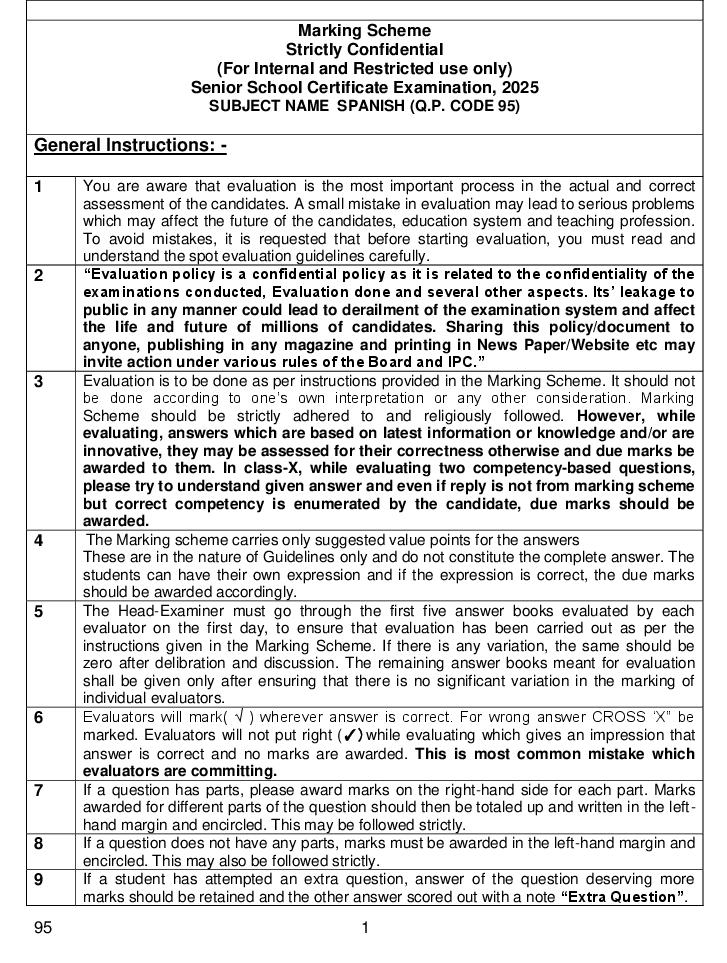
Strictly Confidential
(For Internal and Restricted use only)
Senior School Certificate Examination, 2025
SUBJECT NAME SPANISH (Q.P. CODE 95)
General Instructions: -
1 You are aware that evaluation is the most important process in the actual and correct
assessment of the candidates. A small mistake in evaluation may lead to serious problems
which may affect the future of the candidates, education system and teaching profession.
To avoid mistakes, it is requested that before starting evaluation, you must read and
understand the spot evaluation guidelines carefully.
2 “Evaluation policy is a confidential policy as it is related to the confidentiality of the
examinations conducted, Evaluation done and several other aspects. Its’ leakage to
public in any manner could lead to derailment of the examination system and affect
the life and future of millions of candidates. Sharing this policy/document to
anyone, publishing in any magazine and printing in News Paper/Website etc may
invite action under various rules of the Board and IPC.”
3 Evaluation is to be done as per instructions provided in the Marking Scheme. It should not
be done according to one’s own interpretation or any other consideration. Marking
Scheme should be strictly adhered to and religiously followed. However, while
evaluating, answers which are based on latest information or knowledge and/or are
innovative, they may be assessed for their correctness otherwise and due marks be
awarded to them. In class-X, while evaluating two competency-based questions,
please try to understand given answer and even if reply is not from marking scheme
but correct competency is enumerated by the candidate, due marks should be
awarded.
4 The Marking scheme carries only suggested value points for the answers
These are in the nature of Guidelines only and do not constitute the complete answer. The
students can have their own expression and if the expression is correct, the due marks
should be awarded accordingly.
5 The Head-Examiner must go through the first five answer books evaluated by each
evaluator on the first day, to ensure that evaluation has been carried out as per the
instructions given in the Marking Scheme. If there is any variation, the same should be
zero after delibration and discussion. The remaining answer books meant for evaluation
shall be given only after ensuring that there is no significant variation in the marking of
individual evaluators.
6 Evaluators will mark( √ ) wherever answer is correct. For wrong answer CROSS ‘X” be
marked. Evaluators will not put right (✓)while evaluating which gives an impression that
answer is correct and no marks are awarded. This is most common mistake which
evaluators are committing.
7 If a question has parts, please award marks on the right-hand side for each part. Marks
awarded for different parts of the question should then be totaled up and written in the left-
hand margin and encircled. This may be followed strictly.
8 If a question does not have any parts, marks must be awarded in the left-hand margin and
encircled. This may also be followed strictly.
9 If a student has attempted an extra question, answer of the question deserving more
marks should be retained and the other answer scored out with a note “Extra Question”.
95 1
Page 2
once.
11 A full scale of marks __________(example 0 to 80/70/60/50/40/30 marks as given in
Question Paper) has to be used. Please do not hesitate to award full marks if the answer
deserves it.
12 Every examiner has to necessarily do evaluation work for full working hours i.e., 8 hours
every day and evaluate 20 answer books per day in main subjects and 25 answer books
per day in other subjects (Details are given in Spot Guidelines).This is in view of the
reduced syllabus and number of questions in question paper.
13 Ensure that you do not make the following common types of errors committed by the
Examiner in the past:-
● Leaving answer or part thereof unassessed in an answer book.
● Giving more marks for an answer than assigned to it.
● Wrong totaling of marks awarded on an answer.
● Wrong transfer of marks from the inside pages of the answer book to the title page.
● Wrong question wise totaling on the title page.
● Wrong totaling of marks of the two columns on the title page.
● Wrong grand total.
● Marks in words and figures not tallying/not same.
● Wrong transfer of marks from the answer book to online award list.
● Answers marked as correct, but marks not awarded. (Ensure that the right tick mark
is correctly and clearly indicated. It should merely be a line. Same is with the X for
incorrect answer.)
● Half or a part of answer marked correct and the rest as wrong, but no marks awarded.
14 While evaluating the answer books if the answer is found to be totally incorrect, it should
be marked as cross (X) and awarded zero (0)Marks.
15 Any unassessed portion, non-carrying over of marks to the title page, or totaling error
detected by the candidate shall damage the prestige of all the personnel engaged in the
evaluation work as also of the Board. Hence, in order to uphold the prestige of all
concerned, it is again reiterated that the instructions be followed meticulously and
judiciously.
16 The Examiners should acquaint themselves with the guidelines given in the “Guidelines
for Spot Evaluation” before starting the actual evaluation.
17 Every Examiner shall also ensure that all the answers are evaluated, marks carried over to
the title page, correctly totaled and written in figures and words.
18 The candidates are entitled to obtain photocopy of the Answer Book on request on
payment of the prescribed processing fee. All Examiners/Additional Head Examiners/Head
Examiners are once again reminded that they must ensure that evaluation is carried out
strictly as per value points for each answer as given in the Marking Scheme.
95 2
Page 3
$
MARKING SCHEME
SPANISH
1. 51=5
(i) hablar
(ii) invertido
(iii) has encontrado / encuentras
(iv) necesito / necesitaré / creo que voy a necesitar
(v) Haz
2. 51=5
(i) Mi madre dijo que iba a preparar la cena esa noche.
(ii) Pedro dijo que se había comprado un coche nuevo el día anterior/el día
previo.
(iii) Ana dijo que el verano siguiente/al verano siguiente viajaría a París.
(iv) Mi profesor dijo que ese examen era muy dificil.
(v) Carlos me dijo que me llamaría al día siguiente / el día siguiente.
(vi) Marta dijo que estaba muy cansada ese día / aquel día.
(vii) Ellos dijeron que habían terminado el proyecto la semana anterior / la
semana previa
(viii) Mi amiga me dijo que no olvidara traer el libro a clase.
95 3
Page 4
(i) sea
(ii) diga
(iii) lleguemos
(iv) hayas
(v) mantengan
(vi) esperes
(vii) pueda
(viii) tengamos
4. Past Tense Conjugation 101=10
Conjugate the verbs correctly in the past tense.
(i) salimos, cerró
(ii) viajé, visité
(iii) jugaron, empezó
(iv) vivia, pasaba, trabajaban
(v) comimos
5. 51=5
(i) (B) La lección es estudiada por los alumnos.
(ii) (A) Un coche nuevo fue comprado por mi hermano.
(iii) (B) El evento ha sido organizado por la empresa.
(iv) (A) El tema fue explicado por la profesora en clase.
(v) (C) El puente es diseñado por los ingenieros.
95 4
Page 5
(i) (B) empezaremos
(ii) (A) caminando
(iii) (B) para
(iv) (A) hagan
(v) (B) desde hace
(vi) (C) desde que
(vii) (A) en
7. 52=10
(i) ¿Qué es la “perspectiva múltiple” y cómo se utiliza en el cubismo ?
Esta técnica consiste en representar diferentes puntos de vista de un
objeto en un solo plano, descomponiendo las formas en fragmentos
geométricos y reorganizándolos de manera simultanea.
(ii) Describe las dos fases principales del cubismo y menciona las diferencias
entre ellas. El cubismo tiene dos fases principales :
El cubismo analítico, que predominó entre 1908 y 1912, se caracteriza
por la fragmentación extrema de las formas y el uso de una paleta de
colores limitada, principalmente en tonos terrosos, grises y ocres. En esta
fase, los artistas se enfocaron en descomponer objetos y figuras en sus
elementos más básicos, analizando cada parte y representándola en
formas geométricas abstractas. Esto creaba una complejidad visual que
requería que los espectadores descifraran las formas para entender lo que
se representaba.
El cubismo sintético : A partir de 1912, el cubismo evolucionó hacia una
fase conocida como cubismo sintético. A diferencia de la fase anterior, el
cubismo sintético introdujo colores más vivos y empezó a usar materiales
que no eran tradicionales en la pintura, como trozos de periódicos, papeles
y telas, creando así las primeras obras de collage. Este enfoque permitía
que las obras fueran más accesibles y reconocibles, combinando objetos
reales con representaciones abstractas para formar composiciones
novedosas. En lugar de descomponer las formas, los artistas ahora las
reconstruian, integrando elementos reales para dar un nuevo significado a
sus obras
La principal diferencia entre ambas fases es que el cubismo analítico
descompone las formas en múltiples fragmentos, mientras que el cubismo
sintético las reconstruye de manera más accesible y colorida.
(iii) ¿Cuál fue la contribución de la obra “Las señoritas de Avignon” al
desarrollo del cubismo ?
95 5
Page 6
En este cuadro, se puede observar cómo Picasso deconstruye las formas
humanas, presentando rostros que parecen ser vistos desde diferentes
ángulos a la vez. Esta técnica desafió la manera en que se percibia la figura
humana, sentando las bases para lo que más tarde se llamaria cubismo.
(iv) Menciona dos artistas, además de Picasso y Braque, que fueron
importantes en el movimiento cubista y explica sus contribuciones.
Entre los artistas más destacados del cubismo, además dc Picasso y
Braque, se encuentran Juan Gris y Fernand Léger. Juan Gris, conocido por
su estilo más ordenado y preciso, llevó las ideas cubistas a nuevas
direcciones, mientras que Léger introdujo elementos industriales y
mecánicos en sus pinturas, reflejando la modernidad de la época.
(v) ¿Por qué se considera el cubismo una de las vanguardias más influyentes
del siglo XX ?.
El cubismo transformó la manera en que se concebía el arte visual al
romper con la perspectiva tradicional, introducir la fragmentación y la
multiplicidad de puntos de vista, y utilizar materiales no convencionales.
Su influencia se extendió a movimientos posteriores como el futurismo, el
constructivismo y el arte abstracto Hoy en dia, el cubismo sigue siendo una
fuente de inspiración para artistas y diseñadores que buscan desafiar las
normas establecidas y explorar nuevas formas de expresión visual.
(vi) ¿Qué materiales nuevos introdujeron los artistas en el cubismo sintético y
cómo afectaron al estilo ?
Los artistas del cubismo sintético incorporaron materiales como recortes
de periódicos, papeles, telas y otros objetos en sus obras, dando origen a la
técnica del collage. Esto permitió mayor experimentación, hizo las obras
más accesibles y les otorgó una dimensión nueva al combinar elementos
reales con representaciones abstractas.
(vii) ¿Cómo influyó el cubismo en la literatura, la arquitectura y otras artes ?
El impacto del cubismo se extendió más aIIá de la pintura. Influenció la
escultura, la arquitectura, el diseño gráfico e incluso la literatura. La idea
de la fragmentación y la combinación de múltiples perspectivas fue
adoptada por escritores como Guillaume Apollinaire, quien introdujo estos
conceptos en su poesía, alejándose de las narrativas lineales
convencionales. Además, las formas geométricas y las técnicas del collage
95 6
Page 7
demostrando la versatilidad y la influencia del cubismo en la cultura
moderna.
8. True or False statements 51=5
(i) Verdadero
(ii) Falso
(iii) Falso
(iv) Verdadero
(v) Verdadero
9. 15=5
Lenguaje (El uso correcto de los verbos) = 2 puntos
Contenido/Mensaje = 2 puntos
Reflexión = 1 punto
10. (a) 110=10
Relevancia del contenido (2 puntos)
Organización y coherencia (2 puntos)
Precisión lingüística y gramática (2 puntos)
Riqueza del vocabulario y expresión (2 puntos)
Creatividad y originalidad (1 punto)
Claridad y presentación (1 punto)
(OR)
(Total = 10 puntos)
10. (b) Blog Writing
Relevancia del contenido (2 puntos)
Estructura y coherencia (2 puntos)
Estilo (2 puntos)
Presentación gramatical y ortográfica (2 puntos)
95 7
Page 8
11. Open-ended Question 42=8
The questions are open-ended, and it is expected that students respond
appropriately to these questions so that they can be assessed on their knowledge
about the authors, the most important works, principal themes of each, and the
subject matter.
12. 71=7
(i) Verdadero
(ii) Falso
(iii) Verdadero
(iv) Verdadero
(v) Verdadero
(vi) Verdadero
(vii) Falso
(viii) Verdadero
(ix) Falso
95 8
Document Details
| Board / Org | CBSE |
| Exam | Class 12 |
| Type | Solution |
| Pages | 8 |
| Updated | 24 Sep 2026 |