Manipur Board Class 12 Syllabus 2027 Fine Arts
Finished viewing? Save it for later —
Download Manipur Board Class 12 Syllabus 2027 Fine Arts (PDF · 18 pages)About Manipur Board Class 12 Syllabus 2027 Fine Arts
Manipur Board Class 12 Syllabus 2027 Fine Arts is available here for free download. Published by Manipur Board for Class 12, this syllabus can be viewed online or downloaded as a PDF (18 pages). Candidates preparing for Class 12 can use Manipur Board Class 12 Syllabus 2027 Fine Arts to understand the exam pattern, the type of questions asked, and the overall difficulty level.
Frequently Asked Questions
How can I download Manipur Board Class 12 Syllabus 2027 Fine Arts?
Open this page and click the Download button to save Manipur Board Class 12 Syllabus 2027 Fine Arts as a PDF. It is completely free on AglaSem Docs.
Is Manipur Board Class 12 Syllabus 2027 Fine Arts free to download?
Yes. Manipur Board Class 12 Syllabus 2027 Fine Arts can be viewed online and downloaded as a PDF free of cost on AglaSem Docs.
How many pages does Manipur Board Class 12 Syllabus 2027 Fine Arts have?
Manipur Board Class 12 Syllabus 2027 Fine Arts contains 18 pages, which you can read online or download together as a single PDF.
Where can I find more Class 12 study material?
You can find more Class 12 question papers, sample papers, syllabus, and answer keys on AglaSem Docs.
Manipur Board Class 12 Syllabus 2027 Fine Arts – Text
Read the full text of this syllabus below — useful to quickly search, copy and reference the content online without downloading the PDF.
📄 View text version (19 pages)
Page 1
Manipur Board Class
12 Syllabus 2027 Fine
Arts
EXAM YEAR TYPE SUBJECT
Manipur Class 12 2027 Syllabus Art
Notes · Sample Papers · Previous Year Papers · Mock Tests
Page 2
m .co
m .co s e m
se g l a
a
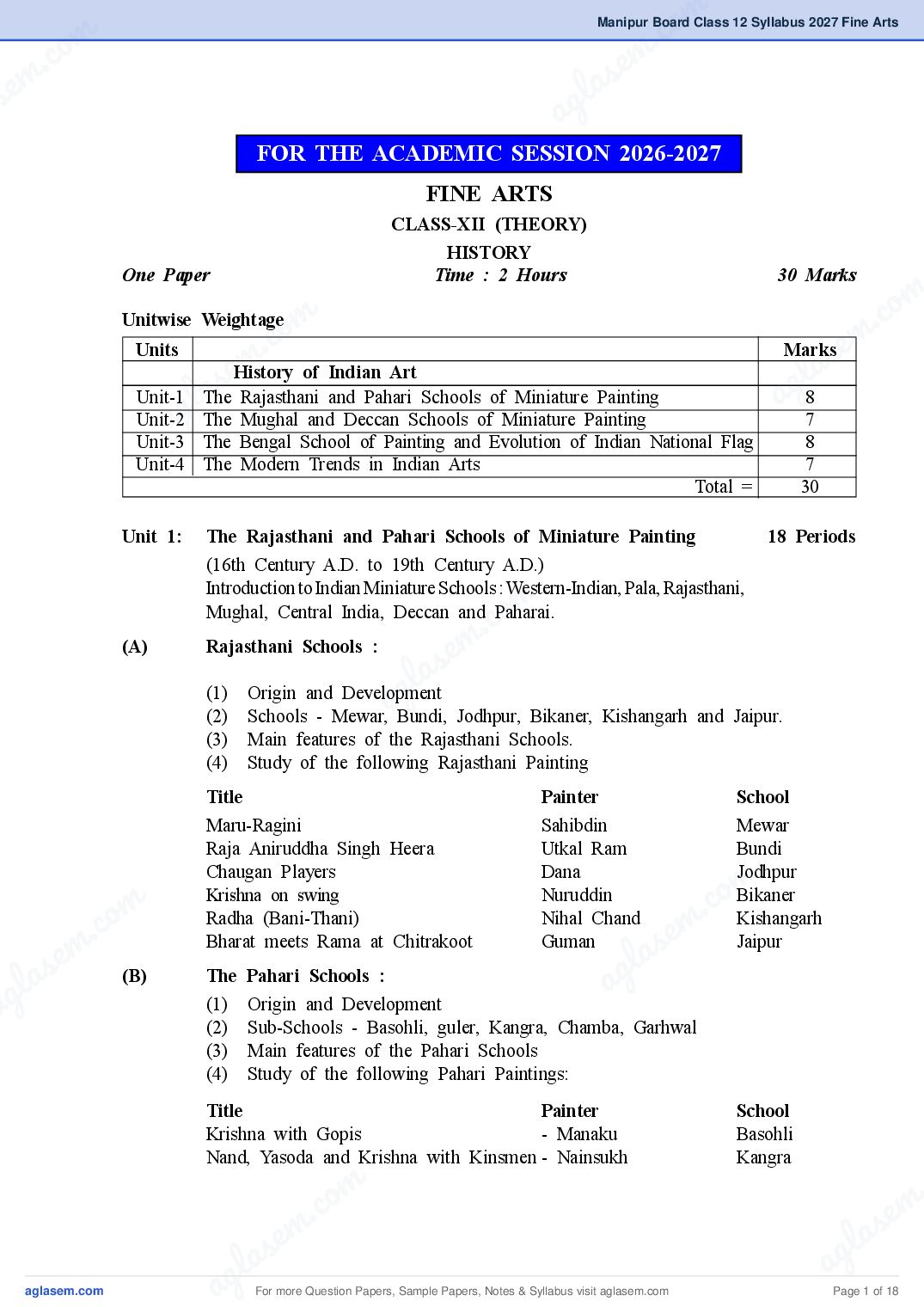
FOR THE ACADEMIC SESSION 2026-2027
FINE ARTS
CLASS-XII (THEORY)
HISTORY
One Paper Time : 2 Hours 30 Marks
m
m .co
.co
Unitwise Weightage
e m
Units
m of Indian Art
eHistory
Marks
l as
s
a Rajasthani and Pahari Schools of Miniature Painting
Unit-1 lThe ag8
a
Unit-2g The Mughal and Deccan Schools of Miniature Painting 7
Unit-3 The Bengal School of Painting and Evolution of Indian National Flag 8
Unit-4 The Modern Trends in Indian Arts 7
Total = 30
Unit 1: The Rajasthani and Pahari Schools of Miniature Painting 18 Periods
(16th Century A.D. to 19th Century A.D.)
Introduction to Indian Miniature Schools : Western-Indian, Pala, Rajasthani,
m
Mughal, Central India, Deccan and Paharai.
.co
(A) Rajasthani Schools :
s em
g la
a
(1) Origin and Development
(2) Schools - Mewar, Bundi, Jodhpur, Bikaner, Kishangarh and Jaipur.
(3) Main features of the Rajasthani Schools.
(4) Study of the following Rajasthani Painting
Title Painter School
Maru-Ragini Sahibdin Mewar
Raja Aniruddha Singh Heera Utkal Ram Bundi
Chaugan Players Dana
m Jodhpur
m Krishna on swing Nuruddin
.co Bikaner
m .co Radha (Bani-Thani)
Bharat meets Rama at Chitrakoot
Nihal Chand
Guman s e m Kishangarh
Jaipur
s e g l a
g la (B) The Pahari Schools :
a
a (1) Origin and Development
(2) Sub-Schools - Basohli, guler, Kangra, Chamba, Garhwal
(3) Main features of the Pahari Schools
(4) Study of the following Pahari Paintings:
Title Painter School
Krishna with Gopis - Manaku Basohli
Nand, Yasoda and Krishna with Kinsmen - Nainsukh Kangra
m .
.co s e m
s em l a
g la ag
a For more Question Papers, Sample Papers, Notes & Syllabus visit Page 1 of 18
Page 3
(16th Century A.D. to 19th Century A.D.) 18 Periods
(A) The Mughal School :
(1) Origin and Development
(2) Main features of the Mughal School
(3) Study of the following Mughal paintings.
Title Painter School
Krishna lifting Mount Govardhan Miskin Akbar
Birth of Salim Ramdas -
Falcon on a birth rest Ustad Mansoor Jahangir
Kabir and Raidas Ustad Faquirullah Khan Shahjahan
Marriage procession of Dara Shikoh Haji Madni Provincial Mughal
(Oudh)
(B) The Deccan School:
(1) Origin and Development
(2) Main features of the Deccan School
(3) Study of the following Deccan Paintings
Title Painter School
Ragini Pat - hamsika - Ahmednagar
Chand Bibi Playing Polo (Chaugan) - Golconda
Unit 3: The Bengal School of Painting: 18 Periods
(A) (1) Introduction to the Bengal School of Painting
(i) Origin and development of the Bengal School
(ii) Main features of the Bengal School
(2) Study of the following Paintings of the Bengal School..
(i) Journey's End – Abanidranath Tagore
(ii) Shiva and Sati – Nandalal Bose
(iii) Radhika – M.A.R. Chugtai
(iv) Ras Lila – Kshitidranath Majumdar
(v) Meghdoot – Ram Gopal Vijaivargiya
(B) Evolution of Indian National Flag and symbolic significance of its forms
and colours
For more Question Papers, Sample Papers, Notes & Syllabus visit Page 2 of 18
Page 4
m .co
m .co s e m
se g l a
a
Unit 4: The Modern Trends in Indian Art: 18 Periods
Introduction
(1) Study of the following Paintings:
(i) Rama Vanquishing the pride f the Ocean - Raja Ravi Varma
m
.co
(ii) Mother and Child - Jamini Roy
m
.co
(iii) Haldi Grinders - Amrita Sher Gil
e m
em
(iv) Mother Teresa - M.F. Husain
l as
s (v) The Vulture - Kamlesh Dutt Pande
la(2) Graphic prints: ag
ag
(i) Whirlpool - Krishna Reddy
(ii) Children - Somnath Hore
(iii) Devi - Jyoti Bhatt
(iv) Of Walls - Anupam Sud
(v) Man, Woman and Tree - Laxma Goud
(3) Sculptures:
m
(i) Triumph of Labour - D.P. Roychowdhury
m .co
e
(ii) Cries Unheard - Amar Nath Seghal
s
la
(iii) Ganesha - P.V. Jankiram
g
a
(iv) Santhal Family - Ramkinkar Vaij
(v) Chatturmukhi - Aekka Yada Giri Rao
Note: The names of artists and their art work as listed above are only suggestive and
in no way exhaustive. Teachers and students should expand this according to their
own resources. However, the question will be set from the above mentioned art
works only.
m
m ——§§§——
.co
m .co s e m
s e g l a
g la a
a
m .
.co s e m
s em l a
g la ag
a For more Question Papers, Sample Papers, Notes & Syllabus visit Page 3 of 18
Page 5
CLASS-XII (PRACTICAL)
Time : 3 Hours
One paper 70 Marks
Unitwise Weightage
Units Period Marks
1. Nature and Object Study 50 25
2. Painting Composition 50 25
3. Sessional Work 48 20
Total 148 70
Unit 1: Nature and Object Study 25 Marks
50 Periods
Studies on the basis of exercises done in Class XI with two or three
objects and two draperies (in different colours) for background and
foreground Exercises in pencil with light and shade and in full colour
from a fixed point of view.
Unit 2: Painting Composition 25 Marks
50 Periods
Imaginative painting based on subjects from Life and Nature in water
and poster colours with colour values.
Unit 3: Portfolio Assessment 20 Marks
48 Periods
(a) Record of the entire year’s performance from sketch to 10 marks
finished product.
(b) Five selected nature and object study exercise in any media
done during the session 5 marks
(c) Three selected works of paintings composition done by the
candidate during the year 3 marks
(d) Two selected works based on any Indian Folk Art (Painting) 2 marks
These selected works prepared during the course by the candidates and
certified by the school authorities as the work done in the school will
be placed before the examiners for assessment.
Note: 1. The candidates should be given one hour-break after first three hours
2. The timetable to be so framed as to allow the students to work continuously
for minimum of two periods at a stretch.
For more Question Papers, Sample Papers, Notes & Syllabus visit Page 4 of 18
Page 6
m .co
m .co s e m
se g l a
a
Guidelines for Evaluation of Practical
1. Marking Scheme :
Part I: Nature and Object Study 25 marks
(i) Drawing (composition) 10
m
(ii) m
Treatment of media/colour 05 .co
.co
(iii) Overall impression
m
10
s e m
s e
Part II: Painting (Composition) l a
25 marks
g l a
(i) Compositional arrangement including emphasis on the subject. ag
10
a (ii) Treatment of media (colour) and appropriate colour scheme 05
(iii) Originally, creativity and overall impression 10
Part III: Portfolio Assessment 20 marks
(i) Record of the entire year’s performance from sketch to
finished product 10
(ii) Five selected nature and object study exercise in any media 05
m
(iii) Three selected painting compositions prepared by the candidate 03
m .co
(iv) Two selected works based on any Indian Folk Art (Painting) 02
s e
la
2. Format of the Question :
a
Part I: Nature and Object Studyg
Draw and paint the still-life of a group of objects arranged on a drawing board
before you, from a fixed point of view (given to you), on a drawing paper of half
imperial size in colours. Your drawing should be proportionate to the size of the
paper. The objects should be painted in realistic manner with proper light and shade
and perspective etc. In this study the drawing board is not to be included.
Note: A group of objects to be decided by the external and internal examiners
jointly as per instructions. The objects for Nature study and object study are to
be arranged before the candidates. m
m .co
.co
Part II: Painting Composition:
e m
e m Make a Painting-Composition on any one of the following five subjects in any
l as
las ag
medium (Water/pastel, Tempera, Acrylic) of your choice on a drawing-paper of half
imperial size, either horizontally or vertically. Your composition should be original
ag and effective. Weightage will be given to a well composed drawing, effective use
of media, proper emphasis on the subject matter and utilization of full space.
Note: Any five subjects for Painting Composition are to be decided by the external
and internal examiners jointly as per instructions and to be mentioned here strictly
just before the start of the examination for Part-II.
m .
.co s e m
s em l a
g la ag
a For more Question Papers, Sample Papers, Notes & Syllabus visit Page 5 of 18
Page 7
1. The examiners (Internal and External) are to select/decide two or three suitable
objects in such a way so that natural and geometrical forms may be covered
in the group of objects:
(i) Natural-forms-large size foliage and flowers, fruits and vegetables, etc.
(ii) Geometrical forms made of wood/plastic/paper/metal/earthen, etc. such
as cube, cone, prism, cylinder and sphere.
2. Objects should be selected generally of large (suitable) size.
3. An object relating to nature, according to the season and location of the examination
centre, must be included in the group of objects. The natural-objects should
be purchased/arranged only on the day of the examination so that its freshness
may be maintained.
4. Two draperies in different colours (one in dark and other in light tone) are
to be included for background and foreground, keeping in view the colours
and tones of the objects selected.
B. Instruction to decide the subjects for Painting-Composition.
1. The examiners (Internal and External) are to select/decide the five subjects
suitable for Painting - Composition.
2. The subjects should be so designed that the candidates may get clear-cut ideas
of the subjects and they can exercise their imagination freely, because it is
not important what you do, but how you do it.
3. The examiners (Internal and External) jointly are to free to select/decide the
subjects, but these should be according to the standard of Class XII and environment
of the school/candidates.
Some identified areas of the subjects for Painting-Composition are given below,
in which some more areas may also be added.
(i) Affairs of family friends and daily life.
(ii) Affairs of family Professionals.
(iii) Games and Sports activities.
(iv) Nature
(v) Fantasy
(vi) National, religious, cultural, historical and social events and celebrations.
4. General Instruction to the examiners :
(i) Candidates should be given one hour break after first three hours.
(ii) Work of the candidates, for parts I, II and III is to be evaluated on the
spot jointly by the external and internal examiners.
(iii) Each work of part I, II and III after assessment is to be marked as examined
and duly signed by the external and internal examiners jointly.
——§§§——
For more Question Papers, Sample Papers, Notes & Syllabus visit Page 6 of 18
Page 8
m .co
m .co s e m
se g l a
a
FINE ARTS
CLASS-XII (PRACTICAL)
Time : 3 Hours 70 Marks
(Visual art activities in terms of materials, media and techniques)
m
.co
Subject matter:
m
.co m
Unit 1: Subject matter: Sketching from life, natural objects and man-made objects. Drawing
from different objects such as:- Trees, clouds, rivers, hills, flowers, different fruits, birds,
m s e
s e
animals, different human forms and human anatomy. Geometrical forms of objects based l a
g l aon geometrical forms like cubes, prisms, cylinders and sphere. Different painting of ag
a landscape such as townscape and rural scenes etc.
Unit 2: Natural study:- Various forms of nature in pencil, colour etc. both indoor and outdoor.
Unit 3: Perspective:- Simple and dimensional laws of visual perception, used in perspective and
common-scene problems based on the concept of two and three dimensions.
Unit 4: Still - life drawing and paintings:- Still-life drawing and painting basing on different
objects such as: fruits, vegetables, flowers, flower vase and plates with two draperies in
m
different colours (one in dark and other in light tone) are also to be included for backbround.
o
c
(A) Elements of arts:- 1. Lines, 2..Form, 3. Space, 4. Light and dark, 5. Colour, 6.
em
Unit 5:
l a s
Texture. (B) Principles of arts:- 1. Balance, 2. Dominance, 3. Rhythm, 4. Opposition,
Rhythm, 4. Rhythm, 5. g
5. Transition. (C) Principles of composition:- 1. Unity, 2. Harmony, 3. Balance, 4.
a Emphasis and Proportion, 6. Abstraction and stylisation. (D)
Creativity in visual art: The elements of the visual art are six viz:- 1. Line, 2. Value, 3.
Perspective, 4. Volume, 5. Colour, 6. Texture.
Unit 6: Collage (Collage making):- Mixed media collage-pasting other materials like rag, button,
cloth cutting and tearing methods.
Unit 7: (A) Colour theory:- 1. Primary colours, 2. Secondary colours, 3. Intermediate colours,
4. Tint, 5. Cool colours, 6. Warm colours, 7. Complementary colours and 8. Analogous
m
.co
colours etc.
m
m .co e m
(B) Pigment colours:- 1. Blue, 2. Red, 3. Yellow, 4. Orange, 5. Green, 6. Violet, 7.
s
s e l a
Brown, 8. White and 9. Black (Explanation of the given above colours are necessary)
g
g la (C) Some pictorial peculiarities of colour.
a
a Unit 8: Drawing and painting: Tools and media:- pencil, pen and ink, brush, pastel colour, water
colour, poster colour, acrylic colour, oil colour. Papers:- Cartridge paper, Hand-made
paper (smooth, medium and rough), Oil sketching paper, Oil canvas cloth (smooth, medium
and rough texture) Easel : Outdoor study and indoor study. Drawing board:- Half imperial
size and imperial size, Drawing pin (thumb pin) Vehicles: Turpentine and Linseed oil
etc.
m .
.co s e m
s em l a
g la ag
a For more Question Papers, Sample Papers, Notes & Syllabus visit Page 7 of 18
Page 9
Appreciation of picture composition, colour and its combination, introduction of general
colour theory. Selected works of old masters and contemporary artists may be discussed
(slide pictures are to be shown with epidiascope and projector)
SHOWING OF ART
Films, slide, reproduction of old masters and modern masters appropriate to the age
group.
FIELD TRIPS
Visit to Museums, art exhibitions, art galleries and places of artist etc. (Inside and Outside
Manipur).
DISPLAY OF ART WORKS AND EXHIBITIONS
Exhibition of student's work should be organised from time to time.
PRESCRIBED TEXTBOOK FOR CLASS XII:
1. History of Indian Art (12)
(A textbook based on Fine Arts syllabus)
Published by: Full Marks Pvt. Ltd.( Progressive Educational Publishers)
9, Daryaganj, New Delhi-110002
REFERENCE BOOKS FOR CLASS XII:
1. Indian Painting
– Percy Brown
– (YMCA Publishing House, Massey Hall, Jai Singh Road Near Parliament Street,
New Delhi - 110001
2. The Art Heritage of India
– E.B. Havell
3. Story of Indian Art
– S.K. Bhattarcharya
– (Atma Ram & Sons, Kashmiri Gate, Delhi - 110006
4. Indian Artists through the ages
– R.K. Chopra
– (R.K.C. Publications, H-49, Raghu Nagar Pankha Road, New Delhi - 110045)
For more Question Papers, Sample Papers, Notes & Syllabus visit Page 8 of 18
Page 10
m .co
m .co s e m
se g l a
a
DESIGN OF
QUESTION PAPER
Subject : FINE ARTS
Paper : Theory
m
.co
Class : XII
m
.co
Full Mark : 30
Time : 2 Hours
e m
em l as
as
WEIGHTAGE TO OBJECTIVES
l ag
agObjectives
Knowledge(K)
Marks
4
Percentage
13%
I Comprehension/Understanding(C/U) 15 50%
Expression (Exp) 9 30%
Skill (S) 2 7%
Total : 30 100%
WEIGHTAGE TO FORMS OF QUESTIONS:
Form of Questions No. of Question Time (in minute) Marks Percentage
Essay/Long Answer (E/LA) 2 40 12 40%
Short Answer (SA-I) 2 26 m 6 20%
.co
II Short Answer (SA-II) 2 16 4 13%
Very Short Answer (VSA) 2
e m 14 2 7%
MCQ
las6 24 6 20%
WEIGHTAGE TO CONTENT:
Total:
ag 14 120 30 100%
UNITS CONTENTS Marks Percentage
History of Indian art
1 The Rajasthani and Pahari Schools of Miniature Painting 8 27%
III 2 The Mughal and Deccan Schools of Miniature Painting 7 23%
The Bengal School of Painting and Evolution of Indian
3 8 27%
National Flag.
4 The Modern Trends in Indian Arts 7 23%
Total : 30
m 100%
m IV SCHEME OF SECTIONS : Nil
.co
m .co V SCHEME OF OPTIONS :
DIFFICULTY LEVEL : s e m
s e VI Difficult : 30% of the total marks
g l a
g la Average : 50% of the total marks a
a Easy : 20% of the total marks
Abbreviation : K(Knowledge), U(Understanding ), C(Comprehension), Exp.(Expression), Skill(S),
E(Essay Type), SA (Short Answer Type), VSA (Very Short Answer Type),
MCQ(Multiple Choice Question)
*N.B.: i. MCQ – 2 Questions for Assertion and reason.
ii) Short Answer (SA-I) – 1 (One) question for Resource Based Learning
m .
.co s e m
s em l a
g la ag
a For more Question Papers, Sample Papers, Notes & Syllabus visit Page 9 of 18
Page 11
FINE ARTS
CLASS-XII (THEORY)
HISTORY
One Paper Time : 2 Hours 40 Marks
Unitwise Weightage
Units Marks
History of Indian Art
Unit-1 The Rajasthani and Pahari Schools of Miniature Painting 8
Unit-2 The Mughal and Deccan Schools of Miniature Painting 7
Unit-3 The Bengal School of Painting and Evolution of Indian National Flag 8
Unit-4 The Modern Trends in Indian Arts 7
Unit-5 History of Manipur Art - II 10
Total = 40
Unit 1: The Rajasthani and Pahari Schools of Miniature Painting 18 Periods
(16th Century A.D. to 19th Century A.D.)
Introduction to Indian Miniature Schools : Western-Indian, Pala, Rajasthani,
Mughal, Central India, Deccan and Paharai.
(A) Rajasthani Schools :
(1) Origin and Development
(2) Schools - Mewar, Bundi, Jodhpur, Bikaner, Kishangarh and Jaipur.
(3) Main features of the Rajasthani Schools.
(4) Study of the following Rajasthani Painting
Title Painter School
Maru-Ragini Sahibdin Mewar
Raja Aniruddha Singh Heera Utkal Ram Bundi
Chaugan Players Dana Jodhpur
Krishna on swing Nuruddin Bikaner
Radha (Bani-Thani) Nihal Chand Kishangarh
Bharat meets Rama at Chitrakoot Guman Jaipur
(B) The Pahari Schools :
(1) Origin and Development
(2) Sub-Schools - Basohli, guler, Kangra, Chamba, Garhwal
(3) Main features of the Pahari Schools
(4) Study of the following Pahari Paintings:
Title Painter School
Krishna with Gopis - Manaku Basohli
Nand, Yasoda and Krishna with Kinsmen - Nainsukh Kangra
For more Question Papers, Sample Papers, Notes & Syllabus visit Page 10 of 18
Page 12
m .co
m .co s e m
se g l a
a
Unit 2: The Mughal and Deccan Schools of Miniature Paintings
(16th Century A.D. to 19th Century A.D.) 18 Periods
(A) The Mughal School :
(1) Origin and Development
m
(2) Main features of the Mughal School
m .co
m .co
(3) Study of the following Mughal paintings.
s e m
s e
Title Painter School
g l a
g l a
Krishna lifting Mount Govardhan Miskin Akbar a
a Birth of Salim Ramdas -
Falcon on a birth rest Ustad Mansoor Jahangir
Kabir and Raidas Ustad Faquirullah Khan Shahjahan
Marriage procession of Dara Shikoh Haji Madni Provincial Mughal
(Oudh)
(B) The Deccan School:
(1) Origin and Development m
(2) Main features of the Deccan School
m .co
(3)
s e
Study of the following Deccan Paintings
Title g la Painter School
Ragini Pat - hamsika
a - Ahmednagar
Chand Bibi Playing Polo (Chaugan) - Golconda
Unit 3: The Bengal School of Painting: 18 Periods
(A) (1) Introduction to the Bengal School of Painting
(i) Origin and development of the Bengal School
(ii) Main features of the Bengal School
o m
m (2) Study of the following Paintings of the Bengal School.. .c
m .co Abanidranath Tagore a s e m
s e (i) Journey's End –
g l
g la (ii) Shiva and Sati – Nandalal Bose
a
a (iii) Radhika
(iv) Ras Lila
– M.A.R. Chugtai
– Kshitidranath Majumdar
(v) Meghdoot – Ram Gopal Vijaivargiya
(B) Evolution of Indian National Flag and symbolic significance of its forms
and colours
m .
.co s e m
s em l a
g la ag
a For more Question Papers, Sample Papers, Notes & Syllabus visit Page 11 of 18
Page 13
Introduction
(1) Study of the following Paintings:
(i) Rama Vanquishing the pride f the Ocean - Raja Ravi Varma
(ii) Mother and Child - Jamini Roy
(iii) Haldi Grinders - Amrita Sher Gil
(iv) Mother Teresa - M.F. Husain
(v) The Vulture - Kamlesh Dutt Pande
(2) Graphic prints:
(i) Whirlpool - Krishna Reddy
(ii) Children - Somnath Hore
(iii) Devi - Jyoti Bhatt
(iv) Of Walls - Anupam Sud
(v) Man, Woman and Tree - Laxma Goud
(3) Sculptures:
(i) Triumph of Labour - D.P. Roychowdhury
(ii) Cries Unheard - Amar Nath Seghal
(iii) Ganesha - P.V. Jankiram
(iv) Santhal Family - Ramkinkar Vaij
(v) Chatturmukhi - Aekka Yada Giri Rao
Note: The names of artists and their art work as listed above are only suggestive and in no
way exhaustive. Teachers and students should expand this according to their own resources.
However, the question will be set from the above mentioned art works only.
Unit 5: History of Manipur Art-II 23 Periods
..................................................................
..................................................................
..................................................................
..................................................................
——§§§——
For more Question Papers, Sample Papers, Notes & Syllabus visit Page 12 of 18
Page 14
m .co
m .co s e m
se g l a
a
FINE ARTS (PAINTING)
CLASS-XII (PRACTICAL)
Time : 3 Hours
One paper 60 Marks
m
Unitwise Weightage m .co
Units .co
m and Object Study
Period Marks
s e m
1.
s eNature 50 25
l a
2.
g la Painting Composition 50 ag
25
3. a Sessional Work 48 10
Total 148 60
Unit 1: Nature and Object Study 25 Marks
50 Periods
Studies on the basis of exercises done in Class XI with two or three
objects and two draperies (in different colours) for background and
m
.co
foreground Exercises in pencil with light and shade and in full colour
from a fixed point of view.
s em
la
Unit 2: Painting Composition 25 Marks
g
a on subjects from Life and Nature in water
Imaginative painting based
50 Periods
and poster colours with colour values.
Unit 3: Portfolio Assessment 10 Marks
48 Periods
(a) Record of the entire year’s performance from sketch to 3 marks
finished product.
(b) Five selected nature and object study exercise in any media
m
c om
done during the session
m.co 2 marks
m . (c) Three selected works of paintings composition done by the
s e
s e candidate during the year
g l a 3 marks
la
(d) Two selected works based on any Indian Folk Art (Painting) 2 marks
g a
a These selected works prepared during the course by the candidates and
certified by the school authorities as the work done in the school will
be placed before the examiners for assessment.
Note: 1. The candidates should be given one hour-break after first three hours
2. The timetable to be so framed as to allow the students to work continuously
for minimum of two periods at a stretch.
m .
.co s e m
s em l a
g la ag
a For more Question Papers, Sample Papers, Notes & Syllabus visit Page 13 of 18
Page 15
1. Marking Scheme :
Part I: Nature and Object Study 25 marks
(i) Drawing (composition) 10
(ii) Treatment of media/colour 05
(iii) Overall impression 10
Part II: Painting (Composition) 25 marks
(i) Compositional arrangement including emphasis on the subject. 10
(ii) Treatment of media (colour) and appropriate colour scheme 05
(iii) Originally, creativity and overall impression 10
Part III: Portfolio Assessment 10 marks
(i) Record of the entire year’s performance from sketch to
finished product 03
(ii) Five selected nature and object study exercise in any media 02
(iii) Three selected painting compositions prepared by the candidate 03
(iv) Two selected works based on any Indian Folk Art (Painting) 02
2. Format of the Question :
Part I: Nature and Object Study
Draw and paint the still-life of a group of objects arranged on a drawing board
before you, from a fixed point of view (given to you), on a drawing paper of half
imperial size in colours. Your drawing should be proportionate to the size of the
paper. The objects should be painted in realistic manner with proper light and shade
and perspective etc. In this study the drawing board is not to be included.
Note: A group of objects to be decided by the external and internal examiners
jointly as per instructions. The objects for Nature study and object study are to
be arranged before the candidates.
Part II: Painting Composition:
Make a Painting-Composition on any one of the following five subjects in any
medium (Water/pastel, Tempera, Acrylic) of your choice on a drawing-paper of half
imperial size, either horizontally or vertically. Your composition should be original
and effective. Weightage will be given to a well composed drawing, effective use
of media, proper emphasis on the subject matter and utilization of full space.
Note: Any five subjects for Painting Composition are to be decided by the external
and internal examiners jointly as per instructions and to be mentioned here strictly
just before the start of the examination for Part-II.
For more Question Papers, Sample Papers, Notes & Syllabus visit Page 14 of 18
Page 16
m .co
m .co s e m
se g l a
a
3. (A) Instructions for the selection of the objects for Nature and Object Study:
1. The examiners (Internal and External) are to select/decide two or three suitable
objects in such a way so that natural and geometrical forms may be covered
in the group of objects:
(i) Natural-forms-large size foliage and flowers, fruits and vegetables, etc. o m
m . c
. co Geometrical
(ii) forms made of wood/plastic/paper/metal/earthen, etc. suchm
s e
m as cube, cone, prism, cylinder and sphere.
e Objects should be selected generally of large (suitable) size. gl a
l as2.
a
g
a 3. An object relating to nature, according to the season and location of the examination
centre, must be included in the group of objects. The natural-objects should
be purchased/arranged only on the day of the examination so that its freshness
may be maintained.
4. Two draperies in different colours (one in dark and other in light tone) are
to be included for background and foreground, keeping in view the colours
and tones of the objects selected.
B.
m
Instruction to decide the subjects for Painting-Composition.
1. .co
The examiners (Internal and External) are to select/decide the five subjects
m
e
suitable for Painting - Composition.
s
2.
la
The subjects should be so designed that the candidates may get clear-cut ideas
g
a
of the subjects and they can exercise their imagination freely, because it is
not important what you do, but how you do it.
3. The examiners (Internal and External) jointly are to free to select/decide the
subjects, but these should be according to the standard of Class XII and environment
of the school/candidates.
Some identified areas of the subjects for Painting-Composition are given below,
in which some more areas may also be added.
(i) Affairs of family friends and daily life.
m
m (ii) Affairs of family Professionals.
.co
m .co (iii) Games and Sports activities.
s e m
s e (iv) Nature
g l a
g la (v) Fantasy a
a (vi) National, religious, cultural, historical and social events and celebrations.
4. General Instruction to the examiners :
(i) Candidates should be given one hour break after first three hours.
(ii) Work of the candidates, for parts I, II and III is to be evaluated on the
spot jointly by the external and internal examiners.
(iii) Each work of part I, II and III after assessment is to be marked as examined
and duly signed by the external and internal examiners jointly.
m .
.co s e m
s em ——§§§——
l a
g la ag
a For more Question Papers, Sample Papers, Notes & Syllabus visit Page 15 of 18
Page 17
CLASS-XII (PRACTICAL)
Time : 36 Hours 60 Marks
(Visual art activities in terms of materials, media and techniques)
Subject matter:
Unit 1: Subject matter: Sketching from life, natural objects and man-made objects. Drawing
from different objects such as:- Trees, clouds, rivers, hills, flowers, different fruits, birds,
animals, different human forms and human anatomy. Geometrical forms of objects based
on geometrical forms like cubes, prisms, cylinders and sphere. Different painting of
landscape such as townscape and rural scenes etc.
Unit 2: Natural study:- Various forms of nature in pencil, colour etc. both indoor and outdoor.
Unit 3: Perspective:- Simple and dimensional laws of visual perception, used in perspective and
common-scene problems based on the concept of two and three dimensions.
Unit 4: Still - life drawing and paintings:- Still-life drawing and painting basing on different
objects such as: fruits, vegetables, flowers, flower vase and plates with two draperies in
different colours (one in dark and other in light tone) are also to be included for backbround.
Unit 5: (A) Elements of arts:- 1. Lines, 2. Form, 3. Space, 4. Light and dark, 5. Colour, 6.
Texture. (B) Principles of arts:- 1. Balance, 2. Dominance, 3. Rhythm, 4. Opposition,
5. Transition. (C) Principles of composition:- 1. Unity, 2. Harmony, 3. Balance, 4.
Rhythm, 4. Rhythm, 5. Emphasis and Proportion, 6. Abstraction and stylisation. (D)
Creativity in visual art: The elements of the visual art are six viz:- 1. Line, 2. Value, 3.
Perspective, 4. Volume, 5. Colour, 6. Texture.
Unit 6: Collage (Collage making):- Mixed media collage-pasting other materials like rag, button,
cloth cutting and tearing methods.
Unit 7: (A) Colour theory:- 1. Primary colours, 2. Secondary colours, 3. Intermediate colours,
4. Tint, 5. Cool colours, 6. Warm colours, 7. Complementary colours and 8. Analogous
colours etc.
(B) Pigment colours:- 1. Blue, 2. Red, 3. Yellow, 4. Orange, 5. Green, 6. Violet, 7.
Brown, 8. White and 9. Black (Explanation of the given above colours are necessary)
(C) Some pictorial peculiarities of colour.
Unit 8: Drawing and painting: Tools and media:- pencil, pen and ink, brush, pastel colour, water
colour, poster colour, acrylic colour, oil colour. Papers:- Cartridge paper, Hand-made
paper (smooth, medium and rough), Oil sketching paper, Oil canvas cloth (smooth, medium
and rough texture) Easel : Outdoor study and indoor study. Drawing board:- Half imperial
size and imperial size, Drawing pin (thumb pin) Vehicles: Turpentine and Linseed oil
etc.
For more Question Papers, Sample Papers, Notes & Syllabus visit Page 16 of 18
Page 18
m .co
m .co s e m
se g l a
a
ART APPRECIATION
Appreciation of picture composition, colour and its combination, introduction of general
colour theory. Selected works of old masters and contemporary artists may be discussed
(slide pictures are to be shown with epidiascope and projector)
SHOWING OF ART
o m
o m . c
Films, slide,
group..c
reproduction of old masters and modern masters appropriate to the age
e m
em l a s
l as FIELD TRIPS a g
ag Visit to Museums, art exhibitions, art galleries and places of artist etc. (Inside and Outside
Manipur).
DISPLAY OF ART WORKS AND EXHIBITIONS
Exhibition of student's work should be organised from time to time.
PRESCRIBED TEXTBOOK FOR CLASS XII:
1. History of Indian Art (12) m
(A textbook based on Fine Arts syllabus) .co
em
Published by: Full Marks Pvt. Ltd.( Progressive Educational Publishers)
s
la
9, Daryaganj, New Delhi-110002
g
a
REFERENCE BOOKS FOR CLASS XII:
1. Indian Painting
– Percy Brown
– (YMCA Publishing House, Massey Hall, Jai Singh Road Near Parliament Street,
New Delhi - 110001
2. The Art Heritage of India
– E.B. Havell
m
m 3. Story of Indian Art .co
m .co – S.K. Bhattarcharya
s e m
s e – (Atma Ram & Sons, Kashmiri Gate, Delhi - 110006
g l a
g la 4. Indian Artists through the ages a
a – R.K. Chopra
– (R.K.C. Publications, H-49, Raghu Nagar Pankha Road, New Delhi - 110045)
m .
.co s e m
s em l a
g la ag
a For more Question Papers, Sample Papers, Notes & Syllabus visit Page 17 of 18
Page 19
QUESTION PAPER
Subject : FINE ARTS
Paper : Theory
Class : XII
Full Mark : 40
Time : 2 Hours
WEIGHTAGE TO OBJECTIVES
Objectives Marks Percentage
Knowledge(K) 6 15
I Comprehension/Understanding(C/U) 20 50
Application (A) 12 30
Skill (S) 2 5
Total : 40 100
WEIGHTAGE TO FORMS OF QUESTIONS:
Form of Questions No. of Question Time (in minute) Marks Percentage
Essay/Long Answer (E/LA) 2 32 10 25
Short Answer (SA-II) 3 30 9 23
II Short Answer (SA-III) 5 20 10 25
Very Short Answer (VSA) 6 18 6 15
MCQ 5 20 5 12
Total: 21 120 40 100
WEIGHTAGE TO CONTENT:
UNITS CONTENTS Marks Percentage
1 The Rajasthani and Pahari Schools of Miniature Painting 8 20
2 The Mughal and Deccan Schools of Miniature Painting 7 18
III The Bengal School of Painting and Evolution of Indian
3 8 20
National Flag.
4 The Modern Trends in Indian Arts 7 17
5 History of Manipur Art - II 10 25
Total : 40 100
IV SCHEME OF SECTIONS : Nil
V SCHEME OF OPTIONS : E/LA & SA-II
DIFFICULTY LEVEL :
VI Difficult : 30% of the total marks
Average : 50% of the total marks
Easy : 20% of the total marks
Abbreviation : K(Knowledge), U(Understanding ), C(Comprehension), Exp.(Expression), Skill(S),
E(Essay Type), SA (Short Answer Type), VSA (Very Short Answer Type),
MCQ(Multiple Choice Question)
*N.B.: i. MCQ – 2 Questions for Assertion and reason.
ii) Short Answer (SA-I) – 1 (One) question for Resource Based Learning
For more Question Papers, Sample Papers, Notes & Syllabus visit Page 18 of 18
Document Details
| Board / Org | Manipur Board |
| Exam | Class 12 |
| Type | Syllabus |
| Pages | 18 |
| Updated | 04 Nov 2026 |