NCERT Solutions Class 4 The World Around Us Chapter 3 Nature Trail
Finished viewing? Save it for later —
Download NCERT Solutions Class 4 The World Around Us Chapter 3 Nature Trail (PDF · 46 pages)About NCERT Solutions Class 4 The World Around Us Chapter 3 Nature Trail
NCERT Solutions Class 4 The World Around Us Chapter 3 Nature Trail is available here for free download. Published by NCERT for Class 4, this solution can be viewed online or downloaded as a PDF (46 pages). Candidates preparing for Class 4 can use NCERT Solutions Class 4 The World Around Us Chapter 3 Nature Trail to understand the exam pattern, the type of questions asked, and the overall difficulty level.
Frequently Asked Questions
How can I download NCERT Solutions Class 4 The World Around Us Chapter 3 Nature Trail?
Open this page and click the Download button to save NCERT Solutions Class 4 The World Around Us Chapter 3 Nature Trail as a PDF. It is completely free on AglaSem Docs.
Is NCERT Solutions Class 4 The World Around Us Chapter 3 Nature Trail free to download?
Yes. NCERT Solutions Class 4 The World Around Us Chapter 3 Nature Trail can be viewed online and downloaded as a PDF free of cost on AglaSem Docs.
How many pages does NCERT Solutions Class 4 The World Around Us Chapter 3 Nature Trail have?
NCERT Solutions Class 4 The World Around Us Chapter 3 Nature Trail contains 46 pages, which you can read online or download together as a single PDF.
Where can I find more Class 4 study material?
You can find more Class 4 question papers, sample papers, syllabus, and answer keys on AglaSem Docs.
NCERT Solutions Class 4 The World Around Us Chapter 3 Nature Trail – Text
Read the full text of this solution below — useful to quickly search, copy and reference the content online without downloading the PDF.
📄 View text version (46 pages)
Page 1
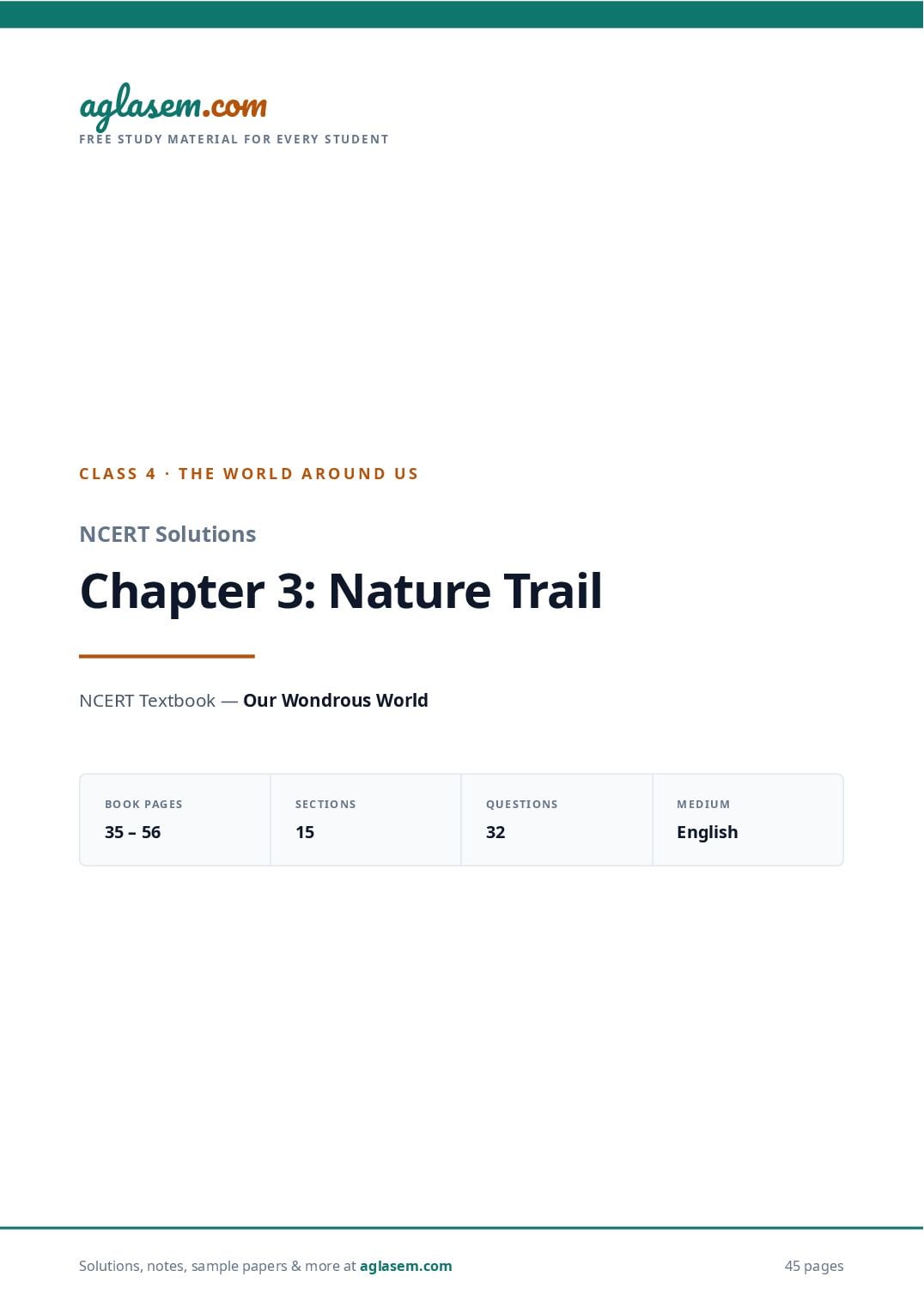
CLASS 4 · THE WORLD AROUND US
NCERT Solutions
Chapter 3: Nature Trail
NCERT Textbook — Our Wondrous World
BOOK PAGES SECTIONS QUESTIONS MEDIUM
35 – 56 15 32 English
Solutions, notes, sample papers & more at 45 pages
Page 2
CLASS 4 · THE WORLD AROUND US · OUR WONDROUS WORLD
NCERT Solutions — Chapter 3: Nature Trail
Abha Didi, a nature scientist, takes a class on a nature trail through the forest at Pachmarhi, Madhya
Pradesh. Along the way the students look at animals, birds, footprints, insects and leaves, learn the safety
rules of a forest, and play the ‘Web of Life’ game to see how every living thing is joined to the rest.
TEXTBOOK BOOK PAGES
Our Wondrous World (Class 4) 35 – 56
SECTIONS QUESTIONS
15 32
MEDIUM
English
In-text Questions — Page 35
The Adventure Begins
Q1 Have you ever seen a banyan tree with its hanging roots touching the ground? A
coloured bird diving into the water? A spider weaving its web? Butterflies flying
around a flower?
The four sights the chapter opens with: a banyan tree, a bird diving into water, a spider
on its web, and butterflies at a flower.
These four sights are all around us. Here is what each one is.
Banyan tree: thick roots grow down from its branches. When they reach the ground they
harden and hold the tree up like new trunks.
A coloured bird diving into water: this is a kingfisher. It waits on a branch, then dives
straight down and catches a fish in its long beak.
Page 1 of 45
Page 3
A spider weaving its web: the spider spins a fine, sticky thread into a wheel-shaped web.
Small insects get caught in it.
Butterflies around a flower: they come to drink the sweet juice, called nectar, that is inside
the flower.
Why the book asks this: Nature is full of amazing animals and plants. We learn
about them by looking closely at things we pass every day.
Sample answer: Yes, I have seen a banyan tree near our village temple. Its hanging roots touch
the ground and we swing on them. I have also seen butterflies on the flowers in our school
garden, and a spider’s web in the corner of our window. I have not yet seen a bird dive into
water.
Try This: Stand still near a tree for five minutes. Count how many different living
things you can see. You will be surprised.
Q2 Abha Didi, will we see monkeys, deer, snakes, eagles and tigers on the way?
Abha Didi’s own reply is: “That is what we have to find out!”
In a forest nobody can promise what you will see. The animals move about on their own. Some
hide, some come out only at night, and some stay high up in the trees.
On this trail the students did see a lot:
monkeys and deer in the forest (pages 38–39);
gaur and a rabbit near the pond (page 42);
a hornbill sitting on a tree (page 44);
a grasshopper that hopped out of the grass (page 49).
They did not see a tiger. They saw only its footprints in the mud near the pond.
Why a tiger is hard to see: A tiger walks very quietly and its stripes hide it in the tall
grass. It also keeps away from jeeps and people.
Tip: Abha Didi also said we must make sure that we do not harm the plants and
animals in the forest. Quiet visitors see more animals than noisy ones.
Write / Discuss — Page 37
Page 2 of 45
Page 4
Safety Rules
DISCUSS
Q1 Can you think of rules that should be followed while you are in a zoo or a forest? For
example, (a) We should not feed birds. (b) ……………… (c) ……………… (d) ………………
Here are three more rules to write in the blanks.
(b) We should not shout or play loud music.
(c) We should not throw plastic, paper or any other garbage there.
(d) We should not pluck leaves and flowers, or break branches.
Other good rules you may write instead:
We should stay with our group and on the path.
We should not touch or chase any animal.
We should not throw stones at animals or at a beehive.
We should wear full clothes and shoes, and carry water.
Why: A zoo or a forest is the animals’ home. We are only visitors there. So we must
not frighten them or spoil the place where they live.
Tip: Feeding a wild animal is harmful. Our food is wrong for it, and the animal soon
stops looking for its own food.
Page 3 of 45
Page 5
Class 4 The World Around Us Chapter 3 Nature Trail
a g l AglaSem · NCERT Solutions
co m
m.
Now, look at the safety rules given below and match them with your list. Have you
e
Q2
m l as
.co
missed out any of the rules given?
a g
s m AND DON’TS
eDOS
gl a
a
1. Please be careful in a new place.
co m
2. Please do not tease animals.
e m . ag
g l as
3. Please do not feed animals.
a
co m
4. Please do not damage trees, and flowers.
e m.
m as
5. Please do not bring pets, firearms, or any kind of weapons.
.co a g l
a s em 6. Please do not bring polythene bags.
ag l 7. Please do not damage public utilities.
m a s
.co agl
8. Please do not throw any garbage in the forest.
se m
g l a
a
The Safety Rules box printed on page 37.
co m
m .
e
Match your list with the book’s list, rule by rule.
c o m g l as
.
m IN THE BOOK a
a s e
RULE DID MY LIST HAVE IT?
agl 3. Please do not feed animals. Yes — it is the example (a) given to us.
se m
com g l a
.
2. Please do not tease animals.
a
Yes
m
ase
agl
4. Please do not damage trees, and flowers. Yes
6. Please do not bring polythene bags. Yes
co m
m .
e
8. Please do not throw any garbage in the forest. Yes
m l as
.co a g
em
1. Please be careful in a new place. Often missed
a s
agl 5. Please do not bring pets, firearms, or any kind of weapons. Often missed
.c
s e m
m a
7. Please do not damage public utilities.
agl
Often missed
. co
e m
l as
The three that most children miss:
a g
Rule 1 — be careful in a new place. We do not know the paths, the water or the animals
there, so we must look and listen carefully.
co m
m .
m ase
.co
a g l Page 4 of 45
Page 6
Rule 5 — no pets, firearms or weapons. A pet dog frightens the wild animals, and weapons
can harm them.
Rule 7 — do not damage public utilities. Benches, taps, dustbins, boards and railings are
there for everybody. Breaking them spoils the visit for the next people.
Why we match the lists: Making our own list first makes us think. Matching it
afterwards shows us what we had not thought of.
Q3 Why are these rules important to be followed?
DOS AND DON’TS
1. Please be careful in a new place.
2. Please do not tease animals.
3. Please do not feed animals.
4. Please do not damage trees, and flowers.
5. Please do not bring pets, firearms, or any kind of weapons.
6. Please do not bring polythene bags.
7. Please do not damage public utilities.
8. Please do not throw any garbage in the forest.
The Safety Rules box printed on page 37.
Because these rules keep the animals safe and keep us safe too.
Page 5 of 45
Page 7
THE RULE WHAT IT PROTECTS
Be careful in a new place Us — we do not know the paths, the water or the animals there
Do not tease or feed animals The animals — teasing frightens them, and our food can make them
ill
Do not damage trees and The forest — trees are the food and the home of many animals
flowers
No pets, firearms or weapons The wild animals — a pet dog or a gun can harm or frighten them
No polythene bags, no garbage Every animal — an animal may swallow plastic and die
Do not damage public utilities The next visitors — taps, benches and boards are for everybody
The one reason behind all of them: The forest is the home of the plants and
animals. We only come for a visit. A good visitor leaves the place exactly as it was —
with nothing taken away and nothing thrown behind.
Activity 1 — Page 39
Page 6 of 45
Page 8
Animals in the Forest
ACTIVITY
Q1 Look closely at the picture and identify the animals. You may take help from your
teacher.
The picture in the book (a painting across pages 38 and 39):
The sky at the top, with small brown birds and long-tailed green
birds flying in it, and birds with blue wings and a buff breast
gliding across.
Tall forest trees covering both pages, some light green and some
dark green.
Two long-tailed animals up in the branches — one peeping
through the leaves, one lying along a branch.
A shaggy, dark-haired animal with a pale snout standing beside
a tree trunk.
Two heavy dark animals with curved horns and white lower legs,
standing under the trees on the brown forest floor.
On the left page, a tall greyish-brown animal with a long face
and branching antlers, and three small orange animals with
white spots feeding on the grass.
The forest scene the students saw from the jeeps. It is a painting spread across two
pages; described here — see the textbook for the painting.
Look at the picture in three parts — the sky, the branches, and the ground.
Page 7 of 45
Page 9
WHERE TO WHAT YOU CAN SEE THERE
LOOK
In the sky A flock of small brown birds (sparrows), a group of long-tailed green birds (parrots
or parakeets), and one blue bird gliding
On the branches Two monkeys — one sitting high up and one lying along a branch
Beside a tree A bear, with long shaggy black hair and a pale snout
trunk
Under a big tree Two gaur — heavy dark animals with strong curved horns
On the grass (left A tall sambar deer with a long face, and three spotted deer feeding
page)
How we name them: We look at the size, the colour, the horns, the tail and the
place where the animal is standing. The book itself names the gaur on page 42 and
says they look like buffaloes but are stronger, with shorter horns.
Tip: Your teacher may point out one or two more animals in the picture. Write down
every name you are told — that is how a nature diary begins.
Page 8 of 45
Page 10
Class 4 The World Around Us Chapter 3 Nature Trail
a g l AglaSem · NCERT Solutions
co m
m.
Divide them into two categories: 1. Animals on land: 2. Birds in the sky:
e
Q2
m l as
m .co a g
l a se
a g The picture in the book (a painting across pages 38 and 39):
The sky at the top, with small brown birds and long-tailed green
om
cgliding
birds flying in it, and birds with blue wings and a buff breast
. ag
em
as
across.
a g l
Tall forest trees covering both pages, some light green and some
dark green.
c o m
Two long-tailed animals up in the branches — one peeping
.
m s em
through the leaves, one lying along a branch.
a
. a gl standing beside
co A shaggy, dark-haired animal with a pale snout
a s em a tree trunk.
agl Two heavy dark animals with curved horns and white lower legs,
s
standing under the trees on the brown forest floor.
m a
.co agl
On the left page, a tall greyish-brown animal with a long face
a s em
and branching antlers, and three small orange animals with
a gl white spots feeding on the grass.
c o m
.
The forest scene the students saw from the jeeps. It is a painting spread across two
m s em
pages; described here — see the textbook for the painting.
a
m . co agl
l a se
ag ANSWER
se m
com a
Put every animal that walks on the ground or climbs a tree in the first list, and every animal that
flies in the sky in the second.
. a g l
m
ase
1. ANIMALS ON LAND
agl 2. BIRDS IN THE SKY
co m
Monkey Sparrow
m .
as e
com l
Bear Parrot (parakeet)
.Gaur a g
e m
as
Blue bird
agl c
.
Sambar deer
s e m
m a
. co agl
Spotted deer
e m
g l as
a
com
m .
m as e
.co
a g l Page 9 of 45
Page 11
Why they go in these two groups: Birds have wings and feathers, so they can fly in
the sky. The other animals have four legs and walk, run or climb on land.
Tip: A monkey climbs high into a tree, but it still belongs with the land animals — it
cannot fly.
Write — Page 40
Animals and their Features
Q1 Name some animals including the birds that you have seen. Write any one feature
of each of them.
NAME OF THE ANIMAL FEATURE
Elephant Long trunk to take food and water
Sparrow Short and strong beak to crack seeds
The table as it is printed in the book, with two rows already filled.
Write the name of an animal you have really seen, and one body part that helps it.
Page 10 of 45
Page 12
NAME OF THE ANIMAL FEATURE
Elephant Long trunk to take food and water
Sparrow Short and strong beak to crack seeds
Cow Flat, wide teeth to chew grass all day
Peacock Long, colourful feathers that open out like a fan
Owl Big eyes and sharp eyesight to see at night
Fish Fins to swim in water
Dog A very good sense of smell to find things
Why every animal has such a feature: Each animal has a body part that helps it get
its food, move about or keep safe. That is why an elephant has a trunk and a
sparrow has a short, strong beak.
Tip: Fill only the animals you have really seen. The table is your own record, not a list
to copy.
Page 11 of 45
Page 13
Q2 Compare its features with the squirrels you see in your area.
The picture in the book (page 40):
Two large squirrels with deep reddish-brown backs and pale
cream undersides.
The one on the left is standing on a thick branch. Its bushy tail is
as long as its whole body and it curls up behind it.
The one on the right is stretched out in a long leap, with its legs
spread and its long tail streaming behind.
The book says under the picture: Indian Giant Squirrel is a big,
red-coloured squirrel found in Pachmarhi and some other
places.
The painting of the Indian Giant Squirrel on page 40; described here — see the textbook
for the picture.
Put the two squirrels side by side and compare them, feature by feature.
FEATURE INDIAN GIANT SQUIRREL THE SQUIRREL WE SEE NEAR OUR
HOMES
Size Very big — as long as your arm when the tail Small — it fits into two hands
is counted
Colour Deep red-brown back with a cream belly Grey-brown, with three light stripes down its
back
Tail Very long and thickly bushy Bushy, but much shorter
Where it High up in big forest trees at Pachmarhi On walls, roofs, garden trees and fences near
stays our houses
How it Leaps a long way from branch to branch Runs quickly up and down a trunk or a wall
moves
Same in both: four legs, sharp front teeth to gnaw nuts and seeds, a bushy tail, and a very
good grip for climbing.
Page 12 of 45
Page 14
Why they are alike and yet different: Both are squirrels, so they have the same
body plan. The giant squirrel is big and red because it lives high in thick forest trees,
while our small striped squirrel lives among houses and gardens.
In-text Questions — Page 42
At the Pond
Q1 Look at these footprints in the mud. Which animal might had left these marks?
1 2 3
The three sets of footprints pressed into the mud beside the pond.
Arya asks this at the pond, and Sarthak answers: “Hmm… maybe a deer or a tiger? Or, a
rabbit?”
Read the shapes to make your own guess.
FOOTPRINT WHAT THE SHAPE TELLS US OUR GUESS
1 A round pad with four toe marks above it, and no claw A big cat, such as a tiger
marks
2 Small prints, wide at one end and drawn to a point at A hoofed animal, such as a
the other deer
3 Three thin toes spread out like a star, with one short A bird, such as an egret or a
toe behind crane
Page 13 of 45
Page 15
Class 4 The World Around Us Chapter 3 Nature Trail
a g l AglaSem · NCERT Solutions
co m
m.
Why footprints are useful: Many animals come to drink and go away. Their feet
m l a se
press marks into the soft mud. By reading the marks we can tell who came, even
o
c saw the animal.
when we .never a g
se m
g l a
aNote about the book: The book prints “Which animal might had left these marks?”
o m
c ag
on page 42. The correct English is “which animal might have left these marks?”. This is
.
m rule.
s e
a printing mistake in the book, not a new
a
agl
co m
m.
Activity 2 — Page 43
m as e
.co l
Footprints near the Pond
a g
se m
a
ACTIVITY
ag l
s
Look at the footprints and guess the name of the animals that you think must have
a
Q1
m
.co agl
come to the pond to drink water.
se m
g l a
a
co m
m .
m as e
.co a g l
se m
g l a
a
1 2 3
se m
com g l a
m . a
ase
agl
The three sets of footprints pressed into the mud beside the pond.
co m
m .
m as e
. o
1 — a tiger. 2 — a deer. 3 — a bird.
c a g l
sem
Here is how each shape leads to that guess.
a
agl Set 1: a big soft pad with four round toe marks above it, and no claw marks. Cats pull their
c
m .
e
claws in while walking, so a tiger leaves a clean, round paw mark like this.
m a s
. co agl
Set 2: small pointed prints. Deer walk on hard hooves, not on soft pads, so their marks are
e m
as
narrow and pointed.
a g l
Set 3: three thin toes spread out like a star. Only a bird leaves such thin lines. Egrets and
cranes walk at the edge of a pond, and the book shows them flying above this very page.
co m
m .
m ase
.co
a g l Page 14 of 45
Page 16
Why they all came here: Every animal needs water. A pond in the forest is the one
place where all of them meet, so the mud around it keeps the marks of many
different animals.
Tip: The book asks you to guess, so a sensible answer is accepted. For set 1 you may
also write “a leopard”, and for set 2 “a gaur” or “a rabbit”, if you can say why.
Q2 Observe and draw the footprint of any animal in the space given here.
The empty box printed in the book, for you to draw the footprint in.
This drawing has to be your own. Follow these steps.
1. Look for wet ground — near a tap, after rain, at a pond edge or in a field.
2. Wait quietly for a dog, a cat, a hen, a goat, a cow or a crow to walk across it.
3. Sit beside the mark. Do not step on it.
4. Count the toes first. Then see whether there is one big pad below them.
5. Draw the outline in your notebook, and write the animal’s name below it.
Sample answer: Three footprints that are easy to find near a home.
Page 15 of 45
Page 17
Dog Goat Hen
One big pad with A hoof split Three toes in front,
four toe marks above it into two parts one short toe behind
Three common footprints you can look for and draw.
What the drawing teaches: No two kinds of feet make the same mark. That is why
a footprint alone is enough to tell us which animal passed by.
Write — Page 44
Page 16 of 45
Page 18
Birds and their Beaks
Q1 Name the birds shown below.
(1) (2)
(3)
(4)
The four birds printed in the book, numbered here so that the answer can point at
them.
(1) Parrot (2) Sparrow (3) Duck (4) Eagle
BIRD NAME THE CLUE IN THE PICTURE
(1) Parrot (rose-ringed Bright green body, a very long pointed tail and a short, thick, curved
parakeet) red beak
(2) Sparrow A small brown bird with a dark patch on its throat and a short, strong
beak
(3) Duck A white bird floating on water, with a flat orange bill and a curved
neck
(4) Eagle A big brown bird with a white head, a hooked yellow beak and strong
claws, sitting on a branch
Page 17 of 45
Page 19
Why the beak is the best clue: A bird’s beak matches its food. The parrot’s thick
curved beak bites hard fruits and nuts. The sparrow’s short strong beak cracks
seeds. The duck’s flat bill sifts food out of the water. The eagle’s sharp hooked beak
tears the meat of the prey it catches.
Did you know? On this same page Abha Didi names two more birds — the hornbill,
which has a headgear like a horn on its forehead, and the owl, whose sharp eyesight
helps it see at night.
Activity 3 — Page 45
Picking up Food
ACTIVITY
Q1 Take different food items like grains, berries, fruits, nuts, etc., in a plate. Try to pick
these food items using a spoon, a toothpick or a pair of sticks. Fill the table below
with appropriate tool(s) for picking each of these food items.
FOOD ITEM APPROPRIATE TOOL(S)
Grains
Berries
Nuts
Pieces of fruits
The table as it is printed in the book.
Do it like this:
1. Put a little of each food in one plate — a few grains of rice or wheat, two or three berries,
some groundnuts, and small pieces of banana or apple.
2. Pick up each food with the spoon first. Note whether it was easy or hard.
3. Try again with the toothpick, and then with the pair of sticks.
4. Write the tool that worked best in the table.
What you will find:
Page 18 of 45
Page 20
Class 4 The World Around Us Chapter 3 Nature Trail
a g l AglaSem · NCERT Solutions
co m
m.
FOOD ITEM APPROPRIATE WHY THAT TOOL WORKS
as e
com
TOOL(S)
. a g l
m
ase
Grains Spoon Grains are tiny and many. A spoon scoops up a lot at one
agl
go.
Berries Pair of sticks A berry is soft and round. Sticks hold it without squashing
co m
. ag
it.
m
seA nut is hard and big. Sticks grip it firmly and it does not
l a
ag roll away.
Nuts Pair of sticks
Pieces of Toothpick
co m
A sharp point goes straight into a soft piece and lifts it.
em.
fruits
m l as
.co a g
a s em the activity is really showing: No single tool picks up everything well. In the
What
a gl same way, no single beak suits every food. Each bird has the beak that suits what it
eats.
m a s
m .co agl
TOOL
l a se
THE BEAK IT IS LIKE THAT BIRD EATS
a g
Spoon The duck’s flat bill Food sifted out of water
co m
Pair of sticks / tongs The sparrow’s short strong beak
m .
Seeds and grains
m as e
.co
Toothpick The sunbird’s long thin beak
a g l
Nectar from inside a flower
a s eAmbent, sharp hook
agl The eagle’s curved beak The meat of the prey it catches
se m
com g l a
. a
Tip: The book says we can guess the eating habits of a bird by looking at its beak
m
ase
and claws. Try it the next time you see a bird.
agl
co m
Activity 4 — Pages 47–48
m .
m as e
.co a g l
se m
g l a
a c
m .
m a s e
e m . co agl
g l as
a
co m
m .
m as e
.co
a g l Page 19 of 45
Page 21
Bird Diary and Animals of the Water
ACTIVITY
Q1 Bird Diary. (a) Go near a tree. (b) Close your eyes and listen to the sounds of
different birds. (c) Now open your eyes and focus on one bird at a time. (d) Observe
how it moves, what it eats, and where it sits. (e) Write your observations in a Bird
Diary! For each bird, note the following:
MY BIRD DIARY
Name
Date
Head colour
Back colour
Wing colours
Beak shape
Throat colour
Colour of legs
Interesting Facts
The Bird Diary card printed on page 47, with a picture of a bird on the left and the blanks on
the right.
This is your own diary, so the writing must be your own. Do it like this.
1. Go to the same tree at the same time every day — early morning is best.
2. Stand still and close your eyes for one minute. Count how many different calls you hear.
3. Open your eyes and choose one bird. Watch only that bird.
4. Fill the ‘Appearance’ boxes from top to bottom while you are still looking at it.
5. Write one or two interesting facts — what it ate, how it moved, where it sat.
Sample answer — a diary page for a house crow, the bird drawn in the book’s card.
Page 20 of 45
Page 22
MY BIRD WHAT I SAW
DIARY
Name House crow
Date 12 July
Head colour Black on top
Back colour Grey
Wing colours Shiny black
Beak shape Thick, strong and slightly curved
Throat colour Grey
Colour of legs Black
Interesting facts It hopped on the ground, picked up a piece of roti and flew to a wall. It called kaa-kaa loudly
when a cat came near.
Why we note the beak shape: The beak tells us what the bird eats. A thick strong
beak like the crow’s can pick up almost anything, so the crow eats grain, fruit and
leftover food.
Tip: Never go close to a nest and never touch a chick. Watch from a distance, and the
birds will keep coming back.
Page 21 of 45
Page 23
Q2 List the animals which live in and around water bodies. Fill in the table given below.
NAME OF THE ANIMAL MOVEMENTS
Fish Swims
Crab Walks
Frog Jumps
Turtle
Crocodile
Snakes
The table as it is printed in the book, with three rows already filled.
Fill the blank rows like this.
NAME OF THE ANIMAL MOVEMENTS
Fish Swims
Crab Walks
Frog Jumps
Turtle Swims in water with its webbed feet, and walks slowly on land
Crocodile Swims in water and crawls on land
Snakes Crawls; a water snake glides through the water
Duck Swims, and also walks and flies
Egret Walks in shallow water on long legs, and flies
Gharial Swims, using its long tail
Page 22 of 45
Page 24
Why they move in these ways: The way an animal moves depends on its body. A
fish has fins, so it swims. A turtle has webbed feet that push the water, so it swims
easily but walks slowly on land. A frog has long back legs, so it jumps.
Special features the book tells us about:
Fish have fins to swim.
The gharial, a type of crocodile, has a long, narrow and pointed snout to catch fish.
Turtles have strong shells to keep them safe and webbed feet to swim easily.
Frogs can live both on land and in water.
Write — Page 49
Tiny Animals
Q1 What are the insects that you find at your home and in your surroundings?
Many insects live very close to us. Here are the ones most children find.
INSECT WHERE YOU FIND IT
Ants In a line on the floor, on the wall, near spilt sugar
Housefly On food, near the dustbin
Mosquito In dark corners and near still water
Cockroach Behind the almirah and near the kitchen sink
Honeybee On flowers in the garden
Butterfly Flying around flowers
Grasshopper In the grass and in fields
Dragonfly Over a pond or a wet field
Beetle On leaves and under stones
Moth Around a tubelight at night
Page 23 of 45
Page 25
Class 4 The World Around Us Chapter 3 Nature Trail
a g l AglaSem · NCERT Solutions
co m
m.
How to be sure it is an insect: Arya tells us the test in the chapter. An insect has
m l a se
three pairs of legs — that is six legs — and one pair of antennae to sense its
o
.c Many insects also have two pairs of wings. a g
m
surroundings.
l a se
ag answer: At my home I find ants in the kitchen, houseflies near the dustbin and
Sample
mosquitoes at night. In our garden I see butterflies on the flowers, honeybees and a
com
. ag
grasshopper in the grass.
se m
l a
ag its legs — it has eight, not six.
Tip: A spider is not an insect. Count
co m
e m.
m l as
.co g
Q2 Name the insects shown below.
m a
l a se
a g
m a s
a b
m
c
.co d
agl
l a se
a g
co m
.
e f g
e m
c o m g l as
. a
The seven small animals printed in the book, labelled (a) to (g).
se m
g l a
a
se m
m Dragonfly (e) Ant (f) Praying mantis (g)
co(d) g l a
. a
em
(a) Butterfly (b) Cockroach (c) Beetle
a s
agl
Grasshopper
co m
m .
m as e
.co a g l
se m
g l a
a c
m .
m a s e
e m . co agl
g l as
a
com
m .
m ase
.co
a g l Page 24 of 45
Page 26
LABEL NAME THE CLUE IN THE PICTURE
(a) Butterfly Two pairs of large, wide, coloured wings and a thin body
(b) Cockroach A flat reddish-brown body with very long, thin antennae
(c) Beetle A hard, shiny black back with a line down the middle, and short antennae
(d) Dragonfly A long thin body with four long, clear wings held out flat
(e) Ant A small body in three parts, with bent antennae
(f) Praying mantis A long green body with two front legs folded up as if praying
(g) Grasshopper A green body with one pair of very big back legs, bent for jumping
Why all seven are insects: Count the legs in each picture. Every one of them has
three pairs of legs and one pair of antennae. That is the test Arya gives in the
chapter.
Did you know? Abha Didi names ants, beetles, bees, flies, praying mantises and
butterflies as insects you will find in the forest. Six of the seven pictures are from her
list.
Activity 5 — Pages 50–51
Page 25 of 45
Page 27
Leaves of Different Plants
ACTIVITY
Q1 During the visit to the nature trail, students collected leaves from different plants.
Help them identify the plants based on the pictures of the leaves given below.
(a) (b) (c) (d)
(e) (f) (g)
The seven leaves the students collected, labelled (a) to (g).
Name a leaf by looking at three things: its shape, its edge, and its veins.
LEAF WHAT THE PICTURE SHOWS THE PLANT
(a) Heart-shaped, with a long thin tail drawn out at the tip Peepal
(b) One stalk carrying many narrow, curved leaflets with toothed edges Neem
(c) Broad and oval, with a pointed tip and thick side veins Banyan
(d) Very large, broad and rounded, with a thick midrib Teak (sagaun)
(e) Long and narrow, dark green, with a smooth edge and a pointed tip Mango
(f) Long oval, light green, with side veins that are easy to see Guava
(g) Small, with a saw-toothed edge all round Rose
Why the shape is enough: Every kind of plant makes leaves of its own shape, and it
makes them the same way every time. So the shape of one leaf is enough to name
the plant it came from.
Page 26 of 45
Page 28
Tip: Leaves differ a little from place to place, and the book gives no answer key. Hold
a real leaf from your school ground beside each picture. Your teacher may name a
different plant of your area for (c), (d), (f) and (g) — write down that name, because it
is the plant you can actually go and see.
Q2 Observe the leaves of different plants in your neighbourhood and fill the table.
DRAW AND NAME COLOUR SHAPE TEXTURE ANY OTHER
THE LEAF OBSERVATION
Lemon Green Oval Smooth Strong smell
The table as it is printed in the book, with the lemon row filled as an example.
Do it like this: pick up four or five fallen leaves near your home. Look at each one in the light,
rub it between your fingers, and smell it. Then fill one row for each leaf.
Sample answer — a completed table.
Page 27 of 45
Page 29
DRAW AND COLOUR SHAPE TEXTURE ANY OTHER
NAME THE OBSERVATION
LEAF
Lemon Green Oval Smooth Strong smell
Mango Dark Long and narrow Smooth and Pointed tip; new leaves are
green shiny reddish
Neem Green Many small Smooth Toothed edge; tastes bitter
leaflets on one
stalk
Peepal Light Heart-shaped Thin and Long tail at the tip; moves in
green smooth the smallest breeze
Banana Green Very long and Smooth Veins run side by side from end
broad to end
Tulsi Dark Small and oval Slightly rough Strong sweet smell
green
What the table shows: No two kinds of leaves are exactly alike. Colour, shape, feel,
smell and the lines on the leaf taken together tell us which plant it belongs to.
Tip: Pick up leaves that have already fallen. Do not pluck fresh leaves from a plant —
the plant needs them.
In-text Question — Page 51
Page 28 of 45
Page 30
Class 4 The World Around Us Chapter 3 Nature Trail
a g l AglaSem · NCERT Solutions
The Lines on a Leaf
co m
e m.
m l as
Q1
.co
Apart from different colours, textures, and shapes, did you observe that the leaves
m a g
l a se
also have different types of lines on them?
a g
co m
e m . ag
g l as
a
co m
e m.
m l as
m .co a g
l a se
a g
s
The two pictures printed in the book, showing two different arrangements of the lines
m a
.co agl
on a leaf.
se m
g l a
a
co m
Yes. These lines are called veins. The book shows two different arrangements of veins.
m .
m l a seLEAVES LIKE THIS
.co ag
em
THE PICTURE HOW THE VEINS ARE ARRANGED
a s
agl The long leaf on Many veins run side by side from one end of the leaf to the Banana, grass, maize,
m
the left other. They do not cross. sugarcane
a se
The leaf on the
. com
One thick vein runs down the middle. Smaller veins Peepal, mango, banyan,
a g l
m
ase
right branch out from it like a net. hibiscus
agl
Why veins matter to us: They are one more thing that helps us tell plants apart.
co m
Two leaves may look the same size and colour, but the way their lines run can be
m .
m
quite different.
as e
.co a g l
se m
g l a
a
Check it yourself: Turn a leaf over. The veins stand out on the back and you can feel
.c
m
them with your finger. This rough back is the side you use for the Leaf Autograph on
m a s e
co agl
the next page.
m .
as e
a g l
Activity 6 — Page 52
com
m .
m ase
.co
a g l Page 29 of 45
Page 31
Leaf Autograph
ACTIVITY
Q1 Leaf Autograph. Place a leaf on a notebook with the rough, vein-side facing up.
Cover it with a plain sheet of paper. Rub a crayon over the paper, and watch the
leaf’s shape appear like magic! Try this with different leaves and see how each one
has its own unique pattern. Name the plant or tree to which the leaf belongs.
Do it like this:
1. Pick up a fallen leaf. Turn it over and feel the back — that is the rough, vein side.
2. Place the leaf on your notebook with the rough side facing up.
3. Cover it with one plain sheet of paper. Hold the paper still with one hand.
4. Lay a crayon on its side and rub it gently over the paper, always in the same direction.
5. The outline and every vein appear on the paper. Write the plant’s name below it.
A crayon rubbing taken from a leaf, and the leaf it was made from.
Why the pattern appears: The veins on the back of the leaf stand up a little above
the rest of the leaf. The crayon colours the paper more darkly where the paper is
pushed up, so the veins print themselves.
Sample answer:
Page 30 of 45
Page 32
MY RUBBING SHOWS SO THE LEAF IS FROM
A heart shape with a long tail and veins spreading like a net Peepal
A long narrow shape with a thick middle line and side veins Mango
A very long shape with many lines running side by side Banana
A small shape with a saw-toothed edge Rose
Tip: Do not press too hard. A light, even rub gives the clearest picture. Rubbings of
four or five leaves side by side make a lovely chart.
Let us Play the Game ‘Web of Life’ — Pages 52–54
Page 31 of 45
Page 33
How to play?
ACTIVITY
Q1 Have you ever wondered how all living beings are connected?
The class sitting in a circle, joined by the ball of yarn during the game.
Yes — every living being is joined to others by food and by shelter. The game makes those joins
visible as threads of yarn.
How to play:
1. Each player gets a card with the name of a plant, animal, or natural element.
2. One player starts by holding a ball of yarn and thinks about their connection to another
player.
3. For example, a tree provides food for a bird or a river supports a fish. The yarn is passed to
that player while the first player still holds on to its thread.
4. The web keeps growing as more connections are made.
5. Now remove one player, like a missing deer for a tiger, or plants for animals.
6. Watch how the web weakens or collapses.
The joins you will make in the game. The book prints sixteen cards on page 53 — the Sun,
grass, a tree, fallen leaves, a pond, seeds, fruits, an elephant, a deer, a lion, a sparrow, a
kingfisher, a vulture, a beetle, an ant and a snake.
Page 32 of 45
Page 34
THIS CARD IS JOINED TO BECAUSE
Sun Grass and tree Plants need sunlight to grow
Grass Deer The deer eats grass
Deer Lion The lion eats the deer
Tree Sparrow The bird nests in the tree and eats its seeds
Pond Kingfisher The fish in the pond are the kingfisher’s food
Fruits Elephant The elephant eats fruits and leaves
Fallen leaves Ant and beetle They live in and feed on the fallen leaves
Snake Vulture The vulture eats animals that have died
Sun Grass Deer Lion
One chain of the web: each one is food for the next.
Why it is called a web and not a chain: A chain is one line. But the deer is joined to
the grass, the pond and the lion all at once. Every player holds several threads, so
the picture that forms is a web.
Page 33 of 45
Page 35
Class 4 The World Around Us Chapter 3 Nature Trail
a g l AglaSem · NCERT Solutions
co m
m.
Now, what if one part of the web disappears? Try removing a player, like a missing
e
Q2
m l as
.co
deer for a tiger or plants for animals.
a g
se m
g l a
a
co m
e m . ag
g l as
a
co m
em.
m l as
m .co a g
l a se
a g
m a s
m .co agl
l a se
a g
co m
m .
m as e
.co a g l
The class sitting in a circle, joined by the ball of yarn during the game.
se m
g l a
a
se m
m happens, step by step. a
. cowhat a g l
m
The web at once becomes weak. Watch
a s eall
a gl
1. The player who leaves lets go of the threads in their hand.
2. Every player who was joined to them feels the thread go loose.
3. That part of the web sags and hangs down.
co m
m .
e
4. If a few more players leave, the whole web falls apart.
m l as
.co
What this means in the forest:
m a g
l a se
ag
.c
s e m
m a
e m . co agl
g l as
a
co m
m .
m ase
.co
a g l Page 34 of 45
Page 36
IF THIS THEN AND THEN
GOES
The deer The tiger has nothing to eat The tiger goes hungry and may die or leave
the forest
The plants All the plant-eating animals go The meat-eating animals lose their food too
hungry
The pond The fish, frogs and turtles cannot live The kingfisher and the egret find no food
The trees Birds, monkeys and insects lose their The forest floor is bare and the soil is washed
home away
The lesson of the game: Nothing in nature lives alone. Everything is connected.
Take away one part and many others are harmed — and that is exactly why we must
protect every plant and every animal, even the small ones.
Let us reflect — Pages 55–56
End of chapter questions and activities
LET US REFLECT
Q1 Which animal would you love to be? What special abilities would it give you?
This answer is your own choice. Pick one animal, then say what its special feature would let you
do.
Page 35 of 45
Page 37
IF I WERE A ITS SPECIAL FEATURE WHAT I COULD THEN DO
Eagle Sharp eyes, wide wings, strong See a small animal from very high up, and fly
claws over hills
Tiger Striped coat and soft padded Hide in tall grass and walk without a sound
paws
Elephant A long trunk Pick up food, pull down branches and give
myself a shower
Fish Fins and gills Swim all day and breathe under water
Indian Giant A long bushy tail Leap a long way from branch to branch without
Squirrel falling
Sample answer: I would love to be an eagle. Its eyes are so sharp that it can spot a small animal
while flying high in the sky. Its wide wings would let me fly over the hills and see the whole
forest below. Its strong, sharp claws would help me hold on to any branch.
What makes a good answer here: Do not just name an animal. Name the feature
as well, and say what that feature would let you do. That is the whole point of the
chapter — each animal has features that suit its life.
Q2 How do you think different plants and animals are dependent on each other?
They depend on each other mainly for food and for a home.
Page 36 of 45
Page 38
WHO DEPENDS ON WHOM FOR WHAT
Deer, elephant, squirrel, Plants Leaves, grass, fruits, seeds — their food
grasshopper
Tiger, lion, eagle, snake Plant-eating animals Their food
Birds, monkeys, insects Trees A place to sit, sleep and build a nest
Fish, frogs, turtles The pond and the Water, food and a safe place
water plants
Plants Insects and birds They carry seeds to new places, so new
plants grow far away
Plants Fallen leaves and They rot and make the soil rich
animal waste
Sun Grass Deer Tiger
One chain from the forest in this chapter.
Follow the chain: the Sun helps the grass grow, the deer eats the grass, and the tiger eats the
deer. Remove any one of them and the rest are in trouble.
Why this matters: This is exactly what the ‘Web of Life’ game shows. Nothing in
nature lives alone. Because everything is joined, harming one plant or one animal
harms many others as well.
Q3 What is the role of a nature scientist?
A nature scientist studies plants and animals. In this chapter Abha Didi is a nature scientist,
and the teacher says she will guide the students in exploring the forest.
Her work is:
to watch plants and animals closely in the place where they live;
Page 37 of 45
Page 39
to note down what they look like, what they eat, how they move and where they sit;
to name them, the way she names the hornbill and explains why it is called a hornbill;
to find out how plants and animals depend on one another;
to tell visitors the safety rules and make sure nobody harms the forest;
to help protect plants and animals and the places where they live.
Why we need such scientists: Most of us pass an animal without really seeing it. A
nature scientist looks carefully, keeps a record, and then teaches others — and we
can only protect what we know about.
Tip: When you keep a Bird Diary, you are doing exactly what a nature scientist does.
Q4 Solve the puzzle. Find the treasures of the forest.
T I G E R U W E B H F
Q S P A R R O W S O O
E G R E T Q W A B R O
J A B A N Y A N I N T
E L E P H A N T S B P
D E E R P G W E O I R
P E Z P A L N C N L I
U S N A K E O T R L N
S Q U I R R E L Z A T
K I N G F I S H E R B
TIGER is already circled for you. Twelve more words are hidden — ten across and three down
(TIGER is one of the across words).
Words that go across (left to right):
Page 38 of 45
Page 40
Class 4 The World Around Us Chapter 3 Nature Trail
a g l AglaSem · NCERT Solutions
co m
m.
WORD ROW STARTS AT COLUMN
m as e
TIGER
.co
1 1 (given)
a g l
se m
g l a 1 7
a
WEB
SPARROWS 2 2
. com1 ag
EGRET 3
em
4 gl
as
BANYAN
a 3
ELEPHANTS 5 1
co m
e m.
com l as
DEER 6 1
. a g
m
ase
SNAKE 8 2
aglSQUIRREL 9 1
m 1 a s
.co agl
KINGFISHER 10
se m
l a
ag
Words that go down (top to bottom):
WORD COLUMN STARTS AT ROW
co m
m .
m as e
.co l
HORNBILL 10 1
a g
s e m
a
11 1
l
FOOTPRINT
ag
m
BISON 9 3
a se
. comto a word is marked. a g l
em
The solved grid — every letter that belongs
a s
agl
co m
m .
m ase
.co a g l
se m
g l a
a c
m .
m a s e
e m . co agl
g l as
a
co m
m .
m as e
.co
a g l Page 39 of 45
Page 41
T I G E R U W E B H F
Q S P A R R O W S O O
E G R E T Q W A B R O
J A B A N Y A N I N T
E L E P H A N T S B P
D E E R P G W E O I R
P E Z P A L N C N L I
U S N A K E O T R L N
S Q U I R R E L Z A T
K I N G F I S H E R B
How to search a grid like this: First read every row from left to right. Then read
every column from top to bottom. The three long down-words, HORNBILL,
FOOTPRINT and BISON, sit in the last three columns, which is why they are easy to
miss.
Did you know? Every one of these thirteen words comes from this chapter. The
bison is the gaur the students saw near the pond, and the footprint is the mark Arya
found in the mud. Two small bonus words also hide in the grid: ANT goes down
column 8 from row 3, and BEE goes down column 3 from row 4.
Q5 Take on the challenge. Plan a nature walk with your family or friends in a nearby
park. To prepare yourself as a guide, identify few plants and animals, and study
their features and interesting facts which you can explain during the walk.
Prepare like a real guide. Work through these steps.
1. Choose the place and time. A nearby park or a school ground. Early morning is best,
because that is when birds are most active.
2. Visit once by yourself first. Walk slowly and decide four or five stops.
3. Pick what you will show. Three plants and three animals is enough.
4. Find one fact about each. Ask your teacher or an elder, or look it up.
Page 40 of 45
Page 42
5. Make a guide sheet like the one below and keep it in your pocket.
6. Start the walk with the safety rules from page 37 — no plucking, no feeding, no noise, no
polythene, no garbage.
Sample answer — a guide sheet for a park walk.
STOP WHAT I WILL SHOW THE FACT I WILL TELL
1 Peepal tree Its leaf has a long tail at the tip, so it moves in the smallest breeze
2 Neem tree One stalk carries many small leaflets; the leaves taste bitter
3 A row of ants An insect has six legs and one pair of antennae — count them
4 Sparrows on the ground Their short strong beak cracks open seeds
5 A crow on a wall Its thick beak lets it eat almost anything
6 A squirrel on a tree Its bushy tail helps it balance while it runs along a branch
What makes a good guide: A guide is not someone who knows everything. A guide
is someone who has looked carefully first, and who can show others what to notice.
Q6 Do an activity. Role-play: Create a scene of a forest in your classroom where
students can perform roles of plants and animals, and of visitors. While enacting
the play, focus on our role to protect animals and plants.
How to put on the play:
1. Make the forest. Put green chart paper trees on the walls. Spread a blue sheet on the floor
for the pond.
2. Give out the roles. Some children are plants (a banyan, a neem, grass), some are animals (a
tiger, a deer, a monkey, a sparrow, an ant), and some are visitors with a guide.
3. Make simple masks from old paper — ears for the deer, a beak for the bird.
4. Act the scene. The visitors come in noisily, drop a polythene bag and try to feed the monkey.
The animals run away and hide.
5. Turn the scene around. The guide reminds everyone of the safety rules. The visitors pick up
their litter, sit quietly — and one by one the animals come back.
6. End with one line each. The tree says ‘I give you shade’, the deer says ‘I eat grass’, the tiger
says ‘I need the deer’, the visitor says ‘I will not harm this forest’.
Page 41 of 45
Page 43
What the play should show: The forest is the animals’ home and we are only
visitors. Quiet, careful visitors see the most, and leave the forest as they found it.
Q7 Let us make a paper turtle! Try using an old newspaper or used paper.
1 2 3
4 5 6
7 8 9
The nine folding steps printed in the book.
Take a square sheet of old newspaper. Then follow the nine steps.
1. Place the square like a diamond. Fold it in half both ways and open it out again, so that you
can see the two creases.
2. Fold it in half to make a triangle. Now bring the two lower corners up to the top corner.
3. You get a diamond. Fold the top flap down along the middle.
4. Fold the two upper side corners outwards along the dotted lines.
5. The shape now has points on all sides. Cut the lowest flap along the dotted line, as the
scissors show.
6. Fold the cut edges inwards to shape the shell.
7. Fold the small middle flap upwards — this becomes the head.
8. Turn the paper over.
9. Your turtle is ready. Draw two eyes on the head.
Page 42 of 45
Page 44
Why old paper: The book says to use an old newspaper or used paper. Using paper
again means one less tree has to be cut.
Tip: Press every fold hard with your thumbnail. Sharp creases make the turtle hold
its shape.
Q8 Find out. Write the name of your state animal, bird, and plant.
You have to find out the answer for your own state. Do it like this.
1. Ask your teacher, or look in the school library.
2. Look at the board at the entrance of a zoo, a park or a forest office — state symbols are often
painted there.
3. Ask at home. Elders often know the state animal.
4. Write all three names in your notebook, and draw one of them.
Some examples you can check:
STATE STATE ANIMAL STATE BIRD STATE TREE
Madhya Swamp deer (Barasingha) Indian paradise flycatcher Banyan
Pradesh (Dudhraj)
Tripura Spectacled monkey Green imperial pigeon Agar
Maharashtra Indian giant squirrel Yellow-footed green pigeon Mango
(Shekru)
Rajasthan Chinkara Great Indian bustard Khejri
Kerala Indian elephant Great hornbill Coconut
palm
Tamil Nadu Nilgiri tahr Emerald dove Palmyra
palm
Why states choose these: A state chooses an animal, a bird and a tree that belong
specially to that place, so that people take pride in them and protect them. The
chapter itself tells us one: the Spectacled Monkey is the state animal of Tripura.
Page 43 of 45
Page 45
Class 4 The World Around Us Chapter 3 Nature Trail
a g l AglaSem · NCERT Solutions
co m
m.
Tip: Two of the animals in this chapter are state symbols — the Spectacled Monkey
as e
comwith your teacher before writing them down. l
of Tripura and the Indian Giant Squirrel of Maharashtra. Always check your own
. a g
em
state’s names
a s
agl
co m
e m . ag
Chapter at a glance
g l as
a
Every animal has features that suit its life — an elephant’s long trunk, a sparrow’s short
strong beak, an eagle’s sharp curved beak and claws, a sunbird’s long beak for nectar.
co m
We can guess what a bird eats by looking at its beak and claws.
se m.
o m g l a
.c webbed feet, the gharial’s long pointed snout.
Animals that live in and around water have special features — fins to swim, a turtle’s strong
m a
se insect has three pairs of legs and one pair of antennae, and often two pairs of wings.
shell and
g l a
a
An
Leaves differ in colour, shape, texture and smell. The lines on a leaf are called veins, and
m a s
agl
they are arranged in two ways — side by side, or branching out like a net.
m .co
se
In the ‘Web of Life’ game we see that all living things are connected. If one part of the web
goes, the whole web grows weak.
g l a
a
A forest is the home of plants and animals. Safety rules — no teasing, no feeding, no
plucking, no polythene, no garbage — keep them safe and keep us safe too.
co m
m .
m as e
.co a g l
se m
g l a
a
se m
com g l a
m . a
ase
agl
co m
m .
m as e
.co a g l
se m
g l a
a c
m .
m a s e
e m . co agl
g l as
a
co m
m .
m ase
.co
a g l Page 44 of 45
Page 46
Quick revision
LIVING THING ITS SPECIAL FEATURE WHAT THE FEATURE DOES FOR IT PAGE
Elephant A long trunk Takes food and water to its mouth 40
Sparrow A short and strong beak Cracks open seeds 40
Indian Giant Squirrel Big, red-coloured, with a very long Leaps between the high trees of the 40
bushy tail forest at Pachmarhi
Hornbill A headgear growing from its Gives the bird its name 44
forehead like a horn
Owl Sharp eyesight Helps it see at night 44
Eagle A sharp, curved beak and sharp Catches and tears its prey 45
claws
Sunbird A long beak Drinks nectar from inside flowers 45
Fish Fins Swims in water 48
Gharial (a type of A long, narrow, pointed snout Catches fish 48
crocodile)
Turtle A strong shell and webbed feet Keeps it safe, and helps it swim easily 48
Insect Three pairs of legs and one pair of Walks, and senses its surroundings 49
antennae
Leaf Veins — the lines on the leaf Run side by side, or branch out like a net 51
Page 45 of 45
Document Details
| Board / Org | NCERT |
| Exam | Class 4 |
| Type | Solution |
| Pages | 46 |
| Language | english |
| Updated | 19 Sep 2026 |