HP Board Class 12 Syllabus 2025
Finished viewing? Save it for later —
Download HP Board Class 12 Syllabus 2025 (PDF · 64 pages)About HP Board Class 12 Syllabus 2025
HP Board Class 12 Syllabus 2025 is available here for free download. Published by Himachal Pradesh Board for Class 11, this syllabus can be viewed online or downloaded as a PDF (64 pages). Candidates preparing for Class 11 can use HP Board Class 12 Syllabus 2025 to understand the exam pattern, the type of questions asked, and the overall difficulty level.
Frequently Asked Questions
How can I download HP Board Class 12 Syllabus 2025?
Open this page and click the Download button to save HP Board Class 12 Syllabus 2025 as a PDF. It is completely free on AglaSem Docs.
Is HP Board Class 12 Syllabus 2025 free to download?
Yes. HP Board Class 12 Syllabus 2025 can be viewed online and downloaded as a PDF free of cost on AglaSem Docs.
How many pages does HP Board Class 12 Syllabus 2025 have?
HP Board Class 12 Syllabus 2025 contains 64 pages, which you can read online or download together as a single PDF.
Where can I find more Class 11 study material?
You can find more Class 11 question papers, sample papers, syllabus, and answer keys on AglaSem Docs.
HP Board Class 12 Syllabus 2025 – Text
Read the full text of this syllabus below — useful to quickly search, copy and reference the content online without downloading the PDF.
📄 View text version (56 pages)
Page 1
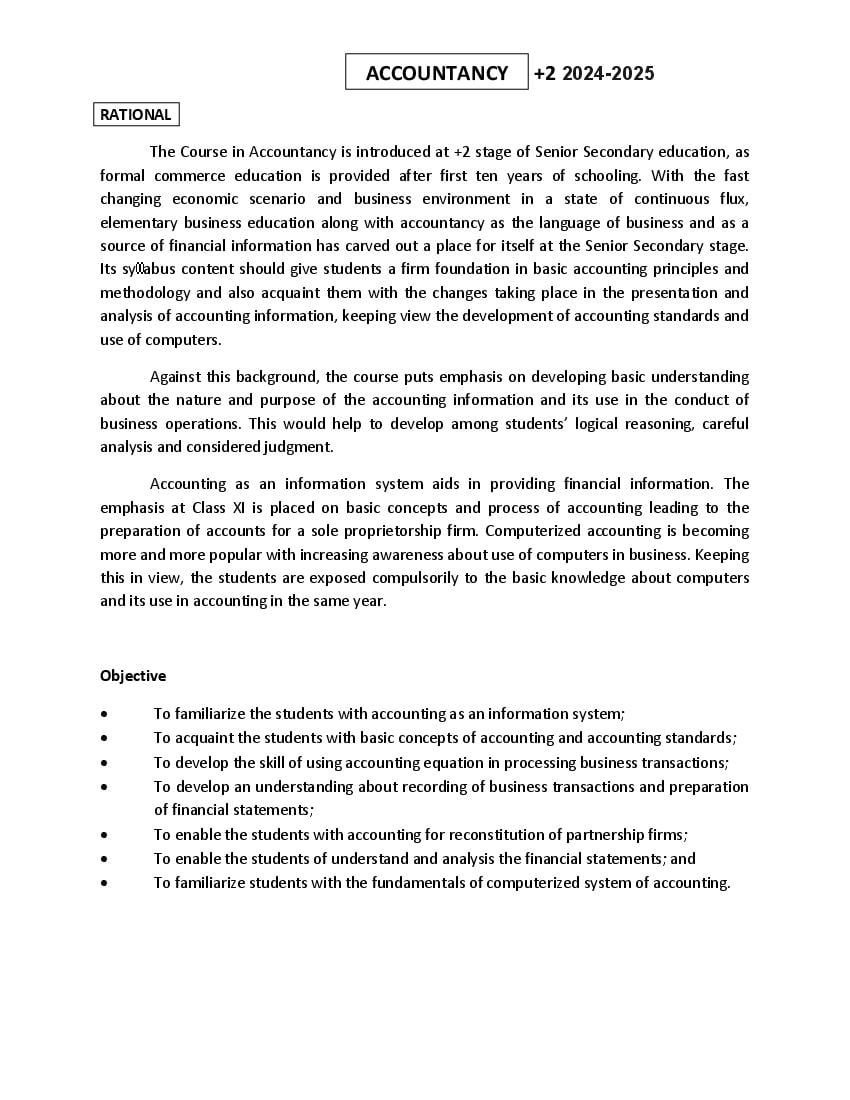
RATIONAL
The Course in Accountancy is introduced at +2 stage of Senior Secondary education, as
formal commerce education is provided after first ten years of schooling. With the fast
changing economic scenario and business environment in a state of continuous flux,
elementary business education along with accountancy as the language of business and as a
source of financial information has carved out a place for itself at the Senior Secondary stage.
Its syllabus content should give students a firm foundation in basic accounting principles and
methodology and also acquaint them with the changes taking place in the presentation and
analysis of accounting information, keeping view the development of accounting standards and
use of computers.
Against this background, the course puts emphasis on developing basic understanding
about the nature and purpose of the accounting information and its use in the conduct of
business operations. This would help to develop among students’ logical reasoning, careful
analysis and considered judgment.
Accounting as an information system aids in providing financial information. The
emphasis at Class XI is placed on basic concepts and process of accounting leading to the
preparation of accounts for a sole proprietorship firm. Computerized accounting is becoming
more and more popular with increasing awareness about use of computers in business. Keeping
this in view, the students are exposed compulsorily to the basic knowledge about computers
and its use in accounting in the same year.
Objective
To familiarize the students with accounting as an information system;
To acquaint the students with basic concepts of accounting and accounting standards;
To develop the skill of using accounting equation in processing business transactions;
To develop an understanding about recording of business transactions and preparation
of financial statements;
To enable the students with accounting for reconstitution of partnership firms;
To enable the students of understand and analysis the financial statements; and
To familiarize students with the fundamentals of computerized system of accounting.
Page 2
PART A: Accountancy Partnership Accounts
1. Chapter 1 Accounting for Partnership : Basic Concepts
2. Chapter 2 Reconstitution of a Partnership Firm – Admission of a Partner
3. Chapter 3 Reconstitution of a Partnership Firm –Retirement/Death of a Partner
4. Chapter 4 Dissolution of Partnership Firm
PART B: Company Accounts and Analysis of Financial Statements
5. Chapter 1 Accounting for Share Capital
6. Chapter 2 Issue and Redemption of Debentures
7. Chapter 3 Financial Statements of a Company
8. Chapter 4 Analysis of Financial Statements
9. Chapter 5 Accounting Ratios
10. Chapter 6 Cash Flow Statement
Part-A Accountancy Partnership Accounts
Chapter 1 Accounting for Partnership : Basic Concepts
1.1 Nature of Partnership
1.2 Partnership Deed
1.3 Special Aspects of Partnership Accounts
1.4 Maintenance of Capital Accounts of Partners
1.5 Distribution of Profit among Partners
1.6 Guarantee of Profit to a Partner
1.7 Past Adjustments
1.8 Final Accounts
Chapter 2 Reconstitution of a Partnership Firm – Admission of a Partner
2.1 Modes of Reconstitution of a Partnership Firm
2.2 Admission of a New Partner
2.3 New Profit Sharing Ratio
2.4 Sacrificing Ratio
2.5 Goodwill
2.6 Adjustment for Accumulated Profits and Losses
2.7 Revaluation of Assets and Reassessment of Liabilities
2.8 Adjustment of Capitals
2.9 Change in Profit Sharing Ratio among the Existing Partners
Chapter 3 Reconstitution of a Partnership Firm –Retirement/Death of a Partner
3.1 Ascertaining the Amount Due to Retiring/Deceased Partner
3.2 New Profit Sharing Ratio 168 3.3 Gaining Ratio
3.4 Treatment of Goodwill
3.5 Adjustment for Revaluation of Assets and Liabilities
3.6 Adjustment of Accumulated Profits and Losses
3.7 Disposal of Amount Due to Retiring Partner
3.8 Adjustment of Partners’ Capitals
3.9 Death of a Partner
Chapter 4 Dissolution of Partnership Firm
4.1 Dissolution of Partnership
4.2 Dissolution of a Firm
4.3 Settlement of Accounts
4.4 Accounting Treatment
Page 3
Chapter 1 Accounting for Share Capital
1.1 Features of a Company
1.2 Kinds of Companies
1.3 Share Capital of a Company
1.4 Nature and Classes of Shares
1.5 Issue of Shares
1.6 Accounting Treatment
1.7 Forfeiture of Shares
Chapter 2 Issue and Redemption of Debentures
2.1 Meaning of Debentures
2.2 Distinction between Shares and Debentures
2.3 Types of Debentures
2.4 Issue of Debentures
2.5 Over Subscription
2.6 Issue of Debentures for Consideration other than Cash
2.7 Issue of Debentures as a Collateral Security
2.8 Terms of Issue of Debentures
2.9 Interest on Debentures
2.10 Writing off Discount/Loss on Issue of Debentures
2.11 Redemption of Debentures
2.12 Redemption by Payment in Lump Sum
2.13 Redemption by Purchase in Open Market
2.14 Redemption by Conversion
Chapter 3 Financial Statements of a Company
3.1 Meaning of Financial Statements
3.2 Nature of Financial Statements
3.3 Objectives of Financial Statements
3.4 Types of Financial Statements
3.5 Uses and Importance of Financial Statements
3.6 Limitations of Financial Statements
Chapter 4 Analysis of Financial Statements
4.1 Meaning of Analysis of Financial Statements
4.2 Significance of Analysis of Financial Statements
4.3 Objectives of Analysis of Financial Statements
4.4 Tools of Analysis of Financial Statements
4.5 Comparative Statements
4.6 Common Size Statement
4.7 Limitations of Financial Analysis
Chapter 5 Accounting Ratios
5.1 Meaning of Accounting Ratios
5.2 Objectives of Ratio Analysis
5.3 Advantages of Ratio Analysis
5.4 Limitations of Ratio Analysis
5.5 Types of Ratios
5.6 Liquidity Ratios
5.7 Solvency Ratios
5.8 Activity (or Turnover) Ratio
5.9 Profitability Ratios
Page 4
6.1 Objectives of Cash Flow Statement
6.2 Benefits of Cash Flow Statement
6.3 Cash and Cash Equivalents
6.4 Cash Flows
6.5 Classification of Activities for the Preparation of Cash Flow Statement
6.6 Ascertaining Cash Flow from Operating Activities
6.7 Ascertainment of Cash Flow from Investing and Financing Activities
6.8 Preparation of Cash Flow Statement
Prescribed Book
Yks[kk”kkL= Hkkx A ds fy, ,d ikB~;iqLrd
ys[kk”kkL= Hkkx B ds fy, ,d IkkB~;iqLrd
Published by N.C.E.R.T. New Delhi
Accountancy book for Part A
Accountancy book for Part B
Page 5
The present syllabus reinforces the ideas introduced in the lower classes while the
students learn new concepts besides getting an exposure to contemporary areas of the subject.
The syllabus also aims at emphasizing the underlying principles that are common to both
animals and plants as well as highlighting the relationship of biology with other areas of
knowledge. The format of the syllabus allows a simple, clear, consequential flow of concepts
without any jarring jumps. The syllabus also stresses the connection of the study of Biology to
real life problems, use of biological discoveries/innovations in everyday life-in environment,
nature, medicine, health and agriculture. The updated syllabus also focuses on reducing the
curriculum load while ensuring that ample opportunities and scope for learning and
appreciating basic concepts of the subject continues to be available within its framework.
The prescribed syllabus is expected to
Promote understanding of basic principles of biology
Learning of emerging knowledge and its relevance to individual and society.
Encourage rational/specific attitude to issues related to population, environment and
development.
Enhance awareness about environmental issues and problems and the appropriate
solutions.
Create awareness amongst the learners about variations amongst the living and
developing respect for the diversities and to appreciate that the most complex biological
phenomenon are also built on essentially simple processes.
It is expected that the students would get an exposure to various branches of Biology in
the syllabus in a more contextual and friendly manner as they study its various units.
Page 6
REPRODUCTION
Chapter 1 : Sexual Reproduction in Flowering Plants
Chapter 2 : Human Reproduction
Chapter 3 : Reproductive Health
GENETICS AND EVOLUTION
Chapter 4 : Principles of Inheritance and Variation
Chapter 5 : Molecular Basis of Inheritance
Chapter 6 : Evolution
BIOLOGY IN HUMAN WELFARE
Chapter 7 : Human Health and Disease
Chapter 8 : Microbes in Human Welfare
BIOTECHNOLOGY
Chapter 9 : Biotechnology : Principles and Processes
Chapter 10 : Biotechnology and its Applications
Rationalised 2023-24
ECOLOGY
Chapter 11 : Organisms and Populations
Chapter 12 : Ecosystem
Chapter 13 : Biodiversity and Conservation
PRACTICALS
1. Two experiments
2. Slide preparation
3. Spotting
4. Investigatory project and viva based on the project
5. Record and Viva based on the experiment
LIST OF EXPERIMENTS
1. Study pollen germination on a slide.
2. Collect and study soil from different sites and study them for texture and moisture
content.
3. Study the pH and Water holding capacity of soil. Correlate with the kinds of plants found
in them.
4. Collect water from different water bodies around you and study them for pH clarity and
presence of any living organisms.
5. Study the presence of suspended particulate matter in air at the two widely different
sites.
6. Study of plant population density by quadrat method.
7. Study of plant population frequency by quadrat method.
Page 7
1. Study of flowers adapted to pollination by different agencies (weed, insect)
2. Study of pollen germination on a slide.
3. Study and identify stages of gamete development i.e. t.s. testis and t.s. ovary through
permanent slide.
4. Study meiosis in onion bud cell or grass hopper testis through permanent slide.
5. Study of t.s. of blastula through permanent slide.
6. Study Mendelian inheritance using seeds of different colour/size of any plant.
7. Study prepared prediqree charts of genetic traits such as rolling of tongue, blood
groups, widow’s peak, colour blindness.
8. Exercise on controlled pollination-emasculation, tagging and bagging.
9. To identify common diseases causing organism like Ascaris, Antamoeba, Plasmodium,
ringworm. Comment of symptoms of diseases that they cause through permanent slides
or specimens.
10. Study plants and animals found in xerophytic condition. Comment upon their
adaptation/ecosystem.
11. Study plants and animals found in aquatic conditions. Comment upon their
adaptation/ecosystem.
12. Study analogous and homologous organs in various plants and animals.
Page 8
RATIONABLE
The courses in Business Studies and Accountancy are introduced at +2 stage of Higher
Secondary Education as formal commerce education is provided after first ten years of
schooling. Therefore, it becomes necessary that instructions in this subject is given in such a
manner that students have a good understanding of the principles and practices bearing in
business (trade and industry) as well as their relationship with the society.
Business is a dynamic process that brings together technology, natural resources and
human initiative in a constantly changing global environment. To understand the framework in
which a business operates, a detailed study of the organization and management of business
processes and its interaction with the environment of business processes and its interaction
with the environment is required. Globalization has changed the way firms transact their
business. Information Technology is becoming a part of business operations in more and more
organizations. Computerized systems are fast replacing other systems. E-business and other
related concepts are picking up fast which need to be emphasized in the curriculum.
The course in Business Studies will prepare students to analysis, manage, evaluate and
respond to changes which affect business. It provides a way of looking at and interacting with
the business environment. It recognizes the fact that business influences and is influenced by
social, political, legal and economic forces. It allows students to appreciate that business is an
integral component of society and develops an understanding of many social and ethical issues.
Therefore, to acquire basic knowledge of the business world, a course in Business
Studies would be useful. It also informs students of a range of study and work options and
bridges the gap between school and work.
OBJECTIVES
To develop in students an understanding of the processes of business and its
environment;
To acquaint students with the dynamic nature and inter-dependent aspects of business;
To develop an interest in the theory and practice of business, trade and industry;
To familiarize candidates with theoretical foundations of organizing, managing and
handling operations of business firm;
To help students appreciate the economic and social significance of business activity and
the social costs and benefits arising there from;
To acquaint students with the practice of managing the operations and resources of
business;
To prepare students to function more effectively and responsibly as consumers,
employers, employees and citizens;
To help students in making the transition from school to the world of work including
self-employment;
To develop in students a business attitude and skills to be precise and articulate.
Page 9
PART A: PRINCIPLES AND FUNCTIONS OF MANAGEMENT
1. Nature and Significance of Management
2. Principles of Management
3. Business Environment -
4. Planning
5. Organizing
6. Staffing
7. Directing
8. Controlling
PART B: Business Finance and Marketing
9. Financial Management
10. Marketing
11. Consumer Protecting
PART A: PRINCIPLE AND FUNCTIONS OF MANAGEMENT
Unit 1: Nature and Significance of Management
Management-concept, objectives, importance.
Nature of management; Management as Science, Art, Profession.
Levels of management-top, middle, supervisory (first level)
Management function-planning, organizing, staffing, directing and controlling
Coordination-nature and importance.
Unit 2: Principles of Management
Principles of Management-meaning, nature and significance
Fayol’s Principles of management.
Taylor’s Scientific Management-Principles and techniques.
Unit 3: Business Environment
Business Environment-meaning, nature and importance.
Dimensions of Business Environment-Economic, Social, Technological, political and Legal.
Economic Environment in India;
Unit 4: Planning
Meaning, features, importance, limitations
Planning process.
Types of Plans- Objectives, Strategy, Policy, Procedure, Method, Rule, Budget, Program.
Unit 5: Organizing
Meaning and importance.
Steps in the process of organizing.
Structure of organization-functional and divisional.
Formal and informal organization.
Delegation: meaning, elements and importance.
Decentralization: meaning and importance.
Difference between delegation and decentralization.
Unit 6: Staffing
Meaning, need and importance of staffing.
Staffing as a part of Human Resource Management.
Steps in staffing process.
Recruitment-meaning and sources.
Selection-meaning and process.
Training and Development-meaning and need. Methods of training: job rotation, apprenticeship,
vestibule and
internship.
Page 10
Meaning, importance and principles.
Elements of Directing
- Supervision-meanings and importance
- Motivation-meaning and importance, Maslow’s hierarchy of needs; Financial and non-financial
incentives.
- Leadership-meaning, importance:
- Communication-meaning and importance, formal and informal communication; barriers to effective
communication.
Unit 8: Controlling
Meaning and importance
Relationship between planning and controlling
Steps in the process of control
Part-B: Business Finance and Marketing
Unit 9: Financial Management
Meaning, role, objectives of financial management
Financial planning- meaning and importance
Capital structure- meaning and factors
Fixed and working Capital-meanings and factors affecting its requirements.
Unit 10: Marketing
Marketing- meaning, functions and role
Distinction between marketing and selling
Marketing mix-concept and elements.
- Product-nature, classification, branding, labelling and packaging
- Physical distribution: meaning, role; Channels of distribution-meaning, types, factors determining
choice of channels.
- Promotion-meaning and role, promotion mix, Role of Advertising and personal selling; objections to
Advertising.
- Price: factors influencing pricing
Unit 11: Consumer Protection
Importance of consumer protection
Consumer rights
Consumer responsibilities
Ways and means of consumer protection-Consumer awareness and legal redressed with special
reference to
Consumer Protection Act.
Role of consumer organizations and NGOs.
PRESCRIBED BOOKS
1 यवसा यक अ ययन एन. सी. ई. आर.ट . वारा का शत
2. Business studies NCERT Publication
Page 11
RATIONAL
Higher secondary is the most crucial stage of school education because at this juncture
specialized discipline based, content-oriented courses are introduced. Students reach this stage
after 10 years of general education and opt for chemistry with a purpose of pursuing their
career in basic sciences or professional courses like medicine, engineering, technology and
study courses in applied areas of science and technology at tertiary level. Therefore, there is a
need to provide learners with sufficient conceptual background of Chemistry, which will make
them competent to meet the challenges of academic and professional courses after the higher
secondary stage.
The new and updated curriculum is based on disciplinary approach with rigor and depth
taking care that the syllabus is not heavy and at the same time it is comparable to the
international level. The knowledge related to the subject of chemistry has undergone
tremendous changes during the past one decade. Many new areas like synthetic materials, bio-
molecules, natural resources, industrial chemistry are coming in a big way and deserve to be an
integral part of chemistry syllabus at senior secondary stage. At international level, new
formulations and nomenclature of elements and compounds, symbols and units of physical
quantities floated by scientific bodies like IUPAC and CGPM are of immense importance and
need to be incorporated in the updated syllabus. The revised syllabus takes care of all these
aspects. Greater emphasis has been laid on use of new nomenclature, symbols and
formulations, teaching of fundamental concepts, applications of concepts in chemistry to
industry/technology, logical sequencing of units, removal of obsolete content and repetition
etc.
OBJECTIVES
The board objectives of teaching Chemistry at Senior Secondary Stage are to help the
learners:
To promote understanding of basic facts and concepts in chemistry while retaining the
excitement of chemistry.
To make students capable of studying chemistry in academic and professional courses (such
as medicine technology) at tertiary level.
To expose the students to various emerging new areas of chemistry and apprise them with
their relevance in their future studies and their application in various spheres of chemical
sciences and technology.
To equip students to face various, changes related to health, nutrition, environment,
population, weather, industries and agriculture.
To develop problem solving skills in students.
To expose the students to different processes used in industries and their technological
applications.
To apprise students with interface of chemistry with other disciplines of science such as
physics, biology, geology, engineering etc.
To acquaint students with different aspects of chemistry used in daily life.
To develop an interest in students to study chemistry as a discipline.
Page 12
Unit No. Title
Chapter- I Solutions
Chapter- II Electrochemistry
Chapter-III Chemical Kinetics
Chapter-IV d- and f-Block Elements
Chapter-V Coordination Compounds
Chapter-VI Haloalkanes and Haloarenes
Chapter-VII Alcohols, Phenols and Ethers
Chapter-VIII Aldehydes, Ketones and Carboxylic acids
Chapter- IX Amines
Chapter-X Biomolecules
PRACTICAL SYLLABUS
A. Surface Chemistry
(a) Preparation of one lyophilic and one lyophobic sol.
Lyophilic sol-Starch, egg albumin and gum.
Lyophobic sol-aluminum hydroxide, ferric hydroxide, arsensious sulphide.
(b) Study of the role of emulsifying agent in stabilizing the emulsions of different oils.
B. Chemical Kinetics
(a) Effect of concentration and temperature on the rate of reaction between sodium
thiosulphate and hydrochloric acid.
(b) Study of reaction rates of any one of the following:
(i) Reaction of iodide ion and with hydrogen peroxide at room temperature using
different concentration of iodide ions.
(ii) Reaction between potassium iodate, KIO3 and sodium sulphite
: (Na2 SO3) using starch solution as indicator (clock reaction).
C. Thermochemistry
(a) Any one of the following experiments:
(i) Enthalpy of dissolution of copper sulphate or potassium nitrate.
(ii) Enthalpy of neutralization of strong acid (HCl) and strong base (NaOH)
(iii) Determination of enthalphy change during interaction (Hydrogen bond
formation) between acetone and chloroform.
Page 13
Variation of cell potential in Zn/Zn2+ǁCu2+/Cu with change in concentration of electrolytes
(CuSO4 or ZnSO4) at room temperature.
E. Chromatography
(i) Separation of pigments from extracts of leaves and flowers by pap chromatography
and determination of Rf values.
(ii) Separation of constituents present in an inorganic mixture containing cations only
(constituents having wide difference in Rf values to be provided)
F. Preparation of Inorganic Compounds
(i) Preparation of double salt of ferrous ammonium sulphate or potash alum.
(ii) Preparation of potassium ferric oxalate.
G. Preparation of Organic Compounds
Preparation of any two of the following compounds
(i) Acetanilide
(ii) Di-benzal acetone
(iii) p-Nitroacetanilide
(iv) Aniline yellow or 2-Napthol aniline dye.
(v) Iodoform
H. Test for the functional groups present in organic compounds:
Unsaturation, alcoholic, phenolic, aldehydic, ketonic, carboxylic and amino (primary groups)
I. Study of Carbohydrates, fats and proteins in pure form and detection of their presence in
given food stuffs.
J. Determination of concentration/molarity of KMnO 4 solution by titrating it against a
standard solution of :
(i) Oxalic acid
(ii) Ferrous ammonium sulphate.
(Students will be required to prepare standard solutions by weighing themselves)
K. Qualitative analysis
Determination of one cation and one anion in a given salt
Cations- Pb2+, Cu2+,As3+, Al3+, Fe3+, Mn2+, Zn2+, Co2+, Ni2+, Ca2+, Sr2+, Ba2+, Mg2+, NH4+
-
Anions- CO32-, S2-, SO32-, SO42-, NO2, NO3, Cl-, Br-, I-, PO43-; C2O42-, CH3COO
(Note Insoluble salts excluded)
Page 14
Syllabus
Subject: Computer Science Class: 10+2
Marks
UNIT - I
Network Operating System
Basic network concepts, Overview and History of Linux, Linux Kernel, Linux
Resources, Advantages of Linux, Creating and Viewing Files, Basic shell
concept, shell commands, I/O redirection, pipelines, vi editor, Linux File
System, manage files using shell, Cyber Laws.
Unit II
Network Operating System Administration (Configuration & Maintenance)
Hardware and Network Operating System Maintenance, Network Security and
IT Career opportunities, Window NT & it’s advantages, Difference between
Linux and Windows NT, Linux firewall and it’s types, Managing Storage
Devices Understanding basic disk concepts and manage system disks, logical
volume concepts and managing logical columns, manage file system attributes
and swap space, Mount point view, Introduction to shell Scripting.
Administering User Accounts using GUI tool and Command Line.
Unit III
Desktop Publishing (Advanced)
Introduction to CorelDraw, Various components of CorelDraw window, Tools in
CorelDraw, Creating Graphics & saving files, Importing images of various
graphic formats and editing them, Designing logos, Greeting Cards etc. Hands
on with CorelDraw.
Unit IV
Elementary Server side Scripting through PHP
Dreamweaver, XHTML, Difference between XHTML and HTML, Fundamentals
of PHP, it’s advantages, Variables, Data Types, Operators, scope of variable,
Control Program Flow (Decision statement and Looping statements), arrays,
functions, working with applications submitting forms, get/post methods,.
Date/time session variables.
Page 15
RDBMS Concepts and MYSQL
Basic of database systems, Problems in Traditional file oriented approach,
Three level architecture of DBMS, Roles of DBA, Data Dictionary, Advantages
and Disadvantages of RDBMS, Constraints: Domain level constraints,
Referential Constraints, SQL Statements: DDL Statements, DML Statements,
DCL Statements, TCL Statements, Concept of Keys, Constraints on Attributes,
SQL Functions.
Unit VI
PL/SQL
PL/SQL block structure, Basics of PL/SQL, Controlling PL/SQL Flow for
Execution, If statements, IF-THEN-ELSE statement Execution Flow, IF-THEN-
ELSEIF statement Execution Flow, LOOP Statement, Basic Loop, For Loop,
While Loop.
Triggers, Types of Triggers: Row-Level Triggers, Statement Level Triggers,
BEFORE and AFTER Triggers.
Cursor, Types of Cursor: Implicit and Explicit Cursor.
Unit VII
Internet Business Applications
Concept of on line service-E-Commerce Practice, Net Banking, Online
submission of various application forms, Various kinds of online reservations
such as railways, Hotels etc., Online, Customer support services, online
marketing & shopping, Social Networking viz, Facebook etc.
Unit VIII
Project Work
Page 16
Rationale
Economics is one of the social sciences, which has great influence on every human
being. As economic life and the economic go through change, the need to ground education in
children's own experience becomes essential. While doing so, it is imperative to provide them
opportunities to acquire analytical skills to observe the understand the economic realities.
At senior secondary stage, the learners are in a position to understand abstract ideas,
exercise the power of thinking and to develop their own perception. It is at this stage, the
learners and exposed to the rigour of the discipline of economics in a systematic way.
The economics courses are introduced in such a way that in the initial stage, the
learners are introduced to the economic realities that the nation is facing today along with
some basic statistical tools to understand these broader economic realities. In the later stage,
the learners are introduced to economics as a theory of abstraction.
The economics courses also contain many projects and activities. These will provide
opportunities for the learners to explore various economic issued both from their day-to-day
life and also from issues, which are broader and invisible in nature. The academic skills that
they learn in these courses would provide opportunities to use information and communication
technologies to facilitate their learning process.
OBJECTIVES
1. Understanding of some basic economics concepts and development of economic reasoning
which the learners can apply in their day-to-day life as citizens, workers and consumers.
2. Realization of learner’s role in nation building and sensitivity to the economic issues that the
nation is facing today.
3. Equipment with basic tools of economic and statistics to analyses economic issues. This is
pertinent for even those who may not pursue this course beyond senior secondary stage.
4. Development of understanding that there can be more than one view on any economics
issue and necessary skills to argue logically with reasoning.
Page 17
PART A : INTRODUCTORY MICRO ECONOMICS
CHAPTER-1: INTRODUCTION
CHAPTER-2: THEORY OF CONSUMER BEHAVIOUR
CHAPTER- 3: PRODUCTION AND COSTS
CHAPTER-4: THE THEORY OF THE FIRM UNDER PERFECT COMPETITION
CHAPTER- 5: MARKET EQUILIBRIUM
PART-B: INTROSUCTORY MACRO ECONOMICS
CHAPTER-1: . INTRODUCTION
CHAPTER-2: NATIONAL INCOME ACCOUNTING
CHAPTER-3: MONEY AND BANKING
CHAPTER-4: DETERMINATION OF INCOME AND EMPLOYMENT
CHAPTER-5 : GOVERNMENT BUDGET AND THE ECONOMY
CHAPTER-6 : OPEN ECONOMY MACROECONOMICS
PART A : INTRODUCTORY MICRO ECONOMICS
1. INTRODUCTION
1.1 A Simple Economy
1.2 Central Problems of an Economy
1.3 Organisation of Economic Activities
1.3.1 The Centrally Planned Economy
1.3.2 The Market Economy
1.4 Positive and Normative Economics
1.5 Microeconomics and Macroeconomics
1.6 Plan of the Book
2. THEORY OF CONSUMER BEHAVIOUR
2.1 Utility
2.1.1 Cardinal Utility Analysis
2.1.2 Ordinal Utility Analysis
2.2 The Consumer’s Budget
2.2.1 Budget Set and Budget Line
2.2.2 Changes in the Budget Set
2.3 Optimal Choice of the Consumer
2.4 Demand
2.4.1 Demand Curve and the Law of Demand
2.4.2 Deriving a Demand Curve from Indifference Curves and Budget Constraints
2.4.3 Normal and Inferior Goods
2.4.4 Substitutes and Complements
2.4.5 Shifts in the Demand Curve
2.4.6 Movements along the Demand Curve and Shifts in the Demand Curve
2.5 Market Demand
2.6 Elasticity of Demand
2.6.1 Elasticity along a Linear Demand Curve
2.6.2 Factors Determining Price Elasticity of Demand for a Good
2.6.3 Elasticity and Expenditure
Page 18
3.1 Production Function
3.2 The Short Run and the Long Run
3.3 Total Product, Average Product and Marginal Product
3.3.1 Total Product
3.3.2 Average Product
3.3.3 Marginal Product
3.4 The Law of Diminishing Marginal Product and the Law of Variable Proportions
3.5 Shapes of Total Product, Marginal Product and Average Product Curves
3.6 Returns to Scale
3.7 Costs
3.7.1 Short Run Costs
3.7.2 Long Run Costs
4. THE THEORY OF THE FIRM UNDER PERFECT COMPETITION
4.1 Perfect Competition: Defining Features
4.2 Revenue
4.3 Profit Maximisation
4.3.1 Condition 1
4.3.2 Condition 2
4.3.3 Condition 3
4.3.4 The Profit Maximisation Problem: Graphical Representation
4.4 Supply Curve of a Firm
4.4.1 Short Run Supply Curve of a Firm
4.4.2 Long Run Supply Curve of a Firm
4.4.3 The Shut Down Point
4.4.4 The Normal Profit and Break-even Point
4.5 Determinants of a Firm’s Supply Curve
4.5.1 Technological Progress
4.5.2 Input Prices
4.6 Market Supply Curve
4.7 Price Elasticity of Supply
5. MARKET EQUILIBRIUM
5.1 Equilibrium, Excess Demand, Excess Supply
5.1.1 Market Equilibrium: Fixed Number of Firms
5.1.2 Market Equilibrium: Free Entry and Exit
5.2 Applications
5.2.1 Price Ceiling
5.2.2 Price Floor
PART-B: INTROSUCTORY MACRO ECONOMICS
1. INTRODUCTION
1.1 Emergence of Macroeconomics
1.2 Context of the Present Book of Macroeconomics
2. NATIONAL INCOME ACCOUNTING
2.1 Some Basic Concepts of Macroeconomics
2.2 Circular Flow of Income and Methods of Calculating National Income
2.2.1 The Product or Value Added Method
Page 19
2.2.3 Income Method
2.2.4 Factor Cost, Basic Prices and Market Prices
2.3 Some Macroeconomic Identities
2.4 Nominal and Real GDP
2.5 GDP and Welfare
3. MONEY AND BANKING
3.1 Functions of Money
3.2 Demand for Money and Supply of Money
3.2.1 Demand for Money
3.2.2 Supply of Money
3.3 Money Creation by Banking System
3.3.1 Balance Sheet of a Fictional Bank
3.3.2 Limits to Credit Creation and Money Multiplier
3.4 Policy Tools to Control Money Supply
4. DETERMINATION OF INCOME AND EMPLOYMENT
4.1 Aggregate Demand and its Components
4.1.1 Consumption
4.1.2 Investment
4.2 Determination of Income in Two-sector Model
4.3 Determination of Equilibrium Income in the Short Run
4.3.1 Macroeconomic equilibrium with price level fixed
4.3.2 Effect of an autonomous change in aggregate demand on income and output
4.3.3 The Multiplier Mechanism
4.4 Some More Concepts
5. GOVERNMENT BUDGET AND THE ECONOMY
5.1 Government Budget – Meaning and its Components
5.1.1 Objectives of Government Budget
5.1.2 Classification of Receipts
5.1.3 Classification of Expenditure
5.2 Balanced, Surplus and Deficit Budget
5.2.1 Measures of Government Deficit
6. OPEN ECONOMY MACROECONOMICS
6.1 The Balance of Payments
6.1.1 Current Account
6.1.2 Capital Account
6.1.3 Balance of Payments Surplus and Deficit
6.2 The Foreign Exchange Market
6.2.1 Foreign Exchange Rate
6.2.2 Determination of the Exchange Rate
6.2.3 Merits and Demerits of Flexible and Fixed Exchange Rate Systems
6.2.4 Managed Floating
BOOKS RECOMMENDED :
O;f"V vFkZ'kkL= ,d ifjp;
lef"V vFkZ'kkL= ,d ifjp; Published by N.C.E.R.T., NEW DELHI
Introductory Microeconomics
Introductory Microeconomics
Page 20
BACKGROUND
Students are expected to have acquired a reasonable degree of language proficiency in
English by the time they come to class XII, and the course will aim, essentially, at promoting the
higher-order language skills.
For a large number of students, the senior secondary stage will be a preparation for the
university, where a fairly high degree of proficiency in English may be required. But for another
large group, the senior secondary stage may be a preparation for entry into the world of work.
The Core Courses should cater to both groups by promoting the language skills required for
academic study as well as the language skills required for the workplace.
OBJECTIVE
The general objective at this stage are :
- to listen to and comprehend live as well as recorded oral presentations on a variety of
topics.
- to develop greater confidence and proficiency in the use of language skills necessary for
social and academic purposes.
- to participate in group discussion/interviews, making short oral presentation of given
topics.
- to perceive the overall meaning and organization of the text (i.e., the relationships of
the different ‘’chunks’’ in the text to the each other).
- to identify the central/main point and supporting details etc.
- to build communicative competence in various registers of English.
- to promote advance language skills with an aim to develop the skills of reasoning,
drawing inferences etc. through meaningful activities.
- to develop ability and knowledge required in order to engage in independent reflection
and enquiry.
- to develop the capacity to appreciate literary use of English and also use English
creatively and imaginatively.
At the end of this stage learners will be able to do the following :
- read and comprehend extended texts (prescribed and non-prescribed) in the following
genres : fiction, science fiction, drama, poetry, biography, autobiography, travel and
sports literature, etc.
- text-based writing (i.e., writing in response to questions or tasks based on prescribed or
unseen texts)
- understand and respond to lectures, speeches, etc.
- write expository/argumentative essays of 250-500 words, explaining or developing a
topic, arguing a case, etc.
Page 21
- write items related to the workplace (minutes, memoranda, notices, summaries,
reports; filling up of forms, preparing CVs, e-mail messages etc.)
- taking/making notes from reference materials, recorded talks etc.
LANGUAGE ITEMS
The Core Course should draw upon the language items suggested for classes IX-X and
develop deeper into their usage and functions. Particular attention may, however, be given to
the following areas of grammar:
- The uses of different tense forms for different kinds of narration (e.g. media, commentaries,
reports, programmer, etc)
- The use of passive forms in scientific and innovative writings.
- Converting one kind of sentence/clause into a different kind of structure of well as other items
to exemplify stylistic variations in different discourses
- Modal auxiliaries – used based on semantic considerations.
METHODS AND TECHNIQUES
The techniques used for teaching should promote habits of self-learning and reduce
dependence on the teacher. In general, we recommend a multi-skill, learner-centred, activity based
approach, of which there can be many variations. The core classroom activity is likely to be that of silent
reading of prescribed/selected texts for comprehension, which can lead to other forms of language
learning activities such as role play, dramatization, group discussion, writing, etc. although many such
activities could be carried out without the preliminary use of textual material. It is important that
students be trained to read independently and intelligently, interacting actively with texts, with the use
of reference materials (dictionaries, thesauruses, etc.) where necessary. Some pre-reading activity will
generally be required, and the course books should suggest suitable activities, leaving teachers free to
devise other activities when desired. So also, the reading of texts should be followed by post reading
activities. It is important to remember that every text can generate different readings. Students should
be encouraged to interpret texts in different ways.
Group and pair activities can be resorted to when desired, but many useful language activities
can be carried out individually.
In general, teachers should encourage students to interact actively with texts and with each
other. Oral activity (group discussion, etc.) should be encouraged.
Page 22
1. The Last Lesson (Aplhonse Daudet)
2. Lost Spring (Anees Jung)
3. Deep Water (William Douglas)
4. The Rattrap (Selma Lagerlof)
5. Indigo (Louis Fischer)
6. Poets and Pancakes (Asokamitran)
7. The Interview
Part I (Christopher Silvester)
Part II (An Interview with Umberto Eco)
8. Going Places (A.R. Barton)
Poetry
1. My Mother At Sixty-Six (Kamala Das)
2. Keeping Quiet (Pablo Neruda)
3. A Thing of Beauty (John Keats)
4. A Roadside Stand (Robert Frost)
5. Aunt Jennifer’s Tigers (Adrienne Rich)
Vistas (Supplementary Reader)
1. The Third Level (Jack Finney)
2. The Tiger King (Kalki)
3. Journey to the end of the Earth (Tishani Doshi)
4. The Enemy (Pearl S. Buck)
5. On the Face of It (Susan Hill)
6. Memories of Childhood
The cutting of My Long Hair (Zitkala-Sa)
We Too are Human Beings (Bama)
Page 23
RATIONAL
Geography is introduced as an elective subject at the senior secondary stage. After ten
years of general education, students branch out at the beginning of this stage and are exposed
to the rigorous of the discipline for the first time. Being an entry point for the higher education,
students choose geography for pursuing their academic interest and, therefore, need a broader
and deeper understanding of the subject. For others, geographical knowledge is useful in daily
lives because it is a valuable medium for the education of young people. Its contribution lies in
the content, cognitive processes, skills and values that geography promotes and thus helps the
students expore, understand and evaluate the environmental and social dimensions of the
world in a better manner.
Since geography explores the relationship between people and the environment, it
includes studies of physical and human environments and the interactions at different scales -
local, state/region, nation and the world. The fundamental principles responsible for the
varieties in the distributional pattern of physical and human features and phenomena over the
earth's surface need to be understood properly. Application of these principles would be taken
up through selected case studies from the world and India. Thus, the physical and human
environment of India and study of some issues from a geographical point of view will be
covered in greater detail. Students will be exposed to different methods used in geographical
investigations.
OBJECTIVES
The course in geography will help learners :
- Familiarise themselves with the terms, key concepts and basic principles of geography.
- Search for, recognize and understand the processes and patterns of the spatial
arrangement of the natural as well as human features and phenomena on the earth's surface;
- Understand and analyse the inter-relationship between physical and human
environments and their impact;
- Apply geographical knowledge and methods of inquiry to new situations or problems at
different levels-local, regional, national and global;
- Develop geographical skills, relating to collection, processing and analysis and
data/information and preparation of report including map and graphs, and use of computers
whereas possible, and
- Utilize geographical knowledge in understanding issues concerning the community such
as environmental issues, socio-economic concerns, gender and become responsible and
effective member of the community.
Page 24
A. Fundamentals of Human Geography
UNIT I
Chapter-1 Human Geography Nature and Scope
UNIT II
Chapter-2 The World Population Distribution, Density and Growth
Chapter-3 Human Development
UNIT III
Chapter-4 Primary Activities
Chapter-5 Secondary Activities
Chapter-6 Tertiary and Quaternary Activities
Chapter-7 Transport and Communication
Chapter-8 International Trade
B. INDIAN: PEOPLE AND ECONOMY
Unit I
Chapter-1 Population : Distribution, Density, Growth and Composition
Unit II
Chapter-2 Human Settlements
Unit III
Chapter-3 Land Resources and Agriculture
Chapter-4 Water Resources
Chapter-5 Mineral and Energy Resources
Chapter-6 Planning and Sustainable Development in Indian Context
Unit IV
Chapter-7 Transport and Communication
Chapter-8 International Trade
Unit V
Chapter-9 Geographical Perspective on Selected Issues and Problems
C. PRACTICAL WORK 20 Marks
Chapter-1 Data – Its Source and Compilation
Chapter-2 Data Processing
Chapter-3 Graphical Representation of Data
Chapter-4 Spatial Information Technology
BOOKS RECOMMENDED
rhu ikB~;iqLRkdsa %
ekuo Hkwxksy ds ewy fl}kUr] Hkkjr&yksx vkSj vFkZO;LFkk] Hkwxksy esa iz;ksxkRed dk;Z Hkkx&2 jk"Vªh;
'kSf{kd vuqla/kku vkSj izf'k{k.k ifj"kn~ }kjk izdkf'krA
Page 25
RATIONALE
Through a focus on a range of important historical sources the students would be
introduced to a set of important historical events and processes. A discussion of these themes,
it is hoped, would allow students not only to know about these events and processes, but also
to discover the excitement of doing history.
OBJECTIVES
- Effort in these senior secondary classes would be to emphasize to students that history
is a critical discipline, a process of enquiry, a way of knowing about the past, rather than just a
collection of facts. The syllabus would help them understand the process through which
historians write history, by choosing and assembling different types of evidence, and by reading
their sources critically. They will appreciate how historians follow the trails that lead to the
past, and how historical knowledge develops.
- The syllabus would also enable students to relate/compare development in different
situations, analyze connection between similar processes located in different time periods, and
discover the relationship between different methods of social enquiry within different social
sciences.
- In class XII the focus will be on a detailed study of some themes in Ancient, Medieval
and Modern Indian history. The object would be to study a set of these themes in some detail
and depth rather than survey the entire chronological span of Indian history. In this sense the
courses will built on the knowledge that the students have acquired in the earlier classes.
- Each theme in class XII will also introduce the student to one type of source for the
study of history. Through such a study students would begin to see what different types of
sources can reveal and what they cannot tell. They would come to know how historians analyze
these sources, the problems and difficulties of interpreting each type of source, and the way a
larger picture of an event, a historical process, or a historical figure, is built by looking at
different types of sources.
- Each theme for class XII will be organized around four subheads : (a) a detailed overview
of the events, issues and processes under discussion, (b) a summary of the present state of
research on the theme, (c) an account of how knowledge about the theme has been acquired.
(d) an excerpt from a primary source related to the theme, explaining how it has been used by
historians.
- In the textbooks each theme would be located in a specific time and place. But these
discussions would be situated within a wider context by (a) plotting the spcific event within
time-lines, (b) discussing the particular event or process in relation to developments in other
places and other times.
Page 26
PART-1
1. Bricks, Beads and Bones (The Harappan Civilisation)
2. Kings, Farmers and Towns (Early State and Economies)
3. Kinship, Caste and Class (Early Societies)
4. Thinkers, Beliefs and Buildings (Cultural Developments)
PART-II
5. Through The Eyes of Travellers ( Perceptions of Society)
6. Bhakti-Sufi Traditions (Changes in Religious Beliefs and Devotional Texts)
7. An Imperial Capital (Vijayanagara)
8. Peasants, Zamindars and The State (Agrarian Society and the Mughal Empire)
PART-III
09. Colonialism and The Countryside (Exploring Official Archives)
10. Rebels and The Raj (1857 Revolt and its Representations)
11. Mahatma Gandhi and The Nationalist Movement (Civil Disobedience and Beyond)
12. Framing The Constitution ( The Beginning of a New Era)
PART-IV
Map Work
PRESCRIBED BOOKS :
1] Hkkjrh; bfrgkl ds dqN fo"k; Hkkx 1] 2 vkSj 3 fg- iz- Ldwy f'k{kk cksMZ /keZ'kkyk }kjk izdkf'kr
Page 27
mPprj ek/;fed Lrj esa izo”s k ysus okyk fo|kFkhZ igys ckj lkekU; f”k{kk ls fo”ks’k vuq”kklu
dh f”k{kk dh vksj mUeq[k gksrk gSA nl o’kkZas esa fo|kFkhZ Hkk’kk ds dkS”kyksa ls ifjfpr gks tkrk gSA Hkk’kk
vkSj lkfgR; ds Lrj ij mldk nk;jk vc ?kj, vkl&iM+ksl] Ldwy] izkar vkSj ns”k ls gksrk gqvk /khjs&/khjs
fo”o rd QSy tkrk gSA og bl mez esa igq¡p pwdk gS fd ns”k dh lkaLd`frd] lkekftd] jktuhfrd
vkSj vkfFkZd leL;kvksa ij fopkj&foe”kZ dj lds] ,d ft+Eesnkj ukxfjd dh rjg viuh ft+Eesnkfj;ksa
dks le> lds rFkk ns”k vkSj [kqn dks lgh fn”kk ns ldus esa Hkk’kk dh rkdr dks igpku ldsA ,sl s s n`<+
Hkkf’kd vkSj oSpkfjd vk/kkj ds lkFk tc fo|kFkhZ vkrk gS rks mls foe”kZ dh Hkk’kk ds :Ik esa fganh dh
O;kid le> vkSj iz;ksx esa n{k cukuk lcls igyk mÌs”; gksxkA fd”kksjkoLFkk ls ;qokoLFkk ds bl
uktqd eksM+ ij fdlh Hkh fo’k; dk pquko djrs le; cPps vkSj muds vfHkHkkod bl ckr dks ysdj
lcls vf/kd fpafrr jgrs gSa fd p;fur fo’k; muds Hkkoh dSfj;j vkSj thfodk ds voljksa esa enn
djsxk fd ughaA bl mez ds fo|kfFkZ;ksa esa fparu vkSj fu.kZ; djus dh izo`fRr Hkh izcy gksrh gS blh
vk/kkj ij os vius ekufld] lekftd] ckSf)d vkSj Hkkf’kd fodkl ds izfr lpsr gksrs gS vkSj vius Hkkoh
v/;;u dh fn”kk r; djrs gSa nl Lrj ij ,sfPNd fganh dk v/;;u ,d l`tukRed] lkfgfR;d]
lkaLd`frd vkSj fofHkUu iz;qfDr;ksa dh Hkk’kk ds :i esa gksxkA bl ckr ij Hkh cy fn;k tk,xk fd fuajrj
fodflr gksrh fganh ds vf[ky Hkkjrh; Lo:Ik ls cPps dk fj”rk cu ldsA
bl Lrj ij fo|kkfFkZ;ksa esa Hkk’kk ds fyf[kr iz;ksx ds lkFk&lkFk mlds ekSf[kd iz;ksx dh
dq”kyrk vkSj n{krk dk fodkl Hkh t:jh gSA iz;kl ;g Hkh gksxk fd fo|kFkhZ vius fc[kjs gq, fopkjksa
vkSj Hkkoksa dh lgt vkSj ekSfyd vfHkO;fDr dh {kerk gkfly dj ldsA
bl ikB~;dze ds v/;;u ls ¼1½ fo|kkFkhZ viuh :fp vkSj vko”;drk ds vuq:Ik lkfgR; dk
xgu vkSj fo”ks’k v/;;u tkjh j[k ldsx a As ¼2½ fo”ofo|ky; Lrj ij fu/kkZfjr fganh lkfgR; ls lacf/kr
ikB~;dze ds lkFk lgt lac/a k LFkkfir dj ldsx a As ¼3½ ys[ku dkS”ky ds O;kogkfjd vkSj l`tukRed
:iksa dh vfHkO;fDr esa l{ke gks ldsaxAs ¼4½ jkstxkj ds fdlh Hkh {ks= esa tkus ij Hkk’kk dk iz;ksx izHkkoh
<ax ls dj ldsx a As vkSj ¼5½ ;g ikB~;dze fo|kFkhZ dks lapkj rFkk izdk”ku tSls fofHkUu {ks=ksa esa viuh
{kerk vktekus ds volj iznku dj ldrk gSA
mn~ns”;
Lk`tukRed lkfgR; dh ljkguk] mldk vkuan mBkuk vkSj mlds izfr l`tukRed vkSj vkykspukRed
n`f’V dk fodklA
lkfgR; dh fofo/k fo/kkvksa ¼dfork] dgkuh] fuca/k vkfn½ egRoiw.kZ dfo;ksa vkSj jpukdkjksa] ize[q k
/kkjkvksa vkSj “kSfy;ksa dk ifjp; djkukA
Hkk’kk dh l`tukRed ckjhfd;ksa vkSj O;kogkfjd iz;ksx dk cks/k rFkk mldk lanHkZ vkSj le;ds
vuqlkj izHkko”kkyh <ax ls ekSf[kd vkSj fyf[kr vfHkO;fDr dj ldukA
fofHkUu Kkukuq”kkluksa ds foe”kZ dh Hkk’kk ds :Ik esa fganh dh fof”k’V izdf` r ,oa {kerk dk cks/k
djkukA
lkfgR; dh izHkkodkjh {kerk dk mi;ksx djrs gq, lHkh izdkj dh fofo/krkvksa ¼/keZ] tkfr] fyax] oxZ]
Hkk’kk vkfn½ ,oa varjksa ds izfr ldkjkRed vkSj laons u”khy joS;s dk fodkl djkukA
ns”k&fons”k esa izpfyr fganh ds :iksa ls ifjfpr djkukA
lapkj&ek/;eksa ¼fizVa vkSj bysDVªkWfud½ esa iz;qDr fganh dh izd`fr ls voxr djkuk vkSj uohu fof/k;ksa
ds iz;ksx dh {kerk dk fodkl djukA
lkfgR; dh O;kid /kkjk ds chp j[kdj jpukvksa dk fo”ys’k.k vkSj foospu djus dh {kerk gkfly
djukA
foijhr ifjfLFkr;ksa esa Hkh Hkk’kk dk bLrseky “kkafr ds lkFk djukA
vewrZ fo’k;ksa ij iz;qDr Hkk’kk dk fodkl rFkk dYiuk”khyrk vkSj ekSfyd fparu ds fy, iz;ksx
djukA
Page 28
1) dkO; vkSj x| laxgz vUrjk Hkkx&2 esa izeq[k jpukdkjksa }kjk fyf[kr fofo/k fo/kkvksa ls lac) dkO;
vkSj x| ¼yxHkx 20 ikB½ jpuk,¡ gksx a hA ;s jpuk,¡ jpukdkjksa vkSj fo/kkvksa dh fofHkUu “kSfy;ksa ls
fo|kFkhZ dks ifjfpr djk,¡xhA jpukvksa esa ys[kd&ifjp; esa mudh lkfgfR;d i`’BHkwfe] lkfgfR;d
izo`fRr la{ksi esa nh tk ldrh gSA iz”u&vH;klksa esa ,sls iz”u gksaxs tks fo|kFkhZ dh l`tukRedrk vkSj
ekSfydrk dk fodkl dj ldsA jpukvksa dh izLrqfr bl izdkj gksxh fd fo|kFkhZ esa lkfgR; ds
fodklkRed Lo:Ik gh le> cu ldsA
2) ,sfPNd ikB~;dze ds fy, iwjd iBu dk izko/kku&lkfgR; dh fofo/k fo/kkvksa dh jpukvksa dk ,d
ladyu ¼vUrjky Hkkx&2½
3) jpukRed vkSj O;kogkfjd ys[ku ij vk/kkfjr ,d iqLrd ¼d{kk XI vkSj d{kk XII nksuksa ds fy,½
vfHkO;fDr vkSj ek/;eA bl iqLrd esa fuEu fo’k; lfEefyr gksaxAs
l`tukRed ys[ku&dfork] ukVd] Mk;jh] dgkuh
lwpuk ra= ds fy, ys[ku
¼d½ fizVa ek/;e ¼lekpkj i= vkSj if=dk½
o`Rr ys[ku] iqLrd&leh{kk] lk{kkRdkj] lekftd fo’k;ksa ij ys[ku
¼[k½ bysDVªkWfud ek/;e
jsfM;ks&nwjn”kZu ds fy, ys[ku] lekpkj ys[ku
O;kogkfjd ys[ku& izfrosnu] dk;Zlwph] dk;Zo`Rr
Page 29
dfork [kaM
vkèkqfud
1- t;'kadj izlkn ¼d½ nsolsuk dk xhr ½
¼[k½dkusZfy;k dk xhr
2- lw;Zdkar f=kikBh ^fujkyk* ¼d½ ljkst Le`fr
3- lfPpnkuan ghjkuan okRL;k;u ¼d½ ;g nhi vosQyk
^vKs;* ¼[k½ eSua s ns[kk] ,d cw¡n
4- osQnkjukFk flag ¼d½ cukjl
¼[k½ fn'kk
5- j?kqohj lgk; ¼d½ olar vk;k
¼[k½ rksM+ks
izkphu
6- rqylhnkl ¼d½ Hkjr&jke dk izse
¼[k½ in
7- efyd eqgEen tk;lh ckjgeklk
8- fo|kifr in
9- ?kukuan dfoÙk
x|&[kaM
1- jktpanz “kqDy ¼izse?ku dh Nk;k&Le`fr½
2- iafMr panz/kj “kekZ xqyjs h ¼lqfefjuh ds euds½
3- Q.kh”ojukFk ^js.kq* ¼laofn;k½
4- Hkh’e lkguh ¼xka/kh] usg: vkSj ;kLlsj vjkQ+kr½
5- vlxj otkgr ¼”ksj] igpku] pkj gkFk] lk>k½
6- fuEkZy oekZ ¼tgk¡¡ dksbZ okilh ugha½
7- eerk dkfy;k ¼nwljk nsonkl
8- gtkjh izlkn f}osnh ¼dqVt½
varjky Hkkx&2
1- lwjnkl dh >ksaiM+h ¼izsepan½
2- fcLdksgj dh ekVh ¼fo”oukFk f=ikBh½
3- viuk ekyok&[kkÅ&mtkM+w lH;rk esa ¼izHkk’k tks”kh½
fu/kkZfjr iqLrdsa %& ¼1½ varjk Hkkx&2 ¼ikB~; iqLrd½ ¼fg-iz- Ldwy f”k{kk cksMZ }kjk izdkf”kr½
¼2½ iwjd iqLrd Hkkx&2 ¼fg-iz- Ldwy f”k{kk cksMZ }kjk izdkf”kr½
¼fofo/k fo/kkvksa dk ladyu½
¼3½ vfHkO;fDr vkSj ek/;e ¼fg-iz- Ldwy f”k{kk cksMZ }kjk izdkf”kr½
Page 30
+2 (2024-2025)
The syllabus in the subject of Mathematics has undergone changes from time to time in
accordance with growth of the subject and emerging needs of society. Senior secondary stage is
a launching stage from where the students go either for higher academic education in
Mathematics or for professional courses like engineering, physical and Bioscience, commerce or
computer applications. The present revised syllabus has been designed in accordance with
National curriculum Frame Work 2005 and as per guidelines given in Focus Group on teaching
of Mathematics 2005 and which is to meet the emerging needs of all categories of students.
Motivating the topics from real life situations and other subject areas, greater emphasis has
been laid on application of various concepts.
OBJECTIVES
The board objectives of teaching Mathematics at senior school stage intend to help the
pupil:
To acquire knowledge and critical understanding particularly by way of motivation of
visualization of basic facts, concepts, terms, principles and symbols and mastery of
underlying processes and skills.
To feel the flow of reasons while proving a result or solving a problem.
To apply the knowledge and skills acquired to solve problems and wherever possible, by
more than one method.
To develop positive attitude to think, analyze and articulate logically.
To develop interest in the subject by participating in related competitions.
To acquaint students with different aspects of mathematics used in daily life.
To develop an interest in students to study mathematics as a discipline.
To develop awareness of the need for national integration, protection of environment
observance of small family norms, removal of social barriers, elimination of sex biases.
To develop reverence and respect towards great Mathematicians for their contribution
to the field of Mathematics.
Page 31
1. Relations and Functions
2. Inverse Trigonometric
3. Matrices
4. Determinants
5. Continuity and Differentiability
6. Application of Derivatives
7. Integrals
8. Application of Integrals
9. Differential Equations
10. Vector Algebra
11. Three Dimensional Geometry
12. Linear Programming
13. Probability
Units
I. RELATIONS AND FUNCTIONS
II. ALGEBRA
III. CALCULUS
IV. VECTORS AND THREE-DIMENSION GEOMETRY
V. LINEAR PROGRAMMING
VI. PROBABILITY
UNIT I. RELATIONS AND FUNCTIONS
1. Relations and Functions:
Introduction, Types of relations: reflexive, symmetric and transitive, equivalence
relations, Types of Functions One to one and onto functions.
2. Inverse Trigonometric Functions:
Basic concept of Trigonometric Function, range, domain, principal value branches,
Graphs of inverse trigonometric functions.
UNIT II. ALGEBRA
1. Matrices:
Concept, notation, order, equality, types of matrices, zero matrix, transpose of a matrix,
symmetric and skew symmetric matrices, Algebra of Matrices and properties.
Page 32
Introduction and definition of Determinant, area of triangle, minors and cofactors,
Adjoint and inverse of a matrices. Application of Determinant and matrices, solving of
system of linear equations using inverse of a matrix.
UNIT III. CALCULUS
1. Continuity and Differentiability:
Continuity and differentiability, derivative of composite functions, chain rule, Algebra of
continues function, derivative of implicit function, Derivative of inverse trigonometric
function. Exponential and logarithmic functions. Logarithmic differentiation. Second
order derivatives.
2. Applications of derivatives:
Rate of change of Quantities, increasing/decreasing functions and related theorem,
maxima and minima , Second Derivatives test, Maximum and minimum values of
function in a closed interval.
3. Integrals:
Introduction of Integrals, Integration as an inverse process of differentiation. Method of
Integration, Integration by substitution, by partial fractions and by parts , integrals of
some particular function and of more types. Fundamental Theorem of Calculus,
Evaluation of Definite integrals by substitution, properties of definite integrals and
evaluation of Definite integrals.
4. Applications of the Integrals:
Introduction, area under simple curves.
5. Differential Equation:
Basic concepts of Differential Equation, order and degree of Differential Equations,
general and particular solutions of differential equation, Methods of solving first order,
first degree differential equation, separation of variables, general solution of differential
equations, homogenous differential equation, linear differential equation.
UNIT IV. VECTORS AND THREE-DIMENSIONAL GEOMETRY
1. Vectors:
Basic concepts of Vector Algebra, direction ratios, Direction cosines, types of vector,
addition, subtraction, multiplication of Vectors, Vector joining two point, section
formula, product of two vectors (scalars (dot) or corss).
2. Three – Dimensional geometry:
Direction cosines and Direction ratios of a line, relation between direction cosines of a
line, equation of lines in space. Angle between two lines, shortest distance between two
lines, distance between two skew and parallel lines.
Page 33
1. Linear Programming:
Introduction, definition of related terminology such as constraints, objective function,
optimization, different types of linear programming (L.P.) problems. Feasible and
infeasible reason. Graphical method to solve the LPP.
UNIT VI. PROBABILITY
1. Probability:
Multiplication theorem on probability, Conditional probability, independent events,
total probability. Baye’s theorem, Partition of a sample space.
PRESCRIBED BOOKS:
1. Mathematics Part-I published by H.P. Board of school Education Dharamshala.
2. Mathematics Part-II published by H.P. Board of school Education Dharamshala.
Page 42
ONE PAPER 3 HOURS 80 MARKS
Some Aspects of Indian Administration :
UNIT 1 EVOLUTION OF INDIAN ADMINISITRATION :
Evolution and development of Central Administration in India (Mughal and British
Period) British influence on Indian administration and its legacies.
UNIT II INDIAN ADMINISTRATION AND CONSTITUTION :
Indian Administration and its social, Economical, Political, Legal and constitutional
influence. Legislative administration and financial relations between the Unions and the States.
Controversy regarding center-state relations.
UNIT III PERSONNEL ADMINISTRATION :
All India Services :- Characteristics, merits and demerits Recruitment and Training of I.A.S., I.P.S.
and I.F.S. (Forest) defects of Recruitment and Training in India. Role of U.P.S.C.
UNIT IV STATE ADMINISTRATION
Governor as Chief Executive. Administrative Secretariat. Role of Chief Secretary.
UNIT V ADMINISTRATION OF LOCAL GOVTS
Meaning, Features, Kinds (Panchayat, Panchyat Samiti, Zila Parishad, Municipal Committee and
Municipal Corporation). Role of B.D.O. and Executive Officers. Reasons for unsatisfactory
functions of Local Govts. and remedies .
UNIT VI DEVELOPMENT ADMINISTRATION :
Meaning, significance and essential factors for development administration. Composition and
functions of Planning Commission in India, NDC (National Development Council), Contributions
and problems of Public Sector in India.
UNIT VII FINANCIAL ADMINISTRATION :
Budget : Meaning , Kinds, Principles and Significance, Preparation of Budget.
UNIT VIII CITIZEN AND ADMINISTRATION :
Importance of citizen's participation in administration, causes of poor citizen's participation in
administration. Methods to make effective citizen's participation in India.
UNIT IX ADMINISTRATIVE TRIBUNALS :
Meaning, reasons for growth, advantages and disadvantages. Differences between
administrative tribunals and laws courts.
UNIT X ADMINISTRATIVE CORRUPTION :
Meaning, Causes and remedies, Ombudsman (Lokpal)
Central Vigilance Commission.
BOOKS RECOMMENDED :
Any book conforming to the syllabus.
Page 43
It covers the following aspects:
Eligibility Conditions for Admission to the course. Conditions for Granting Affiliation to
Schools offering Physical Education as an Elective Subject, Norms for Physical Fitness Test (For
use at the time of Admission). Theory Syllabus Practical Activity Syllabus – Part A, Part B, Part C,
Part-D.
ELIGIBILITY CONDITIONS FOR ADMISSION TO THE COURSE
The following category of Students will be permitted to join the course:
1. Those who have represented the school in Inter-school Tournaments in any game/sport.
2. Those who do not represent the school but are keen to join the course should undergo a
physical fitness test and secure a minimum of 40% marks. The norms of the test to be
used for ascertaining eligibility is given on page 2.
3. Those granted permission to join the course should be medically fit to follow a
prescribed programme of physical education.
4. The unit of a class in physical education and health education should not exceed 40
students.
5. Instructional hours and duration of the period should be strictly as per the norms of the
Board.
CONDITIONS FOR GRANTING AFFILIATION TO SCHOOLS FOR OFFERING PHYSICAL
EDUCATION AS AN ELECTIVE SUBJECT
Only those schools satisfying the following conditions will be permitted to offered
physical education as a course study at +2 stage as an elective subject:
1. The school should have adequate open space to accommodate at least 200mts. track
and play fields for minimum three games/sports.
2. The teacher handling the elective programme to physical education should hold a
Master Degree in Physical Education.
3. The School should provide adequate funds for physical education and health education
for the purchase of equipments, books on physical education and also for the
maintenance of sport facilities.
Page 44
(For admission)
NORMS FOR PHYSICAL FITNESS TEST
(Boys)
Point 100 mts. 12 min. Run/walk Long Jump Cricket Ball Shuttle Run
Marks (sec.) (Mts.) (Mts.) Throw (Mts). (4X10mts.) (Sec.)
10 12.0 2000 5.50 70 8.5
9 12.5 1900 5.25 65 9.0
8 13.0 1800 5.00 60 9.4
7 13.5 1700 4.80 55 9.7
6 13.8 1650 4.65 50 10.0
5 14.0 1600 4.50 45 10.3
4 14.5 1550 4.35 40 10.6
3 14.8 1450 4.10 35 11.0
2 15.3 1350 3.85 30 11.5
1 15.8 1250 3.60 25 12.0
NORMS FOR PHYSICAL FITNESS TEST
(Girls):
Point 100 mts. 12 min. Run/walk Long Jump Cricket Ball Shuttle Run
Marks (sec.) (Mts.) (Mts.) Throw (Mts). (4X10mts.) (Sec.)
10 14.0 1700 5.0 50 9.5
9 14.5 1600 4.75 46 10.0
8 15.0 1500 4.50 42 10.5
7 15.5 1400 4.25 38 11.0
6 16.0 1300 4.00 34 11.5
5 16.5 1200 3.75 30 12.0
4 17.0 1100 3.50 26 12.5
3 17.5 1000 3.25 22 13.0
2 18.0 900 3.00 18 13.5
1 18.5 800 2.75 14 14.0
Page 45
PART – A
THEORY 24 MARKS
1. PHYSICAL FITNESS AND WELLNESS
1. Meaning and Importance of physical Fitness and Wellness.
2. Components of Physical Fitness and Wellness.
3. Factors affecting Physical Fitness and Wellness.
4. Principles of Physical Fitness development.
5. Means of fitness development.
(a) Aerobic Activities – Jogging, Cycling Calisthenics and Rhythmic Exercises.
(b) Participation in Games and Sports.
(c) Circuit Training
2. TRAINING METHODS
1. Meaning and Concept of Training
2. Warming up, Limbering down and their importance.
3. Methods of Training
(a) Methods of Strength Development-Isometric, and Isokinetic Exercises.
(b) Methods of Endurance Development-Continuous Method, Interval Training and
Fartlek.
(c) Methods of Speed Development-Acceleration Runs and Pace Races.
3. SOCIOLOGICAL ASPECTS OF PHYSICAL EDUCATION
1. Meaning of Sociological and its importance in Physical Education and Sports.
2. Games and Sports as man is cultural Heritage.
3. Development of leadership Qualities and group dynamics.
PART-B 12 Marks
1. History of the game/sport (Any one game/sport of student’s choice).
2. Latest general rules of the game/sport (Any one game/sport of student’s choice).
3. Measurement of play fields and specifications of sports equipment.
4. Fundamental skills of the game/sport.
5. Related sports terminologies.
6. Important tournaments and venues.
7. Sports personalities.
8. Sports Awards
Page 46
1. HEALTHFUL LIVING
1. Concept of environment
2. Scope of environment – living environment, work place environment and
environment for leisure activities.
3. Essential elements of healthful environment – safe water, low levels of noise, clean
air, sanitary surrounding, low levels of radioactive radiations and absence of hazards
responsible for accidents in (i) Home and neighborhood in rural and urban areas (ii)
school and work place (iii) during leisure time activities – recreation and sports.
4. Role of individual in improvement of environment for health promotion and
prevention of accidents related to transportation swimming and water sports.
5. Disaster preparedness and health care during disasters.
2. FAMILY HEALTH EDUCATION
1. Meaning and functions of family and its importance as a social institution.
2. Needs and problems of adolescents and their management.
3. Human reproduction – menstruation, conceptional and prenatal care.
4. Problems associated with pre-marital sex and teenage pregnancies.
5. Preparation of marriage.
6. Role of parents in child care.
3. PREVENTION AND FIRST AID FOR COMMON SPORTS INJURIES
1. Soft Tissue Injuries – sprain and strain.
2. Bone injuries.
3. Joint Injuries.
PRACTICAL 20 MARKS
The activity syllabus has been divided into following four parts. The marks of each part
are as follows:
Part-A Track and Field (Two events) - 8 Marks
Part-B Games and Sports (One Game) - 4 Marks
Part-C Achievement in Sports - 10 Marks
Part-D Practical Note Book (Class Record) - 3 Marks
Page 47
Any two events may be opted. Each event will carry 4 marks out of which 2 marks are
for viva concerning athletics event selected by the candidate.
1. Sprints 100 meters or 200 meters or 400 meters.
2. Middle and Long distance running 800 meters or 1500* meters or 3000* meters
3. Broad Jump.
4. Triple Jump*
5. High Jump.
6. Shot Put.
7. Discuss throw.
8. Javelin Throw.
*denotes ‘for boys only’
PART- B TEAM GAMES
Any one game from Group A and B may be opted. The game will carry 4 marks out of
which 2 marks will be proficiency in the game and skills of the game.
Group A Group B
Hockey Badminton
Football* Wrestling*
Volley Ball Table Tennis
Basket Ball Boxing*
Kabaddi Rhythmic (Folk Dance, Drill & Marching)
Kho-Kho
Hand Ball
*denotes ‘for boys only’
PART C ACHIEVEMENT IN SPORTS
(Breakup of 10 marks shall be as follows)
1. School level participation 3
2. Zonal level participation 4
3. District level participation 5
4. State level participation 6
5. National level participation 8
PART D PRACTICAL NOTE BOOK
Practical Record (activities) 3 marks
BOOKS RECOMMENDED:
Published by HPBOSE Dharamshala
Page 48
Senior secondary stage of school education is a stage of transition from general education to
discipline-based focus on curriculum. The present update syllabus keeps in view the rigour and
depth of disciplinary approach as well as the comprehension level of learners. Due care has also
been taken that the syllabus is not heavy and is at the same time, comparable to the
international standards. Salient features of the syllabus include:
Emphasis on basic conceptual understanding of the content.
Emphasis, on use of SI units, symbols, nomenclature of physical quantities and formulations
as per international standards.
Providing logical sequencing of the units of the subject matter and proper placement of
concepts with their linkage for better learning.
Reducing the curriculum load by eliminating overlapping of concepts/content within the
discipline and other disciplines.
Promoting process-skills, problems-solving abilities and applications of Physics concepts.
Besides, the syllabus also attempts to:
Strengthen the concepts developed at the secondary stage to provide firm foundation for
further learning in the subject.
Expose the learners to different processes used in Physics-related industrial and
technological applications.
Develop process-skills and experimental, observational, manipulative, decision making and
investigatory skills in the learners.
Promote problem solving abilities and creative thinking in learners.
Develop conceptual competence in the learners and make them realize and appreciate the
interface of Physics with other disciplines.
COURSE STRUCTURE ( THEORY )
One Paper Time: 3 Hrs 60 Marks
Chapter-1 Electric Charges and Fields
Chapter-2 Electrostatic Potential and Capacitance
Chapter-3 Current Electricity
Chapter-4 Moving Charges and Magnetism
Chapter-5 Magnetism and Matter
Chapter-6 Electromagnetic Induction
Chapter-7 Alternating Current
Chapter-8 Electromagnetic Waves
Chapter-9 Ray Optics and Optical Instruments
Chapter-10 Wave Optics
Chapter-11 Dual Nature of Radiation and Matter
Chapter-12 Atoms
Chapter-13 Nuclei
Chapter-14 Semiconductor Electronics: Materials, Devices and Simple Circuits
Page 49
Chapter-1 :Electric Charges and Fields
Introduction, Electric Charge (only concept), conductors and insulators (only
concept), basic properties of electric charge, coulomb’s law, forces between multiple charges,
electric field, electric field due to system of charges, physical significance of electric field,
electric field lines, electric flux, electric dipole, field of an electric dipole (for points on the axis,
for points on the equatorial plane), physical significance of dipole, dipole in a uniform external
field (Torque), continuous charge distribution, Gauss’s law, applications of Gauss’s law
Chapter-2 : Electrostatic Potential and Capacitance
Introduction, Electrostatic potential, potential due to point charge, potential due
to an electric dipole, potential due to a system of charges, equipotential surface, potential
energy of a system of charges, potential energy in an external field, electrostatics of
conductors, dielectrics and polarization, capacitors and capacitance, the parallel plate
capacitor, elect of dielectric on capacitance, combination of capacitors (series and parallel),
Energy stored in a capacitor (only concept).
Chapter-3: Current Electricity
Introduction, Electric current, electric current in conductors, ohm’s law, drift of
electrons and the origin of resistivity (mobility) limitations of ohms’ law, resistivity of various
resistivity ( only concept), Temperature dependence of resistivity, electrical energy and Power,
cells; EMF; internal resistance, cells in series and in parallel, Kirchhoff’s rules, Wheatstone
bridge.
Chapter-4: Moving Charges and Magnetism
Introduction, Magnetic Force (magnetic field, Lorentz force, magnetic force on a
current carrying conductor), Motion in a magnetic field, Magnetic field due to a current
element; biot-savart law, magnetic field on the axis of a circular current loop, ampere’s circuital
law, magnetic field due to the sale noid, force between tow parallel currents, torque on current
loop; magnetic dipole (Torque on a rectangular current loop in uniform magnetic field circular
current loop as a magnetic dipole), the moving coil galvanometer (conversion into ammeter
and voltmeter).
Chapter-5: Magnetism and Matter
Introduction, The bar magnet (the magnetic field lines, bar magnet as an
equivalent solenoid only concept, the dipole in a uniform magnetic field only concept),
magnetism and Gauss’s law, magnetization and magnetic intensity, magnetic properties
of materials (diamagnetism, paramagnetic, ferromagnetism).
Chapter-6: Electromagnetic Induction
Introduction, Experiments of faraday and Henry, magnetic flux, faraday’s law of
electromagnetic induction, lenz’s law and conservation of energy, motional electromotive
force, inductance (self and mutual), ACA generator.
Chapter-7: Alternating Current
Introduction, AC voltage applied to resistor, AC voltage applied to inductor, AC
voltage applied to a capacitor, representation, of AC current and voltage by rotating vectors
(phasors , AC voltage applied to a series LCR circuit (phasor Diagram solution only), resonance,
power in AC circuit, transformer.
Page 50
Introduction, Displacement current, electromagnetic waves, electromagnetic
spectrum (radio waves, microwaves, infrared waves, visible rays, ultraviolet rays, X-rays,
gamma rays) properties and uses.
Chapter-9: Ray Optics and Optical Instruments
Introduction, Reflection of light by spherical mirrors, (sign convention, focal
length, the mirror equation), refraction of light ( lateral shift, apparent depth), total internal
reflection, refraction at spherical surfaces and by lenses, power of lens, combination of thin
lenses in contact, refraction through prism, optical instruments (the eye, the microscope,
telescope)
Chapter-10: Wave Optics
Introduction, Huygen’s principle, refraction and reflection of plane waves using
huygen’s principle (refraction of a plane wave, refraction at a rare3r medium, reflection of a
plane wave by a plane surface), coherent and incoherent addition of waves, interference of
light waves and young’s experiment (final expression only) diffraction (only qualitative
treatment, Polarization (concept only)
Chapter-11: Dual Nature of Radiation and Matter
Introduction, Electron emission, photoelectric effect, experimental study of
photoelectric effect, photoelectric effect and wave theory of light, einstein’s photoelectric
equation (energy quantum of radiation), particle nature of light ( the photon), wave nature of
matter (only concept).
Chapter-12:Atoms
Introduction, Alpha-particle scattering and Rutherford’s nuclear model of Atom,
atomic spectra (only concept: bohr model of the hydrogen atom (expression for radius of n th
possible orbit only not derivation), the line spectra of hydrogen atom (only qualitative
treatment), De-broglie’s explanation of bohr’s second postulate of quantization.
Chapter-13: Nuclei
Introduction, Atomic masses and composition of nucleus, size of nucleus, mass-
energy and nuclear binding energy, nuclear force, radioactivity (only qualitative), nuclear
energy (fission, fusion, controlled thermonuclear fusion).
Chapter-14: Semiconductor Electronics: Materials, Devices and Simple Circuits
Introduction, classification of metals, conductors and semiconductors (on the
basis of conductivity on the basis of energy bands), intrinsic semi conductor, extrinsic
semiconductor (n-type, P-type), P-N junction (formation), semiconductor dioe (as forward bias
and as reverse bias) application of junction diode as rectifier (half wave and full wave).
PRACTICALS
Every student will perform 10 experiments (5 from each section) and 8 activities (4 from each
section) during the academic year. Two demonstration experiments must be performed by the
teacher with participation of students. The students will maintain a record of these
demonstration experiments.
B. Evaluation Scheme for Practical Examination:
One experiment from any one Section
Two activities (One from each section)
Practical record (experiments & activities)
Record of demonstration experiments & Viva based on these experiments
Viva on experiments and activities
Page 51
EXPERIMENTS
1. To determine resistance per cm of a given wire by plotting a graph of potential difference
versus current.
2. To find resistance of a given wire using meter bridge and hence determine the specific
resistance of its material.
3. To verify the laws of combination (series/parallel) of resistances using a meter bridge.
4. To compare the emf of two given primary cells using potentiometer.
5. To determine the internal resistance of given primary cell using potentiometer.
6. To determine resistance of a galvanometer by half-deflection method and to find its figure
of merit.
7. To convert the given galvanometer (of known resistance of figure of merit) into an
ammeter and voltmeter of desired range and to verify the same.
8. To find the frequency of the a.c. mains with a sonometer.
ACTIVITIES
1. To measure the resistance and impedance of an inductor with or without iron core.
2. To measure resistance, voltage (AC/DC), current (AC and check continuity of a given circuit
using multimeter.
3. To assemble a household circuit comprising three bulbs, three (on/off) switches, a fuse
and a power source.
4. To assemble the components of a given electrical circuit.
5. To study the variation in potential drop with length of a wire for a steady current.
6. To draw the diagram of a given open circuit comprising at least a battery,
resistor/rheostat, key, ammeter and voltmeter. Mark the components that are not
connected in proper order and correct the circuit and also the circuit diagram.
SECTION B
EXPERIMENTS
1. To find the value of v for different values of u in case of, a concave mirror and to the find
the focal length.
2. To find the focal length of a convex lens by plotting graphs between u and v or between
I/u and 1/v.
3. To find the focal length of a convex mirror, using a convex lens.
4. To find the focal length of a concave lens, using a convex lens.
5. To determine angle of minimum deviation for a given prism by plotting a graph between
angle of incidence and the angle of deviation.
6. To determine refraction index of a glass slab using a travelling microscope.
7. To find refractive index of a liquid by using (i) concave mirror, (ii) convex lens and plane
mirror.
8. To draw the I-V characteristic curve of a p-n junction in forward bias and reverse bias.
9. To draw the characteristic curves of a zener diode and to determine its reverse break
down voltage.
10. To study the characteristics of a common-emitter npn or pnp, transistor and to find out
the values of current and voltage gains.
Page 52
1. To study effect of intensity of light (by varying distance of the source) on an L.D.R.
2. To identify a diode, an LED, a transistor, and IC, a resistor and a capacitor from mixed
collection of such items.
3. Use of multimeter to
(i) Identify base of transistor
(ii) Distinguish between npn and pnp type transistors
(iii) See the unidirectional flow of current in case of a diode and an LED.
(iv) Check whether a given electronic components (e.g. diode, transistor or I C ) is in
working order.
4. To observe refraction and lateral deviation of beam of light incident obliquely o glass slab.
5. To observe polarization of light using two Polaroid.
6. To observe diffraction of light due to a thin slit.
7. To study the nature and size of the image formed by (i) convex lens (ii) concave mirror, on
a screen by using a candle and a screen (for different distances of the candle from the
lens/mirror).
8. To obtain a lens combination with the specified focal length by using two lenses from the
given set of lenses.
Page 53
RATIONAE
At the senior secondary level students who opt Political Science are given an
opportunity to get introduced to the diverse concerns of a Political Scientist. At this level there
is a need to enable students to engage with political processes that surround them and
provided them with an understanding of the historical context that has shaped the present. The
different courses introduce the students to the various streams of the discipline of political
science : CONTEMPORAY WORLD-POLTICS, Indian political and international politics. Concerns
of the other two stream - comparative politics and public administration - are accommodated
at different places in these courses. In introducing these streams, special care has been taken
not to burden the students with the current jargon of the discipline. The basic idea here is to lay
the foundations for a serious engagement with the discipline at the under graduation stage.
OBJECTIVES
POLTICS IN INDIA SINCE INDEPENDENCE :-
- Enable students to understand historical processes and circumstances in which the
Constitution was drafted.
- Provide opportunity for students to be familiar with the diverse visions that guided the makers
of the Indian Constitution.
- Enable students to identify the certain key features of the Constitution and compare these to
other constitutions in the world.
- Analyse the way in which the provisions of the Constitution have worked in real political life.
CONTEMPORAY WORLD-POLTICS
- Develop the skills for logical reasoning and abstraction.
- Inculcate attention to and respect for viewpoints other than one's own.
- Introduce students to the different political thinkers in relation to a concept and in everyday
social life.
- Enable students to meaningfully participate in a concern of current political life that surrounds
them.
- Encourage the students to analyses any unexamined prejudices that one may have inherited.
POLITICs IN INDIA AFTER INDEPENDENCE
- enable students to be familiar with some of the key political events and figures in the post-
independence period.
- Develop skills of political analysis through events and processes recent history.
- Develop their capacity to link macro processes with micro situations and their own life.
- Encourage the students to take a historical perspective of making sense of the contemporary
India.
Page 54
- enable the students to expand their horizon beyond India and make sense of the political map
of contemporary world.
- Familiarise the students with some of the key political events and processes in the post cold
war era.
- Equip students to be conscious of the way in which global events and processes shape our
everyday lives.
- Strengthen their capacity for political analysis by thinking contemporary developments in a
historical perspective.
Courses of Studies 80 Marks
UNITS MARKS
PART A : POLTICS IN INDIA SINCE INDEPENDENCE 40
Chapter 1: Challenges of nation building
Chapter 2: Era of one-party dominance
Chapter 3: Politics of planned development
Chapter 4: India’s external relations
Chapter 5: Challenges to and restoration of the congress system
Chapter 6: The crisis of democratic order
Chapter 7: Regional aspirations
Chapter 8: Recent developments in Indian Politics
PART B : CONTEMPORAY WORLD-POLTICS
Chapter 1: The End of Bipolarity
Chapter 2: Contemporary Centres of Power
Chapter 3: Contemporary South Asia
Chapter 4: International Organisations
Chapter 5: Security in the Contemporary World
Chapter 6: Environment and Natural Resources
Chapter 7: Globalisation
PRESCRIBED BOOKS :
1- ledkyhu fo'o jktuhrh fg-iz- Ldwy f'k{kk cksMZ] /keZ'kkyk }kjk izdkf'krA
2- LorU= Hkkjr esa jktuhrh fg-iz- Ldwy f'k{kk cksMZ] /keZ'kkyk }kjk izdkf'krA
Page 55
Psychology is introduced as an elective subject at the higher secondary stage of school
education. As a discipline, psychology specializes in the study of experiences, behaviors and
mental processes of human beings within a socio-cultural and socio-historical context. This
course purports to introduce the learners to the basic ideas, principles and methods in
psychology so as to enable them to understand themselves and their social world better. The
emphasis is put on creating interest and exposure needed by learners to develop their own
knowledge base and understanding.
The courses deals with psychological knowledge and practices which are contextually
rooted. It emphasizes the complexity of behavioral processes and discourages simplistic cause-
effect thinking. This is pursued by encouraging critical reasoning, allowing students to
appreciate the role of cultural factors in behavior, and illustrating how biology and experience
shape behavior. The course while developing an appreciation of subjectivity, also focuses on
multiplicity of worldviews.
It is suggested that the teaching-learning processes should involve students in evolving
their own understanding. Therefore, Teaching of Psychology should be based on the use of case
studies , narratives, experiential exercises, analysis of common everyday experiences, etc.
The present effort at reforming and updating the syllabus is based on the feedback
received from the teachers and students as well as some new educational and curricular
concerns such as, the curriculum load, interdisciplinary approach, issues related to gender
parity, concerns of special and marginalised groups, peace and environmental concerns, and
inculcating citizenship values.
OBJECTIVES
1. To develop appreciation about human behaviour and human mind in the context of
learners' immediate society and environment.
2. To develop in learners an appreciation of multidisciplinary nature of psychological
knowledge and its application in various aspects of life.
3. To enable learners to become perceptive, socially aware and self-reflective.
4. To facilitate students' quest for personal growth and effectiveness, and to enable them
to become responsive and responsible citizens
Page 56
UNIT-WISE WEIGHTAGE
UNITS MARKS
Psychology and self & Psychology and Society
I. Variations in Psychological Attributes
II. Self and Personality
III. Meeting Life Challenges
IV. Psychological Disorders
V. Therapeutic Approaches
VI. Attitude and Social Cognition
VII. Social Influence and Group Processes
Practicals (Psychological testing, Case Profile etc.)
PRACTICALS PSYCHOLOGICAL TESTING (PROFILE) 20 MARKS
The students shall be required to prepare one case profile and conduct five practicals
related to the topics covered in the course. The case profile will include development history of
the subject, using both qualitative (observation, interview, rating scale etc.) and quantitative
(Psychological testing ) approaches. Practicals would involve using standardised psychological
assessment devices in different domains (intelligence, personality, aptitude, adjustment,
attitude, self-concept, and anxiety).
MARKS DISTRIBUTION
(i) Reporting file including case profile :
(ii) Viva Voice :
(iii) Two practicals 6 marks each (3 for accurate conduct and 3 for reporting.)
BOOKS RECOMMENDED :
euksfoKku
Published by N.C.E.R.T., NEW DELHI.
Psychology
Page 57
RATIONAL
Sociology is introduced as an elective subject at the senior secondary stage. The syllabus
is designed to help learners to reflect on what they hear and see in the course of everyday life
and develop a constructive attitude towards society in change; to equip a learner with concepts
and theoretical skills for the purpose. The Curriculum of Sociology at this stage should enable
the learner to understand dynamics of human behavior in all its complexities and
manifestations. The learners of today need answers and explanations to satisfy the questions
that arise in their minds while trying to understand social world. Therefore, there is a need to
develop an analytical approach towards the social structure so that they can meaningfully
participate in the process of social change. There is scope in the syllabus not only for interactive
learning, based on exercises and project work but also for teachers and students to jointly
innovate new ways of learning.
Sociology studies society. The child’s familiarity with the society in which she/he lives in
makes the study of sociology a double edged experience. At one level sociology studies
institutions such as family and kinship, class, caste and tribe religion and region-contexts
with which children are familiar of, even if differentially. For India is a society which is
varied both horizontally and vertically. The effort in the books will be to grapple overtly
with this both as a source of strength and as a site for interrogation.
Significantly the intellectual legacy of sociology equips the discipline with a plural
perspective that overtly engages with the need for defamiliarization, to unlearn and
question the given. This interrogative and critical character of sociology also makes it
possible to understand both other cultures as well as relearn about one’s own culture.
This plural perspective makes for an inbuilt richness and openness that not too many
other disciplines in practice share. From its very inception sociology has had mutually
enriching and contesting traditions of an interpretative method that openly takes into
account ‘subjectivity’ and causal explanations that pays due importance to establishing
causal correspondences with considerable sophistication. Not surprisingly its field work
tradition also entails large scale survey methods as well as a rich ethnographic tradition.
Indeed Indian sociology, in particular has bridged this distinction between what has
often been seen as distinct approaches of sociology and social anthropology. The
Syllabus provides ample opportunity to make the child familiar with the excitement of
field work as well as its theoretical significance for the very discipline of sociology.
The plural legacy of sociology also enables a bird’s eye view and a worm’s eye view of
the society the child lives in. This is particularly true today when the local is inextricably
defined and shaped by macro global processes.
The Syllabus proceeds with the assumption that gender as an organizing principle of
society cannot be treated as an add on topic but is fundamental to the manner that all
chapters shall be dealt with.
The chapters shall seek for a child centric approach that makes it possible to connect the
lived reality of children with social structures and social processes that sociology studies.
A conscious effort will be made to build into the chapters a scope for exploration of
society that makes learning a process of discovery. A way towards this is to deal with
sociological concepts not as givens but a product of societal actions humanly
constructed and therefore open to questioning.
Page 58
1. To enable learners to relate classroom teaching to their outside environment.
2. To introduce them to the basic concepts of sociology that would enable them to
observe and interpret social life.
3. To be aware of the complexity of social processes.
4. To appreciate diversity in society in India and the world at large.
5. To build the capacity of students to understand and analyze the changes in
contemporary Indian society.
One Paper 3 Hours Marks : 80
UNIT-WISE WEIGHTAGE
UNITS MARKS
INDIAN SOCIETY 38 MARKS
Chapter 1 Introducing Indian Society
Chapter 2 The Demographic Structure of the Indian Society
Chapter 3 Social Institutions: Continuity and Change
Chapter 4 The Market as a Social Institution
Chapter 5 Patterns of Social Inequality and Exclusion
Chapter 6 The Challenges of Cultural Diversity
Chapter 7 Suggestions for Project Work
SOCIAL CHANGE AND DEVELOPMENT IN INDIA 42 MARKS
Chapter 1 Structural Change
Chapter 2 Cultural Change
Chapter 3 The Constitution and Social Change
Chapter 4 Change and Development in Rural Society
Chapter 5 Change and Development in Industrial Society
Chapter 6 Globalisation and Social Change
Chapter 7 Mass Media and Communications
Chapter 8 Social Movements
BOOKS RECOMMENDED:
Indian Society
Published by N.C.E.R.T. New Delhi
Social Change And Development In India
Page 59
fo"k;kuqØef.kdk
izFke% ikB% fo|;k¿e`re'uqrs
f}rh;% ikB% j?kqdkSRllaokn
r`rh;% ikB% ckydkSrqde
prqFkZ% ikB% deZxkSjoe~
iPpe% ikB% 'kqduklksins'k%
"k"B% ikB% lwfDrlq/k
lIre% ikB% foØeL;kSnk;Ze~
v"Ve% ikB% dk;± ok lk/;s;]a nsga ok ikr;s;e~
uoe% ikB% nhucU/kq% Jhuk;kj%
n'ke% ikB% ;ksxL; oSf'k"V~;e
,dkn'k% ikB% dFka 'kCnkuq'kklua drZO;e
ifjf'k’V
1- Nun
2- vyïkj
3- vuq”kaflr xzUFk
ikB~;dze% ijh{kkfunsZ”kk”p
vof/k% gksjk=;e~ ,de~ iz”ui=s iw.kkZd% 80
vfLeu~ iz”ui=s PkRokj% [k.Mk% Hkfo’;fUr
[k.M % ^^d** vifBrka”&vocks/kue~
[k.M % ^^[k** jpukReddk;Ze~
[k.M % ^^x** ifBr&vocks/kue~
[k.M % ^^?k** NUn vyadkjk%
izfr[k.Ma foLr`rfooj.ke~
[k.M % ^^d**
¼vifBrka”kkocks/kue~½
¼1½ 40&60 “kCnifjfer% ,d% ljy% vifBr% x|ka”k%
iz”uoSfo/;e~&
i) ,dinsu mRrje~
ii) iw.kZokD;su mRrje~
iii) Hkkf’kddk;Ze~
drZ`&fdz;kinp;ue~
loZuke&laKkinp;ue~
fo”ks’k.k& fo”ks’;p;ue~
lekukFkZd& foykseinp;ue~
Page 60
iz”uoSfo/;e~&
iw.kZokD;su mRrje~ ¼iz”u};e~½
,dinsu mRrje~ ¼,diz”u%½
Hkk’kk& LkEc)dk;Ze~
drkZ& fdz;kinp;ue~
fo”ks’k.k&fo”ks’;&iz;ksx%
loZukeiz;ksx%@laKkiz;ksx%
“kCnkFkZp;ue~@foyksep;ue~
Lkeqfpr”kh’kZdiznkue~A
[k.M&^[k* ¼jpukReda dk;Ze~½
1- iznÙk:ijs[kk;k dFkkla;kstue~@dzek;kstue~
2- lM~drs k/kkfjre~ o.kZue~
[k.M&^x* ¼ifBr&vocks/kue~½
1- =;% va”kk%
(i) Xk|ka”k%
(ii) i|ka”k%
(iii) ukV~;ka”k%
2- dfo ifjp;e~ ,oa ikBL; lkjys[kue~
3- ljykFkZ ys[kue~~
4- cgqfodYih; iz”u
[k.M&^?k* ¼NUnks·yadkjifjp;%½
1- vyadkj ifjp;e~
2- Nun ifjp;e~
3- NUnks·yadkjk/kkfjr cgqfodYih; iz”u
fu/kkZfjr iqLrdkfu%
“kkLorh ¼Hkkx%2½
O;kdj.klkSjHkEk~ ¼la”kksf/krlaLdj.k.ke~½ ¼jk’Vªh;&”kSf{kd&vuq- ,oa izf”k{k.kifj’knk izdkf”kre~½
gk;jlaLd`rxzkej ¼,e~ vkjdkysfyf[kre~½
jpukuqokndkSeqnh ¼dfiynsof}osnhfyf[kre~½
laLd`rlkfgR;ifjp;% ¼lalHkZiqLrde~½ ¼jk-“kS-vuq-iz- ifj’kn izdkf”kre~&
Lka”kksf/krlaLdj.ke~½
Page 61
One Paper 3 Hours 80 Marks
SECTION-A
1. Reading Skills :
(i) Comprehension of an unseen passage (factual) of about 150
words followed by five questions.
2. Writing Skills :
(i) Essay
(ii) Letter writing (Personal, business and official connected with
daily life and application writing)
(iii) Precis Writing
(iv) Sentence making with the help of idiomatic phrases
(v) Advertisements
SECTION-B :
A. Book 1
Jangal ki Ek Rat
(i) One out of two extracts from the prescribed book followed
by short answer type questions for comprehension.
(ii) One essay type question (100 words) on content/theme of
the prescribed book.
(iii) Four short answer type questions from the prescribed book
(B) Book - II
Heroine Ki Talash
(i) One Essay type questions (100 words) on theme/content
(ii) Four short answer type questions on characters/ events/evaluative nature
Short Answer Type Question
Book-1 & Book-2 based MCQ
Character Sketch
Prescribed Text Book :
1. Jangal Ki Ek Rat by Rehan Ahmed Abbasi published by Maktaba Payam-e-Ta'
leem, N. Delhi.
2. Heroine Ki Talash by prof. M. Mujeeb published by Maktaba Jamia , New Delhi.
Recommended Book :
1. Urdu Qawaid, published by the NCERT , New Delhi.
Page 62
The Syllabus Consists of Two Parts:
I. Theory 60 Marks
II. Practical 20 Marks
Total 80 Marks
Theory
The theory paper will be divided into two parts and will be of 3 hours duration.
Part-A (Historical and Philosophical aspects of Yoga)
1. Yoga as defined in the Indian systems of philosophy with special reference to Sankhya
and Yogdarshana.
2. The theory of Chitta its Vrittis and the concept of Kaleshas also the methods of their
control.
3. The importance of social and personal ethics in personal life. A detailed study of Yamas,
Niyamas and Pratyahara, their contribution towards the inclucation of moral values in
life.
4. The role of Yoga Education for the restoration of Communal harmony, peace and
National Internal Integration in the country.
5. General study of the life of:
(i) Gorakh Nath (iV) Shri Aurbindo
(ii) Swami Ram Tirtha (V) Gautama Budha
(iii) Swami Viveka Nanda
Part-B (Therapeutic and Physiological aspects of yoga)
6. Concept of health from the yogic point of view. Yoga as a science of health care and
disease cure.
7. Physiological basis of Asanas, Pranayamas, Mudras and Bandhas. The benefits of such
yogic practices.
8. Seperative study of the effects of yogic and non-yogic system of exercises on human
organism. Yogic way of relaxation.
9. Yoga therapy its importance and limitations.
Study of common diseases such as Diabetes, High and Low Blood Pressure, Obesity,
Insomnia, Chronic Fatigue, Memory loss and retention, Bronchial Asthma. High levels of
blood cholesterol. Gastrict acidity, Ulcer. Chronic constipation, Piles, Hemia, Cervical
spondylitis, Low back pain and certain Postural deformities- theircauses, symptoms and
treatment through yogic therapatic measures.
Page 63
Asanas 6 Marks
Pranayama, Mudras, Bhandas & Dhayana 6 Marks
Shatkarmas 4 Marks
Practical Notebook 4 Marks
Total 20 Marks
(i) Asnas as given in Hatha Yoga Pradeepika, Ghrenda Samhita, Shiva Samhita,
Yogapanishads and other in vogue.
(ii) Kriyas-Shatkaramas (Shatrkriyas) as described in Hatha Yoga Pradeepika,
Ghrenda Samhita and Shatkarama Sangraha.
(iii) Pranayamas- Anuloma-viloma, Ujjai, Bhastrika and familiarity with other
Pranayamas such as Surayabhedana-Chandrabhedana, Sitli-Shitkari, Bhastrika,
Bharamari and Plavani
(iv) Bandhas-Jalandhar, Uddiyana, Mula and Mahavandha.
(v) Meditation-Elementary practice of Medication, Chanting of “OM” and the
practice of dhatana in any of the selected postures i.e. Sidhasna. Swastikasana
Padmasana, Sukhasana and Vajarasana.
(vi) Practical Notebook to be prepared by the students illustrating any nine asanas of
their choice, and two kriyas and two body systems out of the following i.e.
respiratory, glandular, excretory, Human brain and Spinal Chord.
LIST OF YOGIC ASANAS REQUIRED TO BE PERFORMED BY THE STUDENTS IS AS UNDER:
STANDING POSTURES:
Tarasana, Trikonasana, Konasana, Padahastasana, Garudasana, Ardha-Chandrasan,
khagasana, Birbhadrasana, Shirshangushthasana.
SITTING POSTURES:
Padmasana, Vajarasana, Parvatasana, Yogmudrasana, Uttitha-padmasana,
Mandukasana, Paschimottanasana, Akaran-Dhanurasana, Shishankasana, Vakasana,
Padamvakasana, Ardha-matsyenbrasana, Gomukhasana, Gorakshasana,
Edpadsikandasana, Dwipadsikandasana, Uttithadwipadsikandasana, Puran-
matsyenbrasana, Kukutasana, Onkarasana, Ushtrasana.
LYING POSTURES:
Shavasana, Halasana, Uttanapadasana, Matasyasana, Karanpidasana,
Makrasana, Bhugangasana, Dhanurasana, Shalabhasana, Naukasana, Mayurasana,
Shrishasana, Sarvangasana, Chakrasana, Gharabhasana, Pawanmuktasana.
Page 64
1. Patanjal Yogsutras
2. Rajayoga by Swami Vivekandanda
3. Asanas by Swami Kuvalayananda.
4. Pranayama by Swami Kuvalayananda.
5. Hathyoga Pradeepika.
6. Gherandasamhita.
7. Suksham vyama by Swami Dharendra Braham Chari.
8. Yoga Therapy by Swami Kuvalayananda and Dr. S.L. Vinkar.
9. Applied Philosophy by Samson Wright.
10. Ypga Philosophy by S.N. Dasgupta.
11. Yog Chakitsa by Swami Ram Dev.
Document Details
| Board / Org | Himachal Pradesh Board |
| Exam | Class 11 |
| Type | Syllabus |
| Pages | 64 |
| Updated | 09 Jun 2026 |