Kerala SET 2018 Jul Question Paper Anthropology
Finished viewing? Save it for later —
Download Kerala SET 2018 Jul Question Paper Anthropology (PDF · 12 pages)About Kerala SET 2018 Jul Question Paper Anthropology
Kerala SET 2018 Jul Question Paper Anthropology is available here for free download. Published by Kerala Exams for Kerala SET, this question paper can be viewed online or downloaded as a PDF (12 pages). Candidates preparing for Kerala SET can use Kerala SET 2018 Jul Question Paper Anthropology to understand the exam pattern, the type of questions asked, and the overall difficulty level.
Frequently Asked Questions
How can I download Kerala SET 2018 Jul Question Paper Anthropology?
Open this page and click the Download button to save Kerala SET 2018 Jul Question Paper Anthropology as a PDF. It is completely free on AglaSem Docs.
Is Kerala SET 2018 Jul Question Paper Anthropology free to download?
Yes. Kerala SET 2018 Jul Question Paper Anthropology can be viewed online and downloaded as a PDF free of cost on AglaSem Docs.
How many pages does Kerala SET 2018 Jul Question Paper Anthropology have?
Kerala SET 2018 Jul Question Paper Anthropology contains 12 pages, which you can read online or download together as a single PDF.
Where can I find more Kerala SET study material?
You can find more Kerala SET question papers, sample papers, syllabus, and answer keys on AglaSem Docs.
Kerala SET 2018 Jul Question Paper Anthropology – Text
Read the full text of this question paper below — useful to quickly search, copy and reference the content online without downloading the PDF.
📄 View text version (12 pages)
Page 1
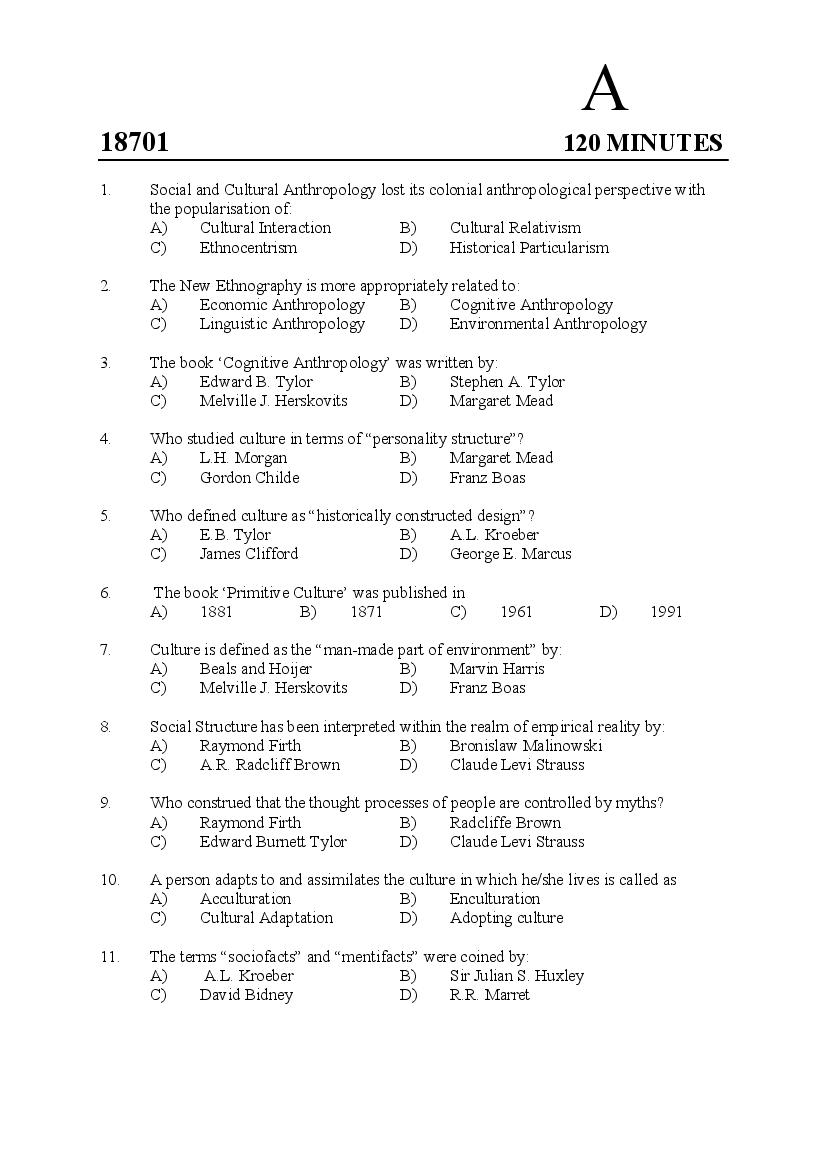
18701 120 MINUTES
1. Social and Cultural Anthropology lost its colonial anthropological perspective with
the popularisation of:
A) Cultural Interaction B) Cultural Relativism
C) Ethnocentrism D) Historical Particularism
2. The New Ethnography is more appropriately related to:
A) Economic Anthropology B) Cognitive Anthropology
C) Linguistic Anthropology D) Environmental Anthropology
3. The book ‘Cognitive Anthropology’ was written by:
A) Edward B. Tylor B) Stephen A. Tylor
C) Melville J. Herskovits D) Margaret Mead
4. Who studied culture in terms of “personality structure”?
A) L.H. Morgan B) Margaret Mead
C) Gordon Childe D) Franz Boas
5. Who defined culture as “historically constructed design”?
A) E.B. Tylor B) A.L. Kroeber
C) James Clifford D) George E. Marcus
6. The book ‘Primitive Culture’ was published in
A) 1881 B) 1871 C) 1961 D) 1991
7. Culture is defined as the “man-made part of environment” by:
A) Beals and Hoijer B) Marvin Harris
C) Melville J. Herskovits D) Franz Boas
8. Social Structure has been interpreted within the realm of empirical reality by:
A) Raymond Firth B) Bronislaw Malinowski
C) A.R. Radcliff Brown D) Claude Levi Strauss
9. Who construed that the thought processes of people are controlled by myths?
A) Raymond Firth B) Radcliffe Brown
C) Edward Burnett Tylor D) Claude Levi Strauss
10. A person adapts to and assimilates the culture in which he/she lives is called as
A) Acculturation B) Enculturation
C) Cultural Adaptation D) Adopting culture
11. The terms “sociofacts” and “mentifacts” were coined by:
A) A.L. Kroeber B) Sir Julian S. Huxley
C) David Bidney D) R.R. Marret
Page 2
through an extension of maternal-uncle and sister’s son relationship.
A) Matrilocal extended family
B) Ambilocal extended family
C) Avunculocal extended family
D) Bilocal extended family
13. The post-marital residence is with or near the groom’s parents is called as:
A) Virilocal B) Bilocal C) Matrilocal D) Neolocal
14. Which is the bigger unit of tribe?
A) Clan B) Moiety C) Phratry D) Lineage
15. The terms “exogamy” and “endogamy” were coined by:
A) E.B. Tylor B) Westermark
C) J.F. McLennan D) G.P. Murdock
16. An individual has several spouses in succession is referred to as:
A) Serial Monogamy B) Polygamy
C) Polygynandry D) Sororal Polygyny
17. In a case, multiple husbands of a woman are own brothers or off-springs of the same
mother, which is called as:
A) Adelphic polyandry B) Non-adelphic polyandry
C) Familial polyandry D) Polyandry
18. Who identified the Classificatory and Descriptive Kinship system?
A) Franz Boas B) McLennan C) L.H. Morgan D) J. Frazer
19. In certain societies, wife stays at her home and husband goes to live with her or visits
her occasionally and in such situation wife’s brother acts as the head of the household
and exercises rights over his sister’s children. This system is known as:
A) Patrilocal B) Matrilocal C) Avunculate D) Amitate
20. The word “Couvade” and its associated idea was introduced to anthropology by:
A) L.H. Morgan B) Franz Boas C) James Frazer D) E.B. Tylor
21. The book ‘Ancient Law’ was written by:
A) E.A. Hobel B) Sir Henry Maine
C) M.J. Herskovits D) Evans Pritchard
22. Stateless political system is represented by:
A) Factual evidences
B) Written law
C) Presence of witnesses and cross-examination
D) Laws and customs
2
Page 3
A) E.R. Leach B) U.C. Hlaing
C) A.R. Walker D) Claude Levi Strauss
24. Read the following statements and choose the correct option.
1. A chiefdom as a form of social organisation is more complex than a tribe or a
band society.
2. It is less complex than a state or a civilization.
A) 1 and 2 are correct
B) 1 and 2 are incorrect
C) 1 is correct and 2 is incorrect
D) 1 is incorrect and 2 is correct
25. Read the following statements and choose the correct options.
1. A norm is simply a shared standard of a social group to which members are
expected to conform.
2. Norm may mean the model or average social behaviour and attitude found in a
social group.
A) 1 and 2 are correct
B) 1 and 2 are incorrect
C) 1 is correct and 2 is incorrect
D) 1 is incorrect and 2 is correct
26. The mobility of Great tradition to Little tradition is
A) Universalisation B) Sanskritisation
C) Parochialisation D) Tribe Caste continuum
27. The sacred-profane dichotomy was proposed by:
A) Franz Boas B) James Frazer
C) James Garber D) Emile Durkheim
28. The book ‘The Rites of Passage’ was written by:
A) Victor Turner B) L.H. Morgan
C) A. Van Gennep D) Marvin Harris
29. Among tribal groups, there may be one or more ghosts or spirits to guide the destiny
of man and this process was theorised as:
A) Manaism B) Shamanism C) Totemism D) Animism
30. Tribal Sub Plan was envisaged in:
A) Fifth Five Year Plan B) Sixth Five Year Plan
C) Seventh Five Year Plan D) Eighth Five Year Plan
31. The attempt to get something for nothing is:
A) General Reciprocity B) Balanced Reciprocity
C) Negative Reciprocity D) Ceremonial exchange
3
Page 4
A) Clockwise
B) Anticlockwise
C) Both clockwise and anticlockwise
D) Many directions
33. The book ‘Habitat, Economy and Society’ was written by:
A) Darryl Ford B) Karl Polanyi
C) Bronislaw Malinowski D) Keith Hart
34. Nuer tribe is categorised as:
A) Hunting B) Fishing C) Pastoralist D) Gathering
35. Which is not categorised on the basis of way of subsistence?
A) Hunting and Gathering Communities
B) Pastoral Communities
C) Fishing Communities
D) Island Communities
36. The study of fossilized human remains is coming under ---- branch of the biological
anthropology.
A) Osteology B) Human Osteology
C) Paleoanthropology D) Skeletal Biology
37. Which is our closest extinct human relative?
A) Homo habilis B) Homo erectus
C) Neanderthal D) Australopithecines
38. Homo erectus was first discovered in:
A) Indonesia B) Africa C) France D) Germany
39. Identify the archaeological period corresponding to the span of Homo erectus
A) Upper Palaeolithic period B) Lower Palaeolithic period
C) Mesolithic period D) Neolithic period
40. Identify the correct sequence of the glacial periods:
A) Mindel - Riss - Wurm - Gunz
B) Wurm - Gunz - Riss - Mindel
C) Riss - Wurm - Mindel - Gunz
D) Gunz - Mindel - Riss - Wurm
41. Acquired characters are inheritable and they are transmitted to the offspring and it is
one of the main assumptions of ---- theory.
A) Lamarcksim B) Darwinism
C) Mutation D) Neo-Darwinism
4
Page 5
A) Africa B) France C) Australia D) China
43. ABO blood group system is based on ---- on the surface of the red blood cells.
A) Fat B) Protein C) Serum D) Colour
44. The human embryo contains a population of cells known as:
A) Stem cells B) Somatic cells C) Skin cells D) Muscle cells
45. In 1735, who classified the human species into four categories based on skin colour
and geographical regions?
A) Charles Darwin B) Carl Linnaeus
C) Francis Galton D) Harry Nelson
46. Ergonomics is a branch of biological anthropology, which deals with:
A) Repairing machines B) Using machines
C) Making machines D) Human engineering
47. Hydraulic theory of civilization was proposed by:
A) Karl Wittfogel B) Gordon Childe
C) William Sanders D) Herbert Spencer
48. Which civilization is an example for Religion Theory?
A) Mesopotamia B) Harappa C) Maya D) Tikal
49. Which of the following is referred to as Karma Veda?
A) Rig Veda B) Yajur Veda C) Sama Veda D) Atharva Veda
50. Which is the first Purusharthas?
A) Kama B) Dharma C) Artha D) Moksha
51. The Indo-European family of language belongs to the ---- languages.
A) Aryan B) Dravidian
C) Austro-Asiatic D) Semito-Hamitic
52. In India, according to John Henry Hutton, the oldest race is:
A) Proto-Australoid B) Negrito
C) Nordic D) Scytho-Dravidian
53. The Sree Narayana Dharma Paripalana Yogam was founded in:
A) 1903 B) 1907 C) 1910 D) 1914
54. The Hindu Gaya was studied by:
A) S.C. Dube B) Surajit Sinha
C) L.P. Vidyarthi D) M.N. Srinivas
5
Page 6
A) McKim Marriot B) Surajit Sinha
C) L.P. Vidyarthi D) M.N. Srinivas
56. The concept “Little Community” was introduced by:
A) Robert Redfield B) McKim Marriot
C) Surajit Sinha D) L.P. Vidyarthi
57. The concept of “Criterion of Form and Geographical Statistics” are related to:
A) Neo Evolution B) Diffusion
C) Theory of Need D) Functionalism
58. Population structure implies:
A) Age and Sex B) Marital status
C) Educational status D) Labour force status
59. The theoretical approach Tribe Caste Continuum was proposed by:
A) M.N. Srinivas B) Robert Redfield
C) L.P. Vidyarthi D) Surajit Sinha
60. The concept of Dominant Caste was introduced by:
A) S.C. Dube B) G.S. Ghurye
C) M.N. Srinivas D) Gaya Pandey
61. Castes and communities adopts caste occupations or non-caste occupation with
economic motivation is:
A) Sanskritisation B) Secularisation
C) Pecuniarisation D) Universalisation
62. Which is a Kerala Tribe?
A) Todas B) Marathi C) Ghond D) Kota
63. Identify a Primitive Vulnerable Tribal Group from the following:
A) Kurichian B) Adiyan C) Koragar D) Paniya
64. Relief type of sculpture is a characteristic feature of ---- sculptures.
A) Jain B) Buddhist C) Hindu D) Sikh
65. True arch is an architectural design of which tradition?
A) Hindu B) Jain C) Islamic D) Buddhist
66. The book ‘Social Revolution in a Kerala Village’ was written by:
A) P.R.G. Mathur B) A. Aiyappan
C) L.K. Anantha Krishna Iyer D) K.C. Alexander
6
Page 7
Expedition”, was conducted in the year:
A) 1888 B) 1898 C) 1878 D) 1889
68. Who was known as an armchair scholar?
A) James Frazer B) Friedrich Ratzel
C) Adolf Bastian D) J. J. Bachofen
69. The concept “Cultural Area” is a major theme of:
A) American Diffusion B) German Diffusion
C) Kulturkreis School D) British Diffusion
70. Ethnographic approach do not use:
A) Participant Observation B) Non-Participant Observation
C) Schedule D) Questionnaire
71. The “Questions on the Manners, Customs, Religions, Superstitions, etc.” was revised
and published as:
A) Anthropological Research
B) Primitive Culture
C) Notes and Queries on Anthropology
D) The Golden Baugh
72. Environment is passive and culture is active in shaping cultures, which provides a
paradigm and its process is known as:
A) Cultural Adaptation B) Environmental Determinism
C) Environmental Possibilism D) Cultural Ecology
73. Key informant is generally associated with:
A) Quantitative Research B) Qualitative Research
C) Survey Research D) Experimental Research
74. Statistics was first used in an anthropological research in 1882 by:
A) E.B. Tylor B) W.H.R. Riverse
C) L.H. Morgan D) G.E. Smith
75. Who is the author of the book ‘The Todas’?
A) Anthony Walker B) Paul Hockings
C) M.B. Emeneau D) W.H.R. Rivers
76. Intensive fieldwork was introduced by:
A) Malinowski B) Robert Redfield
C) Margaret Mead D) Radcliffe Brown
7
Page 8
A) H. Russell Bernard B) Pertti J. Pelto and Gretel H. Pelto
C) Karen Cantrell D) Linda M. Whiteford and Robert T. Trotter
78. The Estate system is of ---- origin.
A) China B) Australia C) Europe D) Africa
79. The use of the word “primitive” has become obsolete with the popularisation of:
A) Cultural Judgement B) Cultural Integration
C) Cultural Adaptation D) Cultural Relativism
80. The book ‘Local Knowledge’ was written by:
A) George E. Marcus B) Clifford Geertz
C) James Clifford D) G. Banfield
81. The mankind of the world progress in similar way under similar environmental
condition and this paradigm was identified as:
A) Diffusion of culture traits B) Psychic unity of mankind
C) Cultural exchange D) Cultural progression
82. Marvin Harris is associated with the:
A) Historical Particularism B) Cultural Materialism
C) Environmental Determinism D) Environmental Possibilism
83. Culture climax was proposed by:
A) A.L. Kroeber B) G.E. Smith
C) Clark Wissler D) Julian H. Steward
84. The usage ‘Cultural Taxonomy’ was introduced by:
A) Julian H. Steward B) Leslie A. White
C) V. Gordon Childe D) Adolf Bastian
85. The book entitled ‘The Chrysanthemum and the Sword’ was written by:
A) Ruth Benedict B) Margaret Mead
C) Abram Kardiner D) Ralph Linton
86. The Content Analysis Method was developed and applied during:
A) French Revolution B) Second World War
C) Russian Revolution D) None of the above
87. The concept of Food Areas is related to:
A) Neo Evolution B) Theory of Need
C) Diffusion D) Functionalism
88. The book entitled ‘Coral Gardens and Their Magic’ was written by:
A) Raymond Firth B) A.R. Radcliffe Brown
C) B. Malinowski D) Claude Levi Strauss
8
Page 9
A) Clark Wissler B) G.E. Smith
C) Malinowski D) Julian H. Steward
90. The approach of ‘going native’ was introduced by:
A) A.L. Kroeber B) Radcliffe Brown
C) B. Malinowski D) E.R. Leach
91. The Trait List approach was associated with:
A) British Diffusionism B) German Diffusionism
C) Both A and B D) None of these
92. ‘A Scientific Theory of Culture’ was written by:
A) A.L. Kroeber B) Clark Wissler
C) B. Malinowski D) Radcliffe Brown
93. Choose the option that provides right match of the items in List I of Basic needs with
that of List II of Cultural Responses.
List I - Basic Needs List II - Cultural Responses
1. Metabolism a. Protection
2. Reproduction b. Commissariat
3. Bodily comforts c. Kinship
4. Safety d. Shelter
A) 1-b , 2-a , 3-c, 4-d B) 1-a , 2-c , 3-d, 4-b
C) 1- b, 2-c , 3-d, 4-a D) 1- d, 2-c , 3-a, 4-b
94. Who proposed the paradigm of continuum in anthropology?
A) Surajit Sinha B) L.P. Vidyarthi
C) McKim Marriot D) Robert Redfield
95. Who is the author of the book ‘Malay Fishermen: Their Peasant Economy’?
A) Raymond Firth B) Robert Redfield
C) George Dalton D) David Kaplan
96. The first full-length peasant study using modern anthropological research methods
was conducted among the peasants of:
A) America B) Australia C) Mexico D) India
97. The analogy of organism to construe social structure was put forwarded by:
A) B. Malinowski B) Raymond Firth
C) Radcliffe Brown D) Claude Levi Strauss
98. The paradigm of Structural Functionalism holds ---- idea.
A) Cultural differences B) Cultural integration of a society
C) Cultural function D) Cultural traits
9
Page 10
A) Jarawas B) Onge C) Sentinelese D) Nicobarese
100. Who formulated the method of study of a culture at a distance?
A) Margaret Mead B) Ruth Benedict
C) France Boas D) Robert Redfield
101. The book ‘Sex and Temperament in Three Primitive Societies’ was written by:
A) Margaret Mead B) Abram Kardiner
C) Ralph Linton D) Ruth Benedict
102. The theoretical background of National Character Study is:
A) Psychological Theory
B) Cultural theory
C) Cultural and Psychological Theory
D) Culture and Personality
103. The author of the book ‘Coming of Age in Samoa’ is:
A) Margaret Mead B) Ruth Benedict
C) Mary Douglas D) Henrietta Moore
104. The book entitled “Argonauts of the Western Pacific” was written by:
A) Radcliffe Brown B) E.R. Leach
C) A.L. Kroeber D) B. Malinowski
105. The book ‘Elementary Structures of Kinship’ was written by:
A) W.H.R. Rivers B) A.L. Kroeber
C) Claude Levi-Strauss D) A.R. Radcliffe Brown
106. The structure of human thought process has foremost importance in understanding
concrete reality and the very theoretical framework is known as:
A) Structural Functionalism B) Psychological Anthropology
C) Structuralism D) Functionalism
107. Binary opposition was severely criticised by:
A) Functionalists B) Structural Functionalists
C) Structuralists D) Post-Structuralists
108. To understand an object, it is inevitable to study both the object and the systems of
knowledge that produced the object, which is a methodological aspect of:
A) Post-structuralism B) Structuralism
C) Cultural Patterns D) National Character
109. Development Anthropology was proposed in 1971 by:
A) Michael Horowitz B) Glynn Cochrane
C) Roger M. Keesing D) Bob Berg
10
Page 11
A) Aristotle B) Ernest Haeckel
C) Plato D) Steward
111. Identify the branch of ecology which deals on how different cultures view different
aspects of their environment.
A) Population ecology B) System ecology
C) Ethno-ecology D) Political ecology
112. To analyse the man-environment relationship, the exploitative technology and the
behaviour involved in the interaction of man to the environment are the basic aspects of:
A) Environmental Determinism B) Environmental Possibilism
C) Cultural Adaptation D) Cultural Ecology
113. Ecological Anthropology was introduced by:
A) Raymond Firth B) Roy A. Rappaport
C) Clark Wissler D) A.L. Kroeber
114. Read the following statements and choose the correct options:
1. Ethnoecology is a study of how different groups of people living in different
places understand the ecosystems around them and their relationships with the
surrounding environment.
2. Ethnoscience seeks how cultures perceive world and classify and organise
their own environment.
A) 1 & 2 are correct B) 1 & 2 are incorrect
C) 1 is correct & 2 is incorrect D) 1 is incorrect & 2 is correct
115. Choose the most appropriate answer regarding the subject matter of Medical Anthropology.
A) Study of diseases
B) Study of socio cultural dimensions of health and diseases
C) Study of health
D) Study of ethno medicine
116. Of the following two statements, one is labelled as Assertion (A) and the other as Reason (R).
Assertion (A): Medical Anthropology’s one area of interest is how different groups views
disease processes and how these views affect treatment or the willingness to
accept treatment.
Reason (R): All the people accept all modern medicines but do not go for modern
treatments.
A) (A) and (R) are correct
B) (A) is correct and (R) is incorrect
C) (A) is incorrect and (R) is correct
D) (A) and (R) are incorrect
11
Page 12
A) Coming to the base camp of a community
B) The regular migration of a community
C) Irregular movement of community
D) The movement of a community for grazing their herds
118. Who developed economic anthropology from the Marxian perspective?
A) Maurice Godlier B) Paul Bohannan
C) Raymond Firth D) Malinowski
119. The book ‘Mappila Fisher Folk of Kerala’ was written by:
A) Joan P. Mencher B) K.C. Alexander
C) P.R.G. Mathur D) A. Aiyappan
120. Barrel-shaped roof is a special feature of the huts of:
A) Kotas B) Todas C) Chenchus D) Nuer
________________________
12
Document Details
| Board / Org | Kerala Exams |
| Exam | Kerala SET |
| Type | Question Paper |
| Pages | 12 |
| Updated | 23 Oct 2026 |