Kerala SET 2018 Jul Question Paper Economics
Finished viewing? Save it for later —
Download Kerala SET 2018 Jul Question Paper Economics (PDF · 16 pages)About Kerala SET 2018 Jul Question Paper Economics
Kerala SET 2018 Jul Question Paper Economics is available here for free download. Published by Kerala Exams for Kerala SET, this question paper can be viewed online or downloaded as a PDF (16 pages). Candidates preparing for Kerala SET can use Kerala SET 2018 Jul Question Paper Economics to understand the exam pattern, the type of questions asked, and the overall difficulty level.
Frequently Asked Questions
How can I download Kerala SET 2018 Jul Question Paper Economics?
Open this page and click the Download button to save Kerala SET 2018 Jul Question Paper Economics as a PDF. It is completely free on AglaSem Docs.
Is Kerala SET 2018 Jul Question Paper Economics free to download?
Yes. Kerala SET 2018 Jul Question Paper Economics can be viewed online and downloaded as a PDF free of cost on AglaSem Docs.
How many pages does Kerala SET 2018 Jul Question Paper Economics have?
Kerala SET 2018 Jul Question Paper Economics contains 16 pages, which you can read online or download together as a single PDF.
Where can I find more Kerala SET study material?
You can find more Kerala SET question papers, sample papers, syllabus, and answer keys on AglaSem Docs.
Kerala SET 2018 Jul Question Paper Economics – Text
Read the full text of this question paper below — useful to quickly search, copy and reference the content online without downloading the PDF.
📄 View text version (16 pages)
Page 1
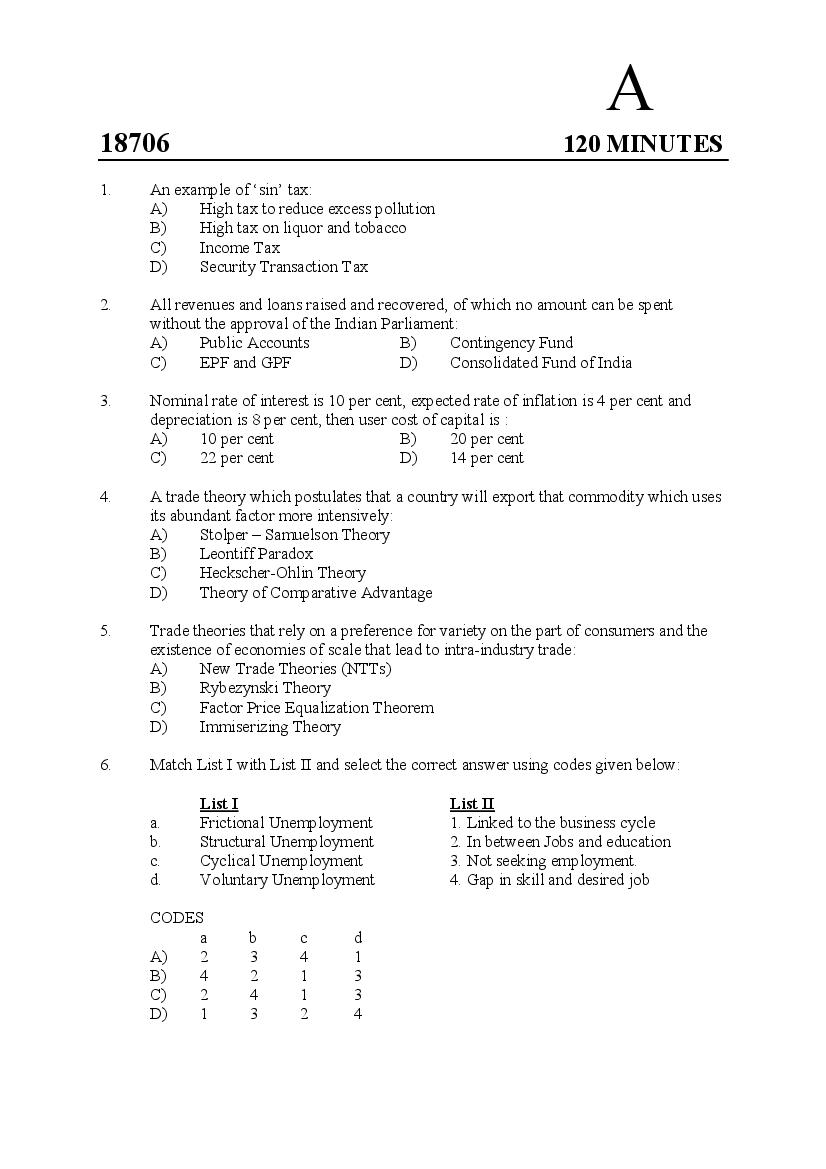
18706 120 MINUTES
1. An example of ‘sin’ tax:
A) High tax to reduce excess pollution
B) High tax on liquor and tobacco
C) Income Tax
D) Security Transaction Tax
2. All revenues and loans raised and recovered, of which no amount can be spent
without the approval of the Indian Parliament:
A) Public Accounts B) Contingency Fund
C) EPF and GPF D) Consolidated Fund of India
3. Nominal rate of interest is 10 per cent, expected rate of inflation is 4 per cent and
depreciation is 8 per cent, then user cost of capital is :
A) 10 per cent B) 20 per cent
C) 22 per cent D) 14 per cent
4. A trade theory which postulates that a country will export that commodity which uses
its abundant factor more intensively:
A) Stolper – Samuelson Theory
B) Leontiff Paradox
C) Heckscher-Ohlin Theory
D) Theory of Comparative Advantage
5. Trade theories that rely on a preference for variety on the part of consumers and the
existence of economies of scale that lead to intra-industry trade:
A) New Trade Theories (NTTs)
B) Rybezynski Theory
C) Factor Price Equalization Theorem
D) Immiserizing Theory
6. Match List I with List II and select the correct answer using codes given below:
List I List II
a. Frictional Unemployment 1. Linked to the business cycle
b. Structural Unemployment 2. In between Jobs and education
c. Cyclical Unemployment 3. Not seeking employment.
d. Voluntary Unemployment 4. Gap in skill and desired job
CODES
a b c d
A) 2 3 4 1
B) 4 2 1 3
C) 2 4 1 3
D) 1 3 2 4
Page 2
List I List II
a. Kerala Panchayat Raj Act 1. 2008
b. Kerala Conservation of Paddy and Wet Land Act 2. 1957
c. Kerala Land Conservancy Act 3. 1969
d. Kerala Land Reforms (Amendment) Act 4. 1994
CODES
a b c d
A) 2 3 4 1
B) 4 2 1 3
C) 2 4 1 3
D) 4 1 2 3
8. Identify the district with lowest percentage of population above 65 years of age (Ageing):
A) Pathanamthitta B) Thiruvananthapuram
C) Kozhikode D) Malappuram
9. Labour Force Participation Rate (LFPR) means:
A) Ratio of employed persons per 1000 persons in the 15-65 age group.
B) Ratio of employed or seeking employment per 1000 persons in the 15-65 age groups.
C) Ratio of persons seeking employment in the total population.
D) Ratio of persons seeking employment in the 15-65 age group.
10. Identify the wrong statement/s from the following.
1. The total outstanding liabilities of the central government include internal
debt, external debt and other liabilities like provident fund and small savings.
2. In the total liabilities of the central government, external debt and other
liabilities other than internal debt contribute more than 25 per cent of GDP.
3. Contribution of internal debt to GDP remains less than 40 per cent.
A) Only 2 is wrong B) 1 and 3 are wrong
C) 2 and 3 are wrong D) Only 1 is wrong.
11. The targeted fiscal deficit of the government of India for the year 2018-19:
A) 3.0 per cent of GDP B) 3.1 per cent of GDP
C) 3.3 per cent of GDP D) 3.5 per cent of GDP
12. NSSO and CSO come under:
A) Ministry of Statistics and Programme Implementation
B) Ministry of Finance
C) Ministry of Industry and Commerce
D) RBI
13. India became a signatory to the Ramsar Convention in:
A) 1991 B) 1990 C) 1982 D) 2000
2
Page 3
1. NGT was established in 1993 under the NGT Act.
2. NGT is not bound by the procedure laid down under the Code of Civil
Procedure, 1908.
3. NGT is guided by the principles of natural justice.
A) Only 2 is correct B) 1 and 3 are correct
C) 2 and 3 are correct D) Only 1 is correct
15. Factor remittances to India is included in the:
A) Trade Account of the BoP B) Current Account of the BoP
C) Capital Account of the BoP D) Reserve Account of the BoP
16. Receipts from sale of shares of Central Public Sector enterprises:
A) Capital receipts B) Non-debt capital receipts
C) Revenue receipts D) Non tax receipts
17. Arc elasticity gives a better estimate of point elasticity of a curvelinear demand curve as:
A) The size of the arc becomes smaller
B) The curvature of the demand curve over the arc becomes less
C) Both A and B
D) Neither of the above
.
18. When a linear consumption function undergoes a parallel shift downwards, the
investment multiplier will:
A) Fall B) Rise marginally
C) Become double D) Remain as before
19. Choose the correct period and Chairman of the Union Finance Commissions:
1. Vijay Kelkar – 13th Finance Commission – 2010-2015
2. C. Rangarajan – 12th Finance Commission – 2005-2010
3. N.K Singh – 15th Finance Commission – 2020-2025
4. Y.V. Reddy – 14th Finance Commission – 2015-2020
Codes:
A) 4 and 2 are correct B) 1 and 4 are correct
C) 2, 3 and 4 are correct D) All are correct
20. The Debt to GSDP ratio of Kerala in 2016-17 is:
A) 24.24 B) 26.78 C) 30.22 D) 19.45
21. Among India’s trading partners, identify the country with which India has highest
trade deficit:
A) USA B) Saudi Arabia C) South Korea D) China
3
Page 4
LokSabha in August 2017:
A) Code on Wages
B) Code on Safety and Working Conditions
C) Code on Industrial Relations
D) Code on Social Security and Welfare.
23. According to A O Hirschman, the industry with the highest combined linkages turned
out to be:
A) Petro chemicals B) Iron & Steel
C) Consumer Goods D) Cement
24. Rejecting null hypothesis, when it is true:
A) Type I error B) Type II error
C) Standard error D) Sampling error
25. Economic growth results:
A) Increase in poverty B) Increase in income
C) Increased welfare to poor D) Reduction in inequality
26. Based on Expert Group on Poverty under the Chairmanship of Dr. C. Rangarajan
(2012), consider the following statements:
1. 11.3 % of the population is BPL in 2011-12 in Kerala
2. 7.3 % of the rural population is BPL in 2011-12 in Kerala
3. The Expert Group computed the average requirements of calories, proteins
and fats based on ICMR norms.
Select the correct answer
A) 1 and 2 are correct B) 2 and 3 are correct
C) 1,2 and 3 are correct D) Only 3 is correct
27. If the two regression equations are 2x+3y-70 =0 and 3x+2y-80=0, obtain the
coefficient of correlations between x and y
A) 2/3 B) -2/3 C) -1/3 D) 1/3
28. Assume the figures given below are current practical cases:
Total Revenue Receipts Rs. 34500/-
Total Capital Receipts excluding Disinvestments Rs. 15400/-
Disinvestments Receipts Rs. 2300/-
Interest Payments Rs. 1250/-
Total Expenditure Rs. 56800/-
Find Primary deficits from the above statements of figures.
A) 3350 B) 6900 C) 5650 D) 3550
4
Page 5
A) Gold has been replaced by a new international reserve asset called SDRs
B) It is considered as ‘Paper Gold’
C) The idea of SDRs was approved in principle at the IMF’s annual meeting in 1950.
D) There is no compulsion to repay previous borrowings from the IMF while
drawing on SDRs.
30. Depression can be remedied by the government even without a budgetary deficit:
A) Pigou Effect B) Haavelmo Effect
C) Spread Effect D) Wealth Effect
31. Wages cut leads to lower interest rates and increased investment:
A) Real Balance Effect B) Pigou Effect
C) Wealth Effect D) Keynes Effect
32. Among the following, who is NOT a Keynesian?
A) Arthur Okun B) Ackley
C) James Tobin D) Anna J Schwartz
33. Structural inflation hypothesis is introduced by:
A) James Tobin B) Charles Schultze
C) G.Myrdal D) Lawrence Klein
34. Match List I with List II and select the correct answer using codes given below:
List I List II
a. Inflation 1. Reduce inflationary trend in Prices without
causing Unemployment
b. Deflation 2. Insufficiency of effective demand
c. Disinflation 3. Government intervention in the price control
d. Suppressed inflation 4. Entrepreneurs benefit
CODES
a b c d
A) 1 2 3 4
B) 2 4 1 3
C) 4 2 1 3
D) 3 2 1 4
35. The theory of continuous market clearing is a proposition of:
A) New Classical economics B) Supply Side economics
C) Monetarism D) New Keynesian economics.
36. The demand curve for a commodity is given by p=20-√ where p and are the price and
amount of the commodity respectively. Then the elasticity of demand at price p = 2 is
A) 2/9 B) -36 C) 162 D) None of these
5
Page 6
10.8. Then the observations are:
A) 54 and 6 B) 81 and 4 C) 36 and 9 D) 27 and 12
38. Skewness is said to be negative when:
A) Mean > Median > Mode B) Mean < Median < Mode
C) Mean > Median < Mode D) Mean > Mode < Median
39. If price comes down by 15 per cent which leads to rise in sales by 20 per cent each
time, then there is:
A) Curvilinear relationship between price and sales.
B) Positive relationship between price and sales.
C) Linear relationship between price and sales
D) Negative relationship between price and sales.
40. All of the solutions possible in the face of existing constraints are described:
A) Dual Solutions B) Primal Solutions
C) Optimal Solutions D) Feasible Solutions.
41. The strategy of maximizing the minimum payoff in game theory:
A) Maximin strategy B) Minimax strategy
C) Mixed strategy D) Pure Strategy
42. A measure of the monopoly power in an industry, which is given by the sum of the
squared values of the market sales shares of all the firms in the industry:
A) Lerner Index B) Herfindahl Index
C) Contestable Market Theory D) Cost Price Index
43. An industry whose long-run supply curve is positively sloped because factor prices
rise as industry output expands:
A) Increasing cost industry B) Decreasing cost industry
C) Constant cost industry D) Crossing Break-even point.
44. The practice of charging different prices in different markets in such a way that the
last unit of the commodity sold in each market gives the same MR:
A) First Degree Price discrimination
B) Second Degree Price discrimination
C) Third Degree Price discrimination
D) Price control under Monopoly.
45. Each oligopolistic firm attempting to maximize its total profits assumes that the other
firm holds its output constant:
A) Bertrand model B) Cournot model
C) Sweezy model D) Chamberlin model.
6
Page 7
isoquant:
A) Production contract curve
B) Product transformation curve
C) Slope of the transformation curve
D) Production possibility curve.
47. The curve that shows the amount of commodity that the consumer would purchase per
unit time at various levels of income:
A) Consumer’s demand curve B) Engel Curve
C) Price consumption curve D) Marginal Utility curve
48. The maximum output an economy can produce without putting upward pressure on
the price level:
A) Nominal GDP B) Potential GDP
C) Real GDP D) GDP at constant Price.
49. Identify the wrong statement:
A) In recession period, GDP gap is negative
B) GDP gap is positive when real GDP is less than potential GDP
C) In recession period, GDP gap is positive.
D) Increase in nominal GDP may not result in increase in real GDP
50. Which of the following results to keep the ratio of capital to labour constant?
A) Capital deepening B) Highly skilled and trained workers
C) Technological advance D) Capital widening
51. Production possibilities curves of two nations usually differ because:
A) Differences on natural resource endowments
B) Differences in consumption pattern
C) Differences in public expenditure
D) Differences in foreign trade.
52. Supply side economics favoured:
A) Reduction capital gains tax rates
B) Increase in income tax rates.
C) Increase in corporate tax rates
D) Increase in labour welfare schemes.
0.2 0.4
53. The technological matrix of a two sector economy is given by = . Then
0.3
the maximum value of d for which technology is viable:
A) 0.45 B) 0.65 C) 0.85 D) None of these
7
Page 8
I. Power of a test is a function of type I – error
II. Type II- error is committed when we reject a true null hypothesis
III. Z- test has the widest range of applicability among all the commonly used tests
A) I and II are true and III is false
B) I and II are false and III is true
C) I and III are true and II is false
D) II and III are false and I is true
55. A theory postulating that the value or price of a commodity is equal to the amount of
labour time involved in the production of a commodity:
A) Malthusian theory of Population
B) Opportunity cost theory
C) Labour theory of value
D) Labour Surplus theory
56. Decreasing opportunity costs to produce more and more units of a commodity are
given by a production possibilities curve that is:
A) Straight line parallel to the X axis
B) Straight line parallel to the Y axis
C) Concave to the origin
D) Convex to the origin
57. A form of economic union that removes all barriers on trade among member nations,
harmonizes trade policies toward the rest of the world, allows for the free movement
of labour and capital among member nations and also harmonizes the monetary, fiscal
and tax policies of its members:
A) Common Market B) Customs Union
C) Economic Union D) Free Trade Area
58. Match List I with List II and select the correct answer using codes given below:
List I List II
a. Stolper-Samuelson theorem 1. Devaluation/Depreciation
b. Offer curve 2. Increase in income of nation’s scarce factor.
c. NIEO 3. Reciprocal demand curve
d. J – Curve effect 4. A set of demands of developing countries
CODES
a b c d
A) 2 3 4 1
B) 4 2 1 3
C) 2 4 1 3
D) 1 3 2 4
8
Page 9
List I List II
a. Smithsonian Agreement 1.1971
b. Maastricht Treaty 2. 1978
c. Jamaica Accords 3. 1979
d. European Monetary System 4. 1991
CODES
a b c d
A) 2 3 4 1
B) 4 2 1 3
C) 1 4 2 3
D) 1 3 2 4
60. Imports of lower-cost supplier from outside the union are replaced by goods and
services from a higher-cost supplier from within, and then it is:
A) Trade diversion
B) Trade creation
C) Abundant Factor prices to rise
D) Abundant Factor prices remain constant
61. Which of the following is NOT a correct statement?
A) Trough is the bottom of a business cycle.
B) Tight monetary policy is a feature during high inflation.
C) India’s budget is surplus on revenue account.
D) India keeps multiple currencies as foreign exchange reserves
62. Among the following, an investor takes the maximum project risk:
A) Mutual Fund B) Private Equity Fund
C) Hedge Fund D) Venture Capital Fund
63. Dow Theory is based on:
A) Three basic Principles B) Four basic Principles
C) Five basic Principles D) Six basic Principles
64. The parties can first approach/appeal against the orders of SEBI:
A) High Court of the concerned state,
B) Forward Market Commission.
C) Ministry of Finance, Government of India
D) Securities Appellate Tribunal.
65. According to Monetarists, money supply consists of:
A) Currency money, demand deposits and time deposits
B) Currency money and demand deposits
C) Only Currency money
D) All alternative liquid stores of value.
9
Page 10
view is held by:
A) D. Robertson B) Keynes
C) James Tobin D) Milton Friedman
67. Banks’ credit creation capacity will reduce when:
A) CRR is increased B) Bank rate falls
C) Repo rate rises D) Repo rate falls.
68. Merchant banking activities in India governed by:
A) Guidelines of SEBI and Ministry of Finance
B) Companies Act, 1956
C) Securities Contracts (Regulation) Act, 1956
D) All the above
69. Identify the strategic variable in the Classical theory of employment:
A) Income
B) Interest rate
C) Investment and full employment
D) Saving and Say’s Law of market
70. The origin of monetarism lies in:
A) Effective Demand and Marginal Efficiency of Capital.
B) Money supply
C) Quantity theory of money
D) Monetary Rule.
71. The horizontal portion of the AS curve is called:
A) The Classical range B) The Keynesian range
C) The Neo-classical range D) The intermediate range
72. Who is the present Vice Chairman of NITI Aayog?
A) Rajiv Kulkarni B) Aravind Subramaniam
C) Aravind Panagaria D) Rajiv Kumar
73. Identify a variable from the following NOT influencing the value of HDI:
A) Literacy Rate B) Sex Ratio
C) Child Mortality Rate D) Infant Mortality Rate
74. The expansionary momentum from the centres of economic expansion to other
regions is:
A) Back wash effects B) Keynes Effect
C) Wealth effect D) Spread effects
75. An increase in the supply of real money balances will cause:
A) The LM curve to shift down to the right
B) The IS curve to shift down and to the right.
C The IS curve to shift up and to the left.
D) The LM curve to shift up and to the left.
10
Page 11
A) Increase in domestic interest rate
B) Fall indomestic private investment
C) Increased public investment.
D) Rise in total borrowing.
77. Substitute goods have:
A) Positive Cross Elasticity of demand
B) Negative Cross Elasticity of demand
C) Relatively negative Cross Elasticity of demand
D) None of the above.
78. Literacy rate calculated taking into account the 7 years and above population in the
denominator is called:
A) Crude literacy rate B) Effective literacy rate
C) Literacy estimation D) Literacy projection.
79. Which of the following is NOT an assumption of linear programming?
A) Constant output prices B) Constant input prices
C) Increasing returns to scale D) Technologically fixed factor production
80. The elasticity of technical substitution is measured by:
A) The Slope of the Isoquant
B) The change in the slope of Isoquant
C) The ratio of factor inputs
D) None of the Above
81. In addition to birth rate and death rate, the population growth rate in a defined area is
influenced by:
A) Child Mortality Rate B) IMR
C) Ageing D) Migration
82. The idea of creative destruction is associated with the theory of:
A) A. O Hirschman B) Schumpeter
C) W.W. Rostow D) Nurkse
83. Interest receipts for the loan given to foreign government will be:
A) Credited in the capital account.
B) Debited in the capital account.
C) Credited in the revenue account.
D) Debited in the revenue account.
84. The Keynesian Cross Model:
A) Assumes full employment of resources.
B) Ignores the money market.
C) Is a supply-determined model
D) All the above
11
Page 12
A) K. K. Kurihara B) Solow
C) Meade D) Hicks
86. Which of the following is/ are included in the capital budget of government of India?
A) Loans received from the rest of the world
B) Borrowings from RBI
C) Expenditure on roads, buildings, etc.
D) All the above
87. Trickle –down strategy implies:
A) Reduction in the income of the upper class by deliberate distribution
B) Higher GNP taking care of poverty
C) Increase in green GDP
D) None of the above
88. Theory of Second Best solution was given by:
A) Lipsey B) Lanscaster C) Both A and B D) None of the above
89. Which of the following is considered as the only form of capital under the Meade
Model?
A) Building B) Machine
C) Land D) All the above
90. Which of the following is correct when the slope of the regression line is negative?
A) The correlation coefficient between the dependent and independent
variables is 1
B) The correlation coefficient between the dependent and independent
variables lies between 0 to 1.
C) The correlation coefficient between the dependent and independent
variables is negative
D) The regression line is parallel to X axis.
91. Which of the following statement(s) is/are correct?
The National Agricultural Policy of 2000 in India aimed at:
I) A growth rate of 6% per annum in agriculture
II) Growth with equity
III) Supply driven growth rate
IV) Demand driven growth rate
Which of the statements given above are correct?
A) I and II only B) II and IV only
C) II and III only D) III and IV only
12
Page 13
I Comparative cost advantage theory was put forward by David Ricardo
II Ricardian Theory is a 2x2x1 trade model
A) I only B) II only
C) Both I and II D) None of the above
93. The thesis of ‘Tragedy of the Commons’ was put forward by:
A) Hardin B) Pareto C) Olson D) Ronald Coase
94. Consumer surplus is largest in:
A) Discriminating Monopoly B) Monopolistic Competition
C) Single –price Monopoly D) Perfect Competition
95. Which of the following statement(s) is / are correct?
I Leibenstein introduces two types of incentives for Under Developed Countries
II Leibenstein introduces two types of incentives for advanced economies
III Positive some incentives are those which increase National Income
A) I only B) Both II and III
C) Both I and III D) None of the above
96. The concept of Hindu Rate of Growth was coined by:
A) Amartya Sen B) V K R V Rao
C) Dadabhai Navroji D) H W Singer
97. Opportunity cost in international trade means:
A) The cost incurred in availing or containing opportunities.
B) Loss of money due to not availing the opportunity
C) The cost on opportunistic item
D) How much of one commodity must be given up to get more of the other.
98. Which of the following statement(s) is/ are correct?
I. St. Petersburg Paradox is a paradox related to probability and decision
theory in economics.
II. St. Petersburg paradox is based on a particular (theoretical) lottery game that
leads to a random variable with infinite expected pay-off.
A) I only B) II only
C) Neither I nor II D) Both I and II
99. Assertion (A ) : The AVC Curve is ‘U’ shaped.
Reason (R): Marginal opportunity cost determines slope of AVC
A) Both (A) and (R) are correct; but (R) is not the correct explanation of (A)
B) Both (A) and (R) are correct; and (R) is the correct explanation of (A)
C) (A) is correct, but (R) is not correct
D) (A) is not correct, but (R) is correct
13
Page 14
optimal provision of
A) Public goods B) Private goods C) Merit goods D) All the above
101. Leibenstein in his Critical Minimum Effort thesis treats population as a factor that is
A) Income depressing B) Income generating
C) Stimulant D) Market-expanding
102. An investment consultant predicts that odds against the price of a certain stock will go
up during the next week are 5:3 and the odds infavour of the price remaining the same
as 3:7. What is the probability that the price of the stock will go down during the next
week?
A) 3/7 B) 3/40 C) 5/8 D) 13/40
103. Assertion (A) : A country’s balance of payments is always equal to zero
Reason (R) : If a country has a deficit in the balance of payments account, this must be
financed by change in reserve, long term capital movements or long term
borrowings
A) Both (A) and (R) are correct; but (R) is not the correct explanation of (A)
B) Both (A) and (R) are correct; and (R) is the correct explanation of (A)
C) (A) is correct, but (R) is not correct
D) (A) is not correct, but (R) is correct
104. During a study of auto accidents the Highway Safety Council found that 70 % of all
accidents occur at night, 80 % are alcohol related and 60 % occur at night and are alcohol
related. What is the probability that an accident occurred at night given that it was
alcohol related?
A) 1/7 B) 1/4 C) 3/4 D) 6/7
105. Which of the assumptions are correct under Cournot’s model?
1. There are only two firms.
2. Firms face Kinked demand curve.
3. Each firm acts on the assumption that the competitor holds its output constant.
A) 1 and 3 only B) 2 and 3 only C) 1 and 2 only D) All the above
106. The taxes which Kaldor proposed for India in 1956 to check tax evasion are:
I Capital gains tax
II Annual tax on wealth
III Personal expenditure tax
IV Gift tax
A) II and III only B) II, III and IV only
C) I, II and III only D) All the above
107. SJSRY was initiated in -----.
A) December 1996 B) April 1997
C) December 1997 D) April 1996
14
Page 15
employment of both labour and capital in the economy. Mrs. John Robinson calls this
as
A) Saddle point B) Shadow point
C) Silver age D) Golden age
109. For a certain establishment the total cost function C and the total revenue function R
are given by = − 15 + 50 + 11 and = 85 − 7 − 21, where x is the
output. Obtain the output for which profit is maximum?
A) 11 B) 7 C) 15 D) 12
110. The Social Marginal Productivity criterion was first put forward by
A) Hollis B. Chenery B) A. E. Khan
C) Both (A) & (B) D) N. S. Buchanan
111. In Harrod-Domar model, actual growth rate is determined by:
A) Saving –Income ratio B) Capital- Output ratio
C) Both A and B D) Neither A nor B
112. Durbin – Watson’d’ statistic is used to test:
A) Serial correlation B) Heteroscedasticity
C) Multicollinearity D) All the above
113. Price effect of an inferior good is:
A) Always positive B) Always negative
C) May be positive D) None of the above
114. Industrial Licensing Policy Enquiry Committee was also known as:
A) Hazari Committee B) Mahalonobis Committee
C) Chakraborty Committee D) Dutt Committee
115. Consider the following Statements:
I. SAARC leaders have agreed upon to create a 'South Asian Free Trade Area'
(SAFTA) during 12th SAARC summit.
II. SAFTA came into force since January 1, 2006 replacing South Asian
Preferential Trade Agreement (SAPTA) which was operative among
SAARC countries, since December 7, 1995.
Which is / are the correct statement(s) from the given code?
A) Only I B) Only II
C) Both I and II D) Neither I nor II
116. Which of the following statement/s is/are correct?
I. Splicing is a technique of linking two or more index number series.
II. Deflating is a technique to eliminate effect of changing price levels
A) Statement I only B) Statement II only
C) Both I and II D) None of the above
15
Page 16
parameters n & p respectively be:
A) 24 and 1/2 B) 18 and 1/4 C) 18 and 2/3 D) 12 and 1/3
118. Given q=AL.3K.7, MPK is:
A) 0 .7 Q/K B) 0 .7 Q/L C) 0.3 Q/L D) 0.3 Q/K
119. Slack variable under linear programming represents:
A) Unused capacity B) Surplus capacity
C) Over utilized capacity D) None of these
120. Which of the following is relevant for Wagner’s Law of Increasing State Activities?
A) Public expenditure does not increase in smooth and continuous manner
B) Public expenditure increase in step like fashion
C) There are inherent tendencies for the activities of the government to increase
both intensively and extensively.
D) Economy grows faster than the governmental sector.
____________________
16
Document Details
| Board / Org | Kerala Exams |
| Exam | Kerala SET |
| Type | Question Paper |
| Pages | 16 |
| Updated | 23 Oct 2026 |