HP Board Class 11 Syllabus 2024 Physics
Finished viewing? Save it for later —
Download HP Board Class 11 Syllabus 2024 Physics (PDF · 6 pages)About HP Board Class 11 Syllabus 2024 Physics
HP Board Class 11 Syllabus 2024 Physics is available here for free download. Published by Himachal Pradesh Board for Class 11, this syllabus can be viewed online or downloaded as a PDF (6 pages). Candidates preparing for Class 11 can use HP Board Class 11 Syllabus 2024 Physics to understand the exam pattern, the type of questions asked, and the overall difficulty level.
Frequently Asked Questions
How can I download HP Board Class 11 Syllabus 2024 Physics?
Open this page and click the Download button to save HP Board Class 11 Syllabus 2024 Physics as a PDF. It is completely free on AglaSem Docs.
Is HP Board Class 11 Syllabus 2024 Physics free to download?
Yes. HP Board Class 11 Syllabus 2024 Physics can be viewed online and downloaded as a PDF free of cost on AglaSem Docs.
How many pages does HP Board Class 11 Syllabus 2024 Physics have?
HP Board Class 11 Syllabus 2024 Physics contains 6 pages, which you can read online or download together as a single PDF.
Where can I find more Class 11 study material?
You can find more Class 11 question papers, sample papers, syllabus, and answer keys on AglaSem Docs.
HP Board Class 11 Syllabus 2024 Physics – Text
Read the full text of this syllabus below — useful to quickly search, copy and reference the content online without downloading the PDF.
📄 View text version (6 pages)
Page 1
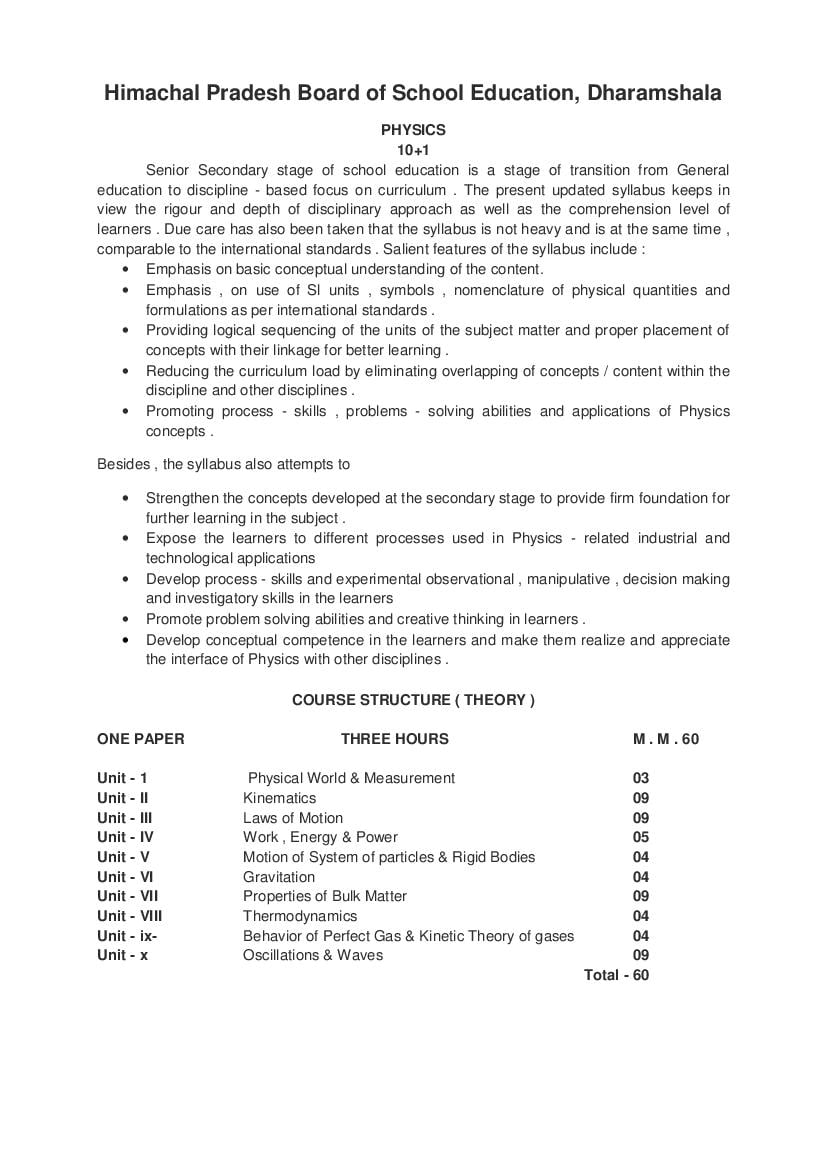
PHYSICS
10+1
Senior Secondary stage of school education is a stage of transition from General
education to discipline - based focus on curriculum . The present updated syllabus keeps in
view the rigour and depth of disciplinary approach as well as the comprehension level of
learners . Due care has also been taken that the syllabus is not heavy and is at the same time ,
comparable to the international standards . Salient features of the syllabus include :
Emphasis on basic conceptual understanding of the content.
Emphasis , on use of Sl units , symbols , nomenclature of physical quantities and
formulations as per international standards .
Providing logical sequencing of the units of the subject matter and proper placement of
concepts with their linkage for better learning .
Reducing the curriculum load by eliminating overlapping of concepts / content within the
discipline and other disciplines .
Promoting process - skills , problems - solving abilities and applications of Physics
concepts .
Besides , the syllabus also attempts to
Strengthen the concepts developed at the secondary stage to provide firm foundation for
further learning in the subject .
Expose the learners to different processes used in Physics - related industrial and
technological applications
Develop process - skills and experimental observational , manipulative , decision making
and investigatory skills in the learners
Promote problem solving abilities and creative thinking in learners .
Develop conceptual competence in the learners and make them realize and appreciate
the interface of Physics with other disciplines .
COURSE STRUCTURE ( THEORY )
ONE PAPER THREE HOURS M . M . 60
Unit - 1 Physical World & Measurement 03
Unit - II Kinematics 09
Unit - III Laws of Motion 09
Unit - IV Work , Energy & Power 05
Unit - V Motion of System of particles & Rigid Bodies 04
Unit - VI Gravitation 04
Unit - VII Properties of Bulk Matter 09
Unit - VIII Thermodynamics 04
Unit - ix- Behavior of Perfect Gas & Kinetic Theory of gases 04
Unit - x Oscillations & Waves 09
Total - 60
Page 2
Physics - scope and excitement ; nature of physical laws , Physics , technology and society . .
Need for measurement : Units of measurement : systems of units : SI units . fundamental and
derived units . Length . mass and time measurements accuracy and precision of measuring
instruments , errors in measurement , significant figures . .
Dimensions of physical quantities , dimensional analysis and its applications .
UNIT - II : KINEMATICS
Frame of reference . Motion in a straight line : Position - time graph , speed and velocity
Uniform and non - uniform motion , average speed and instantaneous velocity . .
Uniformly accelerated motion , velocity - time , position - time graphs , relations for uniformly
accelerated motion ( graphical treatment )
Elementary concepts of differentiation and integration for describing motion.
Scalar and vector quantities : Position and displacement vectors, general vectors and
notation , equality of vector by a real number . addition and subtraction of vector Relative
velocity. Unit vector . Resolution of a vector in a plane-rectangular components. Motion in a
plane. Cases of uniform velocity and uniform acceleration projectile motion. Uniform circular
motion.
UNIT - III : LAWS OF MOTION
Intuitive concept of force , Inertia , Newton ' s first momentum and Newton ' s second law of me
law of motion . Law of conservation of linear momentum and its applications.
Equilibrium of concurrent forces . Static and kinetic friction, Laws of friction, rolling friction.
Dynamics of uniform circular motion : Centripetal force, examples of circular motion (vehicle on
level circular road, vehicle on banked road).
UNIT - IV : WORK , ENERGY AND POWER
Scalar product of vectors . Work done by a constant force and a variable force , kinetic energy ,
work - energy theorem , power .
Notion of potential energy , potential energy of a spring , conservative forces : conservation of
mechanical energy ( kinetic and potential energies ) ; non - conservative forces . elastic and
inelastic collisions in one and two dimensions.
UNIT - V : MOTION OF SYSTEM OF PARTICLES AND RIGID BODY
Centre of mass of a two - particle system . momentum conservation and centre of mass motion .
Centre of mass of a rigid body : centre of mass or uniform rod.
Vector product of vectors : moment of a force , torque , angular momentum , conservation of
angular momentum with some examples.
Equilibrium of rigid bodies rigid body rotation and equations of rotational motion , comparison of
linear and rotational motions : moment of inertia, radius of gyration.
values of moments of inertia for simple geometrical objects ( no derivation ) . Statement of
parallel and perpendicular axes theorems their applications .
Page 3
Keplar ' s laws of planetary motion . The universal law of gravitation .
Acceleration due to gravity and its variation with altitude and depth.
Gravitational potential energy : gravitational potential . Escape velocity.
Orbital velocity of a satellite. Geo-stationary satellites.
UNIT - VII : PROPERTIES OF BULK MATTER
Elastic behavior , Stress - strain relationship . Hooke ' s law , Youngs modulus , bulk
modulus , shear . modulus of rigidity.
Pressure due to a fluid column : Pascal ' s law and its applications ( hydraulic lift and
hydraulic brakes Effect of gravity on fluid pressure.
Viscosity , Stokes ' law , terminal velocity . Reynold ' s number , streamline and
turbulent flow - Bernoulli ' s theorem and its applications.
Surface energy and surface tension angle of contact . application surface tension ideas
to drops , bubbles and capillary rise .
Heat , temperature , thermal expansion / specific heat - calorimetry , change of state -
latent heat .
Heat transfer - conduction , convection and radiation thermal conductivity Newton ' s law
of cooling . ( Periods 12 ) |
Unit VIII : Thermodynamics
Thermal equilibrium and definition of temperature ( zeroth law or thermodynamics ) .
Heat , work and internal energy . First law or thermodynamics .
Second law of thermodynamics : reversible and irreversible processes . Heat engines
and refrigerators . .
Unit IX : Behaviour of Perfect Gas and Kinetic Theory
Equation of state of a perfect gas , work done on compressing a gas .
Kinetic theory of gases - assumptions , concept of pressure . Kinetic energy and
temperature , rms speed of gas molecules , degrees of freedom , law of equipartition of
energy ( statement only ) and application to specific heats of gases ; concept of mean
free path , Avogadro ' s number . . |
Unit x : Oscillations and Waves
Periodic motion - period , frequency , displacement as a function of time .
Periodic functions. Simple harmonic motion (S.H.M) and its equation;
Phase; oscillations of a spring - restoring force and force constant , energy in S . H . M
- Kinetic and potential energies , simple pendulum - derivation expression for its time
period free , forced and damped ( qualitative ideas only ) , resonance .
Wave motion Longitudinal and transverse waves , speed of wave Displacement relation
for a progressive wave . Principle of superposition of waves , reflection of waves ,
standing waves in strings and organ pipes, fundamental mode and harmonics , Beats ,
Doppler effect .
PRACTICALS M . M . 20
Note : Every student will perform 10 experiments ( 5 from each section) and 8 activities ( 4
from each section ) during the academic year.
Two demonstration experiments must be performed by the teacher with participation of
students . The students will maintain a record of these demonstration experiments .
Page 4
- One experiment from any one section
- Two activities ( one from each section )
- Practical Record ( experiments & activities )
- Record of demonstration experiments & Viva Based on these experiments
- Viva on experiments & activities
SECTION - A
Experiments
1. Use of Vernier Callipers
(i) To measure diameter of a small spherical / cylindrical body .
(ii) To measure dimensions of agiven regular body of known mass and hence find its
density .
(iii) To measure internal diameter and depth of a given beakers calorimentre and hence
find its volume .
2. Use of screw gauge
(1) To measure diameter of a given wire ,
(ii) To measure thickness of a given sheet
(iii) To measure volume of an irregular lamina .
3. To determine radius of curvature of a given spherical surface by a spherometer .
4. To find the weight of given body using parallelogram law of vectors.
5. Using a simple pendulum, plot L-T and L-T2 graphs. Hence find the effective length of
second's Pendulum using appropriate graph.
6. To study the relationship between force of limiting frication and normal reaction and to
find co-efficient of frication between a block and a horizontal surface.
7. To find the downward force, along an inclined plane, actiong on a roller due to
gravitational pull of the earth and study its relationship with the angle of inclination by the
plotting graph between force and sinθ.
Activites
1. To make a paper scale of given least count , e . g . 0 . 2cm . 0.5cm
2. Todetermine mass of a given body using a metre scale by princiate moments .
3 To plot agraph for a given set of data , with proper choice of scales and error bars .
4 To measure the force of limiting friction for rolling of a roller on a horizontal plane .
5. To study the variation in range of a jet of water with angle of projection .
6. To study the conservation of energy of a ball rolling down on inclined plane ( using a
double inclined plane ) . . .
7. To study dissipation of energy of a simple pendulum by plotting a graph between square
of amplitude and time . .
Page 5
Experiments
1. To determine Young ' s modulus of elasticity of the material of a given wire .
2. To find the force constant of a helical spring by plottinggraph between load and
extension .
3. To study the variation in volume with pressure for a sample of air at constant
temperature by plotting graphs between P and v , and between P and \ / V .
4. determine the surface tension of water by capillary rise method .
5. To determine the coefficient of viscosity of measuring terminal velocity of a given
spherical body.
6. To study the relationship between the te time by plotting a cooling curve .
7. (i) To study the relation between frequency and length of given wire under constant
tension using sonometer .
( ii ) To study the relation between the length of given wire and tension for constant
frequency using sonometer .
8. To find the speed of sound in air at room temperature tube by two - resonance positions.
9. To determine specific heat of a given ( i ) solid ( ii ) liquid by method of mixtures
Activities
1. To observe change of state and plot a cooling curve for molten way
2. To observe and explain the effect of heating on a bi - metallic strip .
3. To note the change in level of liquid in a container on heating and interpret the
observations .
4. To study the effect of detergent on surface tension by observing capillary rise .
5. To study the factors affecting the rate of loss of heat of a liquid .
6. To study the effect of load on depression of a suitably clamped meter scale loaded ( i )
at its end ( ii ) in the middle . ,
Page 6
class XI
Time : 3 Hrs Design of Question Paper M. M. – 60
Blue Print
S.N. Name of the Unit 1 Mark MCQ 2 marks 3 marks 4 marks Total
Questions Questions Questions Questions Marks
1 Physical world and - - 1 - 3
Measurement
2 Kinematics 1 2 - 1 9
(Internal Choice)
3 Laws of Motion 1 2 - 1 9
(Internal choice)
4 Work, Energy and Power 2 - 1 - 5
(Internal
Choice)
5 Motion of system of particles 1 - 1 - 4
and rigid bodies
6 Gravitation 1 - 1 - 4
(Internal
Choice)
7 Properties of bulk matter 2 2 1 - 9
(1 Internal
Choice)
8 Thermodynamics 1 - 1 - 4
9 Behaviour of Perfect gas and 1 - 1 - 4
Kinetic theory of gases
10 Oscillation and waves 2 - 1 1 9
Break up total 34 Questions 12 6 8 3 29
Total Marks 1x12=12 2x6=12 3x8=24 4x3=12 60
Blue Print of MCQ
Sr. No Type of question Number of questions
1 Concept based /direct 2
2 Numerical based 2
3 Match the columns 2
4 Case study /comprehension 2
5 Assertion and reasoning 2
6 Diagram graph interpretation 1
7 Miscellaneous understanding and knowledge based 1
Total number of questions 12
Each MCQ carries one mark only
No internal choice be given in the MCQ section
PRESCRIBED BOOKS
Physics Published by HPBOSE Dharamshala
Document Details
| Board / Org | Himachal Pradesh Board |
| Exam | Class 11 |
| Type | Syllabus |
| Pages | 6 |
| Updated | 22 Jul 2026 |