HBSE Class 12 Sample Paper 2026 Answers Biotechnology
Finished viewing? Save it for later —
Download HBSE Class 12 Sample Paper 2026 Answers Biotechnology (PDF · 29 pages)About HBSE Class 12 Sample Paper 2026 Answers Biotechnology
HBSE Class 12 Sample Paper 2026 Answers Biotechnology is available here for free download. Published by Haryana Board for Class 12, this answer key can be viewed online or downloaded as a PDF (29 pages). Candidates preparing for Class 12 can use HBSE Class 12 Sample Paper 2026 Answers Biotechnology to understand the exam pattern, the type of questions asked, and the overall difficulty level.
Frequently Asked Questions
How can I download HBSE Class 12 Sample Paper 2026 Answers Biotechnology?
Open this page and click the Download button to save HBSE Class 12 Sample Paper 2026 Answers Biotechnology as a PDF. It is completely free on AglaSem Docs.
Is HBSE Class 12 Sample Paper 2026 Answers Biotechnology free to download?
Yes. HBSE Class 12 Sample Paper 2026 Answers Biotechnology can be viewed online and downloaded as a PDF free of cost on AglaSem Docs.
How many pages does HBSE Class 12 Sample Paper 2026 Answers Biotechnology have?
HBSE Class 12 Sample Paper 2026 Answers Biotechnology contains 29 pages, which you can read online or download together as a single PDF.
Where can I find more Class 12 study material?
You can find more Class 12 question papers, sample papers, syllabus, and answer keys on AglaSem Docs.
HBSE Class 12 Sample Paper 2026 Answers Biotechnology – Text
Read the full text of this answer key below — useful to quickly search, copy and reference the content online without downloading the PDF.
📄 View text version (29 pages)
Page 1
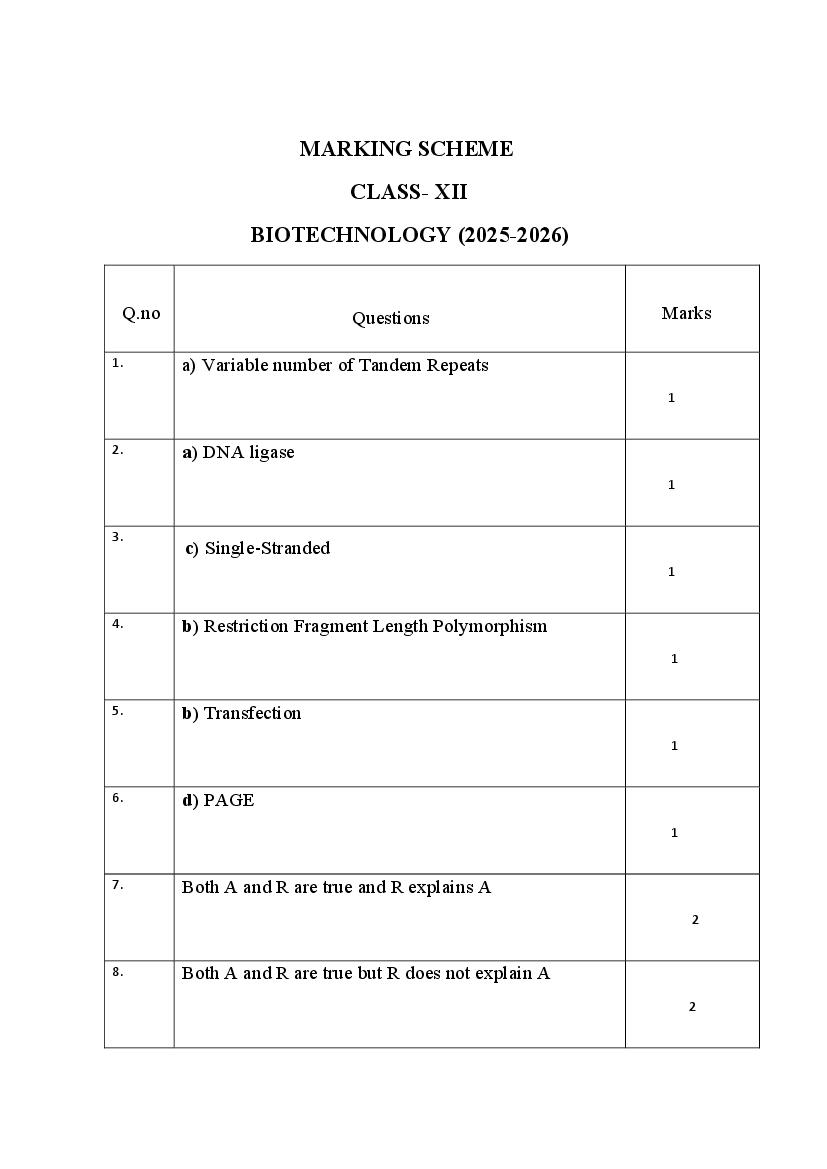
CLASS- XII
BIOTECHNOLOGY (2025-2026)
Q.no Questions Marks
1. a) Variable number of Tandem Repeats
1
2. a) DNA ligase
1
3.
c) Single-Stranded
1
4. b) Restriction Fragment Length Polymorphism
1
5. b) Transfection
1
6. d) PAGE
1
7. Both A and R are true and R explains A
2
8. Both A and R are true but R does not explain A
2
Page 2
1
10. Tissue Culture
1
11. Plasmid
1
12. Cryopreservation
1
13. Virus-free plant production
1
14. Micropropagation
1
15. Sickle Cell Anemia
1
16. What are Restriction Enzymes?
Restriction enzymes, also known as restriction
endonucleases, are specialized enzymes that can cut
DNA at specific sequences, usually palindromic
sequences (same forward and backward).
• Naturally found in bacteria to defend against
viral DNA.
• They recognize specific nucleotide sequences
(called recognition sites) and cut the DNA at or
near those sites.
Example:
Page 3
sequence:
GAATTC and cuts between G and A.
2
Why Are They So Important in DNA
Technology?
1. Cutting DNA Precisely:
Allows scientists to cut DNA at exact locations.
2. Creation of Recombinant DNA:
Used to insert foreign genes into plasmids
(vectors).
3. Gene Cloning:
Essential in inserting genes into bacteria or
other organisms to replicate.
4. Genetic Engineering:
Enables modification of DNA to create
genetically modified organisms (GMOs).
5. DNA Fingerprinting & Diagnosis:
Helps in identifying individuals or detecting
mutations in DNA.
17. What are Cry Proteins?
Cry proteins (short for crystalline proteins) are toxic
proteins produced by the bacterium Bacillus
thuringiensis (Bt).
These proteins have insecticidal properties and are
used in genetically modified (GM) crops to protect
them from insect pests.
2
Page 4
• When an insect larva eats the Cry protein, it
gets activated in the alkaline gut of the insect.
• The protein creates pores in the gut lining,
causing the insect to die from dehydration or
starvation.
Example of Cry Protein:
• Cry1Ac and Cry2Ab: Used in Bt cotton to kill
bollworms.
• Cry1Ab: Used in Bt corn to protect against corn
borers.
Or
Bioinformatics is the field that combines biology,
computer science, and information technology to
analyze and interpret biological data. It plays a vital
role in modern biotechnology.
Major Uses of Bioinformatics in Biotechnology:
1. Genome Sequencing & Analysis
o Helps in reading and interpreting DNA
sequences of humans, plants, and
microbes.
2. Drug Discovery & Development
o Identifies potential drug targets using
molecular modeling and simulations.
3. Genetically Modified Organisms (GMOs)
o Assists in designing genetically
Page 5
functions.
4. Gene Prediction & Annotation
o Identifies coding regions and predicts gene
functions using DNA data.
5. Comparative Genomics
o Compares genomes of different species to
find evolutionary relationships.
6. Protein Structure Prediction
o Helps model 3D structures of proteins
for understanding their function.
7. Personalized Medicine
o Tailors treatments based on a person's
genetic profile.
8. Database Management
Stores and organizes large volumes of biological
data like NCBI, PDB, GenBank.
Page 6
Feature Stirred Type Bioreactor
Bioreactor
Uses mechanical stirrers Uses spray nozzles to
Working
or impellers to mix spray culture media
Principle
nutrients and cells over surfaces
Oxygen Supplied through spargers Supplied through air
Supply and agitation or gas spray
Efficient due to Limited or uneven
Mixing
mechanical agitation mixing
Immobilized cell
Suspension cultures
Used For cultures or surface 2
(microbial/animal cells)
growing organisms
Typically a cylindrical Tall chamber or
Design tank with baffles and column with trays or
stirrer surfaces
Used for making Used in wastewater
Example antibiotics, vaccines, treatment or plant
enzymes tissue cultures
19. Cloning Vectors are DNA molecules used to carry
foreign genetic material into a host cell for replication
or expression.
Two Common Types of Cloning Vectors:
1. Plasmids
o Small, circular, double-stranded DNA 5
found in bacteria
o Example: pBR322, pUC19
2. Bacteriophages (Phage Vectors)
o Viruses that infect bacteria and can carry
Page 7
o Example: Lambda (λ) phage
Option 2: Define the Terms
a) Callus
A callus is an unorganized, mass of undifferentiated
plant cells that forms when plant tissues are cultured
on a nutrient medium.
• It can later differentiate into shoots or roots under
specific conditions.
b) Explant
An explant is a small piece of plant tissue (like leaf,
root, or stem) that is taken from a plant and used to start
a tissue culture.
20. Gene cloning is the process of making identical copies
of a gene using biological tools and host organisms
(usually bacteria).
Steps in Gene Cloning:
1. Isolation of Gene of Interest
o Extract DNA and isolate the gene you
want to clone.
2. Cutting DNA with Restriction Enzymes
o Use enzymes to cut the gene and plasmid
at specific sites.
3. Insertion into Vector (Recombinant DNA)
Page 8
DNA ligase.
4. Transformation
o Introduce recombinant DNA into a host
cell (like E. coli).
5. Selection of Transformed Cells
o Use markers (e.g., antibiotic resistance) to
identify successful clones.
6. Cloning and Expression
o Allow transformed cells to multiply and
express the cloned gene.
Role of Enzymes in PCR (Polymerase Chain Reaction)
PCR is a technique to amplify DNA. Enzymes play a
vital role at each step.
Key Enzyme Used:
1. Taq DNA Polymerase
o Heat-stable enzyme from Thermus
aquaticus.
o Synthesizes new DNA strands during
extension step.
Role in PCR Steps:
1. Denaturation (94–95°C)
o DNA strands separate – no enzyme
involved.
Page 9
o Primers bind to template DNA.
3. Extension (72°C)
o Taq polymerase adds nucleotides to build
the new DNA strand.
21. Genetic Engineering (also called Recombinant DNA
technology) plays a key role in developing crops with
better yield, disease resistance, and improved nutrition
by modifying their genetic material.
1. Improved Yield
• Genes responsible for faster growth or larger
produce are inserted.
• Crops can be made to withstand drought, extreme
temperatures, or salinity, ensuring consistent
yield.
• Example: High-yield Bt cotton and Golden
Rice.
2. Disease Resistance
• Crops are engineered to produce proteins that kill
pests or viruses.
• Reduces the need for chemical pesticides.
• Example:
o Bt crops (cotton, corn) produce Cry
proteins that kill insect larvae.
Page 10
ringspot virus).
3. Nutritional Enhancement (Biofortification)
• Crops are modified to produce more vitamins,
minerals, and essential nutrients.
• Helps fight malnutrition and deficiency diseases.
• Example:
o Golden Rice is enriched with Vitamin A
(β-carotene).
o Iron-enriched wheat and zinc-enriched
rice.
Advantages of Using Genetic Engineering in
Crops:
• Reduces use of chemical fertilizers and pesticides
• Increases crop shelf-life
• Supports sustainable agriculture
• Helps in feeding a growing population
OR 3
Potential Applications of Plant and Animal Cell
Culture
Applications of Plant Cell Culture
Plant cell culture involves growing plant cells or
tissues in a controlled, sterile environment. It has
a wide range of agricultural, pharmaceutical, and
Page 11
1. Micropropagation
• Rapid multiplication of disease-free plants
• Used in agriculture, horticulture, and forestry
2. Production of Secondary Metabolites
• Produces valuable compounds like alkaloids,
flavonoids, and essential oils
• Example: Shikonin, Taxol, Ajmalicine
3. Germplasm Conservation
• Storage of rare or endangered plant species in
vitro
• Useful in biodiversity conservation
4. Genetic Engineering
• Used for gene transfer and creation of transgenic
plants
• Improves traits like drought resistance or pest
tolerance
5. Somatic Hybridization
• Fusion of two different plant cells to create
hybrid plants
• Combines traits from different species
Applications of Animal Cell Culture
Animal cell culture involves growing animal
cells in a nutrient medium under sterile
conditions. It plays a vital role in biotechnology,
Page 12
1. Vaccine Production
• Cultured animal cells are used to produce
vaccines like Hepatitis B, polio, and rabies.
2. Monoclonal Antibody Production
• Used in diagnostics and cancer therapy
3. Tissue Engineering & Regenerative
Medicine
• Helps in creating artificial organs and tissues for
transplantation
• Example: Skin grafts, artificial cartilage
4. Drug Testing & Toxicology
• Used to test new drugs and chemicals on cultured
cells before animal or human trials
5. Genetic Studies & Cancer Research
• Helps in understanding cell behavior, cancer
development, and gene functions
22. Biosafety regulations are a set of guidelines and laws
that ensure the safe handling, use, transport, and release
of Genetically Modified Organisms (GMOs) to protect
human health and the environment.
These regulations are essential for maintaining ethical
and scientific standards in biotechnology.
Why Biosafety Regulations Are Important:
1. Prevents Health Hazards
Page 13
toxic effects in humans or animals.
2. Environmental Protection
o Avoids unintended harm to non-target
organisms, biodiversity, and ecosystems.
3. Regulates Field Trials
o Controls where, how, and when GMOs
can be tested or released.
4. Risk Assessment
o Scientific evaluation is done before
approving any GMO for commercial use.
5. Monitoring and Labeling
o Helps in tracking GMO products and
ensures proper labeling for consumer
awareness.
6. Waste Disposal and Containment
o Ensures safe disposal of GMO materials
and prevents accidental spread.
Agencies Involved in India:
• GEAC (Genetic Engineering Appraisal
Committee)
• RCGM (Review Committee on Genetic
Manipulation)
• DBT (Department of Biotechnology)
3
Or
What Are Transgenic Plants?
Page 14
foreign genes (transgenes) have been inserted using
genetic engineering techniques to give them desirable
traits, such as pest resistance, drought tolerance, or
better nutrition.
Steps to Create Transgenic Plants:
1. Gene Identification
o Select the desired gene (e.g., insect
resistance gene from Bacillus thuringiensis
– Bt gene).
2. Gene Cloning
o The selected gene is isolated and inserted
into a vector (like a plasmid).
3. Gene Insertion into Plant Cells
o The gene is introduced into plant cells
using methods like:
▪ Agrobacterium-mediated
transformation
▪ Gene gun (biolistics)
▪ Electroporation
4. Selection
o Use of marker genes (e.g., antibiotic
resistance) to select successfully
transformed cells.
5. Regeneration
o Transformed plant cells are grown on a
nutrient medium to regenerate into a whole
transgenic plant.
Page 15
o Transgenic plants are tested for the trait,
grown in controlled fields, and multiplied
for large-scale use.
Benefits of Transgenic Plants:
Benefit Example
Bt cotton kills bollworm
Pest resistance
larvae
Disease resistance Virus-resistant papaya
Herbicide tolerance Roundup Ready Soybeans
Improved nutrition Golden rice with Vitamin A
Higher yield & stress Drought-resistant maize or
tolerance rice
Less pesticide and herbicide
Reduced chemical use
needed
Potential Risks of Transgenic Plants:
Risk Concern
Environmental Harm to non-target species,
impact biodiversity loss
Genes may transfer to wild plants
Gene transfer
(superweeds)
Allergic reactions or unknown
Human health
long-term effects
Page 16
Ethical concerns
boundaries
Seed dependency on biotech
Economic issues
companies
23. PCR stands for Polymerase Chain Reaction.
It is a laboratory technique used to amplify (make many
copies of) a specific DNA segment — even from a very
small amount.
Steps in a PCR Reaction:
PCR typically consists of three main steps, repeated for
25–35 cycles:
Denaturation (94–95°C)
• The double-stranded DNA is heated to separate
into single strands.
Annealing (50–65°C)
• Primers (short DNA sequences) bind to the target
DNA strands at specific sites.
Extension/Elongation (72°C)
• The enzyme Taq DNA polymerase adds
nucleotides to extend the primers and synthesize
new DNA strands.
Page 17
These steps are repeated multiple times to
exponentially increase the DNA quantity.
Or
DNA isolation (or extraction) is the process of
separating DNA from cells or tissues in pure form for
analysis or experiments.
3
Basic Steps of DNA Isolation:
Cell Lysis (Breaking the Cells)
• The cell membrane and nuclear membrane are
broken using a lysis buffer containing detergents
like SDS (sodium dodecyl sulfate).
• This releases DNA, proteins, and other cell
contents.
Removal of Proteins and Cell Debris
• Protease enzymes or chemicals (like chloroform
or phenol) are added to break down proteins.
• Centrifugation is used to separate the clear DNA-
containing solution from the debris.
DNA Precipitation
• Cold alcohol (usually ethanol or isopropanol) is
added.
• DNA is insoluble in alcohol, so it precipitates
Page 18
DNA Washing
• The DNA pellet is washed with 70% ethanol to
remove impurities and salts.
• It is then air-dried or dried using vacuum.
DNA Resuspension
• Finally, DNA is dissolved in TE buffer or sterile
water for storage or further use.
Summary Table:
Step Purpose
Cell lysis Break open the cells
Removal of
Remove unwanted proteins/debris
proteins
Make DNA visible and
Precipitation
collectable
Washing Purify the DNA
Resuspension Store DNA in usable form
24. DNA fingerprinting is a technique used to identify
individuals based on unique patterns in their DNA.
The principle is based on the presence of VNTRs
(Variable Number of Tandem Repeats) or STRs (Short
Tandem Repeats) — these are highly variable regions
in the non-coding part of the genome.
Page 19
• Every individual (except identical twins) has a
unique DNA sequence.
• Specific regions of DNA have repeating
sequences that vary in number between
individuals.
• These regions are extracted, amplified (via PCR),
and compared to create a DNA profile.
Use in Paternal Disputes (Paternity Testing):
In cases where the identity of a child’s biological father
is disputed:
1. DNA is extracted from the child, mother, and
alleged father.
2. The child’s DNA profile is compared with both 3
parents.
3. Since a child inherits half DNA from each
parent, the father’s DNA should match with the
child’s non-maternal bands.
4. If there is no match, the alleged person is not the
biological father.
Applications in Paternity Cases:
• Settling legal disputes about biological
fatherhood.
• Used in custody cases, inheritance claims, and
adoption confirmation.
Page 20
25. GEAC is the Genetic Engineering Appraisal
Committee, which functions under the Ministry of
Environment, Forest and Climate Change (MoEFCC),
Government of India.
Main Role:
GEAC is the apex body in India responsible for:
• Approving research and release of genetically
modified organisms (GMOs) and products.
• Ensuring biosafety in the use of GM crops and
biotechnology products.
Key Functions:
1. Evaluate GM Research Projects
o Approves lab and field trials of transgenic
plants.
2. Assess Environmental Impact
3
o Analyzes risk to humans, animals, and
biodiversity.
3. Authorize Commercial Release
o Gives final clearance for GM crops like Bt
cotton.
Page 21
o Makes sure all activities follow India’s
biosafety laws.
Important Point:
• GEAC works according to the rules under the
Environment (Protection) Act, 1986.
• It plays a crucial role in balancing biotechnology
progress with public safety and ethics.
26. Animal cell culture refers to the in vitro (outside the
body) growth of animal cells under controlled
conditions, and it plays a key role in biopharmaceutical
production, especially for therapeutic proteins.
What are Therapeutic Proteins?
These are proteins used to treat diseases by replacing a
deficient or abnormal protein in the body.
Examples: Insulin, Interferons, Monoclonal antibodies,
Human Growth Hormone
Applications of Animal Cell Culture in Therapeutic
Protein Production:
1. Production of Recombinant Proteins
• Animal cells like CHO (Chinese Hamster Ovary)
cells are genetically modified to produce:
Page 22
o Erythropoietin (EPO) for anemia
o Interferons for viral infections and cancer
therapy
2. Monoclonal Antibody Production
• Used in treatments for cancer, autoimmune
disorders, and infectious diseases.
• Example: Trastuzumab (Herceptin) for breast
cancer.
3. Vaccine Production
• Cultured animal cells are used to produce safe
and effective vaccines.
• Example: Polio, Hepatitis B, and COVID-19
vaccines.
4. Gene Therapy Products
• Animal cells are used to grow viral vectors that
carry therapeutic genes to treat genetic disorders.
5. Tissue Engineering and Regenerative Medicine
• Culturing cells to create artificial skin, cartilage,
or even organs, often with proteins that aid
healing.
5
Or
Stem cells are undifferentiated cells that have the
Page 23
• Self-renew (divide and make more stem cells)
• Differentiate into various specialized cell types
(like muscle, nerve, or blood cells)
What is Regenerative Medicine?
Regenerative medicine is a field of medicine that
focuses on repairing, replacing, or regenerating
damaged tissues and organs using cells, genes, or
biologically engineered materials.
Role of Stem Cell Technology in Regenerative
Medicine:
Tissue Repair and Regeneration
• Stem cells can replace damaged cells in tissues
like skin, liver, heart, or nerves.
• Example: Treating burn victims using skin stem
cells.
Organ Regeneration
• Research is ongoing to grow entire organs (like
liver, kidney) in the lab using stem cells — a
future solution to organ donor shortage.
Treatment of Degenerative Diseases
• Helps in treating diseases like:
Page 24
o Alzheimer’s
o Spinal cord injuries
o Type 1 diabetes
Bone Marrow Transplantation
• The oldest and most common form of stem cell
therapy using hematopoietic stem cells to treat
blood cancers like leukemia.
Personalized Medicine
• Patient’s own stem cells can be used to reduce
the risk of rejection and create customized
treatments.
Challenges:
• Ethical concerns (especially with embryonic
stem cells)
• Risk of tumor formation
• High cost and technical complexity
27. Both PCR (Polymerase Chain Reaction) and Gene
Cloning are used to amplify DNA, but they differ in
methods, tools, and applications.
PCR (Polymerase Chain
Feature Gene Cloning
Reaction)
In vitro method to amplify In vivo method to make
Definition
DNA using enzymes and copies of a gene inside
Page 25
Process
Artificial (test tube-based) Biological (cell-based)
Type
Enzyme DNA ligase, Restriction
Taq DNA Polymerase
Used enzymes
Time
Very fast (few hours) Slower (may take days)
Required
Thermal cycler (PCR Vectors like plasmids,
Tool Used
machine) bacteria (E. coli)
Very accurate and
High, but may introduce
maintains stable long
Accuracy errors with long sequences
inserts
Rapid amplification of Cloning, expression, or
Purpose
DNA storage of desired genes
DNA integrated in
Product Only DNA copies living cells for further
use
• PCR is like photocopying DNA quickly in a
machine.
• Gene cloning is like putting the DNA in a cell
and letting the cell multiply naturally.
Or 5
Taq polymerase is a heat-stable DNA polymerase
enzyme that was originally isolated from the
thermophilic bacterium Thermus aquaticus, which lives
in hot springs.
• It is capable of withstanding high temperatures
(up to 95°C), making it ideal for use in PCR
(Polymerase Chain Reaction).
• It synthesizes new DNA strands by adding
nucleotides to a DNA template during the
extension step of PCR.
Key Properties:
• Thermostable: Doesn’t denature at high PCR
temperatures
Page 26
• Fast: Can replicate thousands of base pairs in a
few seconds
Important Application:
Used in PCR (Polymerase Chain Reaction)
• Taq polymerase is essential for DNA
amplification in PCR because it can repeatedly
synthesize DNA even after the high-temperature
denaturation step.
Without Taq polymerase, PCR would not be possible,
as regular enzymes would break down at high heat.
28. What is Biopiracy?
Biopiracy refers to the unauthorized use or patenting of
biological resources (like plants, animals, or traditional
knowledge) by companies or researchers, often without
proper credit or compensation to the local communities
or countries from where they originated.
Famous Examples of Biopiracy:
Neem (Azadirachta indica) – India
• A U.S. company tried to patent the antifungal
properties of neem oil, a plant used in Indian
traditional medicine for centuries.
• The patent was later revoked after a legal
Page 27
Basmati Rice – India
• A U.S.-based company, RiceTec, tried to patent a
variety of Basmati rice developed from Indian
strains.
• This led to a major biopiracy dispute with India
defending its traditional crop.
Turmeric (Haldi) – India 5
• Two U.S. scientists were granted a patent on the
wound-healing properties of turmeric, known in
Indian Ayurvedic medicine.
• The patent was eventually canceled after
evidence of prior traditional use was presented.
Hoodia – South Africa
• A plant used by San tribes to suppress hunger
during long hunts.
• A pharmaceutical company patented it for
weight-loss drugs without initially compensating
the indigenous people.
Page 28
(transgene) into a plant’s genome to modify or improve
its traits (e.g., pest resistance, drought tolerance,
nutrition).
Two Major Methods of Gene Transfer in Plants:
1. Agrobacterium-Mediated Gene Transfer
(Biological Method)
• Uses Agrobacterium tumefaciens, a soil
bacterium that naturally transfers genes into plant
cells.
• Scientists modify the Ti plasmid of the bacterium
to carry desirable genes (instead of tumor-
causing genes). 5
• The bacterium infects plant cells, and the foreign
gene is integrated into the plant genome.
Example:
• Used to develop Bt cotton (with insecticidal Cry
gene)
• Used in virus-resistant papaya
2. Gene Gun or Biolistics (Physical Method)
• Tiny gold or tungsten particles coated with DNA
are shot into plant cells using high pressure.
• The DNA enters the nucleus and integrates into
the plant’s genome.
Example:
Page 29
monocots, which are hard to infect using
Agrobacterium.
Other Gene Transfer Methods (Less Common):
• Electroporation – Using electric pulses to open
cell membranes.
• Microinjection – Directly injecting DNA into
plant cells (rare in plants).
Document Details
| Board / Org | Haryana Board |
| Exam | Class 12 |
| Type | Sample Paper |
| Pages | 29 |
| Updated | 24 Sep 2026 |