HBSE Class 12 Sample Paper 2026 Answers Chemistry
Finished viewing? Save it for later —
Download HBSE Class 12 Sample Paper 2026 Answers Chemistry (PDF · 14 pages)About HBSE Class 12 Sample Paper 2026 Answers Chemistry
HBSE Class 12 Sample Paper 2026 Answers Chemistry is available here for free download. Published by Haryana Board for Class 12, this answer key can be viewed online or downloaded as a PDF (14 pages). Candidates preparing for Class 12 can use HBSE Class 12 Sample Paper 2026 Answers Chemistry to understand the exam pattern, the type of questions asked, and the overall difficulty level.
Frequently Asked Questions
How can I download HBSE Class 12 Sample Paper 2026 Answers Chemistry?
Open this page and click the Download button to save HBSE Class 12 Sample Paper 2026 Answers Chemistry as a PDF. It is completely free on AglaSem Docs.
Is HBSE Class 12 Sample Paper 2026 Answers Chemistry free to download?
Yes. HBSE Class 12 Sample Paper 2026 Answers Chemistry can be viewed online and downloaded as a PDF free of cost on AglaSem Docs.
How many pages does HBSE Class 12 Sample Paper 2026 Answers Chemistry have?
HBSE Class 12 Sample Paper 2026 Answers Chemistry contains 14 pages, which you can read online or download together as a single PDF.
Where can I find more Class 12 study material?
You can find more Class 12 question papers, sample papers, syllabus, and answer keys on AglaSem Docs.
HBSE Class 12 Sample Paper 2026 Answers Chemistry – Text
Read the full text of this answer key below — useful to quickly search, copy and reference the content online without downloading the PDF.
📄 View text version (14 pages)
Page 1
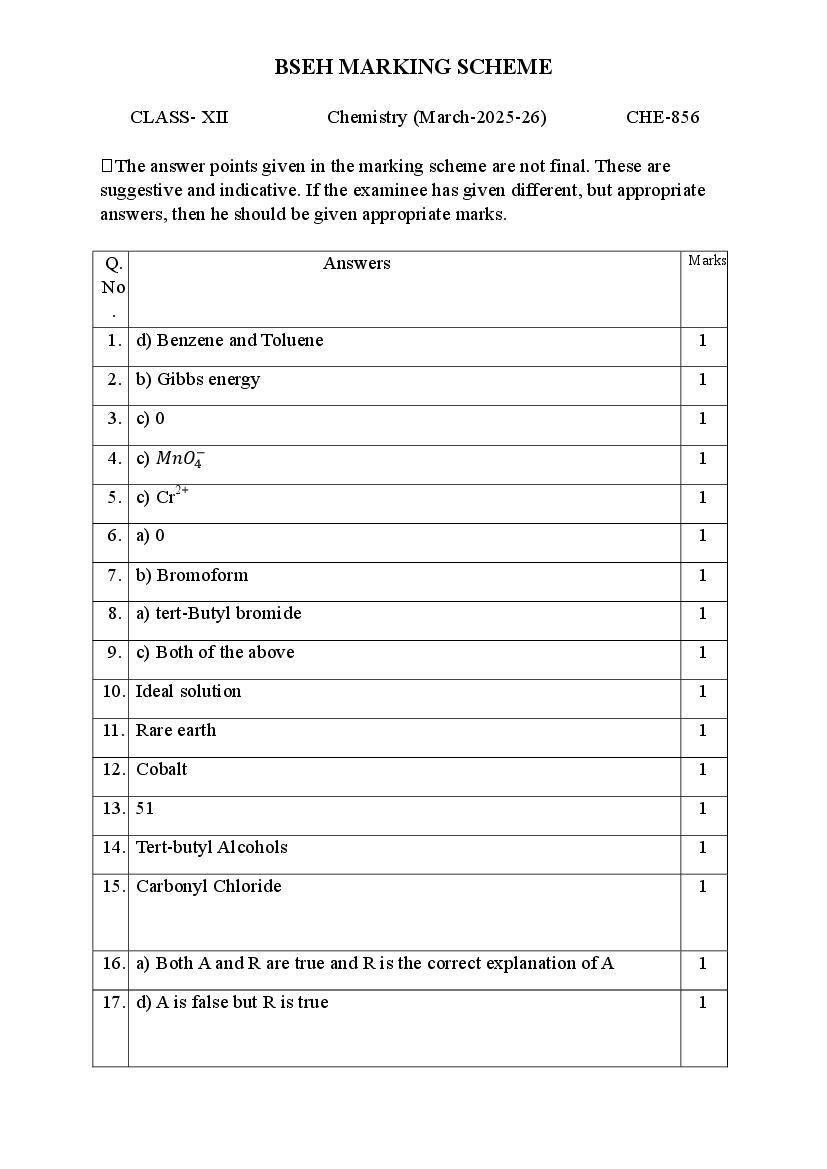
CLASS- XII Chemistry (March-2025-26) CHE-856
The answer points given in the marking scheme are not final. These are
suggestive and indicative. If the examinee has given different, but appropriate
answers, then he should be given appropriate marks.
Q. Answers Marks
No
.
1. d) Benzene and Toluene 1
2. b) Gibbs energy 1
3. c) 0 1
4. c) 𝑀𝑛𝑂 1
5. c) Cr2+ 1
6. a) 0 1
7. b) Bromoform 1
8. a) tert-Butyl bromide 1
9. c) Both of the above 1
10. Ideal solution 1
11. Rare earth 1
12. Cobalt 1
13. 51 1
14. Tert-butyl Alcohols 1
15. Carbonyl Chloride 1
16. a) Both A and R are true and R is the correct explanation of A 1
17. d) A is false but R is true 1
Page 2
19. 2
The partial pressure of the gas in vapour phase (p) is proportional
to the mole fraction of the gas (x) in the solution.
(i) To increase the solubility of CO2 in soft drinks and soda water,
the bottle is sealed under high pressure.
(ii) To avoid bends the tanks used by scuba divers are filled
with air diluted with helium.
iii) At high altitudes the partial pressure of oxygen is less than that
at the ground level. This leads to low concentrations of oxygen in the
blood and tissues of people living at high altitudes or climbers.
(Any two, ½ mark each)
(OR)
Mass of solute (w1) = 1g
Mass of solvent (w2) = 50g
Kf = 5.12 K kg mol-1
Tf = 0.40
×
Since Tf = Kf × ( ½ mark)
×
×
So M2 = Kf ×
×
×
= 5.12 x 𝑔𝑚𝑜𝑙 ( ½ mark)
. ×
= 256 𝑔𝑚𝑜𝑙
(½ mark for answer, ½ mark for unit)
20. The law states that limiting molar conductivity of an electrolyle can 2
be represented as the sum of the individual contributions of the
anion and cation of the electrolyte.
i) to calculate limiting molar conductivity of any electrolyte.
ii) to calculate the degree of dissociation of weak electrolyte.
(iii) to calculate dissociation constant of weak electrolyte.
Page 3
21.
2
22. (i)
N – OH
2
(ii)
H OH
C
H OCH3
23. (i) In 2,2,6 trimethyl cyclohexanone, three methyl groups are presents
at - Position with respect to the ketonic (>C=O) group. Therefore,
these groups cause steric hindrance during the nucleophilic attack of
CN-ion so cyanohydrins is not formed. Due to the absence of methyl
groups in cyclohexanone, there is no steric hindrance and
cyanohydrins is formed.
2
(ii) Semicarbazide has two amino (NH2) groups, out of which one is
involved in resonance. Electron – density on this (NH2) decreases and
it does not act as a nucleophile. But the other (NH2) group (attached O
NH) has a lone pair of electrons which are not involved in resonance.
So, this pair is available for the nucleophilic attack on the carbonyl
group (>C=O) of aldehydes and/or ketones.
Page 4
the presence of dilute alkali as catalyst to form -hydroxy aldehydes,
this is known as Aldol.
.
2CH3 – CHO ⎯⎯⎯⎯⎯ CH3 – CH – CH2 – CHO –
. Ethanal OH
3 – Hydroxybutanal (Aldol)
(1 mark) 2
OR
(i) Tollen’s test / Fehling’s test;
(½ mark)
Ethanal gives the test while propanone does not.
(½ mark)
(ii) Fehling’s test;
(½ mark)
Propanal gives the test while benzaldehyde does not.
(½ mark)
25. Quaternary structure of proteins: Some of the proteins are composed
of two or more polypeptide chains referred to as sub-units. The
spatial arrangement of these subunits with respect to each other is
known as quaternary structure.
Example:- Haemoglobin 2
(½ mark)
Which has four polypeptide chains around a haeme group.
(½ mark)
Page 5
conductance of volume V of a solution containing one mole of
electrolyte kept between two electrodes with an area of cross-section A
and distance of unit length.
Molar conductivity increases with a decrease in concentration. This is
because the total volume V of the solution containing mole of the
electrolyte increases on dilution.
(½ mark)
For weak electrolytes, molar conductivity increases steeply on 3
dilution, especially near lower concentrations as shown in graph.
(½ mark)
(½ mark for proper diagram, ½ mark for each of 3 labelling)
Page 6
𝐸 = 0.236 V
Number of electrons involved in cell reaction (n) = 2
(½ mark)
0
G = -nF 𝐸
(½ mark)
0
G = -2 x 96500 x 0.236 3
G0 = -45548 Jmol-1
(½ mark for answer ½ mark for unit)
0
𝑛 × 𝐸𝑐𝑒𝑙𝑙
𝑙𝑜𝑔𝐾 =
0.059
(½ mark)
𝐾 = 10
(½ mark)
28. i) Diamminechloridonitrito-N-platinum (II)
ii) Potassium trioxalatochromate (III)
iii) Pentaamminecarbonatocobalt (III) chloride
(1 mark each)
3
Page 7
Step 2: Formation of carbocation: It is the slowest step and hence, the
rate determining step of the reaction.
3
Step 3: Formation of ethane by elimination of a proton.
Or
Lucas test can be used to distinguish between primary, secondary and
tertiary alcohols.
(½ mark)
Page 8
(½ mark)
Alcohols are soluble in Lucas reagent while their halides are
immiscible and produce turbidity in solution.
(½mark)
In case of tertiary alcohols, turbidity is produced immediately as they
form the halides easily.
(½mark)
Secondary alcohols produce turbidity after some time.
(½mark)
Primary alcohols do not produce turbidity at room temperature.
(½mark)
30. (i) CHO
,∆
(CHOH)4 ⎯ CH3 – CH2 – CH2 – CH2 – CH2 – CH
CH2OH (n-Hexane)
(ii) CHO COOH
(CHOH)4 ⎯⎯⎯⎯⎯⎯ (CHOH)4
CH2OH CH2OH
3
Gluconic acid
(iii) CHO COOH
(CHOH)4 ⎯⎯⎯⎯⎯⎯ (CHOH)4
CH2OH COOH
Saccharic acid
Page 9
solution side, the pure solvent flows out of the solution through the
semi permeable membrane. This phenomenon is called reverse
osmosis.
(ii) Red blood corpuscles will swell up
OR
Two solutions having the same osmotic pressure at a given 4
temperature are called isotonic solutions.
(iii) The preservation of meat by salting or the preservation of fruits
by adding sugar
(iv) 1 M KCl
Page 10
(i) Position isomerism
(1mark)
(ii) 2, 5 – Dimethylhexane
(1mark)
(iii) (CH3)2C=CH2 4
(1mark)
(iv) (CH3)2C=CH2 + HBr ⎯⎯⎯⎯⎯ (CH3)2CHCH2Br
(1mark)
OR
Wurtz reaction
2Cr(a) + 3Fe3+ (aq) === 2Cr3+ 3Fe(s)
33. . ( . )
E = E° - log
( . )
(1mark)
E° = 0.261 V
.
E = 0.261 - log 10
(1mark)
.
= 0.261 - × (−2)
= 0.261 + 0.0197 = 0.2807 V
(1mark)
(Deduct ½ mark for no or incorrect unit)
‘A’ will prevent iron from corrosion.
(1mark)
So, we can cost the iron surface with metal A because it has more 5
negative Eo value.
Or
Give for same time period:
T1 = 298 K, reaction completed is 10%
T2 = 208 K, reaction completed is 25%
A = 4 x 10¹⁰s-1
For a fist order reaction:
2.303 100
𝑘 = 𝑙𝑜𝑔
𝑡 90
0.1055
𝑘 =
𝑡
Page 11
And
2.303 100
𝑘 = 𝑙𝑜𝑔
𝑡 75
0.2879
𝑘 =
𝑡
(½mark)
According to Arrhenius equation:
𝑘 𝐸 𝑇 −𝑇
𝑙𝑜𝑔 = [ ]
𝑘 2.303 × 𝑅 𝑇 × 𝑇
(½mark)
.
𝐸 308 − 298
𝑙𝑜𝑔 . = [ ]
2.303 × 8.314 298 × 308
(½mark)
-1
𝐸 =76622.7 Jmol
(½mark for answer, ½ mark for unit)
For k at 318K:
According to Arrhenius equation
𝐸
𝑙𝑜𝑔𝑘 = 𝑙𝑜𝑔𝐴 −
2.303 × 𝑅𝑇
(½mark)
76622.7
𝑙𝑜𝑔𝑘 = log(4 × 10 ) −
2.303 × 8.314 × 318
𝑘 = 𝑎𝑛𝑡𝑖𝑙𝑜𝑔(−1.9822)
(½mark)
𝑘 = 1.042 × 10 𝑠
(½mark for answer, ½ mark for unit)
Page 12
Lu) are known as lanthanoids.
General electronic configuration for lanthanoids is:
(𝑛 − 2)𝑓 (𝑛 − 1)𝑑 𝑛𝑠 where n = 6
The steady decrease in the atomic and ionic radii of lanthanide
elements with increasing atomic number is called Lanthanide
contraction.
Consequence:
(i) The size of the atom of the third transition series is closely the
same as that of the atom of the second transition series.
(ii) As there is only a minute change in the iconic radii of lanthanides,
their chemical properties are the same. This makes the separation very
difficult.
OR 5
Potassium permanganate is prepared by fusion of MnO2 with an alkali
metal hydroxide and an oxidizing agent like KNO3.
(½ mark)
2MnO2 + 4KOH + O2 2K2MnO4 + 2H2O
(½ mark)
This produces the dark green K2MnO4 which disproportionate in a
neutral or acidic solution to give permanganate.
(½ mark)
3MnO42- + 4H+ 2MnO4- + MnO2+2H2O
(½ mark)
(a) 5 Fe2+ + MnO4- + 8H+ Mn2+ + 4H2O + 5Fe3+
(b) 5SO2 + 2 MnO4- + 2H2O 2Mn2+ + 4H+ + 5SO42-
(b) 5C2O4 2-+ 2 MnO4- + 16H+ 2Mn2+ + 8H2O + 10CO2
Page 13
formed by heating compound ‘B’ with Br2 and KOH. This is a
Hoffmann bromamide degradation reaction. Therefore, compound ‘B’
is an amide and compound ‘C’ is an amine.
(½ mark)
Compound A is Benzoic acid.
(½ mark)
5
(1Mark)
Page 14
(i) C6H6
(ii) C6H5NHCOCH3
(iii) C6H5SO2NHCH3
(iv) C6H5NC
(iii) C6H5N+H3HSO-4
Document Details
| Board / Org | Haryana Board |
| Exam | Class 12 |
| Type | Sample Paper |
| Pages | 14 |
| Updated | 24 Sep 2026 |