HBSE Class 12 Sample Paper 2026 Answers Entrepreneurship
Finished viewing? Save it for later —
Download HBSE Class 12 Sample Paper 2026 Answers Entrepreneurship (PDF · 9 pages)About HBSE Class 12 Sample Paper 2026 Answers Entrepreneurship
HBSE Class 12 Sample Paper 2026 Answers Entrepreneurship is available here for free download. Published by Haryana Board for Class 12, this answer key can be viewed online or downloaded as a PDF (9 pages). Candidates preparing for Class 12 can use HBSE Class 12 Sample Paper 2026 Answers Entrepreneurship to understand the exam pattern, the type of questions asked, and the overall difficulty level.
Frequently Asked Questions
How can I download HBSE Class 12 Sample Paper 2026 Answers Entrepreneurship?
Open this page and click the Download button to save HBSE Class 12 Sample Paper 2026 Answers Entrepreneurship as a PDF. It is completely free on AglaSem Docs.
Is HBSE Class 12 Sample Paper 2026 Answers Entrepreneurship free to download?
Yes. HBSE Class 12 Sample Paper 2026 Answers Entrepreneurship can be viewed online and downloaded as a PDF free of cost on AglaSem Docs.
How many pages does HBSE Class 12 Sample Paper 2026 Answers Entrepreneurship have?
HBSE Class 12 Sample Paper 2026 Answers Entrepreneurship contains 9 pages, which you can read online or download together as a single PDF.
Where can I find more Class 12 study material?
You can find more Class 12 question papers, sample papers, syllabus, and answer keys on AglaSem Docs.
HBSE Class 12 Sample Paper 2026 Answers Entrepreneurship – Text
Read the full text of this answer key below — useful to quickly search, copy and reference the content online without downloading the PDF.
📄 View text version (9 pages)
Page 1
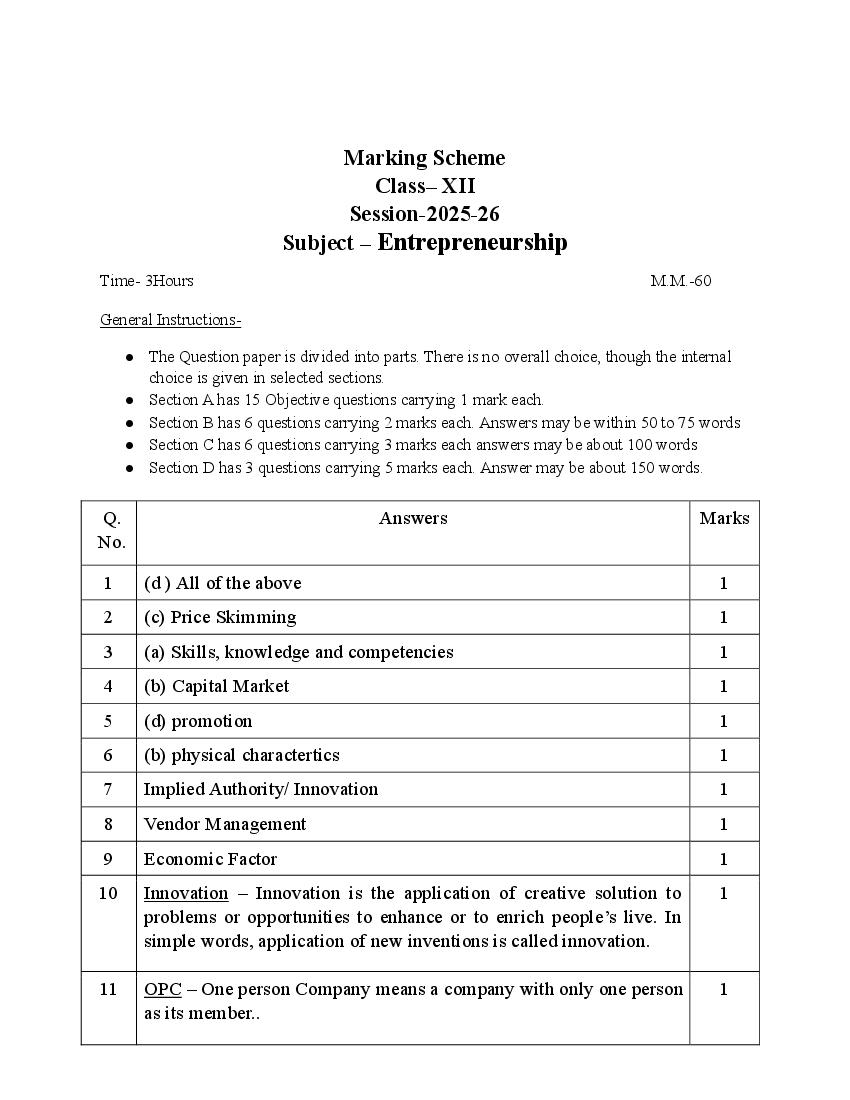
Class– XII
Session-2025-26
Subject – Entrepreneurship
Time- 3Hours M.M.-60
General Instructions-
● The Question paper is divided into parts. There is no overall choice, though the internal
choice is given in selected sections.
● Section A has 15 Objective questions carrying 1 mark each.
● Section B has 6 questions carrying 2 marks each. Answers may be within 50 to 75 words
● Section C has 6 questions carrying 3 marks each answers may be about 100 words
● Section D has 3 questions carrying 5 marks each. Answer may be about 150 words.
Q. Answers Marks
No.
1 (d ) All of the above 1
2 (c) Price Skimming 1
3 (a) Skills, knowledge and competencies 1
4 (b) Capital Market 1
5 (d) promotion 1
6 (b) physical charactertics 1
7 Implied Authority/ Innovation 1
8 Vendor Management 1
9 Economic Factor 1
10 Innovation – Innovation is the application of creative solution to 1
problems or opportunities to enhance or to enrich people’s live. In
simple words, application of new inventions is called innovation.
11 OPC – One person Company means a company with only one person 1
as its member..
Page 2
invest alongside management in new young rapidly growing
companies that have the potential to develop into significant
economic contributors.
13 (a) both Assertion (A) and Reason (R) are true and Reason (R) is the 1
correct explanation for Assertion (A).
14 (a) both Assertion (A) and Reason (R) are true. And Reason (R) is 1
the correct explanation for Assertion (A)
Page 3
Page 4
C. Business Franchise
Page 5
20 Inventory Control – Inventory control is a process of deciding what 2
and how much of various items to be kept in stock. The basis objective
of inventory control is to find out idle level of inventory so that there
is no extra inventory and production level, does not suffer due to look
of inventories.
21 Angle Investor – Angel Investor are wealthy investors who invest in 2
entrepreneurial firms, usually during start up. They provide cash to
young investors and take equity in return.
22. Reasons for Making Business Plan :– 3
1) Used for getting finance from banks or equity
funding.
2) Helps the director to make capital investment
decisions.
3) Evaluation of all elements of business.
4) Provide standards
23 Name of Idea fields :– 3
1) Natural Resources
2) Existing product or services
3) Market drive and Demand drive ideas 4)
Trading related ideas
5) Service sector ideas
24 Organizational Plan – Organizational Plan is the plan that gives 3
complete idea the set up of the organization. Organizational plan
includes the following elements:- 1) Forms of Ownership
2) Identifications and complete details about business
associate
3) Administrative structure, level of mgt. etc.
4) Identification of management team
Page 6
useful because they being :–
1) Short and immediate effect on Sale.
2) Stock clearance is possible with sales promotion
3) Sales promotion techniques help to win over the
competitor
OR
Vendor Management – Vendor management means managing third
party who are supplying various resources including human
resources to organization. Vendor management make sure that third
parties meet the goal of service, quality and cost-optimization.
Few consideration of Vendor Management are :–
i. Establishing goals
ii. Selecting Vendors
iii. Managing Vendors
iv. Consistently meet goals
26 Features of partnership :– 3
i. Formation
ii. Liability
iii. Risk Bearing
iv. Decision Making
v. Continuity
vi. Number of partner vii. Mutual Agency
Relationship
(Explain any 3)
Page 7
current liabilities.
Example of current assets :- Cash, B/R, Prepaid Expenses,
Inventories etc.
OR
Methods of flotation of securities in Primary Market :–
1) Public issue through prospector (Explain any 03)
2) Offer for sale
3) Private placement
4) Right issue
28 5
Creativity – Creativity is the ability to develop new ideas and to
discover new ways of looking at a problem and opportunities. It refers
to “Thinking new things” or “Doing things differently”
Creativity Process :–
1) Analytical planning
2) Resource organization 3)
Implementation
4) Commercial application (1x 4 = 04 marks) OR
It helps the entrepreneur to frame a formal statement enlisting a set of
business goals, the reasons as to why they believe that it is attainable
and the plan for reaching those goals along with the background
information’s about the organization or/and team.
Attempting to reach those goals. (1 mark)
Formats of Business Plan :–
1) Elevator pitch
2) A pitch deck with oral narrative
3) A written presentation for
external stakeholders.
4) An internal operational plan.
(Explain these points in details) (1
x 4 = 04 marks)
Page 8
individuals to find out or alternative which takes into account benefit
of all and nobody is at loss. Negotiation is essential in corporate to
avoid conflicts and improve relationship.
Methods of Negotiation –
1) Integrative/Distributive Negotiation
2) Inductive/Deductive/Mixed Negotiation
3) Soft/Hard Negotiation
(1 x 3 = 03 marks)
OR
Advantages for Franchises :–
1) Established Brand 2)
Quality product
3) Advertisement
4) Financing
5) Training
6) Technological up gradation
7) Uniform Control system
8) Better Start
(explain these points in details)
Page 9
incorporated or not, established for the purpose of assisting,
regulating and controlling of business in buying, selling and dealing
in securities. (01 marks)
Functions –
1) Economic barometer 2)
Pricing of Securities
3) Safety of transactions
4) Constributes to economic growth
5) Providing scope for specialization
6) Liquidity
7) Better allocation of capital
(explain any 04 point) (1 x 4 = 04 marks) OR
Factors effecting working capital –
1) Length of operating cycle
2) Nature of Business
3) Scale of Operation
4) Business cycle fluctuation 5) Seasonal factors
6) Technology and Production cycle
7) Credit allowed
8) Credit avail
9) Operating efficiency
10) Availability of Raw Material 11) Level of
competition
12) Inflation
13) Growth prospects
(Explain any 10 points) ( 10 x ½ = 05 marks )
Document Details
| Board / Org | Haryana Board |
| Exam | Class 12 |
| Type | Sample Paper |
| Pages | 9 |
| Updated | 24 Sep 2026 |