Kerala SET 2018 Jul Question Paper Gandhian Studies
Finished viewing? Save it for later —
Download Kerala SET 2018 Jul Question Paper Gandhian Studies (PDF · 12 pages)About Kerala SET 2018 Jul Question Paper Gandhian Studies
Kerala SET 2018 Jul Question Paper Gandhian Studies is available here for free download. Published by Kerala Exams for Kerala SET, this question paper can be viewed online or downloaded as a PDF (12 pages). Candidates preparing for Kerala SET can use Kerala SET 2018 Jul Question Paper Gandhian Studies to understand the exam pattern, the type of questions asked, and the overall difficulty level.
Frequently Asked Questions
How can I download Kerala SET 2018 Jul Question Paper Gandhian Studies?
Open this page and click the Download button to save Kerala SET 2018 Jul Question Paper Gandhian Studies as a PDF. It is completely free on AglaSem Docs.
Is Kerala SET 2018 Jul Question Paper Gandhian Studies free to download?
Yes. Kerala SET 2018 Jul Question Paper Gandhian Studies can be viewed online and downloaded as a PDF free of cost on AglaSem Docs.
How many pages does Kerala SET 2018 Jul Question Paper Gandhian Studies have?
Kerala SET 2018 Jul Question Paper Gandhian Studies contains 12 pages, which you can read online or download together as a single PDF.
Where can I find more Kerala SET study material?
You can find more Kerala SET question papers, sample papers, syllabus, and answer keys on AglaSem Docs.
Kerala SET 2018 Jul Question Paper Gandhian Studies – Text
Read the full text of this question paper below — useful to quickly search, copy and reference the content online without downloading the PDF.
📄 View text version (12 pages)
Page 1
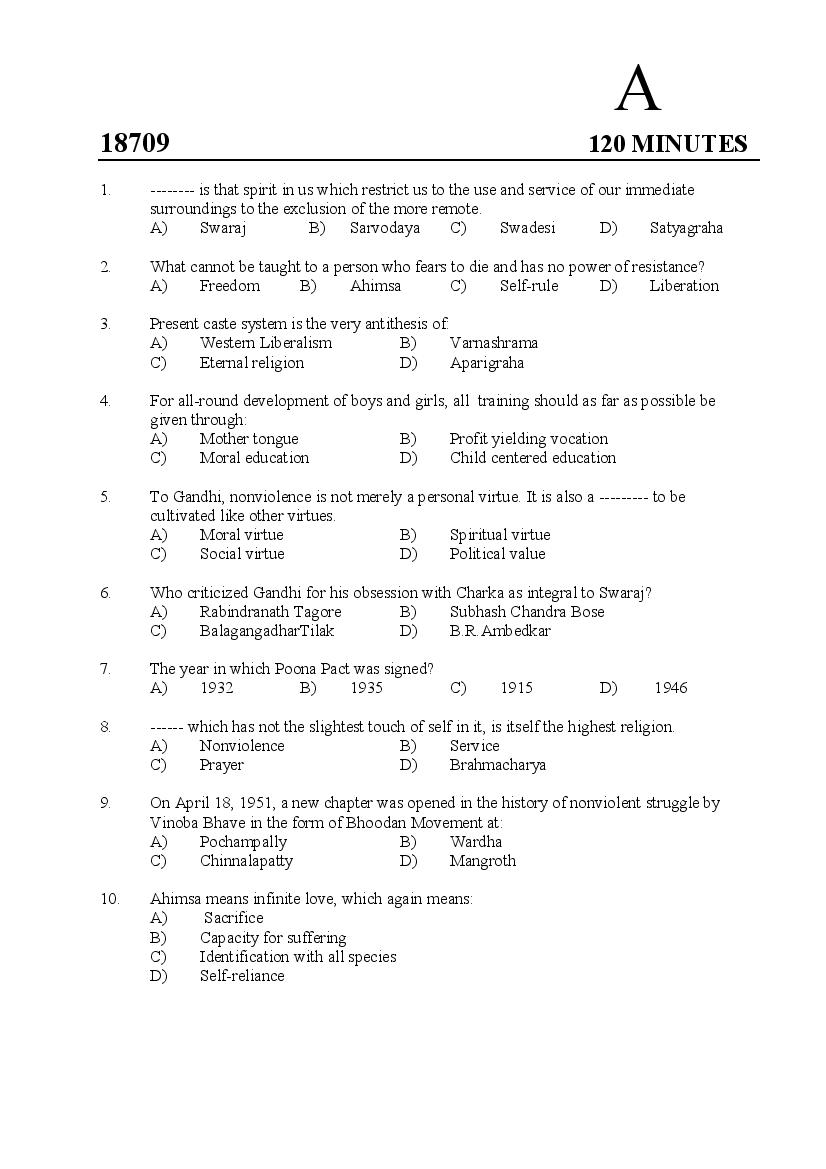
18709 120 MINUTES
1. -------- is that spirit in us which restrict us to the use and service of our immediate
surroundings to the exclusion of the more remote.
A) Swaraj B) Sarvodaya C) Swadesi D) Satyagraha
2. What cannot be taught to a person who fears to die and has no power of resistance?
A) Freedom B) Ahimsa C) Self-rule D) Liberation
3. Present caste system is the very antithesis of:
A) Western Liberalism B) Varnashrama
C) Eternal religion D) Aparigraha
4. For all-round development of boys and girls, all training should as far as possible be
given through:
A) Mother tongue B) Profit yielding vocation
C) Moral education D) Child centered education
5. To Gandhi, nonviolence is not merely a personal virtue. It is also a --------- to be
cultivated like other virtues.
A) Moral virtue B) Spiritual virtue
C) Social virtue D) Political value
6. Who criticized Gandhi for his obsession with Charka as integral to Swaraj?
A) Rabindranath Tagore B) Subhash Chandra Bose
C) BalagangadharTilak D) B.R.Ambedkar
7. The year in which Poona Pact was signed?
A) 1932 B) 1935 C) 1915 D) 1946
8. ------ which has not the slightest touch of self in it, is itself the highest religion.
A) Nonviolence B) Service
C) Prayer D) Brahmacharya
9. On April 18, 1951, a new chapter was opened in the history of nonviolent struggle by
Vinoba Bhave in the form of Bhoodan Movement at:
A) Pochampally B) Wardha
C) Chinnalapatty D) Mangroth
10. Ahimsa means infinite love, which again means:
A) Sacrifice
B) Capacity for suffering
C) Identification with all species
D) Self-reliance
Page 2
A) Constructive programme
B) Truth
C) Removal of untouchability
D) Spinning wheel
12. The key to happiness lies in the worship of --------, which is the giver of all things.
A) Truth B) Dharma C) Ahimsa D) Karmayoga
13. The book in which Gandhi discussed his theory of freedom?
A) Panchayat Raj
B) Satyagraha in South Africa
C) Hind Swaraj or Indian Home Rule
D) The Story of My Experiments with Truth
14. To which religious segment did Gandhi belong?
A) Shaiva B) Mahayana C) Vaishnava D) Svetambara
15. Which book did Gandhi consider as the greatest in all devotional literature?
A) Bhagavat Gita B) TulsiRamayan
C) The Bible D) The Kingdom of God is Within You
16. Name of the poet who gripped Gandhi’s mind and heart in his boyhood.
A) Shyamlal Bhatt B) Meerabai
C) Rabindranath Tagore D) Kabir
17. According to Gandhi, to see the universal and all-pervading Spirit of Truth face to face
one must be able to love
A) Own neighbour as oneself
B) All human beings as oneself
C) The meanest of creations as oneself
D) One’s country as oneself
18. Which book of Romesh Chunder Dutt made Gandhi weep?
A) Development as Freedom
B) The Economic History of India
C) A History of Civilization in Ancient India
D) Poverty and Un- British Rule in India
19. Gandhi is a model of:
A) Self-ruling free person B) Socio-Political leader
C) Brahmachari D) Honest lawyer
20. Which book did Gandhi regard as a gospel of selfless action?
A) The Bible
B) Bhagavath Gita
C) The Kingdom of God is Within you
D) Unto This Last
2
Page 3
A) Uka B) Methab
C) LadhaMaharaj D) Moniya
22. What was the name of maid who taught Gandhi to utter Ramanama to escape from fear?
A) Rukmini Devi B) Rambha C) Tulsi D) Puthalibai
23. Who was the first President of Natal Indian Congress?
A) Dadabhai Navaroji B) Henry Polak
C) M.K.Gandhi D) Dada Abdulla
24. The year in which Gandhi established Phoenix Settlement?
A) 1904 B) 1902 C) 1907 D) 1895
25. What according to Gandhi was the most appropriate organizing principle in India’s
Freedom struggle?
A) Ahimsa B) Spiritualization of politics
C) Self-rule D) Nishkama Karma
26. According to Gandhi all evil thoughts and evil passions are but different forms of:
A) Untruth B) Greed C) Diseases D) Slavery
27. Outer peace is useless without:
A) Inner peace B) Negative Peace
C) Positive peace D) Spirituality
28. How many satyagrahis did join with Gandhi in Dandi march at its origin?
A) 29 B) 89 C) 56 D) 79
29. On a psychological level, satyagraha may be seen as a technique of appealing a latent
inhibition against a ‘species killing its own species’. Who maintains this view?
A) Erick Erikson B) Mahadev Desai
C) A.R.Desai D) Louis Fischer
30. According to Gandhi power based on love is thousand times more effective and
permanent than the one derived from:
A) Selfish motive B) Political authority
C) Fear of punishment D) Spiritual authority
31. Real ------will come not by the acquisition of authority by the few but by the acquisition of
the capacity by all to resist authority when it is abused.
A) Democracy B) Swaraj C) Sarvodaya D) Ramarajya
32. Gandhi believed that a votary of Ahimsa cannot subscribe to the utilitarian formula of:
A) The greatest good of the few
B) The greatest good of greatest number
C) The greatest good of the last
D) The greatest good of the all
3
Page 4
A) Parliament B) Judiciary C) Hospitals D) Caste
34. According to Gandhi, civilization is that mode of conduct which points out to man:
A) Higher learning B) Simple living
C) Spiritual realization D) The path of duty
35. A new dictum ‘science + spirituality = sarvodaya’ was given to the world by:
A) M.K.Gandhi B) Baba Amte
C) Vinoba Bhave D) Ram Manohar Lohia
36. Who was the first black President of South Africa?
A) Barack Obama B) Desmond Tutu
C) Nelson Mandela D) Julius Nyerere
37. In1955, Martin Luther King was heavily involved in Montgomery Alabama boycott of:
A) City buses B) Civil court
C) U S Senate D) Morehouse College
38. Kishorelalbhai and Naraharibhai together drew up a simple, practical ------.
A) Gandhian Plan B) Constructive Programme
C) NaiTalim D) Trusteeship formula
39. What determines the character of production in Gandhian economic order?
A) Profit B) Social necessity than personal greed
C) Employment of people D) Self-reliance and freedom
40. To Gandhi, theoretically when there is perfect love, there must be perfect ----
A) Nonviolence B) Non-possession
C) Brahmacharya D) Swaraj
41. According to Gandhi, --------- is inspired by fellow feeling and compassion.
A) Universal love B) Swadeshi
C) Pure justice D) Self-rule
42. Who wrote the book ‘From socialism to Sarvodaya’?
A) Jayaprakash Narayan B) Jawaharlal Nehru
C) Vinoba Bhave D) M.K. Gandhi
43. The process of removing the internal obstacle to freedom is:
A) Self-suffering B) Selfless action
C) Self-purification D) Self-rule
44. To Gandhi, it is the method of securing rights by personal sufferings: it is the reverse of
resistance by arms. What does it stand for?
A) Self-rule B) Constructive Programme
C) Satyagraha D) Prayer
4
Page 5
A) Moral right B) Economic right
C) Political right D) Individual right
46. Name of the movement that struggled to save the tropical forests of Western Ghats:
A) Chipko Movement B) Appiko Movement
C) Narmada Bachao Andolan D) Jungle Bachao Andolan
47. J.C.Kumarappa opined that if our economic organization is such that more reliance is
placed on resources of ------ economy, there will be more violence.
A) Reservoir B) Current C) Urban D) Rural
48. Nelson Mandela was the founding member of the -------, a group of international leaders
established for the promotion of conflict resolution and problem solving throughout the
world.
A) International centre for conflict resolution
B) Third world Development community
C) Elders
D) Global Peace and security architecture
49. J.C.Kumarappa writes, “there is no such thing as the principles of economics of Gandhiji.
With Gandhiji economics is a part of a……”
A) Political action B) Moral practice
C) Way of life D) Spiritual realization
50. Who wrote the book ‘Capitalism, Socialism or Villagism’?
A) Bharatan Kumarappa B) Jayaprakash Narayan
C) J.C.Kumarappa D) Vinoba Bhave
51. Gandhi took the vow of brahmacharya in:
A) 1907 B) 1906 C) 1920 D) 1914
52. Ram Manohar Lohia observed that “it” is among the rarest and most precious gifts
received by mankind in all history; we may not, however, know how to treasure it and
continue it.What does “it” refer to?
A) HarijanSevaSangh B) LokSevaSangh
C) Nonviolent collective action D) Sarvodaya
53. The person associated with sustainable practices in Ralegan Siddhi is:
A) Baba Amte B) Baba Ramdev
C) Sunderlal Bahuguna D) Anna Hazare
54. Who is the initiator of the ‘people’s court’ in Gujarat?
A) Harivallabh Parikh B) Jayaprakash Narayan
C) Baba Amte D) MedhaPatkar
55. Gandhiji rejects that interpretation of ------ which has no place for anything foreign
because it is foreign
A) Swaraj B) Sarvodaya C) Ahimsa D) Swadeshi
5
Page 6
value?
A) Capable of being self-reliant
B) Capable of building sound character
C) Capable of practicing theory
D) Capable of developing aesthetical sense
57. Which institution has the inscription ‘ SaVidya yaVimuktye’ in its emblem?
A) Gujarat Vidyapith B) Mahatma Gandhi University
C) Gandhigram Rural Institute D) IIT, Madras
58. One of the contents of Khadi economics centers round ------ and production by the masses
A) Production for exchange B) Nonviolent distribution
C) Nonviolent production D) Production for use
59. Efforts for preventing escalation of conflict or reducing the destructive nature of conflict,
less concerned with structural conditions:
A) Conflict resolution B) Conflict transformation
C) Conflict management D) Elimination of conflict
60. Name of Norvegian sociologist, mathematician and the founder of the International
Peace Research Institute, Oslo.
A) Kenneth E. Boulding B) John Kenneth Galbraith
C) Johan Galtung D) Bertrand Russel
61. The author of the book ‘Khadi Economics-a few aspects’:
A) Bharatan Kumarappa B) K.Arunachalam
C) J.D.Sethi D) Pyarelal
62. The sevak of the Sarvodaya Samaj is free from all -----.
A) Social control B) Political control
C) Constructive work D) Organizational control
63. Feminist scholars argue that organized violence is a function of gender imbalance and -------
A) Gender discrimination B) Domestication of women
C) Strategic gender needs D) Patriarchal social relations
64. Fundamental and enduring change away from a protracted, destructive struggle between
adversaries towards a constructive accommodation between them is called
A) Peace making B) Peace building
C) Conflict transformation D) Conflict resolution
65. The other word for an authoritative way of exercising power to maintain order
A) Deterrence B) Reconciliation
C) Domination D) Hegemony
6
Page 7
A) Settlement out of court, emphasis on compromise
B) Conflict management
C) Mediation by third party
D) Reconciliation
67. Irom Sharmila’s struggle was against:
A) Prevention of terrorism Act
B) Terrorist and Disruptive Activities (Prevention) Act,
C) Anti-terrorism, Crime and Security Act
D) Armed forces special powers Act
68. According to J.C. Kumarappa, the charka or the spinning wheel belongs to the ------, while
the textile mills belong to the reservoir economy
A) Rural economy B) Non- sustainable economy
C) Current economy D) Simple economy
69. Which one of the following villages is associated with creating resistance to National
Testing Range?
A) Koodumkulam B) Baliapal
C) Ezhimala D) Pokhran
70. Kerala State government’s decision to implement Panchayat Extension to Scheduled
Areas Act 1996 put an end to:
A) Chengara Samaram B) Muthanga Samaram
C) Nilpu Samaram D) Aaralam protest
71. Who wrote the book ‘Fighting for Hope—the Non-violent Way to a Green Future.’?
A) Petra Kelly B) Vandana Shiva
C) Bertrand Russel D) John Galbriath
72. Structures in our society that promote cooperation, reconciliation, openness, equality and
peaceful actions in conflict situations is:
A) Cultural nonviolence B) Structural nonviolence
C) Peace culture D) Functional nonviolence
73. Martin Luther King Jr. received Nobel Prize at the age of:
A) 35 B) 55 C) 65 D) 50
74. Those parts of our culture that transmit traditions of nonviolent behaviour and which
commemorate and honour nonviolent values.
A) Culture of peace B) Peace education
C) Cultural nonviolence D) Nonviolent action
75. Absence of violence in all of its forms and the presence of mutually beneficial cooperation
and mutual learning.
A) Peace B) Sarvodaya
C) Non-possession D) Self-realization
7
Page 8
Civilization”
A) J. K.Galbriath B) Amarthyasen
C) Petra Kelly D) Johan Galtung
77. On August 28, 1963 he delivered his famous speech “I have a Dream” at the Lincoln
Memorial in Washington D.C. Who is he?
A) Nelson Mandela B) Martin Luther King Jr.
C) Swami Vivekananda D) Jayaprakash Narayan
78. Name of the Commission with Nelson Mandela as President set up to investigate the
human rights and political violations committed by both supporters and opponents of
apartheid between 1960 and 1994.
A) Justice Commission B) South African Human Rights Commission
C) Anti-apartheid Commission D) Truth and Reconciliation Commission
79. Whom did the Amnesty International declare as prisoner of conscience in 2013?
A) Aung San Su Chai B) Winnie Mandela
C) Irom Chanu Sharmila D) Lanza Del Vasto
80. Who was chosen as first individual sathyagrahi by Gandhi?
A) Jayaprakash Narayan B) Vinoba Bhave
C) Jawaharlal Nehru D) Pyarelal
81. France’s Community of Ark is one of the most successful experiments in utopian living
founded by Lanza del Vasto, one of the Christian disciples of Gandhi. What name did
Gandhi give him?
A) Christudas B) Satyadas C) Shantidas D) Snehadas
82. Gandhiji proposed a solution for the management of conflict through nonviolence as
opposed to the traditional ‘threat power’. What was the proposal?
A) Satyagraha B) Panchayat
C) People’s court D) Santhi-sena
83. Conflict resolution theorists need to explore critically at a much deeper level both the
content and approach to conflict resolution training and its relationship to culture. Who
among the following expressed this thesis?
A) Johan Galtung B) Lawrence S.Wittner
C) Lanza del Vasto D) John Paul Lederach
84. The process of promoting knowledge, skills, attitudes and values needed to bring about
behaviour changes that will enable children, youth and adults to prevent conflict and
violence both overt and structural; to resolve conflict peacefully; and to create the
conditions conducive to peace whether intrapersonal, interpersonal, intergroup, national or
international level is called
A) Culture of peace B) Peace movements
C) Peace education D) Peace building
8
Page 9
maintains a collection of all available data on the species threatened with extinction.
A) Red data book B) Green book
C) White book D) Endangered species
86. It is a group of well trained volunteers, sometimes receiving subsistence pay whose
mission is to provide constructive, creative avenues for violence prevention and control.
A) Constructive workers B) Sarvodyasevaks
C) Santhi-sena D) Satyagrahis
87. To Jayaprakash Narayan, ----------- is a combination of seven revolutions viz., political,
social, economic, cultural, ideological or intellectual, educational and spiritual.
A) Sarvodaya B) Ramarajya
C) Holistic revolution D) Total revolution
88. Mediation and Arbitration are most common forms of:
A) Conflict management B) Peace making
C) Peace building D) Alternative dispute resolution
89. The holistic system designed to optimize the productivity and fitness of diverse
communities within the agro-ecosystem, including soil organism, plants, livestock and
people.
A) Natural farming B) Organic production
C) Collective farming D) Communitarianism
90. Indian Parliament passed the 73rd and 74th amendments to the Constitution in:
A) December, 1992 B) October 1994
C) December 1977 D) January 1952
91. When was M. K.Gandhi born?
A) 2nd October 1869 B) 2nd October 1885
C) 2nd October1857 D) 2nd October1879
92. M.K.Gandhi was youngest child of:
A) Ramabai B) Rambabai C) Putlibai D) Rukmini Devi
93. The word that gives the Biblical meaning of peace:
A) Sahion B) Shalom C) Salam D) Sabachthani
94. Who observed that Gandhi embraced Christ, but rejected Christianity?
A) C.F.Andrews B) Henry Polak
C) Louis Fischer D) Kallenbach
95. The bread labour must be motivated by -----------.
A) Self-realization B) Structural nonviolence
C) Caring, love and service D) Positive work culture
9
Page 10
A) Khadi B) Truth
C) Brahmacharya D) Non-possession
97. Karamchand Gandhi was also known as:
A) Manganlal Gandhi B) Tulasidas Gandhi
C) Kaba Gandhi D) None of these
98. Henry David Thoreau refused to pay
A) The poll tax B) The land tax
C) The slave tax D) The professional tax
99. Thoreau’s idea of -------- attracted Gandhi.
A) Passive resistance B) Civil disobedience
C) Retaliation D) Satyagraha
100. Who inspired Gandhi to practice brahmacharya?
A) Shamlal Bhatt B) Puthalibai
C) Raychandbhai D) Gopalakrishna Gokhale
101. A religious term which means unflinching determination and lifelong commitment to
observation of a ritual or ceremony:
A) Vrata B) Astaya C) Celibacy D) Nonpossession
102. With respect to production, Gandhi wanted villages to:
A) Be Self-contained B) Produce for marketing
C) Use intensive machinery D) Import raw materials
103. Who is the author of the book ‘Revolutionary Sarvodaya’?
A) Jayaprakash Narayan B) Ram Manohar Lohia
C) Vinoba Bhave D) Vandana Shiva
104. Vinoba Bhave observed that “the idea of opposition of interests is itself --------“
A) Right B) Wrong C) Misguiding D) Directing
105. Trusteeship implies complete --------.
A) Renunciation of ownership
B) Elimination of possessiveness
C) Abolition of private property
D) Distribution of profit
106. What is the communication process for enabling disputing parties to achieve a mutually
acceptable solution to their difference?
A) Arbitration B) Negotiation
C) Problem solving D) Conflict analysis
10
Page 11
relationship of responsiveness and attentiveness with the other.
A) Positive love B) Absence of antagonism
C) Rapport D) Absence of indifference
108. Who introduced the concept of ‘natural capital’?
A) Amartyasen B) J.C.Kumarappa
C) Vandana Shiva D) E.F.Schumacher
109. In childhood, the plays Shravana Pitrubhakthi and ---------- captured Gandhi’s heart and
mind.
A) Harichandra B) Mahabharat
C) Ramayana D) Kannaki charitham
110. Classical economists catered ------ while Gandhi’s concern was about ethical man
A) Economic man B) Spiritual man
C) Scientific man D) Social man
111. A nonviolent social and ecological movement by rural villagers, particularly women, in
India in the 1970s, aimed at protecting trees and forests slated for government backed
logging. The movement originated in the Himalayan region of Uttar Pradesh (later
Uttarakhand) in 1973 and quickly spread throughout the Indian Himalayas. Name the
movement.
A) Annam Satyagraha B) People’s Science Movement
C) Chipko Movement D) Appiko Movement
112. According to Gandhi, British education in India is:
A) An unmitigated evil B) A boon
C) An inevitable evil D) A step towards civilization
113. Kasturba Gandhi National Memorial Trust was formed under the leadership of Gandhi for
the--------- in the rural areas of the country.
A) Welfare of lepers
B) Welfare and education of women and children
C) Welfare of Harijans
D) Education of children of freedom fighters
114. Gandhi’s satyagraha in ------ was for the farmers who were forced to cultivate indigo by
the British.
A) Champaran B) Bardoli C) Kheda D) Vaikom
115. Cultivation of tolerance for other faiths will impart us a truer understanding of:
A) Other religions B) All religions
C) Our own religion D) None of these
116. Which is the publication that resumed its publication in 1946 after 4 years of
discontinuation owing to suppression of it by the British government?
A) Young India B) Harijan
C) Indian opinion D) National Herald
11
Page 12
A) Chauri-Chaura incident B) Ahmedabad Mill Strike
C) Jallianwala Bagh D) World War I
118. Name the form of satyagraha that can be resorted to against one’s nearest and dearest and
that solely for his/her good.
A) Boycotting B) Non-cooperating
C) Fasting D) Picketing
119. Khadi is the first indispensible step towards the discharge of -------- towards society
A) Swadharma B) Swadeshi dharma
C) Paradharma D) Swaraj Dharma
120. The national movement for protecting the diversity and integrity of living resources,
especially native seeds and for promotion of organic farming and fair trade founded
by Vandana Shiva is:
A) Ecofeminism B) Appiko Movement
C) Navdanya D) Annam Swaraj
___________________
12
Document Details
| Board / Org | Kerala Exams |
| Exam | Kerala SET |
| Type | Question Paper |
| Pages | 12 |
| Updated | 23 Oct 2026 |