Kerala SET 2018 Feb Question Paper Anthropology
Finished viewing? Save it for later —
Download Kerala SET 2018 Feb Question Paper Anthropology (PDF · 14 pages)About Kerala SET 2018 Feb Question Paper Anthropology
Kerala SET 2018 Feb Question Paper Anthropology is available here for free download. Published by Kerala Exams for Kerala SET, this question paper can be viewed online or downloaded as a PDF (14 pages). Candidates preparing for Kerala SET can use Kerala SET 2018 Feb Question Paper Anthropology to understand the exam pattern, the type of questions asked, and the overall difficulty level.
Frequently Asked Questions
How can I download Kerala SET 2018 Feb Question Paper Anthropology?
Open this page and click the Download button to save Kerala SET 2018 Feb Question Paper Anthropology as a PDF. It is completely free on AglaSem Docs.
Is Kerala SET 2018 Feb Question Paper Anthropology free to download?
Yes. Kerala SET 2018 Feb Question Paper Anthropology can be viewed online and downloaded as a PDF free of cost on AglaSem Docs.
How many pages does Kerala SET 2018 Feb Question Paper Anthropology have?
Kerala SET 2018 Feb Question Paper Anthropology contains 14 pages, which you can read online or download together as a single PDF.
Where can I find more Kerala SET study material?
You can find more Kerala SET question papers, sample papers, syllabus, and answer keys on AglaSem Docs.
Kerala SET 2018 Feb Question Paper Anthropology – Text
Read the full text of this question paper below — useful to quickly search, copy and reference the content online without downloading the PDF.
📄 View text version (14 pages)
Page 1
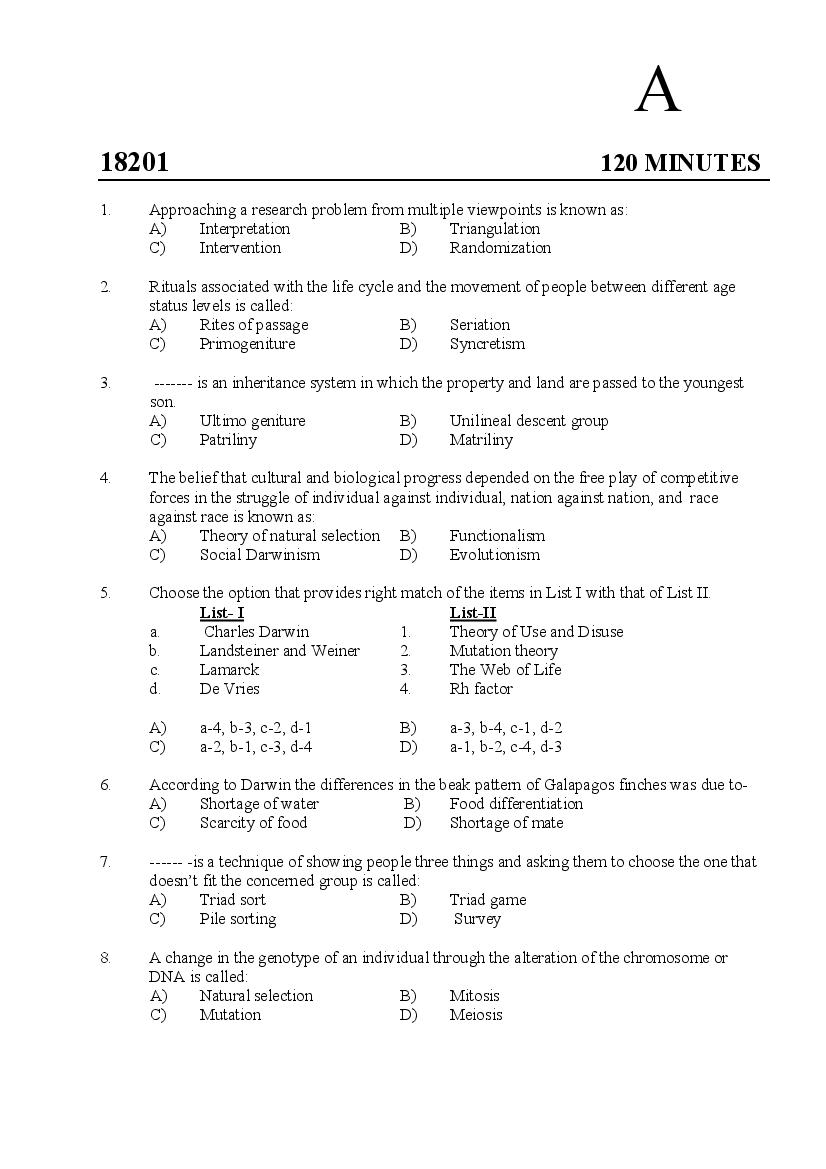
18201 120 MINUTES
1. Approaching a research problem from multiple viewpoints is known as:
A) Interpretation B) Triangulation
C) Intervention D) Randomization
2. Rituals associated with the life cycle and the movement of people between different age
status levels is called:
A) Rites of passage B) Seriation
C) Primogeniture D) Syncretism
3. ------- is an inheritance system in which the property and land are passed to the youngest
son.
A) Ultimo geniture B) Unilineal descent group
C) Patriliny D) Matriliny
4. The belief that cultural and biological progress depended on the free play of competitive
forces in the struggle of individual against individual, nation against nation, and race
against race is known as:
A) Theory of natural selection B) Functionalism
C) Social Darwinism D) Evolutionism
5. Choose the option that provides right match of the items in List I with that of List II.
List- I List-II
a. Charles Darwin 1. Theory of Use and Disuse
b. Landsteiner and Weiner 2. Mutation theory
c. Lamarck 3. The Web of Life
d. De Vries 4. Rh factor
A) a-4, b-3, c-2, d-1 B) a-3, b-4, c-1, d-2
C) a-2, b-1, c-3, d-4 D) a-1, b-2, c-4, d-3
6. According to Darwin the differences in the beak pattern of Galapagos finches was due to-
A) Shortage of water B) Food differentiation
C) Scarcity of food D) Shortage of mate
7. ------ -is a technique of showing people three things and asking them to choose the one that
doesn’t fit the concerned group is called:
A) Triad sort B) Triad game
C) Pile sorting D) Survey
8. A change in the genotype of an individual through the alteration of the chromosome or
DNA is called:
A) Natural selection B) Mitosis
C) Mutation D) Meiosis
Page 2
A) Perspective in tribal studies
B) Studying culture from an insider’s view
C) Perspective in urban studies
D) Studying culture from an outsider’s view
10. Identify the legal argument which has been used primarily by indigenous peoples in North
America & Australia.
A) The ‘Doctrine of Aboriginal title’
B) Constitution
C) The web of life
D) Doctrine of evolution
11. Identify the middle Paleolithic tool making tradition associated with Neanderthals
A) Microlith B) Acheulian C) Mousterian D) Blade tool
12. Meiotic division of the Oocyte in the ovary resulted in the formation of-------.
A) Secondary Oocyte B) Embryo
C) Sperm D) Ovum
13. Read the following statements and choose the correct option:
1. Blood group O is known as universal donor.
2 Blood group A is known as universal recipient.
A) 1 is incorrect but 2 is correct B) 1 is correct but 2 is incorrect
C) 1 & 2 are incorrect D) 1 & 2 are correct
14. Theory of ------- says that ‘the characters making up a pair are separated at the time of
gamete formation’.
A) Mutation Theory B) Law of Segregation
C) Germ plasm Theory D) Synthetic theory
15. Of the following two statements, one is labeled as Assertion (A) and the other as Reason (R).
Assertion (A): Sorroral polygyny is a form of polygyny in which the multiple wives of a
male are sisters.
Reason (R): Tribes of Kerala practice sorroral polygyny.
In the context of the above statements which of the following is correct?
A) A and R are correct and R is the correct example of A.
B) A is correct but R is incorrect
C) A and R are correct and R is not the correct explanation of A.
D) A is incorrect but R is correct
16. The character Baldness in humans is an example of ------- inheritance.
A) Sex linked B) Sex limited
C) Sex influenced D) Sex driven
2
Page 3
A) Soliga B) Jenukuruba C) Ravular D) Kurumba
18. The concept ‘Westernization’ was proposed by:
A) Daryl Ford B) M.N. Srinivas
C) Mckim Marriot D) Redfield
19. Of the following two statements, one is labeled as Assertion (A) and the other as Reason (R).
Assertion (A): Joint family in any society ensures joint ownership of property.
Reason(R): All the castes and communities in Kerala practiced joint family system.
In the context of the above statements which of the following is correct?
A) A and R are correct and R is the correct example of A.
B) A is incorrect but R is correct
C) A and R are correct and R is not the correct explanation of A.
D) A is correct but R is incorrect.
20. Take the odd option regarding the characteristics of present day caste system.
A) Hierarchy B) Purity Pollution
C) Exogamous D) Geographical boundaries
21. Untouchability was practiced in India among castes. Which article of the constitution is
declaring the abolition of this practice among the Scheduled Castes?
A) Article 17 B) Article 13 C) Article 46 D) Article 47
22. A South Indian community called -------was studied by Kathleen Gough.
A) Nadars B) Nayars C) Nayakas D) Nayadi
23. Match the right word for shifting cultivation from List I with that of List II.
List- I List- II
a. Jhum 1. Gond
b Podu 2 Baiga
c Bewar 3. Khond
d Dahiia 4. Naga
A) a-2, b-4, c-1, d-3 B) a-4, b-1, c-3, d-2
C) a-3, b-2, c-4, d-1 D) a-4, b-3, c-2, d-1
24. A good hypothesis has the requirement that it must be ---------
A) Verifiable B) Simple
C) With no contradictions D) All the above
25. In behavioral sciences like psychology,-------is the method commonly used.
A) Observation B) SPSS C) Genealogy D) Case study
26. A variety of dating methods which can be used to establish the age of a fossil, artifact, or
geological feature relative to another is called:
A) Relative dating B) Radio carbon dating
C) Replacement model D) Seriation
3
Page 4
Assertion (A): The book ‘Remembered village’ was written by Robert Redfield.
Reason (R): The above book was based on the study of Tanjore village.
In the context of the above statements which of the following is correct?
A) A and R are correct and R is the correct explanation of A.
B) A and R are incorrect and R is not the correct explanation of A.
C) A is incorrect but R is correct
D) A is correct but R is incorrect
28. Identify the author of the book ‘We the Tikopia: A Sociological Study of Kinship in
Primitive Polynesia’.
A) Raymond Firth B) S.K Srivasthava
C) S.F Nadel D) V.K Srivasthava
29. Find out the year in which the Kerala Scheduled Tribes (Prevention of Alienation and
Restoration of Alienated lands) Act was passed.
A) 1970 B) 1975 C) 1972 D) 1985
30. The Questionnaire that has no options as answers is called:
A) Mailed B) Open ended
C) Close ended D) None of these
31. Of the following two statements, one is labeled as Assertion (A) and the other as Reason (R).
Assertion (A): Mullakuruman is one of the tribal communities in Kerala practiced joint
ownership of property.
Reason (R): Joint property is one of the reasons for the occurrence of joint family system.
In the context of the above statements which of the following is correct?
A) A and R are correct and R is the correct explanation of A.
B) A is correct but R is incorrect.
C) A and R are correct and R is not the correct explanation of A.
D) A is incorrect but R is correct
32. Of the following two statements, one is labeled as Assertion (A) and the other as Reason (R).
Assertion (A): Cultural ecology is one of the key concepts in ecological anthropology.
Reason (R): Julian Steward, an American anthropologist was associated with this
concept.
In the context of the above statements which of the following is correct?
A) A and R are correct
B) A and R are incorrect and R is not the correct explanation of A.
C) A is correct but R is incorrect.
D) A is incorrect but R is correct.
33. Barter is a kind of exchange in tribal societies. Identify the specialized form of barter in
which no verbal communication takes place.
A) Redistribution B) Reciprocity
C) Silent trade D) Kula ring
4
Page 5
List- I List-II
a. E.B Tylor 1. Participant Observation
b Taboo 2. Primitive culture
c. Malinowski 3. Kinship
d. L.H Morgan 4. Prohibited
A) a-2, b-4, c-1, d-3 B) a-3, b-4, c-2, d-1
C) a-1, b-3, c-2, d-4 D) a-4, b-2, c-1, d-3
35. Read the following statements and choose the correct option:
1. Gregor Mendel conducted his experiments in garden pea.
2. The botanical name of garden pea is Pisumsativum.
A) 1& 2 are correct B) 1 is correct but 2 is incorrect
C) 1 & 2 are incorrect D) 1 is incorrect but 2 is correct
36. Tribe -caste continuum is a concept introduced by...
A) Radcliffe Brown B) Malinowski
C) Margaret Mead D) Robert Redfield
37. In research meaning of the term ‘sample’ is:
A) Only a part of the population to be studied
B) Complete population of the study
C) Both the above
D) None of the above
38. ‘Dominant Caste’is an important concept in anthropology in village studies. Identify the
person associated with this concept.
A) Malinowski B) Milton Singer
C) M.N. Srinivas D) McKim Marriot
39. Identify the author.
a. L.P. Vidyarthi 1. Little community, Peasant society and culture
b. A. Aiyyapan 2. Remembered village
c. M.N Srinivas 3. Iravas and culture change
d. Robert Redfield 4. Sacred complex of Hindu Gaya.
A) a-4, b-3, c-2, d -1 B) a-3, b-2, c-1, d-4
C) a-2, b-1, c-4, d-3 D) a-1, b-4, c-3, d-2
40. Case study method was developed by:
A) Geographers B) Botanists
C) Psychologists D) Geologists
41. Identify the book of Marshall Sahlins:
A) Islands of History B) The Toda
C) The Baiga D) Mullukurumbas of Kappala
5
Page 6
A) Hippocrates B) Aristotle
C) Protagoras D) T.K Penniman
43. Find out the chromosome number in humans.
A) 72 B) 46 C) 45 D) 73
44. Which of the following is more correct regarding the tribal problems in India?
A) Land alienation B) Unemployment
C) Illiteracy D) All the above
45. The term ------ is used to denote the gap between the rate of changes in the material and the
non- material culture.
A) Culture core B) Culture complex
C) Culture lag D) Culture trait
46. Choose the option that provides right match of the items in List I with that of List II.
List- I List-II
a. Cholanaicken 1. Nuer
b. Kula ring 2. Cavemen of Kerala
c. Paniyan 3. Malinowski
d. Ghost marriage 4. Bonded labourer
A) a-2, b-3, c-4, d-1 B) a-3, b-2, c-1, d-4
C) a-2, b-3, c-1, d-4 D) a-4, b-1, c-2, d-3
47. Genealogical method was developed by:
A) Evans Pritchard B) Ruth Benedict
C) S.F Nadel D) W.H.R Rivers
48. ------ is the central activity in anthropological research.
A) Observation B) Case study C) Field work D) Interview
49. Tsembaga Maring people of New Guinea are engaged in ---------.
A) Swidden agriculture B) Industrial economy
C) Pastoralism D) Gathering economy
50. Among the human blood groups, ABO blood group is an example of:
A) Sex linked Inheritance B) Multiple Allele
C) Mutation D) Alkaptonuria
51. Take the odd one out from the four subfields of Anthropology.
A) Physical Anthropology B) Linguistic Anthropology
C) Archaeology D) Economic Anthropology
6
Page 7
1. Although anthropologists study the distinctive features of different cultures,
they also recognize the fundamental similarities among people throughout the
world.
2. The results of the fieldwork of the ethnologist or cultural anthropologist are
written up as ethnography.
A) 1 and 2 are incorrect B) 1and 2 are correct
C) 1 is correct but 2 is incorrect D) 1 is incorrect but 2 is correct
53. --------- is a testable proposition concerning the relationship between particular sets of
variables in the collected data.
A) Paradigms B) Hypothesis
C) Theory D) Fact
54. --------- is the technical term for continual interpretation and reinterpretation of texts.
A) Folklore B) Hermeneutics
C) Phenomenology D) Humanism
55. The attitude of judging other cultures based on the norms and values present in one’s
own culture is known as:
A) Ethno methodology B) Ethnocentrism
C) Ethnography D) Ethnology
56. The study of human evolution through the analysis of fossils is called:
A) Primatology B) Ethnology
C) Paleoanthropology D) Forensic anthropology
57. --------- distinguishes Anthropology from other social sciences.
A) Cross-cultural comparison B) Study of culture
C) Holistic approach D) Emic approach
58. Name the branch of Anthropology that deals with the identification of human skeletal
remains for legal purposes.
A) Archaeology B) Biological Anthropology
C) Forensic Anthropology D) Primatology
59. Read the following statements and choose the correct option:
1. Scientific method is a logical system used to evaluate data derived from
systematic observation.
2. Testability and validity lie at the core of the scientific method.
A) 2 is correct but 1 is incorrect B) 1 and 2 are incorrect
C) 1 is correct but 2 is incorrect D) 1 and 2 are correct
60. ---------- is the aspect of culture that is governed by a standardized way of behavior
existing in a society.
A) Society B) Institution C) Community D) Association
7
Page 8
A) Ethnology B) Ethnography C) Primatology D) Genetics
62. Which one of the following is not correct regarding the observation of Tylor on cultural
evolution?
A) The doctrine of survivals added utility and prestige to the comparative method
as the key to ethnological study
B) The evolution of material culture has passed through three successive stages of
development, via ,stone, bronze and iron
C) Culture is an extra somatic temporal continuum of things and events
dependent upon symbolism
D) Contemporary savage people represented the earlier stages of cultural
development which had been traversed by civilized people.
63. Of the following two statements, one is labeled as Assertion (A) and the other as
Reason(R).
Assertion (A): Questionnaire is the technique used by L.H Morgan in studying the
origin of American Indians in Asia and to establish data on evolution
of kinship terminologies.
Reason (R): L.H Morgan was not aware of any other techniques of data collection.
A) A and R are correct B) A and R are incorrect
C) A is correct but R is incorrect D) A is incorrect and R is correct
64. A group of persons of similar age and the same sex who move through some or all of
life’s stages together is called,
A) Associations B) Age-grade C) Age set D) Descent group
65. --------- is a group of people who occupy a specific locality and share common cultural
traditions.
A) Group B) Clan C) Community D) Lineage
66. Identify the author of the book ‘The Evolution of Culture’.
A) Raymond Firth B) Radcliffe Brown
C) Malinowski D) Leslie A. White
67. “ Culture is that complex whole which include knowledge, Belief, arts, morals, law,
custom and any other capabilities and habits acquired by man as a member of society”.
This definition on culture was given by-------
A) Radcliff Brown B) Leslie A. White
C) E.B Tylor D) L.H Morgan
68. Read the following statements and choose the correct option:
1. Material culture consists of the physical products of human society.
2. Non material culture refers to the intangible products of human society.
A) 1 & 2 are correct B) 1 & 2 are incorrect
C) 1 is correct but 2 is incorrect D) 1 is incorrect but 2 is correct
8
Page 9
and support the interests of specific groups within a society.
A) Worldview B) Ideology C) Values D) Norms
70. The condition in which one dominant group impose ideological control over beliefs
and values is termed as-----
A) Cultural relativism B) Cultural diffusion
C) Culture lag D) Cultural hegemony
71. Psychic unity of mankind reveals that
A) Mankind of the world think alike in family crisis
B) Under similar social conditions, mankind of the world show different progress
C) Differential development and environmental role are inversely proportional
D) Under similar environmental condition, mankind of the world progress in
similar way.
72. Kroeber’s concept of culture is:
A) Super organic and super individual
B) Extra somatic temporal continuum of things and events
C) Modification of human needs
D) A nicely balanced system of separate parts
73. Caste is an example of:
A) Endogamous group B) Religious group
C) Exogamous group D) Social group
74. The book ‘Primitive Culture’ was published by -------- in 1871.
A) Murdock B) E.B Tylor C) Franz Boas D) Malinowski
75. In a -------- sample, all of the individuals in the society have an equal chance of being
selected for the survey.
A) Random B) Purposive
C) Stratified D) Convenience
76. Read the following statements and choose the correct option:
1. Culture shock is a severe psychological reaction that results from adjusting to
the realities of a society radically different from one’s own.
2. The symptoms may range from mild irritation to surprise or disgust.
A) 1 & 2 are correct B) 1 & 2 are incorrect
C) I is correct but 2 is incorrect D) 2 is correct but 1 is incorrect
77. --------- refers to the locale that contains various plants, animals and other ecological
conditions to which a species must adjust.
A) Adaptation B) Environmental niche
C) Subsistence D) Demography
9
Page 10
a. Kuruman 1. Pazhassi revolt
b. Kurichiyar 2. Sickle cell anaemia
c. Muthuvan 3. Bonded labourer
d. Paniyan 4. A tribe from Idukki
A) a-4, b-3, c-1, d-2 B) a-2, b-1, c-4, d-3
C) a-4, b-3, c-2, d-1 D) a-1, b-3, c-2, d-4
79. The maximum population that a specific environment can support is known as-----.
A) Life expectancy B) Infant mortality
C) Carrying capacity D) Fecundity
80. Of the following two statements, one is labeled as Assertion (A) and the other as Reason(R).
Assertion (A): The economy of a society consists of the social relationships that
organize the production, consumption and distribution of goods and services.
Reason(R): Division of labour is based on specialized economic roles and activities.
A) A and R are correct B) A is correct but R is incorrect.
C) A is incorrect but R is correct D) A and R are incorrect
81. The concept of sanscritization was first coined and used by M.N Srinivas in 1952 in the
book:
A) Caste and communication in an Indian village
B) Indian caste customs
C) Peasant society and culture
D) Religion and society among the Coorgs of South India
82. Read the following statements and choose the correct option:
1. Many societies practice some form of marriage involving a spouse of one sex and
two or more spouses of the opposite sex.
2. Polyandry is a type of marriage between one wife and two or more husbands.
A) 1 & 2 are correct B) 1 & 2 are incorrect
C) 1 is correct but 2 is incorrect D) 1 is incorrect but 2 is correct
83. Identify the branch of ecology concentrates on how different cultures view different aspects
of their environment.
A) Ecological population B) Population ecology
C) Ethno-ecology D) System ecology
84. ------- is known as the golden age of prosimians.
A) Eocene B) Paleocene C) Mesozoic D) Cretaceous
85. Identify the author of the book ‘Pigs for the ancestors: Ritual in the ecology of New Guinea
people’ published in 1968.
A) Andrew P. Vayda B) Rappaport
C) W.H.R Rivers D) Steward
10
Page 11
A) Radcliffe Brown B) W.H.R. Rivers
C) Raymond Firth D) Claude –Lévi-Strauss
87. The belief that each society should be understood in terms of its own cultural practices and
values is technically known as:
A) Historical particularism B) Functionalism
C) Cultural relativism D) Structuralism
88. The theoretical view of cultural materialism was developed by:
A) Marvin Harris B) Rappaport
C) W.H.R Rivers D) Malinowski
89. The tribes of Andaman Islands belong to:
A) Australoid race B) Caucasoid race
C) Mongoloid race D) Negrito race
90. Aggregation of elements from which the sample is actually drawn is called:
A) Sampling frame B) Sampling units
C) Demography D) Hypothesis
91. Who is considered as the Founder of American school of Diffusion?
A) Franz Boas B) W. James Perry
C) Elliot Smith D) Raymond Firth
92. --------- is a type of armed combat occurring within a political community and usually
involves one kin group taking revenge against another kin group.
A) Band B) Feud
C) Tribe D) Chiefdom
93. Read the following statements and choose the correct option:
1. Complex societies rely on organized police or military force to demonstrate political
authority.
2. Despite the internal mechanisms, however individuals frequently violate norms.
A) 1 & 2 are correct B) 1& 2 are incorrect
C) 1 is correct but 2 is incorrect D) 2 is correct but 1 is incorrect
94. The formula E x T = C (where E = energy, T= technology and C = cultural development)
was proposed by:
A) A.L. Kroeber B) L.H. Morgan
C) E.B Tylor D) L.A White
95. Term closely related to wild life conservation:
A) Forest B) Sanctuary C) Ecozone D) Island
96. Focus group is related to:
A) Primary data B) Secondary data
C) Official data D) None of these
11
Page 12
a) Toda of Nilagiris 1. Malinowski
b) Kattunaicken 2. Evans Pritchard
c) Nuer of Africa 3. W.H.R Rivers
d) Argonauts of Western Pacific 4. Nurit Bird
A) a-3, b-4, c-2, d-1 B) a-4, b-2, c-1, d-3
C) a-1, b-3, c-4, d-2 D) a-2, b-1, c-3, d-4
98. Part-time religious practitioners who are believed to have contact with supernatural beings
and powers are called--------
A) Priest B) Medicine man
C) Shaman D) Chief
99. The terms emic and etic were coined by:
A) WHR Rivers B) Kenneth L Pike
C) Ruth Benedict D) S.F Nadel
100. The Mendelian dihybrid genotypic ratio is:
A) 2:3:1:2:1:2:3:2:1 B) 1:2:1:2:4:2:1:2:1
C) 1:2:4:3:1:2:1:3:1 D) 1:2:3:1:4:1:2:3:1
101. In the book ---------Morgan claimed that during the early stages of cultural evolution, the
productive technology and economic resources were shared by everyone in the society.
A) Ancient Society B) Caste in India
C) India’s changing villages D) Caste, Class and Power
102. Read the following statements and choose the correct option:
1. Marriage is a universal institution that involves residential, cohabitation, economic
co-operation and formation of family.
2. Toda people of Nilgiris practiced Polyandry
A) 1 & 2 are incorrect B) 1& 2 are correct
C) 1 is correct but 2 is incorrect D) 1 is incorrect but 2 is correct.
103. Name the form of exchange in which one tries to get something out of nothing or a lesser
value than it commands.
A) Redistribution B) Market
C) Negative reciprocity D) Distribution
104. Read the following statements and choose the correct option:
1. The concepts ‘sacred and profane’ are first used in the book ‘Elementary forms of
religious life’.
2. This book was not written by L.K .A Iyer
A) 1 & 2 are correct B) 1 is correct but 2 is incorrect
C) 1 & 2 are incorrect D) 1 is wrong but 2 is correct
12
Page 13
1. Family is not a universal institution that involves cohabitation and economic
co-operation.
2. There are different forms of families in different societies.
A) 1 & 2 are incorrect B) 1 & 2 are correct
C) 1 is correct but 2 is incorrect D) 1 is incorrect but 2 is correct
106. A biological condition in which calcium deposits build up in the body’s soft tissues resulting
in internal malfunctioning is known as,
A) Rickets B) Hyper vitaminosis D
C) Hyper pigmentation D) Psoriasis
107. The process of evolution of new species that adapts to new environments is known as-----.
A) Assimilation B) Brachiation
C) Adaptive radiation D) Artificial selection
108. -------- is known as the psychological process of being or becoming accustomed to a new
environment.
A) Acclimatization B) Artificial selection
C) Ethnocentrism D) Domestication
109. The adoption of the language, culture and ethnic identity of the dominant group within a
society by other groups is called,
A) Diffusion B) Evolution C) Adaptation D) Assimilation
110. An economic system in which natural resources as well as the means of production and
distribution of goods are privately owned are called------
A) Socialism B) Communism C) Capitalism D) Catastrophism
111. Choose the option that provides right match of the items in List I with that of List II
List- I List-II
a. Thurston 1. London School of Economics
b. L.H Morgan 2. Malaipandaram study
c. Brian Morris 3. Castes and Tribes of Southern India
d. Malinowski 4. Kinship
A) a-2, b-1, c-4, d-3 B) a-3, b-4, c-2, d-1
C) a-1, b-3, c-2, d-4 D) a-4, b-2, c-1, d-3
112. Of the following two statements, one is labeled as Assertion (A) and the other as Reason (R).
Assertion (A): Ribosomes are known as suicide cells.
Reason (R): Ribosomes contain highly digestive enzymes.
In the context of the above statements which of the following is correct?
A) A and R are correct and R is the correct explanation of A.
B) A is correct but R is incorrect
C) A and R are correct and R is not the correct explanation of A.
D) A is incorrect but R is correct
13
Page 14
A) Robert Chambers B) Ervin Chambers
C) Robert William D) Marvin Harris
114. Choose the option that provides right match of the items in List I with that of List II.
List- I List-II
a. Paniyan 1. Malappuram
b. Koraga 2. Wayanad
c. Mannan 3. Kasargod
d. Cholanaicken 4. Idukki
A) a-1, b-2, c-4, d-3 B) a-2, b-3, c-4, d-1
C) a-3, b-4, c-2, d-1 D) a-4, b-1, c-3, d-2
115. Pan- Egyptian school of thought is also known as:
A) British Neo-evolutionary school
B) American school of Diffusion
C) German school of Diffusion
D) British school of Diffusion
116. Name the zoological ape family living in Europe during the middle and late Miocene,
probably includes the common ancestor of the lesser apes and the great apes:
A) Sivapithecus B) Ramapithecus C) Dryopithecids D) Omomyids
117. -------- technique is a refined type of percussion flaking used during the Middle Paleolithic.
A) Levalloisian B) Flotation
C) Fission-track dating D) Palynology
118. An approach to study human societies that asserts that each society has to be understood
uniquely as a product of its own history.
A) Imperialism B) Historical particularism
C) Historical linguistics D) Gradualism
119. -------- are descent groups composed of clans or phratries that form two groups, dividing the
entire society into equal divisions
A) Moieties B) Tribe C) Castes D) Society
120. Name the Anthropologist who used the concept of ‘culture area’ as a tool for historical
reconstruction.
A) L.K.A Aiyyar B) Clark Wissler
C) Leslie A White D) A. Aiyappan
____________________
14
Document Details
| Board / Org | Kerala Exams |
| Exam | Kerala SET |
| Type | Question Paper |
| Pages | 14 |
| Updated | 23 Oct 2026 |