Manipur Board Class 12 Syllabus 2027 Mao La (MIL)
Finished viewing? Save it for later —
Download Manipur Board Class 12 Syllabus 2027 Mao La (MIL) (PDF · 5 pages)About Manipur Board Class 12 Syllabus 2027 Mao La (MIL)
Manipur Board Class 12 Syllabus 2027 Mao La (MIL) is available here for free download. Published by Manipur Board for Class 12, this syllabus can be viewed online or downloaded as a PDF (5 pages). Candidates preparing for Class 12 can use Manipur Board Class 12 Syllabus 2027 Mao La (MIL) to understand the exam pattern, the type of questions asked, and the overall difficulty level.
Frequently Asked Questions
How can I download Manipur Board Class 12 Syllabus 2027 Mao La (MIL)?
Open this page and click the Download button to save Manipur Board Class 12 Syllabus 2027 Mao La (MIL) as a PDF. It is completely free on AglaSem Docs.
Is Manipur Board Class 12 Syllabus 2027 Mao La (MIL) free to download?
Yes. Manipur Board Class 12 Syllabus 2027 Mao La (MIL) can be viewed online and downloaded as a PDF free of cost on AglaSem Docs.
How many pages does Manipur Board Class 12 Syllabus 2027 Mao La (MIL) have?
Manipur Board Class 12 Syllabus 2027 Mao La (MIL) contains 5 pages, which you can read online or download together as a single PDF.
Where can I find more Class 12 study material?
You can find more Class 12 question papers, sample papers, syllabus, and answer keys on AglaSem Docs.
Manipur Board Class 12 Syllabus 2027 Mao La (MIL) – Text
Read the full text of this syllabus below — useful to quickly search, copy and reference the content online without downloading the PDF.
📄 View text version (6 pages)
Page 1
Manipur Board Class
12 Syllabus 2027 Mao
La (MIL)
EXAM YEAR TYPE
Manipur Class 12 2027 Syllabus
Notes · Sample Papers · Previous Year Papers · Mock Tests
Page 2
m .co
m .co s e m
se g l a
a
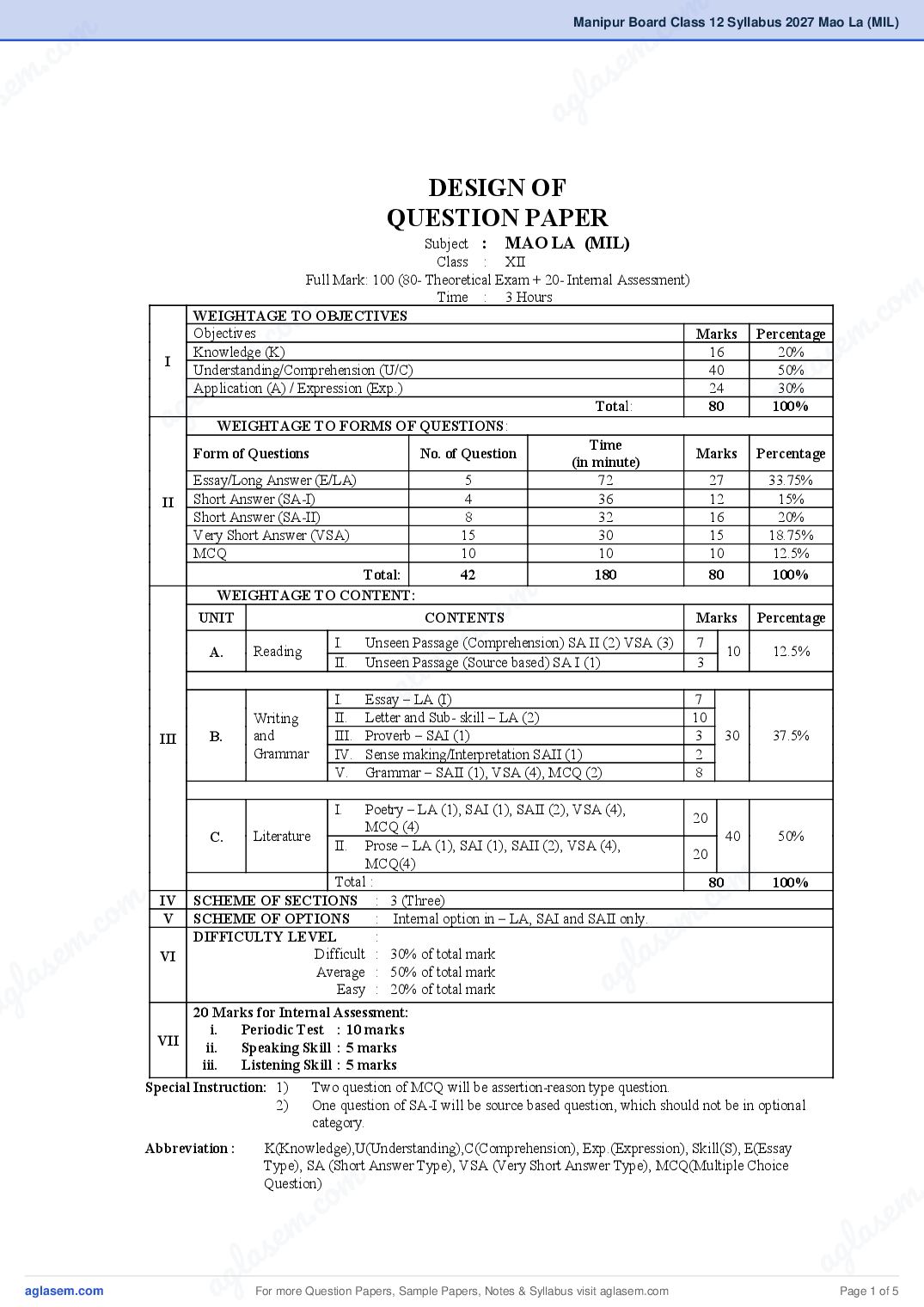
DESIGN OF
QUESTION PAPER
Subject : MAO LA (MIL)
Class : XII
Full Mark: 100 (80- Theoretical Exam + 20- Internal Assessment)
m
.co
Time : 3 Hours
m
WEIGHTAGE TO OBJECTIVES
Objectives
m .co
Knowledge (K)
Marks
16
Percentage
20%
I
s e
Understanding/Comprehension (U/C) 40 50%
l a
g l a
Application (A) / Expression (Exp.)
Total:
24
80 ag
30%
100%
a WEIGHTAGE TO FORMS OF QUESTIONS:
Time
Form of Questions No. of Question Marks Percentage
(in minute)
Essay/Long Answer (E/LA) 5 72 27 33.75%
II Short Answer (SA-I) 4 36 12 15%
Short Answer (SA-II) 8 32 16 20%
Very Short Answer (VSA) 15 30 15 18.75%
MCQ 10 10 10 12.5%
Total: 42 180 80 100%
WEIGHTAGE TO CONTENT:
o m
UNIT CONTENTS
I. Unseen Passage m
. c Marks
Percentage
A. Reading
s e (Comprehension) SA II (2) VSA (3) 7
10 12.5%
la
II. Unseen Passage (Source based) SA I (1) 3
I. Essay g
Writing
a – LA (I)
II. Letter and Sub- skill – LA (2)
7
10
III B. and III. Proverb – SAI (1) 3 30 37.5%
Grammar IV. Sense making/Interpretation SAII (1) 2
V. Grammar – SAII (1), VSA (4), MCQ (2) 8
I. Poetry – LA (1), SAI (1), SAII (2), VSA (4),
20
MCQ (4)
C. Literature 40 50%
II. Prose – LA (1), SAI (1), SAII (2), VSA (4),
20
MCQ(4)
m
.co
Total : 80 100%
m IV SCHEME OF SECTIONS : 3 (Three)
.co m
V SCHEME OF OPTIONS : Internal option in – LA, SAI and SAII only.
m DIFFICULTY LEVEL :
s e
s e VI Difficult : 30% of total mark
g l a
la a
Average : 50% of total mark
ag Easy : 20% of total mark
20 Marks for Internal Assessment:
i. Periodic Test : 10 marks
VII ii. Speaking Skill : 5 marks
iii. Listening Skill : 5 marks
Special Instruction: 1) Two question of MCQ will be assertion-reason type question.
2) One question of SA-I will be source based question, which should not be in optional
category.
Abbreviation : K(Knowledge),U(Understanding),C(Comprehension), Exp.(Expression), Skill(S), E(Essay
Type), SA (Short Answer Type), VSA (Very Short Answer Type), MCQ(Multiple Choice
Question)
m .
.co s e m
s em l a
g la ag
a For more Question Papers, Sample Papers, Notes & Syllabus visit Page 1 of 5
Page 3
For all MIL subjects, the Internal Assessment shall carry a total of 20 marks. Of these,
10 marks shall be allotted to the Periodic Test, while the remaining 10 marks shall be
awarded based on the students respective speaking skills and listening skills assessment.
1. The Periodic Test shall be conducted three times during an academic year. The First
Periodic Test shall be held during June–July, the Second Periodic Test during
August–September, and the Third Periodic Test during October–November. The final
marks for the Periodic Test component shall be calculated on the basis of the average
marks obtained in these best two out of three tests.
However, for the ongoing academic year 2026, as this assessment system is being
introduced for the first time, only two Periodic Tests shall be conducted. The First
Periodic Test shall be held during August–September, and the Second Periodic Test
shall be conducted during October–November. The final marks for the Periodic Test
component shall be determined on the basis of the average marks obtained in these
two tests.
2. (a) Speaking Skills shall be assessed through classroom-based activities such as
debates, extempore speeches, and group discussions. The topics for these activities
shall be selected from contemporary social issues or other relevant areas that are
aligned with the prescribed syllabus of the respective MIL subjects.
b) For the assessment of Listening Skills, students shall be provided with audio
media/poem/passage or other relevant material. This shall be followed by a set of
questions to evaluate the students’ listening comprehension and interpretative
abilities. External/Internal examiners shall be appointed to conduct and evaluate the
students.
-----
For more Question Papers, Sample Papers, Notes & Syllabus visit Page 2 of 5
Page 4
m .co
m .co s e m
se g l a
a
MAO LA (MIL)
CLASS - XII
One Paper 3 Hours 80 Marks
m
.co
UNIT WISE DISTRIBUTION OF MARKS
m
Section .co
Unit/Topics Marks
s eI.mProse 25 la
ag
A
B gl
a II. Poetry 20
C
a III. Reading Unseen Passage (Two) 20
D IV. Writing 20
E V. Grammar 15
Total 80
UNIT WISE DISTRIBUTION OF COURSE CONTENTS
m
m .co
SECTION –A
s e
la
Unit I: PROSE (LEPFÜSHI PAKHRU) 20 Marks
Pieces to be read:
a
1. Pinocchio no orana tto somo
g - Fr. Linus Neli
Onamei kali mazh ü kolo
2. Ozhi ye kahrüri kapimei chüthu 1948 - Fr. William Nepuni
Chüphe khro pilemoe tto asü kotho - Ms. Athini Adani
3. Mazhi aru sopra kowo pha ye AIDS - A. Kholi Pijü
4. Ikhru kholio lo - Kaisü Lohrü Rtd. Al
5. Khreso (Drama) - B. Kaisü Teri
m
m .co
m .co SECTION - B
s e m
s e Unit II: POETRY (CHASHILA)
g l a 20 Marks
g la a
a Pieces to be read:
1. Chanimoe - A. Kholi Pijü
2. Tatho tie - A. Kholi Pijü
3. Okhro - A. Kholi Pijü
4. Le ahrulo - A. Kholi Pijü
5. Motho - A. Kholi Pijü
6. Anako mowo - A. Kholi Pijü
m .
.co s e m
s em l a
g la ag
a For more Question Papers, Sample Papers, Notes & Syllabus visit Page 3 of 5
Page 5
Unit III : READING (KOPHRO) 10 Marks
1. One unseen passage of about 400-450 words.
(a) Short answer type questions to test local, global and inferential
comprehensions.
(b) Vocabulary.
2. Note making of a passage of about 200-300 words.
(a) Note making in an appropriate format.
(b) Summarization.
Note: The passages could be any of the following types:
(a) Factual passages e.g. instructions, descriptions, reports etc.
(b) Discursive passages involving options e.g. argumentative, persuasive.
SECTION - D
Unit IV: WRITING (KORU) 22 Marks
A. Factual description of any events or incidents etc.
in about 80 - 100 words. Choices any one.
B. Letter writing
(i) Business or official letters -
(for making enquiry, registering complaints, asking for and
giving information, placing orders and sending replies)
Or
(ii) Letter to the Editors -
(Giving suggestions, opinion on an issue of public interest)
Or
(iii) Application for a job
C. Composition based on a visual and / verbal input of descriptive nature
Such as an article for publication in a newspaper or a school magazine
in about 100 -150 words.
For more Question Papers, Sample Papers, Notes & Syllabus visit Page 4 of 5
Page 6
m .co
m .co s e m
se g l a
a
Recommended Book for Class XII: Mao la Bvü
Mocholeshe – Kophroleshe (Course)
Lepfüshi Pakhru ( Literature)
Obvü-II (Book-II), Class- XII
By: Asosü Kholi Pijü
m
m Rev. Fr. Neli Linus
.co
m .co Rev. Fr. William Nepuni
s e Ms. Athini Adani
l a
g l a B. Kaisü Teri
ag
a Published By: Mao Academy, Tadubi.
SECTION - E
Unit V: GRAMMAR (OLALU) 08 Marks
m
.co
1. Idioms, Phrases etc.
2. Framing sentences.
s em
g
3. Synonyms and antonymsla etc.
a
4. Difference of meaning in similar word.
Recommended Book: Mao Olalu Bvü XI & XII
(Maola Grammar)
By: A. Kholi Pijü
(late) N. Saleo Kakrü
Published by: Mao Academy, Tadubi. m
m .co
m .co s e m
s e ……………………
g l a
g la a
a
m .
.co s e m
s em l a
g la ag
a For more Question Papers, Sample Papers, Notes & Syllabus visit Page 5 of 5
Document Details
| Board / Org | Manipur Board |
| Exam | Class 12 |
| Type | Syllabus |
| Pages | 5 |
| Updated | 04 Nov 2026 |