CBSE Class 10 Mathematics Basic Question Paper 2020 Set 430-5 Solutions
Finished viewing? Save it for later —
Download CBSE Class 10 Mathematics Basic Question Paper 2020 Set 430-5 Solutions (PDF · 50 pages)About CBSE Class 10 Mathematics Basic Question Paper 2020 Set 430-5 Solutions
CBSE Class 10 Mathematics Basic Question Paper 2020 Set 430-5 Solutions is available here for free download. Published by CBSE for Class 10, this solution can be viewed online or downloaded as a PDF (50 pages). Candidates preparing for Class 10 can use CBSE Class 10 Mathematics Basic Question Paper 2020 Set 430-5 Solutions to understand the exam pattern, the type of questions asked, and the overall difficulty level.
Frequently Asked Questions
How can I download CBSE Class 10 Mathematics Basic Question Paper 2020 Set 430-5 Solutions?
Open this page and click the Download button to save CBSE Class 10 Mathematics Basic Question Paper 2020 Set 430-5 Solutions as a PDF. It is completely free on AglaSem Docs.
Is CBSE Class 10 Mathematics Basic Question Paper 2020 Set 430-5 Solutions free to download?
Yes. CBSE Class 10 Mathematics Basic Question Paper 2020 Set 430-5 Solutions can be viewed online and downloaded as a PDF free of cost on AglaSem Docs.
How many pages does CBSE Class 10 Mathematics Basic Question Paper 2020 Set 430-5 Solutions have?
CBSE Class 10 Mathematics Basic Question Paper 2020 Set 430-5 Solutions contains 50 pages, which you can read online or download together as a single PDF.
Where can I find more Class 10 study material?
You can find more Class 10 question papers, sample papers, syllabus, and answer keys on AglaSem Docs.
CBSE Class 10 Mathematics Basic Question Paper 2020 Set 430-5 Solutions – Text
Read the full text of this solution below — useful to quickly search, copy and reference the content online without downloading the PDF.
📄 View text version (50 pages)
Page 1
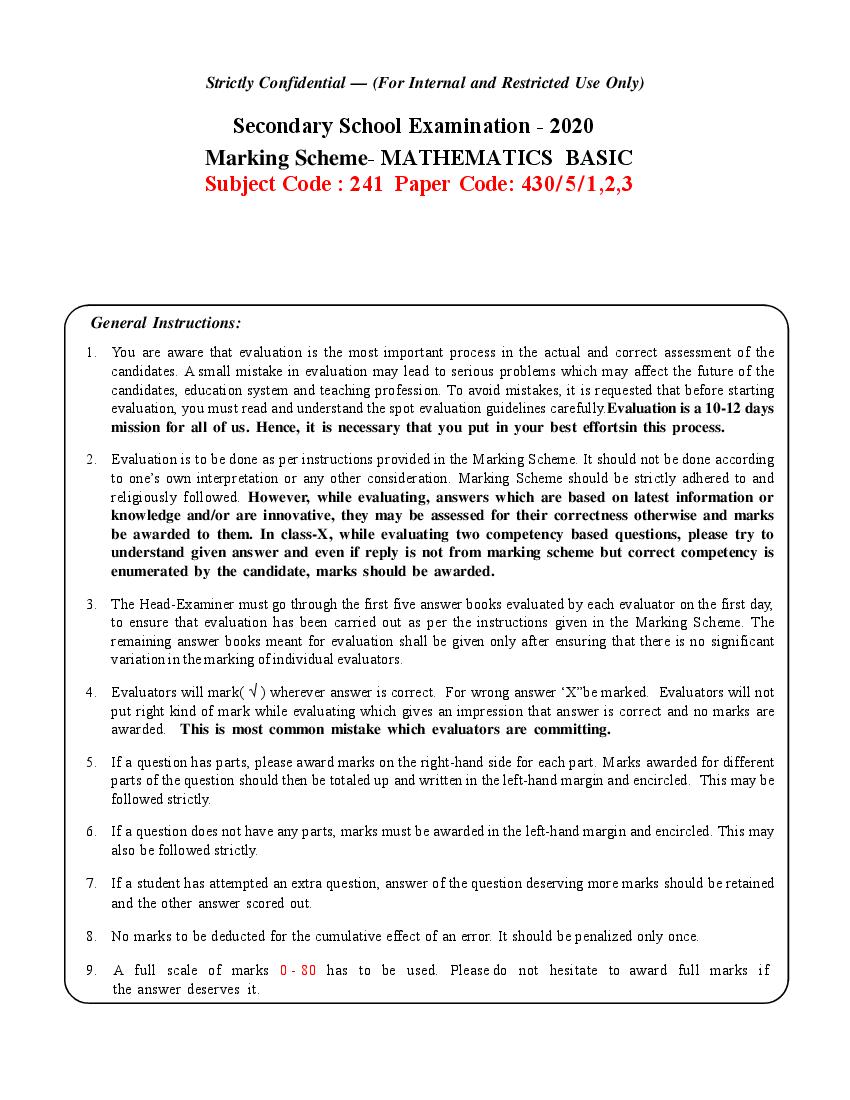
Secondary School Examination - 2020
Marking Scheme- MATHEMATICS BASIC
Subject Code : 241 Paper Code: 430/ 5/ 1,2,3
General Instructions:
1. You are aware that evaluation is the most important process in the actual and correct assessment of the
candidates. A small mistake in evaluation may lead to serious problems which may affect the future of the
candidates, education system and teaching profession. To avoid mistakes, it is requested that before starting
evaluation, you must read and understand the spot evaluation guidelines carefully.Evaluation is a 10-12 days
mission for all of us. Hence, it is necessary that you put in your best effortsin this process.
2. Evaluation is to be done as per instructions provided in the Marking Scheme. It should not be done according
to one’s own interpretation or any other consideration. Marking Scheme should be strictly adhered to and
religiously followed. However, while evaluating, answers which are based on latest information or
knowledge and/or are innovative, they may be assessed for their correctness otherwise and marks
be awarded to them. In class-X, while evaluating two competency based questions, please try to
understand given answer and even if reply is not from marking scheme but correct competency is
enumerated by the candidate, marks should be awarded.
3. The Head-Examiner must go through the first five answer books evaluated by each evaluator on the first day,
to ensure that evaluation has been carried out as per the instructions given in the Marking Scheme. The
remaining answer books meant for evaluation shall be given only after ensuring that there is no significant
variation in the marking of individual evaluators.
4. Evaluators will mark( √ ) wherever answer is correct. For wrong answer ‘X”be marked. Evaluators will not
put right kind of mark while evaluating which gives an impression that answer is correct and no marks are
awarded. This is most common mistake which evaluators are committing.
5. If a question has parts, please award marks on the right-hand side for each part. Marks awarded for different
parts of the question should then be totaled up and written in the left-hand margin and encircled. This may be
followed strictly.
6. If a question does not have any parts, marks must be awarded in the left-hand margin and encircled. This may
also be followed strictly.
7. If a student has attempted an extra question, answer of the question deserving more marks should be retained
and the other answer scored out.
8. No marks to be deducted for the cumulative effect of an error. It should be penalized only once.
9. A full scale of marks 0 - 80 has to be used. Please do not hesitate to award full marks if
the answer deserves it.
Page 2
10. Every examiner has to necessarily do evaluation work for full working hours i.e. 8 hours every day and
evaluate 20 answer books per day in main subjects and 25 answer books per day in other subjects (Details are
given in Spot Guidelines).
11. Ensure that you do not make the following common types of errors committed by the Examiner in the past:-
• Leaving answer or part thereof unassessed in an answer book.
• Giving more marks for an answer than assigned to it.
• Wrong totaling of marks awarded on a reply.
• Wrong transfer of marks from the inside pages of the answer book to the title page.
• Wrong question wise totaling on the title page.
• Wrong totaling of marks of the two columns on the title page.
• Wrong grand total.
• Marks in words and figures not tallying.
• Wrong transfer of marks from the answer book to online award list.
• Answers marked as correct, but marks not awarded. (Ensure that the right tick mark is correctly and
clearly indicated. It should merely be a line. Same is with the X for incorrect answer.)
• Half or a part of answer marked correct and the rest as wrong, but no marks awarded.
12. While evaluating the answer books if the answer is found to be totally incorrect, it should be marked as cross
(X) and awarded zero (0)Marks.
13. Any unassessed portion, non-carrying over of marks to the title page, or totaling error detected by the candidate
shall damage the prestige of all the personnel engaged in the evaluation work as also of the Board. Hence, in
order to uphold the prestige of all concerned, it is again reiterated that the instructions be followed meticulously
and judiciously.
14. The Examiners should acquaint themselves with the guidelines given in the Guidelines for spot Evaluation
before starting the actual evaluation.
15. Every Examiner shall also ensure that all the answers are evaluated, marks carried over to the title page,
correctly totaled and written in figures and words.
16. The Board permits candidates to obtain photocopy of the Answer Book on request in an RTI application and
also separately as a part of the re-evaluation process on payment of the processing charges.
(2)
Page 3
QUESTION PAPER CODE 430/5/1
EXPECTED ANSWER/VALUE POINTS
SECTION A
1. If a pair of linear equations is consistent, then the lines represented by them are
(A) parallel (B) intersecting or coincident
(C) always coincident (D) always intersecting
Sol. (B) Intersecting or coincident. 1
2. The distance between the points (3, – 2) and (– 3, 2) is
(A) 52 units (B) 4 10 units (C) 2 10 units (D) 40 units
Sol. (A) 52 units 1
3. 8 cot2 A – 8 cosec2 A is equal to
1 1
(A) 8 (B) (C) – 8 (D) −
8 8
Sol. (C) –8 1
4. The total surface area of a frustum-shaped glass tumbler is (r1 > r2)
(A) πr1l + πr2l (B) πl (r1 + r2) + πr22
1
(C) πh(r12 + r22 + r1r2 ) (D) h 2 + (r1 − r2 ) 2
3
Sol. (B) πl (r1 + r2) + πr22 1
5. 120 can be expressed as a product of its prime factors as
(A) 5 × 8 × 3 (B) 15 × 23 (C) 10 × 22 × 3 (D) 5 × 23 × 3
Sol. (D) 5 × 23 × 3 1
6. The discriminant of the quadratic equation 4x2 – 6x + 3 = 0 is
(A) 12 (B) 84 (C) 2 3 (D) – 12
Sol. (D) –12 1
7. If (3, – 6) is the mid-point of the line segment joining (0, 0) and (x, y), then the point (x, y) is
⎛3 ⎞
(A) (– 3, 6) (B) (6, – 6) (C) (6, – 12) (D) ⎜ , − 3 ⎟
⎝2 ⎠
Sol. (C) (6, – 12) 1
(3)
Page 4
8. In the given circle in Figure-1, number of tangents parallel to tangent PQ is
P
Q
Fig. 1
(A) 0 (B) many (C) 2 (D) 1
Sol. (D) 1 1
9. For the following frequency distribution:
Class: 0–5 5 – 10 10 – 15 15 – 20 20 – 25
Frequency 8 10 19 25 8
The upper limit of median class is
(A) 15 (B) 10 (C) 20 (D) 25
Sol. (A) 15 1
10. The probability of an impossible event is
1
(A) 1 (B) (C) not defined (D) 0
2
Sol. (D) 0 1
Fill in the blanks in question numbers 11 to 15.
11. A line intersecting a circle in two points is called a _______.
Sol. Secant 1
12. If 2 is a zero of the polynomial ax2 – 2x, then the value of 'a' is _______.
Sol. 1 1
13. All squares are _______ (congruent/similar).
Sol. Similar 1
14. If the radii of two spheres are in the ratio 2 : 3, then the ratio of their respective volumes is
_______.
Sol. 8/27 or 8 : 27 1
15. If ar (Δ PQR) is zero, then the points P, Q and R are _______.
Sol. Collinear 1
(4)
Page 5
Answer the following question numbers 16 to 20:
16. In Figure-2, the angle of elevation of the top of a tower AC from a point B on the ground is 60°.
If the height of the tower is 20 m, find the distance of the point from the foot of the tower.
C
20 m
60°
A B
Fig. 2
AC 1
Sol. = tan 60°
AB 2
20
= 3
AB
20 3 20 1
AB = or
3 3 2
17. Evaluate:
tan 40° × tan 50°
1
Sol. tan 40° × cot 40°
2
1
=1
2
OR
If cos A = sin 42°, then find the value of A.
1
Sol. cos A = sin (90° – 48°)
2
= cos 48°
1
⇒ A = 48°
2
18. A coin is tossed twice. Find the probability of getting head both the times.
1
Sol. Total outcomes = 4
2
1 1
P(getting head both the times) =
4 2
(5)
Page 6
19. Find the height of a cone of radius 5 cm and slant height 13 cm.
1
Sol. h= (13)2 − (5)2 2
1
h = 12 cm
2
20. Find the value of x so that – 6, x, 8 are in A.P.
1
Sol. x+6=8–x
2
1
x =1 2
OR
th
Find the 11 term of the A.P. – 27, – 22, –17, –12, ... .
1
Sol. a = –27, d = 5
2
1
a11 = –27 + 50 = 23
2
SECTION B
Question numbers 21 to 26 carry 2 marks each.
21. Find the roots of the quadratic equation
3x 2 − 4 3 x + 4 = 0.
Sol. 3x 2 − 2 3x − 2 3x + 4 = 0 1
( 3 x − 2)( 3 x − 2 ) = 0 1
2
1
3x − 2 = 0 ⇒ x = 2/ 3 2
22. Check whether 6n can end with the digit '0' (zero) for any natural number n.
Sol. 6n = (2 × 3)n = 2n × 3n 1
1
It is not in form of 2n × 5m
2
1
∴ 6n can’t end with digit ‘0’
2
(6)
Page 7
OR
Find the LCM of 150 and 200.
1
Sol. 150 = 2 × 3 × 52
2
1
200 = 23 × 52
2
1
LCM = 23 × 52 × 3
2
1
= 600
2
1
23. If tan (A + B) = 3 and tan (A – B) = , 0 < A + B ≤ 90°, A > B, then find the value of
3
A and B.
Sol. A + B = 60° ...(i) 1
1
A – B = 30° ...(ii)
2
From (i) and (ii)
A = 45° ⎤ 1
B = 15° ⎥⎦ 2
24. In Figure-3, ΔABC and ΔXYZ are shown. If AB = 3 cm BC = 6 cm, AC = 2 3 cm, ∠A = 80°,
∠B = 60º, XY = 4 3 cm YZ = 12 cm and XZ = 6 cm, then find the value of ∠Y..
A X
80°
3 cm 2 3 cm 4 3 cm 6 cm
60°
B C Y Z
6 cm 12 cm
Figure 3
AB BC AC 1
Sol. Q = = = 1
XZ YZ XY 2
1
∴ ΔABC ~ ΔXZY
2
1
∠C = ∠Y = 40°
2
(7)
Page 8
25. 14 defective bulbs are accidentally mixed with 98 good ones. It is not possible to just look at
the bulb and tell whether it is defective or not. One bulb is taken out at random from this lot.
Determine the probability that the bulb taken out is a good one.
Sol. Total outcomes = 14 + 98 = 112 1
98 7
P(good bulb) = or 1
112 8
26. Find the mean for the following distribution:
Classes: 5 – 15 15 – 35 25 – 35 35 – 45
Frequency: 2 4 3 1
Sol. Classes Freq. Mid value = x f×x Correct table 1
Σfx 1
5-15 2 10 20 x=
Σf 2
230 1
15-25 4 20 80 = = 23
10 2
25-35 3 30 90
35-45 1 40 40
Σf = 10 Σfx = 230
OR
The following distribution shows the transport expenditure of 100 employees:
Expenditure (in (`): 200 – 400 400 – 600 600 – 800 800 – 1000 1000 – 1200
Number of 21 25 19 23 12
employees:
Find the mode of the distribution.
1
Sol. Modal class = 400 – 600
2
⎡ f1 − f 0 ⎤ 1
Mode = l + ⎢ 2f − f − f ⎥ × h
⎣ 1 0 2⎦ 2
⎡ 25 − 21 ⎤ 1
= 400 + ⎢ × 200
⎣ 50 − 21 − 19 ⎥⎦ 2
1
= 400 + 80 = 480
2
(8)
Page 9
SECTION C
Question numbers 27 to 34 carry 3 marks each.
27. A quadrilateral ABCD is drawn to circumscribe a circle. Prove that
AB + CD = AD + BC.
1
Sol. C Correct Figure
R 2
D
Q Proof: AP = AS ⎤
BP = BQ ⎥
S 1
⎥ 4× =2
B CR = CQ ⎥ 2
P
A ⎥
DR = DS ⎦
∴ By adding,
AP + BP + CR + DR = AS + BQ + CQ + DS
1
AB + CD = AD + BC
2
28. The difference between two numbers is 26 and the larger number exceeds thrice of the smaller
number by 4. Find the numbers.
Sol. Let larger No. = x
Let smaller No = y
x – y = 26 ...(i) 1
x – 3y = 4 ...(ii) 1
By solving (i) & (ii), we get
1
∴ x = 37
2
1
y = 11
2
OR
Solve for x and y:
2 3 5 4
+ = 13 and − = – 2
x y x y
1 1
Sol. Let =p & =q
x y
(9)
Page 10
1
2p + 3q = 13 ...(i)
2
1
5p – 3q = –2 ...(ii)
2
By solving (i) & (ii), we get
∴ p = 2, q = 3 1
1 1
∴ =2, =3
x y
1 1
x= y= 1
2 3
29. Prove that 3 is an irrational number..
Sol. Let 3 is rational
a 1
3= (where a & b are +ve integers & co-prime, b ≠ 0)
b 2
a2 = 3b2 ...(i)
3 divides a2
∴ 3 divides a also 1
Let a = 3c & put in (i)
(3c)2 = 3(b)2
3c2 = b2
⇒ 3 divides b2
∴ 3 divides b also 1
∴ 3 divides a and b both
This contradicts our assumption
1
Therefore, 3 is irrational no. 2
30. Krishna has an apple orchard which has a 10 m × 10 m sized kitchen garden attached to it. She
divides it into a 10 × 10 grid and puts soil and manure into it. She grows a lemon plant at A,
a coriander plant at B, an onion plant at C and a tomato plant at D. Her husband Ram praised
her kitchen garden and points out that on joining A, B, C and D they may form a parallelogram.
Look at the below figure carefully and answer the following questions:
(10)
Page 11
y
10
9
8
7 C
6
5 D
4 B
3
2 A
1
x
1 2 3 4 5 6 7 8 9 10
(i) Write the coordinates of the points A, B, C and D, using the 10 × 10 grid as coordinate axes.
(ii) Find whether ABCD is a parallelogram or not.
1
Sol. (i) Coordinates are A(2, 2), B(5, 4), C(7, 7), D(4, 5) 4× =2
2
(ii) AB = (5 − 2)2 + (4 − 2)2 = 13
BC = 13
CD = 13
⎡Q AB = BC = CD = DA ⎤
DA = 13 ⎢∴ ABCD is a parallelogram ⎥ 1
⎣ ⎦
31. If the sum of the first 14 terms of an A.P. is 1050 and its first term is 10 then find the 21st term
of the A.P.
n 1
Sol. [2a + (n − 1) d] = 1050
2 2
7[20 + 13d] = 1050 1
1
∴ d = 10
2
a21 = a + 20d = 10 + 20 × 10 = 210 1
32. Construct a triangle with its sides 4 cm, 5 cm and 6 cm. Then construct a triangle similar to it
2
whose sides are of the corresponding sides of the first triangle.
3
Sol. For correct construction of Δ 1
For construction of similar Δ 2
(11)
Page 12
OR
Draw a circle of radius 2.5 cm. Take a point P at a distance of 8 cm from its centre. Construct
a pair of tangents from the point P to the circle.
Sol. For draw the correct circle & exterior pt. 1
For construction of the pair of tangents 2
33. Prove that:
1
(cosec A – sin A) (sec A – cos A) =
tan A + cot A
⎛ 1 ⎞⎛ 1 ⎞ 1
Sol. LHS = ⎜ − sin A ⎟ ⎜ − cos A ⎟
⎝ sin A ⎠ ⎝ cos A ⎠ 2
1 − sin 2 A 1 − cos 2 A 1
= ×
sin A cos A 2
cos 2 A sin 2 A 1
= ×
sin A cos A 2
1
cos A . sin A
2
1 1
RHS =
sin A cos A 2
+
cos A sin A
1
2 2
= sin A + cos A
sin A ⋅ cos A
1
= sin A ⋅ cos A ∴ LHS = RHS
2
34. In Figure-4, AB and CD are two diameters of a circle (with centre O) perpendicular to each
other and OD is the diameter of the smaller circle.
If OA = 7 cm, then find the area of the shaded region.
B
D C
O
A
Fig. 4
(12)
Page 13
22 7 7 77
Sol. Area of smaller circle = π r 2 = × × = = 38.5 cm 2 1
7 2 2 2
1 22 1
Area of Big semi-circle = × × 7 × 7 = 77 cm 2
2 7 2
1 1
Area of ΔABC = × 14 × 7 = 49 cm 2
2 2
Area of shaded portion = ar. of smaller circle + ar. of big semicircle – ar. of ΔABC
= 38.5 + 77 – 49 = 66.5 cm2 1
OR
In Figure-5, ABCD is a square with side 7 cm. A circle is drawn circumscribing the square.
Find the area of the shaded region.
C
D B
A
Fig. 5
1
Sol. Area of sqaure ABCD = a2 = 72 = 49 cm2
2
Diagonal of square = 2a = 7 2 cm 1
7 2 1
∴ Radius of circle = cm
2 2
2
22 ⎛ 7 2 ⎞ 2 1
Area of circle = ×⎜ ⎟ = 77 cm
7 ⎝ 2 ⎠ 2
1
Area of shaded, portion = 77 – 49 = 28 cm2
2
SECTION D
Question numbers 35 to 40 carry 4 marks each.
35. Find other zeroes of the polynomial
p(x) = 3x4 – 4x3 – 10x2 + 8x + 8,
if two of its zeroes are 2 and – 2 .
(13)
Page 14
Sol. ( x − 2 ) & ( x + 2 ) are two factors
i.e. x2 – 2 is a factor 1
3x 2 − 4x − 4
x 2 − 2 3x 4 − 4x 3 − 10x 2 + 8x + 8
3x 4 – 6x 2
– +
− 4x 3 − 4x 2 + 8x + 8
– 4x 3 + 8x
+ –
2
– 4x 2 + 8
– 4x 2 + 8
+ –
0
1
3x2 – 4x – 4 = (3x + 2) (x – 2)
2
1
∴ –2/3, 2 are other two zeroes.
2
OR
Divide the polynomial g(x) = x3 – 3x2 + x + 2 by the polynomial x2 – 2x + 1 and verify the
division algorithm.
Sol.
x −1
2 3 2
x − 2x + 1 x − 3x + x + 2
x 3 – 2x 2 + x
– + –
− x2 + 2
2
– x 2 − 1 + 2x
+ + −
− 2x + 3
Verify,
P(x) = q(x) × g(x) + r(x)
= (x – 1) (x2 – 2x + 1) + (–2x + 3) 1
= x3 – 3x2 + 3x – 1 – 2x + 3
= x3 – 3x2 + x + 2 1
(14)
Page 15
36. From the top of a 75 m high lighthouse from the sea level, the angles of depression of two ships
are 30° and 45°. If the ships are on the opposite sides of the lighthouse, then find the distance
between the two ships.
Sol. Correct figure 1
D In ΔACD
30° 45°
75 1
75 =
x 3
30° 45°
A x C y B
1
∴ x = 75 3 1
2
In ΔBCD
75
=1
y
∴ y = 75 1
∴ Distance b/w two ships i.e. AB = x + y
= 75 3 + 75
1
= 75( 3 + 1)
2
37. If a line is drawn parallel to one side of a triangle to intersect the other two sides in distinct
points, prove that the other two sides are divided in the same ratio.
1
Sol. For correct given, To prove, Construction, Figure 4× =2
2
For correct proof 2
OR
If Figure-6, in an equilateral triangle ABC, AD ⊥ BC, BE ⊥ AC and CF ⊥ AB.
Prove that 4(AD2 + BE2 + CF2) = 9 AB2.
A
F E
B D C
Figure 6
(15)
Page 16
Sol. Proof
In ΔABD, AD 2 = AB2 − BD 2 ...(i) ⎤
⎥
In ΔBCE BE 2 = BC 2 − CE 2 ...(ii) ⎥ 1 1
3× =1
⎥ 2 2
In ΔACF CF2 = AC2 − AF2 ...(iii) ⎥⎦
AD2 + BE2 + CF2 = AB2 + BC2 + AC2 – BD2 – CE2 – AF2 1
2 2 2
⎛ BC ⎞ ⎛ AC ⎞ ⎛ AB ⎞
2
= 3AB − ⎜ ⎟ −⎜ ⎟ −⎜ ⎟
⎝ 2 ⎠ ⎝ 2 ⎠ ⎝ 2 ⎠
2 3 2
= 3AB − AB
4
9
= AB2
4
1
4(AD2 + BE2 + CF2) = 9AB2 1
2
38. A container open at the top and made up of a metal sheet, is in the form of a frustum of a cone
of height 14 cm with radii of its lower and upper circular ends as 8 cm and 20 cm, respectively.
Find the capacity of the container.
1 1
Sol. Vol. of container = πh(r12 + r22 + r1r2 )
3 2
1 22
= × × 14 [(8) 2 + (20) 2 + 8 × 20] 2
3 7
1 22
= × × 14[64 + 400 + 160]
3 7
1
= 9152 cm3 1
2
3
39. Two water taps together can fill a tank in 9 hours. The tap of larger diameter takes 10 hours
8
less than the smaller one to fill the tank separately. Find the time in which each tap can
separately fill the tank.
Sol. Let smaller diameter tap takes x hours to fill the tank
1
Then, time taken by larger diameter tap to fill the tank = (x – 10) hr
2
(16)
Page 17
ATQ
1 1 8 1
+ = 1
x x − 10 75 2
1
8x2 – 230x + 750 = 0
2
1
(8x – 30) (x – 25) = 0
2
15 1
x= and x = 25
4 2
15
Rejected x = ,
4
Hence, time taken by smaller diameter tap = 25 hrs
1
Time taken by larger diameter tap = 25 – 10 = 15 hrs
2
OR
A rectangular park is to be designed whose breadth is 3 m less than its length. Its area is to
be 4 square metres more than the area of a park that has already been made in the shape of
an isosceles triangle with its base as the breadth of the Rectangular park and of altitude 12 m.
Find the length and breadth of the park.
1
Sol. Correct figure
2
D x C Let length of rectangle = x
12 x–3 x–3
E ∴ Breadth = x – 3
A x B
ar. of reactangle = x(x – 3)
= x2 – 3x 1
Area of Isosceles ΔADE
1
= (x − 3) × 12
2
1
= 6x – 18
2
(17)
Page 18
ATQ
x2 – 3x = 6x – 18 + 4 1
x2 – 9x + 14 = 0
(x – 7) (x – 2) = 0
1
x = 7, x = 2 Rejected
2
∴ Length of rectangle = 7 cm
1
Breadth of rectangle = 4 cm
2
40. Draw a ‘less than’ ogive for the following frequency distribution:
Classes: 0 – 10 10 – 20 20 – 30 30 – 40 40 – 50 50 – 60 60 – 70 70 – 80
Frequency: 7 14 13 12 20 11 15 8
Sol.
getting the pts (10, 7), (20, 21)
(30, 34), (40, 46), (50, 66)
(60, 77), (70, 92), (80, 100) 2
Plotting and Joining the pts to get the correct ogive 2
(18)
Page 19
QUESTION PAPER CODE 430/5/2
EXPECTED ANSWER/VALUE POINTS
SECTION A
1. For the following frequency distribution:
Class: 0–5 5 – 10 10 – 15 15 – 20 20 – 25
Frequency 8 10 19 25 8
The upper limit of median class is
(A) 15 (B) 10 (C) 20 (D) 25
Sol. (A) 15 1
2. The probability of an impossible event is
1
(A) 1 (B) (C) not defined (D) 0
2
Sol. (D) 0 1
3. If (3, – 6) is the mid-point of the line segment joining (0, 0) and (x, y), then the point (x, y) is
3
(A) (– 3, 6) (B) (6, – 6) (C) (6, – 12) (D) ( , − 3)
2
Sol. (C) (6, – 12) 1
4. The discriminant of the quadratic equation 4x2 – 6x + 3 = 0 is
(A) 12 (B) 84 (C) 2 3 (D) – 12
Sol. (D) –12 1
5. In the given circle in Figure-1, number of tangents parallel to tangent PQ is
P
Q
Fig. 1
(A) 0 (B) many (C) 2 (D) 1
Sol. (D) 1 1
6. 8 cot2 A – 8 cosec2 A is equal to
1 1
(A) 8 (B) (C) – 8 (D) −
8 8
Sol. (C) –8 1
(19)
Page 20
7. The point on x-axis which divides the line segment joining (2, 3) and (6, – 9) in the ratio 1 : 3 is
(A) (4, – 3) (B) (6, 0) (C) (3, 0) (D) (0, 3)
Sol. (C) (3, 0) 1
8. If a pair of linear equations is consistent, then the lines represented by them are
(A) parallel (B) intersecting or coincident
(C) always coincident (D) always intersecting
Sol. (B) Intersecting or coincident. 1
9. The total surface area of a frustum-shaped glass tumbler is (r1 > r2)
(A) πr1l + πr2l (B) πl (r1 + r2) + πr22
1
(C) πh(r12 + r22 + r1r2 ) (D) h 2 + (r1 − r2 ) 2
3
Sol. (B) πl (r1 + r2) + πr22 1
10. 120 can be expressed as a product of its prime factors as
(A) 5 × 8 × 3 (B) 15 × 23 (C) 10 × 22 × 3 (D) 5 × 23 × 3
Sol. (D) 5 × 23 × 3 1
Fill the blank in question number 11 to 15.
11. Area of quadrilateral ABCD = Area of Δ ABC + Area of _______.
Sol. ΔACD 1
12. If the radii of two spheres are in the ratio 2 : 3, then the ratio of their respective volumers is
_______.
Sol. 8/27 or 8 : 27 1
13. If 2 is a zero of the polynomial ax2 – 2x, then the value of 'a' is _______.
Sol. 1 1
14. A line intersecting a circle in two points is called a _______.
Sol. Secant 1
15. All squares are _______ (congruent/similar).
Sol. Similar 1
Answer the following question number 16 to 20:
16. A dice is thrown once. If getting a six, is a success, then find the probability of a failure.
1
Sol. Total outcomes = 6
2
5 1
P(Failure) =
6 2
(20)
Page 21
17. Find the value of x so that – 6, x, 8 are in A.P.
1
Sol. x+6=8–x
2
1
x =1 2
OR
th
Find the 11 term of the A.P. – 27, – 22, –17, –12, ... .
1
Sol. a = –27, d = 5
2
1
a11 = –27 + 50 = 23
2
18. In Figure-2, the angle of elevation of the top of a tower AC from a point B on the ground is 60°.
If the height of the tower is 20 m, find the distance of the point from the foot of the tower.
C
20 m
60°
A B
Fig. 2
AC 1
Sol. = tan 60°
AB 2
20 1
= 3
AB 2
20 3 20
AB = or AB =
3 3
19. Evaluate:
tan 40° × tan 50°
1
Sol. tan 40° × cot 40º
2
1
=1
2
(21)
Page 22
OR
If cos A = sin 42°, then find the value of A.
1
Sol. cos A = sin (90° – 48°)
2
= cos 48°
1
⇒ A = 48°
2
20. Find the height of a cone of radius 5 cm and slant height 13 cm.
1
Sol. h= (13)2 − (5)2 2
1
h = 12 cm
2
SECTION B
Question numbers 21 to 26 carry 2 mark each.
21. In Figure-3, ΔABC and ΔXYZ are shown. If AB = 3 cm BC = 6 cm, AC = 2 3 cm, ∠A = 80°,
∠B = 60° XY = 4 3 cm YZ = 12 cm and XZ = 6 cm, then find the value of ∠Y..
A X
80°
3 cm 2 3 cm 4 3 cm 6 cm
60°
B C Y Z
6 cm 12 cm
Figure 3
AB BC AC 1
Sol. Q = = = 1
XZ YZ XY 2
1
∴ ΔABC ~ ΔXZY
2
1
∠C = ∠Y = 40°
2
22. Find the mean for the following distribution:
Classes: 5 – 15 15 – 35 25 – 35 35 – 45
Frequency: 2 4 3 1
(22)
Page 23
Sol. Classes Freq. Mid value = x f×x Correct table 1
Σfx 1
5-15 2 10 20 x=
Σf 2
230 1
15-25 4 20 80 = = 23
10 2
25-35 3 30 90
35-45 1 40 40
Σf = 10 Σfx = 230
OR
The following distribution shows the transport expenditure of 100 employees:
Expenditure (in (`): 200 – 400 400 – 600 600 – 800 800 – 1000 1000 – 1200
Number of 21 25 19 23 12
employees:
Find the mode of the distribution.
1
Sol. Modal class = 400 – 600
2
⎡ f1 − f 0 ⎤ 1
Mode = l + ⎢ ⎥×h
⎣ 2f1 − f 0 − f 2 ⎦ 2
⎡ 25 − 21 ⎤ 1
= 400 + ⎢ × 200
⎣ 50 − 21 − 19 ⎥⎦ 2
1
= 400 + 80 = 480
2
23. Solve for x:
2x 2 + 5 5 x − 15 = 0
( ) − 4 × 2 × (–15)
2
Sol. D= 5 5
1
= 245
2
− b ± D −5 5 ± 7 5
x= = 1
29 4
5 1
x= , −3 5
2 2
(23)
Page 24
24. Check whether 6n can end with the digit '0' (zero) for any natural number n.
Sol. 6n = (2 × 3)n = 2n × 3n 1
1
It is not in form of 2n × 5m
2
1
∴ 6n can’t end with digit ‘0’
2
OR
Find the LCM of 150 and 200.
1
Sol. 150 = 2 × 3 × 52
2
1
200 = 23 × 52
2
1
LCM = 23 × 52 × 3
2
1
= 600
2
5 sin θ − 3 cos θ 1
25. If 5 tan θ = 4, show that = .
5 sin θ + 3 cos θ 7
4 1
Sol. tan θ =
5 2
5 tan θ − 3
LHS = 1
5 tan θ + 3
4
5×−3
5 1 1
⇒ =
4 2
5× + 3 7
5
26. 14 defective bulbs are accidentally mixed with 98 good ones. It is not possible to just look at
the bulb and tell whether it is defective or not. One bulb is taken out at random from this lot.
Determine the probability that the bulb taken out is a good one.
Sol. Total outcomes = 14 + 98 = 112 1
98 7
P(good bulb) = or 1
112 8
(24)
Page 25
SECTION C
Question number 27 to 34 carry 3 marks each.
27. Krishna has an apple orchard which has a 10 m × 10 m sized kitchen garden attached to it. She
divides it into a 10 × 10 grid and puts soil and manure into it. She grows a lemon plant at A,
a coriander plant at B, an onion plant at C and a tomato plant at D. Her husband Ram praised
her kitchen garden and points out that on joining A, B, C and D they may form a parallelogram.
Look at the below figure carefully and answer the following questions:
y
10
9
8
7 C
6
5 D
4 B
3
2 A
1
x
1 2 3 4 5 6 7 8 9 10
(i) Write the coordinates of the points A, B, C and D, using the 10 × 10 grid as coordinate axes.
(ii) Find whether ABCD is a parallelogram or not.
1
Sol. (i) Coordinates are A(2, 2), B(5, 4), C(7, 7), D(4, 5) 4× =2
2
(ii) AB = (5 − 2) 2 + (4 − 2) 2 = 13
BC = 13
CD = 13
⎡Q AB = BC = CD = DA ⎤
DA = 13 ⎢∴ ABCD is a parallelogram ⎥ 1
⎣ ⎦
28. Prove that 3 is an irrational number..
Sol. Let 3 is rational
a 1
3= (where a & b are +ve integers & co-prime, b ≠ 0)
b 2
a2 = 3b2 ...(i)
3 divides a2
∴ 3 divides a also 1
(25)
Page 26
Let a = 3c & put in (i)
(3c)2 = 3(b)2
3c2 = b2
⇒ 3 divides b2
∴ 3 divides b also 1
∴ 3 divides a and b both
This contradicts our assumption
1
Therefore, 3 is irrational no. 2
29. Prove that:
tan θ cot θ
+ = 1 + sec θ cosec θ
1 − cot θ 1 − tan θ
sin θ cos θ
Sol. LHS = cos θ + sin θ 1
cos θ sin θ
1− 1−
sin θ cos θ
sin 2 θ cos 2 θ
= +
cos θ(sin θ − cos θ) sin θ(cos θ − sin θ)
sin 3 θ − cos3 θ
= 1
sin θ ⋅ cos θ(sin θ − cos θ)
1 + sin θ ⋅ cos θ 1 1
= = × +1
sin θ cos θ sin θ cos θ
= cosec θ ⋅ sec θ + 1 = RHS 1
30. Two concentric circles are of radii 5 cm and 3 cm. Find the length of chord of the larger circle
which touches the smaller circle.
Sol. Correct figure 1
In ΔAOB, OA2 = AD2 + OD2
O (5)2 = AD2 + (3)2 1
5
3
∴ AD2 = 16
A D B
1
AD = 4
2
1
∴ Length of chord i.e. AB = 4 × 2 = 8 cm
2
(26)
Page 27
31. The difference between two numbers is 26 and the larger number exceeds thrice of the smaller
number by 4. Find the numbers.
Sol. Let larger No. = x
Let smaller No = y
x – y = 26 ...(i) 1
x – 3y = 4 ...(ii) 1
By solving (i) & (ii), we get
1
∴ x = 37
2
1
y = 11
2
OR
Solve for x and y:
2 3 5 4
+ = 13 and − = – 2
x y x y
1 1
Sol. Let =p & =q
x y
1
2p + 3q = 13 ...(i)
2
1
5p – 3q = –2 ...(ii)
2
By solving (i) & (ii), we get
∴ p = 2, q = 3 1
1 1
∴ =2, =3
x y
1 1
x= y= 1
2 3
(27)
Page 28
32. In Figure-4, AB and CD are two diameters of a circle (with centre O) perpendicular to each
other and OD is the diameter of the smaller circle.
If OA = 7 cm, then find the area of the shaded region.
B
D C
O
A
Fig. 4
2 22 7 7 77
Sol. Area of smaller circle = π r = × × = = 38.5 cm 2 1
7 2 2 2
1 22 1
Area of Big semi-circle = × × 7 × 7 = 77 cm 2
2 7 2
1 1
Area of ΔABC = × 14 × 7 = 49 cm 2
2 2
Area of shaded portion = ar. of smaller circle + ar. of big semicircle – ar. of ΔABC
= 38.5 + 77 – 49 = 66.5 cm2 1
OR
In Figure-5, ABCD is a square with side 7 cm. A circle is drawn circumscribing the square. Find
the area of the shaded region.
C
D B
A
Fig. 5
1
Sol. Area of sqaure ABCD = a2 = 72 = 49 cm2
2
Diagonal of square = 2a = 7 2 cm 1
7 2 1
∴ Radius of circle = cm
2 2
(28)
Page 29
2
22 ⎛ 7 2 ⎞ 2 1
Area of circle = ×⎜ ⎟ = 77 cm
7 ⎝ 2 ⎠ 2
1
Area of shaded, portion = 77 – 49 = 28 cm2
2
33. Construct a triangle with its sides 4 cm, 5 cm and 6 cm. Then construct a triangle similar to it
2
whose sides are of the corresponding sides of the first triangle.
3
Sol. For correct construction of Δ 1
For construction of similar Δ 2
OR
Draw a circle of radius 2.5 cm. Take a point P at a distance of 8 cm from its centre. Construct
a pair of tangents from the point P to the circle.
Sol. For draw the correct circle & exterior pt. 1
For construction of the pair of tangents 2
34. If the sum of first 7 terms of an A.P. is 49 and that of 17 terms is 289, then find the sum of first
n terms.
7
Sol. Q [2a + 6d] = 49
2
a + 3d = 7 ...(i) 1
17
[2a + 16d] = 289
2
1
a + 8d = 17 ...(ii)
2
By solving the eq. (i) & (ii)
1
a = 1, d = 2
2
n
∴ Sn = [2 + (n − 1) × 2]
2
n
= × 2n = n 2 1
2
(29)
Page 30
SECTION D
Question number 35 to 40 carry 4 marks each.
3
35. Two water taps together can fill a tank in 9 hours. The tap of larger diameter takes 10 hours
8
less than the smaller one to fill the tank separately. Find the time in which each tap can
separately fill the tank.
Sol. Let smaller diameter tap takes x hours to fill the tank
1
Then, time taken by larger diameter tap to fill the tank = (x – 10) hr
2
ATQ
1 1 8 1
+ = 1
x x − 10 75 2
1
8x2 – 230x + 750 = 0
2
1
(8x – 30) (x – 25) = 0
2
15 1
x= and x = 25
4 2
15
Rejected x = ,
4
Hence, time taken by smaller diameter tap = 25 hrs
1
Time taken by larger diameter tap = 25 – 10 = 15 hrs
2
OR
A rectangular park is to be designed whose breadth is 3 m less than its length. Its area is to
be 4 square metres more than the area of a park that has already been made in the shape of
an isosceles triangle with its base as the breadth of the Rectangular park and of altitude 12 m.
Find the length and breadth of the park.
1
Sol. Correct figure
D x C 2
12 x–3 x–3
E Let length of rectangle = x
A x B ∴ Breadth = x – 3
ar. of reactangle = x(x – 3)
= x2 – 3x 1
(30)
Page 31
Area of Isosceles ΔADE
1
= (x − 3) × 12
2
1
= 6x – 18
2
ATQ
x2 – 3x = 6x – 18 + 4 1
x2 – 9x + 14 = 0
(x – 7) (x – 2) = 0
1
x = 7, x = 2 Rejected
2
∴ Length of rectangle = 7 cm
1
Breadth of rectangle = 4 cm
2
36. Find the curved surface area of frustum of a cone of height 12 cm and radii of circular ends are
9 cm and 4 cm.
1
Sol. l= (r1 − r2 ) 2 + h 2 = (5) 2 + (12) 2 = 13 cm 1
2
∴ C.S.A of frustom of cone = πl(r1 + r2)
1
= π × 13(9 + 4) 1
2
= 169π or 531.14 cm2 1
37. Draw a ‘less than’ ogive for the following frequency distribution:
Classes: 0 – 10 10 – 20 20 – 30 30 – 40 40 – 50 50 – 60 60 – 70 70 – 80
Frequency: 7 14 13 12 20 11 15 8
Sol.
getting the pts (10, 7), (20, 21)
(30, 34), (40, 46), (50, 66)
(60, 77), (70, 92), (80, 100) 2
Plotting and Joining the points to get the correct ogive 2
(31)
Page 32
38. If a line is drawn parallel to one side of a triangle to intersect the other two sides in distinct
points, prove that the other two sides are divided in the same ratio.
1
Sol. For correct given, To prove, Construction, Figure 4× =2
2
For correct proof 2
OR
If Figure-6, in an equilateral
equilateral triangle
triangleABC, AD ⊥ BC, BE ⊥ AC and CF ⊥ AB.
ABC,AD
Prove that 4(AD2 + BE2 + CF2) = 9 AB2.
A
F E
B D C
Figure 6
Sol. Proof
In ΔABD, AD 2 = AB2 − BD 2 ...(i) ⎤
⎥
In ΔBCE BE 2 = BC 2 − CE 2 ...(ii) ⎥ 1 1
3× =1
⎥ 2 2
In ΔACF CF2 = AC2 − AF2 ...(iii) ⎥⎦
AD2 + BE2 + CF2 = AB2 + BC2 + AC2 – BD2 – CE2 – AF2 1
2 2 2
2 ⎛ BC ⎞ ⎛ AC ⎞ ⎛ AB ⎞
= 3AB − ⎜ ⎟ −⎜ ⎟ −⎜ ⎟
⎝ 2 ⎠ ⎝ 2 ⎠ ⎝ 2 ⎠
2 3 2
= 3AB − AB
4
9
= AB2
4
1
4(AD2 + BE2 + CF2) = 9AB2 1
2
39. Find other zeroes of the polynomial
p(x) = 3x4 – 4x3 – 10x2 + 8x + 8,
if two of its zeroes are 2 and – 2 .
Sol. ( x − 2 ) & ( x + 2 ) are two factors
i.e. x2 – 2 is a factor 1
(32)
Page 33
3x 2 − 4x − 4
x 2 − 2 3x 4 − 4x 3 − 10x 2 + 8x + 8
3x 4 – 6x 2
– +
− 4x 3 − 4x 2 + 8x + 8
– 4x 3 + 8x
+ –
2
– 4x 2 + 8
– 4x 2 + 8
+ –
0
1
3x2 – 4x – 4 = (3x + 2) (x – 2)
2
1
∴ –2/3, 2 are other two zeroes.
2
OR
Divide the polynomial g(x) = x – 3x + x + 2 by the polynomial x2 – 2x + 1 and verify the
3 2
division algorithm.
x −1
2 3 2
Sol. x − 2x + 1 x − 3x + x + 2 2
x 3 – 2x 2 + x
– + –
− x2 + 2
– x 2 − 1 + 2x
+ + −
− 2x + 3
Verify,
P(x) = q(x) × g(x) + r(x)
= (x – 1) (x2 – 2x + 1) + (–2x + 3) 1
= x3 – 3x2 + 3x – 1 – 2x + 3
= x3 – 3x2 + x + 2 1
(33)
Page 34
40. A TV tower stands vertically on the bank of a canal. From a point on the other bank directly
opposite the tower, the angle of elevation of the top of the tower is 60°. From another point on
the bank, which is 20 m away from this point, on the line joining this point to the foot of the
tower, the angle of elevation of the top of the tower is 30°. Find the width of the canal.
Sol. Correct figure 1
D
h
In ΔBCD, = 3
x
h
∴h= 3x 1
30° 60°
A 20 m B x C
h 1
In ΔACD, = 1
x + 20 3
3h = x + 20
By putting h = 3x
⇒ 3x = x + 20
∴ x = 10
∴ width of canal = 10 m 1
(34)
Page 35
QUESTION PAPER CODE 430/5/3
EXPECTED ANSWER/VALUE POINTS
SECTION A
1. If (3, – 6) is the mid-point of the line segment joining (0, 0) and (x, y), then the point (x, y) is
3
(A) (–3, 6) (B) (6, – 6) (C) (6, – 12) (D) ( , − 3)
2
Sol. (C) (6, –12) 1
2. In the given circle in Figure-1, number of tangents parallel to tangent PQ is
P
Q
Fig. 1
(A) 0 (B) many (C) 2 (D) 1
Sol. (D) 1 1
3. The discriminant of the quadratic equation 4x2 – 6x + 3 = 0 is
(A) 12 (B) 84 (C) 2 3 (D) – 12
Sol. (D) –12 1
4. For the following frequency distribution:
Class: 0–5 5 – 10 10 – 15 15 – 20 20 – 25
Frequency 8 10 19 25 8
The upper limit of median class is
(A) 15 (B) 10 (C) 20 (D) 25
Sol. (A) 15 1
3
5. If cos A = , 0° < A < 90°, then A is equal to
2
3
(A) (B) 30° (C) 60° (D) 1
2
Sol. (B) 30° 1
(35)
Page 36
6. The probability of an impossible event is
1
(A) 1 (B) (C) not defined (D) 0
2
Sol. (D) 0 1
7. If a pair of linear equations is consistent, then the lines represented by them are
(A) parallel (B) intersecting or coincident
(C) always coincident (D) always intersecting
Sol. (B) Intersecting or coincident. 1
8. The distance between the points (3, – 2) and (– 3, 2) is
(A) 52 units (B) 4 10 units (C) 2 10 units (D) 40 units
Sol. (A) 52 units 1
9. 180 can be expressed as a product of its prime factors as
(A) 10 × 2 × 32 (B) 225 × 4 × 3 (C) 22 × 32 × 5 (D) 4 × 9 × 5
Sol. (C) 22 × 32 × 5 1
10. The total surface area of a frustum-shaped glass tumbler is (r1 > r2)
(A) π r1l + π r2l (B) π l (r1 + r2) + π r22
1
(C) πh(r12 + r22 + r1r2 ) (D) h 2 + (r1 − r2 ) 2
3
Sol. (B) πl (r1 + r2) + πr22 1
Fill in the blank in question number 11 to 15
11. If 2 is a zero of the polynomial ax2 – 2x, then the value of 'a' is _______.
Sol. 1 1
12. If the radii of two spheres are in the ratio 2 : 3, then the ratio of their respective volumers is
_______.
Sol. 8/27 or 8 : 27 1
13. A line intersecting a circle in two points is called a _______.
Sol. Secant 1
14. If ar (Δ PQR) is zero, then the points P, Q and R are _______.
Sol. Collinear 1
15. All squares are _______ (congruent/similar).
Sol. Similar 1
(36)
Page 37
Answer the following question number 16 to 20
16. A coin is tossed twice. Find the probability of getting head both the times.
1
Sol. Total outcomes = 4
2
1 1
P(getting head both the times) =
4 2
17. Find the radius of the sphere whose surface area is 36π cm2.
1
Sol. 4πr2 = 36π
2
1
r = 3 cm
2
18. Find the value of x so that – 6, x, 8 are in A.P.
1
Sol. x+6=8–x
2
1
x =1 2
OR
th
Find the 11 term of the A.P. – 27, – 22, –17, –12, ... .
1
Sol. a = –27, d = 5
2
1
a11 = –27 + 50 = 23
2
19. In Figure-2, the angle of elevation of the top of a tower AC from a point B on the ground is 60°.
If the height of the tower is 20 m, find the distance of the point from the foot of the tower.
C
60°
A B
Fig. 2
AC 1
Sol. = tan 60°
AB 2
20
= 3
AB
(37)
Page 38
20 3 20 1
AB = or AB =
3 3 2
20. Evaluate:
tan 40° × tan 50°
1
Sol. tan 40° × cot 40°
2
1
=1
2
OR
If cos A = sin 42°, then find the value of A.
1
Sol. cos A = sin (90° – 48°)
2
= cos 48°
1
⇒ A = 48°
2
SECTION B
Question number 21 to 26 carry 2 mark each.
1
21. If tan (A + B) = 3 and tan (A – B) = , 0 < A + B ≤ 90°, A > B, then find the value of
3
A and B.
Sol. A + B = 60° ...(i) 1
1
A – B = 30° ...(ii)
2
From (i) and (ii)
A = 45° ⎤ 1
B = 15° ⎥⎦ 2
22. A letter is selected at random from the set of English alphabets. What is the probability that
it is a vowel?
Sol. Total outcomes = 26 1
5
P(getting vowel) = 1
26
(38)
Page 39
23. Solve for x:
3x 2 + 14 x − 5 3 = 0
Sol. 3x 2 + 15x − x − 5 3 = 0 1
1
[x + 5 3][ 3 x − 1] = 0 2
1 1
x = − 5 3 or x =
3 2
24. Find the mean for the following distribution:
Classes: 5 – 15 15 – 35 25 – 35 35 – 45
Frequency: 2 4 3 1
Sol. Classes Freq. Mid value = x f×x Correct table 1
Σfx 1
5-15 2 10 20 x=
Σf 2
230 1
15-25 4 20 80 = = 23
10 2
25-35 3 30 90
35-45 1 40 40
Σf = 10 Σfx = 230
OR
The following distribution shows the transport expenditure of 100 employees:
Expenditure (in (`): 200 – 400 400 – 600 600 – 800 800 – 1000 1000 – 1200
Number of 21 25 19 23 12
employees:
Find the mode of the distribution.
1
Sol. Modal class = 400 – 600
2
⎡ f1 − f 0 ⎤ 1
Mode = l + ⎢ 2f − f − f ⎥ × h
⎣ 1 0 2⎦ 2
⎡ 25 − 21 ⎤ 1
= 400 + ⎢ × 200
⎣ 50 − 21 − 19 ⎥⎦ 2
1
= 400 + 80 = 480
2
(39)
Page 40
25. Check whether 6n can end with the digit '0' (zero) for any natural number n.
Sol. 6n = (2 × 3)n = 2n × 3n 1
1
It is not in form of 2n × 5m
2
1
∴ 6n can’t end with digit ‘0’
2
OR
Find the LCM of 150 and 200.
1
Sol. 150 = 2 × 3 × 52
2
1
200 = 23 × 52
2
1
LCM = 23 × 52 × 3
2
1
= 600
2
26. In Figure-3, ΔABC and ΔXYZ are shown. If AB = 3 cm BC = 6 cm, AC = 2 3 cm, ∠ A = 80°,
∠ B = 60°, XY = 4 3 cm YZ = 12 cm and XZ = 6 cm, then find the value of ∠ Y..
A X
80°
3 cm 2 3 cm 4 3 cm 6 cm
60°
B C Y Z
6 cm 12 cm
Figure 3
AB BC AC 1
Sol. Q = = = 1
XZ YZ XY 2
1
∴ ΔABC ~ ΔXZY
2
1
∠C = ∠Y = 40°
2
(40)
Page 41
SECTION C
Question numbers 27 to 34 carry 3 marks each.
27. Construct a triangle with its sides 4 cm, 5 cm and 6 cm. Then construct a triangle similar to it
2
whose sides are of the corresponding sides of the first triangle.
3
Sol. For correct construction of Δ 1
For construction of similar Δ 2
OR
Draw a circle of radius 2.5 cm. Take a point P at a distance of 8 cm from its centre. Construct
a pair of tangents from the point P to the circle.
Sol. For draw the correct circle & exterior pt. 1
For construction of the pair of tangents 2
28. If the nth terms of two A.P.s 23, 25, 27, ... and 5, 8, 11, 14, ... are equal, then find the value
of n.
1
Sol. nth term of first A.P = nth term of second A.P
2
23 + (n – 1)2 = 5 + (n – 1)3 1
21 + 2n = 2 + 3n 1
1
n = 19
2
29. In Figure-4, AB and CD are two diameters of a circle (with centre O) perpendicular to each
other and OD is the diameter of the smaller circle.
If OA = 7 cm, then find the area of the shaded region.
B
D C
O
A
Fig. 4
2 22 7 7 77
Sol. Area of smaller circle = πr = × × = = 38.5 cm 2 1
7 2 2 2
1 22 1
Area of Big semi-circle = × × 7 × 7 = 77 cm 2
2 7 2
(41)
Page 42
1 1
Area of ΔABC = × 14 × 7 = 49 cm 2
2 2
Area of shaded portion = ar. of smaller circle + ar. of big semicircle – ar. of ΔABC
= 38.5 + 77 – 49 = 66.5 cm2 1
OR
In Figure-5, ABCD is a square with side 7 cm. A circle is drawn circumscribing the square. Find
the area of the shaded region.
C
D B
A
Fig. 5
1
Sol. Area of sqaure ABCD = a2 = 72 = 49 cm2
2
Diagonal of square = 2a = 7 2 cm 1
7 2 1
∴ Radius of circle = cm
2 2
2
22 ⎛ 7 2 ⎞ 2 1
Area of circle = ×⎜ ⎟ = 77 cm
7 ⎝ 2 ⎠ 2
1
Area of shaded, portion = 77 – 49 = 28 cm2
2
30. Prove that the opposite sides of a quadrilateral circumscribing a circle subtend supplementary
angles at the centre of the circle.
D 1
Sol. Correct figure
2
S R ΔOAP ≅ OAS [By SSS] 1
7 6
8 5 ∠1 = ∠8
A C
1 4
2 3
0
Similarly ∠2 = ∠3
P Q 1
∠4 = ∠5 ∠6 = ∠7
2
B Adding all angles
(42)
Page 43
1
(∠1 + ∠8) + (∠2 + ∠3) + (∠4 + ∠5) + (∠6 + ∠7) = 360°
2
2∠1 + 2∠2 + 2∠5 + 2∠6 = 360°
(∠1 + ∠2) + (∠5 + ∠6) = 180°
1
∠AOB + ∠COD = 180° similarly ∠BOC + ∠DOA = 180°
2
31. Krishna has an apple orchard which has a 10 m × 10 m sized kitchen garden attached to it. She
divides it into a 10 × 10 grid and puts soil and manure into it. She grows a lemon plant at A,
a coriander plant at B, an onion plant at C and a tomato plant at D. Her husband Ram praised
her kitchen garden and points out that on joining A, B, C and D they may form a parallelogram.
Look at the below figure carefully and answer the following questions:
y
10
9
8
7 C
6
5 D
4 B
3
2 A
1
x
1 2 3 4 5 6 7 8 9 10
(i) Write the coordinates of the points A, B, C and D, using the 10 × 10 grid as coordinate axes.
(ii) Find whether ABCD is a parallelogram or not.
1
Sol. (i) Coordinates are A(2, 2), B(5, 4), C(7, 7), D(4, 5) 4× =2
2
(ii) AB = (5 − 2)2 + (4 − 2)2 = 13
BC = 13
CD = 13
⎡Q AB = BC = CD = DA ⎤
DA = 13 ⎢∴ ABCD is a parallel gram ⎥ 1
⎣ ⎦
(43)
Page 44
32. Prove that:
cos A 1 + sin A
+ = 2 sec A
1 + sin A cos A
cos 2 A + (1 + sin A)2
Sol. LHS = 1
cos A (1 + sin A)
2(1 + sin A)
= 1
cos A(1 + sin A)
2
= = 2sec A = R.H.S 1
cos A
33. Prove that 3 is an irrational number..
Sol. Let 3 is rational
a 1
3= (where a & b are +ve integers & co-prime, b ≠ 0)
b 2
a2 = 3b2 ...(i)
3 divides a2
∴ 3 divides a also 1
Let a = 3c & put in (i)
(3c)2 = 3(b)2
3c2 = b2
⇒ 3 divides b2
∴ 3 divides b also 1
∴ 3 divides a and b both
This contradicts our assumption
1
Therefore, 3 is irrational no. 2
34. The difference between two numbers is 26 and the larger number exceeds thrice of the smaller
number by 4. Find the numbers.
Sol. Let larger No. = x
Let smaller No = y
(44)
Page 45
x – y = 26 ...(i) 1
x – 3y = 4 ...(ii) 1
By solving (i) & (ii), we get
1
∴ x = 37
2
1
y = 11
2
OR
Solve for x and y:
2 3 5 4
+ = 13 and − = – 2
x y x y
1 1
Sol. Let =p & =q
x y
1
2p + 3q = 13 ...(i)
2
1
5p – 3q = –2 ...(ii)
2
By solving (i) & (ii), we get
∴ p = 2, q = 3 1
1 1
∴ =2 =3
x y
1 1
x= y= 1
2 3
SECTION D
Question numbers 35 to 40 carry 4 marks each.
3
35. Two water taps together can fill a tank in 9 hours. The tap of larger diameter takes 10 hours
8
less than the smaller one to fill the tank separately. Find the time in which each tap can
separately fill the tank.
Sol. Let smaller diameter tap takes x hours to fill the tank
1
Then, time taken by larger diameter tap to fill the tank = (x – 10) hr
2
(45)
Page 46
ATQ
1 1 8 1
+ = 1
x x − 10 75 2
1
8x2 – 230x + 750 = 0
2
1
(8x – 30) (x – 25) = 0
2
15 1
x= and x = 25
4 2
15
Rejected x = ,
4
Hence, time taken by smaller diameter tap = 25 hrs
1
Time taken by larger diameter tap = 25 – 10 = 15 hrs
2
OR
A rectangular park is to be designed whose breadth is 3 m less than its length. Its area is to
be 4 square metres more than the area of a park that has already been made in the shape of
an isosceles triangle with its base as the breadth of the Rectangular park and of altitude 12 m.
Find the length and breadth of the park.
1
Sol. Let length of rectangle = x Correct figure
2
D x C
12 x–3 x–3 ∴ Breadth = x – 3
E
A x B ar. of reactangle = x(x – 3)
= x2 – 3x 1
Area of Isosceles ΔADE
1
= (x − 3) × 12
2
1
= 6x – 18
2
ATQ
x2 – 3x = 6x – 18 + 4 1
(46)
Page 47
x2 – 9x + 14 = 0
(x – 7) (x – 2) = 0
1
x = 7, x = 2 Rejected
2
∴ Length of rectangle = 7 cm
1
Breadth of rectangle = 4 cm
2
36. A cylindrical bucket, 32 cm high and with radius of base 18 cm, is filled with sand. This bucket
is emptied on the ground and a conical heap of sand is formed. If the height of the conical heap
is 24 cm, then find the radius and slant height of the heap.
1
Sol. Volume of sand in cylinderal bucket = Volume of sand in corres. heap
2
1
π r12 h1 = π r22 h 2
3
1
π × 18 × 18 × 32 = × π × r22 × 24 2
3
1
r22 = 1296
2
r2 = 36 cm
l= (36) 2 + (24) 2
= 1872 = 12 13 cm 1
37. From a point on a bridge across a river, the angles of depression of the banks on opposite sides
of the river are 30° and 45°, respectively. If the bridge is at a height of 10 m from the banks,
then find the width of the river. (Use 3 = 1.73)
Sol. D Correct figure 1
30° 45°
In ΔACD
10 m
1 10
=
30° 45° 3 AC
A C B
1
AC = 10 3 m 1
2
In ΔBCD
(47)
Page 48
10
1=
BC
BC = 10 m 1
1
Width of river (AB) = AC + BC = 10 3 + 10 = 10( 3 + 1) m
2
38. Draw a ‘less than’ ogive for the following frequency distribution:
Classes: 0 – 10 10 – 20 20 – 30 30 – 40 40 – 50 50 – 60 60 – 70 70 – 80
Frequency: 7 14 13 12 20 11 15 8
Sol.
getting the pts (10, 7), (20, 21)
(30, 34), (40, 46), (50, 66) 2
(60, 77), (70, 92), (80, 100)
Plotting and Joining the pts to get the correct ogive 2
39. If a line is drawn parallel to one side of a triangle to intersect the other two sides in distinct
points, prove that the other two sides are divided in the same ratio.
1
Sol. For correct given, To prove, Construction, Figure 4× =2
2
For correct proof 2
OR
If Figure-6, in
in an
an equilateral
equilateral triangle
triangleABC, AD ⊥ BC, BE ⊥ AC and CF ⊥ AB.
ABC,AD
Prove that 4(AD2 + BE2 + CF2) = 9 AB2.
A
F E
B D C
Figure 6
Sol. Proof
In ΔABD, AD 2 = AB2 − BD 2 ...(i) ⎤
⎥
In ΔBCE BE 2 = BC2 − CE 2 ...(ii) ⎥ 1 1
3× =1
⎥ 2 2
In ΔACF CF2 = AC2 − AF2 ...(iii) ⎥⎦
(48)
Page 49
AD2 + BE2 + CF2 = AB2 + BC2 + AC2 – BD2 – CE2 – AF2 1
2 2 2
⎛ BC ⎞ ⎛ AC ⎞ ⎛ AB ⎞
2
= 3AB − ⎜ ⎟ −⎜ ⎟ −⎜ ⎟
⎝ 2 ⎠ ⎝ 2 ⎠ ⎝ 2 ⎠
2 3 2
= 3AB − AB
4
9
= AB2
4
1
4(AD2 + BE2 + CF2) = 9AB2 1
2
40. Find other zeroes of the polynomial
p(x) = 3x4 – 4x3 – 10x2 + 8x + 8,
if two of its zeroes are 2 and – 2 .
Sol. ( x − 2 ) & ( x + 2 ) are two factors
i.e. x2 – 2 is a factor 1
3x 2 − 4x − 4
x 2 − 2 3x 4 − 4x 3 − 10x 2 + 8x + 8
3x 4 – 6x 2
– +
− 4x 3 − 4x 2 + 8x + 8
– 4x 3 + 8x
+ –
2
– 4x 2 + 8
– 4x 2 + 8
+ –
0
1
3x2 – 4x – 4 = (3x + 2) (x – 2)
2
1
∴ –2/3, 2 are other two zeroes.
2
(49)
Page 50
OR
Divide the polynomial g(x) = x – 3x + x + 2 by the polynomial x2 – 2x + 1 and verify the
3 2
division algorithm.
x −1
2 3 2
Sol. x − 2x + 1 x − 3x + x + 2 2
x 3 – 2x 2 + x
– + –
− x2 + 2
– x 2 − 1 + 2x
+ + −
− 2x + 3
Verify,
P(x) = q(x) × g(x) + r(x)
= (x – 1) (x2 – 2x + 1) + (–2x + 3) 1
= x3 – 3x2 + 3x – 1 – 2x + 3
= x3 – 3x2 + x + 2 1
(50)
Document Details
| Board / Org | CBSE |
| Exam | Class 10 |
| Type | Solution |
| Pages | 50 |
| Updated | 22 Jul 2026 |