CBSE Class 10 Science Question Paper 2020 Set 31-2-2 Solutions
Finished viewing? Save it for later —
Download CBSE Class 10 Science Question Paper 2020 Set 31-2-2 Solutions (PDF · 10 pages)About CBSE Class 10 Science Question Paper 2020 Set 31-2-2 Solutions
CBSE Class 10 Science Question Paper 2020 Set 31-2-2 Solutions is available here for free download. Published by CBSE for Class 10, this solution can be viewed online or downloaded as a PDF (10 pages). Candidates preparing for Class 10 can use CBSE Class 10 Science Question Paper 2020 Set 31-2-2 Solutions to understand the exam pattern, the type of questions asked, and the overall difficulty level.
Frequently Asked Questions
How can I download CBSE Class 10 Science Question Paper 2020 Set 31-2-2 Solutions?
Open this page and click the Download button to save CBSE Class 10 Science Question Paper 2020 Set 31-2-2 Solutions as a PDF. It is completely free on AglaSem Docs.
Is CBSE Class 10 Science Question Paper 2020 Set 31-2-2 Solutions free to download?
Yes. CBSE Class 10 Science Question Paper 2020 Set 31-2-2 Solutions can be viewed online and downloaded as a PDF free of cost on AglaSem Docs.
How many pages does CBSE Class 10 Science Question Paper 2020 Set 31-2-2 Solutions have?
CBSE Class 10 Science Question Paper 2020 Set 31-2-2 Solutions contains 10 pages, which you can read online or download together as a single PDF.
Where can I find more Class 10 study material?
You can find more Class 10 question papers, sample papers, syllabus, and answer keys on AglaSem Docs.
CBSE Class 10 Science Question Paper 2020 Set 31-2-2 Solutions – Text
Read the full text of this solution below — useful to quickly search, copy and reference the content online without downloading the PDF.
📄 View text version (10 pages)
Page 1
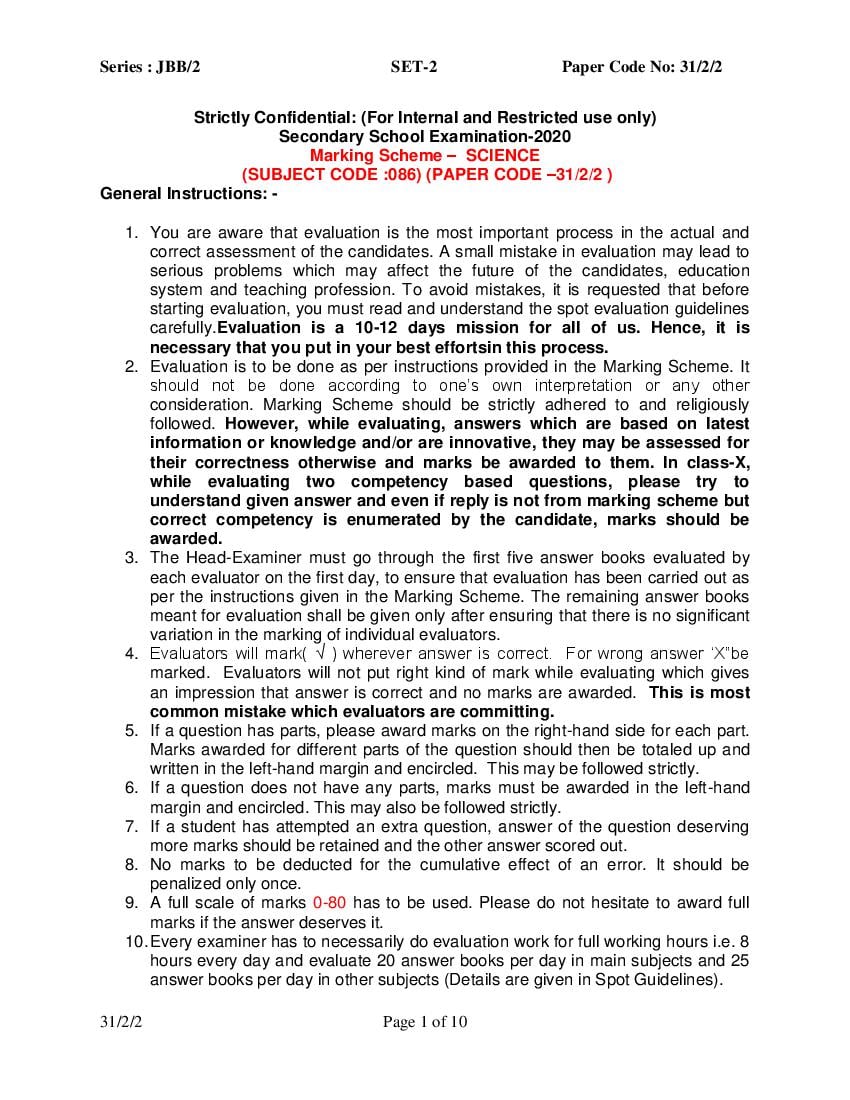
Strictly Confidential: (For Internal and Restricted use only)
Secondary School Examination-2020
Marking Scheme – SCIENCE
(SUBJECT CODE :086) (PAPER CODE –31/2/2 )
General Instructions: -
1. You are aware that evaluation is the most important process in the actual and
correct assessment of the candidates. A small mistake in evaluation may lead to
serious problems which may affect the future of the candidates, education
system and teaching profession. To avoid mistakes, it is requested that before
starting evaluation, you must read and understand the spot evaluation guidelines
carefully.Evaluation is a 10-12 days mission for all of us. Hence, it is
necessary that you put in your best effortsin this process.
2. Evaluation is to be done as per instructions provided in the Marking Scheme. It
should not be done according to one’s own interpretation or any other
consideration. Marking Scheme should be strictly adhered to and religiously
followed. However, while evaluating, answers which are based on latest
information or knowledge and/or are innovative, they may be assessed for
their correctness otherwise and marks be awarded to them. In class-X,
while evaluating two competency based questions, please try to
understand given answer and even if reply is not from marking scheme but
correct competency is enumerated by the candidate, marks should be
awarded.
3. The Head-Examiner must go through the first five answer books evaluated by
each evaluator on the first day, to ensure that evaluation has been carried out as
per the instructions given in the Marking Scheme. The remaining answer books
meant for evaluation shall be given only after ensuring that there is no significant
variation in the marking of individual evaluators.
4. Evaluators will mark( √ ) wherever answer is correct. For wrong answer ‘X”be
marked. Evaluators will not put right kind of mark while evaluating which gives
an impression that answer is correct and no marks are awarded. This is most
common mistake which evaluators are committing.
5. If a question has parts, please award marks on the right-hand side for each part.
Marks awarded for different parts of the question should then be totaled up and
written in the left-hand margin and encircled. This may be followed strictly.
6. If a question does not have any parts, marks must be awarded in the left-hand
margin and encircled. This may also be followed strictly.
7. If a student has attempted an extra question, answer of the question deserving
more marks should be retained and the other answer scored out.
8. No marks to be deducted for the cumulative effect of an error. It should be
penalized only once.
9. A full scale of marks 0-80 has to be used. Please do not hesitate to award full
marks if the answer deserves it.
10. Every examiner has to necessarily do evaluation work for full working hours i.e. 8
hours every day and evaluate 20 answer books per day in main subjects and 25
answer books per day in other subjects (Details are given in Spot Guidelines).
31/2/2 Page 1 of 10
Page 2
the Examiner in the past:-
Leaving answer or part thereof unassessed in an answer book.
Giving more marks for an answer than assigned to it.
Wrong totaling of marks awarded on a reply.
Wrong transfer of marks from the inside pages of the answer book to the title
page.
Wrong question wise totaling on the title page.
Wrong totaling of marks of the two columns on the title page.
Wrong grand total.
Marks in words and figures not tallying.
Wrong transfer of marks from the answer book to online award list.
Answers marked as correct, but marks not awarded. (Ensure that the right
tick mark is correctly and clearly indicated. It should merely be a line. Same is
with the X for incorrect answer.)
Half or a part of answer marked correct and the rest as wrong, but no marks
awarded.
12. While evaluating the answer books if the answer is found to be totally incorrect, it
should be marked as cross (X) and awarded zero (0)Marks.
13. Any unassessed portion, non-carrying over of marks to the title page, or totaling
error detected by the candidate shall damage the prestige of all the personnel
engaged in the evaluation work as also of the Board. Hence, in order to uphold
the prestige of all concerned, it is again reiterated that the instructions be
followed meticulously and judiciously.
14. The Examiners should acquaint themselves with the guidelines given in the
Guidelines for spot Evaluation before starting the actual evaluation.
15. Every Examiner shall also ensure that all the answers are evaluated, marks
carried over to the title page, correctly totaled and written in figures and words.
16. The Board permits candidates to obtain photocopy of the Answer Book on
request in an RTI application and also separately as a part of the re-evaluation
process on payment of the processing charges.
31/2/2 Page 2 of 10
Page 3
MARKING SCHEME- CLASS X SCIENCE (2019-20)
QUESTION PAPER CODE : 31/2/2
S.NO Value Points/Expected Answer MARKS TOTAL
MARKS
SECTION A
1. Two / Lithium and Beryllium 1
2. Due to weak intermolecular forces. 1
3. (a) In the neck region 1
(b) Thyroxine regulates carbohydrate, proteins and fat metabolism in the 1
body./ It promotes growth of body tissue.
(c) Excess of secretion of throxine in the body /overactivity of the thyroid 1
gland 1 4
(d) Can be controlled by including iodised salt in our diet.
(or any other relevant answer)
4. (a) Are deeper hot regions of earth’s crust where molten rocks are 1
formed.
(b) New Zealand / United States of America / China/Indonesia, ½+½
Philippines / Turkey/ New Mexico. (Any two)
(c) Electromagnetic Induction. 1
(d) In case of A.C. transmission of power/electricity takes place 1 4
without much loss of energy.
5. (b) / Group 13 period 2
OR
(b) / X2 Y 1
6. (b) / Clove oil 1
7. (d) / x= Physical state of KClO3 and KCl
y = Reaction condition
z= Physical state of O2 1
8. (b) / Maharashtra 1
9. (c)/ Sugarcane and rice
OR
(c) / Carbon monoxide 1
10. (c) / 8Ω 1
11. (b)/ B,C and D
OR
(d) /Opaque eye lens 1
12. (d) / R 2 > R1 > R 3 1
13. (d) / (A) is false, but (R) is true. 1
14. (a) / Both (A) and (R) are true and (R) is the correct explanation of the
assertion. 1
SECTION-B
15. (i) 2 formula units of CaSO4 /Calcium sulphate share 1 molecule of
water of crystallization. 1
31/2/2 Page 3 of 10
Page 4
(iii) CuSO4 .5H2O CuSO4 + 5H2O
(Blue) (white) 1
/ Due to loss of water of crystallization.
OR
(i)
1
(ii) Wet litmus paper 1
(iii) HCl solution , it is due to the formation of H + ion on in the water
/ H3 O+ (Hydronium ions) ½+½ 3
16. (i) A = CaO / Quick lime/ Calcium oxide ½
B = Ca(OH)2 / Slaked lime / Calcium hydroxide ½
(ii) CaO + H2 O → Ca(OH)2 + heat or energy 1
(iii) Combination reaction ½+½
Exothermic reaction 3
17. (a) (i) BA 1
(ii) B2C 1
(Note : B is hydrogen
(b) None ½ 3
Because none of them show any characteristics of metal. ½
18.
Secretions Functions
(a) mucus (d)Protects the inner lining of stomach
from the acid / softening of food
(b) HCl(Hydrochloric acid) (e)Provides the acidic medium for ½x6
action of enzyme / Kill the germs.
(c) Pepsin (f) Digest proteins
(Note : a,b and c may in any order but there function must match / be given 3
along with the secretion.
19. (a) Grass → Grass hopper → Frog → Snake 1
(Or any other relevant example)
(b) Transfer of food energy to the next higher level will not take place , then
the organisms of the upper trophic levels will be affected , increase in the 1
population of the organisms belonging to the previous trophic level /
imbalance in the food chain.
10% Law 10% law
(c) 2000J 200 J 20J
II Trophic III Trophic IV Trophic 1
Level Level Level
31/2/2 Page 4 of 10
Page 5
OR ½
(a) (i) O2 ½
(ii) O3 ½
(iii) Breathing /Respiration
½
(iv) Absorbs harmful ultra violet (UV) radiations.
uv ½
(b) O2 O+O ½ 3
O + O2 → O3
20. Fossils are the preserved remains or impressions of the animals/ 1
plants of remote past.
Two methods:
(i) Relative Methods: Fossils closer to the surface are more ½ ×2
recent than those found in the deeper layers.
(ii) Dating fossils : Detecing the ratio of different isotopes of ½ ×2 3
same element in the fossils.
21. (a) To show independent inheritance of traits/ Independent assortment. 1
(b) In F1 progeny : All dominant traits. ½
In F2 progeny : original parental and new combinations are visible. ½
(credit marks if examples are written).
(c) 9:3:3:1 1 3
22. (i) Galvanometer (G) shows deflection (for very short time) 1
(ii) Galvanometer (G) shows deflection for a very short time in 1
opposite direction to the previous observation.
Common Reason: Due to variation in current flowing through coil 1, 1
magnetic field associated with coil 2 changes. Due to which an induced
current will generate consequently galvanometer shows momentry 3
defelection.
23. (a) (i) Size of eyeball decreases
(ii) Focal length of eye lens is too long / Power of eye lens decreases. ½+½
(b) Diagrams:
1
(c)
Hypermetropic Eye
1
Corrected Eye
OR
(a) Small size particles scatter shorter wavelength (violet) or large sized 1
particles scatter larger wavelength (Red). 1
(b) Due to variation in physical condition of hot air.
(d) Diagram
31/2/2 Page 5 of 10
Page 6
(Splitting of white light is essential )
24. (i)
1
(ii)
1
(iii)
1 3
SECTION C
25 (a)
Homologous series is a group of compounds which have the same
functional group , same general formula and where to 1
successive member differ by – CH2 in the molecular formula
Example : CH3-OH , CH3 -CH2-OH
Functional group : -OH , General Formula : CnH2n OH 1
(b) Esterification :
The reaction of carboxylic acid with an alcohol in the presence of
H2SO4 yields an ester.
Conc .H 2 SO 4
CH3COOH+C2H5OH CH3COOC2H5 + H20
1½
Heat Ester
(If word equation given award full marks)
Addition Reaction :
A reaction in which two or more atoms are added across a double or
triple bond in presence of catalyst is called addition reactions.
Pt ./Pd or Ni
CH2=CH2+H2 CH3-CH3 1½ 5
26. (a) (i) Al2O3 + 6 HCl 2AlCI3 + 3 H2O 1
31/2/2 Page 6 of 10
Page 7
(iii) 3 Fe + 4 H2O Fe3O4 + 4 H2 1
(b) X + CuSO4 --> Displacement reaction ½
X + ZnSO4 Displacement reaction ½
X + AgNO3 Displacement reaction ½
X > Zn > Cu > Ag ½
OR
(a)
(i) Sodium (Na) / Potassium (K)
(ii) Iodine (I)
(iii) Mercury (Hg)
(iv) Gold (Au)
(v) Silver / Copper ½ ×6
(vi) Carbon / Sulphur / Phosphorous
(b) They are generally stronger / have high tensile strength / high 1
electrical resistivity / resistant to corrosion.
(Any two)
Solder : Lead + Tin / Pb + Sn ½
Amalgam - an alloy in which mercury is one of the constituent /
Any metal + mercury ½ 5
27. (a)
Chemical Method ½
Barrier Method ½
Surgical Method ½
(b) Increase in female foeticide / Declining child sex ratio 1
(Any One)
Benefit : Maintaining male-female sex ratio for a healthy society ½
(c) Bacterial Gonorrhoea ½
Syphilis ½
Viral Warts ½
AIDS ½
OR
(a) (i) Ovary Production of female germ cell/egg 1
Production of hormone – estrogen
(Any one)
(ii)Oviduct Site of fertilization 1
(b) (i) Thickening of the uterus lining 1
(ii) Wall of uterus breaks/Menstruation occurs. 1
(c) Providing the nutrition / O2/to the developing embryo /foetus or 1
removal of waste from the fetus. 5
31/2/2 Page 7 of 10
Page 8
2 chambered heart ½+½
Single Circulation
In Human beings:
4 chambered heart ½+½
Double circulation.
b)
The deoxygenated blood from all body parts is collected by
the veins to pour into venacava.
Vena cava pours blood into the right atrium(RA).
Right atrium transfers this blood into the right ventricle
(RV).
Right ventricle pumps blood to lungs through pulmonary
artery.
The oxygenated blood from the lungs is brought to the left
atrium (LA) through pulmonary vein.
Now the blood is pumped to left ventricle, from where the
blood is distributed to all parts of the body through Aorta. ½x6 5
(If student draws the labeled diagram / flow chart , credit marks)
29. (a)
(i) Real and magnified
1½
Object distance must be between 10 to 20 cm
(ii) Virtual and magnified
1½
Object distance must be less than 10 cm
(b) f = 10 cm ; u = - 10 cm
1 1 1 ½
v
+u = f
1 1 1
= −
v f u
1 1 1
= −
v 10 −10 1
1 1 1
v
= 10 + 10
1 1 ½
= ∴ v = 5cm
v 5
OR
31/2/2 Page 8 of 10
Page 9
of focal length of lens.
(ii) It is a point on principal axis at which light ray parallel to 1
principal axis converges after reflection.
1 1 1 ½
(b) (i) for spherical lens : v − u = f
1 1 1 ½
(ii) for spherical mirror : v + u = f
(c)
2
Distance of object (BO) = 10 cm
Focal length (OF1 ) = 15 cm 5
(If the distance in the diagram are not marked , deduct ½ marks)
30. (a) In this case : Length L becomes l/2 then Area of cross section A
become 2A
L ½
R = ρ A = 6Ω
L/2
R′ = ρ ½
2A
1 L
R’ = 4 ρ A ½
1
R′ = 4 × 6
3 ½
R′ = 2 Ω
(b) No of resistors = 3
Each resistor has resistance = 2Ω
In this arrangement where total resistance is 3Ω
Resistor A of 2Ω is connected in series with a parallel
combination of the resistors B (2Ω) and C (2Ω). ½
Arrangement :
1
2Ω×2Ω
Total resistance R = 2Ω + 2Ω+2Ω
31/2/2 Page 9 of 10
Page 10
R= 2Ω + 4Ω
𝑅 = 2Ω + 1Ω
R = 3Ω
½ ×3 5
31/2/2 Page 10 of 10
Document Details
| Board / Org | CBSE |
| Exam | Class 10 |
| Type | Solution |
| Pages | 10 |
| Updated | 22 Jul 2026 |