PUMDET 2023 Question Paper Mathematics
Finished viewing? Save it for later —
Download PUMDET 2023 Question Paper Mathematics (PDF · 16 pages)About PUMDET 2023 Question Paper Mathematics
PUMDET 2023 Question Paper Mathematics is available here for free download. Published by WBJEEB for PUMDET, this question paper can be viewed online or downloaded as a PDF (16 pages). Candidates preparing for PUMDET can use PUMDET 2023 Question Paper Mathematics to understand the exam pattern, the type of questions asked, and the overall difficulty level.
Frequently Asked Questions
How can I download PUMDET 2023 Question Paper Mathematics?
Open this page and click the Download button to save PUMDET 2023 Question Paper Mathematics as a PDF. It is completely free on AglaSem Docs.
Is PUMDET 2023 Question Paper Mathematics free to download?
Yes. PUMDET 2023 Question Paper Mathematics can be viewed online and downloaded as a PDF free of cost on AglaSem Docs.
How many pages does PUMDET 2023 Question Paper Mathematics have?
PUMDET 2023 Question Paper Mathematics contains 16 pages, which you can read online or download together as a single PDF.
Where can I find more PUMDET study material?
You can find more PUMDET question papers, sample papers, syllabus, and answer keys on AglaSem Docs.
PUMDET 2023 Question Paper Mathematics – Text
Read the full text of this question paper below — useful to quickly search, copy and reference the content online without downloading the PDF.
📄 View text version (16 pages)
Page 1
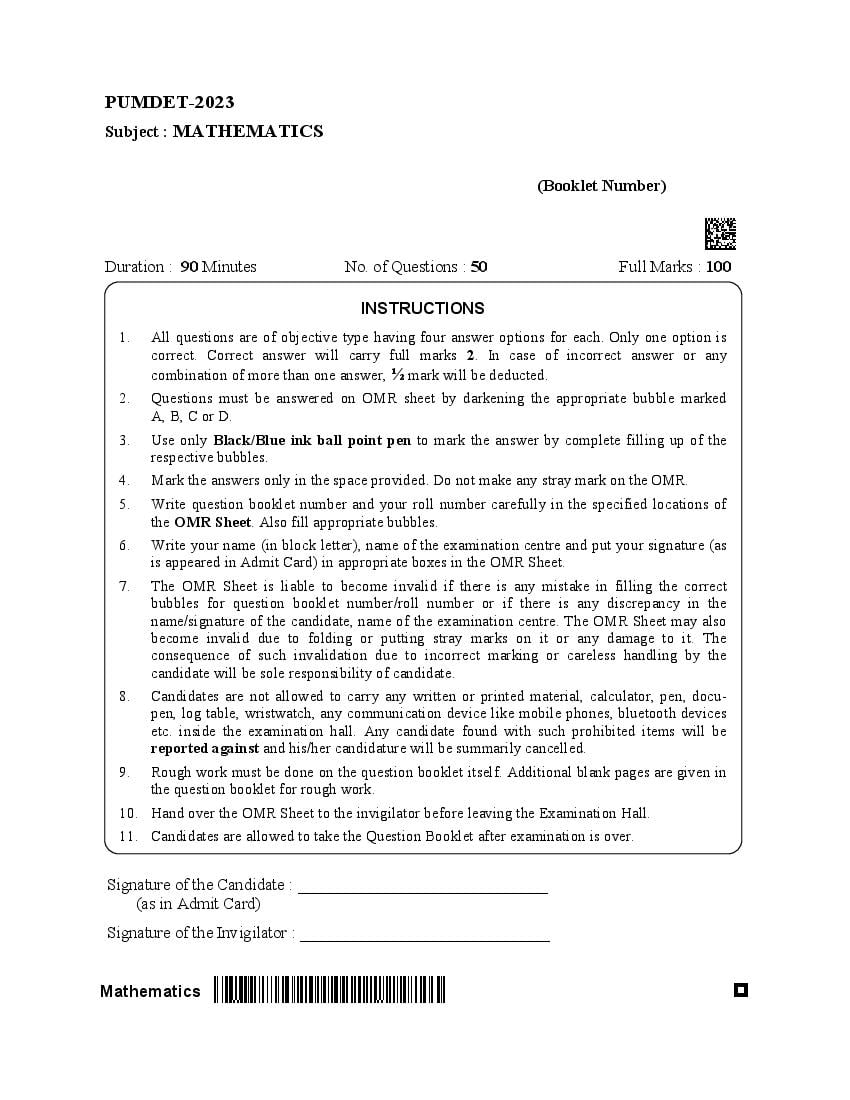
(Booklet Number)
Duration : 90 Minutes No. of Questions : 50 Full Marks : 100
INSTRUCTIONS
1. All questions are of objective type having four answer options for each. Only one option is
correct. Correct answer will carry full marks 2. In case of incorrect answer or any
combination of more than one answer, ½ mark will be deducted.
2. Questions must be answered on OMR sheet by darkening the appropriate bubble marked
A, B, C or D.
3. Use only Black/Blue ink ball point pen to mark the answer by complete filling up of the
respective bubbles.
4. Mark the answers only in the space provided. Do not make any stray mark on the OMR.
5. Write question booklet number and your roll number carefully in the specified locations of
the OMR Sheet. Also fill appropriate bubbles.
6. Write your name (in block letter), name of the examination centre and put your signature (as
is appeared in Admit Card) in appropriate boxes in the OMR Sheet.
7. The OMR Sheet is liable to become invalid if there is any mistake in filling the correct
bubbles for question booklet number/roll number or if there is any discrepancy in the
name/signature of the candidate, name of the examination centre. The OMR Sheet may also
become invalid due to folding or putting stray marks on it or any damage to it. The
consequence of such invalidation due to incorrect marking or careless handling by the
candidate will be sole responsibility of candidate.
8. Candidates are not allowed to carry any written or printed material, calculator, pen, docu-
pen, log table, wristwatch, any communication device like mobile phones, bluetooth devices
etc. inside the examination hall. Any candidate found with such prohibited items will be
reported against and his/her candidature will be summarily cancelled.
9. Rough work must be done on the question booklet itself. Additional blank pages are given in
the question booklet for rough work.
10. Hand over the OMR Sheet to the invigilator before leaving the Examination Hall.
11. Candidates are allowed to take the Question Booklet after examination is over.
Signature of the Candidate : ______________________________
(as in Admit Card)
Signature of the Invigilator : ______________________________
Mathematics
Page 2
Mathematics 2
Page 3
p z z5 z3 5z 2 2
In the annular region 1 z 2, p z has
(A) 5 (B) 3
(C) 2 (D) 1
zero or zeros
z 1
2. Let f z , then f has
z sin z
(A) No singularity (B) Removable discontinuity at z = 0
(C) Pole of order 2 at z = 0 (D) Simple pole at z = 0
Let f z z a , ‘a’ is fixed point in ℂ. Then
2
3.
(A) f is discontinuous function
(B) f is differentiable everywhere in ℂ
(C) f is differentiable only at a point in ℂ but nowhere else
(D) f is not differentiable anywhere in ℂ
4. Let f z x 2 y2 i.2x 2 y2 . Then
(A) f is discontinuous everywhere in ℂ
(B) f is analytic everywhere in ℂ
(C) f is nowhere analytic in ℂ
(D) Cauchy-Riemann equations do not hold anywhere in ℂ
cos ax cos bx
5.
1
x
dx, a, b +, then
(A) The integral is proper
(B) The integral is divergent
(C) The integral is convergent
X
cos ax cos bx
(D) f x dx is unbounded f x
1
x
Mathematics 3
Page 4
6. The solution of xy y x 2 is given by
xy y
(A)A z xy log xy f x, y (B)B z x log y y log x f x
(C)C z y log x yf x f y (D)D z x log y xf y g x
2 2
Here x > 0, y > 0 and f, g are arbitrary functions.
7. Solution of y z p x z q x y , (p, q have their usual meaning) is given by
(A)A f y z, x z 0 (B)B f zx y z, x y z 0
2 2 2
(C)C f x y z, x y z 0 (D)D f x y z, x y z 0
2 2 2 2 2 2
8. Let (X, d1) and (Y, d2) be metric spaces and (XY, d) denote the product space with the
product metric d. Then
(A) (XY, d) is never complete
(B) (XY, d) is complete if any one of (X, d1) and (Y, d2) be complete
(C) (XY, d) is complete iff (X, d1) and (Y, d2) both are complete
(D) (XY, d) is complete if d1(x,y) < d2 (x,y)
9. Let X = ℕ and d : X X be given by
mn
d m, n for all m, n ∈ ℕ.
mn
Then
(A) (X, d) is not a metric space
(B) (X, d) is pseudo metric space
(C) (X, d) is complete metric space
(D) (X, d) is incomplete metric space
Mathematics 4
Page 5
10. Let X :: xx 2 yy 2 11 and metric d be defined by
x, yy
d x1 , y1 , x 2 , y 2 x1 x 2 y1 y 2
2 2
(A) (X, d) is a complete metric space
(B) (X, d) is incomplete metric space
(C) No sequence in (X, d) is a Cauchy sequence
(D) All sequences in (X, d) are Cauchy
11. Let S be the sample space of the random experiment of throwing simultaneously two
unbiased dice and E k a, b S : ab k . If p k P E k , there the correct among the
following is
(A) p9 < p19 < p2 (B) p5 < p21 < p1
(C) p9 < p18 < p6 (D) p4 < p13 < p1
cos xdx 2y dy zdz , where C is the curve x y 1, z 1 , is given by
2 2 2
12.
C
C
(A) 0 (B) 1
1
(C) 2 (D)
2
13. S.H.M. in a resisting medium is
(A) Forced Oscillation
(B) Damped Oscillation
(C) Damped Forced Oscillation
(D) Not Oscillatory motion
Mathematics 5
Page 6
cross-radial acceleration
(A) varies as the distance from the pole
(B) varies as the square of the distance from the pole
(C) varies inversely as the distance from the pole
(D) varies inversely as the square of the distance from the pole
15. The value of n a x is
a 1 Aa a 1 a a x a 1 a
n h n x n h n x
(A)A h x
B a h 1(B)B
a 1Ca a 1 a 1 Da x a nh 1 a x
n n n n
(C)C
nh x nh x
D a nh (D)
16. For the fixed point iteration x k 1 g x k , k 0,1, 2,..... , consider the following statements
P and Q:
2
P: If g x 1 , then fixed point iteration converges to 2 for all x 0 [1, 100]
x
Q: If g x 2 x , then fixed point iteration converges to 2 for all x 0 [0, 100]
Then
(A) both P and Q are true (B) only P is true
(C) only Q is true (D) neither P nor Q is true
17. If the primal has no feasible solution, then its dual has
(A) bounded solution
(B) feasible solution
(C) either unbounded or no feasible solution
(D) feasible solution, but no optimal solution
Mathematics 6
Page 7
equal to m + n – 1, then the solution is called
(A) degenerate solution (B) non-feasible solution
(C) unbounded solution (D) non-degenerate solution
19. Let f(x) be continuously differentiable on the interval (0, ∞) such that f(1) = 1 and
t 2f x x 2f t 2
lim
lim 1 for each x > 0. Then f x dx is
t
t xx tx 1
1 1 14 14 1 1 14 14
2
(A)A 3Alog32log 2
B(B)Blog 2log
9 9 3 3 9 9
1 1 14 14 1 1 14 14
(C)C C 3 3
log log 3
D(D)D log 3log
2 2 9 9 2 2 9 9
dy
20. The solution of the Ordinary Differential Equation P x y Q x may be expressed
dx
in the form
Qdx
PdxB yC e
Pdx
(A)A y e A Cy e C C
Qdx
B y e (B)
Pdx Q Pdx Pdx Q
(C)C y e C yCe De y . Cee d. C e d
P Q dx P Q dx Pdx
C D y (D)
P P
Where C is the integrating constant
21. The equation of the right circular cone whose vertex is at the origin, axis is the X-axis and
the semi-vertical angle is , is
3
(A)A xA xy2 y3z B(B)zB2 zx22x3y
2 2 2 2 2 2
3z 2 3y 2
(C)C yC yz z3x 3x D(D)yD2 yx2 2x9z 9z 2
2 22 2 2 2 2 2
Mathematics 7
Page 8
x 2 4by, b 0 , then the locus of the point is the
(A) x 2 y 2 4a 2 (B) y 2 x 2b 4a 2 0
x 2 y2
(C) 1 (D) xy + 2ab = 0
a 2 b2
23. sin z = 2 is
(A) solvable neither in ℝ nor in ℂ
(B) solvable in ℝ and ℂ
(C)
1
solvable in ℂ only and then one of the expressions is z 2n ilog 2 3
2
where n is integer
n
(D) Solvable in ℂ and z 2n i , n is integer
2 2
24. Which one of the following is correct?
(A) If the quotient group G/H is cyclic, then G must be cyclic.
(B) ∃ a non-cyclic group H for which quotient group G/H is cyclic.
(C) Every group G is isomorphic to a permutation group.
(D) An infinite cyclic group has infinitely many generators.
0 b
25. Let R M 2 z , I : a, b z , then
0 d
(A) I is not a subring of R
(B) I is an Ideal of R
(C) I is a subring but not any Ideal of R
(D) I is a left Ideal of R only
Mathematics 8
Page 9
(A) f(x) has atmost one zero for –1 < C < 0
(B) f(x) cannot have any zero in (1, 2)
(C) f(x) has infinitely many zeros for all C ∈ ℝ
(D) f(x) has two zeros in (1, 2) for all C ∈ ℝ
27. If a prime integer p divides the order of a Group G, then G contains
(A) at least one normal subgroup of order p
(B) no normal subgroup of order p
(C) infinitely many normal subgroups
(D) exactly one normal subgroup
2021 2020 2020 2020
2021 2021 2020 2020
28. det A is
2021 2021 2021 2020
2021 2021 2021 2021
(A) 1 (B) 0
(C) 2021 (D) 2020
29. The last digit of 2004 is
5
(A) 4 (B) 8
(C) 6 (D) 2
30. Let G be a group of order 28. Then
(A) G contains elements of order 7
(B) G may not contain any elements of order 7
(C) G contains elements of order 12
(D) G contains elements of order 5
Mathematics 9
Page 10
(A) Groups of order pq, p and q are prime, are simple groups
(B) Group of order pq, p and q are prime, is cyclic
(C) Let G be a finite group of order 2n, where n is odd integer and greater than 1. Then G
is not simple
(D) Groups of order 56 are simple groups
32. A subset W ( ) is called a Ring if it contains 1 and if a, b W , the numbers a – b and
ab are also in W. Let S = { 2m : m, n are integers}and T = { qp : p, q are integers and q
n
odd }, Then
(A) neither S nor T is a Ring
(B) S is a Ring but T is not a Ring
(C) T is a Ring but S is not a ring
(D) Both S and T are Rings
0 0 2
33. Let A 0 2 0 . Then
2 0 3
(A) Eigen values of A are real but not distinct
(B) Eigen vectors of A are linearly dependent
(C) A is diagonalizable
(D) Eigen values of A are not all real
Mathematics 10
Page 11
x 1 0 1 x
y 1 1 2 y
z 2 1 3 z
Then
(A) T is one-to-one
(B) Ker T consists of elements of form (a, b, c) where a 2 b 2 c 2
(C) Ker T consists of elements of form (a, b, c) where a 2 b 2 3c 2
(D) Ker T consists of elements of form (a, b, c) where a 2 b 2 2c 2
35. Consider the curve represented by y 2 x 5 1 . Then
(A) Curve has no point of inflexion
(B) (0, 1) is a point of inflexion
(C) (1, 0) is a point of inflexion
(D) (0, 0) is a point of inflexion
36. The volume of the catenoid formed by the revolution about the x-axis, of the area bounded
a
by the catenary y (eex/a + e–x/a), the y-axis, the x-axis and ordinate is
2
a
(A)A A sy sy
ax ax B(B)B sy sy
ax ax
2
a
(C)C C sy sy
ax ax D(D) sysy
D a a
ax ax
2
where s is the length of the arc between (0, a) and (x, y)
Mathematics 11
Page 12
f x, y y 2 2x 2 y x 4 y x 4 0
Then
(A) Γ has no double point
(B) Γ has a node at (0, 0)
(C) Γ has a cusp of second species
(D) Γ has a cusp of first species
38. Let Γ denote the graph of f defined by
2x 1 1
y f x log on , 2 ,
x2 2
Then
(A) the curve has no asymptote
(B) the curve has only horizontal asymptote
(C) the curve has only vertical asymptote
1
(D) x , x 2 and y log 2 are asymptotes
2
39. Let f x, y x 3 y3 . Then
1/3
(A) f is not continuous at (0, 0)
f f
(B) neither nor exists at (0, 0)
x y
(C) f is differentiable at (0, 0)
(D) f is not differentiable at (0, 0)
Mathematics 12
Page 13
40. The equation f , 0 defines z implicitly as a function of x and y, say
x x
y z x, y
z = g(x, y). Given gx, gy are continuous and D 2f , 0 . Then
x x
(A) g(x, y) is not homogeneous function of x and y
(B) g(x, y) is a homogeneous function of x and y
(C) gxgy 0
(D) gx2 gy2 1
[D2f means partial derivative of f with respective to second argument]
41. Let I a, b a b , J a, b a p b p , 0 p 1 . Then
p
(A) I a, b J a, b
(B) I a, b J a, b
(C) no specific order relation exists between I a, b and J a, b
1 1
(D) I a, b J a, b in 0 p and I a, b J a, b in p 1
2 2
42. Let f : a, b be of Bounded Variation (BV) in [a, b] and there exists a function
F : a, b such that F f in [a, b]. Then
(A) f has discontinuity of both kind
(B) f has discontinuity of first kind only
(C) f has discontinuity of second kind only
(D) f is continuous in [a, b]
Mathematics 13
Page 14
(A) f x is not pointwise convergent in [0, 1]
n n
(B) f x is pointwise convergent but not uniformly convergent in [0, 1]
n n
(C) f x is uniformly convergent in [0, 1]
n n
(D) lim fn (x) is not bounded
n
44. Let u x 2 2x sin 2x, v x 2x sin 2x esin x . Then
uu xx uu xx
(A) AA lim
lim
lim 0,0, lim
lim
lim 00
x x
vv xx
xx vv xx
u x u x
(B)B lim
lim 0 but lim
lim does not exist
x
vx |x| v x
uu xx uu xx
(C) CC lim
lim
lim lim
lim
lim
x x
vv xx
xx vv xx
u x u x
(D) D lim
lim does not exist but lim
lim 0
vx
x v x
x
sin 2n x
45. Let u n x , x ℝ, then
2n
(A) u x is not uniformly convergent on ℝ
n
n
(B) u x can be differentiated term-by-term
n
n
(C) u x is convergent in ℝ
n
n
(D) u x cannot be differentiated term-by-term
n
n
/ 2
46. Let I R e R sin x dx, J R
2R
1 e R , R 0 . Then
0
(A) I(R) J(R) (B) I(R) > J(R)
(C) I(R) = J(R) (D) no specific order relation exists
Mathematics 14
Page 15
2
47. Let I n e x sin (nx) dx, (n ). Then lim I n
n
0
(A) does not exist (B) is 0
(C) is 1 (D) is e
2x
x 1
48. Let f : be a continuous function and let f 3t dt sin x x . Then f
0
2
is
1 3 2 3
(A) (B)
2 16
6 3 6 3
(C) (D)
24 12
n
49. The series 2n
n 1
(A) is divergent
(B) is convergent and represents 2 in the number scale
(C) represents e
(D) represents log e 2
1n ln n
50. The series n
n 1
(A) consists of terms which are increasing
(B) the nth term does not tend to zero
(C) is convergent
(D) nth term → ∞ and so the series is divergent
Mathematics 15
Page 16
Mathematics 16
Document Details
| Board / Org | WBJEEB |
| Exam | PUMDET |
| Type | Question Paper |
| Pages | 16 |
| Updated | 22 Jul 2026 |