Manipur Board Class 12 Syllabus 2027 Accountancy
Finished viewing? Save it for later —
Download Manipur Board Class 12 Syllabus 2027 Accountancy (PDF · 5 pages)About Manipur Board Class 12 Syllabus 2027 Accountancy
Manipur Board Class 12 Syllabus 2027 Accountancy is available here for free download. Published by Manipur Board for Class 12, this syllabus can be viewed online or downloaded as a PDF (5 pages). Candidates preparing for Class 12 can use Manipur Board Class 12 Syllabus 2027 Accountancy to understand the exam pattern, the type of questions asked, and the overall difficulty level.
Frequently Asked Questions
How can I download Manipur Board Class 12 Syllabus 2027 Accountancy?
Open this page and click the Download button to save Manipur Board Class 12 Syllabus 2027 Accountancy as a PDF. It is completely free on AglaSem Docs.
Is Manipur Board Class 12 Syllabus 2027 Accountancy free to download?
Yes. Manipur Board Class 12 Syllabus 2027 Accountancy can be viewed online and downloaded as a PDF free of cost on AglaSem Docs.
How many pages does Manipur Board Class 12 Syllabus 2027 Accountancy have?
Manipur Board Class 12 Syllabus 2027 Accountancy contains 5 pages, which you can read online or download together as a single PDF.
Where can I find more Class 12 study material?
You can find more Class 12 question papers, sample papers, syllabus, and answer keys on AglaSem Docs.
Manipur Board Class 12 Syllabus 2027 Accountancy – Text
Read the full text of this syllabus below — useful to quickly search, copy and reference the content online without downloading the PDF.
📄 View text version (6 pages)
Page 1
Manipur Board Class
12 Syllabus 2027
Accountancy
EXAM YEAR TYPE SUBJECT
Manipur Class 12 2027 Syllabus Accountancy
Notes · Sample Papers · Previous Year Papers · Mock Tests
Page 2
m .co
m .co s e m
se g l a
a
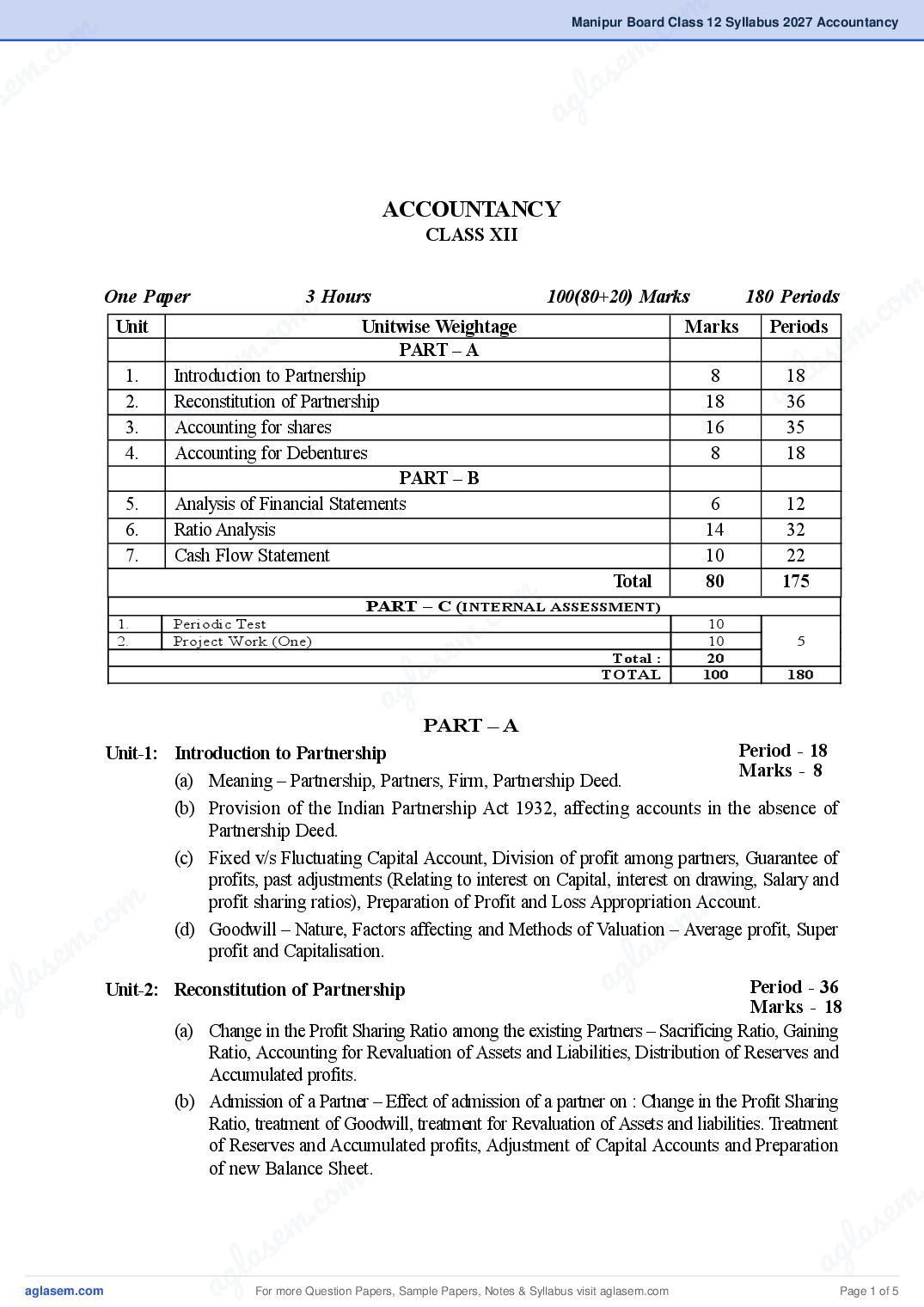
ACCOUNTANCY
CLASS XII
m
.co
One Paper 3 Hours 100(80+20) Marks 180 Periods
m
.co m
Unit Unitwise Weightage Marks Periods
m PART – A
s e
s e 18 la
a36g
1. Introduction to Partnership 8
2.
g l a
Reconstitution of Partnership 18
3. aAccounting for shares 16 35
4. Accounting for Debentures 8 18
PART – B
5. Analysis of Financial Statements 6 12
6. Ratio Analysis 14 32
7. Cash Flow Statement 10 22
Total 80 175
m
.co
PART – C (INTERNAL ASSESSMENT)
1. Periodic Test 10
2. Project Work (One)
s em 10 5
la
Total : 20
TOTAL 100 180
ag
PART – A
Unit-1: Introduction to Partnership Period - 18
Marks - 8
(a) Meaning – Partnership, Partners, Firm, Partnership Deed.
(b) Provision of the Indian Partnership Act 1932, affecting accounts in the absence of
Partnership Deed.
(c) Fixed v/s Fluctuating Capital Account, Division of profit among partners, Guarantee of
profits, past adjustments (Relating to interest on Capital, interest on drawing, Salary and m
m profit sharing ratios), Preparation of Profit and Loss Appropriation Account.
.co
m .co e
(d) Goodwill – Nature, Factors affecting and Methods of Valuation – Average profit, Super
s
m
s e profit and Capitalisation.
g l a
g la Unit-2: Reconstitution of Partnership a Period - 36
a Marks - 18
(a) Change in the Profit Sharing Ratio among the existing Partners – Sacrificing Ratio, Gaining
Ratio, Accounting for Revaluation of Assets and Liabilities, Distribution of Reserves and
Accumulated profits.
(b) Admission of a Partner – Effect of admission of a partner on : Change in the Profit Sharing
Ratio, treatment of Goodwill, treatment for Revaluation of Assets and liabilities. Treatment
of Reserves and Accumulated profits, Adjustment of Capital Accounts and Preparation
of new Balance Sheet.
m .
.co s e m
s em l a
g la ag
a For more Question Papers, Sample Papers, Notes & Syllabus visit Page 1 of 5
Page 3
profit Sharing Ratios, treatment of Goodwill, treatment for Revaluation of Assets and
Liabilities, Adjustment of Accumulated Profit and Reserves. Calculation of deceased
partner’s share of profit till the date of death, preparation of Deceased partner’s Executor’s
Account and preparation of new Balance Sheet.
(d) Dissolution of Partnership Firm – Meaning and Types of Dissolution of firm. Settlement
of accounts – preparation of Realisation Account and related accounts (excluding
piecemeal distribution, sale to a Company and insolvency of partners, firm).
Unit-3: Accounting for Shares Period -35
Marks -16
(a) Share and Share Capital – Meaning, Nature and Types.
(b) Accounting for Share Capital – Issue and Allotment of Equity Shares, Private placement
of Shares, Public subscription of Shares – Over subscription and under subscription of
shares. Issue at par and premium, Calls in advance and arrears. Issue of shares for
consideration other than cash.
(c) Accounting treatment of forfeiture and re-issue.
(d) Disclosure of Share Capital in Company’s Balance Sheet as per Schedule-III
Part-I of the Companies Act 2013.
Unit-4: Accounting for Debentures Period - 18
Marks - 8
(a) Debentures – Meaning, Issue of debentures at par, at discount and at premium. Issue of
debentures for consideration other than cash, Debentures as Collateral Security. Interest
on Debentures (Easy problems).
PART – B
Unit-5: Analysis of Financial Statements. Period - 12
Marks - 6
(a) Financial Statement of a Company – Statement of Profit & Loss and Balance Sheet in
prescribed form with major heading and sub-headings (as per Schedule-III to the
Companies Act 2013)
(Exceptional items, extyraordinary items and profit (loss) from discontinued
operations are excluded)
(b) Financial Statement Analysis – Meaning, Objectives and Limitations.
(c) Tools for Financial Statement Analysis – Comparative Statements, Common Size
Statements, Cash flow Analysis, Ratio Analysis.
Unit-6: Ratio Analysis Period - 32
Marks - 14
(a) Accounting Ratios – Meaning, Objectives and Classification of Ratios.
(b) Liquidity Ratios – Current Ratio and Quick Ratio.
(c) Solvency Ratios – Debt to Equity Ratio, Total Asset to Debt Ratio, Proprietary Ratio,
Interest Coverage Ratio.
For more Question Papers, Sample Papers, Notes & Syllabus visit Page 2 of 5
Page 4
m .co
m .co s e m
se g l a
a
(d) Activity Ratios – Stock Turnover Ratio, Debtors Turnover Ratio, Creditors Turnover Ratio,
Working Capital Turnover Ratio.
(e) Profitability Ratios – Gross Profit Ratio, Operating Ratio, Operating Profit Ratio, No Profit
Ratio.
m
m
Unit-7: Cash Flow Statement Period - 22 .co
.co s e
m Objective and Preparation As per AS-3 (revised) with adjustment Indirect
m Marks - 10
eMethod.
(a) Meaning,
s g l a
l a a
ag
PRESCRIBED TEXT BOOKS :
1. Accountancy (Part – A) for Class XII
By: D.K. Goel, Rajesh Goel and Shelly Goel
Published by: Arya Publications.
2. Analysis of Financial Statement (Part – B) for Class XII
By: D.K. Goel, Rajesh Goel and Shelly Goel m
Published by: Arya Publications.
m .co
s e
la
3. Double Entry Book Keeping for Class XII (Part I & II)
By: T.S. Grewal.
ag
Published by: Sultan Chand and Sons, New Delhi.
REFERENCE BOOKS :
1. Companion Accountancy for Class XII
By: O.P. Gupta, S.R. Goel and S.K. Jain
Published by: S. Dinesh & Co.
m
.co
2. Accountancy for Class XI
m
.co m
By: R.K. Mittal and A.K. Jain
m Published by: V.K. (India) Enterprises. s e
s e g l a
g la a
a ——§§§——
m .
.co s e m
s em l a
g la ag
a For more Question Papers, Sample Papers, Notes & Syllabus visit Page 3 of 5
Page 5
QUESTION PAPER
Subject : ACCOUNTANCY
Paper : Theory
Class : XII
Full Mark : 100(80+20)
Time : 3 Hours
WEIGHTAGE TO OBJECTIVES:
Objectives Marks Percentage
Knowledge(K) 12 15
I Understanding (U) 44 55
Application (A) 24 30
Total: 80 100
WEIGHTAGE TO FORMS OF QUESTIONS:
FORM OF QUESTIONS No. of questions Time (in minutes) Marks Percentage
Essay/Long Answer (E/LA) 3 74 24 30
II Short Answer Type-I (SA-I) 6 42 24 30
Short Answer Type-II (SA-II) 6 24 12 15
Very Short Answer(VSA) 8 16 8 10
MCQ 12 24 12 15
Total: 35 180 m 80 100
WEIGHTAGE TO CONTENT:
PART- A Marks Percentage
1 Introduction to Partnership 8 10.00
2 Reconstitution of Partnership 18 22.50
3 Accounting for Shares 16 20.00
4 Accounting for Debentures 8 10.00
PART- B
5 Analysis of Financial Statements 6 7.50
III 6 Ratio Analysis 14 17.50
7 Cash Flow Statement 10 12.50
Total: 80 100
PART- C (Internal Assessment)
I. Periodic Test 10
IV
II. Project Work(one) 10
Total 20
V SCHEME OF SECTIONS: NIL
VI SCHEME OF OPTIONS: 50% in SA-I & 100% in Essay/ (LA)Type Questions.
DIFFICULTY LEVEL :
VII Difficult : 30% of the total marks
Average : 50% of the total marks
Easy : 20% of the total marks
Special Instruction: 1) Two questions of MCQ will be assertion-reason type question.
2) One question of SA-I will be source based question
Abbreviation: K(Knowledge), U(Understanding), A(Application),S(Skill), E(Essay Type),
SA(Short Answer Type), VSA(Very Short Answer Type), O(Objective Type).
MCQ (Multiple Choice Question).
For more Question Papers, Sample Papers, Notes & Syllabus visit Page 4 of 5
Page 6
m .co
m .co s e m
se g l a
a
MAIN OBJECTIVES OF PROJECT WORKS IN ACCOUNTANCY
FOR CLASS XII.
1. To enable students to practical exposure of accounting practices, concepts
and conventions to real life business situations.
m
m .co
.co
2. To develop analytical, investigative and problem solving skills through
collection, preparation and interpretation of accounting data. e m
em l as
las
3. To develop decision making skills and abilities through analysis and
ag
g interpretation of financial and accounting data.
a 4. To promote independent learning, research aptitude and critical thinking
among students.
5. To improve communication and presentation skills through Report
Writing and Project Preparation.
Class XII Project Work (Any one)
m
any two aspects from the following:
m .co
One specific Project based on financial statement analysis of a company/an enterprise covering
s
1. Comparative and Common size Statementse
2. Accounting Ratios
g la
3. Cash Flow Statement a
Assessment:
The Marks will be allocated on the following heads:
a. Introduction and Objectives : 2
b. Findings /contents/observations 3
c. Analysis and conclusion 2
d. Viva 3
m
m Total = 10
.co
m .co s e m
s e g l a
g la a
a
m .
.co s e m
s em l a
g la ag
a For more Question Papers, Sample Papers, Notes & Syllabus visit Page 5 of 5
Document Details
| Board / Org | Manipur Board |
| Exam | Class 12 |
| Type | Syllabus |
| Pages | 5 |
| Updated | 04 Nov 2026 |