Karnataka 2nd PUC Question Paper 2025 Chemistry
Finished viewing? Save it for later —
Download Karnataka 2nd PUC Question Paper 2025 Chemistry (PDF · 10 pages)About Karnataka 2nd PUC Question Paper 2025 Chemistry
Karnataka 2nd PUC Question Paper 2025 Chemistry is available here for free download. Published by Karnataka Board for Class 12, this question paper can be viewed online or downloaded as a PDF (10 pages). Candidates preparing for Class 12 can use Karnataka 2nd PUC Question Paper 2025 Chemistry to understand the exam pattern, the type of questions asked, and the overall difficulty level.
Frequently Asked Questions
How can I download Karnataka 2nd PUC Question Paper 2025 Chemistry?
Open this page and click the Download button to save Karnataka 2nd PUC Question Paper 2025 Chemistry as a PDF. It is completely free on AglaSem Docs.
Is Karnataka 2nd PUC Question Paper 2025 Chemistry free to download?
Yes. Karnataka 2nd PUC Question Paper 2025 Chemistry can be viewed online and downloaded as a PDF free of cost on AglaSem Docs.
How many pages does Karnataka 2nd PUC Question Paper 2025 Chemistry have?
Karnataka 2nd PUC Question Paper 2025 Chemistry contains 10 pages, which you can read online or download together as a single PDF.
Where can I find more Class 12 study material?
You can find more Class 12 question papers, sample papers, syllabus, and answer keys on AglaSem Docs.
Karnataka 2nd PUC Question Paper 2025 Chemistry – Text
Read the full text of this question paper below — useful to quickly search, copy and reference the content online without downloading the PDF.
📄 View text version (22 pages)
Page 1
Karnataka Secondary Education Examination Board
Question Papers
Page 2
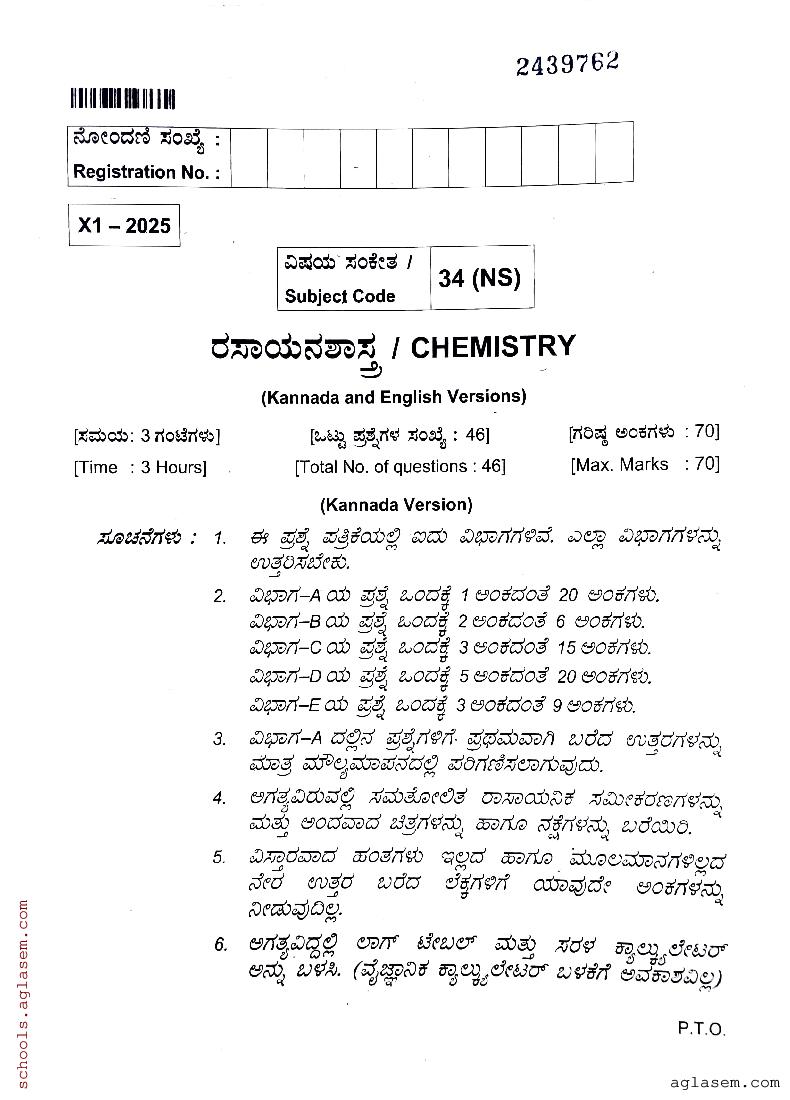
Registration No. :
X1 – 2025
«µÀAiÀÄ ¸ÀAPÉÃvÀ /
34 (NS)
Subject Code
gÀ¸ÁAiÀÄ£À±Á¸ÀÛç / CHEMISTRY
(Kannada and English Versions)
[¸ÀªÀÄAiÀÄ: 3 UÀAmÉUÀ¼ÀÄ] [MlÄÖ ¥Àæ±ÉßUÀ¼À ¸ÀASÉå : 46] [UÀjµÀ× CAPÀUÀ¼ÀÄ : 70]
[Time : 3 Hours] [Total No. of questions : 46] [Max. Marks : 70]
(Kannada Version)
¸ÀÆZÀ£ÉUÀ¼ÀÄ : 1. F ¥Àæ±Éß ¥ÀwæPÉAiÀÄ°è LzÀÄ «¨sÁUÀUÀ½ªÉ. J¯Áè «¨sÁUÀUÀ¼À£ÀÄß
GvÀÛj¸À¨ÉÃPÀÄ.
2. «¨sÁUÀ-A AiÀÄ ¥Àæ±Éß MAzÀPÉÌ 1 CAPÀzÀAvÉ 20 CAPÀUÀ¼ÀÄ.
«¨sÁUÀ-B AiÀÄ ¥Àæ±Éß MAzÀPÉÌ 2 CAPÀzÀAvÉ 6 CAPÀUÀ¼ÀÄ.
«¨sÁUÀ-C AiÀÄ ¥Àæ±Éß MAzÀPÉÌ 3 CAPÀzÀAvÉ 15 CAPÀUÀ¼ÀÄ.
«¨sÁUÀ-D AiÀÄ ¥Àæ±Éß MAzÀPÉÌ 5 CAPÀzÀAvÉ 20 CAPÀUÀ¼ÀÄ.
«¨sÁUÀ-E AiÀÄ ¥Àæ±Éß MAzÀPÉÌ 3 CAPÀzÀAvÉ 9 CAPÀUÀ¼ÀÄ.
3. «¨sÁUÀ-A zÀ°è£À ¥Àæ±ÉßUÀ½UÉ ¥ÀæxÀªÀĪÁV §gÉzÀ GvÀÛgÀUÀ¼À£ÀÄß
ªÀiÁvÀæ ªÀiË®åªÀiÁ¥À£ÀzÀ°è ¥ÀjUÀt¸À¯ÁUÀĪÀÅzÀÄ.
4. CUÀvÀå«gÀĪÀ°è ¸ÀªÀÄvÉÆðvÀ gÁ¸ÁAiÀĤPÀ ¸À«ÄÃPÀgÀtUÀ¼À£ÀÄß
ªÀÄvÀÄÛ CAzÀªÁzÀ avÀæUÀ¼À£ÀÄß ºÁUÀÆ £ÀPÉëUÀ¼À£ÀÄß §gɬÄj.
5. «¸ÁÛgÀªÁzÀ ºÀAvÀUÀ¼ÀÄ E®èzÀ ºÁUÀÆ ªÀÄÆ®ªÀiÁ£ÀUÀ½®èzÀ
£ÉÃgÀ GvÀÛgÀ §gÉzÀ ¯ÉPÀÌUÀ½UÉ AiÀiÁªÀÅzÉà CAPÀUÀ¼À£ÀÄß
¤ÃqÀĪÀÅ¢®è.
6. CUÀvÀå«zÀÝ°è ¯ÁUï mÉç¯ï ªÀÄvÀÄÛ ¸ÀgÀ¼À PÁå®ÄÌöå¯ÉÃlgï
C£ÀÄß §¼À¹. (ªÉÊeÕÁ¤PÀ PÁå®ÄÌöå¯ÉÃlgï §¼ÀPÉUÉ CªÀPÁ±À«®è)
P.T.O.
Page 3
«¨sÁUÀ - A
I. PÉÆnÖgÀĪÀ §ºÀÄ DAiÉÄÌUÀ¼À°è ¸ÀjAiÀiÁzÀ GvÀÛgÀªÀ£ÀÄß Dj¹ §gɬÄj.
(15 × 1 = 15)
1) fêÀ¸ÀvÀéUÀ½UÉ ¸ÀA§A¢ü¹zÀAvÉ vÀ¥ÁàzÀ ºÉýPÉ
a) ºÉaÑ£À fêÀ¸ÀvÀéUÀ¼À ¸ÉêÀ£ÉAiÀÄÄ ºÁ¤PÁgÀPÀªÁVzÉ
b) ºÉaÑ£À fêÀ¸ÀvÀéUÀ¼ÀÄ CªÉÄÊ£ÉÆà UÀÄA¥ÀÄUÀ¼À£ÀÄß ºÉÆA¢gÀÄvÀÛªÉ
c) fêÀ¸ÀvÀéUÀ¼À£ÀÄß ¸À¸ÀåUÀ½AzÀ GvÁࢸÀ§ºÀÄzÀÄ
d) fêÀ¸ÀvÀéUÀ¼À PÉÆgÀvÉAiÀÄÄ gÉÆÃUÀUÀ¼À£ÀÄß GAlĪÀiÁqÀÄvÀÛzÉ
2) ¸ÁgÀd£ÀPÀ C¤®zÀ°è PÀ¥ÀÆðgÀªÀÅ __________ UÉ MAzÀÄ
GzÁºÀgÀuÉAiÀiÁVzÉ.
a) zÀæªÀ zÁæªÀt b) WÀ£À zÁæªÀt
c) C¤® zÁæªÀt d) d°ÃAiÀÄ zÁæªÀt
3) PɼÀV£ÀªÀÅUÀ¼À°è AiÀiÁªÀÅzÀÄ gÀZÀ£Á ¸ÀªÀiÁAUÀvÉAiÀÄ G¥À «¨sÁUÀªÀ®è?
a) ¸ÀªÀÄ£Àé¬Ä ¸ÀªÀiÁAUÀvÉ b) ¸ÀA§AzsÀ ¸ÀªÀiÁAUÀvÉ
c) CAiÀiÁ¤ÃPÀgÀt ¸ÀªÀiÁAUÀvÉ d) eÁå«ÄwAiÀÄ ¸ÀªÀiÁAUÀvÉ
4) ¸ÁgÀjPÀÛ DªÀÄèzÉÆA¢UÉ d® «¨sÀd£ÉAiÀÄ ªÉÄÃ¯É PÀÆå«Ä£ï
ºÉÊqÉÆæÃ¥ÉgÁPÉìöÊqï __________ ¤ÃqÀÄvÀÛzÉ.
a) D¯ÉÆÌúÁ¯ï ªÀÄvÀÄÛ ¦üãÁ¯ï
b) ¦üãÁ¯ï ªÀiÁvÀæ
c) ¦üãÁ¯ï ªÀÄvÀÄÛ C¹mÉÆãï
d) D¯ÉÆÌúÁ¯ï ªÀÄvÀÄÛ C¹mÉÆãï
Page 4
5) «ÄxÁå ¥ÀæxÀªÀÄ QæAiÀiÁªÀUÀðPÉÌ GzÁºÀgÀuÉAiÀÄÄ,
a) ©¹ ¥Áèn£ÀªÀiï ªÉÄïÉäöÊ ªÉÄÃ¯É C¤® CªÉÆäAiÀiÁzÀ «¨sÀd£É
b) ºÉÊqÉÆæÃd£ï ªÀÄvÀÄÛ PÉÆèÃj£ï £ÀqÀÄ«£À zÀÄåw-gÁ¸ÁAiÀÄ£À QæAiÉÄ
c) PÀ©â£À ¸ÀPÀÌgÉAiÀÄ «¯ÉÆêÀÄvÉ
d) Fyãï£À ºÉÊqÉÆæÃd¤ÃPÀgÀt
6) mÉæöÊ«ÄÃxÉʯï CªÉÄÊ£ï£À°è ‘N’ ¥ÀgÀªÀiÁtÄ«£À ¸ÀAPÀgÀtªÀÅ,
a) sp3 b) sp2
c) sp d) dsp2
Br O
7) | || gÀ IUPAC ºÉ¸ÀgÀÄ.
HC3 − CH − CH2 − C − H
a) 3–¨ÉÆæªÉƧÄåmÉÊgÁ°ØºÉÊqï
b) 2–¨ÉÆæªÉÆ¥ÉÆæ¥À£ïD°ØºÉÊqï
c) 3–¨ÉÆæªÉƧÄåmÁ£À¯ï
d) 2–¨ÉÆæªÉƧÄåmÁ£À¯ï
8) PɼÀV£ÀªÀÅUÀ¼À°è CgÉ «zÀÄåzÁéºÀPÀªÀ®èzÀÝ£ÀÄß DAiÉÄÌ ªÀiÁr.
a) ¹°PÁ£ï
b) PÁ§ð£ï-PÀ¥ÀÄà
c) UÁå°AiÀÄA D¸Éð£ÉÊqï
d) «Ä²ævÀ ¹°PÁ£ï
Page 5
9) PɼÀUÉ JgÀqÀÄ ºÉýPÉUÀ¼À£ÀÄß ¤ÃqÀ¯ÁVzÉ :
ºÉýPÉ I : ¥ÁæxÀ«ÄPÀ, ¢éwÃAiÀÄPÀ, vÀÈwÃAiÀÄPÀ CªÉÄÊ£ïUÀ¼ÀÄ ªÀÄvÀÄÛ
ZÀvÀÄxÀðPÀ CªÉÆäAiÀÄA ®ªÀtUÀ¼À «Ä±Àæt GvÀàwÛAiÀiÁUÀĪÀÅzÀÄ
D¯ÉÌöÊ¯ï ºÁå¯ÉÊqïUÀ¼À CªÉÆäAiÀÄA «¨sÀd£ÉAiÀÄ
£ÀÆå£ÀvÉAiÀiÁVzÉ.
ºÉýPÉ II : D¯ÉÌöÊ¯ï ºÁå¯ÉÊqïUÀ¼À CªÉÆäAiÀÄ «¨sÀd£ÉAiÀÄ°è
CªÉÆäAiÀiÁªÀ£ÀÄß C¢üPÀ ¥ÀæªÀiÁtzÀ°è §¼À¹zÁUÀ vÀÈwÃAiÀÄPÀ
CªÉÄÊ£ï ªÀÄÄRå GvÀà£ÀߪÁV zÉÆgÉAiÀÄÄvÀÛzÉ.
ªÉÄð£À ºÉýPÉUÀ¼À ¨É¼ÀQ£À°è, PɼÀUÉ ¤ÃqÀ¯ÁzÀ DAiÉÄÌUÀ¼À°è ¸ÀÆPÀÛªÁzÀ
GvÀÛgÀªÀ£ÀÄß Dj¹.
a) ºÉýPÉ I vÀ¥ÁàVzÉ DzÀgÉ ºÉýPÉ II ¸ÀjAiÀiÁVzÉ
b) ºÉýPÉ I ªÀÄvÀÄÛ ºÉýPÉ II JgÀqÀÆ ¸ÀjAiÀiÁVzÉ
c) ºÉýPÉ I ªÀÄvÀÄÛ ºÉýPÉ II JgÀqÀÆ vÀ¥ÁàVzÉ
d) ºÉýPÉ I ¸ÀjAiÀiÁVzÉ DzÀgÉ ºÉýPÉ II vÀ¥ÁàVzÉ
10) ¥ÉAmÁPÁ¨ÉÆð¤¯ïLgÀ£ï(0) gÀZÀ£ÉAiÀÄÄ
a) ZÀvÀĪÀÄÄðTÃAiÀÄ b) wæPÉÆäÃAiÀÄ ¢é¦gÁ«Äqï
c) CµÀÖªÀÄÄTÃAiÀÄ d) ZËPÀ ¦gÁ«ÄqÀ¯ï
11) ‘A’ ªÀÄvÀÄÛ ‘B’ JgÀqÀÄ ¸ÀAAiÀÄÄPÀÛUÀ¼À£ÀÄß CªÀÅUÀ¼À PÀÄ¢AiÀÄĪÀ ©AzÀÄUÀ½UÁV
¥ÀjÃQë¸À¯ÁUÀÄwÛzÉ. JgÀqÀÆ MAzÉà µÀgÀvÀÄÛUÀ½UÉ M¼À¥ÀmÁÖUÀ, ‘B’ £ÀAvÀgÀ ‘A’
PÀÄ¢AiÀÄ®Ä ¥ÁægÀA©ü¹vÀÄ JAzÀÄ UÀªÀĤ¸À¯ÁVzÉ. ¸ÀAAiÀÄÄPÀÛ ‘B’ C¹mÉÆãï
DVzÀÝgÉ, PɼÀV£ÀªÀÅUÀ¼À°è AiÀiÁªÀÅzÀÄ ¸ÀAAiÀÄÄPÀÛ ‘A’ DVzÉ?
a) ¥ÉÆæ¥À£Á¯ï b) ¥ÉÆæ¥À£ï-1-N¯ï
c) ªÉÄxÁQìFxÉãï d) n-§ÄåmÉãï
Page 6
12) PÉÆnÖgÀĪÀ ¸ÀªÀiÁAVÃAiÀÄ qÉÊPÉÆèÃgÉƨÉAfãïUÀ¼À PÀgÀUÀĪÀ ©AzÀÄ«£À
¸ÀjAiÀiÁzÀ PÀæªÀĪÀ£ÀÄß DAiÉÄÌ ªÀiÁr.
a) o-qÉÊPÉÆèÃgÉƨÉAfãï > m-qÉÊPÉÆèÃgÉƨÉAfãï > p-qÉÊPÉÆèÃgÉƨÉAfãï
b) p-qÉÊPÉÆèÃgÉƨÉAfãï > m-qÉÊPÉÆèÃgÉƨÉAfãï > o-qÉÊPÉÆèÃgÉƨÉAfãï
c) p-qÉÊPÉÆèÃgÉƨÉAfãï > o-qÉÊPÉÆèÃgÉƨÉAfãï > m-qÉÊPÉÆèÃgÉƨÉAfãï
d) m-qÉÊPÉÆèÃgÉƨÉAfãï > o-qÉÊPÉÆèÃgÉƨÉAfãï > p-qÉÊPÉÆèÃgÉƨÉAfãï
13) ¥ÀnÖ - I gÀ°è ¤ÃqÀ¯ÁzÀ PɼÀV£ÀªÀÅUÀ¼À£ÀÄß ¥ÀnÖ - II gÉÆA¢UÉ ºÉÆA¢¹.
¥ÀnÖ - I ¥ÀnÖ - II
i) V 2O 5 A) JxÉÊ£ï C£ÀÄß JxÉ£Á¯ï DV
GvÀ̶ð¸ÀĪÀÅzÀÄ
ii) TiCl4 ªÀÄvÀÄÛ Al(CH3)3 B) D¯ÉÌöÊ£ïUÀ¼À ¥Á°ªÀÄgÉʸÉõÀ£ï
iii) PdCl2 C) ¸À®ÆájPï DªÀÄèªÀ£ÀÄß
vÀAiÀiÁj¸ÀĪÁUÀ SO2 C£ÀÄß
GvÀ̶ð¸À®Ä
iv) ¤PÀ̯ï£À ¸ÀAQÃtðUÀ¼ÀÄ D) ¥Á°ÃJxÀ°Ã£ï vÀAiÀiÁjPÉ
¸ÀjAiÀiÁzÀ DAiÉÄÌAiÀÄ£ÀÄß Dj¹.
a) i – C, ii – D, iii – A, iv – B
b) i – A, ii – B, iii – C, iv – D
c) i – A, ii – C, iii – B, iv – D
d) i – C, ii – A, iii – D, iv – B
Page 7
14) ªÉÃUÀªÀzsÀðPÀ¢AzÀ QæAiÀiÁªÉÃUÀzÀ ºÉZÀѼÀªÀ£ÀÄß F PɼÀV£ÀªÀÅUÀ¼À°è AiÀiÁªÀÅzÀÄ
«ªÀj¸ÀÄvÀÛzÉ?
a) ªÉÃUÀªÀzsÀðPÀªÀÅ »ªÀÄÄäR QæAiÉÄAiÀÄ QæAiÀiÁªÉÃUÀªÀ£ÀÄß PÀrªÉÄ
ªÀiÁqÀĪÀÅzÀjAzÀ ªÀÄĪÀÄÄäR QæAiÉÄAiÀÄ QæAiÀiÁªÉÃUÀªÀÅ ºÉZÁÑUÀÄvÀÛzÉ.
b) ªÉÃUÀªÀzsÀðPÀªÀÅ ¥ÀæwQæ¬Ä¸ÀĪÀ CtÄUÀ½UÉ ºÉZÀÄѪÀj ±ÀQÛAiÀÄ£ÀÄß
MzÀV¸ÀÄvÀÛzÉ, DzÀÄzÀjAzÀ CªÀÅ ¥ÀjuÁªÀÄPÁj ¸ÀAWÀlÖUÀ¼À£ÀÄß
GAlĪÀiÁqÀÄvÀÛzÉ
c) QæAiÀiÁPÁgÀPÀUÀ¼ÀÄ ªÀÄvÀÄÛ GvÀà£ÀßUÀ¼À £ÀqÀÄ«£À ¥ÀlÆPÀgÀt ±ÀQÛAiÀÄ£ÀÄß
PÀrªÉÄ ªÀiÁqÀĪÀ ªÀÄÆ®PÀ ªÉÃUÀªÀzsÀðPÀªÀÅ ¥ÀAiÀiÁðAiÀÄ ªÀiÁUÀðªÀ£ÀÄß
MzÀV¸ÀÄvÀÛzÉ
d) ªÉÃUÀªÀzsÀðPÀªÀÅ PÁgÀPÀ CtÄUÀ¼À ªÀÄzsÉå ¸ÀAWÀlÖUÀ¼À ¸ÀASÉåAiÀÄ£ÀÄß
ºÉaѸÀÄvÀÛzÉ
15) ¸ÁPÀµÀÄÖ ¥ÀæªÀiÁtzÀ 2-«ÄxÉʯï¥ÉÆæ¥É£ï-2-N¯ï C£ÀÄß 358 K £À°è
20% ¥sÁ¸ÀájPï DªÀÄèzÉÆA¢UÉ ©¹ ªÀiÁrzÁUÀ ¤dð°ÃPÀgÀtUÉÆAqÀÄ
ªÀÄÄRå GvÀà£Àß ‘X’ C£ÀÄß ¤ÃqÀÄvÀÛzÉ ªÀÄvÀÄÛ 573 K £À°è ©¹AiÀiÁzÀ vÁªÀÄæzÀ
ªÉÄÃ¯É lmïð-§ÄåmÉʯïD¯ÉÆÌúÁ¯ï (tert-butylalcohol) C£ÀÄß
ºÁ¬Ä¹zÁUÀ ¤dð°ÃPÀgÀtPÉÌ M¼ÀUÁV ‘Y’ C£ÀÄß ¤ÃqÀÄvÀÛzÉ.
‘X’ ªÀÄvÀÄÛ ‘Y’ UÀ½UÉ ¸ÀA§A¢ü¹zÀAvÉ ¸ÀjAiÀiÁzÀ ºÉýPÉAiÀÄ£ÀÄß Dj¹.
a) ‘X’ ªÀÄvÀÄÛ ‘Y’ UÀ¼À PÀÄ¢AiÀÄĪÀ ©AzÀÄUÀ¼ÀÄ ¸ÀªÀĪÁVªÉÉ
b) ‘X’ £À PÀÄ¢AiÀÄĪÀ ©AzÀÄ ‘Y’ £À PÀÄ¢AiÀÄĪÀ ©AzÀÄ«VAvÀ ºÉaÑzÉ
c) ‘X’ £À PÀÄ¢AiÀÄĪÀ ©AzÀÄ ‘Y’ £À PÀÄ¢AiÀÄĪÀ ©AzÀÄ«VAvÀ PÀrªÉÄ EzÉ
d) PÉÆoÀr vÁ¥ÀªÀiÁ£ÀzÀ°è ‘X’ ªÀÄvÀÄÛ ‘Y’ UÀ¼ÉgÀqÀÆ WÀ£ÀgÀÆ¥ÀzÀ°ègÀÄvÀÛªÉ
II. DªÀgÀtzÀ°è PÉÆnÖgÀĪÀ ¥ÀzÀUÀ¼À°è ¸ÀÆPÀÛ ¥ÀzÀªÀ£ÀÄß DAiÉÄÌ ªÀiÁr ©nÖgÀĪÀ
¸ÀܼÀUÀ¼À£ÀÄß ¨sÀwð ªÀiÁr. (5 × 1 = 5)
[PÁ¨ÉÆðPÁåmÁAiÀiÁ£ï, ¥ÀƪÀð-WÁvÁAPÀ, WÁvÁAPÀ, MAn,
PÁ¨ÉÆÃðºÉÊqÉæÃmï, CCl2F2]
16) CgÉíäAiÀĸï CA±ÀªÀ£ÀÄß ___________ CA±ÀªÉAzÀÆ PÀÆqÀ PÀgÉAiÀÄÄvÁÛgÉ.
Page 8
17) __________ J¯ÉPÁÖç£ïUÀ¼À EgÀÄ«PɬÄAzÀ ¥ÁågÁPÁAwÃAiÀÄvÉ
PÀAqÀħgÀÄvÀÛzÉ.
18) PÉÊUÁjPÉAiÀÄ°è ¸ÁªÀiÁ£ÀåªÁV §¼À¸ÀĪÀ MAzÀÄ ¦üæAiÀiÁ£ï __________.
19) D°ÌÃ£ï ªÉÄÃ¯É H3 O ⊕ £À J¯ÉPÁÖç£ï DPÁAQëÃAiÀÄ DPÀæªÀÄt¢AzÀ
__________ GvÀàwÛAiÀiÁUÀÄvÀÛzÉ.
20) ___________ £À eÉÊ«PÀ QæAiÉÄAiÀÄ£ÀÄß UÀÄèPÉÆPÁnðPÁAiÀiïØ ºÁªÉÆÃð£ï
¤AiÀÄAwæ¸ÀÄvÀÛzÉ.
«¨sÁUÀ – B
III. F PɼÀV£À AiÀiÁªÀÅzÁzÀgÀÆ ªÀÄÆgÀÄ ¥Àæ±ÉßUÀ½UÉ GvÀÛj¹. ¥ÀæwAiÉÆAzÀÄ ¥Àæ±ÉßAiÀÄÄ
2 CAPÀUÀ¼À£ÀÄß ºÉÆA¢gÀÄvÀÛzÉ. (3 × 2 = 6)
21) ¸ÀÆPÀÛªÁzÀ gÁ¸ÁAiÀĤPÀ ¸À«ÄÃPÀgÀtzÉÆA¢UÉ ªÀÅmïìð£À QæAiÉÄAiÀÄ£ÀÄß
«ªÀj¹.
22) ªÉƯÁåjn (M), ªÉƯÁå°n (m) ªÀÄvÀÄÛ ªÉÆÃ¯ï ©ü£ÁßA±À ( χ ) UÀ¼ÀÄ
zÁæªÀtUÀ¼À ¸ÁAzÀævÉAiÀÄ£ÀÄß ªÀåPÀÛ¥Àr¸ÀĪÀ PÉ®ªÀÅ «zsÁ£ÀUÀ¼ÁVªÉ.
EªÀÅUÀ¼À°è AiÀiÁªÀŪÀÅ vÁ¥ÀªÀiÁ£ÀªÀ£ÀÄß CªÀ®A©¹gÀÄvÀÛzÉ? PÁgÀtªÀ£ÀÄß
PÉÆr.
23) C£ÀªÀ±ÀåPÀ CªÉÄÊ£ÉÆà DªÀÄèUÀ¼ÀÄ JAzÀgÉãÀÄ? £ÉʸÀVðPÀªÁV zÉÆgÀPÀĪÀ
zÀÄåw ¥ÀlÄvÀéªÀ£ÀÄß ºÉÆA¢gÀzÀ α -CªÉÄÊ£ÉÆà DªÀÄèªÀ£ÀÄß ºÉ¸Àj¹.
24) CAvÀgÁ¼À ¸ÀAAiÀÄÄPÀÛUÀ¼À AiÀiÁªÀÅzÁzÀgÀÆ JgÀqÀÄ UÀÄt®PÀëtUÀ¼À£ÀÄß
§gɬÄj.
25) DxÉÆÃð ªÀÄvÀÄÛ ¥ÁågÁ £ÉÊmÉÆææü£Á¯ïUÀ¼À «Ä±ÀætªÀ£ÀÄß D«
¨sÀnÖE½¸ÀÄ«PÉ ªÀÄÆ®PÀ ¨ÉÃ¥Àðr¸ÀĪÀ ¸ÀAzÀ¨sÀðzÀ°è AiÀiÁªÀ ¸ÀªÀiÁAV D«
¨ÁµÀà²Ã®ªÁUÀÄvÀÛzÉ, ºÉ¸Àj¹. PÁgÀtªÀ£ÀÄß ¤Ãr.
Page 9
«¨sÁUÀ – C
IV. F PɼÀV£À AiÀiÁªÀÅzÁzÀgÀÆ ªÀÄÆgÀÄ ¥Àæ±ÉßUÀ½UÉ GvÀÛj¹. ¥ÀæwAiÉÆAzÀÄ ¥Àæ±ÉßAiÀÄÄ
3 CAPÀUÀ¼À£ÀÄß ºÉÆA¢zÉ. (3 × 3 = 9)
26) ªÀ£Àðgï CªÀgÀ ¸ÀªÀÄ£Àé¬Ä ¸ÀAAiÀÄÄPÀÛUÀ¼À ¹zÁÞAvÀzÀ AiÀiÁªÀÅzÁzÀgÀÆ
ªÀÄÆgÀÄ ¥Àæw¥ÁzÀ£ÉUÀ¼À£ÀÄß w½¹.
27) PÉÆæêÉÄÊmï ( FeCr2O 4 ) C¢j¤AzÀ ¥ÉÆmÁå²AiÀÄA qÉÊPÉÆæêÉÄmï
( K 2Cr2O 7 ) vÀAiÀiÁjPÉAiÀÄ°è M¼ÀUÉÆArgÀĪÀ ¸ÀªÀÄvÉÆðvÀ gÁ¸ÁAiÀĤPÀ
¸À«ÄÃPÀgÀtUÀ¼À£ÀÄß §gɬÄj.
28) [Co(NH3 )5 Br ] SO4 MAzÀÄ CµÀÖªÀÄÄT ¸ÀªÀÄ£Àé¬Ä ¸ÀAAiÀÄÄPÀÛªÁVzÉ. CzÀgÀ
IUPAC ºÉ¸ÀgÀ£ÀÄß §gɬÄj ªÀÄvÀÄÛ CFT (¸ÀánPÀ PÉëÃvÀæ ¹zÁÞAvÀ) UÉ
¸ÀA§A¢ü¹zÀAvÉ ªÉÄð£À ¸ÀAQÃtðzÀ°è d-PÀPÉëUÀ¼À «¨sÀd£ÉAiÀÄ£ÀÄß
¸ÀÆa¸ÀĪÀ gÉÃSÁavÀæªÀ£ÀÄß §gɬÄj.
29) ¯ÁåAxÀ£ÉÊqï PÀÄUÀÄΫPÉ JAzÀgÉãÀÄ? ¯ÁåAxÀ£ÉÊqïUÀ¼ÀÄ ªÀÄvÀÄÛ DQÖ£ÉÊqïUÀ¼ÀÄ
vÉÆÃj¸ÀĪÀ GvÀ̵Àðt ¹ÜwUÀ½UÉ ¸ÀA§A¢ü¹zÀAvÉ MAzÀÄ ºÉÆðPÉ ªÀÄvÀÄÛ
MAzÀÄ ªÀåvÁå¸ÀªÀ£ÀÄß §gɬÄj.
30) [Co(NH3)3 (NO2)3] £À ¥sÀ®QÃAiÀÄ (fac) ªÀÄvÀÄÛ gÉÃSÁA²AiÀÄ (mer)
¸ÀªÀiÁAVÃAiÀÄ gÀZÀ£ÉUÀ¼À£ÀÄß §gɬÄj. ªÉÄð£À ¸ÀAQÃtðzÀ°ègÀĪÀ
¯ÉÆúÀzÀ CAiÀiÁ¤£À ¸ÀªÀÄ£Àé¬Ä ¸ÀASÉåAiÀÄ£ÀÄß £ÀªÀÄÆ¢¹.
V. F PɼÀV£À AiÀiÁªÀÅzÁzÀgÀÆ JgÀqÀÄ ¥Àæ±ÉßUÀ½UÉ GvÀÛj¹. ¥ÀæwAiÉÆAzÀÄ ¥Àæ±ÉßAiÀÄÄ
3 CAPÀUÀ¼À£ÀÄß ºÉÆA¢gÀÄvÀÛzÉ. (2 × 3 = 6)
31) ±ÀÆ£Àå QæAiÀiÁªÀUÀðzÀ gÁ¸ÁAiÀĤPÀ QæAiÉÄAiÀÄ C£ÀÄPÀ°¹zÀ (Integrated)
QæAiÀiÁªÉÃUÀzÀ ¹ÜgÁAPÀ ¸À«ÄÃPÀgÀtªÀ£ÀÄß ¤µÀà¤ß¹.
32) ²µÀÖ ºÉÊqÉÆæÃd£ï «zÀÄåzÁUÀæ (S.H.E.) AiÀÄ CAzÀªÁzÀ ¨sÁUÀUÀ¼À£ÀÄß
UÀÄgÀÄw¹zÀ avÀæ, PÉÆñÀ ¥Àæw¤¢ü¸ÀÄ«PÉ ªÀÄvÀÄÛ CzsÀð-PÉÆñÀ QæAiÉÄAiÀÄ£ÀÄß
§gɬÄj.
Page 10
33) ¹ÜgÀPÀÄ¢«Ä±ÀætªÀ£ÀÄß ªÁåSÁ夹. g˯ïÖ£À ¤AiÀĪÀÄ¢AzÀ IÄuÁvÀäPÀ
«ZÀ®£À ºÉÆA¢gÀĪÀ zÁæªÀtªÀÅ AiÀiÁªÀ jÃwAiÀÄ ¹ÜgÀPÀÄ¢«Ä±ÀætUÀ¼À£ÀÄß
GAlĪÀiÁqÀÄvÀÛªÉ? CzÀPÉÌ MAzÀÄ GzÁºÀgÀuÉAiÀÄ£ÀÄß PÉÆr.
34) ¯Éqï ¸ÉÆÖÃgÉÃeï ¨ÁåljAiÀÄ£ÀÄß ¸ÁªÀiÁ£ÀåªÁV ªÁºÀ£ÀUÀ¼À°è ¢éwÃAiÀÄ
PÉÆñÀªÁV §¼À¸ÀÄvÁÛgÉ. ¢éwÃAiÀÄ PÉÆñÀ JAzÀgÉãÀÄ? ¯Éqï ¸ÉÆÖÃgÉÃeï
¨ÁåljAiÀÄ£ÀÄß G¥ÀAiÉÆÃV¸ÀĪÁUÀ C£ÉÆÃqï ªÀÄvÀÄÛ PÁåxÉÆÃqïUÀ¼À°è
¸ÀA¨sÀ«¸ÀĪÀ QæAiÉÄUÀ¼À£ÀÄß §gɬÄj.
«¨sÁUÀ – D
VI. F PɼÀV£À AiÀiÁªÀÅzÁzÀgÀÆ £Á®ÄÌ ¥Àæ±ÉßUÀ½UÉ GvÀÛj¹. ¥ÀæwAiÉÆAzÀÄ ¥Àæ±ÉßAiÀÄÄ
5 CAPÀUÀ¼À£ÀÄß ºÉÆA¢gÀÄvÀÛzÉ. (4 × 5 = 20)
35) a) PÉÆèÃgÉÆëÄÃxÉãï C£ÀÄß ªÉÄxÉ£Á¯ï DV ¥ÀjªÀwð¸À®Ä
SN2 QæAiÀiÁvÀAvÀæªÀ£ÀÄß §gɬÄj. CzÀgÀ QæAiÀiÁªÀUÀðªÀ£ÀÄß £ÀªÀÄÆ¢¹.
(3)
b) gɹ«ÄPï «Ä±Àæt JAzÀgÉãÀÄ? §ÆåmÉãï-2-D¯ï C£ÀÄß gɹ«ÄPï
«Ä±Àæt gÀÆ¥ÀzÀ°è ¥Àæw¤¢ü¹. (2)
36) a) CªÉÄʯÉÆ¸ï ªÀÄvÀÄÛ CªÉįÉÆ¥ÉQÖ£ïUÀ¼ÀÄ ¦µÀÖzÀ JgÀqÀÄ WÀlPÀUÀ¼ÁVªÉ.
CªÀÅUÀ¼À £ÀqÀÄ«£À AiÀiÁªÀÅzÁzÀgÀÆ JgÀqÀÄ ªÀåvÁå¸ÀUÀ¼À£ÀÄß §gɬÄj.
(2)
b) DgïJ£ïJ ªÀÄvÀÄÛ rJ£ïJ JgÀqÀgÀ®Æè ¸ÁªÀiÁ£ÀåªÁV PÀAqÀħgÀĪÀ
AiÀiÁªÀÅzÁzÀgÀÆ JgÀqÀÄ ¸ÁgÀd£ÀPÀ ¥ÀævÁåªÀÄèUÀ¼À£ÀÄß ¥ÀnÖ ªÀiÁr. (2)
c) ªÀiÁ¯ÉÆÖøï C£ÀÄß d°ÃPÀj¹ UÀÄèPÉÆøï DV ªÉÃUÀªÀ¢üð¸ÀĪÀ
QtéªÀ£ÀÄß ºÉ¸Àj¹. (1)
37) a) ¥ÀævÁåªÀÄèzÀ G¥À¹ÜwAiÀÄ°è PÁ¨ÉÆð¤¯ï UÀÄA¦UÉ HCN
(Hydrogen Cyanide) C£ÀÄß ¸ÉÃj¸ÀĪÀ QæAiÀiÁvÀAvÀæªÀ£ÀÄß §gɬÄj. (3)
b) gÁ¸ÁAiÀĤPÀ ¸À«ÄÃPÀgÀtzÉÆA¢UÉ gÉÆøÀ£ÀäAqï£À C¥ÀPÀµÀðuÉAiÀÄ£ÀÄß
«ªÀj¹. (2)
Page 11
38) a) ¸ÀÆPÀÛªÁzÀ gÁ¸ÁAiÀĤPÀ ¸À«ÄÃPÀgÀtzÉÆA¢UÉ PÁ¨ÉÊð¯ïCªÉÄÊ£ï
QæAiÉÄAiÀÄ£ÀÄß «ªÀj¹. (2)
b) gÁ¸ÁAiÀĤPÀ ¸À«ÄÃPÀgÀtzÉÆA¢UÉ C¤°£ï C£ÀÄß ¨ÉAfãï
qÉÊCgÉhÆäAiÀĪÀiï PÉÆèÃgÉÊqïUÉ ¥ÀjªÀwð¸ÀĪÀÅzÀ£ÀÄß «ªÀj¹. (2)
c) CgÉʯï CªÉÄÊ£ïUÀ¼ÀÄ ªÀÄvÀÄÛ CªÉÆäAiÀiÁ EªÀÅUÀ¼À°è AiÀiÁªÀÅzÀÄ ºÉZÀÄÑ
¥ÀævÁå«ÄèÃAiÀĪÁVzÉ? (1)
39) a) ®ÆPÁ¸ï PÁgÀPÀªÀÅ MAzÀÄ ¥ÀæªÀÄÄR PÁgÀPÀªÁVzÀÄÝ, EzÀÄ
ªÀÄÆgÀÄ ªÀUÀðUÀ¼À D¯ÉÆÌúÁ¯ïUÀ¼À £ÀqÀÄ«£À ªÀåvÁå¸ÀªÀ£ÀÄß
PÀAqÀÄ»rAiÀÄ®Ä ¸ÀºÁAiÀÄ ªÀiÁqÀÄvÀÛzÉ.
®ÆPÁ¸ï PÁgÀPÀzÀ gÁ¸ÁAiÀĤPÀ ¸ÀAAiÉÆÃd£ÉAiÀÄ£ÀÄß §gɬÄj ªÀÄvÀÄÛ
ªÉÄð£À PÁgÀPÀªÀÅ 1º ªÀÄvÀÄÛ 3º-D¯ÉÆÌúÁ¯ïUÀ¼À£ÀÄß ¥ÀævÉåÃQ¸À®Ä ºÉÃUÉ
¸ÀºÁAiÀÄ ªÀiÁqÀÄvÀÛzÉ JA§ÄzÀ£ÀÄß «ªÀj¹. (3)
b) «°AiÀĪÀiï¸À£ï ¸ÀA±ÉèõÀuɬÄAzÀ FxÀgï vÀAiÀiÁjPÉAiÀÄ£ÀÄß ¸ÁªÀiÁ£Àå
gÁ¸ÁAiÀĤPÀ ¸À«ÄÃPÀgÀtzÉÆA¢UÉ «ªÀj¹. (2)
40) ªÉÃUÀªÀzsÀðPÀ ºÉÊqÉÆæÃPÉÆèÃjPï DªÀÄèzÀ C¤®zÀ G¥À¹ÜwAiÀÄ°è
JxÀ£ÉÆìÄPï DªÀÄèzÉÆA¢UÉ ¥ÀæwQæ¬Ä¹ ¸ÁªÀAiÀĪÀ ¸ÀAAiÀÄÄPÀÛ ‘A’,
J¸ÀÖgï ‘B’ C£ÀÄß GvÁࢸÀÄvÀÛzÉ. ‘A’ AiÀÄÄ ¤dð® ªÀiÁzsÀåªÀÄzÀ°è
CrO3 £ÉÆA¢UÉ GvÀ̵ÀðuÉAiÀÄ ªÉÄÃ¯É ‘C’ C£ÀÄß ¤ÃqÀÄvÀÛzÉ. ‘C’ C£ÀÄß
¸ÁA¢æÃPÀj¹zÀ KOH £ÉÆA¢UÉ ©¹ ªÀiÁr ªÀÄvÀÄÛ £ÀAvÀgÀ ¸ÁgÀjPÀÛ
HCl ¤AzÀ D«ÄèÃPÀj¹zÁUÀ ‘A’ ªÀÄvÀÄÛ ‘D’ GvÁࢸÀÄvÀÛzÉ. ªÀÄÆgÀÄ ªÉÆïï
‘D’ AiÀÄÄ PCl3 £ÉÆA¢UÉ ªÀÄÆgÀÄ ªÉÆïï HCOCl CtÄ ¸ÀÆvÀæ«gÀĪÀ
¸ÀAAiÀÄÄPÀÛ ªÀÄvÀÄÛ ‘E’ C£ÀÄß ¤ÃqÀÄvÀÛzÉ. ‘D’ C£ÀÄß °yAiÀÄA C®Æå«Ä¤AiÀÄA
ºÉÊqÉæöÊqï¤AzÀ C¥ÀPÀ¶ð¹ £ÀAvÀgÀ d®«¨sÀd£É¬ÄAzÀ ‘A’ DUÀÄvÀÛzÉ.
‘A’, ‘B’, ‘C’, ‘D’ ªÀÄvÀÄÛ ‘E’ ¸ÀAAiÀÄÄPÀÛUÀ¼À CtĸÀÆvÀæUÀ¼À£ÀÄß §gɬÄj.
Page 12
«¨sÁUÀ – E
(¯ÉPÀÌUÀ¼ÀÄ)
VII. F PɼÀV£À AiÀiÁªÀÅzÁzÀgÀÆ ªÀÄÆgÀÄ ¥Àæ±ÉßUÀ½UÉ GvÀÛj¹. ¥ÀæwAiÉÆAzÀÄ ¥Àæ±ÉßAiÀÄÄ
3 CAPÀUÀ¼À£ÀÄß ºÉÆA¢gÀÄvÀÛzÉ. (3 × 3 = 9)
1
41) F N2 O 5 (g) → 2NO 2 (g) + O 2 (g) ¥ÀæxÀªÀÄ QæAiÉÄAiÀÄ QæAiÀiÁªÀUÀðzÀ°è
2
N2 O 5£À DgÀA©üPÀ ¸ÁgÀvÉAiÀÄÄ 318 K £À°è 1.24 ×10 −2 mol L−1 DVvÀÄÛ.
60 ¤«ÄµÀUÀ¼À £ÀAvÀgÀ N2 O5 ¸ÁgÀvÉAiÀÄÄ 0.20 ×10 −2 mol L−1 DVvÀÄÛ.
318 K £À°è QæAiÀiÁ¹ÜgÁAPÀªÀ£ÀÄß ¯ÉQ̹.
42) 37°C £À°è 450 mL ¤Ãj£À°è, ªÉÆïÁgï zÀæªÀågÁ² 185000 EgÀĪÀ
1.0 g ¥Á°ªÀÄgï C£ÀÄß «°Ã£ÀUÉƽ¹ vÀAiÀiÁgÀÄ ªÀiÁrzÀ zÁæªÀtªÀÅ
GAlĪÀiÁqÀĪÀ ¥ÀgÁ¥ÀgÀt MvÀÛqÀªÀ£ÀÄß ¥Á¸À̯ïì£À°è ¯ÉQ̹.
[R = 8.314 ×10 Pa LK mol ]
3 −1 −1
43) qÉäAiÀįï PÉÆñÀPÉÌ ²µÀÖ E¯ÉPÉÆÖçÃr£À «¨sÀªÀ 1.1 V DzÀgÉ, F PɼÀV£À
QæAiÉÄAiÀÄ ²µÀÖ V¨ïì ±ÀQÛAiÀÄ£ÀÄß ¯ÉPÀÌ ºÁQ.
Zn (s ) + Cu 2 + (aq) → Zn 2 + (aq) + Cu (s )
44) 350 K £À°è ‘A’ ªÀÄvÀÄÛ ‘B’ ±ÀÄzÀÞ zÀæªÀUÀ¼À D«-MvÀÛqÀUÀ¼ÀÄ PÀæªÀĪÁV
450 ªÀÄvÀÄÛ 700 mm Hg DVªÉ. MlÄÖ D«-MvÀÛqÀªÀÅ 600 mm Hg DVzÀÝgÉ,
zÀæªÀ «Ä±ÀætzÀ ¸ÀAAiÉÆÃd£ÉAiÀÄ£ÀÄß PÀAqÀÄ»r¬Äj.
45) vÁ¥ÀªÀiÁ£ÀªÀÅ 300 K ¤AzÀ 310 K UÉ §zÀ¯Á¬Ä¹zÁUÀ ¥ÀæxÀªÀÄ
QæAiÀiÁªÀUÀðzÀ QæAiÀiÁªÉÃUÀ ¹ÜgÁAPÀªÀÅ 2 ×10 −2 s −1 jAzÀ 4 ×10 −2 s −1 UÉ
ºÉZÁÑUÀÄvÀÛzÉ. ¥ÀlÆPÀgÀt ±ÀQÛ (E a ) C£ÀÄß ¯ÉQ̹.
[log 2 = 0.3010, log 2.5 = 0.3979, log 4 = 0.6021, R = 8.314 JK mol ] −1 −1
46) 0.001028 mol L-1 C¹nPï DªÀÄèzÀ ªÁºÀPÀvÉAiÀÄÄ 4.95 × 10 −5 S cm−1
DVzÀÝ°è CzÀgÀ «¨sÀd£À ¤AiÀÄvÁAPÀªÀ£ÀÄß PÀAqÀÄ»r¬Äj. C¹nPï DªÀÄèzÀ
Λ m ¨É¯ÉAiÀÄÄ 390.5 S cm 2mol −1 DVzÉ.
————————
Page 13
(English Version)
Instructions : 1. This question paper has five parts. All parts are
compulsory.
2. PART-A carries 20 marks. Each question carries 1 mark.
PART-B carries 06 marks. Each question carries 2 marks.
PART-C carries 15 marks. Each question carries 3 marks.
PART-D carries 20 marks. Each question carries 5 marks.
PART-E carries 09 marks. Each question carries 3 marks.
3. For PART-A questions only first written answer will be
considered for evaluation.
4. Write balanced chemical equations and draw neat labelled
diagrams and graphs wherever necessary.
5. Direct answers to the numerical problems without detailed
steps and specific unit for final answer will not carry any
marks.
6. Use log tables and simple calculator if necessary.
(Use of scientific calculator is not allowed)
PART – A
I. Select the correct options from the given choices : (15 × 1 = 15)
1) Incorrect statement regarding vitamins,
a) Excess vitamin intake is harmful
b) Most of the vitamins contain amino groups
c) Vitamins can be produced by plants
d) Vitamin deficiency causes diseases
Page 14
2) Camphor in nitrogen gas, is an example of __________.
a) liquid solution b) solid solution
c) gaseous solution d) aqueous solution
3) Which of the following is not a subdivision of structural isomerism?
a) Coordination isomerism b) Linkage isomerism
c) Ionisation isomerism d) Geometrical isomerism
4) Cumene hydroperoxide on hydrolysis with dilute acid gives _________.
a) alcohol and phenol b) only phenol
c) phenol and acetone d) alcohol and acetone
5) An example for pseudo first-order reaction is,
a) The decomposition of gaseous ammonia on a hot platinum surface
b) Photochemical reaction between hydrogen and chlorine
c) Inversion of cane sugar
d) Hydrogenation of ethene
6) The hybridisation of ‘N’ atom in trimethyl amine is,
a) sp3 b) sp2
c) sp d) dsp2
Br O
7) The IUPAC name of | ||
HC3 − CH − CH2 − C − H
a) 3–bromobutyraldehyde b) 2–bromopropanaldehyde
c) 3–bromobutanal d) 2–bromobutanal
8) Select non-semiconductor from the following,
a) silicon b) carbon-black
c) gallium arsenide d) doped silicon
Page 15
9) Given below are two statements :
Statement I : Ammonolysis of alkyl halides has the disadvantage of
yielding a mixture of primary, secondary, tertiary amines
and quaternary ammonium salt.
Statement II : Tertiary amine is obtained as a major product by taking
large excess of ammonia in ammonolysis of alkyl halides.
In the light of the above statements, choose the appropriate answer from
the options given below :
a) Statement I is incorrect but Statement II is correct
b) Both Statement I and Statement II are correct
c) Both Statement I and Statement II are incorrect
d) Statement I is correct but Statement II is incorrect
10) The structure of pentacarbonyliron(0) is,
a) tetrahedral b) trigonal bipyramidal
c) octahedral d) square pyramidal
11) Two compounds ‘A’ and ‘B’ were being tested for their boiling points.
It was observed that ‘A’ started boiling after ‘B’, when both were subjected
to same conditions. If the compound ‘B’ is acetone, which of the following
can be compound ‘A’?
a) Propanal b) Propan-1-ol
c) Methoxyethane d) n-Butane
12) Select the correct order of melting points of isomeric dichlorobenzenes.
a) o-dichlorobenzene > m-dichlorobenzene > p-dichlorobenzene
b) p-dichlorobenzene > m-dichlorobenzene > o-dichlorobenzene
c) p-dichlorobenzene > o-dichlorobenzene > m-dichlorobenzene
d) m-dichlorobenzene > o-dichlorobenzene > p-dichlorobenzene
Page 16
13) Match the following given in List - I with List - II :
List - I List - II
i) V 2O 5 A) Oxidation of ethyne to ethanal
ii) TiCl4 with Al(CH3)3 B) Polymerisation of alkynes
iii) PdCl2 C) Oxidation of SO2 in the
manufacture of sulphuric acid
iv) Nickel complexes D) Manufacture of polyethylene
Choose the correct option :
a) i – C, ii – D, iii – A, iv – B
b) i – A, ii – B, iii – C, iv – D
c) i – A, ii – C, iii – B, iv – D
d) i – C, ii – A, iii – D, iv – B
14) Which of the following explains the increase in the reaction rate by a
catalyst?
a) Catalyst decreases the rate of backward reaction so that rate of
forward reaction increases
b) Catalyst provides extra energy to reacting molecules, so that they
produce effective collisions
c) Catalyst provides an alternative pathway by reducing the activation
energy between the reactants and products
d) Catalyst increases the number of collisions between the reacting
molecules
15) Sufficient amount of 2-methylpropan-2-ol heated with 20% phosphoric
acid at 358 K gives main product ‘X’ with the elimination of water and
tert-butyl alcohol undergoes dehydration when it is passed over heated
copper at 573 K gives ‘Y’
Pick the correct statement regarding X and Y.
a) The boiling points of ‘X’ and ‘Y’ are equal
b) The boiling point of ‘X’ is greater than the boiling point of ‘Y’
c) The boiling point of ‘X’ is lesser than the boiling point of ‘Y’
d) At room temperature both ‘X’ and ‘Y’ exists as a solids
Page 17
II. Fill in the blanks by choosing the appropriate word from those given in
brackets : (5 × 1 = 5)
[carbocation, pre-exponential, exponential, unpaired, carbohydrate, CCl2F2]
16) Arrhenius factor is also called __________ factor.
17) Paramagnetism arised from the presence of _________ electrons.
18) _________ is one of the most common freon in industrial use.
⊕
19) The electrophilic attack of H3O on alkene forms _________.
20) The hormone glucorticoids control the __________ metabolism.
PART – B
III. Answer any three of the following. Each question carries 2 marks : (3 × 2 = 6)
21) Explain Wurtz reaction with suitable chemical equation.
22) Molarity (M), molality (m) and mole fraction (χ) are some methods for
expressing concentration of solutions.
Which of these are temperature dependent? Give reason.
23) What are non-essential amino acids? Name an optically inactive naturally
occuring α -amino acid.
24) Write any two characteristic properties of interstitial compounds.
25) While separating a mixture of ortho and para nitrophenols by steam
distillation, name the isomer which will be steam volatile. Give reason.
Page 18
PART – C
IV. Answer any three of the following. Each question carries 3 marks : (3 × 3 = 9)
26) State any three postulates of Werner’s theory of coordination compounds.
27) Write the balanced chemical equations involved in the manufacture of
potassium dichromate (K 2Cr2O7 ) from chromite ore (Fe Cr2O 4 ) .
28) [Co (NH ) Br ]SO
3 5 4 is an octahedral coordination compound. Write its
IUPAC name and draw the diagram which indicates the splitting of
d-orbitals in above complex with respect to CFT (Crystal Field Theory).
29) What is lanthanoid contraction? Write one comparison and one difference
between lanthanoids and actinoids with respect to oxidation states shown
by them.
30) Write the facial (fac) and meridional (mer) isomeric structures of
[Co (NH3 )3 (NO2 )3 ] . Mention the coordination number of a metal ion in an
above complex.
V. Answer any two of the following. Each question carries 3 marks : (2 × 3 = 6)
31) Derive an integrated rate equation for the rate constant of zero-order
reaction.
32) Write a neat labelled diagram, cell representation and half-cell reaction of
Standard Hydrogen Electrode (S.H.E.).
33) Define azeotropes. What type of azeotropes are formed by solutions with
negative deviation from Raoult’s law? Give an example for it.
34) Lead storage battery is commonly used as a secondary cell in
automobiles. What is secondary cell? Write down the reactions occurs at
anode and cathode during discharging of the lead storage battery.
Page 19
PART – D
VI. Answer any four of the following. Each question carries 5 marks : (4 × 5 = 20)
35) a) Write the SN 2 mechanism for the conversion of chloromethane to
methanol. Mention its order. (3)
b) What is racemic mixture? Represent the butan-2-ol in racemic
mixture form. (2)
36) a) Amylose and Amylopectin are two components of the starch. Write
any two differences between them. (2)
b) List any two nitrogenous bases commonly found in both RNA and
DNA. (2)
c) Name the enzyme that catalyses hydrolysis of maltose into glucose.
(1)
37) a) Write the mechanism of addition of HCN (Hydrogen Cyanide) to
carbonyl group in presence of base. (3)
b) Explain Rosenmund reduction with chemical equation. (2)
38) a) Describe carbylamine reaction with suitable chemical equation. (2)
b) Explain the conversion of aniline to benzene diazonium chloride with
chemical equation. (2)
c) Among aryl amines and ammonia which is more basic? (1)
39) a) Lucas reagent is an important reagent which helps to distinguish
between three classes of alcohols.
Write the chemical composition of the Lucas reagent and explain
how the above reagent helps to distinguish 1° and 3°-alcohols? (3)
b) Illustrate preparation of ether by Williamson synthesis with a general
chemical equation. (2)
40) An organic compound ‘A’ on treatment with ethanoic acid in the presence
of hydrochloric acid gas as a catalyst produces an ester ‘B’. ‘A’ on
oxidation with CrO 3 in an anhydrous medium gives ‘C’. ‘C’ is heated with
concentrated KOH followed by acidification with dilute HCl generates
‘A’ and ‘D’. Three moles of ‘D’ reacts with PCl3 gives three moles of
compound with molecular formula HCOCl and ‘E’. ‘D’ is reduced to ‘A' by
lithium aluminium hydride followed by hydrolysis. Write the molecular
formulas of the compounds ‘A’, ‘B’, ‘C’, ‘D’ and ‘E’.
Page 20
PART – E
(PROBLEMS)
VII. Answer any three of the following. Each question carries 3 marks : (3 × 3 = 9)
41) The initial concentration of N2 O 5 in the following first order reaction.
1
N2 O 5 (g) → 2NO 2 (g) + O 2 (g) was 1.24 ×10 −2 mol L−1 at 318K. The
2
concentration of N2O5 after 60 minutes was 0.20 ×10 −2 mol L−1 . Calculate
the rate constant of the reaction at 318 K.
42) Calculate the osmotic pressure in Pascals exerted by a solution prepared
by dissolving 1.0 g of polymer of molar mass 185000 in 450 mL of water
at 37°C.
[R = 8.314 ×10 Pa LK mol ]
3 −1 −1
43) The standard electrode potential for Daniel cell is 1.1 V. Calculate the
standard Gibbs energy for the reaction :
Zn (s ) + Cu 2 + (aq) → Zn 2 + (aq) + Cu (s )
44) The vapour pressure of pure liquids ‘A’ and ‘B’ are 450 and 700 mm Hg
respectively, at 350 K. Find out the composition of the liquid mixture
if total vapour pressure is 600 mm Hg.
45) The rate constant of a first order reaction increases from 2 ×10 −2 s −1 to
4 ×10 −2 s −1 when the temperature changes from 300 K to 310 K. Calculate
the energy of activation (E a ) .
[log 2 = 0.3010, log 2.5 = 0.3979, log 4 = 0.6021, R = 8.314 JK mol ] −1 −1
46) The conductivity of 0.001028 mol L−1 acetic acid is 4.95 × 10 −5 S cm−1 .
Calculate its dissociation constant if Λ m for acetic acid is
390.5 S cm 2mol −1 .
————————
Page 21
Page 22
Share your recent question papers with us and get paid!
अपने हाल के न प हम भेज और कमाएँ!
To participate, email us with the following details:
भाग लेने के लए हम न न ववरण के साथ ईमेल कर:
- Your Name
- Your Class
- Your Board
- Details of the Question Papers you have
आपके पास उपल ध न प का ववरण
Our team will reach out to you with the next steps.
हमार ट म आगे क या के लए आपसे संपक करे गी।
Email: support@
Document Details
| Board / Org | Karnataka Board |
| Exam | Class 12 |
| Type | Question Paper |
| Pages | 10 |
| Updated | 29 Aug 2026 |