CBSE Class 10 Science Question Paper 2020 Set 31-4-2 Solutions
Finished viewing? Save it for later —
Download CBSE Class 10 Science Question Paper 2020 Set 31-4-2 Solutions (PDF · 9 pages)About CBSE Class 10 Science Question Paper 2020 Set 31-4-2 Solutions
CBSE Class 10 Science Question Paper 2020 Set 31-4-2 Solutions is available here for free download. Published by CBSE for Class 10, this solution can be viewed online or downloaded as a PDF (9 pages). Candidates preparing for Class 10 can use CBSE Class 10 Science Question Paper 2020 Set 31-4-2 Solutions to understand the exam pattern, the type of questions asked, and the overall difficulty level.
Frequently Asked Questions
How can I download CBSE Class 10 Science Question Paper 2020 Set 31-4-2 Solutions?
Open this page and click the Download button to save CBSE Class 10 Science Question Paper 2020 Set 31-4-2 Solutions as a PDF. It is completely free on AglaSem Docs.
Is CBSE Class 10 Science Question Paper 2020 Set 31-4-2 Solutions free to download?
Yes. CBSE Class 10 Science Question Paper 2020 Set 31-4-2 Solutions can be viewed online and downloaded as a PDF free of cost on AglaSem Docs.
How many pages does CBSE Class 10 Science Question Paper 2020 Set 31-4-2 Solutions have?
CBSE Class 10 Science Question Paper 2020 Set 31-4-2 Solutions contains 9 pages, which you can read online or download together as a single PDF.
Where can I find more Class 10 study material?
You can find more Class 10 question papers, sample papers, syllabus, and answer keys on AglaSem Docs.
CBSE Class 10 Science Question Paper 2020 Set 31-4-2 Solutions – Text
Read the full text of this solution below — useful to quickly search, copy and reference the content online without downloading the PDF.
📄 View text version (9 pages)
Page 1
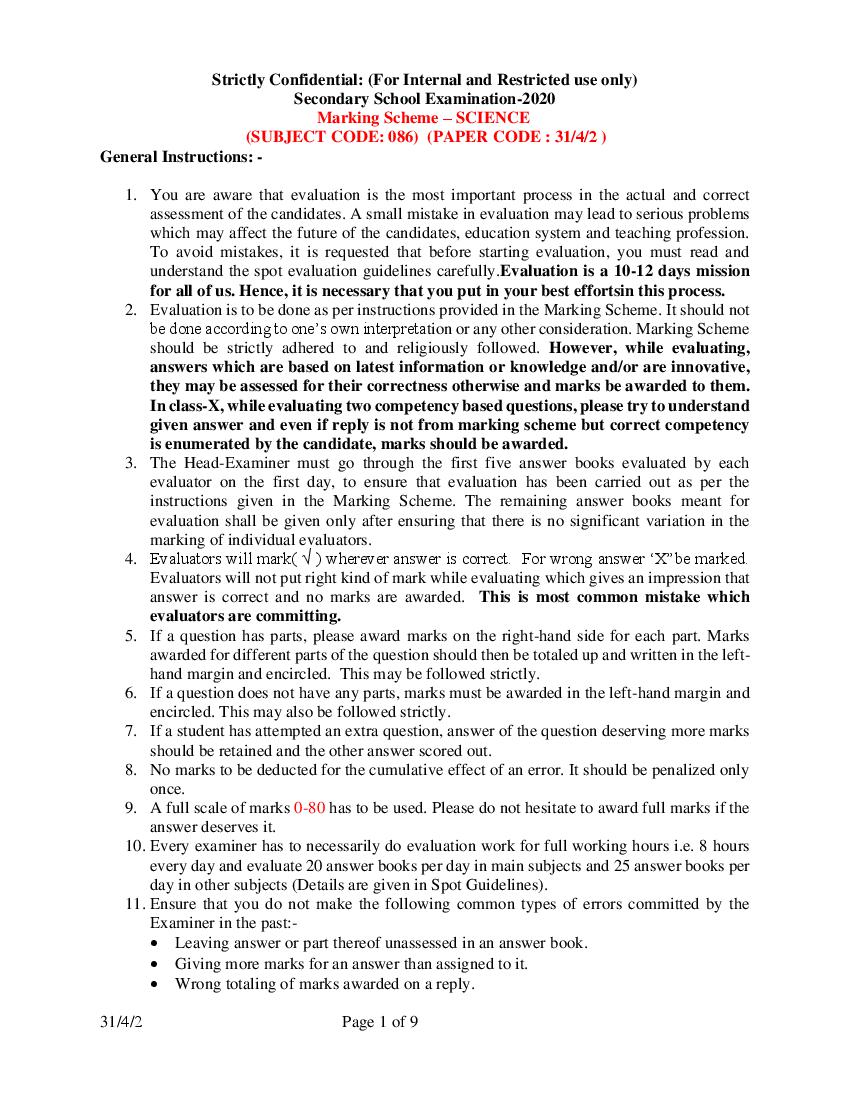
Secondary School Examination-2020
Marking Scheme – SCIENCE
(SUBJECT CODE: 086) (PAPER CODE : 31/4/2 )
General Instructions: -
1. You are aware that evaluation is the most important process in the actual and correct
assessment of the candidates. A small mistake in evaluation may lead to serious problems
which may affect the future of the candidates, education system and teaching profession.
To avoid mistakes, it is requested that before starting evaluation, you must read and
understand the spot evaluation guidelines carefully.Evaluation is a 10-12 days mission
for all of us. Hence, it is necessary that you put in your best effortsin this process.
2. Evaluation is to be done as per instructions provided in the Marking Scheme. It should not
be done according to one’s own interpretation or any other consideration. Marking Scheme
should be strictly adhered to and religiously followed. However, while evaluating,
answers which are based on latest information or knowledge and/or are innovative,
they may be assessed for their correctness otherwise and marks be awarded to them.
In class-X, while evaluating two competency based questions, please try to understand
given answer and even if reply is not from marking scheme but correct competency
is enumerated by the candidate, marks should be awarded.
3. The Head-Examiner must go through the first five answer books evaluated by each
evaluator on the first day, to ensure that evaluation has been carried out as per the
instructions given in the Marking Scheme. The remaining answer books meant for
evaluation shall be given only after ensuring that there is no significant variation in the
marking of individual evaluators.
4. Evaluators will mark( √ ) wherever answer is correct. For wrong answer ‘X”be marked.
Evaluators will not put right kind of mark while evaluating which gives an impression that
answer is correct and no marks are awarded. This is most common mistake which
evaluators are committing.
5. If a question has parts, please award marks on the right-hand side for each part. Marks
awarded for different parts of the question should then be totaled up and written in the left-
hand margin and encircled. This may be followed strictly.
6. If a question does not have any parts, marks must be awarded in the left-hand margin and
encircled. This may also be followed strictly.
7. If a student has attempted an extra question, answer of the question deserving more marks
should be retained and the other answer scored out.
8. No marks to be deducted for the cumulative effect of an error. It should be penalized only
once.
9. A full scale of marks 0-80 has to be used. Please do not hesitate to award full marks if the
answer deserves it.
10. Every examiner has to necessarily do evaluation work for full working hours i.e. 8 hours
every day and evaluate 20 answer books per day in main subjects and 25 answer books per
day in other subjects (Details are given in Spot Guidelines).
11. Ensure that you do not make the following common types of errors committed by the
Examiner in the past:-
• Leaving answer or part thereof unassessed in an answer book.
• Giving more marks for an answer than assigned to it.
• Wrong totaling of marks awarded on a reply.
31/4/2 Page 1 of 9
Page 2
• Wrong question wise totaling on the title page.
• Wrong totaling of marks of the two columns on the title page.
• Wrong grand total.
• Marks in words and figures not tallying.
• Wrong transfer of marks from the answer book to online award list.
• Answers marked as correct, but marks not awarded. (Ensure that the right tick mark is
correctly and clearly indicated. It should merely be a line. Same is with the X for
incorrect answer.)
• Half or a part of answer marked correct and the rest as wrong, but no marks awarded.
12. While evaluating the answer books if the answer is found to be totally incorrect, it should
be marked as cross (X) and awarded zero (0)Marks.
13. Any unassessed portion, non-carrying over of marks to the title page, or totaling error
detected by the candidate shall damage the prestige of all the personnel engaged in the
evaluation work as also of the Board. Hence, in order to uphold the prestige of all
concerned, it is again reiterated that the instructions be followed meticulously and
judiciously.
14. The Examiners should acquaint themselves with the guidelines given in the Guidelines for
spot Evaluation before starting the actual evaluation.
15. Every Examiner shall also ensure that all the answers are evaluated, marks carried over to
the title page, correctly totaled and written in figures and words.
16. The Board permits candidates to obtain photocopy of the Answer Book on request in an
RTI application and also separately as a part of the re-evaluation process on payment of
the processing charges.
31/4/2 Page 2 of 9
Page 3
MARKING SCHEME –CLASS X SCIENCE (2019-20)
QUESTION PAPER CODE : SET 31/4/2
S.NO VALUE POINTS/EXPECTED ANSWER MARKS TOTAL
MARKS
SECTION A
1. Oils containing unsaturated fatty acids/name of any edible oil. 1 1
2 The electric current generated / induced in a conductor by changing
magnetic field around it. 1 1
3. (a) The properties of elements are the periodic functions of their atomic 1
masses.
(b) To fill with undiscovered elements. 1
(c) (ii)/RH4, RO2 1
(d) (i)/Atoms of an element with similar chemical properties but
different atomic masses. 1 4
4. (a) Use of separate bins for plastic and paper ; separation of
biodegradable and non biodegradable waste or any other. ½+ ½
(b)
Packaging of articles like water , food, milk, biscuits etc.
Disposable utility items- bowls, tumblers, plates, leaves etc. ½+½
(c) By providing cloth /jute /earthern pots and utensils/ paper or any
other material for the similar purposes. 1
(d)
Yes ½
The action of microbes is tested in the laboratory creating the
same conditions as in the landfill. ½ 4
5. (B) /fusion of nuclei of male and female gamete. 1 1
6. (B) / Nephron 1
OR
(B) / False feet developed in some unicellular organisms. 1
7. (C) / Valves ensure that the blood does not flow backwards. 1 1
8. (B) / The nucleus of Uranium is bombarded with high energy neutrons. 1 1
OR
(A) / Biomass
9. (A) /1 Ω 1 1
OR
(B) / half 1
10. (C) /direction of the induced current. 1 1
11. (B) 10 % 1 1
12. Note: Treat all answers as correct. Give full credit even if not attempted. 1 1
13. (c) / (A) is true, but ( R ) is false. 1 1
14. (a) / Both ( A ) and ( R) are true and ( R) is the correct explanation of
assertion ( A). 1 1
SECTION B
15. (a) Double displacement reaction. 1
(b) Due to the formation of colourless sulphuric acid in the solution. ½
31/4/2 Page 3 of 9
Page 4
(d)CuSO4 + H2 S → CuS + H2 SO4 1 3
OR
(a) Electrolysis of water. 1
(b) Carbon electrodes / Graphite rod ½
Electric 1
(c) 2H2 O 2H2 + O2
Current
(d) Pure water is a non conductor of electricity /electric current is
carried through the acidic solution by ions. ½
16. (a) Behind the mirror ½
(b) Magnified ½
(c) Virtual and erect ½
Labelled ray diagram
1½ 3
17. Evolution – Gradual change in living organisms with time since
the beginning of life resulting in the formation of a new species/
Evolution is simply the generation of diversity and the shaping
of diversity by environmental selection. 1
Evolution cannot be equated with progress because more and
more complex body designs have emerged and evolved over
time but this does not mean that older designs are
inefficient.Foreg. Bacteria are simpler organisms but some
inhabit the most inhospitable habitats like hot springs, deep sea, 2 3
thermal vents and the ice in Antartica.
OR
Examples of feathers :
- Feathers can start out as providing insulation in cold weather but
later they might become useful for flight. ½
- Some dinosaurs have feathers but they could not fly. 1
- Birds later adapted the feathers for flight . 1
- This shows that birds are closely related to reptiles. ½
18.
Glands Location Function
a) Pituitary gland Brain Stimulates growth in
all organs.
b) Thyroid Neck/ Larynx Regulates
metabolism of fats,
proteins &
carbohydrates.
c) Pancreas Below Stomach Regulates blood
sugar ½×6 3
31/4/2 Page 4 of 9
Page 5
Galvanisation Alloying
1. Coating a layer of zinc metal 1. Mixing of a metal with metal or
on the metal. non-metal.
2. Not a homogeneous mixture. 2. Homogeneous mixture.
3. No change in physical 3.Change in physical properties of
properties of metals takes place. metals takes place.
4. The process is an outcome of 4. Reactivity of metals do not play
the reactivity of metals. any role in it.
5. Prevents rusting only. 5. Some alloys may prevent
rusting and also used for other
advantages.
(Any Three) 1×3 3
OR
Cold Water Hot Water
Reacts violently React more violently
Heat is evolved. More heat is
Sodium evolved.
( Any one point)
Reacts less violently Reacts violently with
Calcium as compared to hot water and sticks
sodium. to surface of metal
and floats on surface
of water.
Magnesium Does not react with React with hot water
cold water and floats on surface
of water. 1×3
20. Carbon atom, the first member of group 14 has the smallest size
in the group and highest inter-atomic force of attraction.
It has four valence electrons and requires four more electrons to
attain stable configuration.
Due to its small size, nucleus of carbon is able to hold the
shared pairs of electrons strongly.
The bonds formed by other elements of the same group are
weaker due to bigger size of their atoms.
(Any Three) 1×3 3
31/4/2 Page 5 of 9
Page 6
upwards under the stimuli of gravity is called geotropism./ The
movement of the part of the plant towards or away from the stimulus
gravity.
-
Diagram 1
Labelling ½+ ½ 3
22. (a) Medium P is optically denser than Q because in it the ray is bending
more towards the normal as ∠𝑟𝑃 < ∠𝑟𝑄 1
(b) 1 dioptre is the power of a lens whose focal length is 1 metre. 1
1
(c) f (m) = P(D) ½
1 ½
=
+0.5D
= + 2m 3
23. By placing second (identical) prism in an inverted position with respect 1
to the first prism.
Diagram 1½
Labelling ½ 3
24. (a) Presbyopia ½
(b) Gradual weakening of the ciliary muscles of the eye / diminishing
1
flexibility of the eye lens.
(c) Bifocal lens
½
1 3
SECTION C
25. Homogeneous mixture of two or more metals, or a metal and a 1
non-metal.
By first melting the primary metal,and then, dissolving the other
31/4/2 Page 6 of 9
Page 7
temperature. 2
Stainless steel- Iron, Nickel, Chromium 1
Hard, does not rust. 1 5
26.
Labelling 1½
Diagram 1½
Process of fertilization :
Pollen tube is formed from the pollen grain .
Fusion of male germ cell with female germ cell to form zygote. 1
Ovary- Changes into fruit ½
Ovule- Changes into Seed ½ 5
OR
(a) The period during adolescence is called puberty/age of males and
females at which reproductive organs become functional. 1
(b) (i) Testes – Production of sperms /Secretion of male sex hormone
testosterone.
(ii) Seminal vesicle – secretes a fluid which makes the transport
of sperms easier/ the fluid secreted gives nutrition to sperms.
(iii) Vas deferens- carries the sperms to the seminal vesicle.
(iv) Urethra- forms a common passage for both the sperms and urine.
(Any one) ½×4
(c) because the sperm formation requires a lower temperature
than the normal body temperature. 1
(d) With the help of a long tail. 1
27.
2
31/4/2 Page 7 of 9
Page 8
same i.e. 6V.
V 6
I1 = = = 0.6 A ½
R1 10
V 6
I2 = = = 0.3 A ½
R 2 20
V 6 ½
I3 = = = 0.2 A
R 3 30
½
b) I= I1 + I2 + I3 = 1.1 A
V
c) R eff = ½
I
6 ½
=1.1 = 5.4Ω
OR
R1 = R 2 = 15Ω V= 6V
i) In series :
R s = R1 + R 2 = 15Ω + 15Ω = 30Ω ½
V 6V ½
I= = = 0.2 A
R3 30Ω
∴ P1 = VI = 6V × 0.2 A = 1.2 W 1
ii) In parallel
R1 × R 2 15 × 15 225
Rp = = = = 7.5Ω ½
R1 + R 2 15 + 15 30
V 6V
I = R = 7.5Ω = 0.8 A ½
p
P2 = VI = 6V × 0.8 A = 4.8W 1
P1 1.2W 1
Ratio of power = = = ½
P2 4.8W 4
∴ P1 ∶ P2 = 1 ∶ 4 ½ 5
28. Olfactory indicator 1
(a) Colourless and Odourless gas is evolved with bubbles . 1
Zinc + Acid → Zinc Salt + H2 ↑
31/4/2 Page 8 of 9
Page 9
(b) Brisk effervescence/ colourless and odourless gas is evolved. 1
Sodium carbonate + Acid Sodium salt of Acid + Water + Carbon
dioxide ↑ 1
( or by using any example of acid like HCl/ H2SO4) 5
OR
Water of crystallization is the fixed number of water molecules
present in one formula unit of a salt. 1
Examples CuSO4 .5H2O ½
Na2CO3.10 H2O ( or Any other) ½
Heat a few crystals of hydrated copper sulphate( bluecolour)
in a dry boiling tube. ½
Water droplets are seen in the boiling tube. ½
Colour : The colour of copper sulphate changes to white . 1
State : The blue crystal changes to white powder. 1
29. (a) For providing energy for various metabolic processes / Formation of
new cells / Repair of damaged or worn out cells & tissues / Developing
resistance against diseases. (Any Two) 1+1
(b) Peristaltic movement / Peristalsis/ Rhythmic contraction and 1
relaxation of the muscles in the lining of alimentary canal.
(c) Herbivores eat plant matter which is rich in cellulose and takes
longer time to digest and hence longer small intestine. 1
(d) The inner lining of the stomach will not be protected from the action 1
of the acid /HCl 5
30 . (a) Mode : Parallel arrangement ½
Reasons :
Voltage across each appliance is same.
Selective operation of devics is possible /separate switch can be
provided in the circuit for each appliance.
If one device is defective or non-operational, working of others
is not affected.
( Any Two) 1×2
(b) 5A ½
15 A ½
Due to difference in power rating of appliances used in household. ½
(c) When live wire and neutral wire come in direct contact/
overloading. ½
Prevention :
By the use of fuse/ using good quality cables. ½ 5
31/4/2 Page 9 of 9
Document Details
| Board / Org | CBSE |
| Exam | Class 10 |
| Type | Solution |
| Pages | 9 |
| Updated | 22 Jul 2026 |