CBSE Class 10 Social Science Question Paper 2020 Set 32-4-3 Solutions
Finished viewing? Save it for later —
Download CBSE Class 10 Social Science Question Paper 2020 Set 32-4-3 Solutions (PDF · 12 pages)About CBSE Class 10 Social Science Question Paper 2020 Set 32-4-3 Solutions
CBSE Class 10 Social Science Question Paper 2020 Set 32-4-3 Solutions is available here for free download. Published by CBSE for Class 10, this solution can be viewed online or downloaded as a PDF (12 pages). Candidates preparing for Class 10 can use CBSE Class 10 Social Science Question Paper 2020 Set 32-4-3 Solutions to understand the exam pattern, the type of questions asked, and the overall difficulty level.
Frequently Asked Questions
How can I download CBSE Class 10 Social Science Question Paper 2020 Set 32-4-3 Solutions?
Open this page and click the Download button to save CBSE Class 10 Social Science Question Paper 2020 Set 32-4-3 Solutions as a PDF. It is completely free on AglaSem Docs.
Is CBSE Class 10 Social Science Question Paper 2020 Set 32-4-3 Solutions free to download?
Yes. CBSE Class 10 Social Science Question Paper 2020 Set 32-4-3 Solutions can be viewed online and downloaded as a PDF free of cost on AglaSem Docs.
How many pages does CBSE Class 10 Social Science Question Paper 2020 Set 32-4-3 Solutions have?
CBSE Class 10 Social Science Question Paper 2020 Set 32-4-3 Solutions contains 12 pages, which you can read online or download together as a single PDF.
Where can I find more Class 10 study material?
You can find more Class 10 question papers, sample papers, syllabus, and answer keys on AglaSem Docs.
CBSE Class 10 Social Science Question Paper 2020 Set 32-4-3 Solutions – Text
Read the full text of this solution below — useful to quickly search, copy and reference the content online without downloading the PDF.
📄 View text version (12 pages)
Page 1
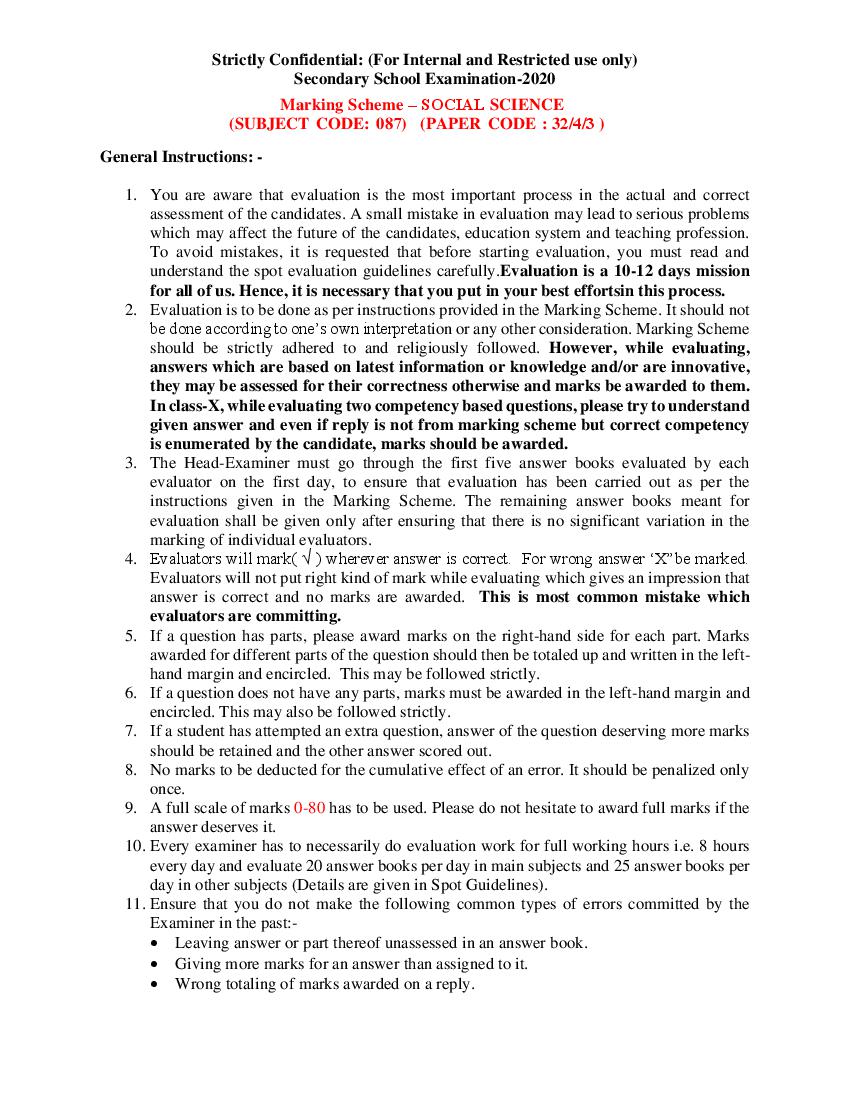
Secondary School Examination-2020
Marking Scheme – SOCIAL SCIENCE
(SUBJECT CODE: 087) (PAPER CODE : 32/4/3 )
General Instructions: -
1. You are aware that evaluation is the most important process in the actual and correct
assessment of the candidates. A small mistake in evaluation may lead to serious problems
which may affect the future of the candidates, education system and teaching profession.
To avoid mistakes, it is requested that before starting evaluation, you must read and
understand the spot evaluation guidelines carefully.Evaluation is a 10-12 days mission
for all of us. Hence, it is necessary that you put in your best effortsin this process.
2. Evaluation is to be done as per instructions provided in the Marking Scheme. It should not
be done according to one’s own interpretation or any other consideration. Marking Scheme
should be strictly adhered to and religiously followed. However, while evaluating,
answers which are based on latest information or knowledge and/or are innovative,
they may be assessed for their correctness otherwise and marks be awarded to them.
In class-X, while evaluating two competency based questions, please try to understand
given answer and even if reply is not from marking scheme but correct competency
is enumerated by the candidate, marks should be awarded.
3. The Head-Examiner must go through the first five answer books evaluated by each
evaluator on the first day, to ensure that evaluation has been carried out as per the
instructions given in the Marking Scheme. The remaining answer books meant for
evaluation shall be given only after ensuring that there is no significant variation in the
marking of individual evaluators.
4. Evaluators will mark( √ ) wherever answer is correct. For wrong answer ‘X”be marked.
Evaluators will not put right kind of mark while evaluating which gives an impression that
answer is correct and no marks are awarded. This is most common mistake which
evaluators are committing.
5. If a question has parts, please award marks on the right-hand side for each part. Marks
awarded for different parts of the question should then be totaled up and written in the left-
hand margin and encircled. This may be followed strictly.
6. If a question does not have any parts, marks must be awarded in the left-hand margin and
encircled. This may also be followed strictly.
7. If a student has attempted an extra question, answer of the question deserving more marks
should be retained and the other answer scored out.
8. No marks to be deducted for the cumulative effect of an error. It should be penalized only
once.
9. A full scale of marks 0-80 has to be used. Please do not hesitate to award full marks if the
answer deserves it.
10. Every examiner has to necessarily do evaluation work for full working hours i.e. 8 hours
every day and evaluate 20 answer books per day in main subjects and 25 answer books per
day in other subjects (Details are given in Spot Guidelines).
11. Ensure that you do not make the following common types of errors committed by the
Examiner in the past:-
• Leaving answer or part thereof unassessed in an answer book.
• Giving more marks for an answer than assigned to it.
• Wrong totaling of marks awarded on a reply.
Page 2
• Wrong question wise totaling on the title page.
• Wrong totaling of marks of the two columns on the title page.
• Wrong grand total.
• Marks in words and figures not tallying.
• Wrong transfer of marks from the answer book to online award list.
• Answers marked as correct, but marks not awarded. (Ensure that the right tick mark is
correctly and clearly indicated. It should merely be a line. Same is with the X for
incorrect answer.)
• Half or a part of answer marked correct and the rest as wrong, but no marks awarded.
12. While evaluating the answer books if the answer is found to be totally incorrect, it should
be marked as cross (X) and awarded zero (0)Marks.
13. Any unassessed portion, non-carrying over of marks to the title page, or totaling error
detected by the candidate shall damage the prestige of all the personnel engaged in the
evaluation work as also of the Board. Hence, in order to uphold the prestige of all
concerned, it is again reiterated that the instructions be followed meticulously and
judiciously.
14. The Examiners should acquaint themselves with the guidelines given in the Guidelines for
spot Evaluation before starting the actual evaluation.
15. Every Examiner shall also ensure that all the answers are evaluated, marks carried over to
the title page, correctly totaled and written in figures and words.
16. The Board permits candidates to obtain photocopy of the Answer Book on request in an
RTI application and also separately as a part of the re-evaluation process on payment of
the processing charges.
Page 3
Social Science (087)
Marking Scheme 32/4/3
MM-80
QNO. EXPECTED ANSWERS/VALUE POINTS PAGE MARKS
SECTION-A NO.
1. D – An Adivasi from Narmada Valley - To fulfil livelihood Eco-pg 4 1
2. Kheda Satyagraha -In support of peasants H-pg 31 1
3. Tertiary sector Eco-pg 1
i. Highest in term of Total production. 23
ii. Highest in term of Employment generation.
iii. Any other relevant point.
Any one point
OR
Eco-pg
Advantages of organized sector 31 1
i. Job security.
ii. Fixed working hours.
iii. Paid leave/ Medical benefits.
iv. Any other relevant point.
Any one point
4. Bihar Eco-pg 1
10
5. The Balkan H-pg 26 1
6. B – Persian H-pg 121 1
7. B – Diamond Sutra H-pg 106 1
8. Caste System
i. Constitution should take stricter measures to prevent caste-
discrimination.
ii. Promote Urbanization. DP-pg 51 1
iii. Growth of literacy.
iv. Occupational mobility.
v. Any other relevant point.
Any one point
OR
Sometimes elections are all about caste system
i. Avoid caste-based appeal
ii. Parties should not muster for caste-based support. DP-pg 51 1
1
Page 4
iv. Any other relevant point.
Any one point
9. C – Sinhalese DP-pg 3 1
10. Power sharing desirable DP-pg 06 1
i. To reduce Conflict.
ii. Ensure Political Stability.
iii. To maintain spirit of Democracy.
iv. Any other relevant point.
Any one of above to describe.
OR
Social groups in the administration of democratic countries
DP-pg 09 1
i. To accommodate social differences.
ii. So that they do not feel alienated.
iii. Any other relevant point.
Any one point
11. A – Different Social Group DP-pg 4 1
12. Conventional/ Non-Renewable G-pg 56 1
13. Manuscripts not widely used in India H-pg 119 1
i. They were fragile and expensive.
ii. Awkward to handle.
iii. Required too much care.
iv. Could not be read easily as written in different styles.
v. Any other relevant point.
Any one point
14. Hind Swaraj – Mahatma Gandhi H-pg 32 1
OR
1
Anandmath – Bankim Chandra Chattopadyay H-pg 47
15. (A) Kalol Oil Field – Gujarat G-pg 57 1
16. D - Uttar Pradesh G-pg 89 1
17. i. Jawaharlal Nehru Port G-pg 85 1
OR
ii. Haldia Port
G-pg 86 1
18. (A) Renewable Resources. G-pg 2 ½+½
(B) Non-Renewable Resources =1
19. G-pg 45, 1
Income of marginal farmer 46
i. Diversify the cropping pattern (from cereal to High value
crops).
2
Page 5
iii. provide non farming jobs iv.Any other relevant point.
Any one point
20. (A) William I H-pg 19 1
SECTION - B
21. Distribution of power between Centre and State
i. The constitution clearly distributes Legislative Powers between
State and Union Government. DP-pg 3
ii. Subjects of National Importance like Foreign affairs/ banking 16,17
came under union list of Central Government.
iii. Subjects of Local importance like Police, Trade came under
state government under State list.
iv. Subject of common interest like education/ marriage came
under Concurrent list of both Centre and State government.
v. Any other relevant point.
Any three points to be explained.
22. Discrimination faced by women
i. Indian Parents prefer male child and abort female. DP-pg 42,
ii. The parents do not spend equally on education of girls. 43 3
iii. Women are paid less than men in various field instead of equal
work/ hours.
iv. Domestic violence
v. Any other relevant point.
Any three points to be described
OR
Changes in castes and caste system in India DP-pg 51 3
i. Old notions of caste hierarchy are breaking down
i. Due to Economic development.
ii. Due to Large scale urbanization.
iii. Due to Growth of literacy and education.
iv. Due to Occupational mobility.
v. Breaking down of old caste hierarchy.
vi. Any other relevant point.
Any three points to be described
23.
Protection of workers in the unorganized sector
i. They are often exploited and not paid fair wages. PG-32
ii. Low and irregular earning. ECO-pg
3
3
Page 6
iv. They are vulnerable people so need economic/ social
protection.
v. Any other relevant point.
Any three points to be explained
OR
Activities in the private sector ECO-pg 3
i. Ownership of assets and delivery of services is in the hands of 32
private individuals or companies.
ii. Motive is to earn profit.
iii. Work according to price mechanism
iv. To get services from private sector we have to pay money to
these individuals and companies
v. Tata Iron and Steel Company Limited (TISCO) or Reliance
industries Limited (RIL) are privately owned.
vi. Any other relevant point.
Any three points to be explained
24.
Railways G-pg 84 3
i. Railways are the principal mode of transport in India.
ii. Railways make it possible to conduct multifarious activities
like business, transportation of goods.
iii. Railways have huge network in India that influence
Indian Economy.
iv. Railways carry out businesses and various multifarious
activities such as pilgrimage tourism, travel,
commuting etc.
v. Help in the transportation of raw materials from the source to
the industries, and the manufactured goods to the market.
vi. Help in the linking of the industries with the market
and develop them.
vii. Any other relevant point.
Any three points to be explained
25. Three Flows identified by the economists H-pg 57 3
i. Flow of trade in goods (wheat or clothes).
ii. Flow of people (Migration of people in search of
employment).
iii. Flow of Capital for Short/ Long term investment.
iv. Any other relevant point.
4
Page 7
OR
3
Textile exports from India H-pg 89
i. Finer variety of cotton came only from India.
ii. Variety of Indian merchants/ banker were involved in
this network of export of trade.
iii. They gave advances to weavers/ procured the woven clothes
from weaving villages.
iv. Any other relevant point.
Any three points to be explained.
26. Source Based Question
H.Pg-36 1+1+1=3
26.1 Explain the understanding of swaraj for plantation workers
Right to move freely in and out of the confined space. (1)
26.2 Explain the inland immigration act of 1859 as a barrier to
freedom of plantation workers.
Plantation workers were not permitted to have move from
tea gardens without permission. (1)
26.3 Explain the main outcome of the participation of workers in
the Non-Cooperation Movement.
i. They were caught by the police and brutally beaten up.
ii. Any other relevant point
Any one (1)
27. Industries causes pollution
i. Air pollution: It is caused by presence of high proportion of
undesirable gase Eco-pg 1+2=3
ii. Water pollution: Organic and inorganic industrial wastes and 76, 78
affluents are discharged into rivers.
iii. Thermal pollution of water: It occurs when hot water from
factories and thermal plants is drained into rivers and
ponds before cooling.
iv. Land pollution: Dumping of wastes specially glass, harmful
chemicals, industrial effluents
v. Noise pollution: Industrial and construction activities,
machinery, factory equipment etc cause a lot of noise
pollution.
Any one to be mentioned. (1)
5
Page 8
(a) Water should be reused and recycled
(b) Rainwater should be harvested
(c) Use of oil or gas should be made instead of coal in
factories to reduce smoke.
(d) Generators should be fitted with silencers to
reduce noise pollution.
(e) Hot water and effluents should be treated before
releasing them in rivers and ponds.
(g) Any other relevant point. (2)
Any two points to be explained
28. Importance of equitable distribution of resources 3
i. For a sustained quality of life. G-pg 03
ii. To eliminate the difference between rich and poor in the
society
iii. To reduce poverty
iv. To maintain Global Peace.
v. To prevent our planet from danger.
vi. Any other relevant point.
Any three points to be explained
OR
Resources for human survival
i. Human can transform material into resources and use them. G-pg 03
ii. Human beings use resources as raw material to satisfy their 3
needs and comforts.
iii. They use them for making clothes, food, construct houses
iv. They use energy resources like coal, gases, etc.
v. for generating power, electricity or as a fuel to run vehicles,
factories etc.
vi. Resources help to main quality of life too.
vii. Any other relevant point.
Any three points to be explained
SECTION-C
29. Democracy is based on political equality.
i. Democracy have formal constitutions DP-pg 90 5
ii. they hold elections
iii. they have parties
iv. they guarantee rights of citizens.
6
Page 9
vi. Enhances the dignity of the individual
vii. Improves the quality of decision making
viii. Provides a method to resolve conflict
ix. Democracy guarantee right to vote to all citizens.
x. Any other relevant point.
Any five points to be explained
30. Contribution of agriculture
i. Agriculture is backbone of Indian Economy.
ii. High share of agriculture in Indian GDP. G-pg 43, 5
iii. It also generate highest 52% of employment still in India. 44
iv. Modernization of Indian agriculture may support economy in
better way.
v. Improving rural infrastructure in field of agriculture also
supporting our economy.
vi. Any other relevant point.
Any five points to be explained
31. Measures to reduce Limitations of political parties
i. Political parties should keep membership registers.
ii. Political parties should hold organizational meeting. DP-pg 86
iii. Political parties should conduct regular internal elections. 5
iv. Political parties should have their own constitution and
followed by its leader.
v. Dynastic succession should not be in political parties.
vi. Any other relevant point.
Ant five points to be explained
32. Self Help Groups
i. They help rural poor/ women to became self-reliant.
ii. Regular meetings of SHG’s provide platform to discuss social Eco-pg
issues such as health, nutrition, domestic violence. 50, 51 5
iii. SHG’s help borrower to overcome of problem of collateral.
iv. They also develop pool of saving.
v. They also reduce poverty
vi. Create opportunities for self-employment.
vii. Any other relevant point.
Any five points to be explained
OR
7
Page 10
i. Goods are bought and sold with the use of money. Eco-pg
ii. Many kinds of services are also exchanged with money. 39
iii. Use of money reduce the need of double coincidence of wants. 5
iv. A person holding money can easily exchange with goods/
services.
v. For ex. A shoe manufacturer wants to sell shoes and buy wheat
so he needs to sell his shoes and then only he can buy wheat.
vi. Any other relevant point.
Any five points to be explained
33. 1830 as the year of great hardship
i. First half of 19th century saw enormous increase in population
in Europe. H-pg 15 5
ii. Number of job seekers greater than employment.
iii. Migration of large population from rural to urban areas.
iv. Stiff competition from imports of cheap machine-made
goods from England.
v. The aristocracy still enjoyed power privileges.
vi. Peasants struggled under burden of Feudal dues.
vii. Rise of food prices due to bad harvest.
viii. Any other relevant point.
Any five points to be explained
OR
Nationalism aligned with imperialism became the cause of first
world war
5
i. The spread of the ideas of romantic nationalism in the Balkans H-pg 27
together with the disintegration of the Ottoman Empire.
ii. Intense rivalry among the European powers over trade,
colonies, naval and military might.
iii. The anti-imperial movements that developed
everywhere were nationalist.
iv. They all struggled to form independent nation state.
v. They were inspired by sense of collective national unity.
vi. European ideas of nationalism developed their own variety
of nationalism.
vii. Any other relevant point.
To be evaluated as a whole
8
Page 11
Source A – Foreign trade and the integration of markets 59-67 5
34.1 How does foreign trade integrate market?
i) Foreign trade creates an opportunity for the producers
to reach beyond the domestic markets.
ii) Producers can sell their products in the markets located
in other countries.
iii) It helps for expanding the choice of goods beyond
domestic market.
iv) It is a main channel connecting countries
v) Any other relevant point
Any two points (2)
Source B - Globalization
34.2 How is globalization expanding human activity across regions
and continents?
i. Movement of people from one country to another
in search of better income/ jobs/ education.
ii. Globalization creates greater opportunities for
large markets around the world.
iii. countries have more access to capital flows
iv. Technology, human capital,
v. cheaper imports and larger export markets
vi. Any other relevant point
Any two points (2)
Source -C World Trade Organization
34.3- The actions and methods of the WTO have evoked strong
debate. Explain
i. Rules of WTO forced developing countries to remove trade
barriers which is unfair in interest of developing countries.
i) Any other relevant point
Any one point (1)
35. 35 A And B - See Attached Map 2+4=6
Map for Visually Impaired Candidates
1X6=6
35.1 Dandi
35.2 Kheda
35.3 Odisha
35.4 Odisha
35.5 Maharashtra
356. Tamil Nadu
35.7 Amritsar
35.8 Mohali
9
Page 12
Document Details
| Board / Org | CBSE |
| Exam | Class 10 |
| Type | Solution |
| Pages | 12 |
| Updated | 22 Jul 2026 |