CBSE Class 12 Question Paper 2021 Home Science (Compartment)
Finished viewing? Save it for later —
Download CBSE Class 12 Question Paper 2021 Home Science (Compartment) (PDF · 14 pages)About CBSE Class 12 Question Paper 2021 Home Science (Compartment)
CBSE Class 12 Question Paper 2021 Home Science (Compartment) is available here for free download. Published by CBSE for Class 12, this question paper can be viewed online or downloaded as a PDF (14 pages). Candidates preparing for Class 12 can use CBSE Class 12 Question Paper 2021 Home Science (Compartment) to understand the exam pattern, the type of questions asked, and the overall difficulty level.
Frequently Asked Questions
How can I download CBSE Class 12 Question Paper 2021 Home Science (Compartment)?
Open this page and click the Download button to save CBSE Class 12 Question Paper 2021 Home Science (Compartment) as a PDF. It is completely free on AglaSem Docs.
Is CBSE Class 12 Question Paper 2021 Home Science (Compartment) free to download?
Yes. CBSE Class 12 Question Paper 2021 Home Science (Compartment) can be viewed online and downloaded as a PDF free of cost on AglaSem Docs.
How many pages does CBSE Class 12 Question Paper 2021 Home Science (Compartment) have?
CBSE Class 12 Question Paper 2021 Home Science (Compartment) contains 14 pages, which you can read online or download together as a single PDF.
Where can I find more Class 12 study material?
You can find more Class 12 question papers, sample papers, syllabus, and answer keys on AglaSem Docs.
CBSE Class 12 Question Paper 2021 Home Science (Compartment) – Text
Read the full text of this question paper below — useful to quickly search, copy and reference the content online without downloading the PDF.
📄 View text version (14 pages)
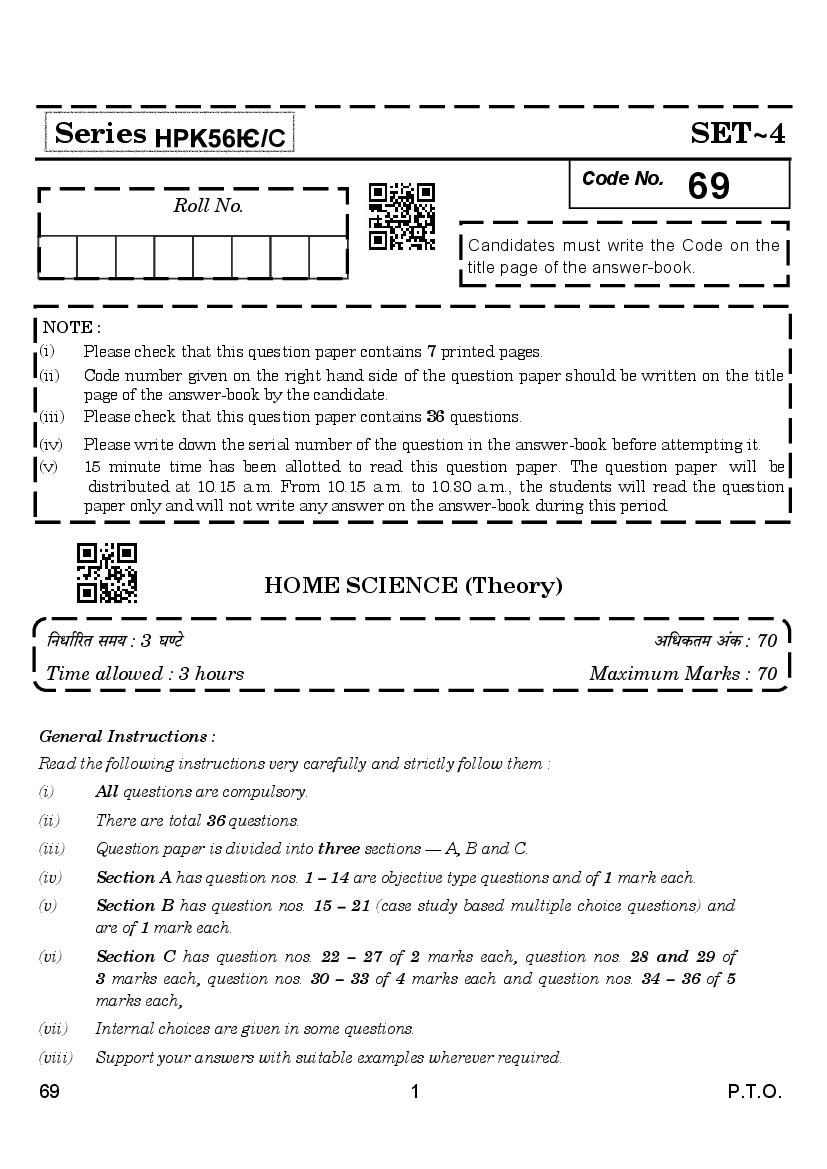
Page 1
Roll No.
Code No.
69
Candidates must write the Code on the
title page of the answer-book.
NOTE :
(i) Please check that this question paper contains 7 printed pages.
(ii) Code number given on the right hand side of the question paper should be written on the title
page of the answer-book by the candidate.
(iii) Please check that this question paper contains 36 questions.
(iv) Please write down the serial number of the question in the answer-book before attempting it.
(v) 15 minute time has been allotted to read this question paper. The question paper will be
distributed at 10.15 a.m. From 10.15 a.m. to 10.30 a.m., the students will read the question
paper only and will not write any answer on the answer-book during this period.
HOME SCIENCE (Theory)
:3 : 70
Time allowed : 3 hours Maximum Marks : 70
General Instructions :
Read the following instructions very carefully and strictly follow them :
(i) All questions are compulsory.
(ii) There are total 36 questions.
(iii) Question paper is divided into three sections A, B and C.
(iv) Section A has question nos. 1 14 are objective type questions and of 1 mark each.
(v) Section B has question nos. 15 21 (case study based multiple choice questions) and
are of 1 mark each.
(vi) Section C has question nos. 22 27 of 2 marks each, question nos. 28 and 29 of
3 marks each, question nos. 30 33 of 4 marks each and question nos. 34 36 of 5
marks each,
(vii) Internal choices are given in some questions.
(viii) Support your answers with suitable examples wherever required.
69 1 P.T.O.
Page 2
Objective Type Questions
1.
hotel staff attend to his complaint ? 1
(A) Arrival
(B) Departure
(C) Pre-arrival
(D) Occupancy
2. According to the Factories Act, 1948 there should be provision of ____________ in the
factory. 1
(A) potable water
(B) shade
(C) crèche for young children
(D) protection for women
3. Eighty-year-old Mr. Sharma lives in a remote rural area. For medical care he can seek
help from : 1
(A) Day care centres
(B) Mobile medicare centres
(C) Multiple service centres
(D) Old age home
4. (a) Who introduced the foot treadle for the sewing machine ? 1
(A) Isaac Singer
(B) Levis Strauss
(C) King Louis XIV
(D) Coco Chanel
OR
(b) Who introduced denim pants ? 1
(A) Isaac Singer
(B) Levis Strauss
(C) King Louis XIV
(D) Coco Chanel
5. Your brother is wearing a blue tie with white shirt and black pant. What is the colour
scheme of his outfit ? 1
(A) Accented neutral
(B) Monochromatic
(C) Achromatic
(D) Analogous
6. (a) Your brother has not gained height since past five years and hence is the
shortest boy in his class. His condition is known as : 1
(A) Stunting
(B) Wasting
(C) Underweight
(D) Obesity
OR
69 2
Page 3
as : 1
(A) Stunting
(B) Wasting
(C) Underweight
(D) Obesity
7. Spinning in washing machines is meant to : 1
(A) dry the clothes
(B) rinse clothes
(C) extract water from clothes
(D) wash and dry clothes
8. Public Service Announcements (PSA) are repeatedly shown for how many seconds on
your television ? 1
(A) 10 to 50 seconds
(B) 10 to 60 seconds
(C) 15 to 30 seconds
(D) 30 to 60 seconds
9. (a) Ergonomics is the relationship between man, ___________ and his ___________ . 1
OR
(b) Besides a good salary, an employer can ensure job satisfaction in his employees
by ___________ and ___________ . 1
10. Aim of Red Ribbon Express was to spread awareness on the issue of ___________ . 1
11. (a) Identify the craft. Name the Indian State where it is made. 1
OR
69 3 P.T.O.
Page 4
Note : The following question is for the Visually Impaired Candidates only, in lieu of Q.No. 11.
(a) Which craft is popular in Assam ? 1
OR
(b) Name a popular craft made in Karnataka. 1
12. Draw a standard mark found in pure gold jewellery. 1
13. What are the two main objectives of SEWA ? 1
14. (a) Name any two high risk foods. 1
OR
(b) Research in the field of food technology has been conducted for decades. Nicolas
Appert developed ____________ process. 1
SECTION B
(Case study based questions)
Case study 1 (Q. No. 15 to 18)
Consumers are the primary component of a socio-economic system. As the purchasing
power increases, people tend to purchase products that will give satisfaction and a
symbol of prestige. But many a times they end up buying substandard goods and get
cheated by the shopkeepers. For this, they must exercise their right to redressal.
15. What do you understand by consumer footfall ? 1
(A) Behaviour of consumers
(B) Number of products
(C) Number of consumers visiting a store
(D) Consumer product
16. Which standard mark should consumers check while buying a bottle of mineral water ? 1
(A) ISI
(B) FPO
(C) AGMARK
(D) AGMARK and FPO
69 4
Page 5
i. be protected against hazardous goods
ii. be informed about quality of product
iii. fair settlement of his genuine grievance
iv. receive compensation
Select the correct option :
(A) i and ii
(B) iii and iv
(C) iv and i
(D) ii and iii
18. Which of these malpractices can vendors adopt to cheat their customers ? 1
i. Standard mark has license number
ii. Weights are hollow
iii. Measures have false bottom
iv. Charge not more than MRP
v. Use table to measure cloth
Select the correct option :
(A) i, iv and ii
(B) iii, iv and ii
(C) iv, v and i
(D) ii, v and iii
Case study 2 (Q. No. 19 to 21)
The professional clinical nutritionist uses a systematic and logical approach to the
therapy are used to improve the overall health of patients with a wide range of
conditions.
19. (a) Your friend is suffering from kidney failure. The dietitian will not give him diet : 1
(A) low in fat
(B) rich in oxalate
(C) low in sodium
(D) low in protein
OR
(b) Your friend is suffering from hypertension. The dietitian will give him diet low in : 1
(A) calcium
(B) protein
(C) iron
(D) sodium
69 5 P.T.O.
Page 6
him ? 1
(A) Fruit juice
(B) Khichri
(C) Butter milk
(D) Coconut water
OR
(b) Your mother has been operated yesterday. The dietitian has asked to give her
liquid diet. You will give : 1
(A) thick tomato soup
(B) thin khichri
(C) fresh orange juice
(D) strained daal soup
21. Mechanical diets are suggested by the dietitian to elderly patients who have _________ . 1
(A) difficulty in chewing
(B) constipation
(C) hypertension
(D) diarrhoea
SECTION C
22. Briefly explain the two aspects of care and maintenance of fabrics. 2
23. Mention any two challenges faced by handicrafts industry. In what two ways is the
government trying to help revive this industry ? 2
24. (a) Explain the role of HACCP in ensuring food safety and quality. 2
OR
(b) Differentiate between CODEX and ISO. 2
25. (a) Write any four salient features of development communication. 2
OR
(b) What do you understand by a campaign ? Why are they effective ? 2
26. Which four skills would you check before hiring an early childhood professional ? 2
27. You are a clinical therapist in a hospital. Which four activities would you adopt for
nutritional care of patients ? 2
28. The primary objective of early childhood care and education is the holistic development
of the child and preparation for school. Justify this statement with the help of three
examples each. 3
69 6
Page 7
OR
(b) (i) How do the clothes get cleaned by agitation and tumbling methods in
washing machines ?
(ii) Which type of drier would you choose for your home ? Why ? 3
30. (a) Illustrate any two ways of creating rhythm in sari and blouse dress, with the
help of diagram.
(b) Suggest a suitable print and texture of a salwar kameez for a girl who is short in
height.
(c) Briefly explain any four factors that you keep in mind while selecting colours for
your dress. 4
31. (a) All children are vulnerable, but some children are more vulnerable than others.
What can be its four reasons ? In what four ways does SOS Village help these
children ? 4
OR
(b) Identify any four causes of youth being vulnerable in India. In what four ways
does Nehru Yuva Kendra help these youth ? 4
32. Identify four ways Staphylococcus can cause illness in your family. Suggest any four
ways to your cook to prevent this infection. 4
33. Suresh has got appointed as an assistant housekeeper. Who all will work under him ?
What responsibilities would he assign to each one of them ? 4
34. What do you understand by the following foods ? Give one example of each. 5
(a) Formulated foods
(b) Synthetic foods
(c) Food derivatives
(d) Medical foods
(e) Manufactured foods
35. As a health worker, you noticed that most of the children in the village have pale
yellowish skin.
(a) What do you think they are suffering from ?
(b) Mention any three additional consequences on their health, if they are not given
timely treatment.
(c) Make their parents aware of nutrition-based and diet-based strategies so that
they can improve the health of their children.
(d) What two government programmes are operational in our country, for such
children ? 5
36. (a) (i) Merchandising is done at which three levels ? Explain in detail.
(ii) What two skills should a merchandiser possess, to be successful ? 5
OR
(b) (i) What do you understand by target market ?
(ii) In what four ways can the market be segmented ? Explain in detail. 5
69 7 P.T.O.
Page 8
H$moS> Z§.
69
narjmWu H$moS >H$mo CÎma-nwpñVH$m Ho$ _wI-n¥ð >na
Adí` {bIo§ &
ZmoQ> :
(i) H¥$n`m Om±M H$a b| {H$ Bg àíZ-nÌ _o§ _w{ÐV n¥ð> 7 h¢ &
(ii) àíZ-nÌ _| Xm{hZo hmW H$s Amoa {XE JE H$moS >Zå~a H$mo N>mÌ CÎma -nwpñVH$m Ho$ _wI-n¥ð> na {bI| &
(iii) H¥$n`m Om±M H$a b| {H$ Bg àíZ-nÌ _| >36 àíZ h¢ &
(iv) H¥$n`m àíZ H$m CÎma {bIZm ewê$ H$aZo go nhbo, CÎma-nwpñVH$m _| àíZ H$m H«$_m§H$ Adí` {bI| &
(v) Bg àíZ-nÌ 15 {_ZQ >H$m g_` {X`m J`m h¡ & àíZ- 10.15 ~Oo {H$`m
OmEJm & 10.15 ~Oo go 10.30 ~Oo VH$ N>mÌ Ho$db àíZ- |Jo Am¡a Bg Ad{Y Ho$ Xm¡amZ do CÎma-nwpñVH$m na
H$moB© CÎma Zht {bI|Jo &
J¥h {dkmZ (g¡ÕmpÝVH$)
:3 : 70
Time allowed : 3 hours Maximum Marks : 70
:
:
(i)
(ii) 36
(iii)
(iv) 1 14 1
(v) 15 21 1
(vi) 22 27 2 28 29
3 30 33 4 34 36 5
(vii)
(viii)
69 8
Page 9
dñVw{Zð> àíZ
1. lr _hmOZ Ho$ H$_ao H$m JrµOa H$m_ Zht H$a ahm h¡ & hmoQ>b Ho$ H$m{_©H$ CZH$s {eH$m`V na H$m`©dmhr, A{V{W
MH«$ (guest cycle) Ho$ H$m¡Z-go MaU _| H$a|Jo ? 1
(A) AmJ_Z
(B) àñWmZ
(C) AmJ_Z-nyd© AdñWm
(D) H$_ao H$m Am{YnË`
2. \ A{Y{Z`_, 1948 Ho$ AZwgma, \ _| _________ H$m àmdYmZ hmoZm Mm{hE & 1
(A) no` Ob
(B) N>m`m
(C) {eewgXZ
(D) _{hbmAm| H$s gwajm
3. Añgr-dfu` lr e_m© EH$ gwXÿa J«m_rU joÌ _| ahVo h¢ & {M{H$Ëgm XoI^mb Ho$ {bE, dh H$hm± go _XX bo gH$Vo
h¢ ? 1
(A) X¡{ZH$ XoI^mb Ho$ÝÐ (S>o-Ho$`a g|Q>a)
(B) _mo~mBb {M{H$Ëgm XoI^mb Ho$ÝÐ
(C) AZoH$ (~hþ) godm Ho$ÝÐ$
(D) d¥ÕmdñWm gXZ
4. (a) {gbmB© _erZ H$mo n¡am| go MbmZo Ho$ {bE nm±d-M¸$s (Q´>oS>b) {H$gZo {dH${gV H$s ? 1
(A) BgmH$ qgJa
(B) bodr ñQ´>m°g
(C) g_«mQ> bwBg XIV
(D) H$moH$mo eZob
AWdm
(b) S>o{Z_ n¢Q> ~ZmZo Ho$ {bE {H$gZo nhb H$s ? 1
(A) BgmH$ qgJa
(B) bodr ñQ´>m°g
(C) g_«mQ> bwBg XIV
(D) H$moH$mo eZob
5. AmnHo$ ^mB© Zo gµ\o$X eQ>© Am¡a H$mbr n¢Q> Ho$ gmW Zrbr Q>mB© nhZr hþB© h¡ & CgHo$ nmo ? 1
(A) {d{eîQ>VmnyU© VQ>ñW (Accented Neutral)
(B) EH$dUu gw_ob (Monochromatic)
(C) AdUu gw_ob (Achromatic)
(D) AZwê$n (Analogous)
6. (a) , Am¡a BgHo$ H$maU AnZr H$jm _| CgH$m H$X
g~go H$_ h¡ mVm h¡ ? 1
(A) ~m¡ZmnZ
(B) j`H$mar
(C) Aën^ma
(D) _moQ>mnZ
AWdm
69 9 P.T.O.
Page 10
OmVm h¡ ? 1
(A) ~m¡ZmnZ
(B) j`H$mar
(C) Aën^ma
(D) _moQ>mnZ
7. dmqeJ _erZm| _| MH«$U H$m CÔoí` `m h¡ ? 1
(A)
(B)
(C)
(D)
8. gmd©O{ZH$ godm KmofUmE± (PSA) ~ma-~ma AmnHo$ Q>obr{dµOZ na {H$VZo goH§$S> Ho$ {bE {XImB© OmVr h¢ ? 1
(A) 10 go 50 goH§$S>
(B) 10 go 60 goH§$S>
(C) 15 go 30 goH§$S>
(D) 30 go 60 goH§$S>
9. (a) _Zwî`, ___________ Am¡a CgHo$ _________ (Ergonomics) H$hVo
h¢ & 1
AWdm
(b) EH$ AÀN>o doVZ Ho$ A{V[aº$, EH$ {Z`moº$m, AnZo H$_©Mm[a`m| _| Zm¡H$ar H$s g§VwpîQ> gw{ZpíMV H$aZo Ho$
{bE _________ Am¡a _________ H$a gH$Vm h¡ & 1
10. _________ Ho$ _wÔo na OmJê$H$Vm \¡$bmZm Wm & 1
11. (a) Bg {eën H$mo nhMm{ZE & `h ^maV Ho$ H$m¡Z-go àm§V _| ~Zm`m OmVm h¡ ? 1
AWdm
69 10
Page 11
: 11
(H$) Ag_ _| H$m¡Z-gm {eën bmoH${à` h¡ ? 1
AWdm
(I) H$Zm©Q>H$ _| ~ZmE JE EH$ bmoH${à` {eën H$m Zm_ ~VmBE & 1
12. ewÕ gmoZo Ho$ Am^yfUm| na 1
13. godm (SEWA) h¢ ? 1
14. (a) {H$Ýht Xmo AË`{YH$ Omo{I_ dmbo ImÚ nXmWm] (high risk foods) Ho$ Zm_ ~VmBE & 1
AWdm
(b) XeH$m| go ImÚ àm¡Úmo{JH$s Ho$ joÌ _| AZwg§YmZ {H$E JE h¢ & {ZH$mobg AßnQ>© (Nicolas Appert) Zo
___________ à{H«$`m H$m {dH$mg {H$`m & 1
IÊS> I
(Ho$g ñQ>S>r AmYm[aV àíZ)
Ho$g ñQ>S>r 1 (à.g§. 15 go 18)
Cn^moº$m EH$ gm_m{OH$-Am{W©H$ àUmbr Ho$ àmW{_H$ KQ>H$ h¢ & O¡go- bmoJ Eogo CËnmXm|
H$s IarX H$aVo h¢ Omo g§VwpîQ> XoVo h¢ Am¡a à{VîR>m H$m àVrH$ ~ZVo h¢ & bo{H$Z H$B© ~ma do K{Q>`m gm_mZ IarXVo h¢
Am¡a XþH$mZXmam| go YmoIm Im OmVo h¢ & BgHo$ {bE CÝh| AnZo {ZdmaU Ho$ A{YH$ma H$m à`moJ H$aZm Mm{hE &
15. Amn Cn^moº$m AmJ_Z g§»`m (consumer footfall) ? 1
(A) Cn^moº$mAm| H$m ì`dhma
(B) CËnmXm| H$s g§»`m
(C) EH$ ñQ>moa na OmZo dmbo Cn^moº$mAm| H$so g§»`m
(D) Cn^moº$m CËnmX
16. EH$ {_Zab nmZr H$s ~moVb IarXVo g_` Cn^moº$mAm| H$mo H$m¡Z- ? 1
(A) AmB©.Eg.AmB©.
(B) E\$.nr.Amo.
(C) EJ_mH©$
(D) EJ_mH©$ Am¡a E\$.nr.Amo.
69 11 P.T.O.
Page 12
i. Omo{I_ CËnmXm| go ~Mmd hmo
ii. CËnmX H$s JwUdÎmm Ho$ {df` _| CÝh| ~Vm`m OmE
iii. CZH$s ghr {eH$m`V H$m C{MV {ZnQ>mZ {H$`m OmE
iv. j{Vny{V© àmßV H$aZm
ghr {dH$ën Mw{ZE :
(A) i Am¡a ii
(B) iii Am¡a iv
(C) iv Am¡a i
(D) ii Am¡a iii
18. {dH«o$Vm, AnZo J«mhH$m| H$mo YmoIm XoZo Ho$ {bE, BZ_| go H$m¡Z-gr Hw$Mmb| AnZm gH$Vo h¢ ? 1
i.
ii. ImoIbo dµOZ H$m Cn`moJ H$aHo$
iii. C^ao hþE Vbo dmbo _mnZ nmÌ H$m Cn`moJ H$aHo$
iv. E_.Ama.nr. (MRP) go A{YH$ n¡go Z boZm
v.
ghr {dH$ën Mw{ZE :
(A) i, iv Am¡a ii
(B) iii, iv Am¡a ii
(C) iv, v Am¡a i
(D) ii, v Am¡a iii
Ho$g ñQ>S>r 2 (à.g§. 19 go 21)
noeoda Z¡Xm{ZH$ nmofU {deofk nmofU XoI^mb à{H«$`m Ho$ {bE EH$ ì`dpñWV Am¡a Vm{H©$H$ Ñ{ï>H$moU H$m Cn`moJ
H$aVo h¢ & dh àË`oH$ amoJr H$s Amdí`H$VmAm| na Ü`mZ XoVo h¢ & BgHo$ Abmdm, nmofU Am¡a Amhma {M{H$Ëgm H$m
Cn`moJ {dñV¥V loUr Ho$ amo{J`m| Ho$ g_J« ñdmñÏ` _| gwYma bmZo Ho$ {bE {H$`m OmVm h¡ &
19. (a) AmnH$m {_Ì JwX} H$s {d\ __________ Amhma Zht X|Jo & 1
(A) dgm _| H$_
(B) oboQ²>g go ^anya
(C) gmo{S>`_ _| H$_
(D) àmoQ>rZ _| H$_
AWdm
(b) mhma {deofk CgHo$ Amhma _| ___________ H$s _mÌm H$_
H$a X|Jo & 1
(A) H¡$pëe`_
(B) àmoQ>rZ
(C) bmoh (Am`aZ)
(D) gmo{S>`_
69 12
Page 13
(A) \$bm| H$m ag
(B) r
(C) bñgr
(D) Zm[a`b nmZr
AWdm
(b) AmnH$s _m± H$m H$b Am°naoeZ hþAm h¡ & Amhma {deofk Zo CÝh| Vab Amhma XoZo H$mo H$hm h¡ & Amn CÝh|
? 1
(A) Q>_mQ>a H$m gyn
(B)
(C) VmµOo g§Vao H$m ag
(D) N>mZm hþAm Xmb H$m nmZr
21. V¡`ma _¥XþAmhma, Amhma {deofk Ûmam ~wµOwJ© amo{J`m| H$mo gwPmE OmVo h¢ {OÝh| __________ H$s g_ñ`m hmo & 1
(A) M~mZo _| H${R>ZmB©
(B) H$ãµO
(C) º$Mmn
(D) A{Vgma
IÊS> J
22. dñÌm| H$s XoI^mb Am¡a aIaImd Ho$ Xmo nhbwAm| H$mo g§{já _| g_PmBE & 2
23.
VarH$m| go _XX H$aZo H$s H$mo{ee H$a ahr h¡ ? 2
24. (a) ImÚ gwajm Am¡a JwUdÎmm gw{ZpíMV H$aZo _| HACCP (EM.E.gr.gr.nr.) H$s ^y{_H$m ñnï> H$s{OE & 2
AWdm
(b) (CODEX) Am¡a AmB©.Eg.Amo. (ISO) Ho$ ~rM A§Va ñnï> H$s{OE & 2
25. (a) {dH$mg g§Mma H$s H$moB© Mma _w»` {deofVmE± ~VmBE & 2
AWdm
(b) ?` ? 2
26. àma§{^H$ ~më`mdñWm Ho$ ì`mdgm{`H$m| _| H$m¡Z-go Mma H$m¡ebm| H$mo XoI H$a Amn CÝh| {Z`wº$ H$a|Jo ? 2
27. Amn EH$ AñnVmb _| Z¡Xm{ZH$ {M{H$ËgH$ h¢ & _arOm| H$s nmofU -g§~§Yr XoI^mb Ho$ {bE Amn H$m¡Z-gr Mma
J{V{d{Y`m± AnZmE±Jo ? 2
28. àma§{^H$ ~më`mdñWm XoI^mb Am¡a {ejm Ho$ _yb CÔoí` ~ÀMo H$m g_J« {dH$mg Am¡a {dÚmb` Ho$ {bE V¡`mar h¡ &
Bg H$WZ H$s nw{ï> VrZ-VrZ CXmhaUm| H$s ghm`Vm go H$s{OE & 3
69 13 P.T.O.
Page 14
AWdm
(b) (i) (agitation) Am¡a AdnmVZ (tumbling)
gmµ\$ hmoVo h¢ ?
(ii) AnZo Ka Ho$ {bE Amn H$m¡Z-go ewîH$H$ H$m M`Z H$a|Jo ? ? 3
30. (a) nmoemH$ _| b` ~ZmZo Ho$ H$moB© Xmo VarHo$ Xem©BE &
(b) EH$ N>moQ>o H$X H$s Ho$ {bE Cn`wº$ qàQ> Am¡a ~ZmdQ> H$m gwPmd
Xr{OE &
(c) AnZr nmoemH$ Ho$ {bE a§Jm| H$m M`Z H$aVo g_` Amn {H$Z Mma H$maH$m| H$m Ü`mZ aI|Jo ? g§jon _|
g_PmBE & 4
31. (a) Xÿgam| H$s Anojm A{YH$ g§doXZerb hmoVo h¢ & BgHo$
? Eg.Amo.Eg. (SOS)
h¡ ? 4
AWdm
(b) ^maV _| `wdmAm| Ho$ g§doXZerb hmoZo Ho$ H$moB© Mma H$maU nhMm{ZE & Zohê$ `wdm H|$Ð BZ `wdmAm| H$s,
{H$Z Mma Vah go _XX H$aVm h¡ ? 4
32. (Staphylococcus) go AmnHo$ n[adma _| {H$Z Mma VarH$m| go ~r_mar \¡$b gH$Vr h¡ ? Bg
g§H«$_U H$mo amoH$Zo Ho$ {bE, AnZo agmoB`o H$mo H$moB© Mma VarHo$ gwPmBE & 4
33. gwaoe H$mo EH$ ghm`H$ ì`dñWmnH$ Ho$ ê$n _| {Z`wº$ {H$`m J`m h¡ & CgHo$ AYrZ H$m¡Z-H$m¡Z H$m_ H$a|Jo ? CZ g~
- µOå_oXm[a`m± gm¢n|Jo ? 4
34. ? àË`oH$ H$m EH$-EH$ CXmhaU Xr{OE & 5
(a) \$m_y©bm~Õ ImÚ
(b) g§íbo{fV ImÚ
(c) ImÚ ì`wËnÞ
(d) {M{H$Ëgr` ImÚ
(e) {d{Z{_©V ImÚ
35. ñdmñÏ` H$m`©H$Vm© Ho$ ZmVo, AmnZo nm`m {H$ Jm±d Ho$ A{YH$m§e ~ÀMm| H$s ËdMm nrbr h¡ &
(a) ?
(b) `{X CÝh| g_` na CnMma Z {X`m OmE, Vmo CZHo$ ñdmñÏ` na hmoZo dmbo H$moB©
hmo gH$Vo h¢ ?
(c) CZHo$ A{^^mdH$m| H$mo nmofU-AmYm[aV Am¡a Amhma-AmYm[aV H$m`©Zr{V`m± Ho$ ~mao _| OmJê$H$ H$s{OE,
{OZ H|$ &
(d) {bE h_mao Xoe _| H$m¡Z-go Xmo gaH$mar H$m`©H«$_ g§Mm{bV h¢ ? 5
36. (a) (i) µ\¡$eZ CÚmoJ _| ì`mnma (_M}ÝS>mBqµOJ) {H$Z VrZ ñVam| na hmoVm h¡ ? {dñVma go g_PmBE &
(ii) g\$b hmoZo Ho$ {bE, EH$ ì`mnmar (_M}ÝS>mBµOa) _| H$m¡Z-go Xmo H$m¡eb hmoZo Mm{hE ? 5
AWdm
(b) (i) ?
(ii) ~mµOma H$mo {H$Z Mma àH$ma go {d^m{OV {H$`m Om gH$Vm h¡ ? {dñVma go g_PmBE & 5
69 14
Document Details
| Board / Org | CBSE |
| Exam | Class 12 |
| Type | Question Paper |
| Pages | 14 |
| Language | english |
| Updated | 22 Jul 2026 |