CBSE Class 12 Question Paper 2021 Physical Education (Compartment)
Finished viewing? Save it for later —
Download CBSE Class 12 Question Paper 2021 Physical Education (Compartment) (PDF · 14 pages)About CBSE Class 12 Question Paper 2021 Physical Education (Compartment)
CBSE Class 12 Question Paper 2021 Physical Education (Compartment) is available here for free download. Published by CBSE for Class 12, this question paper can be viewed online or downloaded as a PDF (14 pages). Candidates preparing for Class 12 can use CBSE Class 12 Question Paper 2021 Physical Education (Compartment) to understand the exam pattern, the type of questions asked, and the overall difficulty level.
Frequently Asked Questions
How can I download CBSE Class 12 Question Paper 2021 Physical Education (Compartment)?
Open this page and click the Download button to save CBSE Class 12 Question Paper 2021 Physical Education (Compartment) as a PDF. It is completely free on AglaSem Docs.
Is CBSE Class 12 Question Paper 2021 Physical Education (Compartment) free to download?
Yes. CBSE Class 12 Question Paper 2021 Physical Education (Compartment) can be viewed online and downloaded as a PDF free of cost on AglaSem Docs.
How many pages does CBSE Class 12 Question Paper 2021 Physical Education (Compartment) have?
CBSE Class 12 Question Paper 2021 Physical Education (Compartment) contains 14 pages, which you can read online or download together as a single PDF.
Where can I find more Class 12 study material?
You can find more Class 12 question papers, sample papers, syllabus, and answer keys on AglaSem Docs.
CBSE Class 12 Question Paper 2021 Physical Education (Compartment) – Text
Read the full text of this question paper below — useful to quickly search, copy and reference the content online without downloading the PDF.
📄 View text version (14 pages)
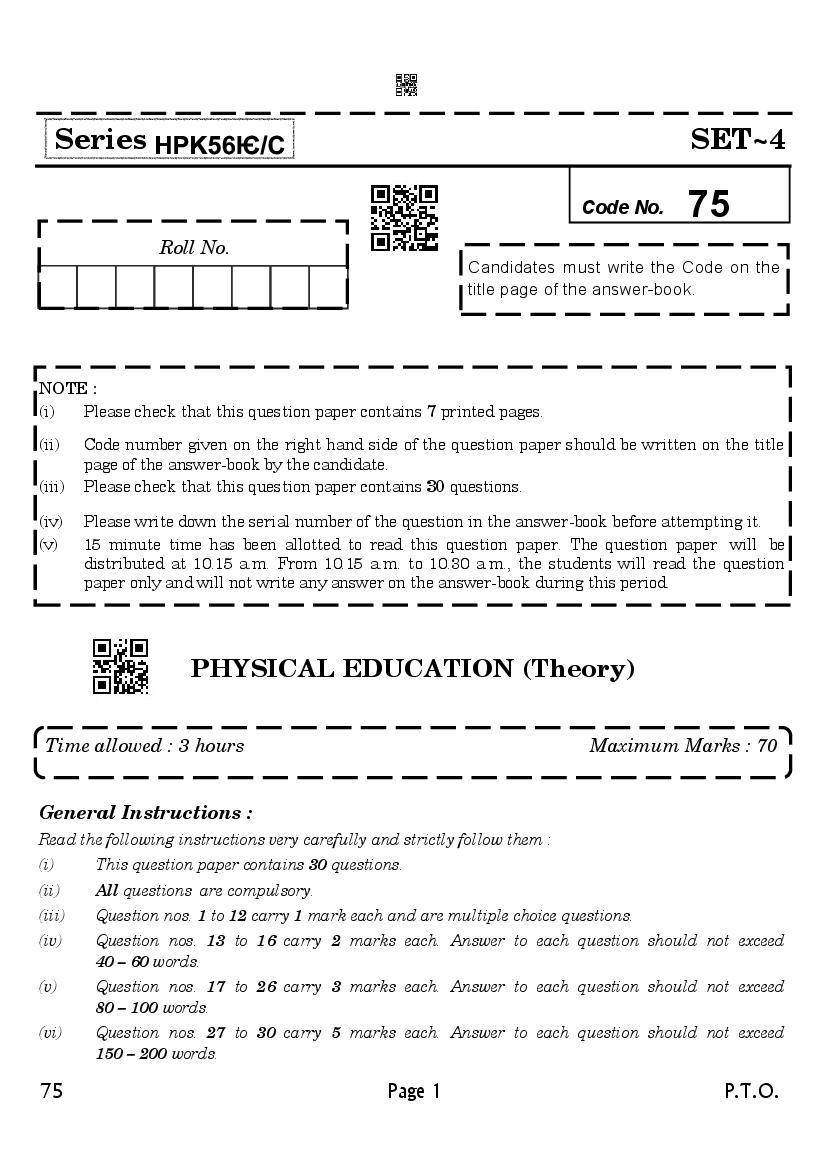
Page 1
Code No. 75
Roll No.
Candidates must write the Code on the
title page of the answer-book.
NOTE :
(i) Please check that this question paper contains 7 printed pages.
(ii) Code number given on the right hand side of the question paper should be written on the title
page of the answer-book by the candidate.
(iii) Please check that this question paper contains 30 questions.
(iv) Please write down the serial number of the question in the answer-book before attempting it.
(v) 15 minute time has been allotted to read this question paper. The question paper will be
distributed at 10.15 a.m. From 10.15 a.m. to 10.30 a.m., the students will read the question
paper only and will not write any answer on the answer-book during this period.
PHYSICAL EDUCATION (Theory)
Time allowed : 3 hours Maximum Marks : 70
General Instructions :
Read the following instructions very carefully and strictly follow them :
(i) This question paper contains 30 questions.
(ii) All questions are compulsory.
(iii) Question nos. 1 to 12 carry 1 mark each and are multiple choice questions.
(iv) Question nos. 13 to 16 carry 2 marks each. Answer to each question should not exceed
40 60 words.
(v) Question nos. 17 to 26 carry 3 marks each. Answer to each question should not exceed
80 100 words.
(vi) Question nos. 27 to 30 carry 5 marks each. Answer to each question should not exceed
150 200 words.
75 Page 1 P.T.O.
Page 2
(A) Round robin
(B) Knock-out
(C) Consolation
(D) Challenge
2. Which of the following is a group of macro-nutrients ? 1
(A) Carbohydrates, Fats, Protein
(B) Vitamins, Minerals, Water
(C) Fats, Fiber, Protein
(D) Minerals, Carbohydrates, Vitamins
3. A disease associated with respiratory tract is ____________ . 1
(A) Asthma
(B) Hypertension
(C) Diabetes
(D) Obesity
OR
Which one of the following asanas is not performed in standing position ? 1
(A) Chakrasana
(B) Tadasana
(C) Sukhasana
(D) Trikonasana
4. The full form of SPD is : 1
(A) Sensory Personal Disorder
(B) Sensory Processing Disorder
(C) Sensory Personality Disorder
(D) Sensory Problem Disorder
5. Psychology is the study of : 1
(A) Cardio-Respiratory system
(B) Behaviour
(C) Motor development
(D) Motion
6. The amount of blood pumped by the heart in one minute is called _________ . 1
(A) Stroke volume
(B) Cardiac output
(C) Heart rate
(D) Cardiac arrest
OR
75 Page 2
Page 3
(A) Rescue
(B) Treatment
(C) First-aid
(D) None of the above
7. 1
(A) Law of inertia
(B) Law of gravity
(C) Law of acceleration
(D) Law of reaction
8. Match List I with List II and select the correct answer from the code given below : 1
List I List II
i. Sit and reach test 1. Speed
ii. Standing broad jump 2. Endurance
iii. 600 mt. run/walk 3. Strength
iv. 50 mt. run 4. Flexibility
Code :
i ii iii iv
(A) 1 2 3 4
(B) 3 4 1 2
(C) 4 2 3 1
(D) 4 3 2 1
9. ___________ is the range of motion of joints. 1
(A) Endurance
(B) Strength
(C) Flexibility
(D) Speed
10. Intrinsic motivation is related to : 1
(A) money
(B) certificate
(C) prize
(D) pleasure
11. Given below are two statements labelled Assertion (A) and Reason (R) : 1
Assertion (A) : Strength is the force that a muscle or group of muscles can exert
against a resistance in one maximum effort.
Reason (R) : There are two types of strength Dynamic and Static.
In the context of above two statements, which one of the following is correct ?
(A) Both Assertion (A) and Reason (R) are true and Reason (R) is the correct
explanation of Assertion (A).
(B) Both Assertion (A) and Reason (R) are true, but Reason (R) is not the correct
explanation of Assertion (A).
(C) Assertion (A) is true, but Reason (R) is false.
(D) Assertion (A) is false, but Reason (R) is true.
75 Page 3 P.T.O.
Page 4
(A) disability etiquettes
(B) disability strategies
(C) disability activities
(D) cognitive disability
OR
Which one of the following is not the corrective measure for Round shoulders ? 1
(A) Hanging on horizontal bars
(B) Chakrasana
(C) Vajrasana
(D) Dhanurasana
13. Identify the following postural deformities and write their names : 2
(A) (B)
(C) (D)
14. Identify the following sports injuries and write their names : 2
(A) (B)
(C) (D)
75 Page 4
Page 5
Q. No. 13 and 14.
13.
India. 2
14. Write any two advantages and two disadvantages of league tournament. 2
15. (a) According to the syllabus, suggest any four As 2
OR
(b) 2
16. Distinguish between cognitive disability and physical disability on the basis of their
characteristics. (any two) 2
17. Given below is data of soft tissue injuries collected from a training centre after
completion of training : 3
(i) From which injury were the players most affected ?
(a) Abrasion
(b) Contusion
(c) Strain
(d) Sprain
(ii) Sprain is related to :
(a) muscle
(b) ligament
(c) skin
(d) bone
(iii) From which injury were the players least affected ?
(a) Sprain
(b) Abrasion
(c) Strain
(d) Contusion
75 Page 5 P.T.O.
Page 6
Q. No. 17.
17. Write any six effects of regular exercise on our Muscular system. 3
18. Sunita is a State level Judo player, who reduces her diet to control her weight. Her
coach advised her about pitfalls of dieting and recommended to her to take sufficient
amount of simple carbohydrates, fats, proteins, vitamins and minerals.
Based on this case, answer the following questions : 3
(i) Glucose, fructose and lactose are __________ .
(a) simple carbohydrates
(b) complex carbohydrates
(c) vitamins
(d) minerals
(ii) ___________ are known as body-building foods.
(a) Carbohydrates
(b) Fats
(c) Proteins
(d) Minerals
(iii) Following are pitfalls of dieting, except
(a) loss of weight.
(b) anaemia.
(c) loss of energy.
(d) healthy weight.
19. (a) Illustrate the procedure to measure speed, agility and balance of a Senior
Citizen. 3
OR
(b) What is the height of a bench for men in Harvard step test ? By using short-term
method, calculate the fitness index, if duration of exercise is 300 seconds and
heart rate is 70 for 1 to 1·5 minutes. 3
20. Enlist any two stages of growth and development. Explain exercise guidelines for any
one of them. 3
21. 3
22. Knowledge of bio-mechanics helps to enhance the performance of sportspersons.
Explain. 3
23. Describe any three disability etiquettes in detail. 3
24. (a) Explain the procedure of any one cardio-vascular fitness test in detail. 3
OR
(b) Explain the procedure for administering chair sit and reach test and chair stand
test in detail. 3
75 Page 6
Page 7
athlete. Justify. 3
OR
(b) State any three differences between isotonic and isometric exercises. 3
26. Differentiate between Abduction and Adduction by giving suitable example from sports. 3
27. (a) Briefly explain the following : 5 1=5
(i) Vitamins
(ii) A healthy weight
(iii) The pitfalls of dieting
(iv) Food intolerance
(v) Food myths
OR
(b) Enlist the nutritive and non-nutritive components of diet and write about any
two nutritive components in detail. 5
28. 5
29. (a) Explain the procedure, benefits and contraindications of any two Asanas to
prevent asthma. 5
OR
(b) Elaborate the procedure, benefits and contraindications of Trikonasana and
Vajrasana to prevent obesity. 5
30. On the basis of knock-out tournament, prepare a fixture of 17 teams mentioning all the
steps involved. 5
75 Page 7 P.T.O.
Page 8
H$moS> Z§. 75
narjmWu H$moS >H$mo CÎma-nwpñVH$m Ho$ _wI-n¥ð >na
Adí` {bIo§ &
ZmoQ> :
(i) H¥$n`m Om±M H$a b| {H$ Bg àíZ-nÌ _o§ _w{ÐV n¥ð> 7 h¢ &
(ii) àíZ-nÌ _| Xm{hZo hmW H$s Amoa {XE JE H$moS >Zå~a H$mo N>mÌ CÎma -nwpñVH$m Ho$ _wI-n¥ð> na {bI| &
(iii) H¥$n`m Om±M H$a b| {H$ Bg àíZ-nÌ _| >30 àíZ h¢ &
(iv) H¥$n`m àíZ H$m CÎma {bIZm ewê$ H$aZo go nhbo, CÎma-nwpñVH$m _| àíZ H$m H«$_m§H$ Adí` {bI| &
(v) Bg àíZ-nÌ 15 {_ZQ >H$m g_` {X`m J`m h¡ & àíZ- 10.15 ~Oo {H$`m
OmEJm & 10.15 ~Oo go 10.30 ~Oo VH$ N>mÌ Ho$db àíZ- -nwpñVH$m na
H$moB© CÎma Zht {bI|Jo &
emar[aH$ {ejm (g¡ÕmpÝVH$)
:3 : 70
:
:
(i) 30
(ii)
(iii) 1 12 1
(iv) 13 16 2 40 60
(v) 17 26 3 80 100
(vi) 27 30 5 150 200
75 Page 8
Page 9
(A) amCÝS> am°{~Z
(B) Zm°H$AmCQ>
(C) H$m°ÝgmoboeZ
(D) M¡b|O
2. {ZåZ _| go H$m¡Z-gm ~¥hV² nmofH$-VÎdm| H$m g_yh h¡ ? 1
(A) H$m~m}hmBS´>oQ>, dgm, àmoQ>rZ
(B) {dQ>m{_Z, I{ZO, Ob
(C) dgm, \$mB~a, àmoQ>rZ
(D) I{ZO, H$m~m}S>mBS´>oQ>, {dQ>m{_Z
3. __________ ídgZ V§Ì go g§~§{YV amoJ h¡ & 1
(A) AñW_m
(B) aº$Mmn
(C) _Yw_oh
(D) _moQ>mnm
AWdm
{ZåZ _| go H$m¡Z- -pñW{V _| {H$`m OmVm ? 1
(A) MH«$mgZ
(B)
(C) gwImgZ
(D) {ÌH$moUmgZ
4. Eg.nr.S>r. H$m nyU© ê$n h¡ : 1
(A) g§doXr ì`{º$JV {dH$ma (g|gar ng©Zb {S>ñAm°S>©a)
(B) g§doXr àg§ñH$aU {dH$ma (g|gar àmogoqgJ {S>ñAm°S>©a)
(C) g§doXr ì`{º$Ëd {dH$ma (g|gar ng©Zo{bQ>r {S>ñAm°S>©a)
(D) g§doXr g_ñ`m {dH$ma (g|gar àm°ãb_ {S>ñAm°S>©a)
5. _Zmo{dkmZ {H$gH$m AÜ``Z h¡ ? 1
(A) öX`-ídgZ V§Ì H$m
(B) ì`dhma H$m
(C) Jm_H$ {dH$mg H$m
(D) J{V H$m
6. öX` Ûmam EH$ {_ZQ> _| {ZH$mg (n§n) H$s JB© aº$ (é{Ya) H$s _mÌm __________ H$hbmVr h¡ & 1
(A) ñQ´>moH$ Am`VZ
(B) H$m{S>©`H$ AmCQ>nwQ>
(C) öX` J{V
(D) öX` KmV
AWdm
75 Page 9 P.T.O.
Page 10
(A) ~Mmd
(B) CnMma
(C) àmW{_H$ CnMma
(D) Cn`w©º$ _| go H$moB© Zht
7. Ý`yQ>Z H$s J{V H$m Xÿgam {Z`_ OmZm OmVm h¡ : 1
(A)
(B) JwéËd H$m {Z`_
(C) ËdaU H$m {Z`_
(D) à{V{H«$`m H$m {Z`_
8. gyMr I Am¡a gyMr II H$m {_bmZ H$aVo hþE {XE JE H$moS> _| go ghr CÎma N>m±{Q>E : 1
I II
i. {gQ> EÊS> arM narjU 1. J{V
ii. Hy$X 2. ghZe{º$
iii. 600 /Mmb 3. e{º$
iv. 50 4. bMrbmnZ
H$moS> :
i ii iii iv
(A) 1 2 3 4
(B) 3 4 1 2
(C) 4 2 3 1
(D) 4 3 2 1
9. __________ H$hVo h¢ & 1
(A) ghZe{º$
(B) e{º$
(C) bMrbmnZ
(D) J{V
10. Am§V[aH$ àoaUm H$m g§~§Y h¡ : 1
(A) n¡gm (YZ) go
(B) à_mU-nÌ (gQ>u{\$Ho$Q>) go
(C) nwañH$ma go
(D) Iwer go
11. ZrMo Xmo H$WZ {XE JE h¢, Omo {H$ A{^H$WZ (A) VWm H$maU (R) Ho$ ê$n _| h¢ : 1
(A) : e{º$ EH$ Eogm ~b h¡, Omo EH$ _m§gnoer `m _m§gno{e`m| Ho$ g_yh Ûmam EH$ A{YH$V_
H$mo{ee (à`mg) _| {H$gr à{VamoY Ho$ {déÕ bJm`m OmVm h¡ &
(R) : e{º$ Xmo àH$ma H$s hmoVr h¡ J{Verb Ed§ pñWa &
Cn`w©º$ Xmo H$WZm| Ho$ g§X^© _| {ZåZ{b{IV _| go H$m¡Z-gm ghr h¡ ?
(A) A{^H$WZ (A) VWm H$maU (R) XmoZm| ghr h¢ VWm H$maU (R), A{^H$WZ (A) H$m ghr ñnîQ>rH$aU h¡ &
(B) A{^H$WZ (A) VWm H$maU (R) XmoZm| ghr h¢, naÝVw H$maU (R), A{^H$WZ (A) H$m ghr ñnîQ>rH$aU
h¡ &
(C) A{^H$WZ (A) ghr h¡, naÝVw H$maU (R) µJbV h¡ &
(D) A{^H$WZ (A) µJbV h¡, naÝVw H$maU (R) ghr h¡ &
75 Page 10
Page 11
(A) Aj_Vm {eîQ>mMma
(B) Aj_Vm aUZr{V`m±
(C) Aj_Vm {H«$`mE±
(D) g§kmZmË_H$ Aj_Vm
AWdm
{ZåZ{b{IV _| go H$m¡Z-gm Jmob H$§Ym| Ho$ {bE gwYmamË_H$ Cnm` h¡ ? 1
(A) j¡{VO X§S>m| (~ma) na bQ>H$Zm
(B) MH«$mgZ
(C) dO«mgZ
(D) YZwamgZ
13. {ZåZ{b{IV AmgZ {dH¥${V`m| H$mo nhMm{ZE VWm CZHo$ Zm_ {b{IE : 2
(A) (B)
(C) (D)
14. {ZåZ{b{IV Iob MmoQ>m| H$mo nhMm{ZE VWm CZHo$ Zm_ {b{IE : 2
(A) (B)
(C) (D)
75 Page 11 P.T.O.
Page 12
13. ^maV _| IobHy$X _| _{hbmAm| H$s ^mJrXmar H$mo àmoËgm{hV H$aZo Ho$ {bE H$moB© Mma gwPmd Xr{OE & 2
14. brJ Qy>Zm©_|Q> Ho$ H$moB© Xmo bm^ d Xmo hm{Z`m± {b{IE & 2
15. (a) nmR>çH«$_ Ho$ AZwgma H$m CnMma (BbmO) H$aZo hoVw {H$Ýht Mma AmgZm| H$mo gwPmBE & 2
AWdm
(b) nmR>çH«$_ Ho$ AZwgma _Yw_oh H$m CnMma (BbmO) H$aZo hoVw {H$Ýht Mma AmgZm| H$mo gwPmBE & 2
16. g§kmZmË_H$ Aj_Vm d emar[aH$ Aj_Vm Ho$ ~rM CZH$s {deofVmAm| Ho$ AmYma na AÝVa ñnîQ> H$s{OE &
(H$moB© ) 2
17. H$mo_b D$VH$ ZrMo {XE JE h¢, Omo {H$ EH$ à{ejU Ho$ÝÐ go à{ejU nyam hmoZo na EH${ÌV
{H$E JE h¢ : 3
qIMmd Iam|M _moM Zrb n
(i) -gr MmoQ> go g~go Á`mXm à^m{dV hþE ?
(a)
(b)
(c) qIMmd
(d) _moM
(ii) _moM H$m g§~§Y {H$ggo h¡ ?
(a) _m§gnoer
(b) {bJm_oÝQ (ApñW~§Y)>
(c) ËdMm
(d) hÈ>r
(iii) -gr MmoQ> go g~go H$_ à^m{dV hþE ?
(a) _moM
(b) Iam|M ( )
(c) qIMmd
(d)
75 Page 12
Page 13
17. {Z`{_V ì`m`m_ Ûmam h_mao _m±gnoer` V§Ì H$moB© {b{IE & 3
18. gwZrVm OwS>mo H$s EH$ am µOZ H$mo {Z`§{ÌV H$aZo Ho$ {bE Amhma _| H$_r H$aVr
h¡ & CgHo$ à{ejH$ Zo Cgo Aënmhma H$s hm{Z`m± ~VmVo hþE, Cgo gab H$m~m©ohmBS´>oQ²>g, dgm, àmoQ>rZ, {dQ>m{_Z d
I{ZO n`m©á _mÌm _| boZo H$s gbmh Xr &
Cn`w©º$ pñW{V Ho$ AZwgma {ZåZ{b{IV àíZm| Ho$ CÎma Xr{OE : 3
(i) ½byH$moµO, \ µO Ed§ µO ___________ h¢ &
(a) gab H$m~m©ohmBS´>oQ²>g
(b) O{Q>b H$m~m©ohmBS´>oQ²>g
(c) {dQ>m{_Ýg
(d) I{ZO VÎd
(ii) ___________ eara Ho$ {Z_m©U dmbo Amhma Ho$ ê$n _| OmZo OmVo h¢ &
(a) H$m~m©ohmBS´>oQ²>g
(b) dgm
(c) àmoQ>rZ
(d) I{ZO VÎd
(iii) {ZåZ{b{IV _| go H$m¡Z-gr Aënmhma H$s hm{Z h¡ ?
(a) dµOZ H$m H$_ hmoZm
(b) aº$mënVm
(c) D$Om© H$m H$_ hmoZm
(d) ñdñW ^ma
19. (a) EH$ d[aîR> ZmJ[aH$ H$s J{V, MnbVm (\w$aVr) d g§VwbZ H$mo _mnZo H$s à{H«$`m H$m dU©Z H$s{OE & 3
AWdm
(b) hmd©S>© ñQ>on narjU _| nwéfm| Ho$ {bE ~¢M H$s D±$MmB© {H$VZr hmoVr h¡ ? AënH$m{bH$ {d{Y H$m Cn`moJ
H$aVo hþE ñdñWVm gyMH$m§H$ ( ) H$s JUZm H$s{OE, `{X ì`m`m_ H$s Ad{Y 300 goH$ÊS> h¡
VWm 1 go 1·5 {_ZQ> _| öX` J{V 70 h¡ & 3
20. d¥{Õ d {dH$mg H$s {H$Ýht Xmo AdñWmAm| H$mo gyMr~Õ H$s{OE & {H$gr EH$ AdñWm hoVw ì`m`m_ g§~§Yr
{Xem-{ZX©oem| H$s ì`m»`m H$s{OE & 3
21. ñH$mo{b`mo{gg Ho$ {bE {H$Ýht VrZ gwYmamË_H$ Cnm`m| H$s ì`m»`m H$s{OE & 3
22. O¡d- h¡ & ì`m»`m H$s{OE & 3
23. {H$Ýht VrZ Aj_Vm {eîQ>mMmam| H$m {dñV¥V dU©Z H$s{OE & 3
24. (a) {H$gr ^r EH$ öX²dm{hH$m nwpîQ> (ñdñWVm) narjU H$s à{H«$`m H$s {dñVma go ì`m»`m H$s{OE & 3
AWdm
(b) Mo`a {gQ> d arM narjU VWm Mo`a ñQ>¢S> narjÊm H$s à{H«$`m H$s {dñVma go ì`m»`m H$s{OE & 3
75 Page 13 P.T.O.
Page 14
Om gH$Vm h¡ & {gÕ H$s{OE & 3
AWdm
(b) AmBgmoQ>mo{ZH$ d AmBgmo_r{Q´>H$ ì`m`m_m| Ho$ ~rM H$moB© VrZ A§Va ~VmBE & 3
26. Iobm| Ho$ Cn`wº$ CXmhaU XoVo hþE AndV©Z Am¡a A{^dV©Z (ES²>S> J{V`m| _| A§Va ñnîQ>
H$s{OE & 3
27. (a) {ZåZ{b{IV H$s g§jon _| ì`m»`m H$s{OE : 5 1=5
(i) {dQ>m{_Ýg
(ii) ñdñW ^ma
(iii) Aënmhma H$s hm{Z
(iv) ^moOZ/ImÚ AghZerbVm
(v) ^moOZ {_WH$$
AWdm
(b) Amhma Ho$ nmofH$ d µJ¡a-nmofH$ VÎdm| H$s gyMr ~ZmBE VWm {H$Ýht Xmo nmofH$ VÎdm| Ho$ ~mao _| {dñVma go
{b{IE & 5
28. ì`{º$Ëd H$mo n[a^m{fV H$s{OE & eoëS>Z H$m dJuH$aU VWm IobHy$Xm| _| BgHo$ _hÎd H$mo g_PmBE & 5
29. (a) X_m (AñW_m) H$s amoH$Wm_ Ho$ {bE {H$E OmZo dmbo {H$Ýht Xmo AmgZm| H$s {d{Y, CZgo hmoZo dmbo bm^
d {ZfoYm| H$mo g_PmBE & 5
AWdm
(b) _moQ>mno H$mo amoH$Zo _| ghm`H$ {ÌH$moUmgZ d dO«mgZ H$s {d{Y, bm^ d {ZfoYm| H$m dU©Z H$s{OE & 5
30. Zm°H$AmCQ> IobHy$X-à{V`mo{JVm Ho$ AmYma na g^r gmonmZm| H$m CëboI H$aVo hþE 17 Q>r_m| H$m EH$ {\
H$s{OE & 5
75 Page 14
Document Details
| Board / Org | CBSE |
| Exam | Class 12 |
| Type | Question Paper |
| Pages | 14 |
| Language | english |
| Updated | 22 Jul 2026 |