CBSE Class 12 Question Paper 2021 Political Science (Compartment)
Finished viewing? Save it for later —
Download CBSE Class 12 Question Paper 2021 Political Science (Compartment) (PDF · 16 pages)About CBSE Class 12 Question Paper 2021 Political Science (Compartment)
CBSE Class 12 Question Paper 2021 Political Science (Compartment) is available here for free download. Published by CBSE for Class 12, this question paper can be viewed online or downloaded as a PDF (16 pages). Candidates preparing for Class 12 can use CBSE Class 12 Question Paper 2021 Political Science (Compartment) to understand the exam pattern, the type of questions asked, and the overall difficulty level.
Frequently Asked Questions
How can I download CBSE Class 12 Question Paper 2021 Political Science (Compartment)?
Open this page and click the Download button to save CBSE Class 12 Question Paper 2021 Political Science (Compartment) as a PDF. It is completely free on AglaSem Docs.
Is CBSE Class 12 Question Paper 2021 Political Science (Compartment) free to download?
Yes. CBSE Class 12 Question Paper 2021 Political Science (Compartment) can be viewed online and downloaded as a PDF free of cost on AglaSem Docs.
How many pages does CBSE Class 12 Question Paper 2021 Political Science (Compartment) have?
CBSE Class 12 Question Paper 2021 Political Science (Compartment) contains 16 pages, which you can read online or download together as a single PDF.
Where can I find more Class 12 study material?
You can find more Class 12 question papers, sample papers, syllabus, and answer keys on AglaSem Docs.
CBSE Class 12 Question Paper 2021 Political Science (Compartment) – Text
Read the full text of this question paper below — useful to quickly search, copy and reference the content online without downloading the PDF.
📄 View text version (16 pages)
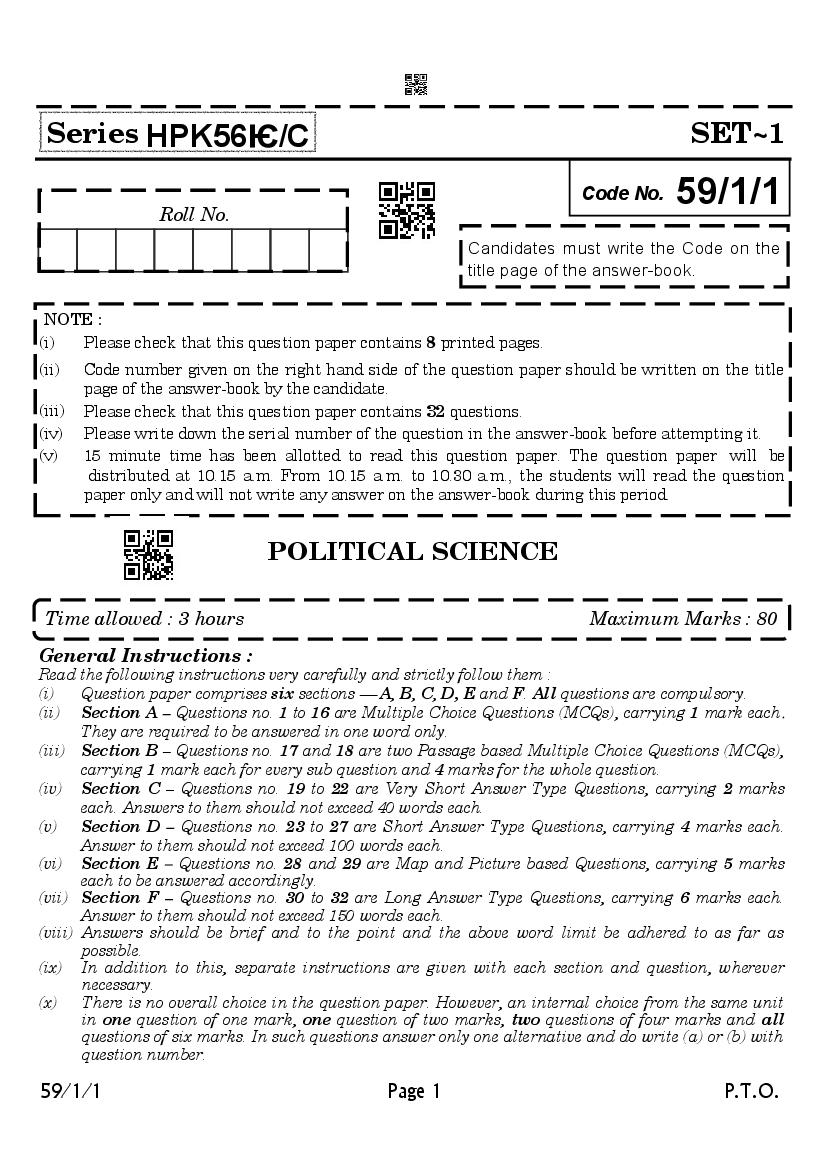
Page 1
Roll No.
Code No. 59/1/1
Candidates must write the Code on the
title page of the answer-book.
NOTE :
(i) Please check that this question paper contains 8 printed pages.
(ii) Code number given on the right hand side of the question paper should be written on the title
page of the answer-book by the candidate.
(iii) Please check that this question paper contains 32 questions.
(iv) Please write down the serial number of the question in the answer-book before attempting it.
(v) 15 minute time has been allotted to read this question paper. The question paper will be
distributed at 10.15 a.m. From 10.15 a.m. to 10.30 a.m., the students will read the question
paper only and will not write any answer on the answer-book during this period.
POLITICAL SCIENCE
Time allowed : 3 hours Maximum Marks : 80
General Instructions :
Read the following instructions very carefully and strictly follow them :
(i) Question paper comprises six sections A, B, C, D, E and F. All questions are compulsory.
(ii) Section A Questions no. 1 to 16 are Multiple Choice Questions (MCQs), carrying 1 mark each
They are required to be answered in one word only.
(iii) Section B Questions no. 17 and 18 are two Passage based Multiple Choice Questions (MCQs),
carrying 1 mark each for every sub question and 4 marks for the whole question.
(iv) Section C Questions no. 19 to 22 are Very Short Answer Type Questions, carrying 2 marks
each. Answers to them should not exceed 40 words each.
(v) Section D Questions no. 23 to 27 are Short Answer Type Questions, carrying 4 marks each.
Answer to them should not exceed 100 words each.
(vi) Section E Questions no. 28 and 29 are Map and Picture based Questions, carrying 5 marks
each to be answered accordingly.
(vii) Section F Questions no. 30 to 32 are Long Answer Type Questions, carrying 6 marks each.
Answer to them should not exceed 150 words each.
(viii) Answers should be brief and to the point and the above word limit be adhered to as far as
possible.
(ix) In addition to this, separate instructions are given with each section and question, wherever
necessary.
(x) There is no overall choice in the question paper. However, an internal choice from the same unit
in one question of one mark, one question of two marks, two questions of four marks and all
questions of six marks. In such questions answer only one alternative and do write (a) or (b) with
question number.
59/1/1 Page 1 P.T.O.
Page 2
1. Which one of the following is not a Baltic Republic ? 1
(A) Estonia
(B) Ukraine
(C) Chechnya
(D) Georgia
2. The President of which one of the following Republics appointed himself to power, first
for ten years and then extended it for another ten years ? 1
(A) Uzbekistan
(B) Chechnya
(C) Lithuania
(D) Georgia
3. Which one of the following statements about the European Union (EU) is not correct ? 1
(A)
(B)
(C) The EU has its own flag and anthem.
(D) The EU does not enjoy any political and diplomatic influence.
4. Which one of the following statements about the ASEAN flag is not correct ? 1
(A) The stalks shown in the flag represent ten South-West Asian countries.
(B) These ten stalks are paddy stalks.
(C) The circle in the flag symbolises the unity of ASEAN.
(D) The bundle of ten stalks bound together represents friendship and solidarity of
the members.
5. Which one of the following statements about present-day Nepal is correct ? 1
(A) It is a Hindu state.
(B) It has monarchy.
(C) It is a secular state.
(D) There is no parliamentary system.
6. Which one of the following developing countries was the first to successfully control the
rate of growth of population ? 1
(A) Bhutan
(B) Pakistan
(C) Nepal
(D) Sri Lanka
7. Identify the UN Agency that also works in the cultural field. 1
(A) UNICEF
(B) WHO
(C) UNHCR
(D) UNESCO
59/1/1 Page 2
Page 3
the maximum number of times ? 1
(A) United States of America
(B) USSR/Russia
(C) United Kingdom
(D) France
9. Who among the - 1
(A) Jayaprakash Narayan
(B) Ram Manohar Lohia
(C) Morarji Desai
(D) L.K. Advani
10. (a) Who among the following leaders was not
Cabinet formed in 1948 after independence ? 1
(A) Maulana Abul Kalam Azad
(B) B.R. Ambedkar
(C) Sardar Vallabhbhai Patel
(D) Mahatma Gandhi
OR
(b) Who among the following Prime Ministers of India nationalised the banks ? 1
(A) Morarji Desai
(B) Lal Bahadur Shastri
(C) Indira Gandhi
(D) Jawaharlal Nehru
11. Which one of the following statements about globalisation is correct ? 1
(A) Globalisation began due to disintegration of the USSR.
(B) Globalisation has caused worldwide interconnectedness.
(C) Globalisation is only an economic phenomenon.
(D) Globalisation has led to different wars.
12. Which one of the following statements is a cultural consequence of globalisation ? 1
(A) Blue jeans can go well with a khadi kurta.
(B) In most of the cases, the State capacity has eroded.
(C) Import duty has been reduced.
(D) Investors of rich countries can invest their capital in developing countries.
13. 1
(A) Indira Gandhi
(B) Lal Bahadur Shastri
(C) Ram Manohar Lohia
(D) K. Kamaraj
14. Which one of the following systems was not promoted by Pandit Deendayal
Upadhyaya ? 1
(A) Western system
(B) Classless system
(C) Casteless system
(D) Conflict-free social system
59/1/1 Page 3 P.T.O.
Page 4
before the completion of five-year term, is true ? 1
(A) The Janata Party split and Morarji Desai lost majority.
(B) The Janata Party could not keep its constituents together.
(C) Due to wi
government had to resign.
(D) The Janata Party lacked direction, leadership and a common programme.
16. Who among the following leaders was the first non-Congress Prime Minister of India ? 1
(A) Atal Bihari Vajpayee
(B) V.P. Singh
(C) P.V. Narasimha Rao
(D) Morarji Desai
SECTION B
17. Read the following passage carefully and answer the questions that follow : 4 1=4
The consequences of globalisation are not confined only to the sphere of politics and
economy. Globalisation affects us in our home, in what we eat, drink, wear and indeed
in what we think. It shapes what we think are our preferences. The cultural effect of
globalisation leads to the fear that this process poses a threat to cultures in the world. It
does so, because globalisation leads to what is called cultural homogenisation. The rise
of a uniform culture is not the emergence of a global culture.
17.1 Which one of the following statements is a consequence of cultural
globalisation ? 1
(A) It narrows down the scope of social justice.
(B) There is increase in the momentum towards inter-dependence between
governments.
(C) Our food choices have increased.
(D) It results in an erosion of state capacity.
17.2 Cultural homogenisation means : 1
(A) rise of global culture.
(B) rise of uniform culture.
(C) rise of different cultures.
(D) rise of a distinctive culture.
17.3 Identify one positive consequence of cultural globalisation. 1
(A) It leads to the shrinking of the cultural heritage of the entire globe.
(B) It spreads western culture in the whole world.
(C) It modifies our culture at the cost of our traditions.
(D) It widens our range of choices in various fields.
17.4 Which one of the following statements is a consequence of cultural
globalisation ? 1
(A) It affects us in what we eat, drink and wear in our homes.
(B) Our thought process remains unaffected.
(C) It leads to economic ruin for the developing countries.
(D) International organisations become weak.
59/1/1 Page 4
Page 5
One of the most important concerns in the early years was that demands for separate
states would endanger the unity of the country. It was felt that linguistic states may
foster separatism and create pressures on the newly founded nation. But the leadership
under popular pressure, finally made a choice in favour of linguistic states. It was hoped
that if we accept the regional and linguistic claims of all regions, the threat of division
and separatism would be reduced. Besides, the accommodation of regional demands and
the formation of linguistic states were also seen as more democratic.
18.1 Which one of the following states was the first to be formed on the basis of
linguistics ? 1
(A) Manipur
(B) Andhra Pradesh
(C) Mysore
(D) Madras
18.2 What was done by the Government of India to redraw the boundaries of states ? 1
(A) The matter was put before the Supreme Court to decide.
(B) Plebiscite was held in all the concerned states.
(C) Appointment of the State Boundary Commission was made in 1956.
(D) States Reorganisation Commission was appointed in 1953.
18.3 How many States and Union Territories were created immediately after the
reorganisation of the states ? 1
(A) 14 States and 6 Union Territories
(B) 16 States and 7 Union Territories
(C) 18 States and 6 Union Territories
(D) 21 States and 7 Union Territories
18.4 Which one option completes the following sentence correctly ? 1
The reorganisation of states on the basis of linguistics led to ________.
(A) disturbances and unrest
(B) the opposition to the formation of linguistic states
(C) the acceptance of the principle of diversity
(D) changed nature of politics in India
SECTION C
19. Analyse the outcome of the severe conflict that took place in the Balkan Republics of
Yugoslavia. 2
20. Union Government ? Explain. 2
21. Highlight any two main objectives of constituting the NITI Aayog. 2 1=2
22. (a) Highlight any two major changes that took place in the Indian politics after
2014. 2 1=2
OR
(b) Explain the basis on which the Bahujan Samaj Party emerged as a formidable
political force. 2
59/1/1 Page 5 P.T.O.
Page 6
23. tic and authoritarian, making life
4 1=4
24.
statement with the help of any four examples. 4 1=4
25. Explain the circumstances that led to the accession of the Princely State of Hyderabad
to the Union of India. 4
26. (a)
considered necessary for the UN after the Cold War. 4 1=4
OR
(b) Mention any four criteria that have been proposed for new permanent members
of the UN Security Council. 4 1=4
27. (a) Explain any four significant changes that have taken place in Indo-China
relations since the end of the Cold War. 4 1=4
OR
(b) Explain the role of the BJP-led NDA Government in the growth of relations
between India and Israel. 4
SECTION E
28. In the political outline map of India given on page 7, five States have been marked
as and . Identify these States on the basis of information given below
and write their correct names in your answer-book along with the respective serial
number of the information used and the concerned alphabets given in the map as per
the following format :
Sr. no. of the Concerned alphabet Name of the
information used in the map State
(i)
(ii)
(iii)
(iv)
(v)
(i) The State from where Prime Minister Narendra Modi has been elected as a
member of Lok Sabha in 2019.
(ii) The State where Somnath Mandir is situated.
(iii) The Union Territory which came into existence in 2019.
(iv) The State where Chief Minister Karpoori Thakur had introduced a new policy of
reservations for OBCs.
(v) The first State to be created on the basis of linguistics in the year 1952. 5 1=5
59/1/1 Page 6
Page 7
Outline Map of India (Political)
B
C
E
D
A
59/1/1 Page 7 P.T.O.
Page 8
(28.1) Name the Prime Minister of India during 1989 90 who belonged to the
National Front.
(28.2) Mention the Article that had given special status to Jammu and Kashmir.
(28.3) Name the first Prime Minister of NDA led by the Bharatiya Janata Party.
(28.4) Name the founder of the Bahujan Samaj Party.
(28.5) Write the full form of UPA. 5 1=5
29. The cartoon given below is related to the victory of Indira Gandhi in 1971 elections.
Study the cartoon carefully and answer the questions that follow :
(i) Why has the cartoonist shown a very big cup in the hands of Indira Gandhi ?
(ii) What has been depicted by the cartoonist by showing a man with a bowl peeping
out of the cup ? Explain.
(iii) What message is being given by this cartoon ? Analyse. 1+2+2=5
Note : The following questions are for the Visually Impaired Candidates only, in lieu of Q. No. 29 :
(29.1)
(29.2)
(29.3) When was the dominance of the Congress Party restored for the second time
and how ? Explain. 1+2+2=5
SECTION F
30. (a) Give any three arguments to justify the imposition of Emergency in 1975. 3 2=6
OR
(b) Analyse any three developments that gave rise to the confrontations between
the Union Government and the Judiciary of India. 3 2=6
31. (a) Why is the end of the Second World War called the beginning of the Cold War ?
Explain any three reasons. 3 2=6
OR
(b) Policy of Non-alignment ? In
spite of being a leader of NAM, why did India sign the Treaty of Friendship with
Soviet Union in 1971 ? Explain. 3+3=6
32. (a) Show with the help of any four examples that the leadership of China changed
1
their policies to reform the Chinese economy. 4 1 =6
2
OR
(b) Show with the help of any four examples that India has tried many
confidence-building measures to reduce tension and risk of war with
1
Pakistan. 4 1 =6
2
59/1/1 Page 8
Page 9
H$moS> Z§. 59/1/1
narjmWu H$moS >H$mo CÎma-nwpñVH$m Ho$ _wI-n¥ð >na
Adí` {bIo§ &
ZmoQ> :
(i) H¥$n`m Om±M H$a b| {H$ Bg àíZ-nÌ _o§ _w{ÐV n¥ð> 8 h¢ &
(ii) àíZ-nÌ _| Xm{hZo hmW H$s Amoa {XE JE H$moS >Zå~a H$mo N>mÌ CÎma -nwpñVH$m Ho$ _wI-n¥ð> na {bI| &
(iii) H¥$n`m Om±M H$a b| {H$ Bg àíZ-nÌ _| >32 àíZ h¢ &
(iv) H¥$n`m àíZ H$m CÎma {bIZm ewê$ H$aZo go nhbo, CÎma-nwpñVH$m _| àíZ H$m H«$_m§H$ Adí` {bI| &
(v) Bg àíZ-nÌ 15 {_ZQ >H$m g_` {X`m J`m h¡ & àíZ- 10.15 ~Oo {H$`m
OmEJm & 10.15 ~Oo go 10.30 ~Oo VH$ N>mÌ Ho$db àíZ- -nwpñVH$m na H$moB©
CÎma Zht {bI|Jo &
amOZr{V {dkmZ
:3 : 80
:
:
(i)
(ii) 1 16 1
(iii) 17 18 4 1
(iv) 19 22 2
40
(v) 23 27 4
100
(vi) 28 29 / 5
(vii) 30 32 6
150
(viii)
(ix)
(x)
: :
(a) (b)
59/1/1 Page 9 P.T.O.
Page 10
1. {ZåZ{b{IV _| go H$m¡Z-gm EH$ ~mpëQ>H$ JUamÁ` h¡ ? 1
(A) EñQ>m{o Z`m
(B) `yH«o$Z
(C) MoMÝ`m
(D) Om°{O©`m
2. {ZåZ{b{IV _| go {H$g JUamÁ` Ho$ amï´>n{V Zo nhbo AnZr {Z`w{º$ Xg df© Ho$ {bE H$s Am¡a {\$a Cg H$m`©H$mb
? 1
(A) CµÁ~o{H$ñVmZ
(B) MoMÝ`m
(C) brWwAm{Z`m
(D) Om°{O©`m
3. `yamonr` g§K (B©.`y.) Ho$ ~mao _| {ZåZ{b{IV _| go H$m¡Z-gm H$WZ ghr h¡ ? 1
(A) `y S>r AW©ì`dñWm h¡ &
(B) `yamonr` g§K H$s {_br-Owbr geñÌ goZmE± {díd _| Xÿgar g~go ~ goZm h¡ &
(C) `yamonr` g§K H$m AnZm ÜdO VWm JmZ h¡ &
(D) `yamonr` g§K H$m H$moB© ^r amOZr{VH$ VWm Hy$Q>Zr{VH$ à^md Zht h¡ &
4. Am{g`mZ Ho$ P§S>o Ho$ ~mao _| {ZåZ{b{IV _| go H$m¡Z-gm H$WZ ghr h¡ ? 1
(A) P§S>o _| {XImB© JB© Xg ~m{b`m± E{e`m Ho$ Xg X{jU-npíM_r Xoem| H$m à{V{Z{YËd H$aVr h¢ &
(B) `o Xg ~m{b`m± YmZ H$s ~m{b`m± h¢ &
(C) P§S>o _| ~Zm d¥Îm Am{g`mZ H$s EH$Vm H$m àVrH$ h¡ &
(D) BH$Æ>o ~±Yr hþB© Xg ~m{b`m| H$m ~§S>b gXñ`m| H$s {_ÌVm VWm EH$Vm H$mo Xem©Vm h¡ &
5. {ZåZ{b{IV _| go H$m¡Z-gm H$WZ dV©_mZ Zonmb Ho$ ~mao _| ghr h¡ ? 1
(A) `h EH$ {hÝXÿ amÁ` h¡ &
(B) `hm± amOV§Ì h¡ &
(C) `h EH$ Y_©{Zanoj amÁ` h¡ &
(D) `hm± g§gXr` àUmbr Zht h¡ &
6. {ZåZ{b{IV _| go H$m¡Z-gm {dH$mgerb Xoe OZg§»`m H$s d¥{Õ Xa H$mo g\$bVmnyd©H$ {Z`§{ÌV H$aZo dmbm nhbm
Xoe h¡ ? 1
(A) ^yQ>mZ
(B) nm{H$ñVmZ
(C) Zonmb
(D) lrb§H$m
7. g§`wº$ amï´> H$s Cg EO|gr H$s nhMmZ H$s{OE Omo gm§ñH¥${VH$ joÌ _| ^r H$m`© H$aVr h¡ & 1
(A) `y.EZ.AmB©.gr.B©.E\$. (`y{Zgo\$)
(B) S>ãë`y.EM.Amo.
(C) `y.EZ.EM.gr.Ama.
(D) `yZoñH$mo
59/1/1 Page 10
Page 11
à`moJ {H$`m h¡ ? 1
(A) g§`wº$ amÁ` A_o[aH$m
(B) gmo{d`V g§K/ê$g
(C) {~«Q>oZ
(D) \«$m§g
9. {ZåZ{b{IV _| go H$m¡Z-gm ZoVm µJ¡a-H$m±J«ogdmX H$s aUZr{V Ho$ {bE OmZm OmVm h¡ ? 1
(A) O`àH$me Zmam`U
(B) am_ _Zmoha bmo{h`m
(C) _moamaOr XogmB©
(D) bmb H¥$îU AmS>dmUr
10. (a) {ZåZ{b{IV _| go H$m¡Z-gm ZoVm Odmhabmb Zohê$ Ho$ ñdV§ÌVm níMmV² 1948 _| ~Zo _§{Ì_§S>b _| EH$
_§Ìr Wm ? 1
(A) _m¡bmZm A~wb H$bm_ AmµOmX
(B) ~r.Ama. Aå~oS>H$a
(C) gaXma d
(D) _hmË_m Jm±Yr
AWdm
(b) {ZåZ{b{IV _| go ^maV Ho$ {H$g àYmZ _§Ìr Zo ~¢H$m| H$m amï´>r`H$aU {H$`m Wm ? 1
(A) _moamaOr XogmB©
(B) bmb ~hmXþa emñÌr
(C) BpÝXam Jm±Yr
(D) Odmhabmb Zohê$
11. {ZåZ{b{IV _| go H$m¡Z-gm H$WZ d¡ídrH$aU Ho$ ~mao _| ghr h¡ ? 1
(A) d¡ídrH$aU H$m àmaå^ gmo{d`V g§K Ho$ {dKQ>Z Ho$ H$maU hþAm &
(B) h¡ &
(C) d¡ídrH$aU Ho$db EH$ Am{W©H$ n[aKQ>Zm h¡ &
(D) d¡ídrH$aU Ho$ H$maU H$B© `wÕ hþE &
12. {ZåZ{b{IV _| go H$m¡Z-gm H$WZ d¡ídrH$aU H$m gm§ñH¥${VH$ n[aUm_ h¡ ? 1
(A) Zrbr OrÝg Ho$ gmW ImXr H$m Hw$Vm© AÀN>m bJVm h¡ &
(B) A{YH$m§e _m_bm| _|, amÁ` H$s j_Vm H$m jaU hþAm h¡ &
(C) Am`mV ewëH$ _| H$_r AmB© h¡ &
(D) YZmT>ç Xoem| Ho$ {ZdoeH$ AnZr ny±Or {dH$mgerb Xoem| _| bJm gH$Vo h¢ &
13. {ZåZ{b{IV _| go {H$gZo O` OdmZ O` {H$gmZ H$m à{gÕ Zmam {X`m Wm ? 1
(A) BpÝXam Jm±Yr
(B) bmb ~hmXþa emñÌr
(C) am_ _Zmoha bmo{h`m
(D) Ho$. H$m_amO
14. n§{S>V XrZ {X`m Wm ? 1
(A) nmíMmË` ì`dñWm
(B) dJ©{dhrZ ì`dñWm
(C) Om{V{dhrZ ì`dñWm
(D) g§Kf©-_wº$ gm_m{OH$ ì`dñWm
59/1/1 Page 11 P.T.O.
Page 12
H$admZo Ho$ ~mao _| gË` h¡ ? 1
(A) OZVm nmQ>u _| {d^mOZ Ho$ H$maU _moamaOr XogmB© H$m ~hþ_V g_má hmo J`m &
(B) OZVm nmQ>u AnZo KQ>H$ Xbm| H$mo g§J{R>V Zht aI gH$s &
(C) H$m±J«og nmQ>u Ûmam g_W©Z dmng {bE OmZo Ho$ H$maU, MaU qgh H$s gaH$ma H$mo Ë`mJ-
(D) OZVm nmQ>u _| {Xem, ZoV¥Ëd VWm EH$ gmPo àmoJ«m_ H$s H$_r Wr &
16. {ZåZ{b{IV ZoVmAm| _| go H$m¡Z, ^maV H$m nhbm µJ¡a-H$m±J«ogr àYmZ _§Ìr Wm ? 1
(A) AQ>b {~hmar dmOno`r
(B) dr.nr. qgh
(C) nr.dr. Za{gåhm amd
(D) _moamaOr XogmB©
IÊS> I
17. {ZåZ{b{IV BgHo$ AmJo {XE JE àíZm| Ho$ CÎma Xr{OE : 4 1=4
d¡ídrH$aU Ho$ n[aUm_ {gµ\©$ Am{W©H$ Am¡a amOZr{VH$ Xm`am| _| hr ZµOa Zht AmVo ; h_ Ka _| ~¡R>o hm| V~ ^r BgH$s
MnoQ> _| hmoVo h¢ & h_ Omo Hw$N> ImVo-nrVo-nhZVo h¢ AWdm gmoMVo h¢ g~ na BgH$m Aga ZµOa AmVm h¡ & h_
{OZ ~mVm| H$mo AnZr ng§X H$hVo h¢ do ~mV| ^r d¡ídrH$aU Ho$ Aga _| V` hmoVr h¢ & d¡ídrH$aU Ho$ gm§ñH¥${VH$
à^mdm| H$mo XoIVo hþE Bg ^` H$mo ~b {_bm h¡ {H$ `h à{H«$`m {díd H$s g§ñH¥${V`m| H$mo Vam nhþ±MmEJr &
d¡ídrH$aU gm§ñH¥${VH$ g_ê$nVm bo AmVm h¡ &
17.1 {ZåZ{b{IV _| go H$m¡Z-gm H$WZ gm§ñH¥${VH$ d¡ídrH$aU H$m n[aUm_ h¡ ? 1
(A) Bggo gm_m{OH$ Ý`m` H$s g§^mdZm H$_ hmoVr h¡ &
(B) gaH$mam| Ho$ ~rM AÝ`moÝ`m{lVm H$s J{V _| d¥{Õ hmoVr h¡ &
(C) h_mao ImZ-
(D) BgHo$ n[aUm_ñdê$n amÁ` H$s j_Vm H$_ hmoVr h¡ &
17.2 ? 1
(A) d¡pídH$ g§ñH¥${V H$m CX`
(B) EH$ O¡gr g§ñH¥${V H$m CX`
(C) {d{^Þ g§ñH¥${V`m| H$m CX`
(D) EH$ {deof g§ñH¥${V H$m CX`
17.3 gm§ñH¥${VH$ d¡ídrH$aU Ho$ EH$ gH$mamË_H$ n[aUm_ H$s nhMmZ H$s{OE & 1
(A) Bggo g§nyU© {díd H$s gm§ñH¥${VH$ Yamoha H$m õmg hmoVm h¡ &
(B) Bggo g§nyU© {díd _| nmíMmË` gä`Vm H$m àgma hmoVm h¡ &
(C) h_mar na§namAm| H$s H$s_V na h_mar g§ñH¥${V _| ~Xbmd AmVm h¡ &
(D)
17.4 {ZåZ{b{IV _| go H$m¡Z-gm H$WZ gm§ñH¥${VH$ d¡ídrH$aU H$m n[aUm_ h¡ ? 1
(A) `h h_mao Ka _| h_mao ImZo, nrZo VWm nhZZo Am{X H$mo à^m{dV H$aVm h¡ &
(B) h_mao gmoMZo H$s à{H«$`m na H$moB© à^md Zht n >Vm &
(C) {dH$mgerb Xoem| H$mo Am{W©H$ ZwH$gmZ hmoVm h¡ &
(D) A§Vam©ï´>r` g§ñWmE± H$_Omoa hmoVr h¢ &
59/1/1 Page 12
Page 13
Am±M AmEJr & Ame§H$m Wr {H$ ZE ^mfmB© amÁ`m| _| AbJmddmX H$s ^mdZm nZnoJr Am¡a Zd -{Z{_©V ^maVr` amï´>
ma ZoV¥Ëd Zo ^mfm Ho$ AmYma na amÁ`m| Ho$ nwZJ©R>Z H$m _Z ~Zm`m &
Cå_rX Wr {H$ AJa ha BbmµHo$ Ho$ joÌr` Am¡a ^mfmB© Xmdo H$mo _mZ {b`m J`m Vmo ~±Q>dmao Am¡a AbJmddmX Ho$
Vao _| H$_r AmEJr & BgHo$ Abmdm joÌr` _m±Jm| H$mo _mZZm Am¡a ^mfm Ho$ AmYma na ZE amÁ`m| H$m JR>Z H$aZm
EH$ bmoH$Vm§{ÌH$ H$X_ Ho$ ê$n _| ^r XoIm J`m &
18.1 ^mfmB© AmYma na ~ZZo dmbm nhbm amÁ` {ZåZ{b{IV _| go H$m¡Z-gm Wm ? 1
(A) _{Unwa
(B) Am±Y« àXoe
(C) _¡gya
(D) _Ðmg
18.2 ^maV gaH$ma Zo amÁ`m| H$s gr_mAm| Ho$ nwZ{Z©Ym© ? 1
(A) `h _m_bm {ZU©` Ho$ {bE
(B) g^r g§~§{YV amÁ`m| _| OZ_V-g§J«h H$adm`m J`m &
(C) 1956 _| amÁ` gr_m Am`moJ {Z`wº$ {H$`m J`m &
(D) 1953 _| amÁ` nwZJ©R>Z Am`moJ H$s {Z`w{º$ H$s JB© &
18.3 amÁ`m| Ho$ nwZJ©R>Z Ho$ VwaÝV ~mX {H$VZo amÁ` VWm H|$Ð-em{gV joÌ ~Zo ? 1
(A) 14 amÁ` VWm 6 Ho$ÝÐ-em{gV joÌ
(B) 16 amÁ` VWm 7 Ho$ÝÐ-em{gV joÌ
(C) 18 amÁ` VWm 6 Ho$ÝÐ-em{gV joÌ
(D) 21 amÁ` VWm 7 Ho$ÝÐ-em{gV joÌ
18.4 -gm {dH$ën ghr T>§J go nyam H$aVm h¡ ? 1
^mfmB© AmYma na amÁ`m| Ho$ nwZJ©R>Z go _________ &
(A) \¡$br
(B) ^mfmB© amÁ`m| Ho$ ~ZmZo H$m {damoY hþAm
(C) {d{^ÞVm Ho$ {gÕm§V H$mo ñdrH¥${V àmá hþB©
(D) ^maV _| amOZr{V H$s àH¥${V ~Xb JB©
IÊS> J
19. `yJmoñbm{d`m _| ~bH$mZ JUamÁ`m| _| hþE JhZ g§Kf© Ho$ n[aUm_ H$m {díbofU H$s{OE & 2
20. Zr{V Am`moJ H$mo g§K gaH$ma H$m qWH$ Q>¢H$ ? ñnï> H$s{OE & 2
21. Zr{V Am`moJ H$mo J{R>V H$aZo Ho$ H$moB© Xmo à_wI CÔoí` COmJa H$s{OE & 2 1=2
22. (a) 2014 Ho$ níMmV² ^maV H$s amOZr{V _| hþE {H$Ýht Xmo _w»` ~Xbmdm| H$mo COmJa H$s{OE & 2 1=2
AWdm
(b) ~hþOZ g_mO nmQ>u H$m EH$ e{º$embr amOZr{VH$ VmH$V Ho$ ê$n _| C^aZo H$m AmYma ñnï> H$s{OE & 2
59/1/1 Page 13 P.T.O.
Page 14
23. gmo{d`V àUmbr na Zm¡H$aemhr Am¡a gÎmmdmXr VmH$V| hmdr hmoVr JBª {Oggo ZmJ[aH$m| H$m OrdZ H${R>Z hmoVm
J`m & {H$Ýht Mma VH$m] go H$WZ H$s nw{ï> H$s{OE & 4 1=4
24. nm{H$ñVmZ gaH$ma ^maV _| em§{V ^§J H$aZo Ho$ {bE {ZaÝVa à`mg H$a ahr h¡ & {H$Ýht Mma CXmhaUm| H$s
ghm`Vm go H$WZ H$s nw{ï> H$s{OE & 4 1=4
25. ^maV g§K _| h¡Xam~mX H$s [a`mgV Ho$ {db` Ho$ {bE CÎmaXm`r n[apñW{V`m| H$s ì`m»`m H$s{OE & 4
26. (a) erV `wÕ Ho$ ~mX g§`wº$ amï´> Ho$ {bE Amdí`H$ g_Po OmZo dmbo g§JR>Z H$s ~ZmdQ> Am¡a BgH$s
à{H«$`mAm| g§~§Yr {H$Ýht Mma gwYmam| H$m dU©Z H$s{OE & 4 1=4
AWdm
(b) g§`wº$ amï´> gwajm n[afX² Ho$ ZE
H$s{OE & 4 1=4
27. (a) erV `wÕ Ho$ níMmV², ^maV Am¡a MrZ Ho$ gå~ÝYm| _| AmE {H$Ýht Mma _hÎdnyU© ~Xbmdm| H$s ì`m»`m
H$s{OE & 4 1=4
AWdm
(b) (BJP) Ho$ ZoV¥Ëd dmbr amOJ (NDA)
gaH$ma H$s ^y{_H$m H$s ì`m»`m H$s{OE & 4
IÊS> L>>
28. n¥ð> 15 na ^maV Ho$ {XE JE amOZr{VH$ aoIm-_mZ{MÌ _| nm±M amÁ`m| H$mo VWm Ho$ Ûmam
A§{H$V {H$`m J`m h¡ & ZrMo Xr JB© OmZH$mar Ho$ AmYma na BZ amÁ`m| H$s nhMmZ H$s{OE Am¡a AnZr
CÎma-nwpñVH$m _| BZHo$ ghr Zm_, à`moJ H$s JB© OmZH$mar H$s H«$_-g§»`m VWm _mZ{MÌ _| {X`m J`m gå~pÝYV
Aja, ZrMo Xr JB© Vm{bH$m Ho$ ê$n _| {b{IE :
à`moJ H$s JB© OmZH$mar _mZ{MÌ _|
amÁ` H$m Zm_
H$s H«$_-g§»`m gå~pÝYV Aja
(i)
(ii)
(iii)
(iv)
(v)
(i) dh amÁ` Ohm± go àYmZ _§Ìr ZaoÝÐ _moXr 2019 _| bmoH$ g^m Ho$ gXñ` Ho$ ê$n _| {Zdm©{MV hþE &
(ii) dh amÁ` Ohm± gmo_ZmW _pÝXa pñWV h¡ &
(iii) dh Ho$ÝÐ-em{gV joÌ Omo 2019 _| ApñVËd _| Am`m &
(iv) dh amÁ` Ohm± _w»` _§Ìr
Wr &
(v) df© 1952 _| ^mfm`r AmYma na ~ZZo dmbm nhbm amÁ` & 5 1=5
59/1/1 Page 14
Page 15
^maV H$m aoIm-_mZ{MÌ (amOZr{VH$)
B
C
E
D
A
59/1/1 Page 15 P.T.O.
Page 16
(28.1) 1989 90 Ho$ Xm¡amZ ^maV Ho$ àYmZ _§Ìr H$m Zm_ {b{IE Omo ZoeZb \«§$Q> Ho$ ZoVm Wo &
(28.2) Oå_y-H$í_ra amÁ` H$mo {deof XOm© XoZo dmbo
(28.3) ^maVr` OZVm nmQ>u Ho$ ZoV¥Ëd _| ~Zr amOJ (NDA) H$s gaH$ma Ho$ nhbo àYmZ _§Ìr H$m Zm_ {b{IE &
(28.4) ~hþOZ g_mO nmQ>u Ho$ g§ñWmnH$ H$m Zm_ {b{IE &
(28.5) g§àJ (UPA) H$m nyU© ê$n {b{IE & 5 1=5
29. ZrMo {X`m J`m H$mQy>©Z 1971 Ho$ MwZmdm| _| hþB© BpÝXam Jm±Yr H$s OrV go gå~pÝYV h¡ & H$mQy>©Z H$m Ü`mZnyd©H$
AÜ``Z H$s{OE VWm BgHo$ AmJo {XE JE àíZm| Ho$ CÎma Xr{OE :
(i) H$mQy>©{ZñQ> Zo B§{Xam Jm±Yr Ho$ hmWm| ?
(ii) H$mQy>©{ZñQ> Zo H$Q>moao Ho$ gmW H$n go ~mha Pm± ? ñnï> H$s{OE &
(iii) ? {díbofU H$s{OE & 1+2+2=5
: 29 :
(29.1) µJar~r hQ>mAmo H$m Zmam {H$gZo {X`m Wm ?
(29.2) {àdr ng© ? H$moB© Xmo H$maU {b{IE &
(29.3) H$m±J«og nmQ>u H$m à^wËd Xÿgar ~ma H$~ ñWm{nV hþAm Am¡a H¡$go ? ñnï> H$s{OE & 1+2+2=5
IÊS> M
30. (a) 1975 _| AmnmVH$mb bmJy H$aZo H$mo Ý`m`g§JV R>hamZo Ho$ {bE H$moB© VrZ VH©$ Xr{OE & 3 2=6
AWdm
(b) Eogr {H$Ýht VrZ KQ>ZmAm| H$m {díbofU H$s{OE {OZHo$ H$maU ^maV H$s g§K gaH$ma VWm Ý`m`nm{bH$m
Ho$ ~rM Q>H$amd n¡Xm hþAm & 3 2=6
31. (a) {ÛVr` {díd `wÕ H$s g_m{á ? H$moB© VrZ H$maU ñnï>
H$s{OE & 3 2=6
AWdm
(b) ^maV H$s ? JwQ>{Zanoj Am§XmobZ H$m ZoVm hmoZo Ho$
~mdOyX, ^maV Zo 1971 _| gmo{d`V g§K Ho$ gmW _¡Ìr g§{Y na hñVmj ? ñnï> H$s{OE & 3+3=6
32. (a) {H$Ýht Mma CXmhaUm| H$s ghm`Vm go Xem©BE {H$ MrZ Ho$ ZoV¥Ëd Zo MrZr AW©ì`dñWm _| gwYma Ho$ {bE
1
AnZr Zr{V`m| _| n[adV©Z {H$E & 4 1 =6
2
AWdm
(b) {H$Ýht Mma CXmhaUm| H$s ghm`Vm go Xem©BE {H$ ^maV Zo nm{H$ Vam|
1
H$mo H$_ H$aZo Ho$ {bE {dídmg-{Z_m©U Ho$ H$B© Cnm` {H$E & 4 1 =6
2
59/1/1 Page 16
Document Details
| Board / Org | CBSE |
| Exam | Class 12 |
| Type | Question Paper |
| Pages | 16 |
| Language | english |
| Updated | 22 Jul 2026 |