CBSE Class 10 Question Paper 2022 Solution Social Science
Finished viewing? Save it for later —
Download CBSE Class 10 Question Paper 2022 Solution Social Science (PDF · 10 pages)About CBSE Class 10 Question Paper 2022 Solution Social Science
CBSE Class 10 Question Paper 2022 Solution Social Science is available here for free download. Published by CBSE for Class 10, this solution can be viewed online or downloaded as a PDF (10 pages). Candidates preparing for Class 10 can use CBSE Class 10 Question Paper 2022 Solution Social Science to understand the exam pattern, the type of questions asked, and the overall difficulty level.
Frequently Asked Questions
How can I download CBSE Class 10 Question Paper 2022 Solution Social Science?
Open this page and click the Download button to save CBSE Class 10 Question Paper 2022 Solution Social Science as a PDF. It is completely free on AglaSem Docs.
Is CBSE Class 10 Question Paper 2022 Solution Social Science free to download?
Yes. CBSE Class 10 Question Paper 2022 Solution Social Science can be viewed online and downloaded as a PDF free of cost on AglaSem Docs.
How many pages does CBSE Class 10 Question Paper 2022 Solution Social Science have?
CBSE Class 10 Question Paper 2022 Solution Social Science contains 10 pages, which you can read online or download together as a single PDF.
Where can I find more Class 10 study material?
You can find more Class 10 question papers, sample papers, syllabus, and answer keys on AglaSem Docs.
CBSE Class 10 Question Paper 2022 Solution Social Science – Text
Read the full text of this solution below — useful to quickly search, copy and reference the content online without downloading the PDF.
📄 View text version (10 pages)
Page 1
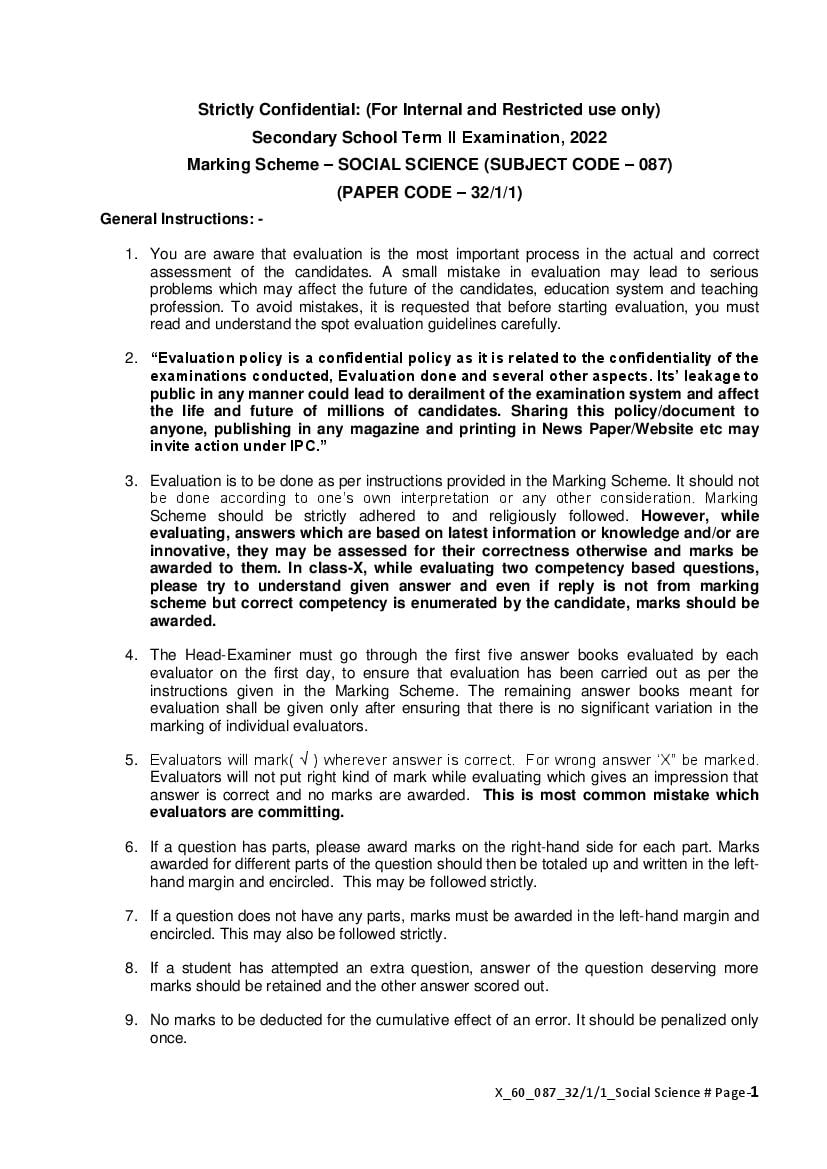
Secondary School Term II Examination, 2022
Marking Scheme – SOCIAL SCIENCE (SUBJECT CODE – 087)
(PAPER CODE – 32/1/1)
General Instructions: -
1. You are aware that evaluation is the most important process in the actual and correct
assessment of the candidates. A small mistake in evaluation may lead to serious
problems which may affect the future of the candidates, education system and teaching
profession. To avoid mistakes, it is requested that before starting evaluation, you must
read and understand the spot evaluation guidelines carefully.
2. “Evaluation policy is a confidential policy as it is related to the confidentiality of the
examinations conducted, Evaluation done and several other aspects. Its’ leakage to
public in any manner could lead to derailment of the examination system and affect
the life and future of millions of candidates. Sharing this policy/document to
anyone, publishing in any magazine and printing in News Paper/Website etc may
invite action under IPC.”
3. Evaluation is to be done as per instructions provided in the Marking Scheme. It should not
be done according to one’s own interpretation or any other consideration. Marking
Scheme should be strictly adhered to and religiously followed. However, while
evaluating, answers which are based on latest information or knowledge and/or are
innovative, they may be assessed for their correctness otherwise and marks be
awarded to them. In class-X, while evaluating two competency based questions,
please try to understand given answer and even if reply is not from marking
scheme but correct competency is enumerated by the candidate, marks should be
awarded.
4. The Head-Examiner must go through the first five answer books evaluated by each
evaluator on the first day, to ensure that evaluation has been carried out as per the
instructions given in the Marking Scheme. The remaining answer books meant for
evaluation shall be given only after ensuring that there is no significant variation in the
marking of individual evaluators.
5. Evaluators will mark( √ ) wherever answer is correct. For wrong answer ‘X” be marked.
Evaluators will not put right kind of mark while evaluating which gives an impression that
answer is correct and no marks are awarded. This is most common mistake which
evaluators are committing.
6. If a question has parts, please award marks on the right-hand side for each part. Marks
awarded for different parts of the question should then be totaled up and written in the left-
hand margin and encircled. This may be followed strictly.
7. If a question does not have any parts, marks must be awarded in the left-hand margin and
encircled. This may also be followed strictly.
8. If a student has attempted an extra question, answer of the question deserving more
marks should be retained and the other answer scored out.
9. No marks to be deducted for the cumulative effect of an error. It should be penalized only
once.
X_60_087_32/1/1_Social Science # Page-1
Page 2
be used. Please do not hesitate to award full marks if the answer deserves it.
11. Every examiner has to necessarily do evaluation work for full working hours i.e. 8 hours
every day and evaluate 30 answer books per day in main subjects and 35 answer books
per day in other subjects (Details are given in Spot Guidelines).This is in view of the
reduced syllabus and number of questions in question paper.
12. Ensure that you do not make the following common types of errors committed by the
Examiner in the past:-
Leaving answer or part thereof unassessed in an answer book.
Giving more marks for an answer than assigned to it.
Wrong totaling of marks awarded on a reply.
Wrong transfer of marks from the inside pages of the answer book to the title page.
Wrong question wise totaling on the title page.
Wrong totaling of marks of the two columns on the title page.
Wrong grand total.
Marks in words and figures not tallying.
Wrong transfer of marks from the answer book to online award list.
Answers marked as correct, but marks not awarded. (Ensure that the right tick mark is
correctly and clearly indicated. It should merely be a line. Same is with the X for
incorrect answer.)
Half or a part of answer marked correct and the rest as wrong, but no marks awarded.
13. While evaluating the answer books if the answer is found to be totally incorrect, it should
be marked as cross (X) and awarded zero (0)Marks.
14. Any unassessed portion, non-carrying over of marks to the title page, or totaling error
detected by the candidate shall damage the prestige of all the personnel engaged in the
evaluation work as also of the Board. Hence, in order to uphold the prestige of all
concerned, it is again reiterated that the instructions be followed meticulously and
judiciously.
15. The Examiners should acquaint themselves with the guidelines given in the Guidelines for
spot Evaluation before starting the actual evaluation.
16. Every Examiner shall also ensure that all the answers are evaluated, marks carried over
to the title page, correctly totaled and written in figures and words.
17. The Board permits candidates to obtain photocopy of the Answer Book on request in an
RTI application and also separately as a part of the re-evaluation process on payment of
the processing charges.
X_60_087_32/1/1_Social Science # Page-2
Page 3
Secondary School Examination TERM–II, 2022
SOCIAL SCIENCE (Subject Code–087)
[ Paper Code : 32/1/1 ]
Maximum Marks : 40
Q. No. EXPECTED ANSWER / VALUE POINTS Marks
SECTION—A 5X2=10
(Very Short Answer Questions )
Why did Indian merchants and industrialists support the Civil 1×2=2
1. Disobedience Movement? Explain.
(i) They wanted protection against imports of foreign goods.
(ii) They wanted protection against rupee-sterling foreign exchange ratio
to discourage imports.
(iii)They formed FICCI to organize their business interests.
(iv) They criticised colonial control over the Indian economy
(v) They saw Swaraj to end colonial restrictions on business.
(vi) Any other relevant point
Any two points to be explained [H, PG - 66]
2. Examine the significance of pipeline transportation in the country. 1X2=2
(i) Initial cost of laying pipelines is high but subsequent running costs
are minimal.
(ii) It rules out trans-shipment losses.
(iii) It also rules out delays.
(iv) These are used for transporting crude oil, petroleum products and
natural gas.
(v) Solids can also be transported through a pipeline when converted into
slurry.
(vi) Any other relevant point
Any two points to be examined. [G, PG—85]
3. Why has India adopted multi-party system? Explain. 1x2=2
(i) India is a large country.
(ii) It has geographical diversity.
(iii) It has social diversity.
(iv) Due to historical reasons.
(v) Any other relevant point.
Any two points to be explained [Demo, PG—77]
4. How is Demand Deposits an essential features of money? 1x2=2
(i) The deposits in the bank accounts can be withdrawn on demand.
(ii) Demand deposits make it possible to directly settle payments without
the use of cash.
(iii) They constitute money in the modern economy.
X_60_087_32/1/1_Social Science # Page-3
Page 4
Any two points to be explained [E, PG—41]
5. Study the given flow chart and answer the questions that follow.
Fibre Weaving Dyeing and Garment
Spinning
Production Knitting Finishing Manufacture
R aw Fibre Yarn Fabric Garments
Fig. : Value addition in the textile industry
5.1 Which is the basic material required for garment manufacturing?
Raw Fibre. 1
5.2 Give one example of value addition in the textile industry.
Spinning/ Weaving/ Dyeing/ Stitching and Finishing.
(Any other example) 1
1+1=2
SECTION—B 3x3=9
(Short Answer-Type Questions)
(a) Differentiate between formal and informal sources of credit.
6. (i) Banks and cooperatives are formal sources of credit while the
informal include moneylenders, traders, employers, relatives, friends
etc.
(ii) The Reserve Bank of India supervises the functioning of formal
sources of loan whereas no organisation supervises informal sector.
(iii) Formal sources charge nominal rate of interest while Informal
lenders charge a much higher interest on loans.
(iv) Mostly urban households are availing credit from formal lenders
whereas the rural households avail credit from informal lenders.
(v) Collateral is an essential condition to get loans in the formal sector
while it is not essential in the informal sector.
(vi) Any other relevant point
Explain any three points of differentiation. [Eco, PG—44,48,49] 1x3=3
Or
(b) How does bank work as a key component of the financial system?
(i) People hold money as deposits with banks which pay an interest rate
on them. 1x3=3
(ii) The major portions of the deposits in banks are used to extend loans.
(iii) Banks mediate between those who have surplus funds called
X_60_087_32/1/1_Social Science # Page-4
Page 5
(iv) Banks charge interest rate on loans than what they offer on deposits.
(v) Banks facilitate different sectors of economy.
(vi) Any other relevant point
Any three points to be explained. [Eco, PG—42]
7. ―It was essential to preserve folk tradition in order to discover one’s
national identity and restore a sense of pride in one’s past.” Support the
statement in reference to India.
(i) Idea of Nationalism was based on the revival of Indian folk lore.
(ii) Folk tales, folk songs and legends were sung by bards.
(iii) Rabindernath Tagore collected ballads, rhymes and myths.
(iv) In Madras, Natesa Shastri published massive four volume collection
of Tamil folk tales (The Folklore of Southern India).
(v) Folklore was considered as manifestation of people’s real thought
and characteristics.
(vi) Many Indian tried to instil a sense of pride in the Indian folk history.
(vii) Any other relevant point.
Any three points to be explained. 1x3=3
[H, PG-47]
8. Explain the role of the Election Commission in the’ registration and
recognition’ of political parties in India.
(i) Every party in the country has to register with the Election
commission.
(ii) The commission treats all parties equally.
(iii) Parties are given a unique symbol—only the official candidates of
that party can use that election symbol.
(iii) Parties ‘recognised’ by the Election Commission are called as
recognised political parties.
(iv) The Election Commission recognized political parties in proportion
of votes and seats
(v) To be recognized as a State party, it should get at least six per cent
of total votes in an election to the Legislative Assembly and wins at
least two seats.
(vi) To be recognized as a National party, it should get at least six per
cent of total votes in Lok Sabha elctions or Assembly elections in
four states and wins at least four seats in Lok Sabha
(vi) Any other relevant point 1x3=3
X_60_087_32/1/1_Social Science # Page-5
Page 6
[D, PG—76]
SECTION—C (LONG ANSWER TYPE QUESTIONS) 2x5=10
(a) “Democracy is a better form of government than any other
9. alternative”. Analyse the statement.
(i) Promotes equality among citizens
(ii) Enhances the dignity of the individual
(iii) Improves the quality of decision-making
(iv) Provides a method to resolve conflicts
(vi) Allows room to correct mistakes
(vii) Accountable, transparent and legitimate governance.
(iv) Any other relevant point 1X5=5
Any five points to be analysed.
[D, PG-90]
Or
(b) Analyse the reasons for the overwhelming support for the idea of
democracy all over the world.
(i) Democratic government is peoples’ own government.
(ii) Countries want to elect their representative by themselves.
(iii) Democracy provides dignity and freedom to its citizens.
(iv) Democracy accommodates social diversity.
(v) Democracy is based on the idea of discussion and negotiation.
(vi) Decision-making is based on norms and procedures and its
transparency.
(vii) Any other relevant point
Any five points to be analysed. 1x5=5
[D, Page—92]
10. (a) Examine the factors which facilitate globalization in India.
(i) Rapid improvement in technology.
(ii) Improvement in Transport.
(iii) Development of Information and Communication.
(iv) Movement of goods and services between countries.
(v) Foreign investment.
(vi) Working with WTO
(vii) Liberalized policies of the government.
X_60_087_32/1/1_Social Science # Page-6
Page 7
Any five points to be examined.
[Eco, PG – 62 to 64]
1x5=5
OR
(b) Assess, how globalization has touched the lives of larger society.
(i) Local and foreign producers have been of advantage to consumers.
(ii) Globalization resulted in greater competition among producers.
(iii) There is a greater choice before the consumers.
(iv) Larger sections of people enjoy improved quality of life.
(v) Due to globalisation people get lower prices for several products.
(vi) New technology oriented products like cellphone, automobiles,
electronics, softdrinks etc are in the market.
(vii) New job opportunities are there for people.
(viii) Any other relevant point.
Any five points to be assessed.
[Eco, PG-66]
1x5=5
SECTION—D (SOURCE BASED) 2x4=8
11. Read the case given below carefully and answer the question that follow :
The Independence Day Pledge, 26 January 1930
‘‘We believe that it is the inalienable right of the Indian people, as of any
other people, to have freedom and to enjoy the fruits of their toil and have
the necessities of life, so that they may have full opportunities of growth. We
believe also that if any government deprives a people of these rights and
oppresses them, the people have a further right to alter it or to abolish it. The
British Government in India has not only deprived the Indian people of their
freedom but has based itself on the exploitation of the masses, and has ruined
India economically, politically, culturally and spiritually. We believe,
therefore, that India must sever the British connection and attain Purna
Swaraj or Complete Independence.’’ [H, PG-63]
11.1 Why was freedom considered inalienable right of Indian people?
(i) Freedom was considered as an inalienable right as it provides full
opportunities of growth.
(ii) Any other relevant point. 1
11.2 Why was Purna Swaraj considered essential by People of India?
(i) The colonial power had ruined India economically, politically,
culturally and spiritually.
(ii) Indians wanted sovereignty and self-govt. or complete independence.
X_60_087_32/1/1_Social Science # Page-7
Page 8
11.3 Explain the significance of Lahore Session of Congress (1929).
(i) The Congress approved a motion for Complete Independence.
(ii) Congress decided to observe 26th January, 1930 as the total
Independence or Purna Swaraj Day.
(iii)Hoisting of flag.
(iv) Any other relevant point
Any two points to be explained. 1x2=2
1+1+2=4
12. Read the case given below carefully and answer the questions that follow : 4
Lifelines of National Economy
For a long time, trade and transport were restricted to a limited space. With
the development in science and technology, the area of influence of trade and
transport expanded far and wide. Today, the world has been converted into a
large village with the help of efficient and fast-moving transport. Transport
has been able to achieve this with the help of equally developed
communication system. Therefore, transport, communication and trade are
complementary to each other.
Today, India is well-linked with the rest of the world despite its vast size,
diversity and linguistic and socio-cultural plurality. Railways, airways,
water- ways, newspapers, radio, television, cinema and internet, etc., have
been contributing to its socio-economic progress in many ways. The trades
from local to international levels have added to the vitality of its economy. It
has enriched our life and added substantially to growing amenities and
facilities for the comforts of life. [G,PG-81]
12.1 How has science an important factor in the development of transport?
(i) The trade and transport expanded far and wide.
(ii) Efficient and fast moving transport.
(iii) Any other relevant point.
(Any one point to be explained) 1
12.2 How has transport integrated socio-cultural plurality?
(i) India is well linked with rest of world.
(ii) Helps in the development of assimilation of cultures.
(iii) Any other relevant.
(Any one point to be explained) 1
12.3 Analyse the significance of communication for a nation.
(i) It is a source of information.
(ii) It enables communication, trade and other forms of exchange.
(iii) It plays an important role in economic growth.
X_60_087_32/1/1_Social Science # Page-8
Page 9
(v) It makes the world closer to each other.
(vi) Any other relevant point
1+1+2=4
(Any two points to be analysed)
1x2=2
SECTION—E
( Map Skill-Based Question )
13 On the given outline Political Map of India, identify the place marked as A
(i) with the help of following information and write its correct name on the line
marked near it.
(A) The place where Non-Cooperation Movement was called off due to
violence. 1
SEE THE ATTACHED MAP
(ii) On the same given map of India, locate the following :
a. (i) Narora Nuclear Plant 1
Or
(ii) Bengaluru Software Technology Park
1
b. Indira Gandhi International Airport
SEE THE ATTACHED MAP
Note : The following questions are for Visually Impaired Candidates 3x1=3
only in lieu of Q. No. 13
13.1 Name the State where the session of Indian National Congress was held in 1
1927—Madras
13.2 (a.) Name the State where Narora Nuclear Plant is located—Uttar Pradesh 1
OR
(b.) Name the State where Bengaluru Software Technology Park is located.
1
Karnataka
13.3 Name the city where Indira Gandhi International Airport is located. Delhi 1
X_60_087_32/1/1_Social Science # Page-9
Page 10
***
X_60_087_32/1/1_Social Science # Page-10
Document Details
| Board / Org | CBSE |
| Exam | Class 10 |
| Type | Solution |
| Pages | 10 |
| Updated | 30 Apr 2026 |