Karnataka 1st PUC Biology Biological Classification MCQ with Answers
Finished viewing? Save it for later —
Download Karnataka 1st PUC Biology Biological Classification MCQ with Answers (PDF · 9 pages)About Karnataka 1st PUC Biology Biological Classification MCQ with Answers
Karnataka 1st PUC Biology Biological Classification MCQ with Answers is available here for free download. Published by Karnataka Board for Class 11, this question bank can be viewed online or downloaded as a PDF (9 pages). Candidates preparing for Class 11 can use Karnataka 1st PUC Biology Biological Classification MCQ with Answers to understand the exam pattern, the type of questions asked, and the overall difficulty level.
Frequently Asked Questions
How can I download Karnataka 1st PUC Biology Biological Classification MCQ with Answers?
Open this page and click the Download button to save Karnataka 1st PUC Biology Biological Classification MCQ with Answers as a PDF. It is completely free on AglaSem Docs.
Is Karnataka 1st PUC Biology Biological Classification MCQ with Answers free to download?
Yes. Karnataka 1st PUC Biology Biological Classification MCQ with Answers can be viewed online and downloaded as a PDF free of cost on AglaSem Docs.
How many pages does Karnataka 1st PUC Biology Biological Classification MCQ with Answers have?
Karnataka 1st PUC Biology Biological Classification MCQ with Answers contains 9 pages, which you can read online or download together as a single PDF.
Where can I find more Class 11 study material?
You can find more Class 11 question papers, sample papers, syllabus, and answer keys on AglaSem Docs.
Karnataka 1st PUC Biology Biological Classification MCQ with Answers – Text
Read the full text of this question bank below — useful to quickly search, copy and reference the content online without downloading the PDF.
📄 View text version (9 pages)
Page 1
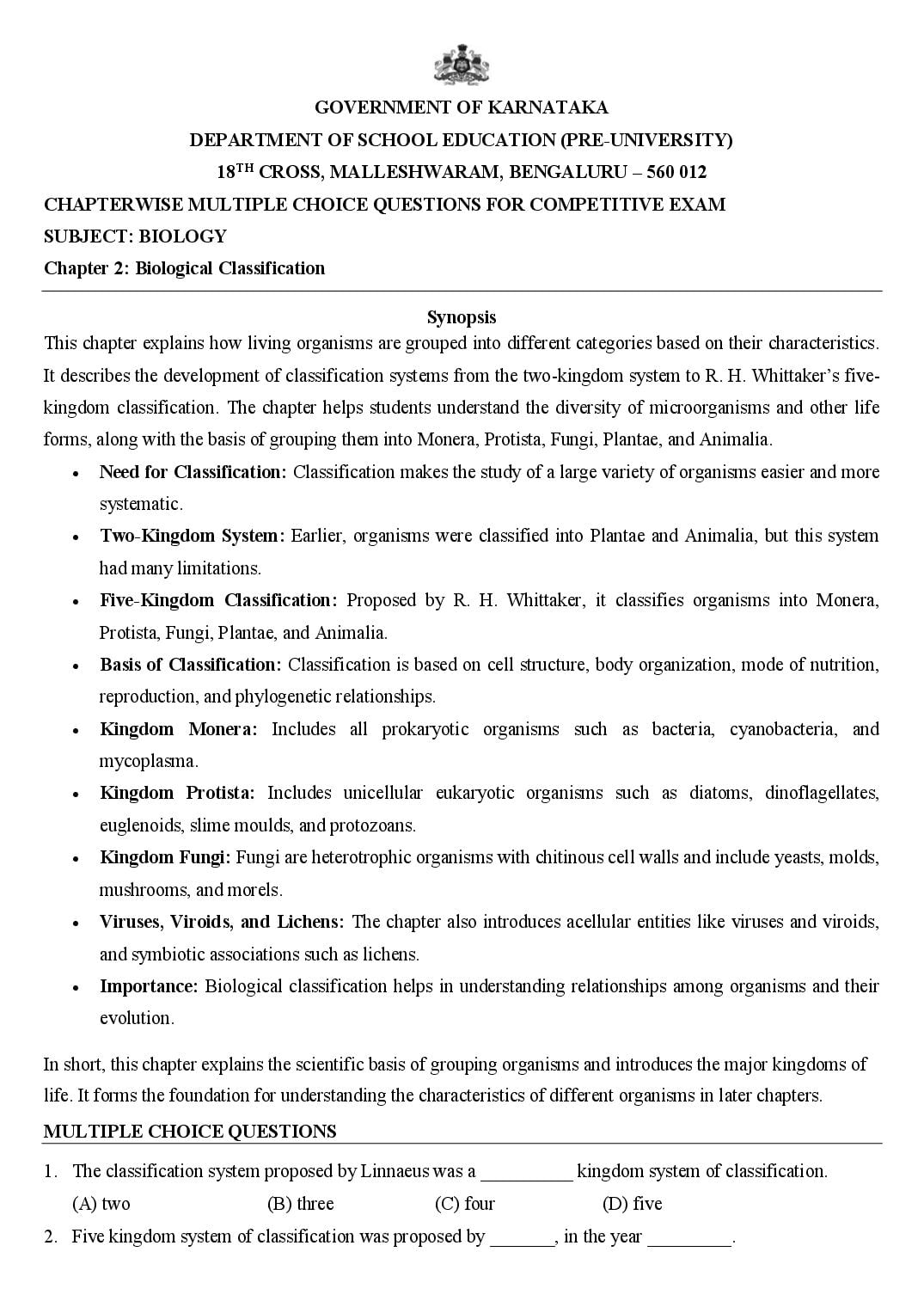
DEPARTMENT OF SCHOOL EDUCATION (PRE-UNIVERSITY)
18TH CROSS, MALLESHWARAM, BENGALURU – 560 012
CHAPTERWISE MULTIPLE CHOICE QUESTIONS FOR COMPETITIVE EXAM
SUBJECT: BIOLOGY
Chapter 2: Biological Classification
Synopsis
This chapter explains how living organisms are grouped into different categories based on their characteristics.
It describes the development of classification systems from the two-kingdom system to R. H. Whittaker’s five-
kingdom classification. The chapter helps students understand the diversity of microorganisms and other life
forms, along with the basis of grouping them into Monera, Protista, Fungi, Plantae, and Animalia.
• Need for Classification: Classification makes the study of a large variety of organisms easier and more
systematic.
• Two-Kingdom System: Earlier, organisms were classified into Plantae and Animalia, but this system
had many limitations.
• Five-Kingdom Classification: Proposed by R. H. Whittaker, it classifies organisms into Monera,
Protista, Fungi, Plantae, and Animalia.
• Basis of Classification: Classification is based on cell structure, body organization, mode of nutrition,
reproduction, and phylogenetic relationships.
• Kingdom Monera: Includes all prokaryotic organisms such as bacteria, cyanobacteria, and
mycoplasma.
• Kingdom Protista: Includes unicellular eukaryotic organisms such as diatoms, dinoflagellates,
euglenoids, slime moulds, and protozoans.
• Kingdom Fungi: Fungi are heterotrophic organisms with chitinous cell walls and include yeasts, molds,
mushrooms, and morels.
• Viruses, Viroids, and Lichens: The chapter also introduces acellular entities like viruses and viroids,
and symbiotic associations such as lichens.
• Importance: Biological classification helps in understanding relationships among organisms and their
evolution.
In short, this chapter explains the scientific basis of grouping organisms and introduces the major kingdoms of
life. It forms the foundation for understanding the characteristics of different organisms in later chapters.
MULTIPLE CHOICE QUESTIONS
1. The classification system proposed by Linnaeus was a __________ kingdom system of classification.
(A) two (B) three (C) four (D) five
2. Five kingdom system of classification was proposed by _______, in the year _________.
Page 2
(C) John Ray, 1975 (D) de Candole, 1978
3. Which of the following characters served as the criteria for five kingdom system of classification as used by
R.H. Whittaker?
(A) Cell structure and thallus organization (B) Mode of nutrition and reproduction
(C) Phylogenetic relationship (D) All of these
4. In Whittaker’s five kingdom system of classification, eukaryotes are distributed among
(A) two kingdoms (B) three kingdoms
(C) four kingdoms (D) all the five kingdoms
5. Match Column-I with Column-II and select the correct option from the codes given below.
Column-I Column-II
(a) Monera (i) Chlamydomonas,
Solanum
(b) Protista (ii) Bacillus, Oscillatoria
(c) Fungi (iii) Euglena, Trypanosoma
(d) Plantae (iv) Mucor; Penicillium
(e) Animalia (v) Felis, Panthera
(A) (a) → (iii), (b) → (ii), (c) → (iv), (d) → (i), (e) → (v)
(B) (a) → (ii), (b) → (iii), (c) → (iv), (d) → (i), (e) → (v)
(C) (a) → (ii), (b) → (iii), (c) → (i), (d) → (iv) (e) → (v)
(D) (a) → (ii), (b) → (v), (c) → (i), (d) → (iv), (e) → (iii)
6. Which one of the following is an incorrect statement regarding Mycoplasma?
(A) They lack a cell wall (B) They are the smallest living cells
(C) They cannot survive without oxygen (D) They are pathogenic in plants and animals
7. Select the pair that consists of plant or animal bacterial diseases.
(A) Cholera and Typhoid (B) Citrus canker and crown gall
(C) Malaria and Dengue (D) Both (A) and (B)
8. Bacteria are grouped under four categories according to their shape. Study the given figures and select the
correct option regarding this.
A B C D
(A) Cocci Bacilli Spirilla Vibrio
(B) Spirilla Bacilli Vibrio Cocci
(C) Bacilli Spirilla Vibrio Cocci
(D) Bacilli Spirilla Cocci Vibrio
Page 3
(i) They are included in the group Archaebacteria.
(ii) They are responsible for the production of biogas in gobar gas plants.
(iii) They live in hot sulphur springs.
(iv) They are strictly anaerobic.
(A) Statement (i) and (ii) are correct (B) Statement (i), (ii) and (iv) are correct
(C) Statement (ii), (iii) and (iv) are correct (D) All statements are correct
10. The Archaebacteria that can survive in extreme salty areas are called as
(A) Halophiles (B) Thermoacidophiles (C) Methanogens (D) all of
these
11. In Escherichia coli
(A) an orgainsed nucleus is present (B) one chromosome is present
(C) one DNA molecule is present (D) one RNA molecule is present
12. Bacteria are considered as plants, because
(A) these have a rigid cell wall (B) these have a green colour
(C) they can reproduce (D) they are present everywhere
13. ‘Peptidoglycan’ is a characteristic constituent of the cell wall of
(A) eubacteria and unicellular eukaryotes (B) bacteria and cyanobacteria
(C) archaebacterial and eukaryotes (C) all members of ‘monera’ and ‘protista’.
14. Which one of the following is correct for structure of cell wall of fungi and bacteria?
(A) Both have glycopeptide
(B) Both are made up of N-acetylglucosamine
(C) Both are made up of N-acetylglucosamine and cellulose
(D) Both are made up of chitin.
15. Which of the following does not evolve oxygen?
(A) Photosynthetic bacteria (B) Blue – green algae
(C) Green algae (D) Autotrophic plants
16. Bacterial cells divide every minute and takes one hour to fill up a cup. How much time will be taken to fill
half the cup?
(A) 59 minutes (B) 30 minutes (C) 60 minutes (D) 29 minutes
17. How many bacteria are produced in four hours if a bacterium divides once in half an hour?
(A) 8 (B) 64 (C) 16 (D) 256
18. Nitrifying bacteria, Nitrosomonas and Nitrobacter
(A) convert (oxidize) ammonia or ammonium compounds into nitrates
(B) convert nitrate into nitrogen.
(C) convert nitrogen into nitrates
(D) convert carbon dioxide into carbohydrates.
Page 4
(A) eukaryotic and multicellular (B) prokaryotic and multicellular
(C) prokaryotic and unicellular (D) eukaryotic and unicellular
20. What is incorrect for mycoplasma?
(A) It shows osmotic response (B) It shows absence of cell wall
(C) They are sensitive to modern antibiotics (D)They are obligate intracellular parasites.
21. Protista includes
(A) protozoa, algae and fungi (B) algae, bryophyte, bacteria and fungi
(C) fungi, slime moulds and vascular plants (D) protozoa, bacteria, algae and bryophyta
22. Which protest reproduces both by binary fission and conjugation?
(A) Amoeba (B) Paramecium (C) Euglena (D) Monocystis
23. Protista contains
(A) Euglena, dinoflagellates and Yeast (B) Amoeba, Paramecium, Hydra
(C) Euglena, Paramecium, mushroom (D) Amoeba, Paramecium and Dinoflagellates
24. Characteristic spores of diatoms are
(A) ascospores (B) basidiospores (C) auxospores (D) zoospores
25. Protists are
1. Unicellular and prokaryote 2. Unicellular and eukaryote
3. Multicellular and eukaryote 4. Autotroph and heterotroph
(A) 1 + 2 + 3 (B) 2 + 3 + 4 (C) 3 + 4 (D) 2 + 4
26. Two species of Amoeba X and Y were kept in fresh water and adapted. Species X developed contractile
vacuole. When both were transferred to sea water and adapted, both X and Y lost their contractile vacuole.
From these observation we conclude that
(A) both X and Y are marine species (B) species Y is marine and X is fresh wear
(C) species X is marine and Y is fresh water (D) both X and Y are fresh water.
27. Which organism behaves like plants in the presence of light and absence of organic food, but in reverse
conditions behaves like animals?
(A) Archaebacteria (B) Euglena (C) Nostoc (D) Paramecium
28. Spore producing body of cellular slime mould is
(A) Pseudoplasmodium (B) Plasmodium (C) Sporangium (D) Sporophore
29. The slima moulds are characterized by the presence of
(A) elaters (B) pseudoelaters (C) capillitium (D) capitulum
30. Amoeba reacts (out of NCERT)
(A) negatively to strong light and positively to weak light
(B) positively to strong light and negatively to weak light
(C) unaffected by light intensity
(D) positive to both strong and weak light
Page 5
(A) Funaria (B) Marchantia (C) Megaceros (D) Dowsonia
32. Heteromorophic alternation of generation is commonly found in
(A) algae (B) fungi (C) bryophyte (D) all of these
33. In which of the following groups would you place a plant which produces spores and embryos but lacks
seeds and vascular tissue?
(A) Fungi (B) Bryophytes (C) Pteridophytes (D) Gymnosperms
34. Among the following which is not characteristic feature of bryophyte?
(A) Motile sperms (B) Presence of archegonium
(C) Water essential for fertilization (D) Photosynthetically independent sporophyte
35. Which one of the following is true moss? (out of NCERT)
(A) Club moss (B) Reindeer moss (C) Irish moss (D) Bog moss
36. Elaters are present in sporogonium of (out of NCERT)
(A) Riccia (B) Marchantia (C) Selaginella (D) Sphagnum
37. Gametophytic generation is dominant in
(A) pteridophyta (B) bryophyta (C) angiosperms (D) pteridophytes
38. First land inhabiting plants are
(A) angiosperms (B) gymnosperms (C) bryophytes (D) pteridophytes
39. Bryophytes can be separated from algae, because they
(A) are thalloid forms (B) have no conducting tissue
(C) possess archaegonia (D) contain chloroplast
40. Bryophytes comprise
(A) sporophyte which has longer duration
(B) dominant phase of gametophyte which is parasitic
(C) dominant phase of gametophyte which produces
(D) small sporophyte phase and generally parasitic on gametophyte
Practice Questions
1. All eukaryotic unicellular organisms belong to
(A) Monera (B) Protista (C) Fungi (D) Bacteria
2. Organisms living in salty areas are called as
(A) Methanogens (B) Halophiles
(C) Heliophytes (D) Thermoacidophiles
3. Naked cytoplasm, multinucleated and saprophytic are the characteristics of
(A) Monera (B) Protista
(C) Fungi (D) Slime molds
4. An association between roots of higher plants and fungi is called
Page 6
5. A dikaryon is formed when
(A) Meiosis is arrested (B) The two haploid cells do not fuse immediately
(C) Cytoplasm does not fuse (D) None of the above
6. Contagium vivum fluidum was proposed by
(A) D. J. Ivanowsky (B) M. W. Beijerinek (C) Stanley (D) Robert Hook
7. Mycobiont and Phycobiont are found in
(A) Mycorrhiza (B) Root (C) Lichens (D) BGA
8. Difference between Virus and Viroid is
(A) Absence of protein coat in viroid but present in virus
(B) Presence of low molecular weight RNA in virus but absent in viroid
(C) Both (A) and (B)
(D) None of the above
9. With respect to fungal sexual cycle, choose the correct sequence of events
(A) Karyogamy, Plasmogamy and Meiosis (B) Meiosis, Plasmogamy and Karyogamy
(C) Plasmogamy, Karyogamy and Meiosis (D) Meiosis, Karyogamy and Plasmogamy
10. Viruses are non-cellular organisms but replicate themselves once they infect the host cell. To which of the
following kingdom do viruses belong to?
(A) Monera (B) Protista (C) Fungi (D) None of the above
11. Members of phycomycetes are found in
(i) Aquatic habitats (ii) On decaying wood
(iii) Moist and damp places (iv) As obligate parasites on plants
Choose form the following option
(A) None of the above (B) (i) and (iv)
(C) (ii) and (iii) (D) All of the above
12. Mycology (mycetology) is a branch which deals with the study of
(A) viruses (B) algae (C) bacteria (D) fungi
13. Which one is saprophytic in nutrition?
(A) Penicillium (B) Aspergillus (C) Neurospora (D) Saccharomyces
14. A group of fungi with septate mycelium in which sexual reproduction is unknown or lacking are classified
under
(A) phycomycetes (B) deuteromycetes (C) ascomycetes (D) basidiomycetes
15. Fungal spores produced asexually at the tips of hyphae are called
(A) sporangiophores (B) anthospores (C) conidiophores (D) meiospores
16. Torula stage of Mucor is in ____ rich medium (out of NCERT)
(A) pesticides (B) sugar (C) antibiotic (D) none of these
17. Facultative saprophyte is
(A) a parasite which cab live as saprophyte (B) always a parasite
(C) always a saprophyte (D) may acquire more of life
Page 7
(A) Root knot disease – Meloidogyne javanica (B) Smart of bajra – Tolysporim penticillariae
(C) Covered smut of barley – Ustilage nuda (D) Late blight of potato – Phytophotora infestans
19. The hyphae of Aspergillus are
(A) aseptate and multinucleate (B) septate and multinucleate
(C) aseptate and uninucleate (D) septate and uninucleate
20. Dikaryon formation is characteristic of
(A) ascomycetes and basidiomycetes (B) phycomycetes and basidiomycetes
(C) ascomycetes phycomycetes (D) phycomycets and zygomycetes
21. Plasmogamy is fusion of
(A) two haploid cell including their nuclei (B) two haploid cells without nuclear fusion
(C) sperm and egg (D) sperm and two polar nuclei
22. Phycology is the study of
(A) algae (B) fungi (C) bacteria (D) all of these
23. Sexual reproduction and mobile cells are absent in
(A) chlorophyceae (B) myxophyceae ` (C) rhodophyceae (D) phacophyceae
24. Agar- agar is obtained form
(A) Gigartina (B) Gelidium (C) Gracillaria (D) all of these
25. Example of coenocytic algae is (out of NCERT)
(A) Vaucheria (B) Chara (C) Nostoc (D) Polysiphonia
26. Coenobium means (out of NCERT)
(A) a hollow spherical colony (B) a group of filaments
(C) palmelloid form (D) none of the above.
27. In physiogical anisogamy
(A) gametes are morphologically similar but physiologically dissimilar
(B) gametes are morophologically dissimilar and physiologically similar
(C) gametes are morphologically and physiologically similar
(D) none of the above
28. Fusion of mature individuals which diereclty act as gametes, is called
(A) isogamy (B) anisogamy (C) hologamy (D) autogamy
29. The non- motile, greatly thickened asexual spores are called
(A) hypnospores (B) aplanospores (C) macrozoospores (D) micorzoospores
30. Which one of the following statements regarding the algae in incorrect?
(A) Most algae are photosynthetic
(B) Algae cab be classified according to their pigments
(C) All algae are filamentous
(C) Spirogyra does not produce zoospores
31. Rhodophyceae is rod coloured due to
(A) xanthophyll (B) carotenoids (C) -phycoerythrin (D) -phycocyanin
Page 8
(A) Bryophyta (B) Pteridophyta (C) Gymnosperms (D) Angiosperms
33. Heterospory is production of
(A) sexual and asexual spores (B) large and small spores
(C) haploid and diploid spores (D) diploid and tetraploid spores
34. Heterothallism refers to (out of NCERT)
(A) fusion which is not accompanied with zygote formation
(B) fusion between morphologically similar strain.
(C) fusion between the strains of structurally similar and physiologically different thallus
(D) all of the above
35. An advantage which made seed bearing plants so greatly surpass the ferns in colonzing the land, is the
evolution of the
(A) ability to photospynthesize (B) fibrous root system
(C) woody stem (D) non-swimming sperms
36. In which of the following plant diploid stage generally dominates
(A) Algae (B) Ferns (C) Mosses (D) Fungi
37. Pteridophytes are characterized by
(A) presence of vascular system (B) absence of flowers
(C) absence of fruits (D) all of the above
38. Which of the following is not a pteridophyte
(A) Ginkgo (B) Selaginella (C) Polypodium (D) Azolla
39. Seed habit originated firstly in some
(A) Pteridophytes (B) pines (C) monocots (D) dicots
40. Which of the following helps in coal formation?
(A) Bacteria (B) Gymnosperm (C) Pteridophytes (D) Archaebacteria
41. Which of the following is not involved in the fertilization of fern?
(A) Pollen tube (B) Water (C) Archaegonia (D) Flagellated sperms
42. Which one of the following is not a cryptogam?
(A) Alae (B) Bryophyta (C) Pteridophyta (D) Gymnosperms
43. In which of the following groups would you placed a plant which produces seeds but lacks flower and
fruits?
(A) Fungi (B) Bryophytes (C) Pteridophyta (D) Gymnosperms
44. Gymnosperms are called naked seed plants because these lack
(A) cotyledon (B) endosperm (C) ovary wall (D) testa
45. What is the similarity between gymnosperms and angiosperms
(A) Phloem of both have companion cell
(B) Endosperm is formed before fertilization in both
(C) Origin of ovule and seeds is similar in both
Page 9
46. Which of the following is living fossil?
(A) Pinus (B) Ginkgo (C) Thuja (D) Deodar
47. Which of the following is not the feature of gymnosperms?
(A) Parallel venation (B) Perennial plants
(C) Distinct branches (long and short branches) (D) Xylem with vessels
48. A typical gymnospermous plant has 8 chromosomes in leaf cells. What will be number of chromosomes in
the cells of its gametophyte?
(A) 16 (B) 8 (C) 4 (D) 24
49. Pollination of pollen grains in Pinus takes place at (out of NCERT)
(A) one celled stage (B) two celled stage
(C) three celled stage (D) four celled stage
50. Non-motile male gametes are formed in
(A) Funaria (B) Selaginella (C) Fern (D) Pinus
51. Which of the following structures in Pinus are haploid?
(A) Megaspore, integument, root (B) Endosperm, megaspore, Pollen grain
(C) Pollen grain, leaf, root (D) Megaspore, endosperm, embryo
Guidance Keys
1. (A) 6. (C) 11. (B) 16. (A) 21. (A) 26. (C) 31. (D) 36. (B)
2. (B) 7. (D) 12. (A) 17. (D) 22. (B) 27. (B) 32. (C) 37. (B)
3. (D) 8. (C) 13. (B) 18. (A) 23. (D) 28. (C) 33. (B) 38. (C)
4. (C) 9. (B) 14. (C) 19. (C) 24. (C) 29. (C) 34. (D) 39. (C)
5. (B) 10. (A) 15. (A) 20. (D) 25. (D) 30. (A) 35. (D) 40. (D)
Practice Keys
1. (B) 7. (C) 14. (B) 21. (B) 28. (C) 35. (D) 42. (D) 49. (D)
2. 8. (A) 15. (C) 22. (A) 29. (A) 36. (B) 43. (D) 50. (D)
(B) 9. (C) 16. (C) 23. (B) 30. (C) 37. (D) 44. (C) 51. (B)
3. (D) 10. (D) 17. (A) 24. (D) 31. (C) 38. (A) 45. (D)
4. (C) 11. (D) 18. (C) 25. (A) 32. (C) 39. (A) 46. (D)
5. (B) 12. (D) 19. (B) 26. (A) 33. (B) 40. (C) 47. (D)
6. (B) 13. (B) 20. (A) 27. (B) 34. (C) 41. (A) 48. (C)
Document Details
| Board / Org | Karnataka Board |
| Exam | Class 11 |
| Type | Question Bank |
| Pages | 9 |
| Updated | 24 Sep 2026 |