Karnataka 1st PUC Mathematics Relations and Functions MCQ with Answers
Finished viewing? Save it for later —
Download Karnataka 1st PUC Mathematics Relations and Functions MCQ with Answers (PDF · 20 pages)About Karnataka 1st PUC Mathematics Relations and Functions MCQ with Answers
Karnataka 1st PUC Mathematics Relations and Functions MCQ with Answers is available here for free download. Published by Karnataka Board for Class 11, this question bank can be viewed online or downloaded as a PDF (20 pages). Candidates preparing for Class 11 can use Karnataka 1st PUC Mathematics Relations and Functions MCQ with Answers to understand the exam pattern, the type of questions asked, and the overall difficulty level.
Frequently Asked Questions
How can I download Karnataka 1st PUC Mathematics Relations and Functions MCQ with Answers?
Open this page and click the Download button to save Karnataka 1st PUC Mathematics Relations and Functions MCQ with Answers as a PDF. It is completely free on AglaSem Docs.
Is Karnataka 1st PUC Mathematics Relations and Functions MCQ with Answers free to download?
Yes. Karnataka 1st PUC Mathematics Relations and Functions MCQ with Answers can be viewed online and downloaded as a PDF free of cost on AglaSem Docs.
How many pages does Karnataka 1st PUC Mathematics Relations and Functions MCQ with Answers have?
Karnataka 1st PUC Mathematics Relations and Functions MCQ with Answers contains 20 pages, which you can read online or download together as a single PDF.
Where can I find more Class 11 study material?
You can find more Class 11 question papers, sample papers, syllabus, and answer keys on AglaSem Docs.
Karnataka 1st PUC Mathematics Relations and Functions MCQ with Answers – Text
Read the full text of this question bank below — useful to quickly search, copy and reference the content online without downloading the PDF.
📄 View text version (20 pages)
Page 1
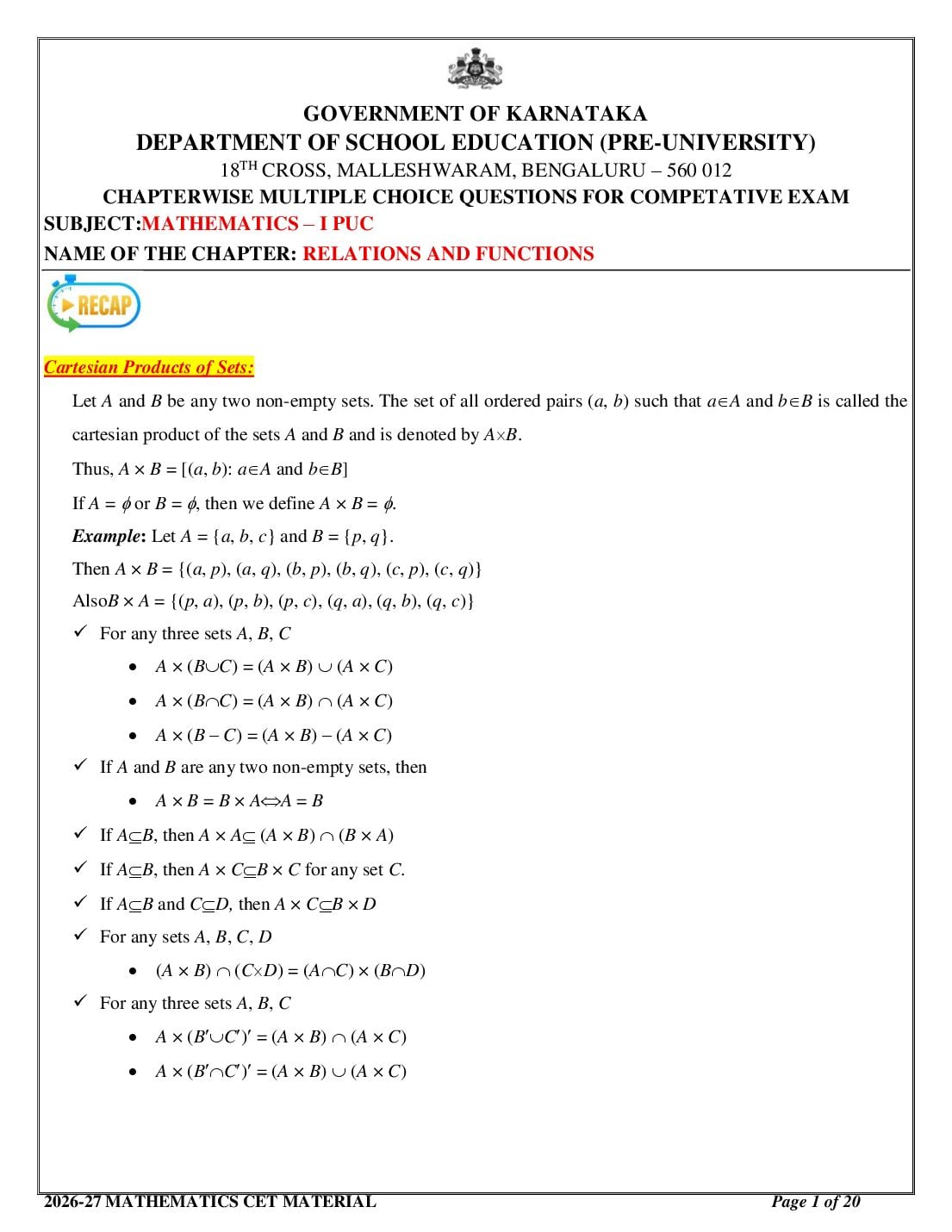
DEPARTMENT OF SCHOOL EDUCATION (PRE-UNIVERSITY)
18TH CROSS, MALLESHWARAM, BENGALURU – 560 012
CHAPTERWISE MULTIPLE CHOICE QUESTIONS FOR COMPETATIVE EXAM
SUBJECT:MATHEMATICS – I PUC
NAME OF THE CHAPTER: RELATIONS AND FUNCTIONS
Cartesian Products of Sets:
Let A and B be any two non-empty sets. The set of all ordered pairs (a, b) such that aA and bB is called the
cartesian product of the sets A and B and is denoted by AB.
Thus, A × B = [(a, b): aA and bB]
If A = or B = , then we define A × B = .
Example: Let A = {a, b, c} and B = {p, q}.
Then A × B = {(a, p), (a, q), (b, p), (b, q), (c, p), (c, q)}
AlsoB × A = {(p, a), (p, b), (p, c), (q, a), (q, b), (q, c)}
For any three sets A, B, C
A × (BC) = (A × B) (A × C)
A × (BC) = (A × B) (A × C)
A × (B – C) = (A × B) – (A × C)
If A and B are any two non-empty sets, then
A × B = B × AA = B
If AB, then A × A (A × B) (B × A)
If AB, then A × CB × C for any set C.
If AB and CD, then A × CB × D
For any sets A, B, C, D
(A × B) (CD) = (AC) × (BD)
For any three sets A, B, C
A × (BC) = (A × B) (A × C)
A × (BC) = (A × B) (A × C)
2026-27 MATHEMATICS CET MATERIAL Page 1 of 20
Page 2
A relation R from a non-empty set A to a non-empty set B is a subset of the cartesian product A × B. The
subset is derived by describing a relationship between the first element and the second element of the
ordered pairs in A × B. The second element is called the image of the first element
Let R A B and (a, b)R. Then we say that a is related to b by the relation R and write it as 𝑎 𝑅 𝑏 .
If (𝑎, 𝑏) ∈ 𝑅, we write it as a R b .
Remarks:
(i) A relation may be represented algebraically either by the Roster method or by the Set-builder method.
(ii) An arrow diagram is a visual representation of a relation.
Note:
The total number of relations that can be defined from a set A to a set B is the number of possible subsets of
pq
A × B. If n(A) = p and n(B) = q, then n (A × B) = pq and the total number of relations is 2
Domain and range of a relation
The set of all first elements of the ordered pairs in a relation R from a set A to a set B is called the domain
of the relation R
The set of all second elements in a relation R from a set A to a set B is called the range of the relation R.
The whole set B is called the codomain of the relation R. Note that range ⊂ codomain
Dom (R) = {a: (a, b) R} and Range (R) = {b: (a, b) R}.
Inverse relation
Let A, B be two sets and let R be a relation from a set A to a set B. Then the inverse of R, denoted by R–1, is a
relation from B to A and is defined by R 1 b, a : a, b R
Clearly (a, b) R (b, a) R–1. Also, Dom (R) = Range R 1 and Range (R) = Dom R 1
Example: Let A = {a, b, c}, B = {1, 2, 3} and R = {(a, 1), (a, 3), (b, 3), (c, 3)}.
Then, (i) R–1 = {(1, a), (3, a), (3, b), (3, c)}
(ii) Dom (R) = {a, b, c} = Range R 1
(iii) Range (R) = {1, 3} = Dom R 1
Functions
A relation f from a set A to a set B is said to be a function if every element of set A has one and only one
image in set B.
In other words, a function f is a relation from a non-empty set A to a non-empty set B such that the domain
of f is A and no two distinct ordered pairs in f have the same first element.
If f is a function from A to B and (a, b) ∈ f, then f (a) = b, where b is called the image of a under f and a is
called the preimage of b under f.
2026-27 MATHEMATICS CET MATERIAL Page 2 of 20
Page 3
Two things should always be kept in mind:
(i) A mapping f : X Y is said to be a function if each element in the set X hasits image in set Y. It is also
possible that there are few elements in set Y which are not the images of any element in set X.
(ii) Every element in set X should have one and only one image. That means it is impossible to have more
than one image for a specific element in set X. Functions can not be multi-valued
(A mapping that is multi-valued is called a relation from X and Y) e.g.
2026-27 MATHEMATICS CET MATERIAL Page 3 of 20
Page 4
A relation f : A B is a function or not it can be checked by a graph of the relation.
If it is possible to draw a vertical line which cuts the given curve at more than one point then the given relation
is not a function and when this vertical line means line parallel to Y-axis cuts the curve at only one point then it
is a function.
2026-27 MATHEMATICS CET MATERIAL Page 4 of 20
Page 5
If a function f is defined from a set A to set B then for f : A B set A is called the domain of function f and set B
is called the co-domain of function f.
The set of all f-images of the elements of A is called the range of function f.
In other words, we can say: Domain = All possible values of x for which f(x) exists.
Range = For all values of x, all possible values of f(x).
Methods for finding domain and range of function
(i) Domain
(a) Expression under even root (i.e., square root, fourth root etc.) 0. Denominator 0.
If domain of y f x and y g x are D1 and D2 respectively then the domain of f x g x or
f x .g x
is D1 D2
f x
Domain of is D1 D2 g x 0 Domain of f x D1 x : f x 0
g x
(ii) Range: Range of y f x is collection of all outputs f x corresponding to each real number in the
domain.
(a) If domain finite number of points range set of corresponding f x values.
(b) If domain R or R – [some finite points]. Then express x in terms of y.
From this find y for x to be defined (i.e., find the values of y for which x exists).
(c) If domain a finite interval, find the least and greatest value for range using monotonicity.
2026-27 MATHEMATICS CET MATERIAL Page 5 of 20
Page 6
2026-27 MATHEMATICS CET MATERIAL Page 6 of 20
Page 7
(1) Even function: If we put (–x) in place of x in the given function and if f x f x , x domain then
function f(x) is called even function. e.g.
f x e x e x , f x x 2 , f x x sin x, f x cos x, f x x 2 cos x all are even functions.
(2) Odd function: If we put (–x) in place of x in the given function and if
f x f x , x domain then f(x) is called odd function. e.g.,
f x e x e x , f x x3 , f x sin x, f x x cos x, f x x 2 sin x all are odd functions.
Properties of even and odd function
The graph of even function is always symmetric with respect to y-axis. The graph of odd function is always
symmetric with respect to origin.
The product of two even/odd functions is an even function.
The sum and difference of two even functions is an even function.
The sum and difference of two odd functions is an odd function.
The product of an even and an odd function is an odd function.
It is not essential that every function is even or odd. It is possible to have some functions which are neither
even nor odd function. e.g.f(x) = x2+ x3, f(x) = loge x, f(x) = ex.
The sum of even and odd function is neither even nor odd function.
Zero function f(x) = 0 is the only function which is even and odd both.
Algebra of real functions
(1) Scalar multiplication of a function:
cf x c. f x where c is a scalar. The new function c. f x has the domain X f
(2) Addition/subtraction of functions:
f g x f x g x The new function has the domain X.
(3) Multiplication of functions:
fg x g. f x f x .g x The product function has the domain X.
(4) Division of functions:
f f x
(i) x The new function has the domain X, except for the values of x for which g x 0
g g x
g g x
(ii) x The new function has the domain X, except for the values of x for which f x 0
f f x
(5) Equal functions: Two function f and g are said to be equal functions, if and only if
(i) Domain of f = Domain of g (ii) Co-domain of f = Co-domain of g
(iii) f x g x x their common domain
2026-27 MATHEMATICS CET MATERIAL Page 7 of 20
Page 8
x y
1. Let 1, 1 2,1 , then the values of x and y respectively re
2 9
(1) 3, 5 (2) 6, 0 (3) 5, 3 (4) 0, 6
2. If G 7,8 and H 5, 4, 2 then G H is
(1) 7,5 , 7,4 , 7,2 , 8,4 , 8,2 (2) 7,5 , 7, 2 , 8,5 , 8, 4 , 8, 2
(3) 7,5 , 7,4 , 7,2 , 8,5 , 8,4 , 8,2 (4) 5,7 , 4,7 , 2,7 , 5,8 , 4,8 , 2,8
3. If A B a, x , a, y b, x , b, y then A and B are
(1) a, b and x (2) a, b and x, y (3) a, b and x, y (4) a and x, y
4. Which of the following is true
(1) If P m, n and Q n, m then P Q m, n n, m
(2) If A and B are nonempty sets, then A B is a nonempty set of ordered pairs x y such that x B
and y A
(3) If A 1, 2 B 3, 4 then A B
(4) If A and B are two sets then A B B A
5. Let A 1, 2 , B 1 , 2 , C 1 , 1, 2 . Then which of the following relation is true?
(1) A = B (2) B C (3) A C (4) A C
6. If A is the null set and B is an infinite set, then A B
(1) infinite set (2) (3) undefined (4) singleton set
7. If A and B are two sets, then A B B A iff
(1) A B (2) B A (3) A B (4) A B
8. Suppose that the number of elements in set A is p, the number of elements of in set B is q and the
number of elements in A x B is 7 then p 2 q 2
(1) 50 (2) 42 (3) 51 (4) 49
9. If two sets A and B have 99 elements in common, then the number of elements common
to the sets A × B and B × A is
(1) 299 (2) 99 2 (3) 100 (4) 18
10. If n(A) = 4, n(B) = 3, n(A × B × C) = 24, then n(C) is equal to
(1) 288 (2) 12 (3) 2 (4) 17
11. Let A 1, 2,3 , B 3, 4 and C 4,5,6 , then A B A C
(1) 1, 4 , 2, 4 , 3, 4 (2) 4, 2 , 3, 4 , 4,1 (3) 2, 4 , 1, 4 (4) 1, 4 , 2, 4
2026-27 MATHEMATICS CET MATERIAL Page 8 of 20
Page 9
(1) 3,1 , 3,3 , 3,8 (2) 1,3 , 2,3 , 3,3 , 8,3
(3) 1, 2 , 2, 2 , 3,3 , 8,8 (4) 8,3 , 8, 2 , 8,1 , 8,8
13. If A x : x W , x 2 B x : x N ,1 x 5 C 3,5 then A B C is
(1) 0,3 , 1,3 (2) 0,3 (3) 1,3 (4) 3,0 , 3,1
14. The Cartesian product of A A has 9 elements, two of which are (–1, 0) and (0, 1), the remaining
elements of A A is given by
(1) 1,1 , 0,0 , 1, 1 , 1, 1 , 0, 1 (2) 1,1 , 0,0 , 1, 1 , 1,0 , 1,1 , 0,1
(3) 1,0 , 0, 1 , 0,0 , 1, 1 , 1, 1 , 1,1 (4) 1,0 , 0, 1
15. Let A 1, 2 and B 3, 4 then number of subsets of A B will have
(1) 8 (2) 16 (3) 32 (4) 64
16. If number of elements in sets A and B are p and q respectively, then the number of relations from A to
B is
(1) 2m n (2) 2mn (3) m n (4) mn
17. Let n A m and n B n, then the total number of nonempty relations that can be defined from A to
B is
(1) mn (2) n m 1 (3) mn 1 (4) 2mn 1
18. If n(A)=2 and total number of possible relations from set A to set B is 1024, then n(B) is
(1) 20 (2) 10 (3) 5 (4)512
19. The sets A and B are not singletons and n A B 21. If A B, n A , n B
(1) 10,11 (2) 11,10 (3) 3,7 (4) 7,5
20. Let A 1, 2,3, 4,5,6, define a relation R from A to A by R x, y ; y x 1 then R is
(1) R 1,2 , 2,3 , 3,4 , 4,5 , 6,7 (2) R 1, 2 , 2,3 , 3, 4 , 4,5
(3) R 1, 2 , 2,3 , 3, 4 , 4,5 , 5,6 (4) R 1,2 , 2,3 , 3,4
21. Let A 1, 2,3, 4,6. LetR be the relation on A defined by a, b : a, b A, b is exactly divisible by a then
which of the following is false
(1) R 1,1 , 1,2 , 1,3 , 1,4 , 1,6 , 2,2 , 2,4 , 2,6 , 3,3 , 3,6 , 4,4 , 6,6
(2) Domain of R is 1, 2,3, 4,6
(3) Range of R is 1, 2,3, 4
(4) Range of R is 1, 2,3, 4,6
2026-27 MATHEMATICS CET MATERIAL Page 9 of 20
Page 10
(1) {(1, 4), (2, 5), (3, 6), ....} (2) {(5, 1), (6, 2), (7, 3), ....}
(3) {(1, 3), (2, 6), (3, 9), ....} (3) {(3, 1), (6, 2), (9, 3), ....}
23. The ordered pair (5,2) belongs to the relation
(1) x, y : y x 5, x, y Z (2) x, y : y x 5, x, y Z
(3) x, y : y x 3, x, y Z (4) x, y : x y 3, x, y Z
24. Let R be a relations in N defined by R 1 x,1 x 2 : x 5, x N . Which of the following is false?
(1) R = {(2,2), (3,5), (4,10), (5,17), (6,25)} (2) Domain of R = {2,3,4,5,6}
(3) Range of R = {2,5,10,17,26} (4) R = {(2,2), (3,5), (4,10), (5,17), (6,26)}
25. If R x, y | y 2 x 7, where x R and 5 x 5 is a relation, then which of the following is false?
(1) Domain of R is 5,5 (2) Domain of R is 5,5
(3) Range of R is 3,17 (4) R x, y | y 2 x 7, x R and 5 x 5
26. Let N be the set of all natural numbers and let R a, b : a, b N and 2a 2b 10 then Range of R is
(1) 1, 2,3, 4 (2) 2, 4,6,8 (3) 2,3, 4 (4) 2,6,8
27. Let the relation R is defined in N by aRb, if 3a+2b=27 the R is
(1) 1,12 , 3,9 , 5, 6 , 7,3 (2) 1,12 , 3,9 , 5, 6 , 7,3 , 9, 0
27
(3) 0, , 1,12 , 3,9 , 5, 6 , 7,3 (4) 2,1 , 9,3 , 6,5 , 3, 7
2
28. Which of the following is true
(1) The ordered pair 5, 2 belongs to the relation R x, y : y x 5, x, y z
1
(2) If x 2, y 5 2,
3
(3) If P 1, 2 then P P P 1,1,1 , 2,2,2 , 1,2,2 , 2,1,1
(4) A B a x , a, y , b, x , b, y then A a, b , B x, y
29. If the sets A and B are defined as
A x, y | y , x 0, x R and B x, y | y x, x R then number of elements in A B is
1
x
(1) (2) 0 (3) 1 (4) 2
30. If R x, y | x and y are int egers and x 2 y 2 64 is a relation, then find the value of R
(1) R 0,8 , 8, 0 (2) R 0,8 , 8, 0 , 8, 0 , 0, 8
(3) R 8, 0 (4) R 8, 0 , 8, 0 , 0, 8
2026-27 MATHEMATICS CET MATERIAL Page 10 of 20
Page 11
1 2 3 4 5 6 7 8 9 10
2 3 2 3 3 2 3 1 2 3
11 12 13 14 15 16 17 18 19 20
1 2 1 3 2 2 4 3 3 3
21 22 23 24 25 26 27 28 29 30
3 1 3 1 1 1 1 4 2 2
Functions:
1. Which of the following relation is a function?
(1) 2,1 , 5,1 , 8,1 , 11,1 , 14,1 , 17,1 (2) 1,3 , 1,5 , 2,5
(3) 2,2 , 2,4 , 3,3 , 4,4 (4) 4,6 , 3,9 , 11,6 , 3,11
2. Which of the following relation is not a function
(1) 2,1 , 4, 2 , 6,3 , 8, 4 , 10,5 , 12,6 , 14,7
(2) 2,1 , 3,1 , 4, 2
(3) 1, 2 , 2,3 , 3, 4 , 4,5 , 5,6 , 6,7
(4) 1,5 , 1,6 , 2,6
3. If f : A B is a function then which of the following is not true to define a function
(1) No two elements of A have the same image is B
(2) A and B are finite non empty sets
(3) Elements in A has an image in B
(4) f : A B is a relation from A to B
4. Let A=[-1,1], B=[-1,1], C 0, . Let R1 x, y A B : x 2 y 2 1 and
R2 x, y A C : x 2 y 2 1
(1) R1 defines a function from A to B (2) R2 defines a function from A to C
(3) R1 and R2 are both functions (4) Both are not functions
5. Is g 1,1 , 2,3 , 3,5 , 4, 7 a function? If this is described by the relation g x ax b the what
value should be assigned to a and b?
(1) Yes, a=2, b=-1 (2) No, a=1,b=-1 (3) No, a=2, b=-1 (4) Yes, a=1, b=-1
6. If f x ax b , where a and b are integers f 1 5 and f 3 3 then a and b are respectively
(1) 0,2 (2) -3,-1 (3) 2,3 (4) 2,-3
2026-27 MATHEMATICS CET MATERIAL Page 11 of 20
Page 12
7. If f x x 2 then
1 1 1
(1) 2 (2) 2.1 (3) 2.5 (4) 0.21
f 3 8 f 4
8. If f x 2 x 2 then
3.8 4
(1) 156 (2) 0.156 (3) 1.56 (4) 15.6
1 1
9. If f x x 3 , then f x f is equal to
x
3
x
1
(1) 2x3 (2) 2 3 (3) 0 (4) 1
x
10. If f and g are real functions defined by f x x 2 7 and g x 3x 5 then f 3 g 5 and
f 2 g 1 respectively be
(1) 6,13 (2) 6, 12 (3) 12, 6 (4) 5, 12
11. The graph of the following function represents the function
(1) f : R R defined by f x x 2 x R 8
6
4
(2) f : R R defined by f x x 3 2
– – – – 0 –2 4 6 8
1
(3) f : R 0 R defined by f x , x R 0 8 6 4 2 2–
x 4–
6–
(4) f : R R defined by f x x 8
12. Which of the following is a identity function?
(1) f : R R defined by f x c, x R, the set of real numbers and C is constant
(2) f : R R defined by f x x 2 , x R, the set of real numbers
(3) f : R R defined by f x x for each x R , the set of real numbers.
(4) f : R R defined by f x x for each x R, the set of real numbers
13. Which of the following is not a constant function
(1) f : R R defined by f x 5, x R (2) f : R R defined by f x k , x R and k is constant
(3) f : R R defined by f x 2, x R (4) f : R R defined by f x x, x R
14. Which of the following is not a polynomial function
(1) f : R R defined by f x x3 x 2 2 x R
2
(2) f : R R defined by f x x 3 2 x x R
(3) f : R R defined by f x x 4 2 x x R
(4) f : R R defined by f x x 2 x R
2026-27 MATHEMATICS CET MATERIAL Page 12 of 20
Page 13
greatest integer less than or equal to x
(1) x x is an integer
(2) x an inter immediately to the left of x if x is not an integer.
(3) 3 0.9 2
(4) 3.29 3
16. For f x x , where [x] is the greatest integer function, which of the following is true, for every
xR
(1) x 1 x (2) x 1 x (3) x 1 x (4) x 1 x
1
17. Which one of the following is correct in respect of graph of y
x 1
(1) The domain is x R | x 1 and the range is the set of reals
(2) The domain is x R | x 1 , the range is y R | y 0 and the graph intersect y-axis at (0,-1)
(3) The domain is the set of reals and the range is the singleton set {0}
(4) The domain is x R | x 1 and the range is the set of points on the y-axis
18. Consider the following statements in respect of relations and functions:
1. All relations are functions but all functions are not relations
2. A relation from A to B is a subset of Cartesian product A x B
3. A relation in A is a subset of Cartesian product A x A
Which of the above statement are correct?
(1) 1 and 2 only (2) 2 and 3 only (3) 1 and 3 only (4) 1,2 and 3
f a
19. If f x e x , then is equal to
f b
(1) f a b (2) f a b (3) f a b (4) f a b
20. If f x x 2 3x 1 and f 2 2 f , then is equal to
1 1 1 1 1 1
(1) (2) (3) or (4) or
2 3 2 2 3 3
2 x : x 3
21. If f : R R be defined by f x x 2 :1 x 3 then f 1 f 2 f 4 is
3 x : x 1
(1) 5 (2) 9 (3) 10 (4) 14
2026-27 MATHEMATICS CET MATERIAL Page 13 of 20
Page 14
f : x R, f x x3 1, where x 1, 0,3,9, 7
(1) 1, 28,344 (2) 0,1, 28 (3) 0,1, 28,344, 780 (4) 344, 730
23. If f x sin 2 x sin 2 x, where [x] = greatest integer, then which of the following is not
true?
1
(1) f 1 (2) f 1 (3) f 1 (4) f 0 0
2 4 2
24. The function f x x 2 2 x , 3 x 3 is redefined as
2 x 3 x 2 2 x 3 x 2
(1) f x 4 2 x 2 (2) f x 4 2 x 2
2x 2 x3 2 x 2 x3
4 3 x 2
2 x 3 x 2
(3) f x 5 2 x 2 (4) f x
2 x 2x 2 x 3
2 x3
25. Identify which of the following given relations are not function
1. h 4, 6 , 3,9 , 11, 6 , 3,11 2. f x, x | x is a real number
1
3. g x, | x is a postive int eger
x
4. s x, x | x is a postive int eger
2
5. t x,3 | x is a postive int eger
(1) only 1 (2) 1 and 3 (3) 2 and 5 (4) 1,2,3,4 and 5
FUNCTIONS
1 2 3 4 5 6 7 8 9 10
1 4 1 2 1 4 2 4 3 1
11 12 13 14 15 16 17 18 19 20
3 3 4 2 4 2 2 2 4 3
21 22 23 24 25
2 3 3 1 1
Domain & Range:
1
1. The domain of the function of defined by f x is
x x
(1) R (2) R (3) R (4)
1
2. The domain of f x 1 x 2 is
2x 1
1
(1) ,1 (2) [1, ) (3) [1, ) (4) ,
2
2026-27 MATHEMATICS CET MATERIAL Page 14 of 20
Page 15
(1) R (2) R Z (3) 0, (4) Z
x2 2 x 1
4. The domain of the function f x
x 2 8 x 12
(1) R 2,6 (2) R 2, 6 (3) R 2,6 (4) R 2,6
log 3 x 7
5. The domain of the function f x is
x2 5x 6
(1) 7, 2,3 (2) 3, 3, 2 (3) 7, 3 (4) 3, 3
6. The domain of the function f x log 2 log3 log 4 x is
(1) , 4 (2) 4, (3) 0, 4 (4) 1,
7. The domain of the function f x 7 3x log e x is
7 7
(1) 0 x (2) 0 x (3) x 0 (4) x
3 3
1
8. The domain of the function f x x 2 is
log10 1 x
(1) 2, 0 0,1 (2) 2,1 (3) 2, 0 (4) 2, 0 0,1
9. The domain of the function f x loge x x , where [ x] is greatest integer is
(1) R (2) R Z (3) 0, (4) Z
x7
10. The domain of the function is
9 x
(1) 7,9 (2) 7,9 (3) 7,9 (4) 7,9
1
11. The domain of the real valued function f x x 2 4 is
x 7x 6
2
(1) R 6, 2 (2) R 2, 6 (3) R 2, 6 (4) R 2, 6
1
12. The domain of the function f x where x denotes greatest integer is
x 7 x 6
2
(1) ,1 [7, ) (2) (,1] 7, (3) 1,7 (4) ,1 7,
1
13. The domain of the function f x is
x 2 x 5
(1) , 2 5, (2) ,3 5, (3) ,3 5, (4) , 2 5,
2026-27 MATHEMATICS CET MATERIAL Page 15 of 20
Page 16
14. f x is real valued function in the domain
x2
(1) (, 1] [3, ) (2) (, 1] (2,3] (3) [1,2) (3, ) (4) [1, 2)
15. If x denotes the greatest integer function x then
1 1 1 2 1 999
2 1000 2 1000 ... 2 1000
(1) 498 (2) 499 (3) 500 (4) 501
16. The range of the function f x sin x x where x denotes the greatest integer is
4 4
(1) 0 (2) 0, sin1 (3) 0 sin1 (4) 0,sin1
1 x2
17. The range of the function f x , x R 0 is
x2
(1) [2, ) (2) (1, ) (3) [1, ) (4) (,1]
18. Let f : R R be a function defined by f x x 2 9 . The range of f is
(1) , 9 9, (2) 9, (3) 3, (4) ,
19. The range of the function f : R R defined by f x 2 , x R
(1) 0, 2 (2) R (3) 2 (4) c
x2 x 1
20. The range of the function f x x R is
x2 x 1
1
(1) (,3] (2) , (3) [3, ) (4) ,3
3
1
21. The range of the function f x is
2 cos 3x
1 1
(1) 2, (2) ,1 (3) ,1 (4) 2,3
3 2
x2
22. Let f x, 2
: x R be a function from R to R. The range of f is
1 x
(1) [0, 1] (2) [0, 1) (3) (0, 1) (4) (1, )
23. Let A 1, 2,3 and B 2, 4, 6,8 . Consider the function f : A B, f x 2 x x A .
The domain, co-domain and range of f respectively are
(1) {1,2,3}, {2,4,6}, {2,4,6,8} (2) {1,2,3}, {2,4,6,8}, {2,4,6}
(3) {2,4,6,8}, {2,4,6,8}, {1,2,3} (4) {2,4,6}, {2,4,6,8}, {1,2,3}
24. Domain and range of the function f : R R defined by f x x 2 is
(1) R, [0, ) (2) R,(,0) (3) R, R (4) , 0 , R
2026-27 MATHEMATICS CET MATERIAL Page 16 of 20
Page 17
25. The domain and range of the function f : R R defined by f x 0 if x 0 is
1 if x0
(1) R, R (2) R,1, 1 (3) R,1,0,1 (4) R,[0, )
26. Find the domain and range of the function whose graph is shown below
(1) Domain = R 1,1 , Range = [-1,1]
(2)Domain = R x : x n , n Z , Range = R 1,1
(3)Domain = R x : x 2n 1 , n Z , Range = R 1,1
(4) Domain = R x : x n , n Z , Range = R
27. The domain and range of the function f x 9 x 2 is
(1) 3,3 and (0,3) (2) 3,3 and [0, 3) (3) 3,3 and [0,3] (4) [3, 3) and (0,3)
4 x
28. The domain and range of real function f defined by f x is given by
x4
(1) Domain = R, Range = 1, 1 (2) Domain R 1 , Range = R
(3) Domain = R 4 , Range 1 (4) Domain R 4 , Range 1,1
1
29. The domain and range of the function f x is
x2
(1) Domain [2, ) Range R (2) Domain (2, ) Range (0, )
(3) Domain = [2, ) Range (0, ) (4) Domain = , 2 Range 0,
1
30. The domain and range of the function f x where x is the greatest integer
x x
(1) R Z , 1, (2) R, 1, (3) R Z [1, ) (4) R, [1, )
DOMAIN AND RANGE
1 2 3 4 5 6 7 8 9 10
4 1 2 4 1 2 2 4 2 2
11 12 13 14 15 16 17 18 19 20
3 1 1 3 3 2 2 2 3 4
21 22 23 24 25 26 27 28 29 30
2 2 2 1 3 2 3 3 2 1
2026-27 MATHEMATICS CET MATERIAL Page 17 of 20
Page 18
1. Let f x 1 x 2 then
(1) f xy f x f y (2) f xy f x f y
f x
(3) f xy f x f y (4) f xy
f y
2. Let f and g be real functions defined by f x 2 x 1 and g x 4 x 7 The value of x for which
f x g x is
(1) x 2 (2) x 2 (3) x 4 (4) x 4
3. If f and g are two real valued functions defined as f x 2 x 1 and g x x 2 1 then consider the
following algebra of functions given in column A and respective answers were given in column B
Column A Column B
(a) f g (i) x2 2 x
2x 1
(b) f g (ii)
x2 1
(c) fg (iii) 2 x3 x 2 2 x 1
f
(d) (iv) x2 2 x 2
g
Which of the following is the correct match?
(1) (a) (iii); (b) (iv); (c) (ii); (d) (i) (2) (a) (iv); (b) (iii); (c) (i); (d) (ii)
(3) (a) (iv); (b) (i); (c) (iii); (d) (ii) (4) (a) (i); (b) (ii); (c) (iv); (d) (iii)
4. Let f and g be two real functions given by
f 2,4 , 5,6 , 8, 1 , 10, 3 and g 2,5 , 7,1 , 8,4 , 10,13 , 11,5
Then consider the following columns
Column A Column B
(a) f g (i) 4 1 3
2, , 8, , 10,
5 4 13
(b) f g (ii) 2,20 , 8, 4 , 10, 39
(c) f g (iii) 2, 1 , 8, 5 , 10, 16
(d) f (iv) 2,9 , 8,3 , 10,10
g
Which of the following is the correct match?
(1) (a) (iii); (b) (iv); (c) (ii); (d) (i) (2) (a) (iv); (b) (iii); (c) (i); (d) (ii)
(3) (a) (i); (b) (ii); (c) (iv); (d) (iii) (4) (a) (ii); (b) (i); (c) (iii); (d) (iv)
2026-27 MATHEMATICS CET MATERIAL Page 18 of 20
Page 19
algebra of functions given in column A and respective answers were given in column B
Column A Column B
(a) f g (i) x x
f g
3
(b) (ii) x 2
(c) fg (iii) x x
f 1
(d) (iv)
g x
Which of the following is the correct match?
(1) (a) (iii); (b) (i); (c) (ii); (d) (iv)(2) (a) (iv); (b) (iii); (c) (i); (d) (ii)
(3) (a) (iv); (b) (i); (c) (iii); (d) (ii)(4) (a) (i); (b) (ii); (c) (iv); (d) (iii)
6. The domain of which the function defined by f x 3x 2 1 and g x 3 x are equal to
4 4 4 4
(1) 1, (2) 1, (3) , 1 , (4) , 1 ,
3 3 3 3
7. Let f and g be two real functions given by f 0,1 , 2, 0 , 3, 4 , 4, 2 , 5,1 and
g 1, 0 , 2, 2 , 3, 1 , 4, 4 , 5,3 then the domain of f.g is given by____
(1) 1, 2,3, 4,5 (2) 1, 0, 2,3, 4 (3) 2,3, 4,5 (4) 4, 0,1, 2
8. f (1) = 1, n 1 f n 1 2 f n 1 then f n
(1) 2n1 (2) 2 n (3) 2n 1 (4) 2n1 1
1 x
9. If f x tan , 1 x 1 and g x 3 4 x 4 x find the domain of f g
2
2 2
1 1 1 3
(1) ,1 (2) ,1 (3) , (4) 1,1
2 2 2 2
1
10. If f x 4 x 3 3x 2 3x 4, then x 3 f
x
2
1 1
(1) f x (2) (3) f (4) f x
f x x
Algebra of real functions
1 2 3 4 5 6 7 8 9 10
3 4 3 1 1 1 3 3 1 4
2026-27 MATHEMATICS CET MATERIAL Page 19 of 20
Page 20
Document Details
| Board / Org | Karnataka Board |
| Exam | Class 11 |
| Type | Question Bank |
| Pages | 20 |
| Updated | 24 Sep 2026 |