Karnataka 1st PUC Biology Breathing and Exchange of Gases MCQ with Answers
Finished viewing? Save it for later —
Download Karnataka 1st PUC Biology Breathing and Exchange of Gases MCQ with Answers (PDF · 17 pages)About Karnataka 1st PUC Biology Breathing and Exchange of Gases MCQ with Answers
Karnataka 1st PUC Biology Breathing and Exchange of Gases MCQ with Answers is available here for free download. Published by Karnataka Board for Class 11, this question bank can be viewed online or downloaded as a PDF (17 pages). Candidates preparing for Class 11 can use Karnataka 1st PUC Biology Breathing and Exchange of Gases MCQ with Answers to understand the exam pattern, the type of questions asked, and the overall difficulty level.
Frequently Asked Questions
How can I download Karnataka 1st PUC Biology Breathing and Exchange of Gases MCQ with Answers?
Open this page and click the Download button to save Karnataka 1st PUC Biology Breathing and Exchange of Gases MCQ with Answers as a PDF. It is completely free on AglaSem Docs.
Is Karnataka 1st PUC Biology Breathing and Exchange of Gases MCQ with Answers free to download?
Yes. Karnataka 1st PUC Biology Breathing and Exchange of Gases MCQ with Answers can be viewed online and downloaded as a PDF free of cost on AglaSem Docs.
How many pages does Karnataka 1st PUC Biology Breathing and Exchange of Gases MCQ with Answers have?
Karnataka 1st PUC Biology Breathing and Exchange of Gases MCQ with Answers contains 17 pages, which you can read online or download together as a single PDF.
Where can I find more Class 11 study material?
You can find more Class 11 question papers, sample papers, syllabus, and answer keys on AglaSem Docs.
Karnataka 1st PUC Biology Breathing and Exchange of Gases MCQ with Answers – Text
Read the full text of this question bank below — useful to quickly search, copy and reference the content online without downloading the PDF.
📄 View text version (17 pages)
Page 1
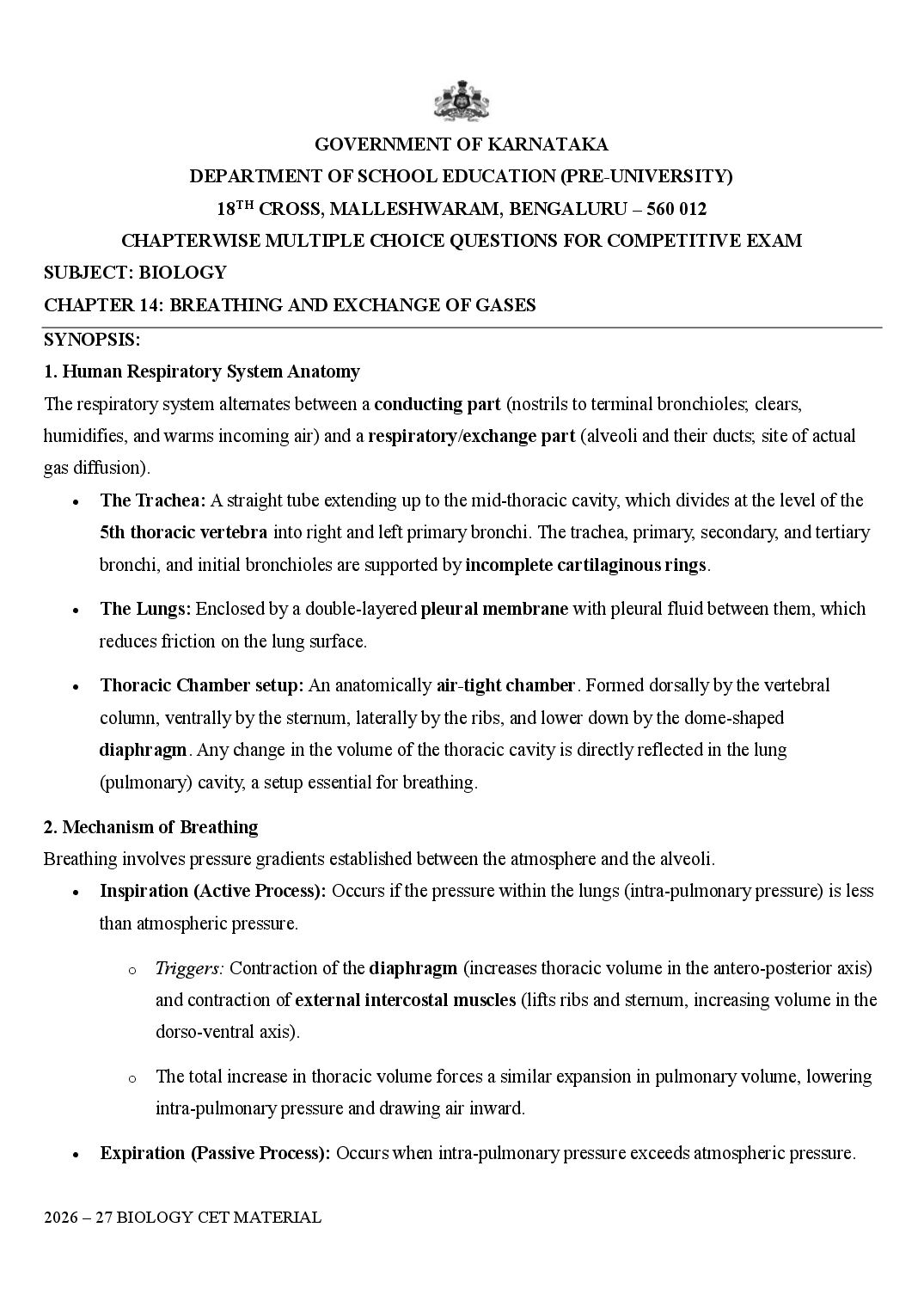
DEPARTMENT OF SCHOOL EDUCATION (PRE-UNIVERSITY)
18TH CROSS, MALLESHWARAM, BENGALURU – 560 012
CHAPTERWISE MULTIPLE CHOICE QUESTIONS FOR COMPETITIVE EXAM
SUBJECT: BIOLOGY
CHAPTER 14: BREATHING AND EXCHANGE OF GASES
SYNOPSIS:
1. Human Respiratory System Anatomy
The respiratory system alternates between a conducting part (nostrils to terminal bronchioles; clears,
humidifies, and warms incoming air) and a respiratory/exchange part (alveoli and their ducts; site of actual
gas diffusion).
• The Trachea: A straight tube extending up to the mid-thoracic cavity, which divides at the level of the
5th thoracic vertebra into right and left primary bronchi. The trachea, primary, secondary, and tertiary
bronchi, and initial bronchioles are supported by incomplete cartilaginous rings.
• The Lungs: Enclosed by a double-layered pleural membrane with pleural fluid between them, which
reduces friction on the lung surface.
• Thoracic Chamber setup: An anatomically air-tight chamber. Formed dorsally by the vertebral
column, ventrally by the sternum, laterally by the ribs, and lower down by the dome-shaped
diaphragm. Any change in the volume of the thoracic cavity is directly reflected in the lung
(pulmonary) cavity, a setup essential for breathing.
2. Mechanism of Breathing
Breathing involves pressure gradients established between the atmosphere and the alveoli.
• Inspiration (Active Process): Occurs if the pressure within the lungs (intra-pulmonary pressure) is less
than atmospheric pressure.
o Triggers: Contraction of the diaphragm (increases thoracic volume in the antero-posterior axis)
and contraction of external intercostal muscles (lifts ribs and sternum, increasing volume in the
dorso-ventral axis).
o The total increase in thoracic volume forces a similar expansion in pulmonary volume, lowering
intra-pulmonary pressure and drawing air inward.
• Expiration (Passive Process): Occurs when intra-pulmonary pressure exceeds atmospheric pressure.
Page 2
normal volume, compressing pulmonary space and expelling air.
o Note: A healthy human breathes 12–16 times/minute. We can enhance the strength of breathing
using additional abdominal muscles.
3. Respiratory Volumes and Capacities (High-Yield Numerical Data)
• Tidal Volume (TV): Volume of air inspired or expired during a normal respiration. (a
healthy man can inspire or expire approximately 6000–8000 mL of air per minute).
• Inspiratory Reserve Volume (IRV): Additional volume of air a person can inspire by a forceful
inspiration. .
• Expiratory Reserve Volume (ERV): Additional volume of air a person can expire by a forceful
expiration. .
• Residual Volume (RV): Volume of air remaining in the lungs even after a forcible expiration.
.
• Inspiratory Capacity (IC): . Total volume of air a person can inspire after a normal
expiration.
• Expiratory Capacity (EC): . Total volume of air a person can expire after a normal
inspiration.
• Functional Residual Capacity (FRC): . Volume of air that will remain in the lungs after a
normal expiration.
• Vital Capacity (VC): . The maximum volume of air a person can breathe in after a
forced expiration.
• Total Lung Capacity (TLC): (or ). Total volume of air
accommodated in the lungs at the end of a forced inspiration.
4. Exchange of Gases
Gases diffuse across membranes driven by a partial pressure ( ) gradient, moving from high to low pressure.
The diffusion membrane consists of three ultra-thin layers: the thin squamous epithelium of alveoli, the
endothelium of alveolar capillaries, and the basement substance separating them. Total thickness is less than a
millimeter.
NCERT Partial Pressures Chart ( ):
Page 3
• Alveoli: |
• Deoxygenated Blood: |
• Oxygenated Blood: |
• Tissues: |
Note: The solubility of is 20–25 times higher than that of . Therefore, the amount of that can
diffuse through the diffusion membrane per unit difference in partial pressure is much higher compared to .
5. Transport of Gases
I. Oxygen Transport
• Modes: 97% is transported by RBCs as Oxyhemoglobin; remaining 3% is carried dissolved in blood
plasma.
• Binding dynamics: Each hemoglobin molecule can carry a maximum of 4 molecules of . Binding is
highly dependent on .
• Shift Dynamics:
o In Alveoli: High , low , lower concentration, and lower temperature favor the
formation of oxyhemoglobin.
o In Tissues: Low , high , high concentration (low pH), and higher temperature favor
the dissociation of oxygen from oxyhemoglobin (Bohr Effect).
• Yield: Every of oxygenated blood can deliver around of to the tissues under normal
physiological conditions.
II. Carbon Dioxide Transport
• Modes: 70% is carried as Bicarbonate ions ( ); 20–25% is carried bound to hemoglobin as
Carbamino-hemoglobin; 7% is carried in a dissolved state through plasma.
• Mechanism: Tissues produce continuously. In RBCs, the high concentration of the enzyme
Carbonic Anhydrase drives the hydration of :
In alveoli where is low, the reaction reverses, releasing free .
• Yield: Every of deoxygenated blood delivers approximately of to the alveoli.
Page 4
• Respiratory Rhythm Center: Located in the medulla region of the brain; primarily responsible for
regulating respiratory rhythm.
• Pneumotaxic Center: Located in the pons region of the brain; can moderate the functions of the
respiratory rhythm center by reducing the duration of inspiration, thereby altering the respiratory rate.
• Chemosensitive Area: Situated adjacent to the rhythm center; highly sensitive to and hydrogen
ions. High levels activate this area, which signals the rhythm center to make remedial adjustments. The
role of oxygen in the regulation of respiratory rhythm is quite insignificant.
Disorders
• Asthma: Difficulty in breathing causing wheezing due to inflammation of bronchi and bronchioles.
• Emphysema: A chronic disorder in which alveolar walls are damaged, drastically reducing the
respiratory surface area. One of the major causes is cigarette smoking.
• Occupational Respiratory Disorders: Found in stone-breaking or grinding industries. Long exposure
produces massive dust that triggers fibrosis (proliferation of fibrous tissues), leading to serious lung
damage. Workers must wear protective masks.
Classroom discussion questions
1. Bulk of oxygen diffuses from the plasma into the red blood corpuscles where it joins loosely with Fe3+ ions
of haemoglobin (Hb) to form bright red oxyhaemoglobin (HbO2). The process is called
(A) oxidation (B) oxygenation (C) hydration (D) dehydrogenation
2. During CO2 transport, HCO3− diffuses from erythrocytes to plasma and in turn upsets the ionic balance
momentarily. In order to keep the ionic balance, an equal number of Cl– pass into the erythrocytes from
plasma. The process is known as
(A) Hamburger phenomenon (B) bicarbonate shift
(C) carbonation (D) Bohr’s effect
3. Haldane effect plays more important role in promoting carbon dioxide transport than that of the Bohr’s
effect in promoting oxygen transport because
(A) oxyhaemoglobin is a stronger acid which donates hydrogen ion (H+) which in turn displace carbon
dioxide from blood
(B) carbaminohaemoglobin is a stronger acid which splits into hydrogen ion and bicarbonate ( HCO3− )
(C) carbon dioxide reacts with water to form carbonic acid that lowers the pH in tissue
(D) carbon dioxide is less soluble in venous blood than in arterial blood
Page 5
doubted his statement a case was reported to police. Post mortem report confirmed that it was a murder. The
test performed by the medical expert was taking a piece of lung and putting in water where it
(A) kept floating (B) settled at the bottom
(C) showed blood clots (D) none of these
5. People living at sea level have around 5 million RBC per cubic millimeter of their blood whereas those
living at an altitude of 5400 metres have around 8 million. This is because at high altitude
(A) people eat more nutritive food, therefore more RBCs are formed
(B) people get pollution-free air to breathe and more oxygen is available
(C) atmospheric O2 level is less and hence more RBCs are needed to absorb the required amount of O 2 to
survive
(D) there is more UV radiation which enhances RBC production
6. Which one of the following statements is incorrect?
(A) The principle of countercurrent flow facilitates efficient respiration in gills of fishes
(B) The residual air in lungs slightly decreases the efficiency of respiration in mammals
(C) The presence of non-respiratory air sacs increases the efficiency of respiration in birds
(D) In insects, circulating body fluids serve to distribute oxygen to tissues
7. During rest, the metabolic needs of the body are at their minimum. Which of the following is indicative of
this situation?’
(A) Rate of breathing (B) O2 intake and CO2 output
(C) Pulse rate (D) All of these
8. Although much CO2 is carried in blood, yet blood does not become acidic, because
(A) it is absorbed by the leucocytes
(B) it combines with water to form H2CO3 which is neutralized.by Na2CO3
(C) CO2 transport and blood buffers play an important role in it
(D) it is continuously diffused through the tissues and is not allowed to accumulate
9. In man and mammals, air passes from outside into the lungs through
(A) nasal cavity, larynx, pharynx, trachea, bronchi, alveoli
(B) nasal cavity, pharynx, larynx, trachea, bronchioles, bronchi, alveoli
(C) nasal cavity, larynx, pharynx, trachea, bronchioles, alveoli
(D) nasal cavity, pharynx, larynx, trachea, bronchi, bronchioles, alveoli
10. In the tissues, high concentrations of carbon dioxide
(A) increases the affinity of haemoglobin to both oxygen and hydrogen
(B) increases the affinity of haemoglobin to oxygen but decreases its affinity to hydrogen
(C) decreases the affinity of haemoglobin to oxygen but increases its affinity to hydrogen
Page 6
11. A person breathing normally at rest, takes in and expels approximately half a litre of air during each
respiratory cycle. This is called
(A) inspiratory reserve volume (B) tidal volume
(C) expiratory reserve volume (D) vital capacity
12. Vital capacity of lungs is
(A) IRV + ERV (B) IRV + ERV + TV – RV
(C) IRV + ERV + TV + RV (D) IRV + ERV + TV
13. Identify the correct statement with reference to transport of respiratory gases by blood.
(A) Haemoglobin is necessary for transport of carbon dioxide and carbonic anhydrase for transport of
oxygen
(B) Haemoglobin is necessary for transport of oxygen and carbonic anhydrase for transport of carbon
dioxide
(C) Only oxygen is transported by blood
(D) Only carbon dioxide is transported by blood
14. With reference to human respiration, which of the following is correct?
(A) Pulmonary ventilation is equal to alveolar ventilation
(B) Alveolar ventilation is less than pulmonary ventilation
(C) Alveolar ventilation is more than pulmonary ventilation
(D) Pulmonary ventilation is less than alveolar ventilation
15. Which of the following is true for CO2 concentration?
(A) More in alveolar air than in expired air (B) More in expired air than in alveolar air
(C) More in inspired air than in alveolar air (D) More in inspired air than in expired air
16. Listed below are four respiratory capacities (i - iv) and four jumbled respiratory volumes of a normal adult
human.
Respiratory capacities Respiratory volumes
(i) Residual volume 2500 mL
(ii) Vital capacity 3500 mL
(iii) Inspiratory reserve volume 1200 mL
(iv) Inspiratory capacity 4500 mL
Which one of the following is the correct matching of two capacities and volumes?
(A) (ii) 2500 mL, (iii) 4500 mL (B) (iii) 1200 mL, (iv) 2500 mL
(C) (iv) 3500 mL, (i) 1200 mL (D) (i) 4500 mL, (ii) 3500 mL
17. Which of the following statements is true about RBCs in humans?
(A) They carry about 20-25 per cent of CO2
Page 7
(C) They transport about 80 per cent oxygen only and the rest 20 per cent of it is transported in dissolved
state in blood plasma
(D) They do not carry CO2 at all
18. Chemosensitive area of respiratory centre in medulla is affected by
(A) less CO2 and H+ ions (B) less O2 and H+ ions
(C) excess CO2 and H+ ions (D) excess O2 and H+ ions
19. Match Column - I with Column - II and select the correct option from the codes given below.
Column-I Column-II
(a) TV + ERV (i) Expiratory capacity
(b) RV - ERV + TV + IRV (ii) Total lung capacity
(c) ERV + RV (iii) Functional residual capacity
(A) (a) → (i), (b) → (ii), (c) → (iii) (B) (a) → (iii), (b) → (i), (c) → (ii)
(C) (a) → (iii), (b) → (ii), (c) → (i) (D) (a) → (ii), (b) → (iii), (c) → (i)
20. In man and mammals, air passes from outside into the lungs through
(A) Nasal cavity, larynx, pharynx, trachea, bronchi, alveoli.
(B) Nasal cavity, larynx, pharynx, trachea, bronchioles, alveoli.
(C) Nasal cavity, pharynx, larynx, trachea, bronchioles, bronchi, alveoli
(D) Nasal cavity, pharynx, larynx, trachea, bronchi, bronchioles, alveoli.
21. During forced expiration, actively contracting muscles include the
(A) Diaphragm
(B) External intercostals
(C) Abdominal muscles and external intercostals
(D) diaphragm and intestinal muscle
22. Carbon dioxide is transported via blood to lungs mostly
(A) As carbaminohaemoglobin and as carbonic acid. (B) In the form of carbonic acid
only.
(C) In combination with haemoglobin only. (D) Dissolved in blood plasma.
23. With respect to respiratory apparatus, pick out the incorrect pair / pairs.
(A) Insects - Tracheoles (B) Amphibians - Skin and lungs
(C) Starfish - Dermal bronchial (D) Crustacean - lungs
24. In mammals, the tracheal cartilaginous rings are
(A) Complete rings (B) Incomplete rings
(C) Incomplete dorsally (D) Incomplete laterally
Page 8
(A) Both are paired and branched. (B) Ciliated epithelium is present in both.
(C) walls of both can not be deformed. (D) In both head originates from pharynx.
26. What is true about haemoglobin?
(A) It is a dipeptide and present in red blood corpuscles in bloodworm.
(B) It is present in the dissolved state in blood plasma in earthworm.
(C) It is a dipeptide in mammals and localized in red blood corpuscles.
(D) It is present in dissolved state in blood plasma in scorpions.
27. The vital capacity of the lung signifies the volume of air
(A) Breathed in during normal inspiration. (B) Breathed out with forcible expiration.
(C) Breathed out with forcible expiration. (D) With deep inspiration and forcible expiration.
28. In breathing, entering air becomes
(A) Warm and filtered. (B) Cold and then warm.
(C) Warm, filtered and moistened. (D) Cold and moistened.
29. The exchange of gases in the alveoli of the lungs takes place by
(A) Osmosis 2 Simple diffusion (C) Passive transport (D) Active transport
30. Division of mammalian lungs into a very large number of tiny alveoli around alveolar ducts opening into
bronchioles, is
(A) An inefficient system of ventilation of alveoli though with very little residual air
(B) An inefficient system of ventilation of alveoli resulting in very high percentage of residual air in the
lungs.
(C) A very efficient system of ventilating the alveoli with no residual air.
(D) An efficient system of ventilation of alveoli with little or no residual air.
31. Dissociation curve is connected with
(A) Oxyhaemoglobin (B) Oxygen (C) Carbon dioxide (D) None of the above
32. A small space called __________ lies in between the two lungs.
(A) Mediastinum (B) Bronchioles (C) Alveoli (D) Cardiac notch
33. The site of gaseous exchange in lungs is
(A) Liver (B) Alveoli (C) Trachea (D) None of these
34. Oxyhaemoglobin is an unstable compound because
(A) Haemoglobin is a complex pigmented protein.
(B) There is a physical bonding between oxygen and haemoglobin.
(C) There is a chemical bonding between oxygen and haemoglobin.
(D) One molecule of haemoglobin combines with four molecules of oxygen.
35. Respiration can be defined as
Page 9
released energy to ATP.
(B) A catabolic process by which animals cells utilize oxygen, produce carbon dioxide and convert the
released energy to ATP.
(C) An anabolic process by which animal cells utilize oxygen and carbon dioxide to form ATP.
(D) An anabolic process by which animal cells utilize oxygen, produce carbon dioxide and convert the
released energy to ATP.
36. If O2 concentration in tissue was almost as high as at the respiratory surface
(A) Oxyhaemoglobin would dissociate to supply to the tissue.
(B) Haemoglobin would combine with more O2 at respiratory surface.
(C) Oxyhaemoglobin would not dissociate to supply O2 to the tissue.
(D) CO2 will interfere the O2 transport.
37. In lungs there is definite exchange of ions between RBC and plasma. Removal of CO2 from blood involves
(A) Influx of Cl– ions into RBC. (B) Influx of HCO3− ions into RBC.
(C) Efflux of CL– ions into RBC. (D) Efflux of HCO3− ions into RBC.
38. Which of the following statements correctly defines ' Bohr effects"?
(A) Rise in PCO2 with a decrease in CO2 concentration.
(B) Rise in PCO2 with an increase in CO2 concentration.
(C) Rise in PCO2 with an increase in CO2 and decrease in
(D) Rise in PCO2 with a decrease in pH (concentration at which 50% haemoglobin of blood is saturated with
oxygen).
39. In lungs in order to facilitate the removal of CO2 from the blood, there is an exchange of ions between RBC
and the plasma which involves the movement of
(A) Chloride ions from RBC to plasma. (B) Cl– ions from plasma to RBC.
(C) Bicarbonate ions from RBC to plasma. (D) Cl– and bicarbonate ions as in (A) and (B)
40. Which is true for CO2 concentration?
(A) More in alveolar air than in expired air. (B) More in expired air than in alveolar air.
(C) More in inspired air than in expired air. (D) More in inspired air than in alveolar air.
41. Respiration mechanism is controlled by
(A) Central nervous system. (B) Autonomic nervous system.
(C) Sympathetic nervous system. (D) Parasympathetic nervous system.
42. The respiratory centre in brain which controls inspiration and expiration, is situated in
(A) Medulla oblongata (B) Cerebellum (C) Hypothalamus (D) Pericardium
43. During strenuous exercise, which of the following change occurs?
Page 10
(C) Strach is converted into glucose. (D) Pyruvic acid is converted into lactic acid.
44. Which of the following conditions is responsible for increase in ventilation rate of lungs?
(A) Increase of CO2 content in inhaled air. (B) Increase of CO2 content in exhaled air.
(C) Decrease of O2 content in inhaled air. (D) Decrease of O2 content in exhaled air.
45. The form of energy used in respiration is
(A) Chemical energy (B) Electrical energy (C) Mechanical energy (D) Radiant energy
46. Foetal haemoglobin has a greater affinity for ___ than adult haemoglobin.
(A) CO2 (B) CO (C) H2O (D) O2
47. Blood analysis of a patient reveals an unusually high quantity of carboxyhaemoglobin content. Which of
the following is responsible for this high quantity?
(A) Carbon dioxide (B) Carbon monoxide
(C) Carbon disulphide (D) Chloroform
48. Ravi, who lived at sea level, had around 5 million RBC per cubic millimeter of his blood. Later when he
lived at an altitude of 18,000 ft, showed around 8 million RBC per cubic millimeter of blood. this is an
adaptation because
(A) At high altitude he ate more nutritive food.
(B) He had pollution free air to balance breathe.
(C) At high altitude O2 level is less hence more RBC were required to absorb enough oxygen.
(D) At high altitude there is more UV radiation which enhances RBCs production.
49. Ascent of high mountains may cause altitude sickness in men. Prime cause of this is
(A) Excess of CO2 in blood. (B) Decreased efficiency of
haemoglobin.
(C) Decreased partial pressure of oxygen. (D) Decreased proportion of oxygen in air.
50. Oxygen- binding to hemoglobin in blood is
(A) Directly proportional to concentration of CO2 in the medium
(B) Inversely proportional to concentration of CO2 in the medium
(C) Directly proportional to concentration of CO in the medium
(D) Independent of concentration of CO in the medium
51. The blood brain barrier
(A) Consists of both anatomical and physiological factors
(B) Regulates to some extent the passage of substances from the blood to the interstitial fluid of the brain
(C) Is anatomically related to the formation of tight junctions between adjacent capillary endothelial cells
(D) All of the above are correct
Page 11
correct combination of alphabets with numbers
Column I Column II
(Disorder) (Symptom)
(a) Asthma 1 Inflammation of nasal tract
(b) Bronchitis 2 Spasm of tracheal muscles
(c) Rhinitis 3 Fully blown out alveoli
(d) Emphysema 4 Inflammation of bronchi
5 Cough with bloody sputum
Codes
(a) (b) (c) (d)
(A) 4 2 5 1
(B) 5 3 2 1
(C) 3 1 5 4
(D) 2 4 1 3
Practice Questions:
1. Respiration in insects is called direct because
(A) The tissues exchange O2/CO2 directly with the air in the tubes
(B) the tissues exchange O2/CO2 directly with coelomic fluid
(C) The tissues exchange O2/CO2 directly with the air outside through body surface
(D) Tracheal tubes exchange O2/CO2 directly with the haemocoel which then exchange with tissues
2. Regarding the functions of our respiratory system, mark the wrong entry.
(A) humidifies the air (B) Warms up the air (C) Diffusion of gases (D) Cleans up the air
3. A person suffers punctures in his chest cavity in an accident, without any damage to the lungs its effect
could be
(A) Reduced breathing rate (B) Rapid increase in breathing rate
(C) no change in respiration (D) Cessation of breathing
4. It is known that exposure to carbon monoxide is harmful to animals because
(A) It reduces CO2 transport (B) It reduces O2 transport
(C) It increases CO2 transport (D) It destroys hemoglobin
5. Mark the true statement among the following with reference to normal breathing
(A) Inspiration is a passive process where as expiration is active
(B) Inspiration is a active process where as expiration is passive
(C) Inspiration and expiration are active processes
Page 12
6. A person breathes in some volume of air by forced inspiration after having a forced expiration. This
quantity of air taken is
(A) Total lung capacity (B) Tidal volume
(C) Vital Capacity (D) inspiratory capacity
7. Mark the incorrect statement in context to O2 binding to Hb
(A) Higher pH (B) Lower temperature
(C) Lower PCO2 (D) Higher PO2
8. Mark the correct pair of muscles involved in the normal breathing in humans
(A) External and internal intercostal muscles (B) Diaphragm and abdominal muscles
(C) Diaphragm and external intercostal muscles (D) Diaphragm and internal intercostal muscles
9. Incidence of Emphysema – a respiratory disorder is high in cigarette smokers. In such cases
(A) The bronchioles are found damaged (B) The alveolar walls are found damaged
(C) The plasma membrane is found damaged (D) the respiratory muscles are found damaged
10. Respiratory process is regulated by certain specialized centres in the brain. One of the following listed
centres can reduce the inspiratory duration upon stimulation
(A) Medullary inspiratory centre (B) Pneumotoxic centre
(C) Apneustic centre (D) Chemosensitive centre
11. CO2 dissociates from carbamino haemoglobin when
(A) pCO2 is high & pO2 is low (B) pO2 is high and pCO2 is low
(C) pCO2 and pO2 are equal (D) None of the above
12. The breathing movements, air volume can be estimated by
(A) Stethoscope (B) Hygrometer
(C) sphygmomanometer (D) Spirometer
13. Identify the correct and incorrect match about respiratory volume and capacities and mark the correct
answer
(i) inspiratory capacity (IC) = Tidal Volume + Residual Volume
(ii) Vital Capacity (VC) = Tidal Volume (TV) + Inspiratory Reserve volume (IRV) + Expiratory Reserve
volume (ERV)
(iii) Residual Volume (RV) = vital capacity (VC) − Inspiratory Reserve Volume (IRV)
(iv) Tidal Volume (TV) = Inspiratory Capacity (IC) – Inspiratory Reserve Volume (IRV)
Options:
(A) (i) Incorrect, (ii) incorrect, (iii) Incorrect,(iv) correct
(B) (i) incorrect, (ii) correct, (iii) Incorrect, (iv) correct
(C) (i) correct, (ii) correct, (iii) Incorrect, (iv) correct
Page 13
14. The oxygen-haemoglobin dissociation curve will show a right shift in case of
(A) High pCO2 (B) High pO2
(C) Low pCO2 (D) Less H+ concentration
15. Match the following and mark the correct options
Animal Respiratory Organ
(a) Earthworm (i) Moist cuticle
(b) Aquatic Arthropods (ii) Gills
(c) Fishes (iii) Lungs
(d) Birds/ Reptiles (iv) Trachea
Options:
(A) (a) → (ii); (b) → (i); (c) → (iv); (d) → (iii) (B) (a) → (i); (b) → (iv); (c) → (ii); (d) → (iii)
(C) (a) → (i); (b) → (iii); (c) → (ii); (d) → (iv) (D) (a) → (i); (b) → (ii); (c) → (iv); (d) → (iii)
In the following questions, a statement of Assertion (A) is followed by a statement of Reason (R). Mark the
correct choice as:
(A) If both Assertion and Reason are true and Reason is the correct explanation of Assertion
(B) If both Assertion and Reason are true but Reason is not the correct explanation of Assertion
(C) If Assertion is true but Reason is false
(D) If both Assertion and Reason are false.
16. Assertion: Aerobic animals are not truely aerobic.
Reason: They produce lactic acid anaerobically.
17. Assertion: Aerobic respiration involves the exchange of respiratory gases twice.
Reason: Exchange occurs from lung to heart and then heart to lung.
18. Assertion: Respiratory gas goes from higher partial pressure region to the region of lower partial
pressure.
Reason: Respiratory gas exchange occurs through osmosis.
19. Assertion: Abdominal muscle is related with respiration in animals.
Reason: Relaxation of abdominal muscles draws in air.
20. Assertion: In mammals, complex respiratory system has developed.
Reason: Mammalian skin is impermeable to gases.
21. Assertion: Lungs replace the skin very effectively in mammals as respiratory organs.
Reason: Respiration by lungs is termed pulmonary respiration.
22. Assertion: Forceful expiration occurs through expiratory muscles.
Page 14
23. Assertion: Vital capacity is higher in athletes than non - athletes.
Reason: Vital capacity is about 3.5 - 4.5 litres in a normal adult person.
24. Assertion: Oxyhaemoglobin carries 1 - 4 molecules of oxygen in the blood.
Reason: The capacity of oxyhaemoglobin depends on the degree of (Fe") saturation with oxygen.
25. Assertion: During inspiration, the volume of thorax increases.
Reason: This happens due to the relaxation of diaphragm and inspiratory muscles.
26. Assertion: A person has died because of carbon monoxide poisoning.
Reason: A person slept in a closed room with a lamp burning.
27. Assertion: Gaseous exchanges continue in the lungs without interruption even during expiration.
Reason: Residual volume of air can never be driven out by respiration.
28. Assertion: Erythrocytes can carry out anaerobic metabolism only.
Reason: In erythrocytes, carbon-dioxide is converted into bicarbonates.
29. Assertion: During expiration, volume of thorax decreases and air is expelled out.
Reason: This happens due to the contraction of expiratory muscles.
30. Assertion: During inspiration, pressure of air falls in the thorax.
Reason: There is a rise in volume of thorax during inspiration.
31. Assertion: It is beneficial to respire through mouth than through the nasal openings.
Reason: Air gets filtered when passed through the mouth.
32. Assertion: More of oxygen is released from oxyhaemoglobin in a more active tissue than in a less active
one.
Reason: This is because partial pressure of carbon-dioxide is very low in an active tissue than in a less
active one.
33. Assertion: Symptoms of mountain sickness develops when a person living on plains ascends and stays on a
mountain.
Reason: Air pressure and partial pressure of oxygen falls with the rise in altitude.
34. Assertion: Oxygenation of blood promotes the release of carbon-dioxide from the blood in the lungs.
Reason: Carbon-dioxide is carried as bicarbonates in erythrocytes of blood.
35. Assertion: One should not sleep in a closed room with a lamp burning inside.
Reason: This can cause the production of carbon monoxide which renders haemoglobin inactive by binding
to it and forming carbamino haemoglobin.
36. Assertion: Voice of women and children is high pitched whereas that of men is low pitched.
Reason: Vocal cords of men are longer than that of women and children.
37. Assertion: Coughing and sneezing are necessary.
Reason: Coughing and sneezing are reflex actions.
Page 15
(A) Caused by a variant of Pneumococcus pneumoniae
(B) An acute form of asthma
(C) Caused by a variant of Corona virus
(D) Affect non- vegetarians faster
39. Blood analysis of a patient reveals an unusually high quantity of carboxyhaemoglobin content. Which of the
following conclusions is most likely to be correct? The patient has inhaling polluted air containing high
contents of
(A) Carbon dioxide (B) Carbon monoxide
(C) Carbon disulphide (D) Chloroform
40. Dough kept overnight in warm weather becomes soft an spongy because of
(A) Cohesion (B) Osmosis
(C) Absorption of CO2 from atmosphere (D) Fermentation
41. In glycolysis, during oxidation electrons are removed by
(A) NAD+ (B) Molecular oxygen
(C) ATP (D) Glyceraldehyde-3-phosphate
42. R. Q. of fat is
(A) Move than one (B) One (C) Less than one (D) Infinite
43. Alveoli become enlarged and damaged with reduced surface area in heavy smokers. The condition is called
(A) Silicosis (B) Emphysema (C) Asthma (D) Bronchitis
44. After deep inspiration, maximum expiration of lungs is called
(A) Vital capacity (B) Total lung capacity
(C) Inspiratory capacity (D) Functional residual capacity
45. Respiratory quotient is defined as
Volume of CO2 formed Volumeof CO2 formed
(A) (B)
Volume of CO2 used Volume of O2 used
Volumeof O 2 formed Volume of O2 formed
(C) (D)
Volume of CO 2 used Volumeof N 2 used
46. How many ATP molecules could maximally be generated from one molecule of glucose, if the complete
oxidation of one mole of glucose to CO2 and H2O yields 686 Kcal an the useful chemical energy available
in the high energy phosphate bond of one mole of ATP is 12 Kcal/
(A) Two (B) Thirty (C) Fifty seven (D) One
47. Which of the following factors raise the P50 value and shifts the HbO2 dissociation curve to right and vice
versa
1. Rise in PCO 2
2. Rise in H+ ions (= Fall in pH)
Page 16
(A) 1, 2 and 3 are correct (B) 1 and 2 are correct
(C) 2 and 4 are correct (D) 1 and 3 are correct
48. Chloride shift occurs in response to
(A) HCO3− (B) K+ (C) H+ (D) Na+
49. Pneumotaxic center is present in
(A) Cerebrum (B) Cerebellum (C) Medulla (D) pons Varolii
50. Aerobic respiratory pathway is appropriately termed
(A) Catabolic (B) Parabolic (C) Amphibolic (D) Anabolic
51. Hamburger’s phenomenon is called
(A) Bicarbonate shift (B) Chloride shift (C) Hydrogen shift (D) Sodium shift
52. Which of the following is the cofactor of carbonic anhydrase?
(A) Fe (B) Zn (C) Cu (D) Mg
53. A large proportion of oxygen is left unused in the human blood even after its uptake by the body tissues.
This O2
(A) Acts as a reserve during muscular exercise
(B) Raises the pCO2 of blood to 75 mm of Hg
(C) Is enough to keep oxyhemoglobin saturation at 96%
(D) Helps in releasing more O2 to the epithelial tissues
54. Congestion of the lungs is one of the main symptoms in
(A) Hypotension (B) Coronary heart disease
(C) Angina (D) Heart failure
Classroom discussion Keys
1. (B) 11. (B) 21. (C) 31. (A) 41. (A)
2. (A) 12. (D) 22. (A) 32. (A) 42. (A)
3. (A) 13. (B) 23. (D) 33. (A) 43. (D)
4. (A) 14. (B) 24. (C) 34. (C) 44. (A)
5. (C) 15. (A) 25. (C) 35. (B) 45. (D)
6. (D) 16. (C) 26. (C) 36. (C) 46. (D)
7. (D) 17. (A) 27. (D) 37. (D) 47. (B)
8. (C) 18. (C) 28. (C) 38. (D) 48. (C)
9. (D) 19. (A) 29. (B) 39. (B) 49. (C)
10. (C) 20. (D) 30. (D) 40. (A) 50. (D)
Page 17
Practice question Keys
1. (D) 12. (D) 23. (B) 34. (B) 45. (B)
2. (D) 13. (B) 24. (A) 35. (C) 46. (C)
3. (D) 14. (B) 25. (C) 36. (A) 47. (B)
4. (D) 15. (B) 26. (A) 37. (B) 48. (A)
5. (B) 16. (A) 27. (A) 38. (C) 49. (D)
6. (A) 17. (C) 28. (B) 39. (B) 50. (C)
7. (D) 18. (C) 29. (A) 40. (D) 51. (B)
8. (D) 19. (A) 30. (A) 41. (A) 52. (B)
9. (B) 20. (B) 31. (D) 42. (C) 53. (A)
10. (B) 21. (B) 32. (C) 43. (B) 54. (D)
11. (B) 22. (C) 33. (A) 44. (A)
Document Details
| Board / Org | Karnataka Board |
| Exam | Class 11 |
| Type | Question Bank |
| Pages | 17 |
| Updated | 24 Sep 2026 |