Karnataka 1st PUC Biology Biomolecules MCQ with Answers
Finished viewing? Save it for later —
Download Karnataka 1st PUC Biology Biomolecules MCQ with Answers (PDF · 11 pages)About Karnataka 1st PUC Biology Biomolecules MCQ with Answers
Karnataka 1st PUC Biology Biomolecules MCQ with Answers is available here for free download. Published by Karnataka Board for Class 11, this question bank can be viewed online or downloaded as a PDF (11 pages). Candidates preparing for Class 11 can use Karnataka 1st PUC Biology Biomolecules MCQ with Answers to understand the exam pattern, the type of questions asked, and the overall difficulty level.
Frequently Asked Questions
How can I download Karnataka 1st PUC Biology Biomolecules MCQ with Answers?
Open this page and click the Download button to save Karnataka 1st PUC Biology Biomolecules MCQ with Answers as a PDF. It is completely free on AglaSem Docs.
Is Karnataka 1st PUC Biology Biomolecules MCQ with Answers free to download?
Yes. Karnataka 1st PUC Biology Biomolecules MCQ with Answers can be viewed online and downloaded as a PDF free of cost on AglaSem Docs.
How many pages does Karnataka 1st PUC Biology Biomolecules MCQ with Answers have?
Karnataka 1st PUC Biology Biomolecules MCQ with Answers contains 11 pages, which you can read online or download together as a single PDF.
Where can I find more Class 11 study material?
You can find more Class 11 question papers, sample papers, syllabus, and answer keys on AglaSem Docs.
Karnataka 1st PUC Biology Biomolecules MCQ with Answers – Text
Read the full text of this question bank below — useful to quickly search, copy and reference the content online without downloading the PDF.
📄 View text version (11 pages)
Page 1
DEPARTMENT OF SCHOOL EDUCATION (PRE-UNIVERSITY)
18TH CROSS, MALLESHWARAM, BENGALURU – 560 012
CHAPTERWISE MULTIPLE CHOICE QUESTIONS FOR COMPETITIVE EXAM
SUBJECT: BIOLOGY
CHAPTER 8: BIOMOLECULES
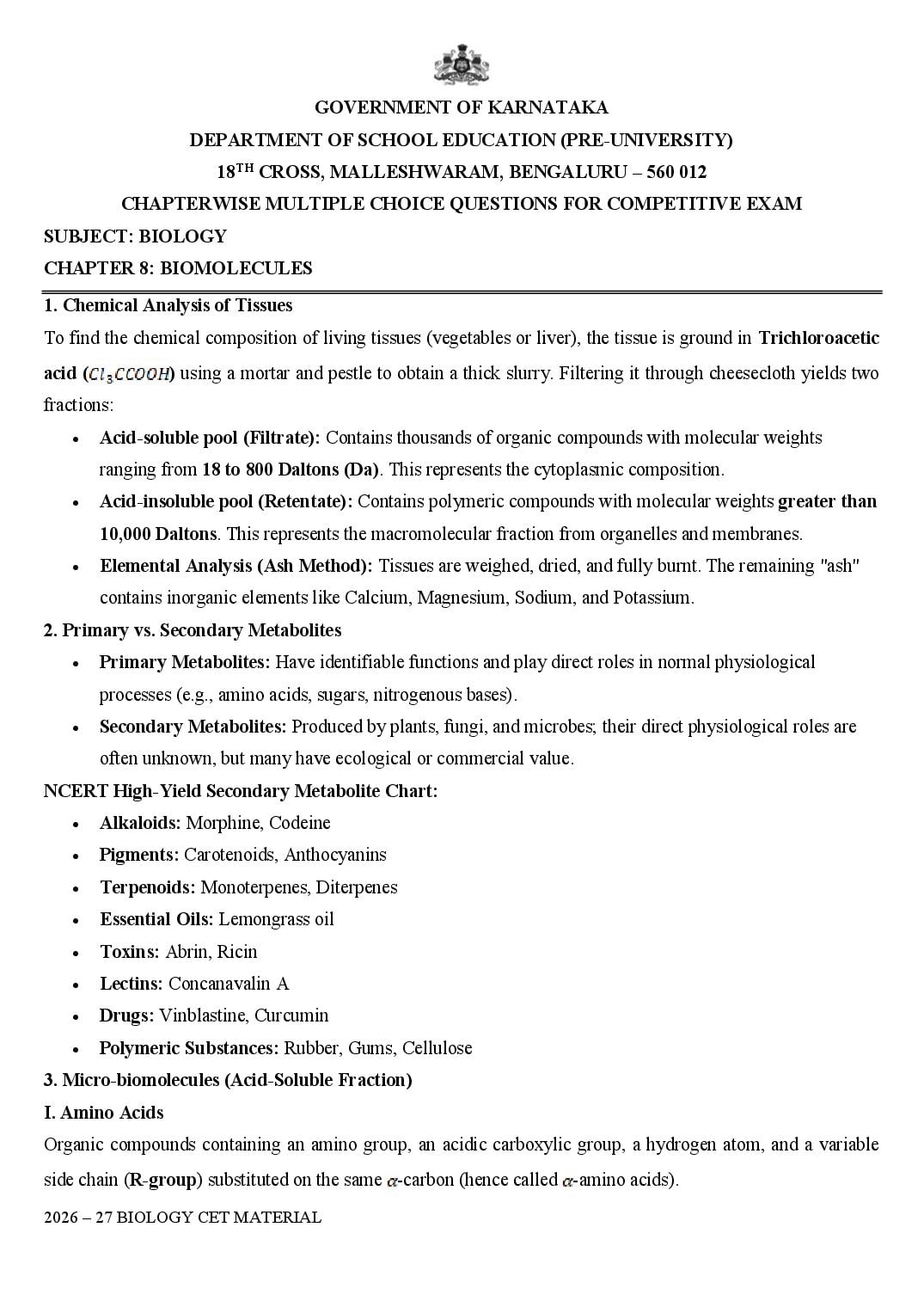
1. Chemical Analysis of Tissues
To find the chemical composition of living tissues (vegetables or liver), the tissue is ground in Trichloroacetic
acid ( ) using a mortar and pestle to obtain a thick slurry. Filtering it through cheesecloth yields two
fractions:
• Acid-soluble pool (Filtrate): Contains thousands of organic compounds with molecular weights
ranging from 18 to 800 Daltons (Da). This represents the cytoplasmic composition.
• Acid-insoluble pool (Retentate): Contains polymeric compounds with molecular weights greater than
10,000 Daltons. This represents the macromolecular fraction from organelles and membranes.
• Elemental Analysis (Ash Method): Tissues are weighed, dried, and fully burnt. The remaining "ash"
contains inorganic elements like Calcium, Magnesium, Sodium, and Potassium.
2. Primary vs. Secondary Metabolites
• Primary Metabolites: Have identifiable functions and play direct roles in normal physiological
processes (e.g., amino acids, sugars, nitrogenous bases).
• Secondary Metabolites: Produced by plants, fungi, and microbes; their direct physiological roles are
often unknown, but many have ecological or commercial value.
NCERT High-Yield Secondary Metabolite Chart:
• Alkaloids: Morphine, Codeine
• Pigments: Carotenoids, Anthocyanins
• Terpenoids: Monoterpenes, Diterpenes
• Essential Oils: Lemongrass oil
• Toxins: Abrin, Ricin
• Lectins: Concanavalin A
• Drugs: Vinblastine, Curcumin
• Polymeric Substances: Rubber, Gums, Cellulose
3. Micro-biomolecules (Acid-Soluble Fraction)
I. Amino Acids
Organic compounds containing an amino group, an acidic carboxylic group, a hydrogen atom, and a variable
side chain (R-group) substituted on the same -carbon (hence called -amino acids).
Page 2
o If R = , it is Glycine (simplest, optically inactive).
o If R = , it is Alanine.
o If R = , it is Serine.
• Chemical Nature:
o Acidic: Glutamic acid. Basic: Lysine, Arginine. Neutral: Valine. Aromatic: Tyrosine,
Phenylalanine, Tryptophan.
• Zwitterion Form: The structure of amino acids shifts dynamically at different pH levels due to the
ionizable nature of and groups.
II. Lipids
Water-insoluble molecules, technically not polymers, but categorized in the insoluble fraction due to their
behavior when cell membranes are disrupted.
• Fatty Acids: Hydrocarbon chain ending in a group. Palmitic acid has 16 carbons (including
carboxyl carbon); Arachidonic acid has 20 carbons. They can be saturated (no double bonds) or
unsaturated (one or more double bonds).
• Glycerides: Fatty acids esterified with glycerol (trihydroxy propane). Can be monoglycerides,
diglycerides, or triglycerides. Oils have lower melting points (e.g., Gingelly oil) and remain liquid in
winter.
• Phospholipids: Phosphorylated lipids found in cell membranes (e.g., Lecithin).
III. Nitrogenous Bases & Nucleosides/Nucleotides
• Nitrogenous Bases: Heterocyclic rings. Purines (Adenine, Guanine) and Pyrimidines (Cytosine, Uracil,
Thymine).
• Nucleosides: Nitrogenous base + Sugar (e.g., Adenosine, Guanosine, Thymidine, Uridine, Cytidine).
• Nucleotides: Nitrogenous base + Sugar + Phosphate group (e.g., Adenylic acid, Guanylic acid, Uridylic
acid). These are the monomeric units of nucleic acids.
4. Macro-biomolecules (Acid-Insoluble Fraction)
Biopolymers with molecular weights exceeding 10,000 Da.
I. Proteins
Heteropolymers of -amino acids linked by peptide bonds (formed when the of one amino acid reacts
with the of the next, releasing water).
• Collagen is the most abundant protein in the animal world. RuBisCO (Ribulose bisphosphate
carboxylase-oxygenase) is the most abundant protein in the whole biosphere. GLUT-4 enables glucose
transport into cells.
Protein Structures:
Page 3
acid; the last is the C-terminal amino acid.
2. Secondary Structure: The protein thread is folded into local shapes, such as the right-handed -helix
or -pleated sheet, stabilized by hydrogen bonds.
3. Tertiary Structure: The polypeptide chain folds upon itself like a hollow woolen ball, creating a 3D
structure. This structure is absolutely necessary for the biological activity of proteins/enzymes.
4. Quaternary Structure: Architecture of proteins composed of more than one polypeptide subunit (e.g.,
human Hemoglobin has 4 subunits: and ).
II. Carbohydrates (Polysaccharides)
Long chains of monosaccharides linked by glycosidic bonds (formed via dehydration between two carbon
atoms of adjacent monosaccharides).
• Storage Polysaccharides: Starch (plant storehouse; forms helical secondary structures that can trap
molecules to give a blue color) and Glycogen (animal storehouse; highly branched).
• Structural Polysaccharides: Cellulose (unbranched plant cell wall polymer; does not hold because it
lacks complex helices). Chitin is a complex, nitrogen-containing homopolymer of N-acetyl
glucosamine forming the exoskeleton of arthropods.
III. Nucleic Acids (DNA & RNA)
Polymers of nucleotides linked by phosphodiester bonds (linking the 3'-carbon of one sugar to the 5'-carbon of
the next via a phosphate group).
• DNA B-Form Secondary Structure (Watson-Crick Model): Double helix with antiparallel strands.
The backbone is formed by the sugar-phosphate-sugar chain. The bases project inward, pairing via
hydrogen bonds ( with 2 hydrogen bonds; with 3 hydrogen bonds). Each turn of the helix
contains 10 base pairs, with a pitch of 34 Å ( ) and a distance of 3.4 Å between base pairs.
5. Enzymes
Enzymes are biological catalysts, almost entirely composed of proteins (exception: Ribozymes, which are
catalytic RNA molecules).
I. Mechanism of Action
Enzymes lower the activation energy required for a chemical reaction, increasing the rate of transition from
substrate ( ) to product ( ). The substrate binds to the active site of the enzyme to form a transient enzyme-
substrate ( ) complex.
II. Factors Affecting Enzyme Activity
• Temperature and pH: Enzymes show maximum activity at an optimum temperature and pH.
Activity declines below or above this point. Low temperatures preserve the enzyme in a temporarily
inactive state, whereas high temperatures denature the protein structure.
Page 4
maximum velocity ( ). Beyond , adding more substrate cannot increase the rate because all
enzyme active sites are saturated.
• Inhibition: When a chemical closely resembling the substrate binds to the active site, it shuts down
activity. This is competitive inhibition (e.g., inhibition of succinic dehydrogenase by malonate, which
structurally competes with the true substrate succinate).
III. Classification of Enzymes
Divided into 6 major classes:
1. Oxidoreductases/Dehydrogenases: Catalyze oxidoreduction between two substrates.
2. Transferases: Catalyze the transfer of a group (other than hydrogen) between a pair of substrates.
3. Hydrolases: Catalyze the hydrolysis of ester, ether, peptide, glycosidic, or bonds.
4. Lyases: Catalyze the removal of groups from substrates by mechanisms other than hydrolysis, leaving
double bonds.
5. Isomerases: Catalyze the interconversion of optical, geometric, or positional isomers.
6. Ligases: Catalyze the linking together of two compounds (e.g., joining , , or bonds).
IV. Co-factors
Non-protein constituents bound to the enzyme to make it catalytically active. The protein part of the enzyme is
called the apoenzyme.
• Prosthetic Groups: Organic compounds tightly bound to the apoenzyme (e.g., haem in peroxidase and
catalase).
• Co-enzymes: Transiently bound organic compounds, often derived from vitamins (e.g., NAD and
NADP contain the vitamin niacin).
• Metal Ions: Form coordinate bonds with the substrate and active site side chains (e.g., Zinc is a co-
factor for the proteolytic enzyme carboxypeptidase).
• Note: Removing the co-factor completely destroys the catalytic activity of the enzyme.
CLASSROOM DISCUSSION QUESTIONS
1. Take a living tissue, grind it in trichloroacetic acid using pestle and mortar, and then strain it, you would
obtain two fractions: acid- soluble and acid-insoluble fraction. Acid-insoluble fraction does not contain
(A) Polysaccharides (B) nucleic acids
(C) Lipids (D) flavonoids and alkaloids.
2. Select the option that correctly identifies the chemical bonds present in the given biomolecules.
Polysaccharides Proteins Fats Water
(A) Ester Peptide Glycosidic Hydrogen
(B) Glycosidic Peptide Ester Hydrogen
(C) Glycosidic Peptide Hydrogen Ester
Page 5
3. Which of the following elements is not found in living organism?
(A) Silicon (B) Magnesium (C) Iron (D) Sodium
4. Which of the following is a saturated fatty acid?
(A) Oleic acid (B) Linoleic acid
(C) Arachidonic acid (D) Palmitic acid
5. Which of the following is a heteropolymer?
(A) Cellulose (B) Chitin (C) Starch (D) Glycogen
6. Study the given statements and select the correct option.
(i) Carbohydrates, proteins, nucleic acids and lipids are primary metabolites.
(ii) Alkaloids, flavonoids, rubber, etc. are secondary metabolites.
(iii) Linoleic, linoleic and Palmitic acids are the three essential fatty acids.
(A) Statements (i) and (ii) are correct (B) Statements (i) and (iii) are incorrect
(C) Statements (i) and (iii) are correct (D) Only statement (ii) is incorrect
7. In a DNA molecule, the phosphate group is attached to _________ carbon of the sugar residue of its own
nucleotide carbon of the sugar residue of the next nucleotide by _________ bonds.
(A) 5, 3, phosphodiester (B) 5, 3, glycosidic
(C) 3, 5, phosphodiester (D) 3, 5, glycosidic
8. Refer the given reaction.
Enzyme A
C12 H 22 O11 + H 2 O ¾ ¾ ¾ ¾ ¾
® 2C6 H12O6
Mallose Glucose
Enzyme A used in the reaction, belongs to which class of enzymes?
(A) Dehydrogenases (B) Transferases (C) Hydrolases (D) Lyases
9. Which of the following statements is not correct regarding chitin?
(A) It is a storage polysaccharide.
(B) It is a heteropolysaccharide.
(C) It is a constituent of arthropod exoskeleton and fungal cell wall.
(D) It is a second most abundant carbohydrate on earth.
10. The -pleated sheet structure of proteins is due to
(A) Formation of peptide bonds
(B) Coiling of polypeptide chains
(C) Folding of the coiled polypeptide chains
(D) Linking together of two or more polypeptide chains.
11. In Primary structure of proteins is due to the presence of
(A) peptide bonds (B) disulphide (S – S) linkages
(C) hydrogen bonds (D) ionic bonds.
Page 6
X Y
(A) Activation energy without enzyme Activation energy with enzyme
(B) Activation energy with enzyme Activation energy without enzyme
(C) Substrate concentration with enzyme Substrate concentration without enzyme
(D) Substrate concentration without enzyme Substrate concentration with enzyme
13. Which of the following statements is incorrect regarding enzymatic activity?
(A) It increases with increase in substrate concentration up to the saturation point.
(B) It is highest at optimum pH value.
(C) It initially decreases with increase in pH value.
(D) It initially increases with increase in temperature and then decreases.
14. Essential amino acids include
(A) Leucine (B) valine (C) tryptophan (D) all of these.
15. The component present in both nucleotides and nucleosides is
(A) Sugar (B) phosphate
(C) Nitrogenous base (D) both (A) and (C).
16. Read the given statements and select the correct option.
Statement 1: Haemoglobin is an example of quaternary structure of proteins.
Statement 2: Haemoglobin molecules are composed of four polypeptide chains—two α-chains and two β-
chains.
(A) Both statements I and 2 are correct and statement 2 is the correct explanation of statement 1.
(B) Both statements 1 and 2 are correct but statement 2 is not the correct explanation of statement 1.
(C) Statement 1 is correct and statement 2 is incorrect.
(D) Both statements 1 and 2 are incorrect.
17. A form of amino acid with both positive and negative charges simultaneously in the same molecule is
(A) Amphipathic form (B) stable form (C) zwitter ionic form (D) neutral form.
18. Match Column - I with Column - II and select the correct option from the codes given below.
Column-I Column-II
(a) Galactose (i) Protein
Page 7
(c) Fructose (iii) Brain sugar
(d) Lecithin (iv) Heparin
(e) Insulin (v) Fruit sugar
(A) (a) → (v), (b) → (iii), (c) → (ii), (d) → (i), (e) → (iv)
(B) (a) → (v), (b) → (iii), (c) → (i), (d) → (iv), (e) → (ii)
(C) (a) → (i), (b) → (ii), (c) → (iii), (d) → (v) (e) → (iv)
(D) (a) → (iii), (b) → (iv), (c) → (v), (d) → (ii), (e) → (i)
19. Saturated fatty acids possess _____ bonds between carbon atoms and are _____at room temperature.
(A) Single, solids (B) double, solids
(C) single, liquids (D) double, liquids
20. Cytidine is a
(A) Nitrogenous base (B) nucleoside
(C) nucleotide (D) nucleic acid.
21. Which one of the following is the sweetest sugar?
(A) Fructose (B) Glucose (C) Galactose (D) Sucrose
22. Which of the following is the characteristic of plants?
(A) Glucose and cellulose (B) Pyruvic acid and glucose
(C) Celulose and starch (D) starch and pyruvic acid
23. Sucrose, a common table sugar, is composed of
(A) glucose + fructose (B) glucose + galactose
(C) fructose + galactose (D) none of these
24. A complex polysaccharide produced from sucrose by the bacterium Leuconostic mesenteroides is
(A) chitin (B) starch (C) cellulose (D) dextran
25. Which of the following chemical characteristics is not common to all living beings?
(A) Similar triplet code for amino acids (B) Energy is stored by high phosphate bonds
(C) Type of protein present in the body (D) Ribosomes are the sites of protein synthesis
26. Proteins consist of
(A) carbon, hydrogen, chlorine, Sulphur (B) carbon, hydrogen, oxygen, nitrogen
(C) carbon, manganese, phosphors, nitrogen (D) carbon, iodine, oxygen and inorganic phosphate
27. High content of lysine is present in
(A) wheat (B) apple (C) maize (D) banana
28. Maltose consists of which one of the following?
(A) - glucose and - galactose (B) - glucose and - fructose
(C) - sucrose and - glucose (D) Glucose and glucose
Page 8
(A) Glycine (B) Valine (C) Leucine (D) Isoleucine
30. A ribose (but not deoxyribose) nucleotide is
(A) cytosine – pentose sugar – phosphate (B) guanine – pentose sugar – phosphate
(C) thymine – pentose sugar – phosphate (D) uracil – pentose sugar – phosphate
31. ATP is
(A) adenosine D-ribose three phosphate (B) adenosine L-ribose three phosphate
(C) adenosine D- ribose three phosphate (D) adenine L-ribose three phosphate
32. DNA strands are antiparallel because of the presence of
(A) H–bond (B) peptide bonds
(C) disulfide bonds (D) phosphate –diester bonds
33. The base pair of DNA are correctly shown as
(A) A T and C = G (B) A = T and C G
(C) A= T and C = G (D) A T and C G
34. Ultraviolet light absorbed by nucleic acid is
(A) 26 nm (B) 75 nm (C) 260 nm (D) 1500 nm
35. Nucleoside is made up of
(A) Sugar only (B) Phosphate only
(C) Sugar and phosphate (D) Sugar and base
36. RNA is absent in
(A) plasmalemma (B) cytoplasm (C) chromosomes (D) ribosomes
37. Who got the Nobel prize working on enzymes in the year 1978?
(A) W. Arber and D. Nathans (B) Nass and Nass
(C) R. Misra (D) H.G. Khorana
38. Which one of the following statements is true for the enzymes?
(A) All enzymes are proteins (B) All proteins are enzymes
(C) All enzymes are not proteins (D) All enzymes are vitamins
39. Enzymes are different from inorganic catalysts by
(A) not being used up in reactions (B) being proteinaceous in nature
(C) having high diffusion rate (D) working at high temperature
40. The enzymes, which combines with non-protein part of form a functional enzyme known as
(A) co-enzyme (B) holoenzyme (C) apoenzyme (D) prosthetic group
41. Coenzyme can function
(A) in association with a vitamin (B) in association with an apoenzyme
(C) independently of the apoenzyme (D) in association with a protein
42. In which one of the following enzymes, is copper necessarily associated as an activator?
Page 9
(C) Carbonic anhydrase (D) Trytophanase
43. To explain the mechanism of enzymatic action, who proposed “Lock and key hypothesis”?
(A) Fischer (B) Jacob (C) Koshland (D) Sumner
44. Jacob and Monad named those enzymes allosteric whose activity is regulated by
(A) substrate (B) end product (C) coenzymes (D) prosthetic groups
45. Competitive inhibitors (like malonate) alter
(A) velocity of reaction (B) value of Km (Michelis constant)
(C) active site (D) structure of enzyme
46. Basically how many types of enzyme have been recognized by International Union of Biochemistry?
(A) 4 (B) 5 (C) 6 (D) 8
47. Which of the following has highest lactose content?
(A) Human milk (B) cow milk (C) Buffalo milk (D) Goat milk
48. The given graph shows the effect of substrate concentration on the rate of reaction of the enzyme green
gram phosphatase.
What does the graph indicate?
(A) The rate of enzyme reaction is directly proportional to the substrate concentration
(B) Presence of an enzyme inhibitor in the reaction mixture
(C) Formation of an enzyme- substrate complex
(D) At higher substrate concentration the pH increases
49. Which one belong to hydrolase group?
(A) Amylase (B) Transaminase (C) Citrate synthetase (D) Enolase
50. Enzymes which are slightly different in molecular structure but can perform identical activity are called
(A) isoenzymes (B) holoenzymes (C) apoenzymes (D) coenzymes
Practice Questions
1. It is said that elemental composition of living organisms and that of inanimate objects (like earth’s crust) are
similar in the sense that all the major elements are present in both. Then what would be the difference
between these two groups? Choose a correct answer from among the following:
(A) Living organisms have more gold in them than inanimate objects
(B) Living organisms have more water in their body than inanimate objects
Page 10
(D) Living organisms have more calcium in them than inanimate objects.
2. Many elements are found in living organisms either free or in the form of compounds. One of the following
is not, found in living organisms.
(A) Silicon (B) Magnesium (C) Iron (D) Sodium
3. Aminoacids, as the name suggests, have both an amino group and a carboxyl group in their structure. In
addition, all naturally occurring aminoacids (those which are found in proteins) are called L-aminoacids.
From this, can you guess from which compound can the simplest aminoacid be made?
(A) Formic acid (B) Methane (C) Phenol (D) Glycine
4. Many organic substances are negatively charged e.g., acetic acid, while others are positively charged e.g.,
ammonium ion. An aminoacid under certain conditions would have both positive and negative charges
simultaneously in the same molecule. Such a form of aminoacid is called
(A) Positively charged form (B) Negatively charged form
(C) Neutral form (D) Zwitter ionic form
5. Sugars are technically called carbohydrates, referring to the fact that their formulae are only multiple of
C(H2O). Hexoses therefore have six carbons, twelve hydrogens and six oxygen atoms. Glucose is a hexose.
Choose from among the following another hexose.
(A) Fructose (B) Erythrose (C) Ribulose (D) Ribose
6. When you take cells or tissue pieces and grind them with an acid in a mortar and pestle, all the small
biomolecules dissolve in the acid. Proteins, polysaccharides and nucleic acids are insoluble in mineral acid
and get precipitated. The acid soluble compounds include aminoacids, nucleosides, small sugars etc. When
one adds a phosphate group to a nucleoside one gets another acid soluble biomolecule called
(A) Nitrogen base (B) Adenine
(C) Sugar phosphate (D) Nucleotide
7. When we homogenize any tissue in an acid the acid soluble pool represents
(A) Cytoplasm (B) Cell membrane (C) Nucleus (D) Mitochondria
8. The most abundant chemical in living organisms could be
(A) Protein (B) Water (C) Sugar (D) Nucleic acid
9. A homopolymer has only one type of building block called monomer repeated ‘n’ number of times. A
heteropolymer has more than one type of monomer. Proteins are heteropolymers made of aminoacids.
While a nucleic acid like DNA or RNA is made of only 4 types of nucleotide monomers, proteins are made
of
(A) 20 types of monomers (B) 40 types of monomers
(C) 3 types of monomers (D) only one type of monomer
10. Proteins perform many physiological functions. For example, some functions as enzymes. One of the
following represents an additional function that some proteins discharge
Page 11
(C) Pigments making colours of flowers (D) Hormones
11. Glycogen is a homopolymer made of
(A) Glucose units (B) Galactose units
(C) Ribose units (D) Amino acids
12. The number of ‘ends’ in a glycogen molecule would be
(A) Equal to the number of branches plus one
(B) Equal to the number of branch points
(C) One
(D) Two, one on the left side and another on the right side
13. A pure protein should normally have
(A) Two ends (B) One end (C) Three ends (D) No ends
14. Enzymes are biocatalysts. They catalyze biochemical reactions. In general they reduce activation energy of
reactions. Many physico-chemical processes are enzyme mediated. Some examples of enzyme mediated
reactions are given below. Tick the wrong entry
(A) Dissolving CO2 in water (B) Untwining the two strands of
DNA
(C) Hydrolysis of sucrose (D) Formation of peptide bond
Classroom discussion Keys
1. (D) 11. (A) 21. (A) 31. (C) 41. (B)
2. (B) 12. (B) 22. (C) 32. (B) 42. (A)
3. (A) 13. (C) 23. (A) 33. (A) 43. (B)
4. (D) 14. (D) 24. (D) 34. (D) 44. (B)
5. (B) 15. (D) 25. (C) 35. (A) 45. (B)
6. (A) 16. (A) 26. (B) 36. (A) 46. (C)
7. (A) 17. (C) 27. (A) 37. (A) 47. (A)
8. (C) 18. (D) 28. (D) 38. (B) 48. (B)
9. (A) 19. (A) 29. (A) 39. (C) 49. (A)
10. (D) 20. (B) 30. (D) 40. (B) 50. (A)
Practice Question Keys
1. (C) 5. (A) 9. (A) 13. (A)
2. (A) 6. (D) 10. (D) 14. (D)
3. (B) 7. (A) 11. (A) 15. (B)
4. (D) 8. (B) 12. (A)
Document Details
| Board / Org | Karnataka Board |
| Exam | Class 11 |
| Type | Question Bank |
| Pages | 11 |
| Updated | 24 Sep 2026 |