Karnataka 1st PUC Biology Respiration in Plants MCQ with Answers
Finished viewing? Save it for later —
Download Karnataka 1st PUC Biology Respiration in Plants MCQ with Answers (PDF · 18 pages)About Karnataka 1st PUC Biology Respiration in Plants MCQ with Answers
Karnataka 1st PUC Biology Respiration in Plants MCQ with Answers is available here for free download. Published by Karnataka Board for Class 11, this question bank can be viewed online or downloaded as a PDF (18 pages). Candidates preparing for Class 11 can use Karnataka 1st PUC Biology Respiration in Plants MCQ with Answers to understand the exam pattern, the type of questions asked, and the overall difficulty level.
Frequently Asked Questions
How can I download Karnataka 1st PUC Biology Respiration in Plants MCQ with Answers?
Open this page and click the Download button to save Karnataka 1st PUC Biology Respiration in Plants MCQ with Answers as a PDF. It is completely free on AglaSem Docs.
Is Karnataka 1st PUC Biology Respiration in Plants MCQ with Answers free to download?
Yes. Karnataka 1st PUC Biology Respiration in Plants MCQ with Answers can be viewed online and downloaded as a PDF free of cost on AglaSem Docs.
How many pages does Karnataka 1st PUC Biology Respiration in Plants MCQ with Answers have?
Karnataka 1st PUC Biology Respiration in Plants MCQ with Answers contains 18 pages, which you can read online or download together as a single PDF.
Where can I find more Class 11 study material?
You can find more Class 11 question papers, sample papers, syllabus, and answer keys on AglaSem Docs.
Karnataka 1st PUC Biology Respiration in Plants MCQ with Answers – Text
Read the full text of this question bank below — useful to quickly search, copy and reference the content online without downloading the PDF.
📄 View text version (18 pages)
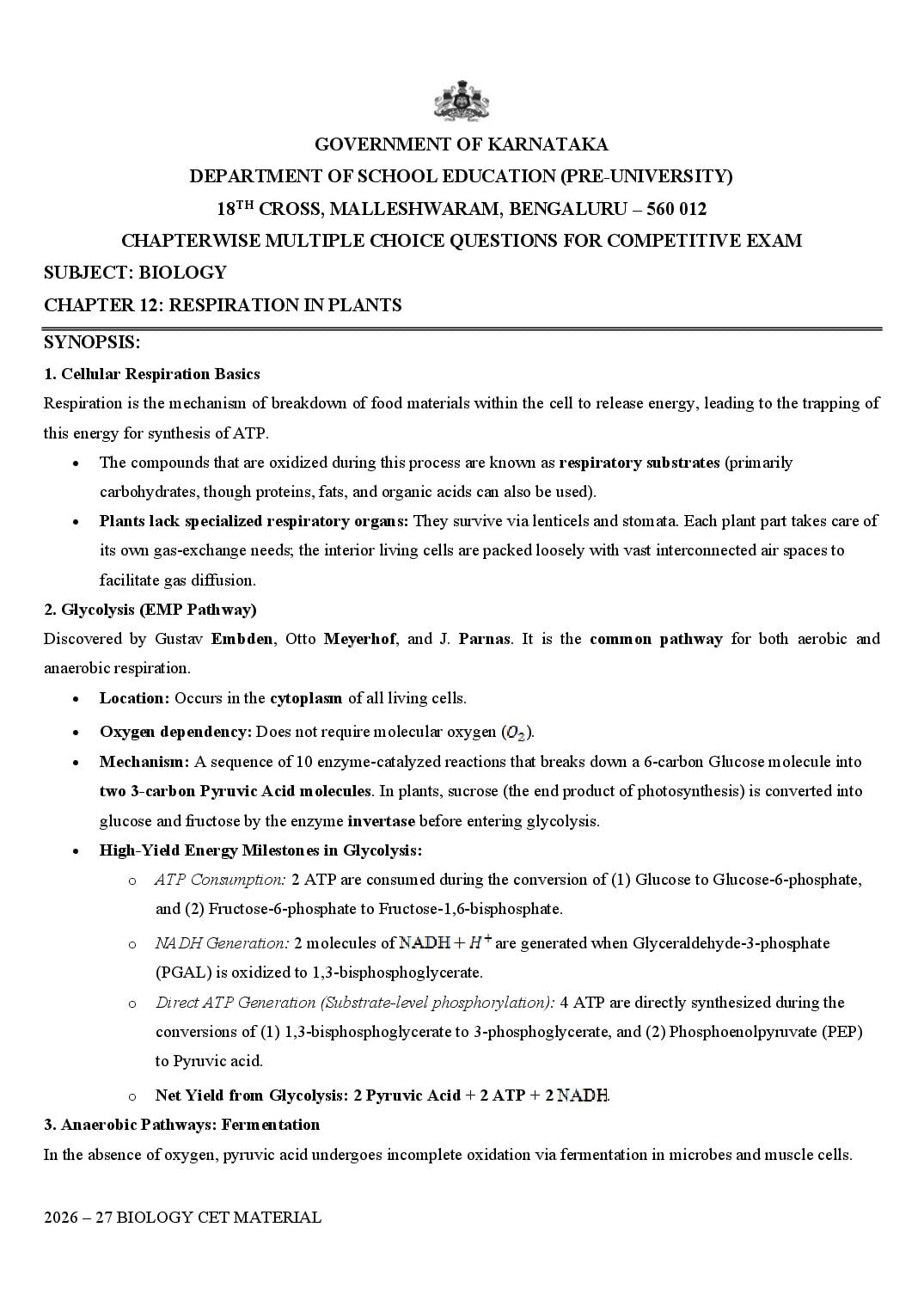
Page 1
DEPARTMENT OF SCHOOL EDUCATION (PRE-UNIVERSITY)
18TH CROSS, MALLESHWARAM, BENGALURU – 560 012
CHAPTERWISE MULTIPLE CHOICE QUESTIONS FOR COMPETITIVE EXAM
SUBJECT: BIOLOGY
CHAPTER 12: RESPIRATION IN PLANTS
SYNOPSIS:
1. Cellular Respiration Basics
Respiration is the mechanism of breakdown of food materials within the cell to release energy, leading to the trapping of
this energy for synthesis of ATP.
• The compounds that are oxidized during this process are known as respiratory substrates (primarily
carbohydrates, though proteins, fats, and organic acids can also be used).
• Plants lack specialized respiratory organs: They survive via lenticels and stomata. Each plant part takes care of
its own gas-exchange needs; the interior living cells are packed loosely with vast interconnected air spaces to
facilitate gas diffusion.
2. Glycolysis (EMP Pathway)
Discovered by Gustav Embden, Otto Meyerhof, and J. Parnas. It is the common pathway for both aerobic and
anaerobic respiration.
• Location: Occurs in the cytoplasm of all living cells.
• Oxygen dependency: Does not require molecular oxygen ( ).
• Mechanism: A sequence of 10 enzyme-catalyzed reactions that breaks down a 6-carbon Glucose molecule into
two 3-carbon Pyruvic Acid molecules. In plants, sucrose (the end product of photosynthesis) is converted into
glucose and fructose by the enzyme invertase before entering glycolysis.
• High-Yield Energy Milestones in Glycolysis:
o ATP Consumption: 2 ATP are consumed during the conversion of (1) Glucose to Glucose-6-phosphate,
and (2) Fructose-6-phosphate to Fructose-1,6-bisphosphate.
o NADH Generation: 2 molecules of are generated when Glyceraldehyde-3-phosphate
(PGAL) is oxidized to 1,3-bisphosphoglycerate.
o Direct ATP Generation (Substrate-level phosphorylation): 4 ATP are directly synthesized during the
conversions of (1) 1,3-bisphosphoglycerate to 3-phosphoglycerate, and (2) Phosphoenolpyruvate (PEP)
to Pyruvic acid.
o Net Yield from Glycolysis: 2 Pyruvic Acid + 2 ATP + 2 .
3. Anaerobic Pathways: Fermentation
In the absence of oxygen, pyruvic acid undergoes incomplete oxidation via fermentation in microbes and muscle cells.
Page 2
pyruvic acid decarboxylase and alcohol dehydrogenase.
• Lactic Acid Fermentation: Occurs in certain bacteria and animal muscle cells during strenuous exercise.
Pyruvic acid is reduced to lactic acid by the enzyme lactate dehydrogenase.
• Crucial Constraints:
o Both pathways utilize the produced during glycolysis, converting it back to so glycolysis
can continue.
o No extra ATP is made beyond the 2 net ATP from glycolysis.
o Energy release is hazardous; less than 7% of the energy in glucose is trapped. Yeast poisons itself to
death when the concentration of alcohol reaches 13%.
4. Aerobic Respiration
Occurs in the presence of oxygen within the mitochondria. It involves the complete oxidation of pyruvic acid into
and .
I. The Oxidative Decarboxylation of Pyruvate (Link Reaction)
Pyruvate enters the mitochondrial matrix and undergoes oxidative decarboxylation catalyzed by pyruvate
dehydrogenase. It requires several coenzymes, including and Coenzyme A.
• Yield: Since 1 glucose yields 2 pyruvates, this step produces 2 Acetyl CoA, 2 , and 2 .
II. Tricarboxylic Acid (TCA) Cycle / Krebs Cycle
Proposed by Hans Krebs. Occurs in the mitochondrial matrix.
• Mechanism:
1. Condensation: Acetyl CoA ( ) combines with Oxaloacetic acid (OAA, ) to form Citric Acid ( ),
catalyzed by citrate synthase.
2. Decarboxylations: Citric acid undergoes two successive decarboxylations to form -ketoglutaric acid
( ) and then Succinyl-CoA ( ).
3. Substrate-level Phosphorylation: Succinyl-CoA converts to Succinic acid, generating a molecule of
GTP (which quickly forms ATP).
4. Oxidations: Succinic acid is oxidized to Malic acid, reducing to . Malic acid is then
oxidized back to OAA, reducing to .
• Net Yield from 1 Turn of TCA Cycle: 3 +1 + 1 ATP/GTP + 2 .
• Net Yield from 1 Molecule of Glucose (2 Turns): 6 +2 + 2 ATP + 4 .
III. Electron Transport System (ETS) & Oxidative Phosphorylation
Occurs on the inner mitochondrial membrane (cristae). Metabolic energy stored in and is converted
into ATP through a series of electron acceptors.
• The 5 Multi-Protein Complexes:
Page 3
o Complex II: Succinate dehydrogenase (receives electrons from ).
o Complex III: Cytochrome complex.
o Complex IV: Cytochrome oxidase (contains cytochromes and two copper centers). Oxygen acts
as the final hydrogen acceptor here, reducing to form .
o Complex V: ATP Synthase.
• Proton Gradient: As electrons move down the chain, Complexes I, III, and IV pump protons from the matrix
into the intermembrane space. This creates a high proton concentration outside the matrix. Protons flow back
into the matrix through the channel of Complex V, driving the headpiece to synthesize ATP.
• Conversion Values:
o Oxidation of 1 yields 3 ATP.
o Oxidation of 1 yields 2 ATP.
5. The Respiratory Balance Sheet (Net ATP Calculation)
Assumptions: The pathways are sequential; cytosolic is efficiently transferred into the mitochondria; no
intermediates leave the loop.
Stage Direct ATP Reduced Coenzymes ATP from ETS Total
Glycolysis 2 ATP 2 ATP (or 4) 8 ATP
Link Reaction — 2 ATP 6 ATP
Krebs Cycle 2 ATP 6 +2 ATP 24 ATP
Net Balance 4 ATP 10 +2 34 ATP 38 ATP
Note: Depending on the shuttle system used to transport cytosolic into the mitochondria, the final net yield can be
36 or 38 ATP per glucose molecule.
6. Amphibolic Pathway & Respiratory Quotient (RQ)
• Amphibolic Nature: Respiration is traditionally viewed as a catabolic process (breaking down molecules).
However, respiratory intermediates are also drawn out to synthesize other compounds (e.g., Acetyl CoA is used
to synthesize fatty acids). Because it involves both catabolism and anabolism, the respiratory pathway is
correctly termed amphibolic.
• Respiratory Quotient (RQ): The ratio of the volume of evolved to the volume of consumed during
respiration.
Page 4
o Fats (e.g., Tripalmitin): (Less than 1.0; typical for lipids).
o Proteins: .
o Pure organic acids: (e.g., Malic acid ).
CLASSROOM DISCUSSION QUESTIONS
1. Respiratory substrates are the organic substances which are _______________ during respiration to liberate
energy.
(A) Oxidized (B) reduced (C) synthesized (D) both (A) and (B)
2. Match Column-I with Column-II and select the correct option from the codes given below.
Column-I Column-II
(a) Glycolysis (i) Inner mitochondrial
membrane
(b) TCA cycle (ii) Mitochondrial matrix
(c) ETS (iii) Cytoplasm
(A) (a) → (iii), (b) → (i), (c) → (ii) (B) (a) → (iii), (b) → (ii), (c) → (i)
(C) (a) → (i), (b) → (ii), (c) → (iii) (D) (a) → (ii), (b) → (i), (c) → (iii)
3. Select the wrong statement with respect to glycolysis.
(A) It occurs outside mitochondria.
(B) It is an anaerobic phase.
(C) Glucose undergoes partial oxidation to form 2 molecules of pyruvic acid.
(D) Glucose is phosphorylated to glucose-6-phosphate by isomerase enzyme
4. Which of the following steps during glycolysis is associated with utilization of ATP?
(A) Glucose → Glucose – 6-phosphate
(B) Fructose-6-phosphate → Fructose-1, 6-biphosphate
(C) PEP → Pyruvic acid
(D) Both (A) and (B)
5. Which of the following conversions involve ATP synthesis during glycolysis?
(A) Glucose → Glucose – 6-phosphate
(B) Fructose-6-phosphate → Fructose-1, 6-biphosphate
(C) 1, 3-bisphosphoglyceric acid (BPGA) → 3-phosphoglyceric acid (PGA)
(D) All of these
6. Fate of pyruvic acid during aerobic respiration is
(A) Lactic acid fermentation (B) alcoholic acid fermentation
(C) Oxidative decarboxylation (D) oxidative phosphorylation
Page 5
2+
Pyruvic + CoA + NAD+ acid ⎯⎯⎯⎯⎯⎯⎯ Mg
Pyruvatedehydrogenase
→ A + B + NADH + H +
A B
(A) PEP CO2
(B) Acetyl
CO2
CoA
(C) CO2 H2O
(D) Acetyl
H2O
CoA
8. Select the wrong statement.
(A) Oxidative decarboxylation of pyruvic acid requires the presence of enzyme pyruvate dehydrogenase.
(B) All living cells whether aerobic or anaerobic perform glycolysis.
(C) Cyanide does not stop chemiosmosis.
(D) Respiratory chain uses O2 as final hydrogen acceptor.
9. Substrate level phosphorylation occurs during which step of Krebs’ cycle?
(A) Succinyl-CoA → Succinic acid (B) Isocitric acid → Oxalosuccinic acid
(C) Oxalosuccinic acid → -keto glutaric acid (D) Malic acid → OAA
10. The ultimate electron acceptor of respiration in an aerobic organism is
(A) Cytochrome (B) oxygen (C) hydrogen (D) glucose
11. Phosphorylation of glucose during glycolysis is catalysed by
(A) Phosphoglucomutase (B) phosphoglucoisomerase
(C) Hexokinase (D) phosphorylase
12. Pyruvic acid, the key product of glycolysis can have many metabolic fates. Under aerobic condition it forms
(A) lactic acid (B) CO2 + H2O (C) acetyl CoA + CO2 (D) ethanol + CO2
13. Electron Transport System (ETS) is located in mitochondrial
(A) Outer membrane (B) inter membrane space
(C) Inner membrane (D) matrix
14. Which of the following exhibits the highest rate of respiration?
(A) Growing shoot apex (B) Germinating seed
(C) Root tip (D) Leaf bud
15. Select the correct statement.
(A) Pyruvate is formed in the mitochondrial matrix.
(B) During the conversion of succinyl CoA to succinic acid a molecule of ADP is produced.
(C) Oxygen is vital in respiration for removal of hydrogen.
Page 6
16. The end product of oxidative phosphorylation is
(A) NADH (B) Oxygen (C) ADP (D) ATP + H2O
17. The first 5-C dicarboxylic acid in Krebs’ cycle which is used in nitrogen metabolism is
(A) OAA (B) citric acid
(C) -ketoglutaric acid (D) acetyl coenzyme A.
18. Identify X, Y and Z in the given diagram of citric acid cycle and select the correct option.
X Y Z
(A) GTP NADH2 FADH2
(B) FADH2 NADH2 GTP
(C) NADH2 FADH2 GTP
(D) CO2 NADH2 ADP
19. Match Column-I with Column-II and select the correct option from the codes given below.
Column-I Column-II
(a) TCA cycle (i) Inner mitochondrial membrane
(b) F0 − F1 particles (ii) Hans Krebs
(c) End product of glycolysis (iii) Oxidative decarboxylation
(d) Pyruvate dehydrogenase (iv) Pyruvic acid
(A) (a) → (ii), (b) → (i), (c) → (iv), (d) → (iii) (B) (a) → (i), (b) → (ii), (c) → (iv), (d) → (iii)
(C) (a) → (ii), (b) → (iii), (c) → (iv), (d) → (i) (D) (a) → (iii), (b) → (ii), (c) → (i), (d) → (iv)
20. Which step is called gateway step/link reaction in aerobic respirations?
(A) Glycolysis (B) Formation of acetyl coenzyme A
(C) Citric acid formation (D) ETS terminal oxidation
21. During anaerobic conditions, the rate of glycolysis increases is called as
(A) Compensation point (B) Extinction point
(C) Warburg effect (D) Pasteur effect
22. The incomplete breakdown of sugars in anaerobic respiration results in the formation of
(A) Fructose and water (B) Glucose and CO2
(C) Alcohol and CO2 (D) Water and CO2
23. When a molecule of pyruvic acid is subjected to anaerobic oxidation and forms lactic acid, there is
(A) Loss of 3 ATP molecules. (B) Loss of 6 ATP molecules.
(C) Gain of 2 ATP molecules. (D) Gain of 4 ATP molecules.
Page 7
(A) Carboxylase (B) Dehydrogenase
(C) Decarboxylase and dehydrogenase (D) Phosphatase
25. During anaerobic respiration in yeast
(A) Water and CO2 are end products.
(B) CO2, C2H5OH and energy are end products.
(C) H2S, C6H12O6 and energy are the end products.
(D) H2O, CO2 and energy are the only end products.
26. Anaerobic respiration takes place in the
(A) Mitochondria (B) Cytoplasm (C) Lysosomes (D) ER
27. In anaerobic respiration in plants
(A) Oxygen is taken in. (B) Oxygen is given out.
(C) Carbon dioxide is given out. (D) Carbon dioxide is taken in.
28. Which one of the following reactions represents anaerobic respiration?
(A) 6CO2 + 6H2 → C6H12O6 + 3O2 (B) C6H12O6 + 6O2 → CO2 +H2O + energy
(C) C6H12O6 → 2C2H5OH + 2CO2 + energy (D) 6CO2 + 6H2O → C6H12O6 + 6H2O + 3O2
29. In both aerobic and anaerobic respiration which same product is formed?
(A) Lactic acid (B) Pyruvic acid (C) Citric acid (D) Organic acid
30. Pneumatophores are responsible for a kind of respiration mainly present in
(A) Hydrophytes (B) Mangroove plants (C) Epiphytes (D) xerophytes
31. If a starved plant is provided with glucose, the rate of respiration would
(A) Decrease (B) Increase
(C) Become constant (D) First rise and then fall
32. Oxidative phosphorylation is related to the formation of
(A) ATP by chloroplast via photosynthesis. (B) ATP by chondriosome via photolysis.
(C) ATP by cytomplasm via glycolysis. (D) ATP by chondrisome via respiration.
33. The energy yield as a result of total oxidation of one glucose molecule during cellular respiration is to
convert
(A) 38 molecules of ADP into 38 molecules of ATP.
(B) 30 molecules of ADP into 30 molecules of ATP.
(C) 36 molecules of ADP into 36 molecules of ATP.
(D) 32 molecules of ADP into 32 molecules of ADP.
34. Aerobic respiration is more advantageous to a large organism than anaerobic respiration, because aerobic
respiration
(A) Does not require sunlight.
Page 8
(C) Does not require molecular oxygen and hydrogen.
(D) Releases more energy from an equal amount of nutrients.
35. In oxidative phosphorylation, oxidation and phosphorylation take place simultaneously and form
(A) NADP (B) DPN (C) Pyruvic acid (D) ATP
36. The aerobic respiration yields
(A) 8NADH2, 2FADH2, 2ATP (B) 10NADH2, 2FADH2, 38ATP
(C) 12NADH2, 30ATP, H2O (D) 10NADH2, 2FADH2, 2GTP,
2ATP
37. Which of the following forms the connecting link between glycolysis and Kreb's cycle?
(A) Glucose (B) Ethyl alcohol (C) Lactic acid (D) Pyruvic acid
38. Ganong's respiroscope is used to demonstrate ………
(A) Production of carbon dioxide during aerobic respiration.
(B) Production of heat during aerobic respiration.
(C) Evolution of oxygen during photosynthesis.
(D) Evolution of carbon dioxides during fermentation.
39. ATP stands for
(A) Adenosine triphosphate (B) Adenine diphosphate
(C) Adenosine tetraphosphate (D) Adenine triphosphate
40. Which is common in respiration and photosynthesis?
(A) Oxidation (B) Phytochrome (C) Cytochrome (D) Photosystem
41. Conversion of fructose - 6 - phosphate to fructose 1, 6 diphosphate is catalyzed by
(A) Phosphofructose kinase (B) Aldolase
(C) Hexokinase (D) None of these
42. Besides the net gain of 2 ATP molecules in glyoclysis which other molecules are simultaneously formed?
(A) FADH2 (B) NADPH2 (C) NADH2 (D) FAMH2
43. In glycolysis, the end product is
(A) Protein which is converted to glucose. (B) Glucose which is converted into fructose.
(C) Starch which is converted into glucose. (D) glucose which is converted into pyruvic acid.
44. Glycolysis occurs in
(A) Cytoplasm (B) Aerobic respiration
(C) Anaerobic respiration (D) All of these
45. Which one of the following is the first step of glycolysis?
(A) Breakdown of glucose. (B) Phosphorylation of glucose.
(C) Conversion of glucose into fructose. (D) Dehydrogenation of glucose.
Page 9
(A) End product is CO2, H2O (B) Substrate level phosphorylation
(C) Production of ATP (D) Expenditure of ATP
47. Between which of the following stages GTP is formed by substrate level phosphorylation?
(A) Succinate to fumarate (B) Ketoglutarate to succinate
(C) Oxalosuccinate to glutarate (D) Fumarate to malate
48. Kerb's cycle starts with the formation of six carbon compound by reaction between
(A) Malic acid and acetyl CoA. (B) Succinic acid and pyruvic acid.
(C) Fumaric acid and pyruvic acid. (D) Acetyl CoA and oxaloacetic acid.
49. The order of occurrence of the cytochromes in the F1 particles is
(A) cyt b, cyt c, cyt a - cyt a3 (B) cyt c, cyt b, cyt a - cyta3
(C) cyt a, cyt b, cyt c - cyt a3 (D) cyt a3 - cyt a, cyt c, cyt b
50. When an unripe banana is sealed in a polythene bag, it remains green for many days. But if an apple is also
sealed in the same bag, the banana ripens and turns yellow within a few days. The reason is that apple
(A) Removes O2 released by the banana and thus promotes ripening.
(B) Produces CO2 which promotes ripening.
(C) Removes CO2 which inhibits ripening.
(D) Releases ethylene which promotes ripening.
51. If RQ is 0.6 in a respiratory metabolism, it would mean that
(A) carbohydrates are used as respiratory substrate
(B) organic acids are used as respiratory substrate
(C) the oxidation of the respiratory substrate consumed less more oxygen than the amount of CO2 released
(D) the oxidation of respiratory substrate consumed less oxygen than the amount of CO2 released
52. Respiratory quotient in anaerobic respiration is
(A) 0.7 (B) 0.9 (C) unity (D) infinity
53. Choose the correct combination of labeling the molecules involved in the pathway of anaerobic respiration
in yeast.
(A) A-Ethanol, B-CO2, C-Acetaldehyde (B) A-CO2, B-Ethanol, C-Acetaldehyde
(C) A-Acetaldehyde, B-CO2, C-Ethanol (D) A-Ethanol, B-Acetaldehyde, C-CO2
Page 10
represent net reactants of products.
The number 2, 2, 6 can all be
(A) NADH (B) ATP (C) H2O (D) FAD and FADH2
55. Match the following columns.
Column I Column II
(Stage) ( ATP produced through ETS)
(a) Glycolysis 1 6
(b) Formation of acetyl co- 2 3
A
(c) Kreb’s cycle 3 18
Codes
(a) (b) (c)
(A) 1 2 3
(B) 2 1 3
(C) 3 2 1
(D) 3 1 2
56. NADH2 → FAD → FADH2
The given reaction occurs in
(A) heart cells (B) kidney cells (C) liver cells (D) nerve cells
57. Bear is a product of fermentation by
(A) Rhizopus stolonifer (B) Caedobacter taeniospiralis
(C) Bacillus subtills (D) Saccharomyces cerevisiae
58. Wine and beer are produced directly by fermentation. Brandy and whisky require both fermentation and
distillation because
(A) fermentation is inhibited at alcohols level of 10-18%
(B) distillation prolongs storage
(C) distillation improves quality
(D) distillation purifies the beverage
59. Citric acid industrially best produced by
Page 11
(C) Penicillium purpurogenum (D) Lactobacillus delbreukii
60. In yeast during anaerobic respiration, how many glucose molecules are required for production of 38 ATP
molecules?
(A) 1 (B) 2 (C) 19 (D) 38
Practice questions
1. The ultimate electron acceptor of respiration in anaerobic organisms is:
(A) Cytochrome (B) Oxygen (C) Hydrogen (D) Glucose
2. Phosphorylation of glucose during glycolysis is catalyzed by
(A) Phosphoglucomutase (B) Phosphoglucoisomerase
(C) Hexokinase (D) Phosphorylase
3. Pyruvic acid, the key product of glycolysis can have many metabolic fates. Under aerobic condition it forms
(A) Lactic acid (B) CO2 + H2O
(C) Acetyl CoA + CO2 (D) Ethanol + CO2
4. Which of the following exhibits the highest rate of respiration?
(A) Growing shoot apex (B) Germinating seed
(C) Root tip (D) Leaf bud
5. Choose the correct statement:
(A) Pyruvate is formed in the mitochondrial matrix.
(B) During the conversion of succinyl Co-A to succinic acid a molecule of ATP is synthesized.
(C) Oxygen is vital in respiration for removal of hydrogen
(D) there is complete breakdown of glucose in fermentation.
6. Mitochondria are called powerhouses of the cell. Which of the following observations support this
statement?
(A) Mitochondria synthesize ATP
(B) Mitochondria have a double membrane
(C) The enzymes of the Krebs cycle and the cytochromes are found in mitochondria.
(D) Mitochondria are found in almost all plants and animal cells
7. The end product of oxidative phosphorylation is
(A) NADH (B) Oxygen (C) ADP (D) ATP +H2O
8. Match the following and choose the correct option from those given below.
Column I Column II
(a) Molecular oxygen (i) - Ketoglutaric acid
(b) Electron acceptor (ii) hydrogen acceptor
Page 12
dehydrogenase
(d) Decarboxylation (iv) acetyl Co A
Options
(A) (a) → (ii); (b) → (iii); (c) → (iv); (d) → (i) (B) (a) → (iii); (b) → (iv); (c) → (ii); (d) → (i)
(C) (a) → (ii); (b) → (i); (c) → (iii); (d) → (iv) (D) (a) → (iv); (b) → (iii); (c) → (i); (d) → (ii)
Assertion and Reason type questions:
Directions: In the following questions, a statement of Assertion (A) is followed by a statement of Reason (R).
Mark the correct choice as:
(A) If both Assertion and Reason are true and Reason is the correct explanation of Assertion
(B) If both Assertion and Reason are true but Reason is not the correct explanation of Assertion
(C) If Assertion is true but Reason is false
(D) If both Assertion and Reason are false
9. Assertion: Glycolysis is called as common pathway.
Reason: Aerobic respiration consists of two steps.
10. Assertion: Substrate level phosphorylation is present in glycolysis.
Reason: Substrate level phosphorylation causes synthesis of ATP.
11. Assertion: Terminal oxidation occurs at terminal step of respiration.
Reason: Terminal oxidation occurs both in aerobic and anaerobic conditions.
12. Assertion: The inner membrane of mitochondria contains systems involving electron transport.
Reason: The mitochondrial matrix contains enzymes of Krebs' cycle.
13. Assertion: Pyruvate contains a large amount of energy.
Reason: Aerobic degradation of pyruvate occurs inside the mitochondrion.
14. Assertion: Oxidative phosphorylation is the synthesis of energy rich ATP.
Reason: The enzyme required for ATP synthesis is called ATP synthase.
15. Assertion: The pentose phosphate pathway is not a mainline pathway for the oxidation of glucose.
Reason: PPP generates energy in the form of ATP.
16. Assertion: Energy is used up in the process of respiration.
Reason: Respiration is an endergonic process.
17. Assertion: Fats have higher physiological fuel value than carbohydrates.
Reason: Fats are the respiratory fuel.
18. Assertion: The product of the first reaction of the Krebs' cycle is citric acid, a six-carbon compound.
Reason: The first reaction of the Krebs' cycle is the condensation of acetyl CoA with oxaloacetate.
19. Assertion: Electron transport chain is also called cytochrome system.
Page 13
20. Assertion: At compensation point there is no exchange of gases.
Reason: Photosynthesis and respiration stop at compensation point.
21. Assertion: Cyanide inhibits respiration.
Reason: Cyanide combines with oxygen at terminal oxidation step.
22. Assertion: Krebs' cycle is a high energy producing process.
Reason: 24 ATP molecules are produced it self in Krebs' cycle.
23. Assertion: The Krebs' cycle is poisoned by malonate.
Reason: Malonate decreases oxaloacetate concentration.
24. Assertion: Krebs' cycle occurs in aerobic respiration.
Reason: Krebs' cycle occurs in mitochondria.
25. Assertion: Respiration is efficient than fermentation.
Reason: Complete oxidation takes place in respiration.
26. Assertion: The terminal cytochrome reacts with oxygen.
Reason Cytochromes are a group of copper-containing electron transferring proteins.
27. Assertion: Glycolysis is the first step of respiration in which glucose is completely broken into CO,
and H2O.
Reason: In this, there is net gain of twenty four molecules of ATP.
28. Assertion: Krebs' cycle is an amphibolic pathway of the cell.
Reason: It provides energy for metabolism in plants.
29. Assertion: Respiratory quotient provides important information regarding the nature of respiratory substrate
being respired.
Reason: RQ of germinating seeds of cereal is less than unity.
30. Assertion: At compensation point rate of respiration is equal to rate of photosynthesis.
Reason: Compensation point is achieved only during early daytime.
31. Assertion: Pentose phosphate pathway is an alternate method for anaerobic respiration.
Reason: It occurs in mitochondria.
32. The given figure of Calvin cycle shows the carbon assimilation in C3 plants. Choose the correct labeling of
the carbohydrate molecule (Marked as I, II and III) involved in the Calvin cycle.
Page 14
(A) RuBp Triose phosphate PGA
(B) PGA RuBP Triose phosphate
(C) PGA Triose phosphate RuBP
(D) RuBP PGA phosphate Triose phosphate
33. The given diagram represents the Calvin cycle.
Q
GP(PGA)
P triose phosphate R hexose phosphate Starch
RuBP
S
At which stage (indicated by P, Q, R and S) is CO2 incorporated?
(A) P (B) q (C) R (D) S
34. The given figure shows the diagrammatic representation of the Hetch and Slack pathway few labelling are
marked as P, Q and R
Which of the following option shows the correct labeling of P, Q, and E?
P Q R
(A) C3 acid Reduction C4 acid
(B) Fixation C4 acid Regeneration
(C) C4 acid Decarboxylation C3 acid
(D) Carboxylation C3 acid Reduction
35. In respiration, respiratory substances cab be used
(A) carbohydrate (B) protein (C) organic acid (D) All of these
36. The main purpose of cellular respiration is to
Page 15
(B) convert kinetic energy to potential energy
(C) create energy in the cell
(D) convert energy stored in the chemical bonds of glucose to an energy that the cell can use
37. Cyanide resistant pathway is
(A) anaerobic respiration (B) aerobic respiration (C) Both (A) and (B) (D) None of
these
38. 2NADH (H+) produced during anaerobic glycolysis yield
(A) 6 ATP molecules (B) 4 ATP molecules (C) 8 ATP molecules (D) None of these
39. The end product of glycolysis
(A) pyruvic acid (B) acetyl coenzyme (C) citric acid (D) oxalo acetic acid
40. In anaerobic respiration the correct sequence of catabolism of glucose is
(A) glycolysis, TCA cycle, oxidative phosphorylation
(B) glycolysis, fermentation
(C) glycolysis, oxidative phosphorylation, TCA cycle
(D) ocxidative phosphorylation, TCA cycle, glycolysis
41. Link enzyme in cellular respiration is
(A) citrate synthetase (B) pyruvate dehydrogenase
(C) isocitrate dehydrogenase (D) succinyl thiokinase
42. Which of the following enzyme is responsible for formation of glucose from glycose 6-phosphate?
(A) Kinase (B) Aldolase (C) Dehydrogenase (D) Phosphatase
43. An ATP molecule is structurally most similar to a molecule of
(A) RNA nucleotide (B) DNA nucleotide (C) amino acid (D) fatty acid
44. Enzymes found attached to inner membrane of mitochondria instead of matrix is/ are
(A) succinic dehydrogenase (B) cytochrome oxidase
(C) Both (A) and (B) (D) malic dehydrogenase
45. In the production of ethanol, pyruvic acid first converted to acetaldehyde by the enzyme
(A) Alcohol dehydrogenase (B) Alcohol oxidase
(C) Pyruvate dehydrogenase (D) Pyruvate decarboxylase
46. Alcoholic fermentation takes place in the presence of
(A) maltase (B) zymase (C) amylase (D) invertase
47. How much percentage of energy is released during lactic acid and alcoholic fermentation?
(A) 2 (B) 9 (C) 8 (D) less than 7
48. Which of the following is used in the formation of alcohol?
(A) Sucrose (B) Glucose (C) Galactose (D) Fructose
Page 16
(A) conversion of pyruvic acid to acetyl coenzyme – A
(B) oxidative decarboxylation fo −ketoglutaric acid
(C) oxidation of succinic acid
(D) cleavage of succinyl coenzyme - A
50. Net gain of ATP molecules per hexose during aerobic respiration is
(A) 12 (B) 18 (C) 36 (D) 30
51. NADP, NAD and FAD are acceptors of
(A) phosphate (B) electrons (C) oxygen (D) hydrogen
52. The enzymes for TCA cycle are present in
(A) plastids (B) Golgi complex (C) mitochondria (D) endoplasmic reticulum
53. Which of the following is a 4- carbon compound?
(A) Oxaloacetic acid (B) Phosphoglyceric acid
(C) Ribulose bisphosphate (D) Phosphoenol pyruvate
54. Biological oxidation in Kreb’s cycle involves
(A) O2 (B) CO2 (C) O3 (D) NO3
55. Enzyme of electron transport system are present in
(A) inner mitochondrial membrane (B) matrix
(C) inner membranous space (D) endoplasmic reticulum
56. Net yield of ATP molecules in aerobic respiration during Kreb’s cycle per glucose molecule is
(A) 2 ATP molecules (B) 8 ATP molecules
(C) 36 ATP molecules (D) 38 ATP molecules
57. Protein directly cannot be used as a respiratory substrate, it breaks down into
(A) amino acid (B) fatty acid (C) glycolytic acid (D) fumaric acid
58. Identify the specific group, which carries out the following biochemical reaction. Aspartic acid + -
ketoglutaric acid → Oxaloacetic acid + glutamic acid
(A) synthetases (B) peptidases (C) transaminases (D) lyases
59. In which of the following reactions of glycolysis, a molecule of water is removed from the substrate?
(A) Fructose – 6 –phosphate → Fructose -1-6-bisphosphate
(B) 3-phosphate-glyceraldehyde → 1, 3 bisphosphoglyceric acid
(C) PEP → Pyruvic acid
(D) 2-phosphoglycerate → PEP
60. Match the compounds given in column I with the number of carbon atoms present in them which are listed
under column II. Choose the answer which gives the correct combination of alphabets of the two columns.
Page 17
(a) Oxaloacetate 1 6 C-compound
(b) Phosphoglyceraldehyde 2 5 C-compound
(c) Isocitrate 3 4-C-compound
(d) A-ketoglutarate 4 3 C− compound
5 2 C− compound
Codes
(a) (b) (c) (d)
(A) 4 5 2 3
(B) 3 4 1 2
(C) 3 5 1 2
(D) 2 4 1 5
61. In oxidative decarboxylation, only a carbon molecule of pyruvic acid is get oxidized, other two carbon
molecule goes to form
(A) Acetyl Co – A (B) CO2 (C) citric acid (D) Both (A) and (B)
62. Plants need one of the following for ATP formation.
(A) N and P (B) N and Cu (C) N and Ca (D) K
63. Plants need one of the following for ATP formation.
(A) cyclic AMP (B) XO-A (C) GMP (D) ATP
64. C4 value of f4 may be expected for the complete oxidation of which one of the following?
(A) Glucose (B) Malic acid (C) Oxalic acid (D) Tartaric acid
Classroom discussion question Keys
1. (A) 11. (C) 21. (D) 31. (B) 41. (A) 51. (C)
2. (B) 12. (C) 22. (C) 32. (D) 42. (A) 52. (D)
3. (D) 13. (C) 23. (A) 33. (A) 43. (D) 53. (D)
4. (D) 14. (B) 24. (C) 34. (D) 44. (D) 54. (B)
5. (C) 15. (C) 25. (B) 35. (D) 45. (B) 55. (D)
6. (C) 16. (D) 26. (B) 36. (A) 46. (A) 56. (D)
7. (B) 17. (C) 27. (C) 37. (D) 47. (B) 57. (D)
8. (C) 18. (C) 28. (C) 38. (A) 48. (D) 58. (A)
9. (A) 19. (A) 29. (B) 39. (A) 49. (A) 59. (B)
10. (B) 20. (B) 30. (B) 40. (C) 50. (D) 60. (C)
Page 18
1. (B) 9. (C) 17. (B) 25. (B) 33. (A) 41. (B) 49. (C) 57. (A)
2. (C) 10. (B) 18. (A) 26. (C) 34. (C) 42. (A) 50. (C) 58. (C)
3. (C) 11. (C) 19. (B) 27. (D) 35. (D) 43. (B) 51. (B) 59. (D)
4. (B) 12. (B) 20. (C) 28. (B) 36. (D) 44. (C) 52. (C) 60. (B)
5. (C) 13. (B) 21. (C) 29. (C) 37. (B) 45. (D) 53. (A) 61. (A)
6. (A) 14. (B) 22. (D) 30. (C) 38. (A) 46. (B) 54. (A) 62. (A)
7. (D) 15. (C) 23. (A) 31. (D) 39. (A) 47. (D) 55. (A) 63. (B)
8. (A) 16. (D) 24. (B) 32. (D) 40. (B) 48. (A) 56. (C) 64. (C)
Document Details
| Board / Org | Karnataka Board |
| Exam | Class 11 |
| Type | Question Bank |
| Pages | 18 |
| Updated | 24 Sep 2026 |