Karnataka 1st PUC Biology Structural Organisation in Animals MCQ with Answers
Finished viewing? Save it for later —
Download Karnataka 1st PUC Biology Structural Organisation in Animals MCQ with Answers (PDF · 9 pages)About Karnataka 1st PUC Biology Structural Organisation in Animals MCQ with Answers
Karnataka 1st PUC Biology Structural Organisation in Animals MCQ with Answers is available here for free download. Published by Karnataka Board for Class 11, this question bank can be viewed online or downloaded as a PDF (9 pages). Candidates preparing for Class 11 can use Karnataka 1st PUC Biology Structural Organisation in Animals MCQ with Answers to understand the exam pattern, the type of questions asked, and the overall difficulty level.
Frequently Asked Questions
How can I download Karnataka 1st PUC Biology Structural Organisation in Animals MCQ with Answers?
Open this page and click the Download button to save Karnataka 1st PUC Biology Structural Organisation in Animals MCQ with Answers as a PDF. It is completely free on AglaSem Docs.
Is Karnataka 1st PUC Biology Structural Organisation in Animals MCQ with Answers free to download?
Yes. Karnataka 1st PUC Biology Structural Organisation in Animals MCQ with Answers can be viewed online and downloaded as a PDF free of cost on AglaSem Docs.
How many pages does Karnataka 1st PUC Biology Structural Organisation in Animals MCQ with Answers have?
Karnataka 1st PUC Biology Structural Organisation in Animals MCQ with Answers contains 9 pages, which you can read online or download together as a single PDF.
Where can I find more Class 11 study material?
You can find more Class 11 question papers, sample papers, syllabus, and answer keys on AglaSem Docs.
Karnataka 1st PUC Biology Structural Organisation in Animals MCQ with Answers – Text
Read the full text of this question bank below — useful to quickly search, copy and reference the content online without downloading the PDF.
📄 View text version (9 pages)
Page 1
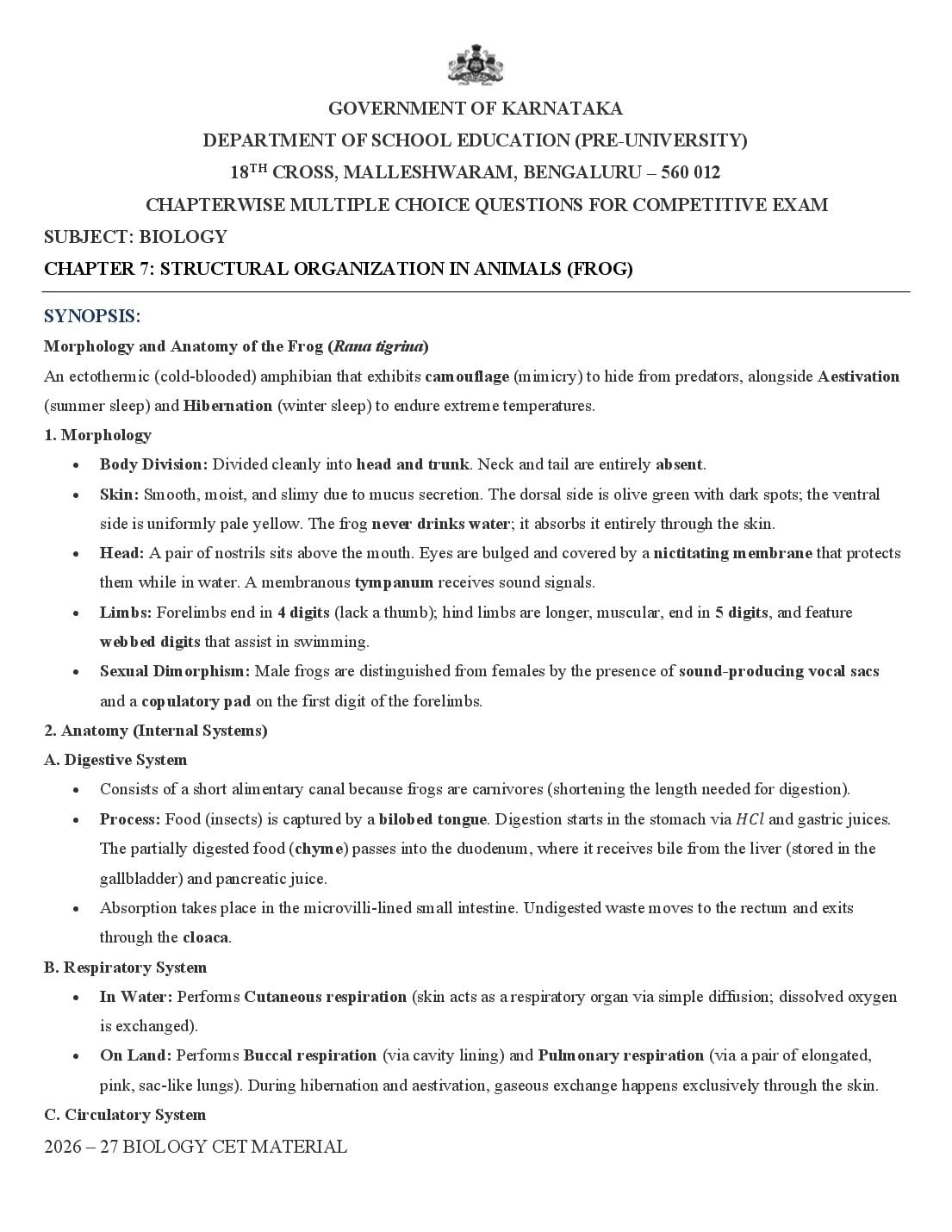
DEPARTMENT OF SCHOOL EDUCATION (PRE-UNIVERSITY)
18TH CROSS, MALLESHWARAM, BENGALURU – 560 012
CHAPTERWISE MULTIPLE CHOICE QUESTIONS FOR COMPETITIVE EXAM
SUBJECT: BIOLOGY
CHAPTER 7: STRUCTURAL ORGANIZATION IN ANIMALS (FROG)
SYNOPSIS:
Morphology and Anatomy of the Frog (Rana tigrina)
An ectothermic (cold-blooded) amphibian that exhibits camouflage (mimicry) to hide from predators, alongside Aestivation
(summer sleep) and Hibernation (winter sleep) to endure extreme temperatures.
1. Morphology
• Body Division: Divided cleanly into head and trunk. Neck and tail are entirely absent.
• Skin: Smooth, moist, and slimy due to mucus secretion. The dorsal side is olive green with dark spots; the ventral
side is uniformly pale yellow. The frog never drinks water; it absorbs it entirely through the skin.
• Head: A pair of nostrils sits above the mouth. Eyes are bulged and covered by a nictitating membrane that protects
them while in water. A membranous tympanum receives sound signals.
• Limbs: Forelimbs end in 4 digits (lack a thumb); hind limbs are longer, muscular, end in 5 digits, and feature
webbed digits that assist in swimming.
• Sexual Dimorphism: Male frogs are distinguished from females by the presence of sound-producing vocal sacs
and a copulatory pad on the first digit of the forelimbs.
2. Anatomy (Internal Systems)
A. Digestive System
• Consists of a short alimentary canal because frogs are carnivores (shortening the length needed for digestion).
• Process: Food (insects) is captured by a bilobed tongue. Digestion starts in the stomach via 𝐻𝐶𝑙 and gastric juices.
The partially digested food (chyme) passes into the duodenum, where it receives bile from the liver (stored in the
gallbladder) and pancreatic juice.
• Absorption takes place in the microvilli-lined small intestine. Undigested waste moves to the rectum and exits
through the cloaca.
B. Respiratory System
• In Water: Performs Cutaneous respiration (skin acts as a respiratory organ via simple diffusion; dissolved oxygen
is exchanged).
• On Land: Performs Buccal respiration (via cavity lining) and Pulmonary respiration (via a pair of elongated,
pink, sac-like lungs). During hibernation and aestivation, gaseous exchange happens exclusively through the skin.
C. Circulatory System
Page 2
membrane.
• Special Portals:
o Hepatic Portal System: Venous connection between liver and alimentary canal.
o Renal Portal System: Venous connection between kidneys and lower parts of the body.
• Blood: Contains plasma and cells. RBCs are uniquely nucleated and contain hemoglobin.
D. Excretory System
• Consists of a pair of compact, dark red, kidney-bean-like kidneys situated dorsally. The functional unit is the
nephron.
• In males, two ureters emerge from the kidneys and act as a urinogenital duct opening into the cloaca. In females,
ureters and oviducts open separately into the cloaca.
• The frog is a ureotelic animal (excretes urea).
E. Nervous & Endocrine Control
• Nervous System: Organized into Central (brain and spinal cord), Peripheral (10 pairs of cranial nerves), and
Autonomic systems. Brain is divided into forebrain (olfactory lobes, paired cerebral hemispheres, diencephalon),
midbrain (optic lobes), and hindbrain (cerebellum and medulla oblongata).
• Endocrine System: Chemical coordination via hormones from pituitary, thyroid, parathyroid, thymus, pineal body,
adrenal glands, pancreas, and gonads.
F. Reproductive System
• Male: A pair of yellowish ovoid testes are found adhered to the upper part of kidneys by a double fold of peritoneum
called mesorchium. From these, 10–12 vasa efferentia emerge, enter the kidney, and open into Bidder’s canal,
communicating ultimately with the urinogenital duct.
• Female: A pair of ovaries situated near kidneys with no functional connection to them. Oviducts open into the
cloaca separately. A female lays 2,500 to 3,000 ova at a time.
• Development: Fertilization is external and takes place in water. Development is indirect, involving a fish-like
swimming larval stage called a tadpole, which undergoes metamorphosis to become an adult.
CLASS ROOM DISCUSSION QUESTIONS
1. Rana tigrina displays all of the following habits except
(a) camouflage (b) aestivation
(c) hibernation (d) endothermy
2. The frogs have the ability to change its colour to hide them from their enemies. This protective colouration is
called
(a) hibernation (b) aestivation
(c) mimicry (d) camouflage
3. The skin of frogs is slippery and smooth due to the presence of
Page 3
(c) waxy skin (d) mucilage
4. Body of a frog is divisible into
(a) head and trunk (b) head, neck and trunk
(c) trunk and tail (d) head, neck, trunk and tail
5. The forelimbs and hindlimbs of frogs are
(a) four digits (b) five digits
(c) four and five digits, respectively (d) five and four digits, respectively
6. Male frog can be distinguished from female frog by the presence of
(a) vocal sacs and copulatory pad on the first digit of the forelimb
(b) a neck and tail is absent
(c) the hindlimb ends in the five digits
(d) eyes are bulged and covered by the nictitating membrane
7. The alimentary canal of frog is short because frogs are
(a) herbivores (b) carnivores
(c) omnivores (d) heterotrophs
8. In frog, excess of the bile juice secreted by the liver is stored in
(a) intestine (b) pancreas
(c) gall bladder (d) rectum
9. In frog, for the digestion of food, walls of the stomach secrete
(a) pepsin and renin (b) amylase and tryptophanase
(c) HCl and gastric juices (d) HCl and pepsin
10. In frogs, digested food is absorbed by
(a) villi and microvilli in intestine (b) villi in cloaca
(c) microvilli in cloaca (d) villi and microvilli in stomach and intestine
11. Given below is the diagram of internal organs of frog. Identify A to F.
Page 4
(b) A–Gall bladder, B–Lungs, C–Fat bodies, D–Kidney, E–Rectum, F–Urinary bladder
(c) A–Gall bladder, B–Lungs, C–Ovary, D–Kidney, E–Ileum, F–Urinary bladder
(d) A–Gall bladder, B–Lungs, C–Fat bodies, D–Kidney, E–Colon, F–Urinary bladder
12. The respiration by lungs in frog is called
(a) pulmonary respiration (b) pericardial respiration
(c) alveolar respiration (d) None of these
13. During aestivation and hibernation in frogs, gaseous exchange takes place through
(a) skin (b) nose
(c) lungs (d) scales
14. The vascular system of the frog is
(a) open type (b) closed type
(c) double circulatory (d) portal
15. The blood vascular system of the frog consists of
(a) heart, blood vessels and blood without haemoglobin
(b) blood vessels, capillaries and neurogenic heart
(c) haemolymph, blood vessels and heart
(d) arteries, veins, capillaries, heart and blood containing RBCs and WBCs
16. Three-chambered heart of the frog contains
(a) two ventricles and one atrium (b) two atria and one ventricle
(c) one auricle and two ventricles (d) one auricle, one ventricle and one atrium
17. Heart of the frog is covered by a membrane called
(a) pericardium (b) plasma membrane
(c) pleuromembrane (d) durameter
18. The lymph of frog lacks
(a) plasma proteins only (b) WBCs and RBCs
(c) RBCs and few proteins (d) RBCs, WBCs and proteins
19. In male frog, ureters act as
(a) urinogenital ducts (b) cloaca
(c) urinary bladder (d) genital ducts
20. Which of the following is the structural and functional unit of kidney in the frog?
(a) Ureters (b) Cloaca
(c) Nephrons (d) Bidder's canal
21. In frogs, cloaca is an opening of
Page 5
(c) Both (a) and (b) (d) None of these
22. The frog is a/an
(a) ureotelic animal (b) ammonotelic animal
(c) uricotelic animal (d) None of these
23. Excretory system of the frog consists of
(a) pair of kidneys, ureters, urinary bladder, cloaca
(b) single kidney, urinary bladder and cloaca
(c) kidney and cloaca (d) urethra and cloaca
24. The system for control and coordination in frogs comprises
(a) highly evolved neural system and endocrine glands
(b) highly evolved exocrine glands and least developed nervous system
(c) least developed endocrine system and nervous system
(d) endocrine and exocrine glands
25. The number of pairs of cranial nerves arising from the brain of frog is
(a) 10 (b) 9 (c) 8 (d) 7
26. The forebrain of frog consists of
(a) optic and olfactory lobes (b) paired diencephalon
(c) olfactory lobes and unpaired diencephalon (d) Both (a) and (b)
27. The midbrain of the frog is characterized by a pair of
(a) cerebral hemisphere (b) cerebellum
(c) optic lobes (d) olfactory lobes
28. Hindbrain of a frog consists of
(a) cerebellum and medulla oblongata (b) olfactory lobes and cerebral hemispheres
(c) a pair of optic lobes (d) cerebrum and cranium
29. Find out the pair in reference to the frog which is not correctly matched.
(a) Hearing – Tympanum with external ears (b) Touch – Sensory papillae
(c) Smell – Nasal epithelium (d) Vision – Simple eyes
30. In frogs, sensory papillae, taste buds and nasal epithelium are ......, while eyes and internal ears are well-
organised structures.
(a) cellular aggregations around muscular tissue
(b) cellular aggregations around nerve endings
(c) cellular aggregations around fatty tissue
(d) cellular aggregations around heart
31. The number of vasa efferentia that arises from testes in frog's male reproductive system is
Page 6
32. In male frogs, cloaca is a small median chamber that is used to pass
(a) sperms (b) urine (c) faecal matter (d) All of the above
33. Select the correct route for the passage of sperms in male frogs.
(a) Testes → Bidder's canal → Kidney → Vasa efferentia → Urinogenital duct → Cloaca
(b) Testes → Vasa efferentia → Kidney → Seminal vesicle → Urinogenital duct → Cloaca
(c) Testes → Vasa efferentia → Bidder's canal → Ureter → Cloaca
(d) Testes → Vasa efferentia → Kidney → Bidder's canal → Urinogenital duct → Cloaca
34. Identify A, B, C, D and E in the given figure of male reproductive system of frog.
(a) A–Fat bodies, B–Testis, C–Ureters, D–Vasa efferentia, E–Kidney
(b) A–Nephrons, B–Testis, C–Ureters, D–Villi, E–Kidney
(c) A–Vasa efferentia, B–Testis, C–Adrenal gland, D–Fat bodies, E–Kidney
(d) A–Mesorchium, B–Testis, C–Adrenal gland, D–Fat bodies, E–Kidney
35. Observe the following figure of female reproductive system of frog and identify A to D.
(a) A–Urinary duct, B–Ova, C–Ovary, D–Cloaca, E–Urethra
(b) A–Oviduct, B–Ovary, C–Ova, D–Cloaca, E–Urinary bladder
(c) A–Oviduct, B–Ovary, C–Ova, D–Rectum, E–Adrenal gland
(d) A–Urinogenital duct, B–Ovary, C–Ovum, D–Coelom, E–Urethra
36. In female frogs,
(a) ovaries are absent (b) ovaries are functionally connected with kidneys
(c) ovaries are not connected with kidney functionally
(d) ovaries and oviducts are rudimentary
I. Assertion and Reason
Direction (Q. No. 196-208) In each of the following questions, a statement of Assertion (A) is given followed by
corresponding statement of Reason (R). Of the statements, mark the correct answer as:
(a) If both A and R are true and R is the correct explanation of A.
(b) If both A and R are true, but R is not the correct explanation of A.
Page 7
(d) If A is false, but R is true.
37. Assertion (A) Columnar epithelium is also known as glandular epithelium.
Reason (R) Cells of columnar epithelium form the lining of the stomach.
38. Assertion (A) Compound epithelium plays major role in absorption, secretion and excretion.
Reason (R) Compound epithelium is not found in the stomach lining.
39. Assertion (A) Bone is the hardest tissue of the body.
Reason (R) Hardness of the bone is due to the calcification of its matrix.
40. Assertion (A) Adipose tissues are specialized to store fats.
Reason (R) The extra nutrients, which are not used immediately by the body get converted into fats.
41. Assertion (A) Cardiac muscle tissue is a contractile tissue present only in heart.
Reason (R) Cardiac muscle tissue provides rhythmic contraction to the heart.
42 Assertion (A) Earthworm moves by crawling.
Reason (R) Crawling in earthworm occurs by the muscular contraction and extension of the body.
43. Assertion (A) Earthworms are known as ‘friends of farmers’.
Reason (R) These help in increasing soil fertility by the process of vermicomposting.
44. Assertion (A) Respiratory gaseous exchange in earthworm occurs through the moist body surfaces into their
bloodstream.
Reason (R) Earthworms lack specialized breathing structures.
45. Assertion (A) Blood of the earthworm is red in colour.
Reason (R) Earthworm contains hemoglobin dissolved in the plasma.
46. Assertion (A) Earthworm is a hermaphrodite.
Reason (R) Hermaphroditism compensates for the lack of asexual reproduction by increasing the rate of
multiplication.
47. Assertion (A) If the head of a cockroach is cut off, it will remain alive for as long as one week.
Reason (R) The head of cockroach holds only a bit of nervous system.
48. Assertion (A) In frog’s vascular system, the composition of lymph is same as that of the blood.
Reason (R) In frog, lymph lacks RBCs and few proteins.
49. Assertion (A) Frogs have webbed feet.
Reason (R) Degree of webbing is directly proportional to the amount of time they spend in water.
II. Statement Based Questions
50. Consider the following statements.
I. The RBCs, WBCs and platelets are nucleated in frogs.
II. In frogs, there is a special venous connection between liver and intestine called hepatic portal system.
Select the correct option.
Page 8
(c) I is false, II is true (d) Both I and II are false
51. Consider the following statements.
I. External ears are absent in frog, only tympanum with internal ears aids in hearing .
II. The eyes of frog possess single unit hence, are simple.
Select the correct option.
(a) Both I and II are true (b) I is true, II is false
(c) Both I and II are false (d) I is false, II is true
52. Which of the following statements are correct in reference with the frog?
I. Eyes are bulged and covered by nictitating membrane.
II. Membranous tympanum receives the sound signals.
III. The frog never drinks water.
IV. Heart possesses sinus venosus.
Select the correct option:
(a) I and II (b) III and IV
(c) I and IV (d) I, II, III and IV
53. Consider the following statements about frog.
I. Skin acts as a respiratory organ only in water.
II. Development is indirect through tadpole larva.
III. Bidder canal is present in kidneys into which vasa efferentia opens in male frog.
IV. They possess well-developed renal portal system.
Which of the statements given above is/are incorrect?
(a) Only I (b) I and III (c) I, II, and III (d) II and IV
54. Frog's heart when taken out of the body continues to beat for some time.
I. Frog is not a poikilotherm.
II. Frog does not have any coronary circulation.
III. Heart is 'myogenic' in nature.
IV. Heart is autoexcitable.
Select the option containing the correct statements.
(a) Only III (b) Only IV (c) I and II (d) III and IV
Key
Page 9
d c a a c a b c c a
11 12 13 14 15 16 17 18 19 20
b a a b d b a c a c
21 22 23 24 25 26 27 28 29 30
c a a a a c c a a b
31 32 33 34 35 36 37 38 39 40
b d d c b c b d a b
41 42 43 44 45 46 47 48 49 50
a b a a a b a d b b
51 52 53 54
a d a d
Document Details
| Board / Org | Karnataka Board |
| Exam | Class 11 |
| Type | Question Bank |
| Pages | 9 |
| Updated | 24 Sep 2026 |