Karnataka 1st PUC Chemistry Structure of Atom MCQ with Answers
Finished viewing? Save it for later —
Download Karnataka 1st PUC Chemistry Structure of Atom MCQ with Answers (PDF · 13 pages)About Karnataka 1st PUC Chemistry Structure of Atom MCQ with Answers
Karnataka 1st PUC Chemistry Structure of Atom MCQ with Answers is available here for free download. Published by Karnataka Board for Class 11, this question bank can be viewed online or downloaded as a PDF (13 pages). Candidates preparing for Class 11 can use Karnataka 1st PUC Chemistry Structure of Atom MCQ with Answers to understand the exam pattern, the type of questions asked, and the overall difficulty level.
Frequently Asked Questions
How can I download Karnataka 1st PUC Chemistry Structure of Atom MCQ with Answers?
Open this page and click the Download button to save Karnataka 1st PUC Chemistry Structure of Atom MCQ with Answers as a PDF. It is completely free on AglaSem Docs.
Is Karnataka 1st PUC Chemistry Structure of Atom MCQ with Answers free to download?
Yes. Karnataka 1st PUC Chemistry Structure of Atom MCQ with Answers can be viewed online and downloaded as a PDF free of cost on AglaSem Docs.
How many pages does Karnataka 1st PUC Chemistry Structure of Atom MCQ with Answers have?
Karnataka 1st PUC Chemistry Structure of Atom MCQ with Answers contains 13 pages, which you can read online or download together as a single PDF.
Where can I find more Class 11 study material?
You can find more Class 11 question papers, sample papers, syllabus, and answer keys on AglaSem Docs.
Karnataka 1st PUC Chemistry Structure of Atom MCQ with Answers – Text
Read the full text of this question bank below — useful to quickly search, copy and reference the content online without downloading the PDF.
📄 View text version (13 pages)
Page 1
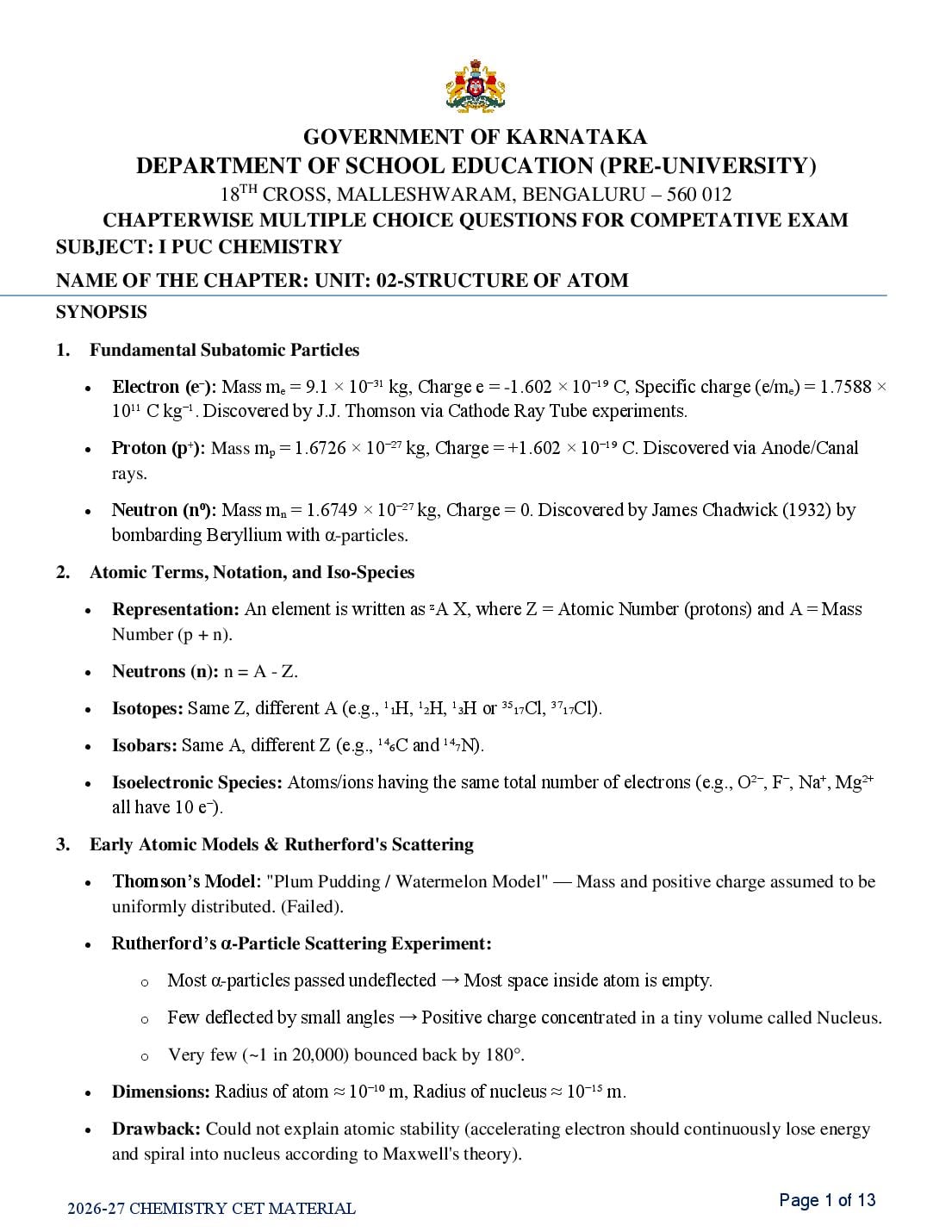
DEPARTMENT OF SCHOOL EDUCATION (PRE-UNIVERSITY)
18TH CROSS, MALLESHWARAM, BENGALURU – 560 012
CHAPTERWISE MULTIPLE CHOICE QUESTIONS FOR COMPETATIVE EXAM
SUBJECT: I PUC CHEMISTRY
NAME OF THE CHAPTER: UNIT: 02-STRUCTURE OF ATOM
SYNOPSIS
1. Fundamental Subatomic Particles
• Electron (e⁻): Mass mₑ = 9.1 × 10⁻³¹ kg, Charge e = -1.602 × 10⁻¹⁹ C, Specific charge (e/mₑ) = 1.7588 ×
10¹¹ C kg⁻¹. Discovered by J.J. Thomson via Cathode Ray Tube experiments.
• Proton (p⁺): Mass mₚ = 1.6726 × 10⁻²⁷ kg, Charge = +1.602 × 10⁻¹⁹ C. Discovered via Anode/Canal
rays.
• Neutron (n⁰): Mass mₙ = 1.6749 × 10⁻²⁷ kg, Charge = 0. Discovered by James Chadwick (1932) by
bombarding Beryllium with α-particles.
2. Atomic Terms, Notation, and Iso-Species
• Representation: An element is written as ᶻA X, where Z = Atomic Number (protons) and A = Mass
Number (p + n).
• Neutrons (n): n = A - Z.
• Isotopes: Same Z, different A (e.g., ¹₁H, ¹₂H, ¹₃H or ³⁵₁₇Cl, ³⁷₁₇Cl).
• Isobars: Same A, different Z (e.g., ¹⁴₆C and ¹⁴₇N).
• Isoelectronic Species: Atoms/ions having the same total number of electrons (e.g., O²⁻, F⁻, Na⁺, Mg²⁺
all have 10 e⁻).
3. Early Atomic Models & Rutherford's Scattering
• Thomson’s Model: "Plum Pudding / Watermelon Model" — Mass and positive charge assumed to be
uniformly distributed. (Failed).
• Rutherford’s α-Particle Scattering Experiment:
o Most α-particles passed undeflected → Most space inside atom is empty.
o Few deflected by small angles → Positive charge concentrated in a tiny volume called Nucleus.
o Very few (~1 in 20,000) bounced back by 180°.
• Dimensions: Radius of atom ≈ 10⁻¹⁰ m, Radius of nucleus ≈ 10⁻¹⁵ m.
• Drawback: Could not explain atomic stability (accelerating electron should continuously lose energy
and spiral into nucleus according to Maxwell's theory).
2026-27 CHEMISTRY CET MATERIAL Page 1 of 13
Page 2
• Electromagnetic waves travel at speed of light c = 3.0 × 10⁸ m s⁻¹ in vacuum.
• Key Relations:
o ν=c/λ
o ν̄ = 1 / λ = ν / c
(where ν = frequency in Hz or s⁻¹, λ = wavelength in m, ν̄ = wavenumber in m⁻¹ or cm⁻¹)
5. Planck’s Quantum Theory & Photoelectric Effect
• Radiant energy is absorbed or emitted discretely in packets called quanta (or photons for light):
o E = hν = (h × c) / λ
(Planck’s constant h = 6.626 × 10⁻³⁴ J s)
• Total Energy: E_total = n × h × ν (where n = number of photons).
• Photoelectric Effect (Einstein's Equation):
o E_incident = W₀ + K.E._max
o hν = hν₀ + ½ mₑ v²
o ν₀ = Threshold Frequency (minimum frequency required for emission).
o W₀ = hν₀ = Work Function of metal.
o Kinetic energy of ejected photoelectron depends only on frequency ν, whereas the number of
ejected electrons depends only on light intensity.
6. Hydrogen Line Spectrum & Rydberg Formula
• Spectral transitions between energy levels emit light of discrete wavelengths given by the Rydberg
Equation:
o ν̄ = 1 / λ = R_H × Z² × [ (1 / n₁²) - (1 / n₂²) ]
(Rydberg Constant RH = 109,677 cm⁻¹ = 1.097 × 10⁷ m⁻¹)
7. Spectral Series Summary Table
Series n₁ n₂ Spectral Region
Lyman 1 2, 3, 4, ... Ultraviolet (UV)
Balmer 2 3, 4, 5, ... Visible
Paschen 3 4, 5, 6, ... Infrared (IR)
Brackett 4 5, 6, 7, ... Infrared (IR)
Pfund 5 6, 7, 8, ... Infrared (IR)
2026-27 CHEMISTRY CET MATERIAL Page 2 of 13
Page 3
(n = 1) is given by:
o Total lines = [n × (n - 1)] / 2
8. Bohr's Postulates for Hydrogen & Single-Electron Ions (He⁺, Li²⁺, Be³⁺)
• Electrons revolve only in non-radiating stationary orbits.
• Quantization of Angular Momentum:
o mₑ × v × r = n × (h / 2π) (where n = 1, 2, 3, ...)
9. Key Bohr Formulas for Single-Electron Species
• Radius of nᵗʰ orbit:
o rₙ = (52.9 × n²) / Z pm = (0.529 × n²) / Z Å (For Hydrogen ground state n = 1, Z = 1 → r₁ = 52.9
pm = a₀)
• Energy of nᵗʰ orbit:
o Eₙ = -2.18 × 10⁻¹⁸ × (Z² / n²) J atom⁻¹ = -13.6 × (Z² / n²) eV atom⁻¹
o Negative sign indicates that the electron is bound to the nucleus (lower energy than free electron
at rest where E∞ = 0).
• Velocity of electron: vₙ ∝ Z / n.
10. Limitations of Bohr's Model
1. Fails to explain spectra of multi-electron atoms.
2. Cannot explain fine structure splitting of spectral lines.
3. Cannot explain Zeeman Effect (splitting in magnetic field) and Stark Effect (splitting in electric field).
4. Violates Heisenberg Uncertainty Principle (assumes well-defined paths/trajectories).
11. Dual Nature of Matter (de Broglie Hypothesis)
• All moving particles exhibit wave-like behavior.
• de Broglie Wavelength Equation:
o λ = h / p = h / (m × v) = h / √(2 × m × K.E.)
• For Charged Particle (accelerated through potential V):
o λ = h / √(2 × m × q × V)
• Connection with Bohr's Postulate: Circumference of nᵗʰ Bohr orbit is an integral multiple of de
Broglie wavelength:
o 2π × rₙ = n × λ
2026-27 CHEMISTRY CET MATERIAL Page 3 of 13
Page 4
• It is impossible to determine simultaneously both the precise position and precise momentum (or
velocity) of a microscopic particle:
o Δx × Δp ≥ h / 4π ⇒ Δx × (m × Δv) ≥ h / 4π (Δx = Uncertainty in position, Δv = Uncertainty in
velocity)
• Significance: Significant only for subatomic particles (e.g., electrons); negligible for macroscopic
objects. Rules out the existence of definite Bohr orbits!
13. Quantum Mechanical Model & Wave Function (ψ)
• Derived from the Schrödinger Wave Equation: Ĥψ = Eψ.
• Wave Function (ψ): Has no direct physical meaning; acts as an orbital wave function.
• Probability Density (|ψ|²): Represents the probability of finding an electron at a given point per unit
volume. Always positive.
14. Orbit vs. Orbital
• Orbit: A well-defined 2D circular path around the nucleus (Bohr concept; invalid).
• Orbital: A 3D region of space around the nucleus where the probability of finding an electron is
maximum (~90%).
15. The Four Quantum Numbers
Permissible
Quantum Number Symbol Represents / Significance
Values
Principal n 1, 2, 3, ... Shell number, size, and major energy level.
Azimuthal Subshell, 3D shape, and orbital angular
l 0 to (n - 1)
(Subsidiary) momentum.
Magnetic Orbital mₗ -l ... 0 ... +l Spatial orientation of orbital (2l + 1 values).
Electron Spin mₛ +½, -½ Spin direction (↑ or ↓).
16. Subshell Shapes & Value Summary
• l = 0 (s-subshell): Spherical shape (1 orbital).
• l = 1 (p-subshell): Dumbbell shape (3 orbitals: pₓ, pᵧ, p_z).
• l = 2 (d-subshell): Double-dumbbell shape (5 orbitals: d_xy, d_yz, d_zx, d_x²-y², d_z²).
• l = 3 (f-subshell): Complex shape (7 orbitals).
2026-27 CHEMISTRY CET MATERIAL Page 4 of 13
Page 5
o L = √[ l × (l + 1) ] × (h / 2π)
17. Radial and Angular Nodes
• Node: Region where the probability density |ψ|² = 0.
• Radial Nodes (Spherical Nodes): = n - l - 1
• Angular Nodes (Nodal Planes): = l
• Total Nodes:
o Total Nodes = (n - l - 1) + l = n - 1
18. Rules for Filling Orbitals in Atoms
1. Aufbau Principle: Orbitals are filled in order of increasing energy based on the (n + l) Rule:
o Lower (n + l) orbital is filled first.
o If two orbitals have the same (n + l) value, the orbital with lower n has lower energy and fills
first.
o Order: 1s < 2s < 2p < 3s < 3p < 4s < 3d < 4p < 5s < 4d ...
2. Pauli’s Exclusion Principle: No two electrons in an atom can have the same set of all four quantum
numbers.
o Consequence: An orbital can hold a maximum of 2 electrons of opposite spins.
o Capacity Formulas: Max e⁻ in a shell = 2n²; Max e⁻ in a subshell = 2 × (2l + 1).
3. Hund’s Rule of Maximum Multiplicity: Electron pairing in degenerate orbitals (p, d, f) does not occur
until each orbital is singly occupied with parallel spins.
19. Stability of Half-Filled and Fully-Filled Subshells
Configurations with half-filled (p³, d⁵, f⁷) or fully-filled (p⁶, d¹⁰, f¹⁴) subshells possess extra stability due to:
1. Symmetrical Distribution of Electrons: Leads to lower mutual shielding and stronger nuclear
attraction.
2. Maximum Exchange Energy: Electrons with parallel spins exchange positions in degenerate orbitals,
releasing stabilizing exchange energy.
20. Exceptional Electronic Configurations (Crucial for Questions)
Due to extra stability of half-filled and fully-filled subshells, an electron shifts from 4s to 3d:
• Chromium (Cr, Z = 24): [Ar] 3d⁵ 4s¹ (Expected [Ar] 3d⁴ 4s²)
• Copper (Cu, Z = 29): [Ar] 3d¹⁰ 4s¹ (Expected [Ar] 3d⁹ 4s²)
• Chromium Ion (Cr³⁺): [Ar] 3d³ 4s⁰ (Electrons are removed first from 4s, then from 3d)
• Iron Ion (Fe³⁺, Z = 26): [Ar] 3d⁵ 4s⁰
2026-27 CHEMISTRY CET MATERIAL Page 5 of 13
Page 6
2.1 Discovery of sub-atomic particles
1. What is wrong about anode rays?
a) They are produced by ionization of molecules of the residual gas.
b) Their𝑒/𝑚 ratio is constant.
c) They do not originate from the anode.
d) They are deflected by electrical and magnetic field.
2. Which property of neuron and proton is approximately same?
a) Symbol b) Mass
c) Relative charge d) Actual charge
3. Cathode rays are
a) electromagnetic waves b) stream of𝛼 - particles
c) stream of electrons d) stream of positrons
4. How many number of electrons are present in a particle which carries a charge of5.5 × 10−16 𝐶 ?
a) 1560 b) 3432
c) 2432 d) 8240 [KCET 2014]
5. The magnitude of the charge on the electron is4.8 × 10−10 esu. What is the magnitude of the charge on the
proton on the nucleus of helium atom? [KCET 2013]
a) 6.4 × 10⁻¹⁰ 𝑒𝑠𝑢 b) 9.6 × 10⁻¹⁰ 𝑒𝑠𝑢
c) 4.8 × 10⁻¹⁰ esu d) 14.4 × 10⁻¹⁰ esu
6. Mass number of an atom is the sum of [KCET 2015]
a) number of electrons + number of neutrons
b) number of protons + number of electrons
c) number of protons + number of neutrons
d) number of protons + number of neutrons + number of electrons
2.2 Atomic models
32 2−
7. The number of protons, neutrons and electrons in the ion 16 𝑠 respectively are [KCET 2016]
a) 16,16,18 b) 16,18,16
c) 16,16,16 d) 18,16,16
8. 𝑀𝑔2+ is isoelectronic with
a) 𝐶𝑢2+ b) 𝐶𝑎2+
c) 𝑍𝑛2+ d) 𝑁𝑎 +
9. The group having isoelectronic species is [KCET 2017]
a) 𝑂2− , 𝐹 − , 𝑁𝑎+ , 𝑀𝑔2+ b) 𝑂− , 𝐹 − , 𝑁𝑎+ , 𝑀𝑔2+
2026-27 CHEMISTRY CET MATERIAL Page 6 of 13
Page 7
10. Which is not isoelectronic with the other three? [KCET 2018]
a) 𝑂2 b) 𝐶𝑁 −
c) CO d) 𝑁𝑂 +
11. Rutherford’s scattering experiment is related to the size of the
a) atom b) electron
c) nucleus d) neutron
12. An ion with mass number 56 contains 3 units of positive charge and30.4% more neutrons than electrons.
What would be the symbol of this ion? [JEE MAIN 2019]
a) 56
26 𝐹𝑒
3+
b) 56
27 𝐶𝑜
2+
c) 56
26 𝐹𝑒
2+
d) 58
27 𝐶𝑜
3+
2.3 Developments leading to the Bohr’s model of atom
13. If wavelength of photon is2.2 × 10−11 𝑚 and ℎ = 6.6 × 10⁻³⁴ 𝐽 𝑠 , then momentum of photon
a) 6.89 × 10−43 𝑘𝑔 𝑚 𝑠 −1 b) 3 × 10⁻²³ 𝑘𝑔 𝑚 𝑠 −1
c) 1.452 × 10−44 𝑘𝑔 𝑚 𝑠 −1 d) 3.33 × 10⁻²² 𝑘𝑔 𝑚 𝑠 −1 [KCET 2018]
14. With regard to photoelectric effect, identify the correct statement among the following. [KCET 2019]
a) Energy of𝑒 − ejected increases with the increase in the intensity of incident light.
b) Number of𝑒 − ejected increases with the increase in the intensity of incident light.
c) Number of𝑒 − ejected increases with the increase in work function.
d) Number of𝑒 − ejected increases with the increase in the frequency of incident light.
15. The number of photons emitted per second by a 60 watt source of monochromatic light of wavelength 663
nm is(ℎ = 6.63 × 10⁻³⁴ 𝐽 𝑠)
a) 3 × 10⁻²⁰ b) 1.5 × 10²⁰
c) 2 × 10²⁰ d) 4 × 10⁻²⁰
𝑜
16. If wavelength of1𝑠𝑡 line of Balmer series is 6500𝐴 , then wavelength of 2𝑛𝑑 line of Balmer series is
𝑜 𝑜
a) 8775𝐴 b) 4814.8𝐴
𝑜 𝑜
c) 180.5𝐴 d) 3250𝐴 [KCET 2017]
17. The shortest wavelength of the line in hydrogen atomic spectrum of Lyman series when𝑅𝐻 =
109678 𝑐𝑚−1 is [KCET 2016]
𝑜 𝑜
a) 1215.67𝐴 b) 1127.30𝐴
𝑜 𝑜
c) 1002.7𝐴 d) 911.7𝐴
18. Which one of the following corresponds to a photon of highest energy?
a) 𝑣‾ = 30 𝑐𝑚−1 b) 𝜆 = 300 𝑛𝑚
2026-27 CHEMISTRY CET MATERIAL Page 7 of 13
Page 8
19. Given below are the spectral lines for an atom of hydrogen. Mark the lines which are not correctly matched
with the value of𝑛1 and 𝑛2 ? [KCET 2020]
a) (i) and (iv) b) (i) and (iii)
c) (i) and (ii) d) (ii) and (iv)
20. A certain metal when irradiated by light(𝑣 = 3.2 × 10¹⁶ 𝐻𝑧) emits photoelectrons with twice of K.E. as
did photoelectrons when the same metal is irradiated by light ( 𝑣 = 2.0 × 10¹⁶ 𝐻𝑧) . The 𝑣0 of the metal is
a) 4 × 10¹² 𝐻𝑧 b) 1.2 × 10¹⁶ 𝐻𝑧
c) 1.2 × 10¹⁴ 𝐻𝑧 d) 8 × 10¹⁵ 𝐻𝑧 [JEE MAIN 2018]
𝑜
21. Wave number and frequency of yellow radiation having wavelength5800𝐴 are
a) 1.66 × 10⁻⁸ 𝑐𝑚−1 ; 7.21 × 10¹⁴ 𝑠 −1 b) 1.724 × 10⁴ 𝑐𝑚−1 ; 5.172 × 10¹⁴ 𝑠 −1
c) 1.92 × 10⁻⁴ 𝑐𝑚−1 ; 5.172 × 10¹⁹ 𝑠 −1 d) 2.246 × 10⁴ 𝑐𝑚−1 ; 1.72 × 10¹⁰ 𝑠 −1
22. Emission transitions in the Paschen series to orbit𝑛 = 3 from orbit 𝑛 can be represented as 𝑣 =
1 1
3.29 × 10¹⁵ ( 𝐻𝑧) [(3)2 − 𝑛2 ] . The value of 𝑛 if the transition is observed at 1285 nm (wavelength) is
a) 4 b) 3
c) 6 d) 5 [KCET 2019]
23. The electron in the hydrogen atom undergoes transition from higher orbitals to orbital of radius 211.6 pm.
This transition is associated with [NEET 2020]
a) Brackett series b) Lyman series
c) Balmer series d) Paschen series
24. A 100 watt bulb emits monochromatic light of wavelength 400 nm. Calculate the number of photons
emitted per second by the bulb.
a) 2 × 10⁻²⁰ 𝑠 −1 b) 1 × 10⁻²⁰ 𝑠 −1
c) 3 × 10²⁰ 𝑠 −1 d) 2 × 10²⁰ 𝑠 −1
2.4 Bohr’s model for Hydrogen atom
25. The energy associated with first orbit of𝐻𝑒 + is
a) 0 J b) −0.545 × 10⁻¹⁸ 𝐽
c) −4.58 × 10⁻¹⁸ 𝐽 d) −8.72 × 10⁻¹⁸ 𝐽
26. The energy of electron in the𝑛𝑡ℎ Bohr orbit of H - atom is
2026-27 CHEMISTRY CET MATERIAL Page 8 of 13
Page 9
a) 𝑒𝑉 b) 𝑒𝑉
𝑛2 𝑛4
−13.6 −13.6
c) 𝑒𝑉 d) 𝑒𝑉
𝑛3 𝑛
27. The radius of which of the following orbit is same as that of the Bohr’s first orbit of hydrogen atom?
a) 𝐵𝑒 3+ (𝑛 = 2) b) 𝐿𝑖 2+ (𝑛 = 2)
c) 𝐿𝑖 2+ (𝑛 = 3) d) 𝐻𝑒 + (𝑛 = 2) [KCET 2017]
28. If the electron falls from𝑛 = 5 to 𝑛 = 4 in the H - atom, then emitted energy is
a) 0.306 eV b) 0.65 eV
c) 1.89 eV d) 12.09 eV
29. The energy of second Bohr’s orbit of the hydrogen atom is−328 𝑘𝐽 𝑚𝑜𝑙 −1 , hence the energy of fourth
Bohr’s orbit would be
a) −41 𝑘𝐽 𝑚𝑜𝑙 −1 b) −82 𝑘𝐽 𝑚𝑜𝑙 −1
c) −1312 𝑘𝐽 𝑚𝑜𝑙 −1 d) −164 𝑘𝐽 𝑚𝑜𝑙 −1
30. Splitting of spectral lines under the influence of magnetic field is called
a) Photoelectric effect b) Zeeman effect
c) Stark effect d) none of these
31. The ionisation potential of the ground state of hydrogen atom is2.17 × 10−11 ergs per atom. Calculate the
wavelength of the photon that is emitted when an electron in 3𝑟𝑑 Bohr orbit return to 1𝑠𝑡 orbit in hydrogen
atom.
𝑜 𝑜
a) 1026𝐴 b) 1370𝐴
𝑜 𝑜
c) 8212𝐴 d) 2737𝐴
32. Calculate the energy of H - atom orbital (J atom−1 ) whose angular momentum is 4.2178 × 10⁻³⁴ 𝑘𝑔 𝑚2 /
𝑠𝑒𝑐 . [KCET 2020]
a) −87.8 × 10⁻¹⁹ b) −34.88 × 10⁻¹⁸
c) −1.36 × 10⁻¹⁹ d) −5.45 × 10⁻¹⁹
33. What would be the wavelength and name of series respectively for the emission transition for H - atom if it
starts from the orbit having radius 1.3225 nm and ends at 211.6 pm?
a) 600 nm, Lyman b) 434 nm, Balmer
c) 434 pm, Paschen d) 545 pm, Pfund
2.5 Towards Quantum mechanical model of the atom
34. Two particles𝐴 and 𝐵 are in motion. If the wavelength associated with ’A’ is 33.33 nm, the wavelength
associated with ’ 𝐵 ’ whose momentum is 1/3𝑟𝑑 of ’A’ is [KCET 2018]
a) 2.5 × 10⁻⁸ 𝑚 b) 1.25 × 10⁻⁷ 𝑚
c) 1.0 × 10⁻⁷ 𝑚 d) 1.0 × 10⁻⁸ 𝑚
2026-27 CHEMISTRY CET MATERIAL Page 9 of 13
Page 10
35. What will be the uncertainty in velocity of an electron when the uncertainty in its position is 1000𝐴 ?
a) 5.79 × 10⁻¹⁰ 𝑚 𝑠 −1 b) 5.79 × 10⁴ 𝑚 𝑠 −1
c) 5.79 × 10² 𝑚 𝑠 −1 d) 5.79 × 10⁸ 𝑚 𝑠 −1
36. The uncertainty in momentum of an electron is1 × 10−5 𝑘𝑔 𝑚/𝑠 . The uncertainty in its position will be
(ℎ = 6.62 × 10⁻³⁴ 𝑘𝑔 𝑚2 /𝑠)
a) 1.05 × 10⁻²⁸ 𝑚 b) 5.27 × 10⁻³⁰ 𝑚
c) 5.25 × 10⁻²⁸ 𝑚 d) 1.05 × 10⁻²⁶ 𝑚
37. What will be the uncertainty in velocity of a bullet with a mass of 10 g whose position is known
with±0.01 𝑚𝑚 ?
a) 5.275 × 10⁻³³ 𝑚 𝑠 −1 b) 5.275 × 10⁻²⁸ 𝑚 𝑠 −1
c) 5.275 × 10⁻²⁵ 𝑚 𝑠 −1 d) 5.275 × 10⁻⁵ 𝑚 𝑠 −1
𝑜
38. A microscope using suitable photons is employed to locate an electron in an atom within a distance of0.1𝐴
. What is the uncertainty involved in the measurement of its velocity?
a) 5.79 × 10⁶ 𝑚/𝑠 b) 6.69 × 10⁸ 𝑚/𝑠
c) 4.42 × 10⁶ 𝑚/𝑠 d) 7.32 × 10⁸ 𝑚/𝑠
39. The accelerating potential that must be imparted to a proton beam to give it an effective wavelength of 0.05
nm is (wt. of one mole of proton = 1.008 g) [KCET 2017]
a) 3.25 eV b) 52.05 eV
c) 0.325 eV d) 5.205 eV
40. If the de Broglie wavelength of a particle of mass m is 100 times its velocity, then its value in terms of its
mass (m) and Planck’s constant (h) is
1 𝑚 1 ℎ
a) 10 √ ℎ b) 10 √𝑚
ℎ 𝑚
c) 10√𝑚 d) 10√ ℎ
41. Uncertainty in position of an electron (mass= 9.1 × 10⁻²⁸ 𝑔 ) moving with a velocity of 3 × 10⁴ 𝑐𝑚/𝑠
accurate upto 0.001% will be (Use ℎ/(4𝜋) in uncertainty expression where ℎ = 6.626 × 10⁻²⁷ erg
second) [KCET 2021]
a) 1.93 cm b) 3.84 cm
c) 5.76 cm d) 7.68 cm
2.6 Quantum mechanical model of atom
42. Consider the following sets of quantum numbers: Which of the below setting is not permissible
arrangement of electrons in an atom?
1 1
a) n - 4, l - 0, m - 0, s - − b) n - 3, l - 2, m - - 2, s - −
2 2
2026-27 CHEMISTRY CET MATERIAL Page 10 of 13
Page 11
c) n - 3, l - 2, m - - 3, s - + 2 d) n - 5, l - 3, m - 3, s - + 2
43. The correct set of quantum numbers for the unpaired electron of chlorine atom is [NEET 2016]
1 1
a) 3,1,1, ± 2 b) 2,1, −1, + 2
1 1
c) 3,0,0, ± 2 d) 2,0,0, + 2
44. The number of angular and radial nodes in3𝑝 orbital respectively are [NEET 2018]
a) 2, 1 b) 2, 3
c) 1, 1 d) 3, 1
45. In any subshell, the maximum number of electrons having same value of spin quantum number is
a) 4𝑙 + 2 b) 𝑙 + 2
c) 2𝑙 + 1 d) √𝑙(𝑙 + 1)
46. Subsidiary quantum number specifies
a) nuclear stability b) orientations of orbital
c) size of orbital d) shape of orbital
47. What is the maximum number of orbitals that can be identified with the following quantum numbers?
n = 3, l = 1, m 𝑙 = 0 [KCET 2018]
a) 2 b) 1
c) 3 d) 4
48. The region where probability density function reduces to zero is called
a) nodal surfaces b) probability density region
c) wave function d) orientation surfaces
49. Which of the following sets of quantum numbers belongs to highest energy?
1 1
a) 𝑛 = 3, 𝑙 = 0, 𝑚 = 0, 𝑠 = + 2 b) 𝑛 = 4, 𝑙 = 0, 𝑚 = 0, 𝑠 = + 2
1 1
c) 𝑛 = 3, 𝑙 = 2, 𝑚 = 1, 𝑠 = + 2 d) 𝑛 = 3, 𝑙 = 1, 𝑚 = 1, 𝑠 = + 2
50. The correct set of four quantum numbers for the outermost electron of sodium(𝑍 = 11) is [KCET 2019]
a) 3,1,0,1/2 b) 3,1,1,1/2
c) 3,0,0,1/2 d) 3,2,1,1/2
51. Which atom(𝑋) is indicated by the following configuration? 𝑋 → [𝑁𝑒]3𝑠 2 3𝑝3
a) Phosphorus b) Chlorine
c) Nitrogen d) Sulphur
52. Which of the following configurations does not follow Hund’s rule of maximum multiplicity?
a) 1𝑠 2 2𝑠 2 2𝑝6 3𝑠 2 3𝑝4 4𝑠 2 b) 1𝑠 2 2𝑠 2 2𝑝6 3𝑠 2 3𝑝6 4𝑠 2 3𝑑6
c) 1𝑠 2 2𝑠 2 2𝑝6 3𝑠 2 3𝑝6 4𝑠1 3𝑑 5 d) 1𝑠 2 2𝑠 2 2𝑝6 3𝑠 2 3𝑝2
53. The orbital diagram in which both Pauli’s exclusion principle and Hund’s rule are violated is
2026-27 CHEMISTRY CET MATERIAL Page 11 of 13
Page 12
c) d) [KCET 2017]
54. Describe the orbital with following quantum numbers: [KCET 2016]
1. 𝑛 = 3, 𝑙 = 2
2. 𝑛 = 4, 𝑙 = 3
a) (i)3𝑝 , (ii) 4𝑓 b) (i)3𝑑 , (ii) 4𝑑
c) (i)3𝑓 , (ii) 4𝑓 d) (i)3𝑑 , (ii) 4𝑓
55. How many electrons in an atom have the following quantum numbers? 𝑛 = 4, 𝑚𝑠 = −1/2 [KCET 2020]
a) 18 b) 32
c) 16 d) 8
56. The electronic configurations of Eu (Atomic No. 63), Gd (Atomic No. 64) and Tb (Atomic No. 65) are
a) 4𝑓 7 6𝑠 2 , [𝑋𝑒]4𝑓 8 6𝑠 2 and 4𝑓 8 5𝑑1 6𝑠 2 b) 4𝑓 6 5𝑑1 6𝑠 2 , [𝑋𝑒]4𝑓 7 5𝑑1 6𝑠 2 and 4𝑓 9 6𝑠 2
c) 4𝑓 6 5𝑑1 6𝑠 2 , [𝑋𝑒]4𝑓 7 5𝑑1 6𝑠 2 and 4𝑓 8 5𝑑1 6𝑠 2 d) 4𝑓 7 6𝑠 2 , [𝑋𝑒]4𝑓 7 5𝑑1 6𝑠 2 and 4𝑓 9 6𝑠 2
57. The magnetic quantum number for𝑑 - orbital is given by
a) 0,1,2 b) 0, ±1, ±2
c) 2 d) 5
58. An electron is in one of the 3𝑑 - orbitals. What are the possible values of 𝑛, 𝑙 and 𝑚 for this electron?
a) 𝑛 = 3, 𝑙 = 2, 𝑚𝑙 = −2, −1,0, +1, +2 b) 𝑛 = 3, 𝑙 = 0, 𝑚𝑙 = 0
c) 𝑛 = 3, 𝑙 = 3, 𝑚𝑙 = −3, −2, −1,0, +1, +2, +3 d) 𝑛 = 3, 𝑙 = 1, 𝑚𝑙 = −1,0, +1
59. The electronic configuration of𝐶𝑟 3+ is
a) 3𝑑2 4𝑠1 b) 3𝑑 5 4𝑠1
c) 3𝑑4 4𝑠 2 d) 3𝑑 3 4𝑠 0
60. 𝑃 is the probability of finding the 1𝑠 electron of hydrogen atom in a spherical shell of infinitesimal
thickness 𝑑𝑟 , at a distance 𝑟 from the nucleus. The volume of this shell is 4𝜋𝑟 2 𝑑𝑟 . The qualitative sketch
of the dependence of 𝑃 on 𝑟 is [KCET 2020]
a) b)
c) d)
2026-27 CHEMISTRY CET MATERIAL Page 12 of 13
Page 13
Q.No Key Q.No Key Q.No Key Q.No Key Q.No Key
1 B 2 B 3 C 4 B 5 B
6 C 7 A 8 D 9 A 10 A
11 C 12 A 13 B 14 B 15 C
16 B 17 D 18 B 19 D 20 D
21 B 22 D 23 C 24 D 25 D
26 A 27 A 28 A 29 B 30 B
31 A 32 C 33 B 34 C 35 C
36 B 37 B 38 A 39 C 40 C
41 A 42 C 43 A 44 C 45 C
46 D 47 B 48 A 49 C 50 C
51 A 52 A 53 A 54 D 55 C
56 D 57 B 58 A 59 D 60 C
*********
2026-27 CHEMISTRY CET MATERIAL Page 13 of 13
Document Details
| Board / Org | Karnataka Board |
| Exam | Class 11 |
| Type | Question Bank |
| Pages | 13 |
| Updated | 24 Sep 2026 |