Karnataka 1st PUC Chemistry Classification of Elements and Periodicity in Properties MCQ with Answers
Finished viewing? Save it for later —
Download Karnataka 1st PUC Chemistry Classification of Elements and Periodicity in Properties MCQ with Answers (PDF · 11 pages)About Karnataka 1st PUC Chemistry Classification of Elements and Periodicity in Properties MCQ with Answers
Karnataka 1st PUC Chemistry Classification of Elements and Periodicity in Properties MCQ with Answers is available here for free download. Published by Karnataka Board for Class 11, this question bank can be viewed online or downloaded as a PDF (11 pages). Candidates preparing for Class 11 can use Karnataka 1st PUC Chemistry Classification of Elements and Periodicity in Properties MCQ with Answers to understand the exam pattern, the type of questions asked, and the overall difficulty level.
Frequently Asked Questions
How can I download Karnataka 1st PUC Chemistry Classification of Elements and Periodicity in Properties MCQ with Answers?
Open this page and click the Download button to save Karnataka 1st PUC Chemistry Classification of Elements and Periodicity in Properties MCQ with Answers as a PDF. It is completely free on AglaSem Docs.
Is Karnataka 1st PUC Chemistry Classification of Elements and Periodicity in Properties MCQ with Answers free to download?
Yes. Karnataka 1st PUC Chemistry Classification of Elements and Periodicity in Properties MCQ with Answers can be viewed online and downloaded as a PDF free of cost on AglaSem Docs.
How many pages does Karnataka 1st PUC Chemistry Classification of Elements and Periodicity in Properties MCQ with Answers have?
Karnataka 1st PUC Chemistry Classification of Elements and Periodicity in Properties MCQ with Answers contains 11 pages, which you can read online or download together as a single PDF.
Where can I find more Class 11 study material?
You can find more Class 11 question papers, sample papers, syllabus, and answer keys on AglaSem Docs.
Karnataka 1st PUC Chemistry Classification of Elements and Periodicity in Properties MCQ with Answers – Text
Read the full text of this question bank below — useful to quickly search, copy and reference the content online without downloading the PDF.
📄 View text version (11 pages)
Page 1
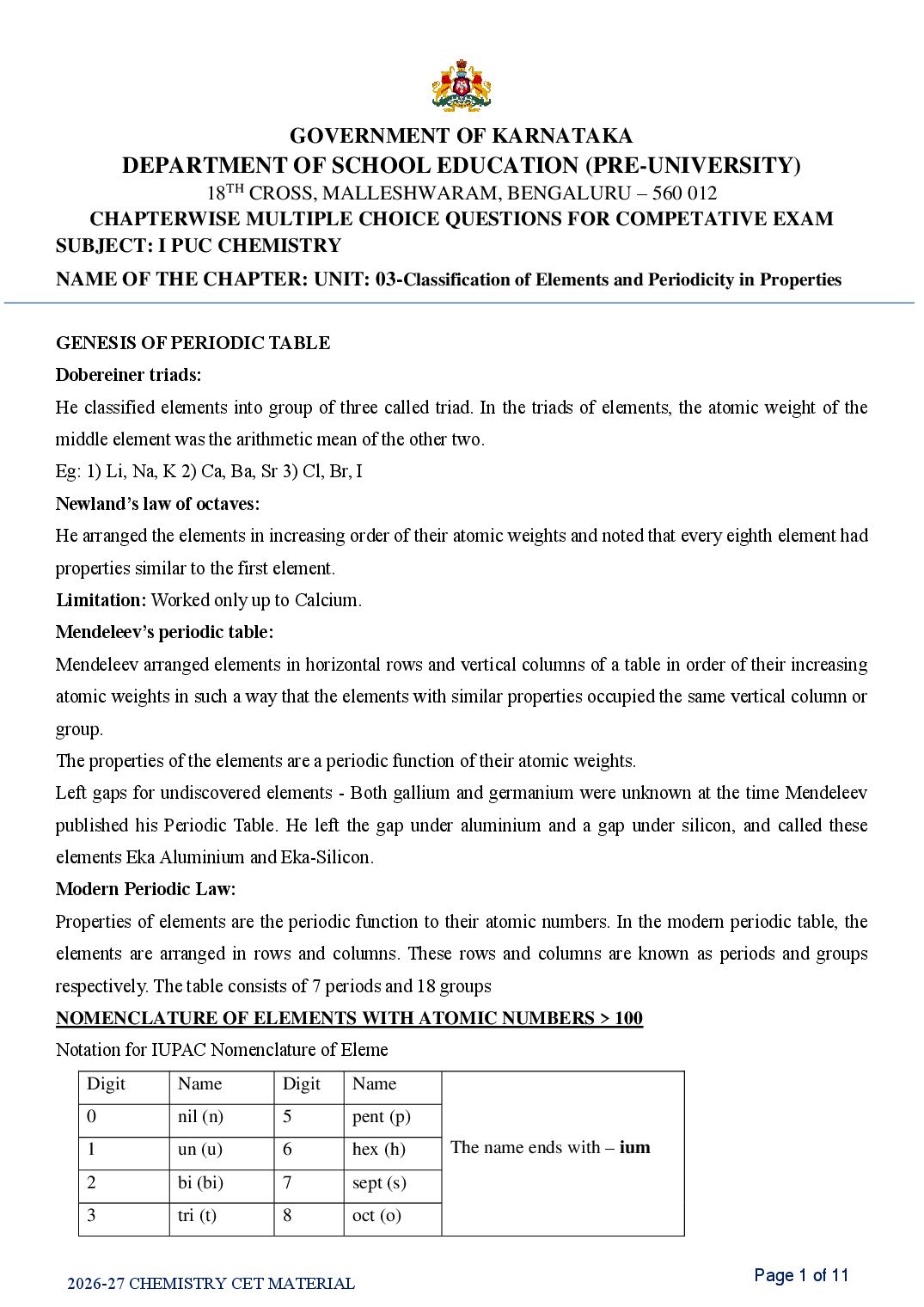
DEPARTMENT OF SCHOOL EDUCATION (PRE-UNIVERSITY)
18TH CROSS, MALLESHWARAM, BENGALURU – 560 012
CHAPTERWISE MULTIPLE CHOICE QUESTIONS FOR COMPETATIVE EXAM
SUBJECT: I PUC CHEMISTRY
NAME OF THE CHAPTER: UNIT: 03-Classification of Elements and Periodicity in Properties
GENESIS OF PERIODIC TABLE
Dobereiner triads:
He classified elements into group of three called triad. In the triads of elements, the atomic weight of the
middle element was the arithmetic mean of the other two.
Eg: 1) Li, Na, K 2) Ca, Ba, Sr 3) Cl, Br, I
Newland’s law of octaves:
He arranged the elements in increasing order of their atomic weights and noted that every eighth element had
properties similar to the first element.
Limitation: Worked only up to Calcium.
Mendeleev’s periodic table:
Mendeleev arranged elements in horizontal rows and vertical columns of a table in order of their increasing
atomic weights in such a way that the elements with similar properties occupied the same vertical column or
group.
The properties of the elements are a periodic function of their atomic weights.
Left gaps for undiscovered elements - Both gallium and germanium were unknown at the time Mendeleev
published his Periodic Table. He left the gap under aluminium and a gap under silicon, and called these
elements Eka Aluminium and Eka-Silicon.
Modern Periodic Law:
Properties of elements are the periodic function to their atomic numbers. In the modern periodic table, the
elements are arranged in rows and columns. These rows and columns are known as periods and groups
respectively. The table consists of 7 periods and 18 groups
NOMENCLATURE OF ELEMENTS WITH ATOMIC NUMBERS > 100
Notation for IUPAC Nomenclature of Eleme
Digit Name Digit Name
0 nil (n) 5 pent (p)
1 un (u) 6 hex (h) The name ends with – ium
2 bi (bi) 7 sept (s)
3 tri (t) 8 oct (o)
2026-27 CHEMISTRY CET MATERIAL Page 1 of 11
Page 2
Elements: Valence Shell Nature Position in Modern
Electronic Periodic Table
Configuration
s-block ns1-2 Metals 1 and 2 group elements
p – block ns2np1-6 Metalloids & nonmetals but some of Groups 13 to 18
them are metals also.
d-Block (n-1) d1-10 ns1-2 Metals 3 to 12 groups
f-Block (n-2) f1-14(n-1) d 0-1ns2 Metals 4fseries– Lanthanoids
Radioactive metals 5f series– Actinoids
Periodicity in Atomic Properties:
1. Atomic Radius:
Within a given period, atomic radius decreases from left to right. This is due to the effect of increase in
nuclear charge while the electrons are being added to the same shell.
Within a given group atomic radius increases down the group. This is due to the increase in number of shells.
Isoelectronic ions: Species containing same number of electrons.
For example, O2–, F–, Na+ and Mg2+ have the same number of electrons (10).
➢ The cation with the greater positive charge will have a smaller radius because of the greater attraction of
the electrons to the nucleus.
➢ Anion with the greater negative charge will have the larger radius.
2) Ionisation potential or Ionisation Energy: A quantitative measure of the tendency of an element to lose
electron is given by its Ionization Enthalpy. It represents the energy required to remove an electron from an
isolated gaseous atom in its ground state
Ionization energy increases along the period while decreases down the group.
Factors which influence I.E.
Atomic size: the larger the size of the atom, the smaller the I.E.
Effective nuclear charge: The greater the effective charge on the nucleus of an atom, greater energy will be
required to remove the electron.
Penetration effect of orbitals: The order of energy required to remove electron from s,p,d-and-orbitals of a
shell is s>p>d>f.
Shielding or screening effect: Screening effect results in decrease of force of attraction between the nucleus
and the outermost electron and lesser energy is required to separate the electron. Thus, the value of I.P.
decreases.
Stability of half-filled and fully-filled orbitals: According to Hund's rule the stability of half-filled or
completely filled degenerate orbitals is comparatively high. So comparatively more energy is required to
separate the electron from such atoms.
EXCEPTIONS: a) IE of N > IE of O b) IE of Be > IE of B
2026-27 CHEMISTRY CET MATERIAL Page 2 of 11
Page 3
negative ion, the enthalpy change accompanying the process is defined as the Electron Gain Enthalpy (ΔegH).
EXCEPTIONS: EGE of O/F is less than EGE of S/Cl
Electron affinity increases along the period while decreases down the group
Chlorine has the highest value for electron gain enthalpy.
4) Electronegativity: A qualitative measure of the ability of an atom in a chemical compound to attract shared
electrons to itself is called electronegativity. Unlike ionization enthalpy and electron gain enthalpy, it is not a
measurable quantity.
Electronegativity of elements increases along the period while decreases down the group.
Fluorine is the most electronegative element in the periodic table.
5) Metallic Character of an Element
Non-metallic elements have strong tendency to gain electrons.
Non-metallic character is directly related to electronegativity and metallic character is inversely related to
electronegativity.
Across a period, electronegativity increases. Hence, non-metallic character increases (and metallic character
decreases).
Down a group, electronegativity decreases. Hence, non-metallic character decreases (and metallic character
increases).
Property Along the period Down the group
Atomic size Decreases Increases
Ionisation energy Increases Decreases
Electron gain enthalpy Increases Decreases
Electronegativity Increases Decreases
Effective nuclear charge Increases Decreases
Metallic property Decreases Increases
Non-metallic property Increases Decreases
Periodic Trends in Chemical Properties
Periodicity of Valence or Oxidation States
The valence of representative elements is usually equal to the number of electrons in the outermost orbitals
and / or equal to eight minus the number of outermost electrons. Nowadays the term oxidation state is
frequently used for valence.
Anomalous Properties of Second Period Elements
The first element of each of the groups 1 (lithium) and 2 (beryllium) and groups 13-17 (boron to fluorine)
differs in many respects from the other members of their respective group. For example, lithium unlike other
alkali metals, and beryllium unlike other alkaline earth metals, form compounds with pronounced covalent
character; the other members of these groups predominantly form ionic compounds. In fact the behaviour of
2026-27 CHEMISTRY CET MATERIAL Page 3 of 11
Page 4
aluminium, respectively. This sort of similarity is commonly referred to as diagonal relationship in the periodic
properties.
The anomalous behaviour is attributed to their small size, large charge/ radius ratio and high electronegativity
of the elements.
In addition, the first member of group has only four valence orbitals (2s and 2p) available for bonding, whereas
the second member of the groups have nine valence orbitals (3s, 3p, 3d). As a consequence of this, the
maximum covalency of the first member of each group is 4, whereas the other members of the groups can
expand their valence shell to accommodate more than four pairs of electrons.
Furthermore, the first member of p-block elements displays greater ability to form pπ – pπ multiple bonds to
itself (e.g., C = C, C ≡ C, N = N, N ≡ Ν) and to other second period elements (e.g., C = O, C = N, C ≡ N,
N = O) compared to subsequent members of the same group.
Periodic Trends and Chemical Reactivity
The maximum chemical reactivity at the extreme left (among alkali metals) is exhibited by the loss of an
electron leading to the formation of a cation and at the extreme right (among halogens) shown by the gain of
an electron forming an anion.
The chemical reactivity of an element can be best shown by its reactions with oxygen and halogens. Elements
on two extremes of a period easily combine with oxygen to form oxides. The normal oxide formed by the
element on extreme left is the most basic (e.g., Na2O), whereas that formed by the element on extreme right
is the most acidic (e.g., Cl2O7). Oxides of elements in the centre are amphoteric (e.g., Al2O3 , As2O3 ) or neutral
(e.g., CO, NO, N2O). Amphoteric oxides behave as acidic with bases and as basic with acids, whereas neutral
oxides have no acidic or basic properties.
Concept 1: Need for Classification, Genesis of Periodic Classification and Nomenclature of elements
with Z > 100
1. Which pair is an example of Dobereiner’s triad?
(a) Li, Na, K (b) H, He, Li
(c) Na, Mg, Al (d) Cl, Ar, K
2. The major limitation of Newlands’ law was that it worked well only up to:
(a) Hydrogen (b) Calcium
(c) Iron (d) Copper
3. Mendeleev left gaps in his periodic table to:
(a) Reduce size of table (b) Adjust isotopes
(c) Accommodate undiscovered elements (d) Avoid noble gases
4. The modern periodic table contains how many groups?
(a) 7 (b) 8
(c) 16 (d) 18
2026-27 CHEMISTRY CET MATERIAL Page 4 of 11
Page 5
(a) 119 (b) 108
(c) 102 (d) 109
6. Eka-aluminium predicted by Mendeleev was later discovered as:
(a) Germanium (b) Gallium
(c) Scandium (d) Indium
7. Given below and the atomic masses of the elements:
Element: Li Na Cl K Ca Br Sr I Ba
Atomic mass
7 23 35.5 39 40 80 88 127 137
(gmol– 1)
Which of the following doesn’t form triad? CET 2025
(a) Ba, Sr, Ca (b) Cl, Br, I
(c) Cl, K, Ca (d) Li, Na, K
8. The IUPAC symbol for the element with atomic number 119 would be
(a) Une (b) Uun
(c) Uue (d) Unh
9. Consider the two statements and choose the correct answer
Statement I: Periodicity in properties arises due to repetition of valence shell electronic configuration.
Statement II: Therefore, atomic number is more fundamental than atomic mass for classification.
(a) Statement I is correct but Statement II is incorrect
(b) Both Statement I and Statement II are correct
(c) Statement I is incorrect but Statement II is correct
(d) Both Statement I and Statement II are incorrect
Concept 2: Electronic configurations of elements and the periodic table
10. A metalloid is CET 2024
(a) Bi (b) Sb
(c) P (d) Se
11. Match List I with List II CET 2026
List - I (Element-Atomic number) List - II (Position in periodic table)
(a) Ra - 88 (i) 4th period, 13th group
(b) Ga - 31 (ii) 6th period, 6th group
(c) W - 74 (iii) 5th period, 10th group
(d) Pd - 46 (iv) 7th period, 2nd group
Choose the correct answer from the options given below.
(a) a – iv, b – i, c – ii, d – iii (b) a– i, b - ii, c - iii, d – iv
(c) a – iv, b – ii, c – iii, d – i (d) a – iii, b – iv, c – i, d – ii
2026-27 CHEMISTRY CET MATERIAL Page 5 of 11
Page 6
(a) transition metal (b halogen
(c) representative element (d) alkali metal
13. An element having atomic number 120 is
(a) transition metal (b inner transition metal
(c) alkaline earth metal (d) alkali metal
14. The element Z = 114 has been discovered recently. It will belong to which of the following family /group
and its electronic configuration NEET 2017
(a) Halogen family, [Rn]5f14 6d10 7s2 7p5 (b) Nitrogen family, [Rn]5f146d107s27p6
(c) Oxygen family, [Rn]5f146d107s27p4 (d) Carbon family, [Rn]5f14 6d10 7s2 7p2
15. The elements in which electrons are progressively filled in 4f orbitals are called CET 2019
(a) lanthanoids (b) halogens
(c) actinoids (d) transition elements
16. The electronic configuration of an element is 1s2 2s2 2p6 3s23p3. What is the atomic number of the element,
which is present just below the above element in the periodic table?
(a) 33 (b) 34
(c) 36 (d) 39
17. The last element of the p block in 6th period is represented by the outermost electronic configuration
(a) 5f14 6d10 7s2 7p6 (b) 4f14 5d10 6s2 6p4
(c) 4f14 5d10 6s2 6p6 (d) 7s2 7p6 CET 2020
Concept 3: Periodic trends in properties of elements – Atomic radius & Ionic radius
18. Which of the following orders of ionic radii is correctly represented? CET 2018
(a) H- > H > H+ (b) Na+ > F– > O2–
(c) F– > O2– > Na+ (d) Al3+ > Mg2+ > N3–
19. The correct arrangement for the ions in the increasing order of their radii is CET 2014
(a) Na+, Cl–, Ca2+ (b) Ca2+, K+, S2–
(c) Ca2+, K+, S2– (d) Cl–, F–, S2–
20. Identify the wrong statement in the following
(a) Amongst isoelectronic species, smaller the positive charge on the cation, smaller is the ionic radius.
(b) Amongst isoelectronic species, greater the negative charge on the anion, larger is the ionic radius.
(c) Atomic radius of the elements increases as one move down the first group of the periodic table.
(d) Atomic radius of the elements decreases as one move across from left to right in the second period of
the periodic table.
21. Ionic radii are
(a) Inversely proportional to effective nuclear charge
(b) Inversely proportional to square of the effective nuclear charge
2026-27 CHEMISTRY CET MATERIAL Page 6 of 11
Page 7
(d) Directly proportional to square of the effective nuclear charge
22. The ions O-2, F-1, Na+1, Mg+2 and Al+3 are isoelectronic. Their ionic radii show
(a) an increase from O-2 to F-1 and then decrease from Na+1 to Al+3
(b) a decrease from O-2 to F-1 and then increase from Na+1 to Al+3 +
(c) a significant increase from O-2 to Al+3
(d) a significant decrease from O-2 to Al+3
23. Which one of the following ions will be smallest in size?
(a) Na+ (b) Mg2+
(c) F− (d) O2 –
24. In the isoelectronic species the ionic radii (A0) of N3–, O2– and F– are respectively given by
(a) 1.71, 1.40, 1.36 (b) 1.71, 1.36, 1.40
(c) 1.36, 1.40, 1.71 (d) 1.36, 1.71, 1.40
25. From the following pairs of ions which one is not an iso-electronic pair?
(a) O2–, F– (b) Na+, Mg2+
(c) Mn2+, Fe3+ (d) Fe2 +, Mn2+
Concept 4: Periodic trends in properties of elements - Ionisation enthalpy
26. The first ionisation enthalpy of the following elements is in the order CET 2017, CET 2019
(a) Si < P < C < N (b) P < Si < N < C
(c) P < Si < C < N (d) C < N < Si < P
27. Which of the following electronic configuration of an element has the lowest ionisation enthalpy?
(a) 1s2 2s2 2p5 (b) 1s2 2s2 2p3
(c) 1s2 2s2 2p6 3s1 (d) 1s2 2s2 2p6
28. The correct order of ionisation energy of C, N, O, F is CET 2009, CET 2012
(a) F < O < N < C (b) F < N < C < O
(c) C < N < O < F (d) C < O < N < F
29. Generally, the first ionisation energy increases along the period. But there are some exceptions. One of
which is not an exception is CET 2010, CET 2011
(a) N and O (b) Na and Mg
(c) Mg and Al (d) Be and B
30. Amongst the elements with following electronic configurations, which one may have the highest
ionisation energy
(a) [Ne] 3s2 3p3 (b) [Ar] 3d10 4s2 4p3
(c) [Ne] 3s2 3p2 (d) [Ne] 3s2 3p1
31. Which electronic configuration of an element has abnormally high difference between second and third
ionisation energy?
2026-27 CHEMISTRY CET MATERIAL Page 7 of 11
Page 8
(c) 1s2 2s2 2p6 3s2 3p1 (d) 1s2 2s2 2p6 3s2
32. For one of the element various successive ionization enthalpies (kJmol– 1) are given below.
I.E in 1st 2nd 3rd 4th 5th
kJmol– 1 577.5 1810 2750 11580 14820
The element is CET 2015
(a) Al (b) Si
(c) Mg (d) P
33. For the second period elements the correct increasing order of first ionization enthalpy is
(a) Li < Be < B < C < N < O < F < Ne (b) Li < B < Be < C < O < N < F < Ne
(c) Li < B < Be < C < N < O < F < Ne (d) Li < Be < B < C < O < N < F < Ne
34. The five successive ionization enthalpies of an element are 800, 2427, 3658, 25024 and 328221
kJmol– 1. The number of valence electrons in the element is
(a) 2 (b) 3
(c) 4 (d) 5
35. The 3rd ionization enthalpy is highest in
(a) Alkali metals (b) alkaline earth metals
(c) Chalcogen (d) Pnictogens
36. The correct order in which the first ionization potential increases is
(a) K, Be, Na (b) Be, Na, K
(c) Na, K, Be (d) K, Na, Be
37. The correct order of first ionisation enthalpy of given elements is CET 2023
(a) C < B < Be < Li (b) Li < Be < B < C
(c) Li < B < Be < C (d) Be < Li < B < C
Concept 5: Periodic trends in properties of elements - Electron gain enthalpy
38. Which of the following represents the correct order of increasing electron gain enthalpy with negative sign
for the elements O, S, F and Cl?
(a) Cl < F < O < S (b) F < S < O < Cl
(c) O < S < F < Cl (d) S < O < Cl < F
39. Within each pair of element F and Cl, S and Se and Li and Na, respectively, the elements that release
more energy upon electron gain are
(a) Cl, S & Li (b) F, Se & Na
(c) Cl, Se & Na (d) F, S & Li
40. The electron gain enthalpy (in kJmol– 1) of fluorine chlorine bromine and iodine respectively are
(a) – 333, –349, – 325, – 296 (b) – 296, – 325, – 333, – 349
(c) –333, – 325, – 349, – 296 (d) – 349, – 333, –325, – 296
2026-27 CHEMISTRY CET MATERIAL Page 8 of 11
Page 9
enthalpy is
(a) A more negative value than the first (b) Almost the same as that of the first
(c) Negative but less negative than the first (d) A positive value
Concept 6: Periodic trends in properties of elements - Electronegativity
42. The correct order of electronegativities of N, O, F and P is CET 2012
(a) F > O > P > N (b) F > O > N > P
(c) N > O > F > P (d) F > N > P > O
43. The electronic configuration of the elements X, Y, Z and J are given below. Which element has the
highest metallic character?
(a) X = 2, 8, 4 (b) Y = 2, 8, 8
(c) 2, 8, 8, 1 (d) J = 2, 8, 8, 7
44. One of the characteristic properties of non-metals is that they
(a) are reducing agents (b) form basic oxides
(c) form cations by the gain of electrons (d) are electronegative
45. Which of the following sets has strongest tendency to form anions?
(a) Ga, In, Tl (b) Na, Mg, Al
(c) N, O, F (d) V, Cr, Mn
46. The most electronegative element in the periodic table is
(a) Nitrogen (b) fluorine
(c) chlorine (d) oxygen
47. Among the statements I to IV, the correct ones are:
I) Be has a smaller atomic radius compared to Mg.
II) Be has higher I.E. than Al.
III) Charge /radius ratio of Be is greater than that of Al.
IV) Both Al and Be forums covalent compounds.
(a) I, II & IV (b) II, III & IV
(c) I, II & III (d) I, III & IV
48. In the periodic table, with the increase in atomic number, the metallic character of an element
(a) decrease in a period and increases in a group
(b) increases in a period and decreases in a group
(c) increases in a period as well as in the group
(d) decreases in a period and also in the group
49. In which of the following options the order of arrangement does not agree with the variation of property
indicated against it?
(a) B < C < O < N (increasing first ionisation enthalpy)
2026-27 CHEMISTRY CET MATERIAL Page 9 of 11
Page 10
(c) Li < Na < K < Rb (increasing metallic radius)
(d) Al3+ < Mg2+ < Na+ < F– (increasing ionic size)
50. In general, the property (magnitudes only) that shows an opposite trend in comparison to other properties
across a period
(a) Electronegativity (b) Electron gain enthalpy
(c) ionization enthalpy (d) atomic radius
Concept 7: Periodic Trends in Chemical Properties, Periodic Trends and Chemical Reactivity
51. Which of the following elements can show covalency greater than 4?
(a) Be (b) P
(c) F (d) B
52. Diagonal relationship is shown by
(a) Be and Ca (b) Li and Na
(c) Be and Mg (d) Be and Al
53. An element of atomic weight 40 has 2, 8, 8, 2 as the electronic configuration. Which one of the
following statements regarding this element is not correct?
(a) It belongs to II group of the periodic table.
(b) It has 20 neutrons.
(c) The formula of its oxide is MO2
(d) It belongs to 4th period of the periodic table.
54. Which of the following elements form pЛ - pЛ bond with itself? CET 2017
(a) P (b) Se
(c) Te (d) N
55. Which of the following oxides is not expected to react with sodium hydroxide?
(a) B2O3 (b) CaO
(c) SiO2 (d) BaO
56. Among the following, the one which is most basic is
(a) ZnO (b) MgO
(c) Al2O3 (d) N2O5
57. The oxide of an element with electronic configuration 1s2 2s2 2p6 3s1 is
(a) amphoteric (b) basic
(c) acidic (d) neutral
58. Which one of the following metallic oxides exhibit amphoteric nature? CET 2017
(a) BaO (b) Al2O3
(c) Na2O (d) CaO
59. Amphoteric oxide among the following is CET 2022
(a) Ag2O (b) SnO2
2026-27 CHEMISTRY CET MATERIAL Page 10 of 11
Page 11
60. The electronic configuration of two elements X and Y are given below:
X = 1s2 2s2 2p6 3s2 3p6 4s2
Y = 1s2 2s2 2p6 3s2 3p5
The formula of the ionic compound that can be formed between these elements is
(a) XY (b) XY2
(c) X2Y (d) XY3
ANSWER KEY
1 2 3 4 5 6 7 8 9 10
a b c d d b c c b b
11 12 13 14 15 16 17 18 19 20
a a c d a a c a b a
21 22 23 24 25 26 27 28 29 30
a d b a d a c d b a
31 32 33 34 35 36 37 38 39 40
d c b b a d c c a a
41 42 43 44 45 46 47 48 49 50
d b c d c b a a b d
51 52 53 54 55 56 57 58 59 60
b d c d b b b b c b
***********
2026-27 CHEMISTRY CET MATERIAL Page 11 of 11
Document Details
| Board / Org | Karnataka Board |
| Exam | Class 11 |
| Type | Question Bank |
| Pages | 11 |
| Updated | 24 Sep 2026 |