Karnataka 1st PUC Biology Animal Kingdom MCQ with Answers
Finished viewing? Save it for later —
Download Karnataka 1st PUC Biology Animal Kingdom MCQ with Answers (PDF · 21 pages)About Karnataka 1st PUC Biology Animal Kingdom MCQ with Answers
Karnataka 1st PUC Biology Animal Kingdom MCQ with Answers is available here for free download. Published by Karnataka Board for Class 11, this question bank can be viewed online or downloaded as a PDF (21 pages). Candidates preparing for Class 11 can use Karnataka 1st PUC Biology Animal Kingdom MCQ with Answers to understand the exam pattern, the type of questions asked, and the overall difficulty level.
Frequently Asked Questions
How can I download Karnataka 1st PUC Biology Animal Kingdom MCQ with Answers?
Open this page and click the Download button to save Karnataka 1st PUC Biology Animal Kingdom MCQ with Answers as a PDF. It is completely free on AglaSem Docs.
Is Karnataka 1st PUC Biology Animal Kingdom MCQ with Answers free to download?
Yes. Karnataka 1st PUC Biology Animal Kingdom MCQ with Answers can be viewed online and downloaded as a PDF free of cost on AglaSem Docs.
How many pages does Karnataka 1st PUC Biology Animal Kingdom MCQ with Answers have?
Karnataka 1st PUC Biology Animal Kingdom MCQ with Answers contains 21 pages, which you can read online or download together as a single PDF.
Where can I find more Class 11 study material?
You can find more Class 11 question papers, sample papers, syllabus, and answer keys on AglaSem Docs.
Karnataka 1st PUC Biology Animal Kingdom MCQ with Answers – Text
Read the full text of this question bank below — useful to quickly search, copy and reference the content online without downloading the PDF.
📄 View text version (21 pages)
Page 1
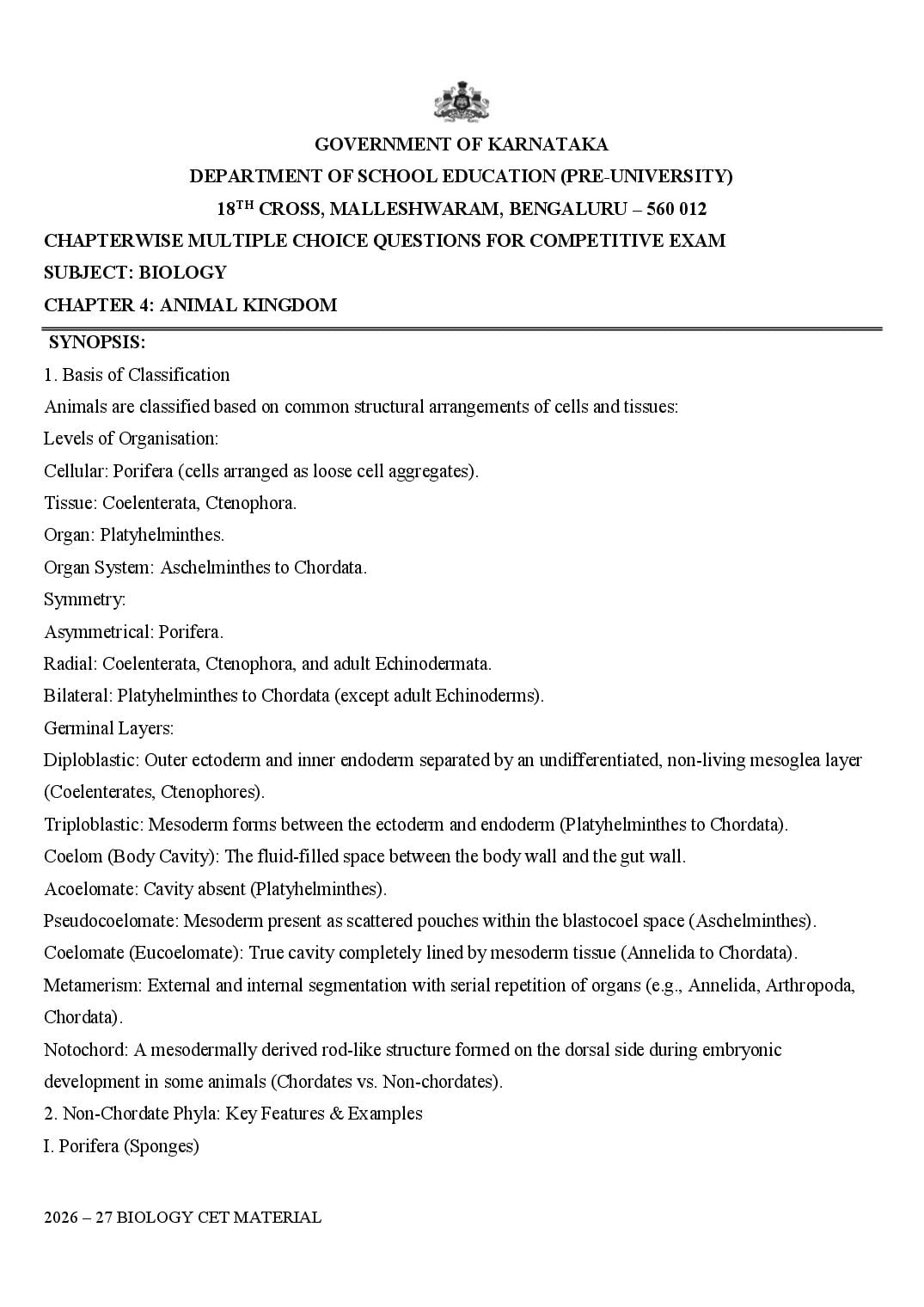
DEPARTMENT OF SCHOOL EDUCATION (PRE-UNIVERSITY)
18TH CROSS, MALLESHWARAM, BENGALURU – 560 012
CHAPTERWISE MULTIPLE CHOICE QUESTIONS FOR COMPETITIVE EXAM
SUBJECT: BIOLOGY
CHAPTER 4: ANIMAL KINGDOM
SYNOPSIS:
1. Basis of Classification
Animals are classified based on common structural arrangements of cells and tissues:
Levels of Organisation:
Cellular: Porifera (cells arranged as loose cell aggregates).
Tissue: Coelenterata, Ctenophora.
Organ: Platyhelminthes.
Organ System: Aschelminthes to Chordata.
Symmetry:
Asymmetrical: Porifera.
Radial: Coelenterata, Ctenophora, and adult Echinodermata.
Bilateral: Platyhelminthes to Chordata (except adult Echinoderms).
Germinal Layers:
Diploblastic: Outer ectoderm and inner endoderm separated by an undifferentiated, non-living mesoglea layer
(Coelenterates, Ctenophores).
Triploblastic: Mesoderm forms between the ectoderm and endoderm (Platyhelminthes to Chordata).
Coelom (Body Cavity): The fluid-filled space between the body wall and the gut wall.
Acoelomate: Cavity absent (Platyhelminthes).
Pseudocoelomate: Mesoderm present as scattered pouches within the blastocoel space (Aschelminthes).
Coelomate (Eucoelomate): True cavity completely lined by mesoderm tissue (Annelida to Chordata).
Metamerism: External and internal segmentation with serial repetition of organs (e.g., Annelida, Arthropoda,
Chordata).
Notochord: A mesodermally derived rod-like structure formed on the dorsal side during embryonic
development in some animals (Chordates vs. Non-chordates).
2. Non-Chordate Phyla: Key Features & Examples
I. Porifera (Sponges)
Page 2
(spongocoel) and goes out through the osculum.
Cellular Novelty: Spongocoel and canals are lined by flagellated cells called choanocytes (collar cells) that
drive water flow. Internal skeleton is composed of spicules or spongin fibers. Hermaphrodite; indirect
development with a distinct larval stage.
Examples: Sycon (Scypha), Spongilla (Freshwater sponge), Euspongia (Bath sponge).
II. Coelenterata (Cnidaria)
Key Features: Aquatic, mostly marine, sessile or free-swimming. Possess stinging cells called cnidoblasts or
cnidocytes on tentacles for anchorage, defense, and prey capture. Gastro-vascular cavity opens via a single
mouth on the hypostome.
Dimorphism: Exist in two body forms: Polyp (sessile, cylindrical like Hydra, Adamsia) and Medusa (umbrella-
shaped, free-swimming like Aurelia). Some display Metagenesis (alternation of generations), where polyps
produce medusae asexually, and medusae form polyps sexually (e.g., Obelia).
Examples: Physalia (Portuguese man-of-war), Adamsia (Sea anemone), Pennatula (Sea-pen), Gorgonia (Sea-
fan), Meandrina (Brain coral).
III. Ctenophora (Comb Jellies)
Key Features: Exclusively marine, radially symmetrical, diploblastic. Body bears 8 external rows of ciliated
comb plates for locomotion.
Unique Property: Exhibit bioluminescence (the property of a living organism to emit light). Reproduction is
exclusively sexual; fertilization is external with indirect development.
Examples: Pleurobrachia, Ctenoplana.
IV. Platyhelminthes (Flatworms)
Key Features: Dorso-ventrally flattened body. Endoparasites showing structures like hooks and suckers.
Specialized cells called flame cells perform osmoregulation and excretion. Mostly hermaphrodite; fertilization
is internal with many larval stages (Taenia). Planaria possesses high regeneration capacity.
Examples: Taenia (Tapeworm), Fasciola (Liver fluke).
V. Aschelminthes (Roundworms)
Key Features: Circular in cross-section. Organ-system level, pseudocoelomate. Alimentary canal is complete
with a well-developed muscular pharynx. Dioecious (sexes are separate), often showing sexual dimorphism
(females are distinctly longer than males).
Examples: Ascaris (Roundworm), Wuchereria (Filaria worm), Ancylostoma (Hookworm).
VI. Annelida (Segmented Worms)
Key Features: True coelomates exhibiting metameric segmentation. Aquatic forms like Nereis possess lateral
appendages called parapodia for swimming. Longitudinal and circular muscles assist in locomotion.
Page 3
by lateral nerves to a double ventral nerve cord. Circulatory system is closed type.
Examples: Nereis (dioecious), Pheretima (Earthworm - monoecious), Hirudinaria (Blood-sucking leech -
monoecious).
VII. Arthropoda (Largest Phylum)
Key Features: Over two-thirds of all named species on Earth. Chitinous exoskeleton. Body consists of head,
thorax, and abdomen. Possess jointed appendages.
Organs: Respiratory organs include gills, book gills, book lungs, or tracheal system. Circulatory system is open
type. Excretion takes place through Malpighian tubules. Sensory organs include antennae, simple/compound
eyes, and statocysts (balance organs).
Examples: Apis (Honey bee), Bombyx (Silkworm), Anopheles/Culex/Aedes (Vectors), Locusta (Gregarious
pest), Limulus (King crab - living fossil).
VIII. Mollusca (Second Largest Phylum)
Key Features: Terrestrial or aquatic. Unsegmented body covered by a calcareous shell. Differentiated into a
distinct head, muscular foot, and visceral hump. A soft, spongy layer of skin forms a mantle over the visceral
hump.
Organs: The space between the hump and mantle (mantle cavity) houses feather-like gills for respiration and
excretion. The head contains sensory tentacles. The mouth contains a file-like rasping organ for feeding called a
radula.
Examples: Pila (Apple snail), Pinctada (Pearl oyster), Sepia (Cuttlefish), Loligo (Squid), Octopus (Devilfish),
Aplysia (Sea-hare), Dentalium (Tusk shell), Chaetopleura (Chiton).
IX. Echinodermata (Spiny Skinned)
Key Features: Calcareous endoskeleton of ossicles. All are marine. Adults show radial symmetry, but larvae
show bilateral symmetry.
System: Distinctive water vascular system helps in locomotion, capture/transport of food, and respiration.
Alimentary canal is complete with mouth on lower (ventral) side and anus on upper (dorsal) side. Excretory
system is entirely absent.
Examples: Asterias (Starfish), Echinus (Sea urchin), Antedon (Sea lily), Cucumaria (Sea cucumber), Ophiura
(Brittle star).
X. Hemichordata
Key Features: Small group of marine worm-like animals. Cylindrical body consists of an anterior proboscis, a
collar, and a long trunk. A rudimentary structure in the collar region called the stomochord is present (similar to
a notochord but structurally distinct). Respiration via gills; excretion via proboscis gland. Open circulatory
system.
Examples: Balanoglossus, Saccoglossus.
Page 4
Characterized by the presence of a notochord, a dorsal hollow nerve cord, and paired pharyngeal gill slits. They
are bilaterally symmetrical, triploblastic, coelomate, and possess a post-anal tail and a closed circulatory
system.
Subphyla Breakdown
1.Urochordata (Tunicata): Notochord present only in larval tail (e.g., Ascidia, Salpa, Doliolum).
2.Cephalochordata: Notochord extends from head to tail region and persists throughout life (e.g.,
Branchiostoma / Amphioxus / Lancelet).
Note: Urochordata and Cephalochordata are collectively called Protochordates and are exclusively marine.
3.Vertebrata: Notochord is present during the embryonic period; it is replaced by a cartilaginous or bony
vertebral column in the adult.
4. Subphylum Vertebrata: Class Overview
Vertebrata is divided into two divisions: Agnatha (lacks jaw) and Gnathostomata (bears jaw).
Division I: Agnatha
Class: Cyclostomata: Ectoparasites on some fishes. Elongated body with 6–15 pairs of gill slits for respiration.
Sucking and circular mouth without jaws. Cranium and vertebral column are cartilaginous. Marine, but migrate
to fresh water for spawning, where they die within a few days; their larvae return to the ocean after
metamorphosis.
Examples: Petromyzon (Lamprey), Myxine (Hagfish).
Division II: Gnathostomata (Superclasses: Pisces & Tetrapoda)
Superclass: Pisces (Bear Fins)
Class 1: Chondrichthyes (Cartilaginous Fishes): Marine with a cartilaginous endoskeleton. Notochord persists
throughout life. Gill slits are separate without an operculum (gill cover). Skin has tough placoid scales. Jaws are
powerful; teeth are modified placoid scales directed backward. Air bladder is absent, so they must swim
constantly to avoid sinking. Poikilothermic (cold-blooded). Heart is two-chambered (one auricle, one ventricle).
Many are viviparous; males bear claspers on pelvic fins.
Examples: Scoliodon (Dogfish), Pristis (Sawfish), Carcharodon (Great white shark), Trygon (Stingray -
possesses poison sting), Torpedo (possesses electric organ).
Class 2: Osteichthyes (Bony Fishes): Marine and freshwater fishes with a bony endoskeleton. Streamlined body
with cycloid/ctenoid scales. Four pairs of gills covered by an operculum. Air bladder is present which regulates
buoyancy. Heart is two-chambered. Mostly oviparous; fertilization is usually external.
Examples: Exocoetus (Flying fish), Hippocampus (Sea horse), Labeo (Rohu), Catla, Clarias (Magur), Betta
(Fighting fish), Pterophyllum (Angel fish).
Superclass: Tetrapoda (Bear Limbs)
Page 5
divisible into head and trunk; tail may be present in some. Skin is moist without scales. Tympanum represents
the ear. Alimentary canal, urinary, and reproductive tracts open into a common chamber called the cloaca.
Heart is three-chambered (two auricles, one ventricle). Respiration by gills, lungs, or skin. Oviparous, external
fertilization, indirect development.
Examples: Bufo (Toad), Rana (Frog), Hyla (Tree frog), Salamandra (Salamander), Ichthyophis (Limbless
amphibia).
Class 2: Reptilia: Creeping or crawling mode of locomotion. Mostly terrestrial. Body covered by dry and
cornified skin, epidermal scales or scutes. Tympanum represents the ear. Heart is usually three-chambered, but
four-chambered in crocodiles. Poikilotherms. Snakes and lizards shed their scales as skin cast. Internal
fertilization, oviparous, direct development.
Examples: Chelone (Turtle), Testudo (Tortoise), Chameleon (Tree lizard), Calotes (Garden lizard), Crocodilus
(Crocodile), Alligator, Hemidactylus (Wall lizard). Poisonous snakes: Naja (Cobra), Bangarus (Krait), Vipera
(Viper).
Class 3: Aves (Birds): Presence of feathers and most can fly (except flightless birds like Ostrich). Forelimbs are
modified into wings. Hind limbs have scales and are modified for walking, swimming, or clasping tree
branches. Skin is dry without glands except the oil gland at the base of the tail. Endoskeleton is fully bony; long
bones are hollow with air cavities (pneumatic bones). Digestive tract has additional chambers: the crop and
gizzard. Heart is four-chambered. Homeothermic (warm-blooded). Respiration by lungs; air sacs connected to
lungs supplement respiration.
Examples: Corvus (Crow), Columba (Pigeon), Psittacula (Parrot), Struthio (Ostrich), Pavo (Peacock),
Aptenodytes (Penguin), Neophron (Vulture).
Class 4: Mammalia: Characterized by the presence of milk-producing mammary glands to nourish the young
ones. Two pairs of limbs adapted for walking, running, climbing, burrowing, swimming, or flying. Skin
uniquely possesses hair. External ears or pinnae are present. Different types of teeth are present in the jaw
(heterodont). Heart is four-chambered. Homeothermic. Respiration via lungs. Sexes separate, internal
fertilization, viviparous (with few exceptions), direct development.
Examples: Ornithorhynchus (Platypus - oviparous); Macropus (Kangaroo), Pteropus (Flying fox), Camelus
(Camel), Macaca (Monkey), Rattus, Canis, Felis, Elephas, Equus, Delphinus (Common dolphin), Balaenoptera
(Blue whale), Panthera tigris, Panthera leo (viviparous).
Classroom discussion questions
1. Which one of the following is a matching pair of an animal and a certain phenomenon it exhibits?
(A) Pheretima – Sexual dimorphism (B) Musca – Complete metamorphosis
(C) Chameleon – Mimicry (D) Taenia – Polymorphism
2. Which one of the following is a matching set of a phylum and its three examples?
Page 6
(B) Cnidaria-Bonellia, Physalia, Aurelia
(C) Platyhelminthes-Planaria, Schistosoma, Enterobius
(D) Mollusca-Loligo, Teredo, Octopus
3. What is true about Nereis, scorpion, cockroach and silver fish
(A) They all possess dorsal heart (B) None of them is aquatic
(C) They all belong to the same phylum (D) They all have jointed paired appendages
4. Which one of the following is a matching pair of a body feature and the animal possessing it?
(A) Ventral central nervous system – Leech
(B) Pharyngeal gills slits absent in embryo – Chameleon
(C) Ventral heart – Scorpion
(D) Post-anal tail – Octopus
5. Which one of the following phyla is correctly matched with its two general characteristics?
(A) Echinodermata – pentamerous radial symmetry and mostly internal fertilization
(B) Mollusca – normally oviparous and development through a trochophore or veliger larva
(C) Arthropoda – body divided into head, thorax and abdomen and respiration by tracheae
(D) Chordata – notochord persists throughout and separate anal and urinary openings to the outside
6. Which one of the following groups of three animals each is correctly matched with their one characteristic
morphological feature?
Animals Morphological features
(A) Scorpion, spider, cockroach - Ventral solid central nervous system
(B) Cockroach, locust, Taenia - Metameric segmentation
(C) Liver fluke, sea anemone, sea cucumber - Bilateral symmetry
(D) Centipede, prawn, sea urchin - Jointed appendages
7. Which of the following is wrongly matched?
(A) Haemoglobin in mammals – RBC (B) Haemozoin – Plasmodium cytoplasm
(C) Hemocyanin – prawn (D) Haemoglobin dissolved in blood - Pheretima
8. Which of the following has radial symmetrical adult and bilateral symmetrical larva?
(A) Echinodermata (B) Reptilia
(C) Amphibia (D) Nemathelminthes
9. Bilateral symmetry, metameric segmentation, coelom an open circulatory system characterizes which of the
following phylum?
(A) Annelida (B) Mollusca
(C) Arthropoda (D) Echinodermata
Page 7
the correct option from the codes given below.
Column-I Column-II
(Animals with common (Animals with zoological
name) name)
(a) Star fish (i) Sepia
(b) Jelly fish (ii) Astropecten
(c) Devil fish (iii) Aurelia
(d) Cuttle fish (iv) Octopus
(v) Hippocampus
(A) (a) → (ii), (b) → (iii), (c) → (iv), (d) → (i) (B) (a) → (iii), (b) → (iv), (c) → (i), (d) → (v)
(C) (a) → (ii), (b) → (i), (c) → (iv), (d) → (iii) (D) (a) → (v), (b) → (i), (c) → (iv), (d) → (ii)
11. Match the locomotory organs given under Column-I with phylum in which they are seen, listed under
Column-II and select the correct option from the codes given below.
Column-I Column-II
(Locomotory (Phylum)
organs)
(a) Pseudopodia (i) Mollusca
(b) Parapodia (ii) Chondrichthyes
(c) Muscular foot (iii) Protozoa
(d) Fins (iv) Annelids
(A) (a) → (iii), (b) → (i), (c) → (iv), (d) → (ii) (B) (a) → (i), (b) → (iii), (c) → (iv), (d) → (ii)
(C) (a) → (iv), (b) → (iii), (c) → (ii), (d) → (i) (D) (a) → (iii), (b) → (iv), (c) → (i), (d) → (ii)
12. Which one of the following statements about certain given animals is correct?
(A) Round worms (Aschelminthes) are pseudo-coelomates
(B) Molluscs are acoelomates
(C) Insects are pseudo-coelmates
(D) Flatworm (Platyhelminthes) are coelomates
13. Which one is mismatched?
(A) Hydra vulgaris - sea water (B) Hydra gangetica - fresh water
(C) Obelia – sea water (D) Physalia - sea water
14. Which is not correct for sponges?
(A) Internal fertilization (B) External fertilization
(C) Gemmule formation (D) Gametes are formed from epidermal cells
Page 8
(A) The division of body into head, neck, trunk and tail
(B) Their body covered with an exoskeleton
(C) The possession of two pairs of functional appendages
(D) The presence of well-developed skull
16. Which of the following pairs are correctly matched?
Animals Morphological
features
(i) Crocodile - 4-chambered heart
(ii) Sea urchin - Parapodia
(iii) Obelia - Metagenesis
(iv) Lemur - Thecodont
(A) (ii), (iii) and (iv) (B) (i) and (iv)
(C) (i) and (ii) (D) (i), (iii) and (iv)
17. Which of the following is an exclusive character of class Mammalia?
(A) Internal fertilization (B) Presence of a completely 4-chambered heart
(C) Homoiothermy (D) Presence of a muscular diaphragm
18. Which of the following is a correct sequence of decreasing order of number of species?
(A) Aves, Pisces, reptiles, amphibians, mammals (B) Pisces, aves, reptiles, mammals,
amphibians
(C) Pisces, mammals, reptiles, amphibians, aves (D) Amphibians, aves, Pisces, mammals, reptiles
19. Match the zoological names given under Column-I with their common names given under Column-II and
select the correct option from the codes given below.
Column-I Column-II
(a) Labeo rohita (i) Jungle fowl
(b) Gallus gallus (ii) Carp
(c) Bos indicus (iii) Tussar
silkmoth
(d) Antheraea (iv) Cattle
mylitta
(A) (a) → (ii), (b) → (iii), (c) → (i), (d) → (iv) (B) (a) → (iii), (b) → (i), (c) → (iv), (d) → (ii)
(C) (a) → (ii), (b) → (i), (c) → (iv), (d) → (iii) (D) (a) → (ii), (b) → (i), (c) → (iii), (d) → (iv)
20. Read the given statements and select the correct option.
Statement 1: Cephalochordata bears notochord all along the body throughout life.
Page 9
(A) Both statements 1 and 2 are correct and statement 2 is the correct explanation of statement 1.
(B) Both statements 1 and 2 are correct but statement 2 is not the correct explanation of statement 1.
(C) Statement 1 is correct and statement 2 is incorrect
(D) Both statements 1 and 2 are incorrect.
21. Which one of the following statements about all the four of Spongilla, leech, dolphin and penguin is
correct?
(A) Penguin is homoiothermic while the remaining three are poikilothermic.
(B) Leech is a fresh water form while all others are marine.
(C) Spongilla has special collared cells called choanocytes, not found in the remaining three.
(D) All are bilaterally symmetrical
22. Match the excretory organs listed under column-I with the animals given under Column-II and select the
correct option.
Column-I Column-II
(Excretory organs) (Animals)
(a) Nephridia (i) Hydra
(b) Malpighian (ii) Leech
tubules
(c) Protonephridia (iii) Shark
(d) Kidneys (iv) Round
worms
(v) Cockroach
(A) (a) → (ii), (b) → (v), (c) → (iv), (d) → (iii) (B) (a) → (iv), (b) → (ii), (c) → (i), (d) → (v)
(C) (a) → (iv), (b) → (ii), (c) → (iv), (d) → (iii) (D) (a) → (ii), (b) → (iv), (c) → (v), (d) → (i)
23. Which of the following have porous body and are diploblastic?
(A) Aurelia and Obelia (B) Adamsia and Euplectella
(C) Leucosolenia and Spongilla (D) Sycon and Hydra
24. Phylum mollusca can be distinguished from other invertebrates by the presence of
(A) Bilateral symmetry and exoskeleton (B) A mantle and gills
(C) Shell and non-segmented body (D) A mantle and non-segmented body
25. How do you differentiate a butterfly from a moth?
(A) Moth has feathery antennae but butterfly has club shaped antennae.
(B) Moth has one pair of wings but butterfly has two pairs of wings.
(C) Moth is diurnal but butterfly is nocturnal.
Page 10
26. Which of the following are examples of Arthropoda?
(A) Silver fish, star fish, prawn (B) Clam worm, apple snail, honey bee
(C) Sea star, tongue worm, scorpion (D) Cockroach, scorpion, prawn
27. Which of the following is not a characteristic feature of sponges?
(A) Cellular level of organization (B) Presence of ostia
(C) Intracellular digestion (D) Body supported by chitin
28. Match Column-I with Column-II and select the correct option from the codes given below.
Column-I Column-II
(a) Choanocytes (i) Platyhelminthes
(b) Cnidoblasts (ii) Ctenophora
(c) Flame cells (iii) Porifera
(d) Nephridia (iv) Coelenterata
(e) Comb plates (v) Annelida
(A) (a) → (ii), (b) → (i), (c) → (iv), (d) → (v), (e) → (iii)
(B) (a) → (ii), (b) → (iv), (c) → (i), (d) → (v), (e) → (iii)
(C) (a) → (v), (b) → (i), (c) → (iii), (d) → (ii) (e) → (iv)
(D) (a) → (iii), (b) → (iv), (c) → (ii), (d) → (v), (e) → (ii)
29. The figure of Labeo rohita is given below. Identify the parts labeled as A, B, C, D, E, F and G.
A B C D E F G
(A) Nostril Eye Anal fin Dorsal fin Caudal fin Pectoral fin Pelvic fin
(B) Nostril Eye Anal fin Caudal fin Dorsal fin Pectoral fin Pelvic fin
(C) Nostril Eye Dorsal fin Caudal fin Anal fin Pelvic fin Pectoral fin
(D) Nostril Eye Dorsal fin Caudal fin Pectoral fin Anal fin Pelvic fin
30. Which of the following is incorrectly matched?
(A) Spiny tailed lizard – Uromastix hardwickii (B) Garden lizard – Hemidactylus flaviviridis
(C) Gilla monster – Heloderma (D) Monitor lizard – Varanus
31. The flightless bird among the following is
(A) Columba (B) Neophron (C) Struthio (D) Corvus
32. Identify the aquatic mammal(s) from the following.
(i) Balaenoptera (ii) Equus (iii) Delphinus (iv) Pteropus (v) Felis
Page 11
33. Which one of the following kinds of animals are triploblastic?
(A) Flat worms (B) Sponges (C) Ctenophores (D) Corals
34. Which one of the following statements about certain given animals is correct?
(A) Roundworms (Aschelminthes) are pseudocoelomates
(B) Molluscs are acoelomates
(C) Insects are pseudocoelomates
(D) Flatworms (Platyhelminthes) are coelomates
35. Ascaris is characterized by the
(A) absence of true coelom, but the presence of metamerism
(B) presence of neither true coelom nor metamerism
(C) presence of true coelom, but the absence of metamerism
(D) presence of true coelom and metamerism (metamerisation)
36. Which one of the following groups of animals is bilaterally symmetrical and triploblastic?
(A) Coelenterates (Cnidarians) (B) Aschelminthes (roundworms)
(C) Ctenophores (D) Sponges
37. The animal with bilateral symmetry in young stage and radial pentamerous symmetry in the adult stage
belongs to the phylum
(A) Annelida (B) Mollusca (C) Cnidaria (D) Echinodermata
38. True coelom is the space lying between the alimentary canal and body wall, enclosed by the layers of
(A) ectoderm on both sides
(B) endoderm onside and ectoderm on the other
(C) mesoderm on one side and ectoderm on the other
(D) mesoderm on both sides
39. Radial symmetry is often exhibited by animals having
(A) one opening of alimentary canal (B) aquatic mode of living
(C) benthos/ sedentary (D) ciliary mode of feeding
40. Coelom derived from blastocoel is known as
(A) enterocoelom (B) schizocoelom (C) pseudocoelom (D) haemocoelom
41. Cellular organization of body is present in
(A) annelida (B) Platyhelminthes (C) porifera (D) urochordata
42. Coelom produced by splitting of mesoderm is
(A) hydrocoel (B) enterocoel (C) schizocoel (D) None of these
43. In organisms belonging to Echinodermata. Hemichordate and Chordata, the anus of the digestive tract
develops first in the embryo and mouth is formed later. Animals possessing this body plan are called as
Page 12
44. In diploblastic animals, ectoderm and endoderm are separated by an undifferentiated layer called as
(A) peritoneum (B) mesoderm (C) mesoglea (D) schizocoel
45. The kind of coelom represented in the diagram is characteristic of
(A) earthworm (B) cockroach (C) roundworm (D) tapeworm
46. Choose the correct match pair
(A) Radial symmetry – Coelenterates
(B) Coelomates – Aschelminthes
(C) Metameric segmentation – Mollusca
(D) Metagenesis – Echinoderms
(E) Triploblastic – Sponges
47. An opening serving as both mouth and anus is found in
(A) coelenterates and poriferans (B) coelenterates and aschelminthes
(C) coelenterates and annelids (D) coelenterates and Platyhelminthes
48. The animal which shows metameric segmentation is
(A) housefly (B) earthworm (C) round worm (D) Planaria
49. Annelids possess
(A) tube – within – a – tube plane, unsegmented body and haemocoel
(B) blind – sec – plan, segmented body and true coelom
(C) tube – within – a tube – plane, metameric segmentation and true coelom
(D) tube – within – a – tube- plan, pseudosegmentation and enterocoelom
50. Radial symmetry is depicted by
(A) Porifera (B) Porifera and Coelenterata
(C) Echinodermata and Platyhelminthes (D) Echinodermata and Coelenterata
51. Read the following statements
I. Sagittal section is the vertical section passing through the middle line of body
II. Flatworms and protochordates show only intracellular digestion .
III. Body of sponges have a single cavity with one opening to outside.
IV. Tapeworms show pseudometamerism
Choose the option with all incorrect statements
(A) II and III (B) II, III and IV (C) I and II (D) all of these
52. Match the following Columns and chose the correct option from the codes given below
Column I Column II
(a) Schizocoelom 1 Echinodermata
Page 13
(c) Mesogloea 3 Hydra
(d) Cellular 4 Porifera
organization
Codes
(a) (b) (c) (d)
(A) 1 4 3 2
(B) 1 3 2 4
(C) 3 4 2 1
(D) 2 1 3 4
53. Which of the following features is not present in the phylum – Arthropoda?
(A) Metameric segmentation (B) Parapodia
(C) Joined appendages (D) Chitinous exoskeleton
54. Match the following Column I with Column II for housefly classification select the correct option using the
codes given below
Column I Column II
(a) Family 1 Diptera
(b) Order 2 Arthropoda
(c) Class 3 Muscidae
(d) Phylum 4 Insecta
Codes
(a) (b) (c) (d)
(A) 3 1 4 2
(B) 3 2 4 1
(C) 4 3 2 1
(D) 4 2 1 3
55. Which of the following characteristics is mainly responsible for diversification of insects on land
(A) Eyes (B) Segmentation (C) Bilateral symmetry (D) Exoskeleton
56. Which of the following endoparasites of humans does show viviparity?
(A) Ascaris lumbricodies (B) Ancylostoma duodenale
(C) Enterobius uermicularis (D) Trichinella spiralis
57. In which one of the following the genus name, its two characters and its phylum are not correctly matched,
whereas the remaining three are correct?
Genus name Two characters Phylum
Page 14
(ii) Mouth with radula
(B) Asterias (i) Spiny skinned Echinodermata
(ii) water vascular system
(C) Sycon (i) canal system Porifera
(D) (i) Jointed appendages Arthropods
Periplaneta Arthropoda
(ii) Chitinous exoskeleton
58. select the taxon that represents both marine and fresh water species
(A) Echinoderms (B) Ctenophora (C) Cephalochordata (D) Cnidaria
59. Planaria possesses high capacity of
(A) metamorphosis (B) regeneration
(C) alternation of generation (D) bioluminescence
60. Which group of animas belong to the same phylum?
(A) Malarial parasite, Amoeba, mosquito (B) Earthworm pinworm, tapeworm
(C) Prawn, scorpion , Locusta (D) Sponge, sea anemone, starfish
Practice Corner
1. In some animal groups, the body is found divided into compartments with at least some organs/ organ
repeated. This characteristic feature is named
(A) Segmentation (B) Metamerism (C) Metagenesis (D) Metamorphosis
2. Given below are types of cells present in some animals. Each one is specialized to perform a single specific
function except
(A) Choanocytes (B) Interstitial cells (C) Gastrodermal (D) Nematocytes
3. Which one of the following sets of animals share a four chambered heart?
(A) Amphibian, Reptiles, Birds (B) Crocodiles, Birds, Mammals
(C) Crocodiles, Lizards, Turtles (D) Lizards, Mammals, Birds
4. Which of the following pairs of animals has non glandular skin
(A) Snake and Frog (B) Chameleon and Turtle
(C) Frog and Pigeon (D) Crocodile and Tiger
5. Birds and mammals share one of the following characteristics as a common feature.
(A) Pigmented skin (B) Alimentary canal with some modification
(C) Viviparity (D) Warm blood nature
6. Which one of the following sets of animals belong to single taxonomy
(A) Cuttlefish, Jellyfish, Silverfish, Dogfish, Starfish
Page 15
(C) Monkey, Chimpanzee, man
(D) Silkworm, Tapeworm, Earthworm
7. Which one of the following statements is incorrect?
(A) Mesoglea is present in between ectoderm and endoderm in Obelia.
(B) Radial symmetry is found in Asterias
(C) Fasciola is a Pseudocoelomate animal
(D) Taenia is a triploblastic animals
8. Which one of the following statements is incorrect?
(A) In cockroaches and prawns excertion of waste material occurs through malpighian tubules.
(B) In ctenophores, locomotion is mediated by comb plates.
(C) In Fasciola flame cells take part in excretion
(D) Earthworms are hermaphrodites and yet cross fertilization take place among them
9. Which one of the following is oviparous?
(A) Platypus (B) Flying fox (bat) (C) Elephant (D) Whale
10. Which one of the following is not a poisonous snake?
(A) Cobra (B) Viper (C) Python (D) Krait
11. Match the following list of animals with their level of organisation. Division of Labour
Division of Labour Animals
(a) Organ level (i) Pheritima
(b) Cellular aggregate (ii) Fasciola
level
(c) Tissue level (iii) Spongilla
(d) Organ system level (iv) Obelia
Choose the correct match showing division of labour with animal example
(A) (i) → (b); (ii) → (c); (iii) → (d); (iv) → (a) (B) (i) → (b); (ii) → (d); (iii) → (c); (iv) → (a)
(C) (i) → (d); (ii) → (a); (iii) → (b); (iv) → (c) (D) (i) → (a); (ii) → (d); (iii) → (c); (iv) → (b)
12. Body cavity is the cavity present between body wall and gut wall. In some animals the body cavity is not
lined by mesoderm. Such animals are called
(A) Acoelomate (B) Pseudocoelomate
(C) Coelomate (D) Haemocoelomate
13. Match the column A with column B and choose the correct option
Column I Column II
(a) Porifera (i) Canal system
Page 16
(c) Annelida (iii) Muscular pharynx Comb
plates
(d) Aschelminthes (iv) Jointed appendages
(e) Echinodermata (v) metameres
(A) (a) → (ii); (b) → (iii); (c) → (v); (d) → (iv); (e) → (i)
(B) (a) → (ii); (b) → (v); (c) → (iii); (d) → (iv); (e) → (i)
(C) (a) → (i); (b) → (iii); (c) → (v); (d) → (iv); (e) → (ii)
(D) (a) → (i); (b) → (v); (c) → (iii); (d) → (iv); (e) → (ii)
14. One of the representative of phylum- Arthropoda is
(A) cuttle fish (B) silver fish (C) puffer fish (D) flying fish
15. Which one of the following have the highest number of species in nature?
(A) Insects (B) Birds (C) Angiosperms (D) Fungi
16. Which one of the following groups of three animals each is correctly matched with its one characteristic
morphological feature?
Animals Morphological feature
(A) Liver fluke, sea Bilateral symmetry
Anemone, sea cucumber
(B) Centipede, prawn, sea Jointed appendages
urchin
(C) Scorpion, spider, cockroach Ventral solid central
Nervous system
(D) Cockroach, locust, Taenia Metameric
segmentation
17. Which one of the following does not have an excretory system?
(A) Myxine (B) Carcharodon (C) Balanoglossus (D) Asterias
18. Tube- feet are the locomotory organs of
(A) Platyhelminthes (B) Echinodermita (C) Mollusca (D) Arthropoda
19. With reference to phylum – Echinodermata, identify the classes which have Pedicellariae
(A) Crinoidea and Holothuroidea (B) Holothuroidea and Echinoidea
(C) Asteroidea and Echinoidea (D) Ophiuroidea and Holothuroidea
20. A molluscan with calcareous spicules is
(A) Lepidopleurus (B) Doris (C) Neopilina (D) Chaetoderma
21. Sensory cells of Hydra possess
Page 17
22. A coelenterate without medusoid stage in life cycle is
(A) Obelia (B) Aurelia (C) Physalia (D) Metridium
23. Fasciola hepatica is
(A) hermaphrodite with self- fertilisation
(B) hermaphroidite with preferably cross fertilisation
(C) unisexual
(D) sexually sterile
24. Tube feet is the locomotory organ in
(A) starfish (B) jelly fish (C) scolidon (D) silver fish
25. Which of the following phylum is characterized by the presence of water vascular system?
(A) Mollusca (B) Arthropoda (C) Echinodermata (D) Annelida
26. Which of the following characteristic features always holds true for the corresponding group of animals?
(A) Viviparous – Mammalia
(B) Possess a mouth with an upper and a lower jaw – Chordata
(C) 3-chambered heart with one incompletely divided ventricle – Reptilia
(D) Cartilaginous endoskeleton – Chondrichthyes
27. Correct mathc of the name of the animal (column I) with its one characteristic (Column II) and the phylum/
class (Column III) to which it belongs is
Column I Column II Column III
(A) Petromyzon Ectoparasite Cyclostomata
(B) Ichthyophis Terrestrial Reptilia
(C) Limulus Body covered by chitinous Pisces
exoskeleton
(D) Adamsia Radially symmetrical Porifera
28. What will you look for to identify the sex of the following?
(A) Male frog-A copulatory pad on the 1st digit of the hindlimb
(B) Female cockroach – Anal cerci
(C) Male shark- Claspers borne on pelvic fins
(D) Female Ascaris – Sharply curved posterior end
29. The chordate features shared by the non-chordates are
(A) bilateral symmetry (B) triploblastic condition and bilateral symmetry
(C) metamerism (D) All of the above
30. Which of the following characters is present essentially in chordates?
(A) Dorsal heart
Page 18
(C) Ventral spinal chord
(D) Blood flow in forward direction is ventral blood vessels
31. Ovoviviparity is seen in this caecilian
(A) Wuchereria (B) Typhlonectes (C) Ichthyophis (D) Uraeotyphlus
32. Acoustic spots in frog are present in
(A) osseous labyrinth (B) carotid
(C) membranous labyrinth (D) All of these
33. Which of the following vertebrates show the formation of middle ear (Eustachain recess) for the first time?
(A) Exocoetus (B) Rana (C) Echis (D) Hippocampus
34. Dry skin with scales or scutes without gland is a characteristic of
(A) fishes (B) Reptilia (C) Amphibia (D) Aves
35. Neopallium is found in the brain of
(A) amphibinas (B) advanced reptiles (C) mammals (D) Both (B) and (C)
36. The snake eating snake is
(A) black cobra (B) king cobra (C) rattle snake (D) anaconda
37. With one of the following match is incorrect?
(A) Garden lizard – Hemidoctylus flauiuiridis
(B) Mountain lizard – Varanus
(C) Worm lizard – Rhineura
(D) Collared lizard – Iguana
38. Identify the correct pair of birds with a raft – like keel and lacking green gland and syrinyx
(A) Tinamus and Apteryx (B) Rhea and Dromeous
(C) Casuarius and Struthio (D) Kiwi and Rhea
39. Which character is not same in aves and mamals?
(A) Single systemic arch (B) Metanephric kidney
(C) Seven cervical vertebrae (D) Homeotherms
40. Identify and select the correct match in the Column I, II and Column III
Column I Column II Column III
(A) Earthworm Annelida Super – class
(B) Frog Rana Species
(C) Lancelet Vertebrata Division
(D) Walrus Mammalia Class
41. Pouched mammals are
(A) prototherians (B) metatherians (C) eutherians (D) therians
Page 19
(A) The presence of milk producing gland
(B) They have two pairs of limbs
(C) Skin is unique in possessing hair
(D) Homodont type of dentition
43. Which of the following statements are correct/ incorrect?
I. In torpedo, the electric organs are capable of generating strong electric shock to paralyse the prey.
II. Bony fishes use pectoral, pelvic, dorsa, anal and caudal fins in swimming.
III. Amphibian skin is moist and has thick scales.
IV. Birds are poikilothermous animals
V. The most unique mammalin characteristic is the presence of milk producing mammary glands by which
the young ones are nourished.
(A) I, II and III are correct, but IV and V are incorrect
(B) I, II and V are correct, but III and IV are incorrect
(C) I, II and III are incorrect, but IV and V are correct
(D) I, II and IV are incorrect, but III and V are correct
44. Which of the following is an exclusive character of class – Mammalia?
(A) Homeothermy (B) Internal fertilisation
(C) The presence of a four – chambered heart (D) The presence of a muscular diaphragm
45. In mammals, the secondary palate is formed by the union of
(A) Premaxilla, pterygoid and squamosal bones (B) Maxilla, quadrate and palatine bones
(C) Premaxilla, maxilla and palatine bones (D) Premaxilla, quadrate and squamosal bones
46. Match the following Columns and choose the correct option from the codes given below
Column I Column II
(a) Green glands 1 Scolopendra
(b) Amphids and 2 Respiratory organ
phasmids
(c) Ctenidia 3 Shell protein
(d) Poison claw 4 Excretory organs
(e) Concholin 5 Sense organs
Codes
(a) (b) (c) (d) (e)
(A) 4 5 2 1 3
(B) 1 3 4 5 2
Page 20
(D) 3 4 5 2 1
47. Pheromone is
(A) a product of endocrine gland (B) used for animal communication
(C) mRNA (D) always protein
48. Match the following Columns and choose the correct option from the codes given below
Column I Column II
(a) Choanocytes 1 Platyhelminthes
(b) Cnidoblasts 2 Ctenophora
(c) Flame cells 3 Porifera
(d) Nephridia 4 Coelenterata
(e) Comb plates 5 Annelida
Codes
(a) (b) (c) (d) (e)
(A) 2 1 4 5 3
(B) 2 4 1 5 3
(C) 5 1 3 2 4
(D) 3 4 1 5 2
49. The point by which Annelida advanced over Nematoda is
(A) true coelom (B) metameric segmentation
(C) closed circulation (D) All of these
50. Which of the following statement is correct regarding Dentalium?
(A) It is a freshwater Mollusca
(B) It is also known as “grief slug”
(C) It bears filamentous tentacles useful in feeding
(D) The shell of Dentalium yields an excellent quantity of lime
51. Which of the following belongs to class – Arachnida?
(A) Mite (B) Silk moth (C) Peripatus (D) Julus
52. The feature peculiar to Platyhelminthes is
(A) the presence of reduced locomotory organs
(B) digestive system of platyhelminthes is well – developed
(C) Platyhelminthes are hermaphrodite
(D) proglottids show the presence of mouth and anus
53. The long bones are hollow and connected by air passage. These are characteristic of
Page 21
54. The body of rohu fish is covered by
(A) cycloid scale, but the tail is homocercal (B) placoid scale, but the tail is heterocercal
(C) cycloid scale, but the tail is heterocercal (D) placoid scale, but the tail is homocercal
Classroom discussion Keys
1. (B) 7. (C) 13. (A) 19. (C) 25. (A) 31. (C) 37. (D) 43. (B) 49. (C) 55. (D)
2. (D) 8. (A) 14. (B) 20. (B) 26. (D) 32. (A) 38. (D) 44. (C) 50. (D) 56. (D)
3. (A) 9. (C) 15. (D) 21. (C) 27. (D) 33. (A) 39. (B) 45. (C) 51. (A) 57. (A)
4. (A) 10. (A) 16. (D) 22. (A) 28. (D) 34. (A) 40. (C) 46. (A) 52. (D) 58. (D)
5. (C) 11. (D) 17. (D) 23. (C) 29. (C) 35. (B) 41. (C) 47. (D) 53. (B) 59. (B)
6. (A) 12. (A) 18. (B) 24. (D) 30. (B) 36. (B) 42. (C) 48. (B) 54. (A) 60. (C)
Practice question Keys
1. (B) 8. (A) 15. (A) 22. (D) 29. (D) 36. (B) 43. (B) 50. (D)
2. (B) 9. (A) 16. (C) 23. (B) 30. (B) 37. (A) 44. (D) 51. (A)
3. (B) 10. (C) 17. (D) 24. (A) 31. (B) 38. (C) 45. (C) 52. (C)
4. (C) 11. (C) 18. (B) 25. (C) 32. (C) 39. (C) 46. (A) 53. (B)
5. (D) 12. (B) 19. (C) 26. (D) 33. (B) 40. (D) 47. (B) 54. (A)
6. (C) 13. (C) 20. (A) 27. (A) 34. (B) 41. (B) 48. (D)
7. (A) 14. (B) 21. (B) 28. (C) 35. (D) 42. (D) 49. (D)
Document Details
| Board / Org | Karnataka Board |
| Exam | Class 11 |
| Type | Question Bank |
| Pages | 21 |
| Updated | 24 Sep 2026 |