Karnataka 1st PUC Biology Body Fluids and Circulation MCQ with Answers
Finished viewing? Save it for later —
Download Karnataka 1st PUC Biology Body Fluids and Circulation MCQ with Answers (PDF · 23 pages)About Karnataka 1st PUC Biology Body Fluids and Circulation MCQ with Answers
Karnataka 1st PUC Biology Body Fluids and Circulation MCQ with Answers is available here for free download. Published by Karnataka Board for Class 11, this question bank can be viewed online or downloaded as a PDF (23 pages). Candidates preparing for Class 11 can use Karnataka 1st PUC Biology Body Fluids and Circulation MCQ with Answers to understand the exam pattern, the type of questions asked, and the overall difficulty level.
Frequently Asked Questions
How can I download Karnataka 1st PUC Biology Body Fluids and Circulation MCQ with Answers?
Open this page and click the Download button to save Karnataka 1st PUC Biology Body Fluids and Circulation MCQ with Answers as a PDF. It is completely free on AglaSem Docs.
Is Karnataka 1st PUC Biology Body Fluids and Circulation MCQ with Answers free to download?
Yes. Karnataka 1st PUC Biology Body Fluids and Circulation MCQ with Answers can be viewed online and downloaded as a PDF free of cost on AglaSem Docs.
How many pages does Karnataka 1st PUC Biology Body Fluids and Circulation MCQ with Answers have?
Karnataka 1st PUC Biology Body Fluids and Circulation MCQ with Answers contains 23 pages, which you can read online or download together as a single PDF.
Where can I find more Class 11 study material?
You can find more Class 11 question papers, sample papers, syllabus, and answer keys on AglaSem Docs.
Karnataka 1st PUC Biology Body Fluids and Circulation MCQ with Answers – Text
Read the full text of this question bank below — useful to quickly search, copy and reference the content online without downloading the PDF.
📄 View text version (23 pages)
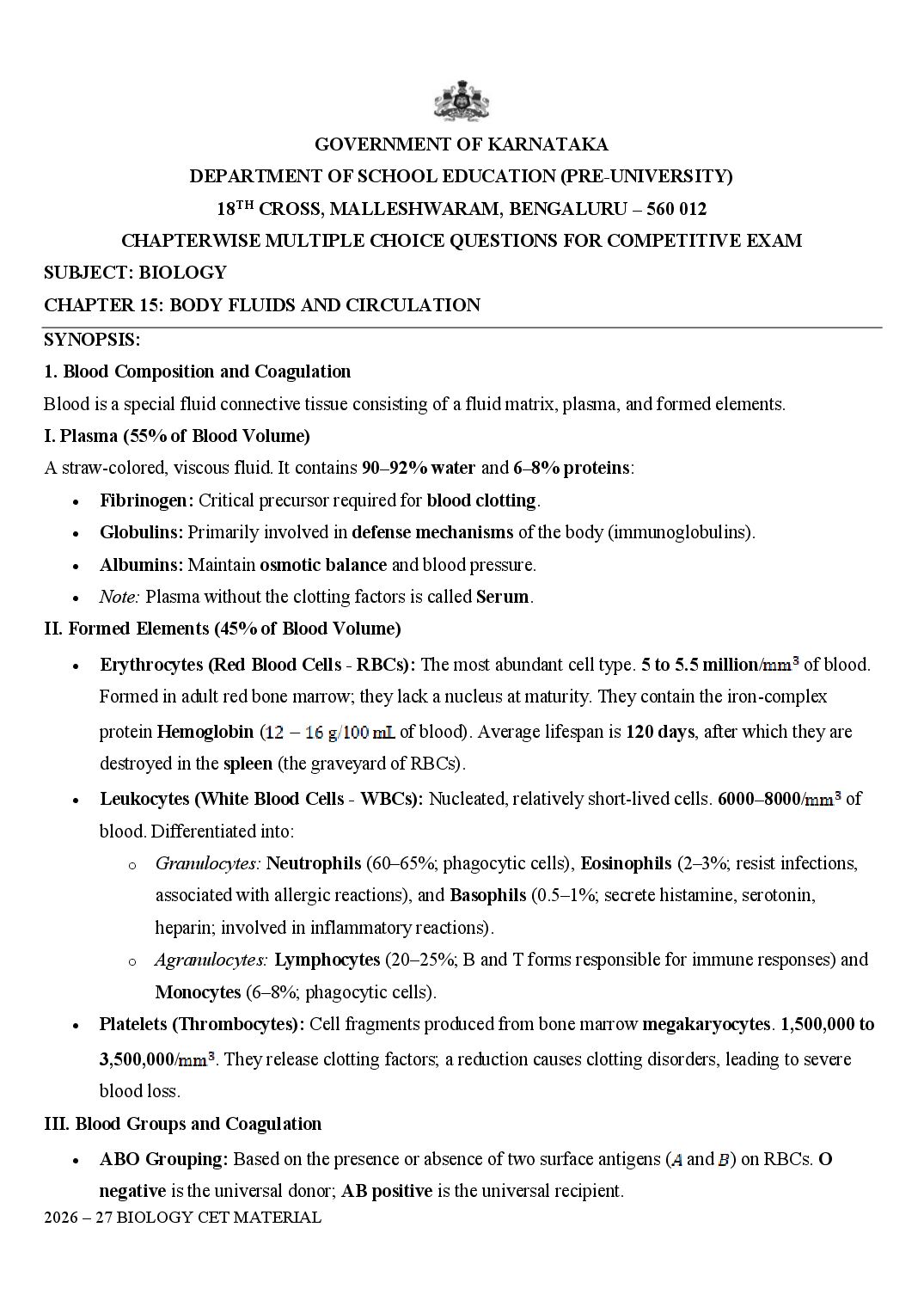
Page 1
DEPARTMENT OF SCHOOL EDUCATION (PRE-UNIVERSITY)
18TH CROSS, MALLESHWARAM, BENGALURU – 560 012
CHAPTERWISE MULTIPLE CHOICE QUESTIONS FOR COMPETITIVE EXAM
SUBJECT: BIOLOGY
CHAPTER 15: BODY FLUIDS AND CIRCULATION
SYNOPSIS:
1. Blood Composition and Coagulation
Blood is a special fluid connective tissue consisting of a fluid matrix, plasma, and formed elements.
I. Plasma (55% of Blood Volume)
A straw-colored, viscous fluid. It contains 90–92% water and 6–8% proteins:
• Fibrinogen: Critical precursor required for blood clotting.
• Globulins: Primarily involved in defense mechanisms of the body (immunoglobulins).
• Albumins: Maintain osmotic balance and blood pressure.
• Note: Plasma without the clotting factors is called Serum.
II. Formed Elements (45% of Blood Volume)
• Erythrocytes (Red Blood Cells - RBCs): The most abundant cell type. 5 to 5.5 million/ of blood.
Formed in adult red bone marrow; they lack a nucleus at maturity. They contain the iron-complex
protein Hemoglobin ( of blood). Average lifespan is 120 days, after which they are
destroyed in the spleen (the graveyard of RBCs).
• Leukocytes (White Blood Cells - WBCs): Nucleated, relatively short-lived cells. 6000–8000/ of
blood. Differentiated into:
o Granulocytes: Neutrophils (60–65%; phagocytic cells), Eosinophils (2–3%; resist infections,
associated with allergic reactions), and Basophils (0.5–1%; secrete histamine, serotonin,
heparin; involved in inflammatory reactions).
o Agranulocytes: Lymphocytes (20–25%; B and T forms responsible for immune responses) and
Monocytes (6–8%; phagocytic cells).
• Platelets (Thrombocytes): Cell fragments produced from bone marrow megakaryocytes. 1,500,000 to
3,500,000/ . They release clotting factors; a reduction causes clotting disorders, leading to severe
blood loss.
III. Blood Groups and Coagulation
• ABO Grouping: Based on the presence or absence of two surface antigens ( and ) on RBCs. O
negative is the universal donor; AB positive is the universal recipient.
Page 2
positive fetus can trigger maternal antibodies during a first delivery. In subsequent pregnancies, these
antibodies can destroy fetal RBCs, a fatal condition called Erythroblastosis fetalis (prevented by
giving anti-Rh antibodies right after the first delivery).
• Blood Clotting (Coagulation): A cascade of enzymatic reactions initiated by injured tissue and
platelets. Prothrombinase converts inactive Prothrombin in plasma into active Thrombin. Thrombin
then converts soluble Fibrinogen into insoluble Fibrin threads that trap dead blood cells. Calcium ions
( ) play a crucial role in this clotting cascade.
2. Lymph (Tissue Fluid)
As blood passes through tissue capillaries, water and small water-soluble substances are squeezed out into
intercellular spaces, forming interstitial or tissue fluid. It possesses the same mineral distribution as plasma
but lacks large proteins and formed elements. The lymphatic system collects this fluid and drains it back into
major veins. This fluid is called Lymph; it is a colorless fluid containing specialized lymphocytes and acts as
an important carrier for nutrients and hormones. Fats are absorbed into lymph through lacteals in the intestinal
villi.
3. Human Circulatory System Anatomy
The human heart is a mesodermally derived, muscular organ situated in the thoracic cavity, protected by a
double-walled membranous sac called the pericardium.
• Valves:
o The right atrium and right ventricle are separated by a tricuspid valve.
o The left atrium and left ventricle are separated by a bicuspid (mitral) valve.
o The openings of the aorta and pulmonary artery are guarded by semilunar valves. These valves
prevent any backward flow of blood.
• Nodal Tissue (Myogenic Nature): The human heart is myogenic—its contractions are generated
internally by specialized auto-excitable cardiac muscle patches:
o Sino-atrial Node (SAN): Positioned in the upper right corner of the right atrium. It generates the
maximum number of action potentials (70–75/min), determining the fundamental cardiac
rhythm. Hence, it is called the Pacemaker.
o Atrio-ventricular Node (AVN): Positioned in the lower left corner of the right atrium.
o AV Bundle / Purkinje Fibres: Passes down the interventricular septum, splitting into right and
left branches that distribute throughout the ventricular walls, driving coordinated ventricular
contractions.
4. The Cardiac Cycle
The sequential event cycle repeating at a normal rate of 72 beats/minute, lasting roughly 0.8 seconds per cycle.
Page 3
from pulmonary veins and vena cava flow into the left and right ventricles. Semilunar valves are closed.
2. Atrial Systole (0.1 s): The SAN generates an action potential, driving both atria to contract
simultaneously. This increases the flow of blood into the ventricles by about 30%.
3. Ventricular Systole (0.3 s): The action potential travels via the AVN and Bundle of His to the
ventricular muscles, driving ventricular contraction.
o As ventricular pressure rises, the tricuspid and bicuspid valves snap shut immediately to
prevent backflow, producing the first heart sound ("lubb").
o As pressure exceeds arterial pressure, the semilunar valves force open, pumping blood into the
circulatory arches.
4. Ventricular Diastole: Ventricles relax. As ventricular pressure drops below arterial pressure, blood
attempts to flow backward, forcing the semilunar valves to snap shut immediately, producing the
second heart sound ("dupp").
Stroke Volume: The volume of blood pumped out by each ventricle during a single cardiac cycle .
5. Electrocardiogram (ECG)
A graphic record of the electrical activity of the heart during a cardiac cycle, obtained using an
electrocardiograph instrument.
• P Wave: Represents the electrical excitation (depolarization) of the atria, leading to atrial
contraction.
• QRS Complex: Represents the depolarization of the ventricles, initiating ventricular contraction.
Counting the number of QRS complexes in a given time interval easily determines a patient's heart rate.
• T Wave: Represents the return of the ventricles from excited to normal state (repolarization). The end
of the T wave marks the end of ventricular systole.
6. Double Circulation & Portal Arches
Humans show complete Double Circulation:
1. Systemic Circulation: Oxygenated blood leaves the left ventricle via the aorta, travels through tissue
capillaries, and returns as deoxygenated blood to the right atrium via the vena cava.
2. Pulmonary Circulation: Deoxygenated blood leaves the right ventricle via the pulmonary artery,
travels to the lungs for oxygenation, and returns as oxygenated blood to the left atrium via pulmonary
veins.
• Hepatic Portal System: A unique vascular connection where blood from the alimentary canal passes
through the liver via the hepatic portal vein before entering the systemic circulation.
• Coronary Circulation: A dedicated system of blood vessels solely responsible for circulating blood to
and from the cardiac musculature.
Page 4
• Hypertension (High Blood Pressure): Blood pressure persistently higher than the normal 120/80 mm
Hg (120 is systolic, 80 is diastolic). A reading of 140/90 or higher indicates hypertension, which can
damage vital organs like the brain and kidneys.
• Coronary Artery Disease (CAD) / Atherosclerosis: Affects the vessels supplying blood to the heart
muscle. Caused by deposits of calcium, fat, cholesterol, and fibrous tissues that make the lumen of
arteries narrower.
• Angina Pectoris: Acute chest pain that occurs when not enough oxygen reaches the heart muscle.
Common in middle-aged and elderly individuals.
• Heart Failure: A state where the heart is not pumping blood effectively enough to meet the needs of
the body. Often called congestive heart failure because congestion of the lungs is a primary symptom.
Distinct from cardiac arrest (heart stops beating) or heart attack (heart muscle is suddenly damaged by
an inadequate blood supply).
CLASSROOM DISCUSSION QUESTIONS:
1. Heart pumps blood more forcefully in older persons than younger ones due to
(A) decrease in oxygen content of blood (B) decrease in elasticity of arteries
(C) fall in nutrient content of blood (D) increase in elasticity of arteries
2. Which of the following statements are incorrect?
(i) Leucocytes disintegrate in spleen and liver
(ii) RBCs, WBCs and blood platelets are produced by bone marrow
(iii) Neutrophils bring about destruction and detoxification of toxins of protein origin
(iv) Important function of lymphocytes is to produce antibodies
(A) (i) and (ii) (B) (i) and (iv) (C) (i) and (iii) (D) (ii) and (iii)
3. Match Column - I with Column - II and select the correct option from the codes give below.
Column-I Column-II
(a) Factor II (i) Thromboplastin
(b) Factor III (ii) Prothrombin
(c) Factor VIII (iii) Hageman factor
(d) Factor XII (iv) Antihaemophilic
globulin
(A) (a) → (iii), (b) → (iv), (c) → (ii), (d) → (i) (B) (a) → (iv), (b) → (iii), (c) → (ii), (d) → (i)
(C) (a) → (ii), (b) → (i), (c) → (iv), (d) → (iii) (D) (a) → (i), (b) → (ii), (c) → (iii), (d) → (iv)
4. The given figure shows the vertical section of human heart. Identify the parts labelled as A to K.
Page 5
F - Left auricle, G - Right auricle, H -Superior vena cava, I - Right ventricle, J - Tricuspid valves,
K - Inferior vena cava
(B) A - Aorta, B - Pulmonary artery, C- Pulmonary veins, D - Left auricle, E -
Tricuspid valves, F - Left ventricle, G - Right ventricle, H - Inferior vena cava,
I - Right auricle, J - Semilunar valves, K - Superior vena cava
(C) A - Aorta, B - Superior vena cava, C - Inferior vena cava, D - Right
ventricle, E - Tricuspid valves, F - Right auricle, G - Left auricle, H -
Pulmonary vein, I - Right ventricle, J - Semilunar valves, K- Pulmonary
artery
(D) A - Aorta, B - Superior vena cava, C - Inferior vena cava, D - Left ventricle, E - Semilunar valves,
F - Left auricle, G – Right auricle, H - Pulmonary artery, I - Right ventricle, J - Tricuspid valves,
K - Pulmonary vein
5. The correct route through which pulse-making impulse travels in the heart is
(A) SA node → Purkinje fibres → bundle of His → AV node → heart muscles
(B) SA node → AV node → bundle of His → Purkinje fibres → heart muscles
(C) AV node → bundle of His → SA node → Purkinje fibres → heart muscles
(D) AV node → SA node → Purkinje fibres → bundle of His → heart muscles.
6. Which of the following is correct about human heart?
(A) The volume of both atria > the volume of both ventricles
(B) The volume of both ventricles > the volume of both atria
(C) The volume of both atria = the volume of both ventricles
(D) Ventricles are upper chambers and atria are lower chambers in our heart
7. Which two of the following changes (i-iv) usually tend to occur in the plain dwellers when they move to
high altitudes (3,500 m or more)?
(i) Increase in red blood cell size (ii) Increase in red blood cell production
(iii) Increase in breathing rate (iv) Increase in thrombocyte count
(A) (ii) and (iii) (B) (iii) and (iv) (C) (i) and (iv) (D) (i) and (ii)
8. In humans, blood passes from the post caval to the diastolic right atrium of heart due to
(A) stimulation of the sino auricular node
(B) pressure difference between the post caval and atrium
(C) pushing open of the venous valves
(D) suction pull
9. Read the following statements and select the correct option.
Statement 1: The SA node acts as pacemaker.
Page 6
(A) Both statements 1 and 2 are correct and statement 2 is the correct explanation of statement 1.
(B) Both statements I and 2 are correct but statement 2 is not the correct explanation of statement 1.
(C) Statement 1 is correct and statement 2 is incorrect.
(D) Both statements 1 and 2 are incorrect.
10. Which one of the following is a matching pair?
(A) Lubb - sharp closure of AV valves at the beginning of ventricular systole
(B) Dup - sudden opening of semilunar valves at the beginning of ventricular diastole
(C) Pulsation of the radial artery - valves in the blood vessels
(D) Initiation of the heart beat - Purkinje fibres
11. The given figure shows an angiogram of the coronary blood vessel. Which one of the following statements
correctly describes, what is being done?
(A) It is a coronary artery which has a cancerous growth that is being removed.
(B) It is a coronary artery which is blocked by a plaque and the same is being cracked.
(C) It is a coronary vein in which the defective valves are being opened.
(D) It is a coronary vein blocked by a parasite (blood fluke) that is being removed.
12. Blood does not clot inside blood vessels due to the presence of
(A) heparin (B) fibrinogen (C) vitamin K (D) thrombin
13. In the given figure of the heart which of the labelled part (1, 2, 3, 4, 5) carries oxygenated blood?
(A) 1, 2, 3 and 4 (B) 1 and 5 (C) 1 and 4 (D) 3 and 5
14. In ECG, P-R interval corresponds to
(A) time delay in A-V node
(B) S-A nodal conduction time
(C) increased ventricular contraction
Page 7
15. Which of the following statements is incorrect?
(A) Veins are typically larger in diameter than arteries
(B) Because of their small size, blood flows more rapidly in capillaries than in other parts of circulatory
system
(C) Walls of arteries are elastic enabling them to stretch and shrink during changes in blood pressure
(D) Veins contain more blood than any other part of circulatory system
16. Read the following statements and select the correct ones.
(i) Nodal tissue is specialised cardiac musculature in human heart which has the ability to generate action
potential due to an external stimuli
(ii) Position of SAN - right corner of right atrium
(iii) Position of AVN - right corner of ventricle
(iv) AV bundle continues from AVN
(v) Purkinje fibers are modified cardiac muscle fibers that originate from the atrioventricular node and
spread into the two ventricles
(A) (i) and (ii) (B) (i) and (iii) (C) (ii), (iv) and (v) (D) All of these
17. Choose the schematic diagram which properly represents pulmonary circulation in humans.
oxygenated deoxygenated
Left auricle ⎯⎯⎯⎯⎯→ Lungs ⎯⎯⎯⎯⎯⎯→ Right ventricle
(A) blood blood
oxygenated oxygenated
Left auricle ⎯⎯⎯⎯⎯→ Lungs ⎯⎯⎯⎯⎯→ Right ventricle
(B) blood blood
deoxygenated oxygenated
(C) Right ventricle ⎯⎯⎯⎯⎯⎯
blood
→ Lungs ⎯⎯⎯⎯⎯→ Left auricle
blood
oxygenated deoxygenated
Right ventricle ⎯⎯⎯⎯⎯→ Lungs ⎯⎯⎯⎯⎯⎯→ Left ventricle
(D) blood blood
18. Human blood maintains homeostasis in the internal environment of the body by
(A) replenishment of nutrients and oxygen and elimination of metabolic wastes from the extracellular fluid
(B) replenishment of oxygen and elimination of CO2
(C) maintenance of blood sugar level and conversion of aminoacids into urea and destruction of wornout
RBCs
(D) maintenance of ion concentration in the blood and body fluids by eliminating nitrogenous wastes.
19. During ventricular systole
(A) oxygenated blood is pumped into the pulmonary artery and deoxygenated blood is pumped into the
artery
(B) oxygenated blood is pumped into the aorta and deoxygenated blood is pumped into the pulmonary vein
Page 8
pulmonary artery
(D) oxygenated blood is pumped into the aorta and deoxygenated blood is pumped into the pulmonary
artery
20. Match the types of WBC listed under Column - I with the shape of nucleus given under Column - II and
select the correct option from codes given below.
Column-I Column-II
(a) Neutrophils (i) Kidney-
shaped
(b) Eosinophils (ii) S-shaped
(c) Basophils (iii) 3 to 5 lobes
(d) Monocytes (iv) 2 lobes
(v) Disc-shaped
(A) (a) → (iii), (b) → (iv), (c) → (i), (d) → (ii) (B) (a) → (v), (b) → (iii), (c) → (i), (d) → (iv)
(C) (a) → (ii), (b) → (i), (c) → (v), (d) → (iii) (D) (a) → (iii), (b) → (iv), (c) → (ii), (d) → (i)
21. Which one of the following statements is correct with regard to the principle of safe blood transfusion?
(A) The donor’s red blood corpuscles should not contain antibodies against the recipient’s serum.
(B) The recipient’s serum should not contain antigens against the donor’s antibodies
(C) The recipient’s serum should not contain the antibodies against the red blood corpuscles of the donor
(D) The recipient’s red blood corpuscles should not contain antibodies against the donor’s antigen
22. In the figure given below, which blood vessel represents vena cava?
(A) C (B) D (C) A (D) B
23. Which of the following sequences is truly a systemic circulation pathway?
(A) Right ventricle → Pulmonary aorta → Tissues → Pulmonary veins → Left auricle
(B) Right auricle → Left ventricle → Aorta → Tissues → Veins → Right auricle
(C) Left auricle → Left ventricle → Pulmonary aorta → Tissues → Right auricle
(D) Left auricle → Left ventricle → Aorta → Arteries → Tissues → Veins → Right atrium
24. Systemic heart refers to
(A) The two ventricles together in humans,
Page 9
(C) Left auricle and left ventricle in higher vertebrates.
(D) Entire heart in lower vertebrates.
25. The first heart sound is
(A) 'lubb' sound at the end of systole. (B) ' dub' sound at the end of systole.
(C) ' lubb' sound at the beginning of systole. (D) ' dub' sound at the beginning of systole.
26. In the heart of mammal, the bicuspid valve is situated between
(A) Left auricle and left ventricle. (B) Post caval and right caval.
(C) Right auricle and left auricle. (D) Right ventricle and pulmonary aorta.
27. Systolic pressure is higher than diastolic pressure because
(A) Arteries are contracting during systole.
(B) Blood is pumped with increased pressure in the arteries by the heart during systole but not during
diastole.
(C) Arteries resist during systole only.
(D) Volume of blood is higher in systole than that of diastole in the heart.
28. The murmuring sound in heart takes place due to
(A) The defective and leaking valve. (B) The thromobosis in coronary artery.
(C) Defect in SA node. (D) The arterial pluse.
29. The beating of heart of man is heared on the left side because
(A) The left ventricle is towards the left side. (B) Both the ventricles are towards the left side.
(C) Entire heart is on the left side. (D) The aorta is on the left side.
30. The atrio - ventricular valves of the heart is prevented from turning inside out by tough strands of
connective tissue. This connective tissue is called as
(A) Tendinous cords (B) Tricuspid valve (C) Pocket valve (D)Bicusplid valve
31. The typical lubb - dup sounds heard in the heart beat of a healthy person are due to
(A) Closing of the tricuspid and bicuspid valve.
(B) blood flow through the aorta.
(C) Closing of the bicuspid - tricuspid and semilunar valuves.
(D) Closing of the semilunar valves.
32. Cardiac output signifies
(A) The amount of blood entering the heart per unit time.
(B) The amount of blood entering the lung per unit time.
(C) The amount of blood leaving the heart per unit time.
(D) the amount of blood leaving the lung per unit time.
33. Heart beats are accelerated by
Page 10
(C) Carnial nerves and adrenaline. (D) Sympathetic nerves and epinephrine.
34. Which one is the correct route through which pulse making impulse travels in the heart?
(A) SA node→ Purkinje fibres → Bundle of His → AV node → Heart muscles.
(B) AV node → SA node → Purkinje fibres → Bundle of His → Heart muscles.
(C) AV node → Bundle of His → SA node → Purkinje fibres → Heart muscles.
(D) SA node → AV node → Bundle of His → Purkinje fibres → Heart muscles.
35. The pace - setter in the heart is called
(A) Purkinje fibres (B) Sino - atrial node (SAN)
(C) Papillary muscle (D) Atrio - ventricular node (AVN)
36. valves are necessary in veins but not in arteries because
(A) Blood flows with greater force in veins.
(B) Blood in veins flows without jerk.
(C) Blood from heart may not be pushed back into vein.
(D) Pressure in veins is low, which can flow the blood.
37. Heart beat originates from
(A) Pacemaker (B) Cardiac muscles (C) Left atrium (D) Right ventricle
38. Bundle of His is a network of
(A) Nerve fibres found throughout the heart.
(B) Muscle fibres distributed throughout the heart walls.
(C) Muscle fibres found only in the ventricle wall.
(D) Nerve fibres distributed in ventricles.
39. What is correct about sinus venosus?
(A) It is situated on dorsal surface of rabbit's heart. (B) It is situated ventrally in frog's
heart.
(C) It sends blood to dorsal aorta. (D) It opens into right auricle.
40. In rabbit oxygenated blood flows from
(A) Left auricle to left ventricle during auricular systole.
(B) Right auricle to right ventricle during ventricular systole.
(C) Right ventricle to aorta during ventricular systole.
(D) Pulmonary vein to left auricle during auricular systole.
41. The blood vascular system of mammals is known as double vascular system because
(A) A group of veins carry oxygenated and other group conduct deoxygenated blood.
Page 11
from heart to lung by another set.
(C) The two different systems never meet.
(D) All of the above.
42. Open vascular system is found in
(A) Man 2 Fish (C) Prawn (D) Snake
43. Which of the following is the correct statement about the circulatory system of cockroaches?
(A) It is closed type of circulatory system.
(B) It is a complicated type of circulatory system.
(C) It takes place without the participation of tissue.
(D) It has 13 chambered heart and in each segment one pair of ostia are present.
44. Mammals are said to have a ' double circulatory system'. This means that
(A) The blood vessels are paired.
(B) There are two types of blood vessels attached to every organ; an artery and a vein.
(C) There are two system; one from the heart to the lungs and back to the heart and other to and from rest of
the body.
(D) The blood circulates twice as quickly.
45. The heart of a crocodile consists of
(A) A single auricle and two ventricles. (B) Two auricles and a single ventricle
(C) Two auricles and two ventricles. (D) A single auricle and a single ventricle.
46. Which one of the following is a matching pair?
(A) Lub - Sharp closure of AV valves at the beginning of ventricular systole.
(B) Dupp - Sudden opening of semilunar valves at the beginning of ventricular diastole.
(C) Pulsation of the radial artery - valves in the blood vessels
(D) Initiation of the heart beat - Purkinje fibres
47. Purkinje's fibres of the vertebrate heart are modified
(A) Parasympathetic nerves (B) Sympathetic nerves
(C) Motor nerves (D) Muscle cells
48. Which of the following has thickest wall?
(A) right atrium (B) Left atrium (C) Right ventricle 4 Left ventricle
49. Cardiac output is determined by
(A) Heart rate (B) Stroke volume (C) Blood flow (D) Both (A) and (B)
50. ' Heart of Heart ' is
(A) SA node (B) AV node (C) Bundle of His (D) Purkinje fibres
51. Human heart is enclosed in a double walled sac called
Page 12
52. When the right ventricle contracts the blood goes into
(A) Aorta (B) Brian (C) Pulmonary artery (D) None of these
53. The opening of upper chamber of the heart into the lower chamber is known as
(A) Sinu - auricular aperture (B) Auriculo - ventricular aperture
(C) Atrioventricular septum (D) Atrioventricular node.
54. The accompanying diagram shows the three stages in the cardiac cycle.
Which of the following is the correct sequence?
(A) A, B, C (B) B, C, A (C) C, A, B (D) C, B, A
55. Vitamin K is required for
(A) synthesis of prothrombin (B) conversion of prothrombin to thrombin
(C) formation of thromboplastin (D) formation of prothrombinase.
56. Which of the following is not phagocytic in nature?
(A) Monocyte (B) Lymphocyte (C) Mast cell (D) Neutrophil
57. Megakaryocytes are the
(A) cells found between the space in the lamellae of compact bone tissues
(B) cells of bone marrow which give rise to thrombocytes
(C) phagocytes found in the lymph
(D) cells producing antibodies against antigens.
58. The breakdown of haemoglobin into heme and globin takes place in
(A) lymphoid tissue (B) liver (C) kidney (D) none of these.
59. The formation of erythrocytes in foetus takes place in
(A) liver and spleen (B) red bone marrow (C) blood plasma (D) sarcoplasm.
60. Leucopenial is the condition where
(A) laucocytes decrease below 5000 per cubic mm of blood
(B) bone marrow is destroyed
(C) total number of lymphocyte decrease from 2% to 0.5%
(D) leucocytes increases above 6000 per cubic mm of blood.
61. In which of the following situations, there is a risk factor for children of incurring erythroblastosis foetalis?
(A) Mother is RH –Ve and father is Rh –Ve (B) Mother is Rh –Ve and father is Rh + Ve
(C) Mother is Rh –Ve and father is Rh + Ve (D) Mother is Rh + Ve and father is Rh –Ve
Page 13
agglutinate. Hence your blood group is _________ type.
(A) AB (B) O (C) A (D) B
63. Study the diagram given below and identify the cells labelled as A, B, C and D, and choose the correct
option
(A) A = Eosinophil, B = Erythrocyte, C = Neutrophil and D = Basophil
(B) A = Eosinophil, B = Lymphocyte, C = Neutrophil and D = Monocyte
(C) A = Erythrocyte, B = Basophil, C = Neutrophil and D = Lymphocyte
(D) A = Eosinophil, B = Monocyte, C = Neutrophil and D = Lymphocyte
64. Doctors use stethoscopes to hear the sounds produced during each cardiac cycle. The second sound is heard
when
(A) AV node receives signal sound is heard when
(B) AV valves open up
(C) ventricular walls vibrate due to gushing in of blood from atria
(D) semilunar valves close down after the blood flows into vessels from ventricles.
65. Identify the correct statement regarding cardiac activity.
(A) Normal activities of the human heart is regulated intrinsically, hence, it is neurogenic.
(B) A special neural centre in the medulla oblongata can moderate the cardiac function through the CNS.
(C) Adrenal medullary hormones can increase cardiac output.
(D) The end of a T-wave marks the end of diastole.
66. The frequency of heat beat in our body is maintained by
(A) AV Node (B) SA Node (C) bundle of His (D) chordae tendineae.
67. Given below is the ECG of a normal human. Which one of its components is correctly interpreted below?
(A) Complex QRS – one complete pulse
(B) Peak T- initiation of total cardiac contraction
(C) Peak P and peak R together – systolic and diastolic blood pressures
(D) Peak P- initiation of left atrial contraction only.
68. How many double circulations are normally completed by the human heart, in one minute?
Page 14
69. The valves which allow blood to flow from the ventricles into the arteries and not in the opposite direction
are
(A) semilunar valves (B) bicuspid and tricuspid valves
(C) semilunar valve and tricuspid valve (D) aortic valve and Mitral valve.
70. Which of the following statements(S) regarding the cardiac system is /are correct?
(i) Human heart is an ectodermal derivative.
(ii) Mitral valve guards the opening between the right atrium and left ventricle.
(iii) SAN is located on the left upper corner of the right atrium.
(iv) Stroke volume Heart rate = Cardiac output.
(A) (i) only (B) (i) and (ii) (C) (ii) and (iii) (D) (iv) only
71. Match column – II and select the correct option from the codes given below.
Column – 1 Column – II
(a) Superior vena (i) Carries deoxygenated blood to lungs
cava
(b) Inferior vena cava (ii) Carries oxygenated blood from lungs
(c) Pulmonary artery (iii) Brings deoxygenated blood from lower
(d) Pulmonary vein (iv) Bring deoxygenated blood from upper part to body to right
atrium
(A) A − (ii), B − (iv) , C − (iii), D − (i) (B) A − (iv), B − (i), C − (ii), D − (iii)
(C) A − (iv), B − (iii), C − (i), DF − (ii) (D) A − (iv), B − (i), C − (iii), D − (ii)
72. In the given figure the durations of the events of the cardiac cycle are given. Identify these events and select
the correct option
A B C
(A) Auricular systole Joint diastole Ventricular systole
(B) Ventricular systole Joint diastole Auricular systole
(C) Ventricular systole Auricular systole Joint diastole
(D) Joint diastole Auricular systole Ventricular systole
73. During acute myocardial infarction which of the following changes occurs in the ECG?
(A) Flattened T wave (B) Depressed ST segment
(C) Elevated ST segment (D) Increased length of PQ interval
Page 15
(A) sinoatrial node (B) atrioventricular node
(C) bundle of His (D) heart valve
75. Which of the following contains blood with the lowest oxygen content?
(A) Aorta (B) Left atrium (C) Right ventricle (D) Pulmonary veins
76. Match the following columns.
Column I Column II
(a) Heart failure 1. Heart muscle is suddenly damaged by an inadequate blood
supply.
(b) Cardiac arrest 2. Chest pain due to inadequate reaching the heart muscles.
(c) Heart attack 3. Atherosclerosis
(d) Coronary Artery 4. Heart not pumping blood effectively enough to meet the
Disease (CAD) needs of the body.
(e) Angina pectoris 5. Heart stops beating.
Codes
(a) (b) (c) (d) (e)
(A) 4 5 1 3 2
(B) 5 4 1 3 2
(C) 4 5 1 2 3
(D) 5 4 2 3 1
77. What does diagram A, B and C indicates?
Page 16
(A) A−Atrial diastole, B − Atrial systole, C − Ventricular systole
(B) A − Atrial systole, B − Atrial diastole, C − Ventricular systole
(C) A − Atrial diastole, B − Atrial systole, C − Ventricular diastole
(D) A − Atrial systole, B − Atrial diastole, C − Ventricular diastole
Practice questions:
1. Mark, among the following a cell which does not exhibit phagocytotic activity
(A) Monocytes (B) Neutrophil (C) Basophil (D) Macrophage
2. One of the common symptoms observed in people infected with Dengue fever is
(A) Significant decrease in RBC count (B) Significant decrease in WBC count
(C) Significant decrease in platelets count (D) Significant increase in platelets count
3. Which among the following is correct during each cardiac cycle?
(A) The volume of blood pumped out by the Rt and Lt ventricles is same
(B) The volume of blood pumped out by the Rt and Lt ventricles is different
(C) The volume of blood received by each atrium if different
(D) The volume of blood received by the aorta and pulmonary artery is different
4. Cardiac activity could be moderated by the autonomous neural system. Tick the correct answer
(A) The parasympathetic system stimulates heart rate and stroke volume
(B) The sympathetic system stimulates heart rate and stroke volume
(C) The parasympathetic system decreases the heart rate but increase stroke volume
(D) The sympathetic system decreases the heart rate but increase
5. Mark the pair of substances among the following which is essential for coagulation of blood
(A) Heparin and calcium ions (B) Calcium ions and platelet factors
(C) Oxalates and citrates (D) Platelet factors and heparin
6. ECG depicts depolarization and repolarization processes during the cardiac cycle. In the ECG of a normal
healthy individual one of the following waves is not represented
(A) Depolarisation of atria (B) Repolarisation of atria
(C) Depolarisation of ventricles (D) Repolarisation of ventricles
7. Which one of the following types of cells lack nucleus?
(A) RBC (B) Neutrophils (C) Eosinophils (D) Monocytes
8. Which one of the following blood cells is involved in antibody production
(A) B−Lymphocytes (B) T−Lymphocytes (C) RBC (D) Neutrophils
Page 17
impulse
(A) S A Node A V Node Purkinje fiber AV Bundle
(B) S A Node Purkinje fiber AV Bundle AV Bundle
(C) S A Node AV Bundle AV Bundle Purkinje
fiber
(D) S A Node Purkinje fiber AV Bundle A V Node
10. The cells involved in inflammatory reactions are
(A) Basophils (B) Neutrophils
(C) Eosinophils (D) Lymphocytes
11. The second heart sound (dubb) is associated with the closure of
(A) Tricuspid valve (B) semilunar valves
(C) Bicuspid valve (D) Tricuspid and bicuspid valves
12. Which of the following correctly explains a phase/ event in cardiac cycle in a standard electrocardiagram?
(A) QRS complex indicates atrial contraction.
(B) QRS complex indicates ventricular contraction
(C) Time between S and T represents atrial systole
(D) P-wave indicates beginning of ventricular contraction
13. Which of the following statements in incorrect?
(A) A person of ‘O’ blood group has anti ‘A’ and anti ‘B’ antibodies in his blood plasma.
(B) A person of ‘B’ blood group can’t donate blood to a person of ‘A’ blood group
(C) Blood group is designated on the basis of the presence of antibodies in the blood plasma
(D) A person of AB blood group is universal recipient.
14. What would be the cardiac output of a person having 72 heart beats per minute and a stroke volume of 50
ml?
(A) 360 mL (B) 3600 mL (C) 7200mL (D) 5000mL
15. Match the terms given under Column ‘A’ with their functions given under Column ‘B’ and select the
answer from the option given below:
Column I Column II
(a) Lymphatic (i) Carries oxygenated blood
System
(b) Pulmonary vein (ii) Immune Response
(c) Thrombocytes (iii) To drain back the tissue fluid to the circulatory
system
Page 18
Options:
(A) (a) → (ii); (b) → (i); (c) → (iii); (d) → (iv) (B) (a) → (iii); (b) → (i); (c) → (iv); (d) → (ii)
(C) (a) → (ii); (b) → (i); (c) → (iii); (d) → (iv) (D) (a) → (i); (b) → (ii); (c) → (iii); (d) → (iv)
16. Read the following statements and choose the correct option
Statement 1: Atria receive blood from all parts of the body which subsequently flows to ventricles
Statement 2: Action potential generated at sino−atrial node passes from atria to ventricles.
(A) Action mentioned in Statement 1 is dependent on action mentioned in statement 2
(B) Action mentioned in Statement 2 is dependent on action mentioned in statement 1
(C) Action mentioned in Statement 1 and 2 are independent of each other.
(D) Action mentioned in Statement 1 and 2 are synchronous.
In the following questions, a statement of Assertion (A) is followed by a statement of Reason (R). Mark the
correct choice as:
(A) If both Assertion and Reason are true and Reason is the correct explanation of Assertion
B) If both Assertion and Reason are true but Reason is not the correct explanation of Assertion
(C) If Assertion is true but Reason is false
(D) If both Assertion and Reason are false.
17. Assertion: A chronic vasoconstriction of arterioles may cause hypertension.
Reason: In vasoconstriction abnormal rise in the arterial blood pressure occurs.
18. Assertion: The increased permeability of the lymph capillaries is easily altered.
Reason: The increased permeability of the capillary walls leads to oedema or swelling.
19. Assertion: Arterioles possess smooth muscles in their walls.
Reason: These smooth muscles help in regulating blood volume flowing through a tissue or organ.
20. Assertion: The open circulatory system is more efficient than the closed circulatory system.
Reason: The blood flows far more rapidly in open circulatory system than in the closed one.
21. Assertion: Larger animals have higher heart rates than smaller animals.
Reason: Metabolic rate of a smaller animal is higher than a larger animal.
22. Assertion: The cardiac impulse is said to be myogenic.
Reason: Rate of formation and conduction of cardiac impulse can be changed by the action of nerves.
23. Assertion: Walls of ventricles are thicker than the auricles.
Reason: This helps in preventing the back flow of the blood.
24. Assertion: Atrial systole precedes the ventricular systole.
Reason: The cardiac impulse passes relatively slowly across the AV node.
Page 19
Reason: Left ventricle needs to pump blood to nearby lungs only.
26. Assertion: AV bundle is essential for the conduction of cardiac impulse.
Reason: There is no continuity between the cardiac muscle fibres of the auricles and those of the
ventricles.
27. Assertion: AV node is also called as the pacemaker of the heart.
Reason: It is because of the fact that AV node determines the rate of heart beat.
28. Assertion: Pulse rate per minute can be counted to know the heart rate.
Reason: Each heart beat sends one pulse along the arteries.
29. Assertion: There is no mixing of oxygenated and deoxygenated blood in the human heart.
Reason: Valves are present in the heart which allows the movement of blood in one direction only.
30. Assertion: Hypertension is observed in arteriosclerotic patients.
Reason: In the condition of arteriosclerosis, the arteries lose their elasticity and get stiffened.
31. Assertion: An artificial pacemaker can replace the sinoatrial node of heart.
Reason: This is because, an artificial pacemaker is capable of stimulating the heart electrically to maintain
its beats.
32. Assertion: Blood is the circulatory fluid.
Reason: Blood has some advantage over water.
33. Assertion: Many advanced invertebrates have open circulatory system.
Reason: The open circulatory system is open to the environment.
34. Assertion: The vertebrates have closed circulatory system.
Reason: Circulation is confined in certain regions of the body.
35. Assertion: Heart valves resemble swing doors in action.
Reason: Valves are present in the heart chamber, at the opening of the heart into large arteries and veins.
36. Assertion: The normal heart rate is 75 beams min and cardiac cycle is 0.8 sec.
Reason: Cardiac cycle is inversely proportional to the heart rate.
37. Assertion: Mammalian heart can prevent the mixing of deoxygenated and oxygenated blood.
Reason: Sinus venosus has totally fused will the right auricle.
38. Assertion: SA node is called the "contractiar centre" or "pacemaker".
Reason: The nodal fibres of SA node are embedded in the wall of right atrium.
39. Assertion: Cardiac output rises duricz exercise.
Reason: Cardiac output helps in less oxygen consumption.
40. Assertion: Distribution of blood flow regulated mainly by the arterioles.
Reason: Arterioles are the site of the major pressure drop in the cardiovascular system.
41. Assertion: Pulse can be felt on veins in each heart beat.
Page 20
42. Assertion: Cardiac output is the volume of blood pumped by left or right ventricle in one minute.
Reason: It is calculated by multiplying the heart rate by the stroke volume.
43. Assertion: During diastole, blood flowing into the ventricles sometimes produces a third heart sound.
Reason: Third heart sound occurs during mid-diastole.
44. Assertion: Fainting is a homeostatic mechanism.
Reason: Prolonged standing leads to fainting.
45. Assertion: EEG is of immense diagnostic value in the cardiac diseases.
Reason: Defects in cardiac functions can be reflected in changes in the pattern of electrical potentials
recorded in the EEG.
46. Heart of elephant is
(A) neurogenic (B) myogenic (C) Both (A) and (B) (D) None of these
47. Increase of blood sugar level is called
(A) diabetes insipidus (B) diabetes mellitus (C) hypoglycemia (D) Both (A) and (B)
48. Blue baby syndrome results from
(A) excess of chloride (B) methaemoglobin
(C) excess of dissolved oxygen (D) excess of TDS (Total Dissolved States)
49. Which of the given option is correct about blood groups and donor compatibility?
(A) (B) (C) (D)
50. The diagram below shows how things get to and from the liver. They labelled as A, B, C, D, E and F.
Which one of the following labellings is the correct one?
(A) A is the hepatic portal veing and E is the hepatic vein
(B) C is the intestine and F is the hepatic portal vein
(C) D is the hepatic portal vein and F is the hepatic vein
(D) B is the pancreatic artery and E is the hepatic artery
51. Which is correct about blood clotting?
Page 21
(C) (D)
52. Assertion (A) Smaller the organism, higher is the rate of metabolism per gram weight.
Reason (R) The heart rate of a six months old baby is much higher than that of an old person.
(A) Both A and R are true ad R is the correct explanation of A
(B) Both A and R are true, but R is not the correct explanation of A
(C) A is true, but R is false
(D) Both A and R are false
53. In given diagram which one is vena cava?
(A) A (B) B (C) C (D) D
54. Which of the following sentences is correct?
I. ECG is of a great clinical significance.
II. Electsrocardiograph is the recording of electrical changes during the cardiac cycle.
III. To obtain a standard ECG, a patient is connected to the machine with 3 electrical electrodes (one to each
wrist and to the left ankle).
IV. Normal activates of the heart are regulated intrinsically.
V. Electrocardiogram records the electrical activity of heart.
The option with correct statements is
(A) I, II III and V (B) I, III, IV and V (C) II, III, IV and V (D) I, II, IV and V
55. The number of valves that guards the opening at the origin of carotico systemic aorta is
(A) two (B) three (C) four (D) one
Page 22
is different from that in tissues. Each Hb can bind to up to four oxygen molecules. Suppose, we have an
equal number of Hb and oxygen molecules and all the oxygen molecules are in bounded form. Then, which
of the following is true?
(A) Almost all the Hb molecules have one bound oxygen molecule
(B) Nearly half of all the Hb molecules are bound to two oxygen molecules
(C) Nearly one-fourth of all the Hb molecules are bound to four oxygen molecules each
(D) Most of the Hb molecules have one bound oxygen or have two or more bound oxygen molecules
57. Which off the following statement(s) is/are incorrect?
I. The AV node and the bundle of His constitute, the electrical link between the atria and the ventricles.
II. The bundle of His is a bundle of electrical nodes which allows the ventricles to contract.
III.The bundle of His is a group of fibres that carry the electrical impulses through the centre of the heart.
IV. The bundle of His is located in the artrial region.
Choose the correct option.
(A) II, III and IV (B) I, III and IV (C) I, II and IV (D) I, II and III
58. The valves, which allows the blood to flow from the ventricles into the pulmonary arteries and in the
opposite direction (right atrium to ventricle) are
(A) AV valve and semilunar valve (B) bicuspid and tricuspid valve
(C) semilunar and tricuspid valve (D) aortic and mitral valve
59. Match the following columns.
Column I Column II
(a) Trachycardia 1 Increased heart rate.
(b) Bradycardia 2 Irregular heartbeat.
(c) Arrhythmia 3 Decreased heart rate.
(d) Arteriosclerosis 4 Hardening or loss of elasticity of
arteries.
Codes
(a) (b) (c) (d)
(A) 1 2 3 4
(B) 4 3 2 1
(C) 1 3 2 4
(D) 1 4 3 2
60. Blood that flows from the lungs to the heart is bright red rather than dark red due to
(A) carbon dioxide (B) oxygen
Page 23
61. Identify A and B in the given graph and choose the correct option accordingly.
(A) A− Lungs; B − Liver (B) A − Lungs; B − Tissue
(C) A − Tissue; B − Lungs (D) A − Kidney; B − Liver
CLASSROOM DISCUSSION Keys
1. (B) 11. (B) 21. (C) 31. (C) 41. (D) 51. (B) 61. (B) 71. (D)
2. (C) 12. (A) 22. (B) 32. (C) 42. (C) 52. (C) 62. (B) 72. (C)
3. (C) 13. (C) 23. (D) 33. (D) 43. (D) 53. (B) 63. (D) 73. (D)
4. (B) 14. (A) 24. (C) 34. (D) 44. (C) 54. (D) 64. (D) 74. (C)
5. (B) 15. (B) 25. (C) 35. (D) 45. (C) 55. (A) 65. (C) 75. (A)
6. (B) 16. (C) 26. (A) 36. (C) 46. (A) 56. (B) 66. (A) 76. (A)
7. (A) 17. (C) 27. (B) 37. (A) 47. (D) 57. (B) 67. (C)
8. (B) 18. (D) 28. (A) 38. (C) 48. (D) 58. (B) 68. (A)
9. (C) 19. (D) 29. (A) 39. (D) 49. (D) 59. (A) 69. (D)
10. (A) 20. (D) 30. (A) 40. (A) 50. (A) 60. (A) 70. (C)
Practice question Keys
1. (C) 10. (A) 19. (A) 28. (A) 37. (B) 46. (B) 55. (B)
2. (D) 11. (B) 20. (D) 29. (B) 38. (B) 47. (B) 56. (C)
3. (A) 12. (B) 21. (A) 30. (A) 39. (C) 48. (B) 57. (D)
4. (B) 13. (C) 22. (B) 31. (A) 40. (A) 49. (B) 58. (C)
5. (B) 14. (B) 23. (C) 32. (B) 41. (D) 50. (C) 59. (C)
6. (B) 15. (B) 24. (A) 33. (C) 42. (B) 51. (D) 60. (B)
7. (A) 16. (B) 25. (D) 34. (C) 43. (B) 52. (B) 61. (B)
8. (A) 17. (A) 26. (A) 35. (B) 44. (A) 53. (A)
9. (C) 18. (B) 27. (D) 36. (B) 45. (D) 54. (B)
Document Details
| Board / Org | Karnataka Board |
| Exam | Class 11 |
| Type | Question Bank |
| Pages | 23 |
| Updated | 24 Sep 2026 |