Karnataka 1st PUC Biology Anatomy of Flowering Plants MCQ with Answers
Finished viewing? Save it for later —
Download Karnataka 1st PUC Biology Anatomy of Flowering Plants MCQ with Answers (PDF · 30 pages)About Karnataka 1st PUC Biology Anatomy of Flowering Plants MCQ with Answers
Karnataka 1st PUC Biology Anatomy of Flowering Plants MCQ with Answers is available here for free download. Published by Karnataka Board for Class 11, this question bank can be viewed online or downloaded as a PDF (30 pages). Candidates preparing for Class 11 can use Karnataka 1st PUC Biology Anatomy of Flowering Plants MCQ with Answers to understand the exam pattern, the type of questions asked, and the overall difficulty level.
Frequently Asked Questions
How can I download Karnataka 1st PUC Biology Anatomy of Flowering Plants MCQ with Answers?
Open this page and click the Download button to save Karnataka 1st PUC Biology Anatomy of Flowering Plants MCQ with Answers as a PDF. It is completely free on AglaSem Docs.
Is Karnataka 1st PUC Biology Anatomy of Flowering Plants MCQ with Answers free to download?
Yes. Karnataka 1st PUC Biology Anatomy of Flowering Plants MCQ with Answers can be viewed online and downloaded as a PDF free of cost on AglaSem Docs.
How many pages does Karnataka 1st PUC Biology Anatomy of Flowering Plants MCQ with Answers have?
Karnataka 1st PUC Biology Anatomy of Flowering Plants MCQ with Answers contains 30 pages, which you can read online or download together as a single PDF.
Where can I find more Class 11 study material?
You can find more Class 11 question papers, sample papers, syllabus, and answer keys on AglaSem Docs.
Karnataka 1st PUC Biology Anatomy of Flowering Plants MCQ with Answers – Text
Read the full text of this question bank below — useful to quickly search, copy and reference the content online without downloading the PDF.
📄 View text version (30 pages)
Page 1
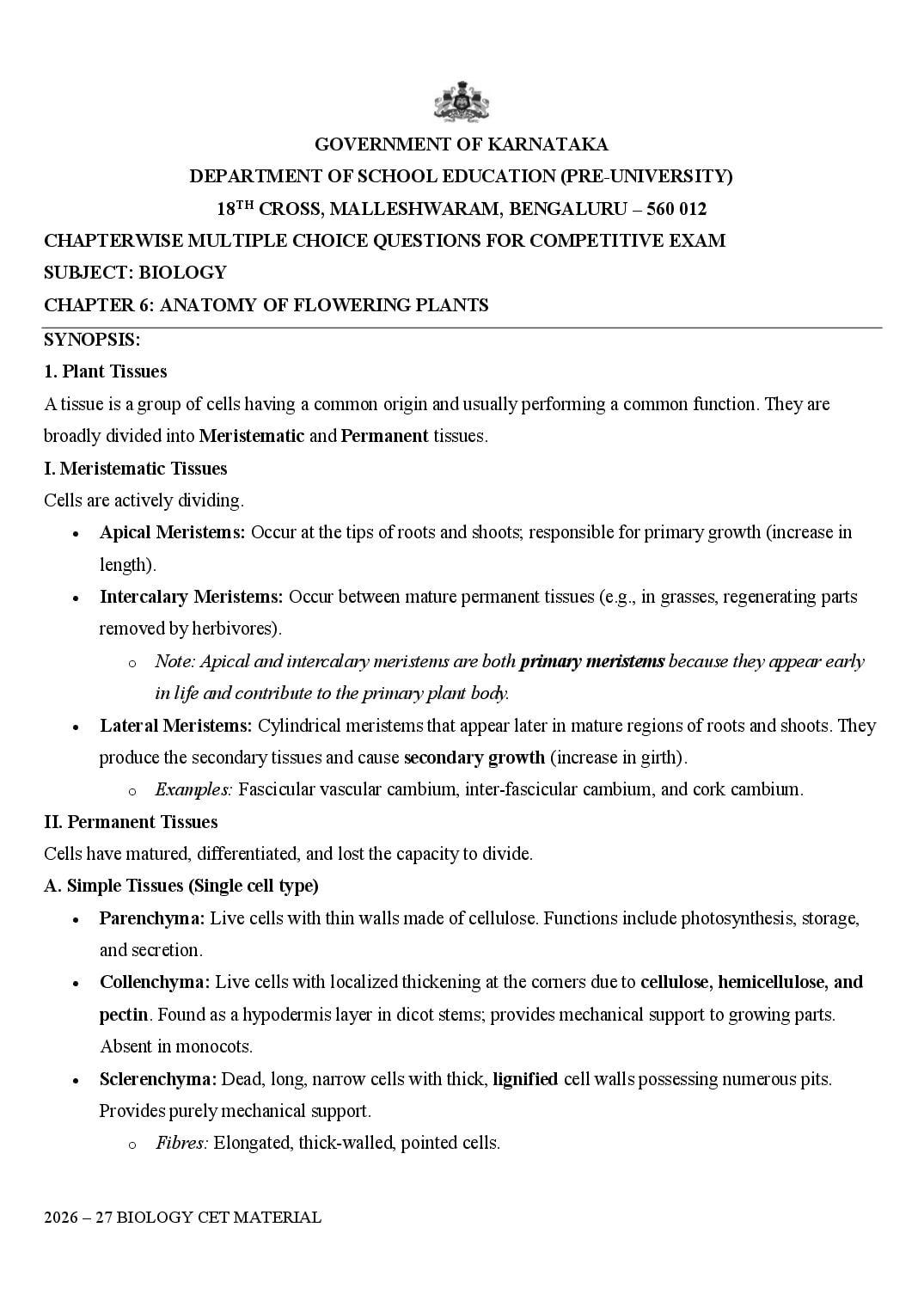
DEPARTMENT OF SCHOOL EDUCATION (PRE-UNIVERSITY)
18TH CROSS, MALLESHWARAM, BENGALURU – 560 012
CHAPTERWISE MULTIPLE CHOICE QUESTIONS FOR COMPETITIVE EXAM
SUBJECT: BIOLOGY
CHAPTER 6: ANATOMY OF FLOWERING PLANTS
SYNOPSIS:
1. Plant Tissues
A tissue is a group of cells having a common origin and usually performing a common function. They are
broadly divided into Meristematic and Permanent tissues.
I. Meristematic Tissues
Cells are actively dividing.
• Apical Meristems: Occur at the tips of roots and shoots; responsible for primary growth (increase in
length).
• Intercalary Meristems: Occur between mature permanent tissues (e.g., in grasses, regenerating parts
removed by herbivores).
o Note: Apical and intercalary meristems are both primary meristems because they appear early
in life and contribute to the primary plant body.
• Lateral Meristems: Cylindrical meristems that appear later in mature regions of roots and shoots. They
produce the secondary tissues and cause secondary growth (increase in girth).
o Examples: Fascicular vascular cambium, inter-fascicular cambium, and cork cambium.
II. Permanent Tissues
Cells have matured, differentiated, and lost the capacity to divide.
A. Simple Tissues (Single cell type)
• Parenchyma: Live cells with thin walls made of cellulose. Functions include photosynthesis, storage,
and secretion.
• Collenchyma: Live cells with localized thickening at the corners due to cellulose, hemicellulose, and
pectin. Found as a hypodermis layer in dicot stems; provides mechanical support to growing parts.
Absent in monocots.
• Sclerenchyma: Dead, long, narrow cells with thick, lignified cell walls possessing numerous pits.
Provides purely mechanical support.
o Fibres: Elongated, thick-walled, pointed cells.
Page 2
guava, pear, and sapota, and seed coats of legumes.
B. Complex Tissues (Multiple cell types working together)
• Xylem: Conducts water and minerals from roots to leaves. Consists of:
o Tracheids: Elongated, dead, tube-like cells with lignified walls and tapering ends.
o Vessels: Long cylindrical tube-like structures with lignified walls and a large central cavity; cells
are interconnected via perforations in their common walls. Angiosperm unique hallmark
(absent in most gymnosperms).
o Xylem Fibres: Highly thickened walls and obliterated central lumens.
o Xylem Parenchyma: Fleshy, living cells; store food (starch/fat) and tannins. Radial conduction of
water happens via ray parenchymatous cells.
o Developmental arrangement: Endarch (Protoxylem lies towards center, metaxylem towards
periphery; typical of stems) vs. Exarch (Protoxylem lies towards periphery, metaxylem towards
center; typical of roots).
• Phloem: Transports organic food materials. Consists of:
o Sieve Tube Elements: Long, tube-like structures arranged longitudinally, associated with
companion cells. End walls are perforated to form sieve plates. Mature elements possess a
peripheral cytoplasm and a large vacuole but lack a nucleus; their functions are controlled by
the nucleus of companion cells.
o Companion Cells: Specialized parenchymatous cells that help maintain the pressure gradient in
the sieve tubes.
o Phloem Parenchyma: Elongated, tapering cylindrical cells storing food resins and mucilage.
Absent in most monocotyledons.
o Phloem Fibres (Bast fibres): Sclerenchymatous, dead at maturity. Extensively utilized
commercially (Jute, Flax, Hemp).
o Gymnosperm Variant: Gymnosperms lack sieve tubes and companion cells; they possess
albuminous cells and sieve cells.
2. Tissue Systems
Divided into three structural zones:
• Epidermal Tissue System: Outer covering containing epidermal cells, stomata, and epidermal
appendages (trichomes on stems which are multicellular and secretory; root hairs on roots which are
unicellular elongations for absorption).
• Ground Tissue System: All tissues except epidermis and vascular bundles. Formed of parenchyma,
collenchyma, and sclerenchyma. Differentiated into cortex, pericycle, medullary rays, and pith. In
leaves, the ground tissue consists of thin-walled chloroplast-containing cells called mesophyll.
Page 3
bundles.
• Radial Arrangements: Xylem and phloem lay on separate radii alternating with each other (seen
uniquely in roots).
• Conjoint Arrangements: Xylem and phloem are jointly situated along the same radius (typical of
stems and leaves).
o Conjoint Open: Contains cambium between xylem and phloem; capable of secondary growth
(Dicot stems).
o Conjoint Closed: Lacks cambium; incapable of secondary growth (Monocot stems).
3. Anatomy of Roots, Stems, and Leaves
Dicot Root vs. Monocot Root
• Dicot Root: Cortex is followed by endodermis with water-impermeable waxy Casparian strips made
of suberin. Pericycle gives rise to lateral roots and vascular cambium during secondary growth. Xylem
bundles are fewer (diarch to tetrarch, i.e., 2 to 4 patches). Pith is small or inconspicuous.
• Monocot Root: Anatomically similar to dicot root, but it possesses polyarch xylem bundles (more than
six patches) and a large, well-developed pith. It never undergoes secondary growth.
Dicot Stem vs. Monocot Stem
• Dicot Stem: Epidermis contains trichomes. Hypodermis is collenchymatous. Vascular bundles are
arranged in a characteristic ring layout, which is open type with endarch xylem. Pith is large and
central.
• Monocot Stem: Hypodermis is sclerenchymatous. Vascular bundles are scattered throughout the
ground tissue, surrounded by a sclerenchymatous bundle sheath. Bundles are conjoint closed type;
water-containing cavities are present within the vascular bundles. Pith is un-differentiated.
Dorsiventral (Dicot) Leaf vs. Isobilateral (Monocot) Leaf
• Dorsiventral Leaf: Stomata are usually greater in number on the lower (abaxial) epidermis than on the
upper (adaxial) epidermis. Mesophyll is distinctly differentiated into upper palisade parenchyma
(elongated cells) and lower spongy parenchyma (loose oval cells with air cavities).
• Isobilateral Leaf: Stomata are distributed equally on both surfaces (amphistomatic). Mesophyll is
undifferentiated. In grasses, certain adaxial epidermal cells modify into large, empty, colorless cells
called bulliform cells. When flaccid due to water stress, they cause leaves to curl inward to minimize.
Classroom discussion questions:
1. Select the option that correctly identifies the labelling A, B and C in the given figure showing section of
root apical meristem.
A B C
Page 4
(B) Protoderm Cortex Root cap
(C) Hypodermis Epidermis Cortex
(D) Tunica Protoderm Root cap
2. Read the following statements regarding meristematic cells and select the correct ones.
(i) Cells possess the ability to grow and divide.
(ii) Cells have dense cytoplasm with prominent nucleus.
(iii) Well developed ER and Mitochondria are present.
(A) (i) and (ii) (B) (ii) and (iii) (C) (i) and (iii) (D) (i), (ii) and (iii)
3. Identify the given figure and select the correct option for A, B and C.
A B C
(A) Leaf primordium Shoot apical Apical bud
meristem
(B) Leaf primordium Shoot apical Axillary bud
meristem
(C) Root hair Root apical Axillary bud
meristem
(D) Root hair Root apical Apical bud
meristem
4. Column-I with Column-II and select the correct option from codes given below.
Column-I Column-II
(a) Meristem (i) Photosynthesis,
storage
(b) Parenchyma (ii) Mechanical support
(c) Collenchyma (iii) Actively dividing
cells
(d) Sclerenchyma (iv) Stomata
(e) Epidermal (v) Sclereids
tissue
(A) (a) → (i), (b) → (iii), (c) → (v), (d) → (ii), (e) → (iv)
(B) (a) → (iii), (b) → (i), (c) → (ii), (d) → (v), (e) → (iv)
(C) (a) → (ii), (b) → (iv), (c) → (v), (d) → (i) (e) → (iii)
(D) (a) → (v), (b) → (iv), (c) → (iii), (d) → (ii), (e) → (i)
5. Cells of ________ tissue are living, show angular wall thickenings and provide mechanical support.
Page 5
6. Which of the following tissues has dead cells with thick and lignified cell walls, having a few or numerous
pits?
(A) Sclerenchyma (B) Collenchyma (C) Xylem (D) Phloem
7. Both apical meristems and intercalary meristems are ___________ meristems.
(A) Primary (B) secondary (C) lateral (D) both (B) and (C)
8. Interfascicular cambium and cork cambium are formed due to
(A) Cell division (B) differentiation (C) dedifferentiation (D) Redifferentiation
9. A plant tissue, when stained, showed the abundance of hemicellulose and pectin in wall of its cells. The
tissue represents
(A) Collenchyma (B) sclerenchyma (C) xylem (D) meristem
10. Given figures (P and Q) represent the stomatal apparatus of dicot and monocot leaves respectively. Select
the option which correctly labels A, B and C.
A B C
(A) Stoma Subsidiary cells Guard cells
(B) Stoma Subsidiary cells Epidermal cells
(C) Guard cells Stoma Chloroplast
(D) Stoma Guard cells Subsidiary cells
11. Match Column-I with Column-II and select the correct option from the codes given below.
Column-I Column-II
(a) Vessels (i) Cells are living, with thin cellulosic cell walls
(b) Tracheids (ii) Cells possess highly thickened walls with obliterated central lumen
(c) Xylem fibres (iii) Individual members are interconnected through perforations in their
common walls
(d) Xylem parenchyma (iv) Elongated tube-like cells with thick, lignified walls and tapering ends
(A) (a) → (iv), (b) → (iii), (c) → (ii), (d) → (i) (B) (a) → (iii), (b) → (iv), (c) → (ii), (d) → (i)
(C) (a) → (ii), (b) → (iv), (c) → (iii), (d) → (i) (D) (a) → (iv), (b) → (ii), (c) → (iii), (d) → (i)
12. The given figure shows which of the following cells?
Page 6
(C) Xylem vessel (D) Xylem tracheid
13. In (i), protoxylem lies towards periphery and metaxylem lies towards centre. Such an arrangement of
primary xylem is called as (ii).
(i) (ii)
(A) stems Endarch
(B) stems exarch
(C) roots Endarch
(D) roots Exarch
14. A piece of wood having no vessels may belong to
(A) Teak (B) Mango (C) Pine (D) Palm
15. Identify the given figure and select the correct option for the parts labelled as A, B and C
(A) C represents the cells which are replaced by albuminous cells in non-flowering plants such as
gymnosperms.
(B) A represents phloem parenchyma, which is absent in most monocots.
(C) B represents the cells which become dead on maturity
(D) All of these
16. Read the following statements and select the correct ones.
(i) Phloem parenchyma is absent in most monocots.
(ii) Gymnosperms lack tracheids and vessels.
(iii) Gymnosperms lack companion cells.
(A) (i) and (ii) (B) (ii) and (iii) (C) (i) and (iii) (D) (i), (ii) and (iii
17. Sclereids are present in
(A) Fruit walls of nuts (B) grit of guava and pear
(C) seed coats of legumes (D) all of these
18. A vessel-less piece of stem possessing prominent sieve tubes would belong to
(A) Pinus (B) Eucalyptus (C) Grass (D) Trochodendron
Page 7
(A) Root hair - Unicellular
(B) Stem hair - Multicellular
(C) Trichomes - Cause water loss
(D) Guard cells - Regulate opening and closing of
stomata
20. Which of the following tissue system constitute bulk of the plant body?
(A) Epidermal tissue system (B) Ground tissue system
(C) Vascular tissue system (D) Both (A) and (C)
21. In __________ vascular bundle, a strip of vascular cambium is present in between the xylem and phloem
(A) Open (B) closed (C) endarch (D) exarch
22. Identify the different zone of a typical root shown in figure and select the correct answer regarding these.
X Y Z
(A) Zone of cell Zone of cell Meristematic zone
differentiation maturation
(B) Zone of cell elongation Zone of cell Meristematic zone
maturation
(C) Meristematic zone Zone of cell Zone of cell maturation
elongation
(D) Zone of cell maturation Zone of cell Meristematic zone
elongation
23. Casparian strips are the bands of thickenings present on __________ walls of endodermis
(A) Radial (B) tangential (C) central (D) both (A) and (B)
24. Match Column-I with Column-II and select the correct option from the codes given below
Column-I Column-II
(a) Stele (i) Innermost layer of cortex
(b) Endodermis (ii) Suberin
(c) Casparian (iii) All the tissues outer to vascular
strips cambium
Page 8
(A) (a) → (iv), (b) → (i), (c) → (ii), (d) → (iii) (B) (a) → (iii), (b) → (ii), (c) → (i), (d) → (iv)
(C) (a) → (i), (b) → (ii), (c) → (iii), (d) → (iv) (D) (a) → (iv), (b) → (ii), (c) → (i), (d) → (iii)
25. The given diagrams are of lactiferous tissues. Choose the correct option about them.
(A) Lactiferous tissue contains colourles milky or yellow colour fluid called latex
(B) Latex cells do not fuse together to form a network
(C) Latex vessels fuse with each other and form a network, e. g. Papaver
(D) All are correct
26. The given figure shows the annual rings in the TS of an old stem. Choose the incorrect statement about it.
(Rationalized)
(A) Annual rings represent the wood formed in a single year
(B) It consists of two types of wood namely spring wood and autumn wood
(C) The early or spring wood is much narrower than the autumn or late wood
(D) Spring wood consists of larger and wider xylem elements
27. Identity different types of the steles and choose the correct option
(A) A – Hapllostele, B – Haplostele, C – Plectostele, D – Solenostele
(B) A – Actinostele, B – Haplostele, C – Pletostele, D – Solenostele
(C) A – Pletostele, B – Haplostele, C – Actinostele, D – Solenostele
(D) A – Solenostele, B – Plectostele, C – Actinostele, D – Haplostele
Page 9
in the figure (Column I) with their functions (Column II) and choose the correct option from the codes
given below
Column I Column II
(a) A 1 Transportation of organic food
(b) B 2 Contains chloroplasts and carryout
photosynthesis
(c) C 3 Conduction of water and solutes
(d) D 4 Performs transpiration
Codes
(a) (b) (c) (d)
(A) 1 2 3 1
(B) 2 3 1 4
(C) 4 3 2 1
(D) 3 1 4 2
29. The diagram given below shows LS of root apical meristem
Read the statements regarding the structures labelled as A to D and choose the correct option
I. The structure A is quiescent centre which may function as reserve meristem
II. The structure B is pith, usually consists of parenchymatous tissue
III. The structure C is procambium which gives rise to lateral roots
IV. The structure D forms medullary rays.
(A) I and III (B) III and IV
(C) Only II (D) I and IV
30. Carefully observe the given diagram of TS of a dicot stem
Page 10
I. Hypodermis is the part of general cortex consisting of a single layer of collenchymatous cells
II. Pericycle is multilayered with alternating bands of parenchyma and sclerenchyma
III. Medullary rays are present between adjacent vascular bundles.
IV. Pith is present in the centre of stem and helps in the radial conduction of food and water
Choose the correct option
(A) I and IV (B) I and II (C) II and III (D) Only IV
31. In the given diagram of LS of phloem, several parts have been indicated by A, B, C and D. Choose the
option that correctly identifies them
(A) A _ Plasmodesmata, B – Companion cell, C – Phloem parenchyma, D – Sieve tube cell
(B) A – Companion cell, B – Plasmodesmata, C – Phloem parenchyma, D – Sieve tube cell
(C) A – Sieve tube cell, B – Plasmodesmata, C – Phloem parenchyma, D – Companion cell
(D) A – Phloem parenchyma, B – sieve tube cell, C – Plasmodesmata, D – Companion cell
32. Consider, the given diagram showing TS of a typical monocot root
Now, go through the following statements are choose th4e correct option
Page 11
slats.
II. The young endodermal cells possess an internal strip of pectin and c4ellulose which is known as
Casparian strip
III. In monocots pericycle forms cambium and produced lateral roots.
IV. Conjunctive parenchyma does not produce cambium
(A) I and II (B) II and III (C) I, II and III (D) I andIV
33. Match the Column I with Column II and choose the correct option from the codes given below
Column I Column II
(a) 1 Selerenchyma
(b) 2 Parenchyma
(c) 3 Collenchyma
Codes
(a) (b) (c)
(A) 1 2 3
(B) 3 2 1
(C) 1 3 2
(D) 2 3 1
34. Refer to the given diagrams (A to D) of xylem elements. Identify them and choose the correct pairing of
element and its function.
(A) A (Tracheid) – Storage of food material
(B) B (Fibre) – Transports organic material
(C) C (Vessel) – Water transportation
(D) D (Xylem parenchyma) – Mechanical element
35. Refer to the given figure of stomatal apparatus. Choose the option that is not true about it.
Page 12
(B) They are fewer in case of stems, but abundant in case of leaves
(C) Stomata are surrounded by less modified cells called subsidiary cells
(D) Stomata regulate transpiration and gaseous exchange
36. The given diagram is showing position of different types of meristems
Match the Column I with Column II and choose the correct option from the codes gives below.
Column I Column II
(a) Apical meristem 1 Elongation of organs
(b) Intercalary 2 Forms another layer of corlex
meristem
(c) Vascular cambium 3 Growth in length
(d) Cork cambium 4 Derived from conjunctive parenchyma of
root
Codes
(a) (b) (c) (d)
(A) 3 1 2 4
(B) 1 2 3 4
(C) 3 1 4 2
(D) 4 3 2 1
37. Carefully observe the diagram of longitudinal section of a vegetative shoot apex
Consider the following statements with reference to the above diagram
Page 13
II. Cells of corpus are oval- shaped and derived from procambium of shoot
III. Cells of procambium differentiate rapidly and form xylem and phloem.
IV. Ground meristem diffenrtiates into pith in the centre and pericycle, endodermis, etc. towards the outside
Choose the correct option
(A) I and II (B) I, II and III (C) I, III and IV (D) I and IV
38. Consider the given diagram of phloem elements and choose the incorrect statement about it
(A) Phloem fibers occur abundantly in secondary phloem and provide mechanical strength
(B) Companion cells help in maintaining a proper pressure gradient in the help in maintaining a proper
pressure gradient in the sieve tube elements
(C) Sieve tubes are elongated tubular conducting channels of phloem
(D) Phloem, parenchyma are ordinary dead cells which store food, resin, latex, etc
39. Consider the given diagram showing LS of reproductive apex. Choose the correct option from the following
statements
(A) Carpels are the first to be formed
(B) Sepal primordia are last to be formed
(C) The meristematic cells get depleted or consumed in the formation of various floral parts
(D) Only few parts of reproductive shoot apex show meristematic activity
Page 14
and choose the correct option
(A) A – filiformsclereid, B – Macrosclereid, C – Osteosclereid, D – Astrosclereid
(B) A – Filiformsclereid, B – Osteosclereid, C – Macrosclereid, D – Astrosclereid
(C) A – Macrosclereid, B – Osteosclereid, C – Astrosclereid, D – Filiformasclereid
(D) A – Osteosclereid, B – Astrosclereid, C – Macrosclereid, D – Filiformasclereid
41. In the given diagram of LS of vegetative shoot apex identify the parts labelled as A, B, C and D.
(A) A- Axillary bud, B – Young leaf, C – Protoderm, D – Plastochron
(B) A – Procambium, B – Axillary bud, C – Young leaf, D – Protoderm
(C) A – Protoderm, B – Axillary bud, C – Young leaf, D – Procambium
(D) A – Young leaf, B – Protoderm , C – Plastochron, D – Axillary bud
42. The given figure shows the stomatal apparatus of plant leaf. Match the parts labelled as A, B, C and D in the
figure (Column I) with their functions/ characteristics (Column II) and choose the correct option
Column I Column II
(a) A 1 Involved in photosynthesis
(b) B 2 Regulate transpiration and gaseous
exchange
(c) C 3 Surround the guard cell
Codes
(a) (b) (c) (a) (b) (c)
Page 15
(C) 2 3 1 (D) 3 2 1
43. The given figures are of different types of vascular bundles. Identify A, B, C, D and choose the correct
option
(A) A – Conjoint collateral, B – Bicollateral, C – Amphicribal, D – concentric
(B) A – Amphicribal, B – Conjoint collateral, C – Bicllateral, D – Concentric
(C) A – Concentric, B – Bicollateral, C – conjoint collateral, D – Amphicribal
(D) A – Bicollateral, B – Amphicribal, C – Cencentric, D – Conjoint collateral
44. Refer to the given figure of lenticles choose the incorrect statement about it
(A) Lenticles appear on the surface of the bark as raised scars containing oval, rounded or oblong
depressions
(B) Lenticels may occur scattered or form longitudinal rows
(C) The lenticel is filled up by loosely arranged thin walled, rounded and suberized or unsupervised cells
called complementary cells
(D) Lenticels are found in climbers but not in woody tress
45. In the given diagram of TS of stele of a dicot root, different parts are labelled as A, B, C, D, E and F.
Identify them and choose the correct option
(A) A- Pericycle, B – Conjunctive tissue, C – Metaxylem, D – Protoxylem, E – Phloem, F- Pith
(B) A – Endodermis, B – Conjunctive tissue, C – Protoxylem, D – Metaxylem, E- Phloem, F – Pith
Page 16
(D) A – Endodermis, B – Pith, C – Protoxylem, D – Metaxylem, E – Phloem, F – Conjunctive tissue
46. Match the Column I with Column II and choose the correct option from the codes given below.
Column I Column II
(a) 1 Produce essential oil
(b) 2 Absorption of water and mineral salts
(c) 3 Contains poison
(d) 4 Protect against sudden changes of
temperature
Codes
(a) (b) (c) (d)
(A) 4 3 2 2
(B) 2 4 1 3
(C) 1 2 3 4
(D) 4 3 2 1
47. Living scllerenchymatous fibres possessing nucleated protoplast are found in
(A) grapevine (B) Tamarix aphlla (C) corchorus (D) Cannabis
48. Which of the following statements is incorrect?
(A) In exarch condition, protoxylem lies outside of metaxylem
(B) In endarch condition, protoxylem lies towards the centre
(C) In centrarch condition, protoxylem lies in the middle of metaxylem
(D) Exarch condition is found in roots while endarch condition is found in stem.
49. Identify the correctly matched pair
(A) Bicollateral vascular bundles – Cucurbita pepo
(B) Amphicribal vascular bundles – Dracaena
(C) Amphivasal vascular bundles – Prunus
Page 17
50. Match the column I with column II and select the correct option form the codes given the codes given
below
Column I Column II
(a) Astrosclereid (i) Dicot leaves
(b) Osteosclereid (ii) Grit of fruits
(c) Macrosclereid (iii) Intracellular spaces of leaves and stem in
hydrophytes
(d) Brachysclereid (iv) Seed coat of leguminosae family
(A) (a) – (ii), (b) – (iv), (c) – (i), (d) – (iii) (B) (a) – (iv), (b) – (iii), (c) – (ii), (d) – (i)
(C) (a) – (iii), (b) – (i), (c) – (iv), (d) – (ii) (D) (a) – (ii), (b) – (iii), (c) – (i), (d) – (iv)
51. Refer to the given diagram and select the correct statements regarding this
(i) A is responsible for increase in length and is found at base of internodes, leaves or nodes
(ii) B is a separated part of A that contributes to increase in length of plant
(iii) C divides only radially and contributes to increase in girth of plant
(iv) B and C are present on lateral sides of plant
(A) (ii) and (iii) only (B) (i) and (iv) only
(C) (ii), (iii) and (iv) only (D) All of these
52. Which of the following is not a function of epidermis?
(A) Protection of internal tissues
(B) Exchange of gases
(C) Provide mechanical strength and flexibility
(D) Minimise surface transpiration
Practice questions
1. A transverse section of stem is stained first with safranin and then with fast green following the usual
schedule of double staining for the preparation of a permanent slide. What would be the colour of the
stained xylem and phloem?
(A) Red and green (B) Green and red
Page 18
2. Match the followings and choose the correct option from below
Column I Column II
(a) Meristem (i) Photosynthesis,
storage
(b) Parenchyma (ii) Mechanical support
(c) Collenchyma (iii) Actively dividing
cells
(d) Sclerenchyma (iv) Stomata
(e) Epidermal (v) Sclereids
tissue
Options:
(A) (a) → (i), (b) → (iii); (c) → (v); (d) → (ii); (e) → (iv)
(B) (a) → (iii), (b) → (i); (c) → (ii); (d) → (v); (e) → (iv)
(C) (a) → (ii), (b) → (iv); (c) → (v); (d) → (i); (e) → (iii)
(D) (a) → (v), (b) → (iv); (c) → (iii); (d) → (ii); (e) → (i)
3. Match the following and choose the correct option from below
Column I Column II
(a) Cuticle (i) Guard cells
(b) Bulli form (ii) Single layer
cells
(c) Stomata (iii) Waxy layer
(d) Epidermis (iv) Empty colorless
cell
Options:
(A) (a) → (iii), (b) → (iv); (c) → (i); (d) → (ii) (B) (a) → (i), (b) → (ii); (c) → (iii); (d) → (iv)
(C) (a) → (iii), (b) → (ii); (c) → (iv); (d) → (i) (D) (a) → (iii), (b) → (ii); (c) → (i); (d) → (iv)
4. Identify the tissue system from among the following
(A) Parenchyma (B) Xylem (C) Epidermis (D) Phloem
5. Epiblema of roots is equivalent to
(A) Pericycle (B) Endodermis (C) Epidermis (D) Stele
6. A conjoint and open vascular bundle will be observed in the transverse section of
(A) Monocot root (B) Monocot stem
(C) Dicot root (D) Dicot stem
Page 19
(A) Cork and cork cambium (B) Cork cambium and cork
(C) Secondary cortex and cork (D) Cork and secondary cortex
8. In which of the following pairs of parts of a flowering plant is epidermis absent?
(A) Root tip and shoot tip (B) Shoot bud and floral bud
(C) Ovule and seed (D) Petiole and pedicel
9. How many shoot apical meristems are likely to be present in a twig of a plant possessing, 4 branches and 26
leaves
(A) 26 (B) 1 (C) 5 (D) 30
10. Fibres are likely to be absent in
(A) Secondary phloem (B) Secondary Xylem
(C) Primary phloem (D) Leaves
11. When we peel the skin of a potato tuber, we remove
(A) Periderm (B) Epidermis (C) Cuticle (D) Sapwood
12. Which one of the following cell types always divides by anticlinal cell division?
(A) Fusiform initial cells (B) root cap (C) Protoderm (D) Phellogen
13. What is the fate of primary xylem in a dicot root showing extensive secondary growth?
(A) It is retained in the center of the axis (B) It gets crushed
(C) May or may not get crushed (D) It gets surrounded by primary phloem
14. Read the following statements and choose the incorrect statement
(A) Annual rings are not distinct in plants of tropical regions
(B) The spring wood is wider than autumn wood
(C) Spring wood is darker in colour and of higher density than autumn wood
(D) The transition from spring to autumn wood is a gradual process.
15. Select the incorrectly matched pair
(A) Vascular cambium of root - Derived from conjunctive parenchyma
(B) Interfascicular vascular - Derived from medullary ray cells
(C) Cork cambium - Derived from inner layer of cortex
(D) Would cambium - derived form cells around injury
16. Read the given table of differences between tow secondary tissues X and Y
X Y
(i) X is composed of dead cells Y is composed of living cells
(ii) It is protective in function It takes part in storage of food
(iii) Cell walls are impermeable Cell walls are permeable
Page 20
arranged spaces.
Select the correct option regarding X and Y
(A) X is phloem fibre and Y is companion cell (B) X is sieve tube and Y is vessel
(C) X is epidermis and Y is cortex (D) X is phellem and Y is phelloderm
17. Anomalous secondary growth occurs in
(A) Cortical bundles of Nyctanthes (B) Stem of Zea mays
(C) Stem of Helianthus (D) All of these
18. Consider the following difference between primary phloem and secondary phloem
Primary phloem Secondary phloem
(i) Occurs in all vascular plant organs Restricted to stem and roots of perennial dicots
and gymnosperms
(ii) Formed from lateral meristem Formed from procambium
(iii) Present towards the periphery Formed inner to primary phloem
(iv) There is no differentiation Differentiated into protophloem and
metaphloem
(v) Radial system of phloem rays is Radial system is absent
present
Choose the incorrect set of differences
(A) (i), (ii) and (iii) only (B) (ii), (iv) and (v) only
(C) (ii), (iii) and (iv) only (D) (i), (iv) an (v) only
19. Which of the given statements is correct regarding anatomical adaptations in leaves
(A) Epidermis is single layered in leaves of Begonia and Nerium.
(B) Upper surface of leaf bear stomatal crypts in Nerium
(C) Floating leaves are epistomatic as in Nymphea
(D) Sumerged hydrophytic leaves of Hydrilla bears stomata only on lower surface
20. Match the column I with column II
Column I Column II
(a) Cutch (i) Caesalpinia sappan
(b) Haematoxylin (ii) Pterocarpus santalinus
(c) Brazilin (iii) Acacia catechu
(d) Santalin (iv) Haematoxylon campechiaum
(A) (a) – (iii), (b) – (iv), (c) – (i), (d) – (ii) (B) (a) – (ii), (b) – (iv), (c) – (iii), (d) – (i)
(C) (a) – (iv), (b) – (i), (c) – (ii), (d) – (iii) (D) (a) – (ii), (b) – (iv), (c) – (i), (d) – (iii)
Page 21
(A) These are bands of thickenings along the radial and tangential walls of endodermal cells
(B) They prevent plasmolysis of endodermal cells
(C) These are composed of lignin, suberin and tannins
(C) These are composed of lignin, suberin and tannins,
(D) It prevents movement of substances between cortex and pericycle
22. Consider the following statements regarding epidermal appendages and select the correct option stating
which one is true and which one is false
(i) Aerial hairs are unicellular appendages that enclose stationary hair and protect plant parts agents sudden
temperature changes
(ii) Glandular trichomes secret oil and impart characteristic odour to plants
(iii) Prickles are multicellular emergences devoid of vascular supply
(iv) The digestive glands of insectivorous plants are also trichome in nature
(i) (ii) (iii) (iv)
(A) T F F F
(B) F T T T
(C) T F T T
(D) F T F t
23. Select the incorrect statement
(A) Pericycle gets converted into secondary meristem to form phellogen
(B) Phellogen divides towards the inner side to form few layers of thick phelloderm
(C) Towards the outer side of phellogen are formed dead cells
(D) The phellogen, phelloderm and periderm together constitute phellem
24. Consider the differences between two simple permanent tissues and identify them correctly from given
option
Tissue A Tissue B
(i) Composed of living cells Composed of dead cells
(ii) Walls comprise of angular thickenings Wall thickenings may be of ligin or cellulose
or both
(iii) Provides mechanical strength and Provides mechanical strength only
elasticity
(A) A is chlorenchyma and B is collenchyma (B) A is parenchyma and B is sclerenchyma
(C) A is collenchyma and B is sclerenchyma (D)A is collenchyma and B is salaried
25. Hard bast are
Page 22
(B) secondary phloem without abundant fibres
(C) secondary phloem with abundant fibres
(D) ray parenchyma with radially arraigned cells
26. The cork is impervious to water because
(A) it is filled with air (B) its cells have deposition of lignin and tannins
(C) its cell possesses suberized cell walls (D) all of these
27. Identify the incorrect commercial use to bark
(A) In tanning (B) As insect repellent
(C) As antiseptic (D) In sound proofing
28. Refer to the statements regarding sieve elements
(i) Sieve elements show nacreous thickenings on lateral walls
(ii) They may possess simple or compound sieve plate
(iii) Sieve tubes are syncytes and the perforations are surrounded by callose
(iv) They allow selective and restricted diffusion of soluble organic substances
Select the option with all correct statements
(A) (i) and (iv) only (B) (ii) and (iv) only
(C) (i), (ii) and (iv) only (D) (i), (ii) and (iii) only
29. Grasses are monocots
(A) with single bundle sheath (B) having double bundle sheath
(C) having large bundle sheath extensions (D) showing Kranz anatomy
30. Which of the following is not a function of cortex in monocot roots?
(A) Conduction of water from root hairs to inner tissues
(B) Produce protective exodermis in older roots
(C) Produce lateral roots
(D) Storage of food
31. Refer to the given characteristic features of a given section of stem and identify it correctly.
(i) The hypodermis is made up of 3-4 layered lacunate collenchyma
(ii) The pericycle is homogenous comprising of 4- 5 layers of sclerenchyma
(iii) Vascular bundles are bicollateral
(iv) The outline of primary stem is angular
Select the correct option
(A) The given section of sunflower, a primary dicot stem
(B) The section belongs is Zea mays, a monocot stem
(C) The section is a primary dicot stem of Cucurbita
Page 23
32. Select the incorrect statement
(A) Ring porous wood found in Cassia fistula
(B) Ring porous wood shows broader vessels in spring wood and quite narrow vessels in autumn wood
(C) In diffuse porous wood, both autumn and spring wood comprises of large sized vessels
(D) Diffuse porous wood is more advanced than ring porous wood since it helps in better translocation at
great heights
33. Refer to the given table to differences between vessels and tracheids and select the incorrect pair of
difference
Vessels Tracheids
(i) These are made up of single cell These are made up of numerous cells
(ii) The ends are rounded or The ends are generally oblique and
transverse tapering
(iii) Walls are thick and lumen is Walls are less thickened lumen is wide
narrow
(iv) Occur in all angiosperms Occur in all vascular
(A) (i), (iii) and (iv) only (B) (ii) and (iii) only
(C) (i) and (ii) only (D) (iv) only
34. Select in incorrect statements with respect to lenticels
(A) They are raised corky spots in periderm of stem
(B) They are formed beneath the stomata of epidermis
(C) These comprise of unsuberised complementary cells
(D) They get closed in summer in temperate plants to check excessive evaporation
35. Select the incorrect statement regarding given figure
(A) A gives rise to medullary rays (B) B gives rise to epidermis
(C) C gives rise to vascular tissues (D) A, B and C are histogens of shoot apex
36. The cells of the quiescent centre are characterized by
(A) having dense cytoplasm and prominent nuclei
(B) actively dividing cells giving rise to initials
Page 24
(D) a zone of active and inactive cells in region of root apex
37. The process of dilation involves
(A) formation of secondary xylem on the inner side
(B) formation of vascular rays
(C) gradual movement of vascular cambium to outside
(D) both (A) and (C)
38. Torus refers to
(A) thickening on pit membrane of tracheids in some gymnosperms
(B) pit cavity of tracheids in the form of a flask
(C) elongated tubes or tracheids closed at one end
(D) none of these
39. The activities of sieve tube are controlled by
(A) albuninous cells (B) nucleous of companion cells
(C) adjacent sieve tube member (D) phloem parenchymatous cells
40. Depending upon the type of xylem found in roots of plants match the column I and II
Column I Column II
(a) Diarch (i) Castor
(b) Triarch (ii) Maize
(c) Tetrarch (iii) Tomato
(d) Polyarch (iv) Pea
Select the correct option
(A) (a) – (i), (b) – (iii), (c) – (iv), (d) – (ii) (B) (a) – (iii), (b) – (iv), (c) – (ii), (d) – (ii)
(C) (a) – (i), (b) – (iii), (c) – (ii), (d) – (iv) (D) (a) – (iv), (b) – (i), (c) – (ii), (d) – (iii)
41. From the given section of conducting tissue identify the labels A – D and select the correct option
Select the correct option
A B C D
(A) Vessels Tracheids Xylem fibres Xylem parenchyma
companion
Page 25
(C) Sieve tube Phloem fibres Sieve plate Phloem parenchyma
(D) Tracheids Xylem fibres Vessels Xylem parenchyma
42. The epidermal tissue system in plants has many important roles. Choose the incorrect function not displayed
by this tissue system
(A) Storage of water (B) Healing of wounds
(C) Maintained root pressure (D) rolling and unrolling of leaves
43. Refer to the given figure of T. S of old woody dicot stem and consider the statements regarding A, B, and
C. Choose the option with incorrect ones (RATIOINALISED)
(i) A is protective in function and is called periderm
(ii) B is soft and light in colour
(iii) C is susceptible to attack of pathogen and insects
(iv) B is mechanical in function due to deposition of metabolites and tyloses
(A) (i) and (ii) only (B) (iii) and (iv) only
(C) (i) and (iv) only (D) None of these
44. Select the incorrectly matched pair
(A) Nectaries – Euphorbia pulcherrima (B) Digestive glands – Drosera
(C) Resin secreting glands- Pinus (D) Hydathodes – Calotropis
45. Choose the correct statement
(A) Additive division add to dilation by anticlinal division
(B) Multiplicative division of vascular cambium forms secondary tissues by periclinal divisions
(C) radial system of secondary vascular tissues is produced by ray initials
(D) Axial system of secondary vascular tissues is formed by vascular rays
46. Duramen is
(A) softwood devoid of vessels (B) nonfunctional heartwood
(C) porous wood with abundant vessels (D) functional sapwood
47. Consider the table of differences between two tissue X and Y
Tissue X Tissue Y
(i) Comprises mainly of dead cells but only Comprises of mainly living cells but
Page 26
(ii) Related to conduction of sap Helps in conduction of organic solutes
(iii) Conducting elements are of two types Conducting elements are of one type
(iv) Constitutes the bulk of woody parts Constitutes a small part of vascular
tissue
Based on above differences, identify the tissues X and Y
(A) x is sapwood and Y is heart wood (B) X is secondary tissue and Y is primary tissue
(C) X is xylem and Y is phloem (D) X is protoxylem and Y is metaxylem
48. Refer to the given figure of section of plant part and identify its characteristics
Select the incorrect option
(A) Hairs are absent in epidermal tissue system
(B) Endodermis and pericycle are absent
(C) Vascular bundles are scattered, conjoint, collateral and open
(D) The section belongs to that o fa monocot stem
49. Read the following stages in formation of secondary vascular tissues and arrange them in sequence, as they
occur
I. Pericycle gives rise to wavy band of vascular cambium
II. Cambial strips and primary phloem bundles are pushed slightly to outside
III. The primary phloem gets crushed by growth of secondary vascular tissues
IV. Secondary xylem is produced on the inner side, and secondary phloem is formed on outside
V. Wide multiseriate medullary rays are formed opposite protoxylem
(A) I → II → V → IV → II (B) II → I → V → IV → III
(C) V →IV → II → III → I (D) III → II → I → V → IV
50. Refer to the given figure and select the incorrect statement regarding them
(A) A tissues are irregularly arranged angular tissues, with thickenings at angles e. g., Vitis
(B) B tissues are identified as plate thickenings on tangential walls e. g., stem of sunflower.
Page 27
(D) C tissues are found in stem of Targets
51. Consider the following statements regarding the given figure and select the incorrect one
(i) ‘L’ is the collenchymatous hypodermis that provides mechanical strength and flexibility to young dicot
stems
(ii) ‘M’ is the innermost layer of cortex which usually possesses Casparian strips
(iii) ‘N’ is the parenchymatous pericyclic that synthesizes food.
(iv) ‘O’ is xylem which is exarch with respect to the positions of protoxylem and metaxylem
(A) (i) only (B) (i) and (ii) only
(C) (iv) only (D) (ii), (iii) and (iv) only
52. Refer to the given flow chart showing differentiation of cells
Choose the correct statement regarding P, Q, R and S
(A) P is the terminal portion of root
(B) Q represents sieve tubes formed of several cells placed end to end
(C) R may be living parenchymatous cells comprising of thin-walled isodiametric cells
(D) S can be collenchyma tissue providing strength to young stems and petioles
53. Read the differences between tissues X and Y and choose the correct statement regarding X and Y
Tissue X Tissue Y
Page 28
chloroplasts cavities
(ii) Cells are large Cells are small
(iii) Helps in photosynthesis Helps in buoyancy
(A) Tissue X is xylem parenchyma found in stem of Cucurbita
(B) Tissue Y is prosenchyma providing strength to tender parts of plant
(C) Tissue X is phloem parenchyma taking part in both storage and conduction of food
(D) Tissue Y is aerenchyma found in petiole of Canna
54. Select the incorrect statements regarding figure A. E.
I. D – shows thickening present in the form of ladder
II. A – shows annular thickenings laid in the form of rings
III. C – Thickenings are present in early formed tracheids in the form of a network
IV. B-shows pitted tracheids which may be simple and bordered
V. E- represent spiral thickenings in tracheids
(A) IV and V only (B) I and III only (C) I, III and IV only (D) III, IV and V only
55. Refer to the given figure and read the statements regarding labels A – D
(A) A forms pith (B) B forms endodermis
(C) C gives rise to protoderm (D) D gives rise to protoderm
56. Read carefully the differences between the two sections X and Y of plnt parts showing secondary growth
Section X Section Y
(i) The vascular cambium is in the form of a circular strip Vascular cambium is in the form
of a wavy band
(ii) Vascular cambium is made up of both primary and Vascular cambium is secondary
secondary meristematic tissues in origin
Page 29
(iv) Phellogen arises from a superficial layer of cortex Phellogen originates from
pericycle
Select the correct option regarding plat sections X and Y
(A) Section X can be of dicot leaf
(B) Section Y is of monocot root
(C) Section X shows secondary growth in dicot stem
(D) Section Y shows secondary growth in monocot stem
57. Refer to the given figure and identify the statements correctly describing it
(i) Epidermis is single layered and covered with cuticle on both the sides
(ii) Mesophyll is diffenrtiates into palisade parenchyma and spongy parenchyma
(iii) Outer side of the vascular bundle have few layers of collenchyma
(iv) Vascular bundles are conjoint, collateral and closed
(A) (i), (ii) and (iv) only (B) (i), (ii), and (iii) only
(C) (ii) and (iii) only (D) All of these
Classroom discussion Keys
1. (A) 8. (C) 15. (A) 22. (D) 29. (C) 36. (C) 43. (A) 50. (C)
2. (A) 9. (A) 16. (C) 23. (D) 30. (C) 37. (D) 44. (D) 51. (A)
3. (B) 10. (D) 17. (D) 24. (A) 31. (B) 38. (D) 45. (B) 52. (C)
4. (B) 11. (B) 18. (D) 25. (D) 32. (D) 39. (C) 46. (B)
5. (C) 12. (C) 19. (C) 26. (C) 33. (D) 40. (C) 47. (B)
6. (A) 13. (D) 20. (B) 27. (A) 34. (C) 41. (B) 48. (C)
7. (A) 14. (C) 21. (A) 28. (B) 35. (C) 42. (D) 49. (A)
Practice Question Keys
1. (A) 5. (C) 9. (C) 13. (A) 17. (D) 21. (A) 25. (C) 29. (D)
2. (B) 6. (D) 10. (D) 14. (C) 18. (A) 22. (C) 26. (C) 30. (B)
3. (A) 7. (B) 11. (A) 15. (C) 19. (B) 23. (B) 27. (C) 31. (C)
4. (A) 8. (A) 12. (D) 16. (A) 20. (C) 24. (D) 28. (C) 32. (C)
Page 30
34. (A) 38. (A) 42. (C) 46. (B) 50. (D) 54. (D)
35. (D) 39. (B) 43. (B) 47. (C) 51. (D) 55. (C)
36. (C) 40. (B) 44. (D) 48. (C) 52. (C) 56. (C)
Document Details
| Board / Org | Karnataka Board |
| Exam | Class 11 |
| Type | Question Bank |
| Pages | 30 |
| Updated | 24 Sep 2026 |