Karnataka 1st PUC Biology Cell Cycle and Cell Division MCQ with Answers
Finished viewing? Save it for later —
Download Karnataka 1st PUC Biology Cell Cycle and Cell Division MCQ with Answers (PDF · 16 pages)About Karnataka 1st PUC Biology Cell Cycle and Cell Division MCQ with Answers
Karnataka 1st PUC Biology Cell Cycle and Cell Division MCQ with Answers is available here for free download. Published by Karnataka Board for Class 11, this question bank can be viewed online or downloaded as a PDF (16 pages). Candidates preparing for Class 11 can use Karnataka 1st PUC Biology Cell Cycle and Cell Division MCQ with Answers to understand the exam pattern, the type of questions asked, and the overall difficulty level.
Frequently Asked Questions
How can I download Karnataka 1st PUC Biology Cell Cycle and Cell Division MCQ with Answers?
Open this page and click the Download button to save Karnataka 1st PUC Biology Cell Cycle and Cell Division MCQ with Answers as a PDF. It is completely free on AglaSem Docs.
Is Karnataka 1st PUC Biology Cell Cycle and Cell Division MCQ with Answers free to download?
Yes. Karnataka 1st PUC Biology Cell Cycle and Cell Division MCQ with Answers can be viewed online and downloaded as a PDF free of cost on AglaSem Docs.
How many pages does Karnataka 1st PUC Biology Cell Cycle and Cell Division MCQ with Answers have?
Karnataka 1st PUC Biology Cell Cycle and Cell Division MCQ with Answers contains 16 pages, which you can read online or download together as a single PDF.
Where can I find more Class 11 study material?
You can find more Class 11 question papers, sample papers, syllabus, and answer keys on AglaSem Docs.
Karnataka 1st PUC Biology Cell Cycle and Cell Division MCQ with Answers – Text
Read the full text of this question bank below — useful to quickly search, copy and reference the content online without downloading the PDF.
📄 View text version (16 pages)
Page 1
DEPARTMENT OF SCHOOL EDUCATION (PRE-UNIVERSITY)
18TH CROSS, MALLESHWARAM, BENGALURU – 560 012
CHAPTERWISE MULTIPLE CHOICE QUESTIONS FOR COMPETITIVE EXAM
SUBJECT: BIOLOGY
CHAPTER 10: CELL CYCLE AND CELL DIVISION
SYNOPSIS:
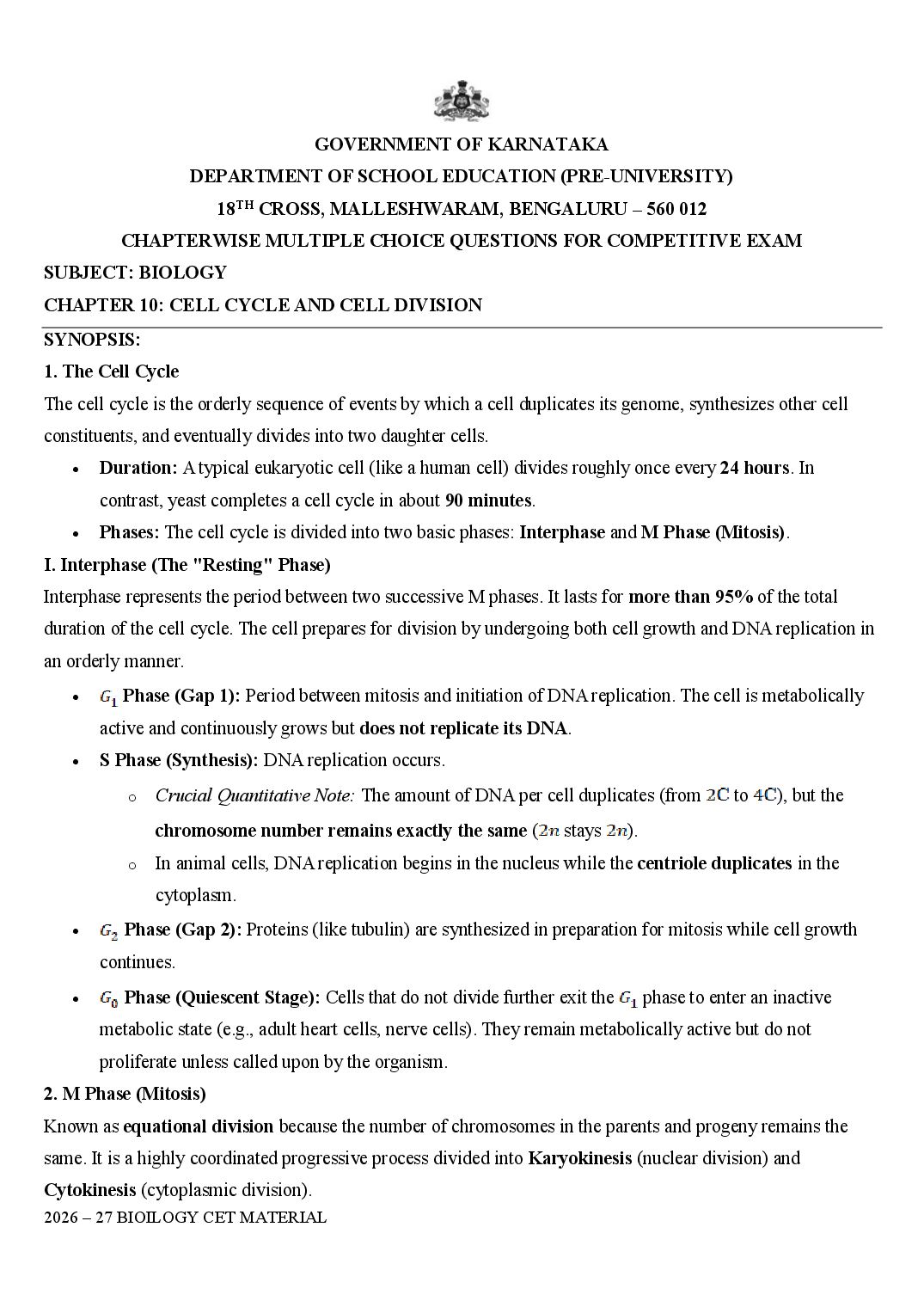
1. The Cell Cycle
The cell cycle is the orderly sequence of events by which a cell duplicates its genome, synthesizes other cell
constituents, and eventually divides into two daughter cells.
• Duration: A typical eukaryotic cell (like a human cell) divides roughly once every 24 hours. In
contrast, yeast completes a cell cycle in about 90 minutes.
• Phases: The cell cycle is divided into two basic phases: Interphase and M Phase (Mitosis).
I. Interphase (The "Resting" Phase)
Interphase represents the period between two successive M phases. It lasts for more than 95% of the total
duration of the cell cycle. The cell prepares for division by undergoing both cell growth and DNA replication in
an orderly manner.
• Phase (Gap 1): Period between mitosis and initiation of DNA replication. The cell is metabolically
active and continuously grows but does not replicate its DNA.
• S Phase (Synthesis): DNA replication occurs.
o Crucial Quantitative Note: The amount of DNA per cell duplicates (from to ), but the
chromosome number remains exactly the same ( stays ).
o In animal cells, DNA replication begins in the nucleus while the centriole duplicates in the
cytoplasm.
• Phase (Gap 2): Proteins (like tubulin) are synthesized in preparation for mitosis while cell growth
continues.
• Phase (Quiescent Stage): Cells that do not divide further exit the phase to enter an inactive
metabolic state (e.g., adult heart cells, nerve cells). They remain metabolically active but do not
proliferate unless called upon by the organism.
2. M Phase (Mitosis)
Known as equational division because the number of chromosomes in the parents and progeny remains the
same. It is a highly coordinated progressive process divided into Karyokinesis (nuclear division) and
Cytokinesis (cytoplasmic division).
Page 2
1. Prophase:
o Chromatin material condenses to form distinct compact chromosomes. Each chromosome shows
two sister chromatids attached at the centromere.
o Centrosomes (duplicated during S phase) begin moving towards opposite poles.
o Diagnostic feature: At the end of prophase, the nuclear envelope, nucleolus, Golgi complexes,
and endoplasmic reticulum disappear entirely.
2. Metaphase:
o The nuclear envelope is completely broken down. Chromosomes spread through the cytoplasm.
o Spindle fibers from opposite poles attach to the kinetochores (disc-shaped structures on the
centromere) of sister chromatids.
o Chromosomes align along the equator of the cell, forming the metaphase plate. This stage is the
best time to study the morphology of chromosomes.
3. Anaphase:
o The centromere of each chromosome splits simultaneously, separating the two sister chromatids.
o Chromatids (now referred to as daughter chromosomes) are pulled towards opposite poles by the
shortening of spindle fibers attached to kinetochores.
4. Telophase:
o Chromosomes reach their respective poles, decondense, and lose their individuality.
o The nuclear envelope reforms around each chromosome cluster. The nucleolus, Golgi complex,
and ER reappear.
Cytokinesis (Division of Cytoplasm)
• Animal Cells: Achieved by the appearance of a furrow in the plasma membrane, which gradually
deepens and joins in the center to divide the cell.
• Plant Cells: Due to the rigid cell wall, plant cells form a cell plate starting from the center and growing
outward to meet the existing lateral walls. The cell plate represents the future middle lamella.
• Note: If karyokinesis is not followed by cytokinesis, a multinucleate condition arises, leading to the
formation of a syncytium (e.g., liquid endosperm in coconut).
3. Meiosis
The specialized cell division that reduces the chromosome number by half, resulting in the production of
haploid ( ) daughter cells (gametes). It involves two sequential cycles of nuclear and cell division (Meiosis I
and Meiosis II), but only a single cycle of DNA replication (during the pre-Meiosis I interphase S phase).
Meiosis I (Reductional Division)
Prophase I
Extended and highly complex; divided into five sub-stages based on chromosomal behavior:
Page 3
continues.
• Zygotene: Homologous chromosomes begin pairing up, a process called synapsis. This pairing is
accompanied by the formation of a complex structure called the synaptonemal complex. The complex
formed by a pair of synapsed homologous chromosomes is called a bivalent or a tetrad.
• Pachytene: The four chromatids of each bivalent chromosome become clearly distinct. Crossing over
occurs—the exchange of genetic material between non-sister chromatids of homologous chromosomes.
This process is mediated by the enzyme recombinase at points called recombination nodules.
• Diplotene: Dissolution of the synaptonemal complex begins. The homologous chromosomes tend to
separate from each other except at the sites of crossovers. These X-shaped structures are called
chiasmata. In oocytes of some vertebrates, diplotene can last for months or years.
• Diakinesis: Terminalisation of chiasmata occurs. The meiotic spindle is assembled to prepare the
homologous chromosomes for separation. By the end, the nucleolus disappears and the nuclear envelope
breaks down.
Remaining Stages of Meiosis I
• Metaphase I: The bivalent chromosomes align on the equatorial plate. Spindle fibers from opposite
poles attach to the pairs of homologous chromosomes.
• Anaphase I: The homologous chromosomes separate, moving to opposite poles, while sister
chromatids remain attached at their centromeres. This is the exact step where reduction in ploidy
happens ( ).
• Telophase I: The nuclear membrane and nucleolus reappear. This is followed by cytokinesis, resulting
in a dyad of cells.
• Interkinesis: The short-lived stage between Meiosis I and Meiosis II. There is no replication of DNA
during interkinesis.
Meiosis II (Equational Division)
Meiosis II resembles a regular mitotic division, acting upon the haploid cells produced in Meiosis I.
• Prophase II: Initiated immediately after cytokinesis before chromosomes fully elongate. The nuclear
membrane disappears again.
• Metaphase II: Chromosomes align at the equator, and spindle fibers attach to the kinetochores of sister
chromatids.
• Anaphase II: Simultaneous splitting of the centromere of each chromosome occurs, allowing the sister
chromatids to separate and move toward opposite poles.
• Telophase II: The nuclear envelope reforms around the four clusters of chromosomes. Cytokinesis
follows, resulting in the formation of a tetrad of four haploid ( ) daughter cells, each genetically
distinct from the parent cell due to crossing over.
Page 4
Feature Mitosis Meiosis I Meiosis II
Type of Division Equational Reductional Equational
Remains same (
Ploidy Change Reduced by half ( ) Remains same ( )
or )
Synapsis /
Absent Present (during Prophase I) Absent
Crossing Over
Behavior in Centromeres split; sister Centromeres do not split; Centromeres split; sister
Anaphase chromatids separate homologous pairs separate chromatids separate
Number of 2 genetically identical
2 haploid cells 4 genetically diverse cells
Daughter Cells cells
Classroom discussion questions
1. Read the following statements about cell division and select the correct answer.
(i) M phase represents the phase when actual cell division occurs, and I phase represents the phase
between two successive M phases.
(ii) In the 24 hours average duration of cell cycle of a human cell, cell division proper lasts for only about
an hour.
(iii) M phase constitutes more than 95% of the duration of cell cycle.
(A) (i) and (ii) (B) (ii) and (iii) (C) (i) and (iii) (D) (i), (ii) and (iii)
2. Identify A, B, C and D in the given diagram depicting cell cycle and select the correct option.
A B C D
(A) G0 G1 S G2
Page 5
(C) G1 G0 S G2
(D) S G0 G1 G2
3. Select the incorrect statement regarding S phase of interphase.
(A) Occurs between G1 and G2
(C) Centrioles duplicate in the cytoplasm
(B) DNA replicates in the nucleus
(D) As DNA is doubled, number of chromosomes also doubles
4. Match Column - I with Column - II and select the correct option from the codes given below.
Column-I Column-II
(a) Chromosomes move to spindle equator (i) Pachytene
(b) Centromere splits and chromatids apart (ii) Zygotene
(c) Pairing between homologous chromosomes (iii) Anaphase
(d) Crossing over between homologous chromosomes (iv) Metaphase
(A) (a) → (i), (b) → (ii), (c) → (iii), (d) → (iv) (B) (a) → (iii), (b) → (i), (c) → (iv), (d) → (ii)
(C) (a) → (iv), (b) → (iii), (c) → (ii), (d) → (i) (D) (a) → (ii), (b) → (iii), (c) → (iv), (d) → (i)
5. Human cells in culture show a cell cycle to be completed in approximately
(A) 42 hours (B) 24 hours (C) 24 hours (D) 24 days
6. Yeast cell divides once in approximately every
(A) 90 minutes (B) 9 minutes (C) 24 minutes (D) 24 seconds.
7. Which one is the correct sequence of a cell cycle?
(A) G2 → M → G1 → S (B) S → G2 → M → G1
(C) G1→ S → G2 → M (D) M → G1 → S → G2
8. A cell cycle includes
(A) Interphase and M-phase/divisional phase (B) Prophase, metaphase, anaphase and telophase
(C) G1, S and G2 phases (D) Karyokinesis and cytokinesis
9. Which of the following phases of the cell cycle is not a part of interphase?
(A) S (B) G1 (C) G0 (D) M
10. To build up food reserves in the cytoplasm, chromosomes become unfolded to start transcription of mRNA
and rRNA, during which phase of meiosis - I?
(A) Diakinesis (B) Zygotene (C) Diplotene (D) Leptotene
11. Non-dividing cells like heart cells and nerve cells are in ______ phase.
(A) G1 (B) G2 (C) G4 (D) G0
12. The cells that do not divide further, exit G1 phase to enter an inactive stage called _______ of the cell cycle.
Page 6
13. Centrioles undergo duplication during (i) of (ii), and begin to move towards opposite poles of the cell
during (iii) stage of (iv) .
(i) (ii) (iii) (iv)
(A) S phase Interphase Prophase Mitosis
(B) S phase Interphase Anaphase Mitosis
(C) Prophase Mitosis Metaphase Mitosis
(D) Prophase Mitosis Anaphase Mitosis
14. ________ is characterized by all the chromosomes coming to lie at the equator, with one chromatid
connected by its kinetochore to spindle fibres from one pole and its sister chromatid connected by its
kinetochore to spindle fibres from the opposite pole.
(A) Prophase (B) Metaphase (C) Anaphase (D) Telophase
15. ________ is the best stage to count the number and study the morphology of chromosomes.
(A) Prophase (B) Metaphase (C) Anaphase (D) Telophase
16. At which stage of mitosis, the two daughter chromatids separate from each other, migrate towards the
opposite poles and are now referred to as chromosomes of the future daughter nuclei?
(A) Prophase (B) Metaphase (C) Anaphase (D) Telophase
17. Coiling of chromatids in mitotic and meiotic division is
(A) paranemic in both
(B) plectonemic in both
(C) paranemic in mitosis and pletonemic in meiosis
(D) plectonemic in mitosis and paranemic in meiosis
18. As there is more and more condensation of chromatin during cell division, there occurs
(A) increase in heterochromatin
(B) increase in euchromatin
(C) differentiation of heterochromatin and euchromatin decreases
(D) differentiation of heterochromatin and euchromatin is clearly shown.
19. Condensation of chromosomes occurs in
(A) prophase I (B) prophase II (C) anaphase (D) metaphase
20. The replication of nuclear DNA occurs in
(A) G1 phase (B) G2 phase (C) S phase (D) M phase
21. The number of DNA in chromosomes at G2 stage of cell cycle is
(A) one (B) two (C) four (D) eight
22. Synapsis is pairing of
(A) any two chromosomes (B) non-homologous chromosome
Page 7
23. Synaptonemal complex is formed during
(A) meiosis (B) amitosis (C) mitosis (D) cytokinesis
24. Bivalents in meiosis are
(A) tetrad (B) pairs of non- homologous chromosomes
(C) pairs of several chromatids (D) pairs of homozygous chromosomes
25. In pachytene stage of meiosis, the chromosomes appear
(A) single stranded (B) double stranded (C) three stranded (D) four stranded
26. Recombination of gens occur at
(A) prophase in mitosis (B) prophase I in meiosis
(C) prophase II in meiosis (D) metaphase II in meiosis
27. If there were 4 chromosomes present during prophase, how many chromosomes are there in each cell at the
end of anaphase II?
(A) 16 (B) 4 (C) 2 (D) 8
28. How many mitotic divisions must occur in a cell of root tip to form 256 cells?
(A) 256 (B) 8 (C) 128 (D) 64
29. In meiosis, the centromere divides during
(A) prophase – I (B) metaphase – I (C) anaphase – I (D) anaphase - II
30. The no. of chromosome groups at the equatorial plate in metaphase –I of meiosis in plant with 2n = 50 shall
be
(A) 50 (B) 25 (C) 30 (D) 100
31. Which one of the following pairs is correctly matched?
(A) Anaphase I – Homologous chromosomes are separated
(B) Metaphase I – Pairing maternal and paternal homologous chromosomes takes place
(C) Interphase – A nuclear envelope encloses each haploid set of chromosomes
(D) Prophase I – Non-homologous chromosomes are separated
32. Chromosome number is halved meiosis during
(A) metaphase – I (B) anaphase – I (C) Metaphase – II (D) telophase – I
33. Chromosome start separating at which stage of mitosis?
(A) Early metaphase (B) Late metaphase
(C) Early anaphase (D) early telophase
34. DNA replication occurs during
(A) prophase (B) metaphase (C) anaphase (D) interphase
35. If a cell has a chromosome number after first meiosis equal to 48. The chromosome number in the daughter
cell after the completion of meiosis will be
Page 8
36. The number of chromatids in a chromosome at anaphase is
(A) 2 in mitosis and 1 in meiosis (B) 1 in mitosis and 2 in meiosis
(C) 2 each in mitosis and meiosis (D) 2 in mitosis and 4 in meiosis
37. The process by which the chromosome are separated in the sex cells and their number reduced from the
diploid to haploid condition is known as
(A) division (B) mitosis (C) conjugation (D) meiosis
38. Prophase of reduction division is divided into number of stages. The correct chronological sequence is
(A) leptotene – pachytene – zygotene – diplotene – diakinesis
(B) leptotene – diplotene – pachytene – zygotene – diakinesis
(C) leptotene – zygotene –diplotene – pachytene – diakinesis
(D) leptotene – zygotene – pachytene – diplotene – diakinesis
39. Regarding the sequence of cell cycle, which one is correct
(A) G1, G2, S and M (B) S, G1, G2, and M
(C) G1, S, G2, and M (D) G2, S, G1 and M
40. G2 phase of mitosis takes
(A) 50% time of cell cycle (B) 25 to 33% time of cell cycle
(C) 12 to 16 % time of cell cycle (D) 4% time of cell cycle
41. Meiosis is significant because
(A) it produces identical cells
(B) it restores the original number of chromosomes (after fertilization)
(C) there is doubling of DNA contents in the cell
(D) it occurs only in vegetative cells
42. DNA replication takes place in
(A) G1 phase (B) G2 phase (C) S phase (D) mitotic phase
43. Phragmoplast is precursor of
(A) cell plate (B) chloroplast (C) chromoplast (D) colorless plastid
44. The study of chromosomes at meiotic diplotene shows that
(A) the intimately paired chromosome repel each other and begin to separate
(B) the pairing of homologous chromosome which had initiated in the earlier stage is completed
(C) the homologous chromosomes remain united by chiasmata
(D) none of the above
45. Which is not true for anaphase
(A) Golgi body and ER are reformed (B) Chromosomes move to opposite poles
(C) Spindle poles move farther apart (D) Centromeres split and chromatids separate
Page 9
(A) S phase (B) G2 phase (C) G1 phase (D) None of these
Practice questions
1. Meiosis results in
(A) Production of gametes (B) Reduction in the number of
chromosomes
(C) Introduction of variation (D) all of the above
2. At which stage of meiosis does the genetic constitution of gametes is finally decided
(A) Metaphase I (B) Anaphase II (C) Metaphase II (D) Anaphase I
3. Meiosis occurs in organisms during
(A) Sexual reproduction (B) Vegetative reproduction
(C) Both sexual and vegetative reproduction (D) None of the above
4. During anaphase-I of meiosis
(A) Homologous chromosomes separate (B) Non-homologous autosomes separate
(C) Sister chromatids separate (D) Non-sister chromatids separate
5. Mitosis is characterized by
(A) Reduction division (B) Equal division
(C) Both reduction and equal division (D) None of the above
6. A bivalent of meiosis-I consists of
(A) Two chromatids and one centromere (B) Two chromatids and two centromere
(C) Four chromatids and two centromere (D) Four chromatids and four centromere
7. Cells which are not dividing are likely to be at
(A) G1 (B) G2 (C) G (D) S phase
8. Which of the events listed below is not observed during mitosis?
(A) Chromatin condensation
(B) Movement of centrioles to opposite poles
(C) Appearance of chromosomes with two chromatids joined together at the centromere.
(D) Crossing over
9. Identify the wrong statement about meiosis
(A) Pairing of homologous chromosomes
(B) Four haploid cells are formed
(C) At the end of meiosis the number of chromosomes are reduced to half
(D) Two cycle of DNA replication occurs
10. Select the correct statement about G1 phase
(A) Cell is metabolically inactive (B) DNA in the cell does not replicate
Page 10
11. Cytokinesis in an animal cell takes place by _______ method in _______ direction; while in a plant cell it
occurs by _______ method is ________ direction.
(A) furrowing, centrifugal, cell plate, centripetal (B) furrowing, centripetal, cell plate, centrifugal
(C) cell plate, centrifugal, furrowing, centripetal (D) cell plate, centripetal, furrowing, centrifugal
12. The graph given shows the change in DNA content during various phases (A to D) in a typical mitotic cell
cycle. Identify the phases and select the correct option.
A B C D
(A) G2 G1 S M
(B) G S G2 M
(C) G1 S G2 M
(D) M G1 S G2
13. Identify the structures indicated by labels (i), (ii), (iii) and (iv) and select the correct option.
(A) (i) - Chromatid, (ii) - Centriole, (iii) - Centromere, (iv) - Chromosome
(B) (i) - Chromosome, (ii) - Centriole, (iii) - Centromere, (iv) - Chromatid
(C) (i) - Chromatid, (ii) - Centromere, (iii) - Centriole, (iv) - Chromosome
(D) (i) - Chromosome, (ii) - Centromere, (iii) - Centriole, (iv) - Chromatid
14. The members of a homologous pair of chromosomes
(A) are identical in size and appearance
(B) contain identical genetic information
(C) separate and move to opposite poles of the cell during mitosis
(D) are found only in haploid cells
15. During meiosis - I in humans, one of the daughter cells receives
(A) only maternal chromosomes
(B) a mixture of maternal and paternal chromosomes
(C) same number of chromosomes as present in parent cell
(D) none of these
16. The number of chromosomes is reduced to half during
(A) mitosis (B) meiosis - II
(C) meiosis - I (D) fertilization
Page 11
(i) Bivalents are tetrads.
(iii) One bivalent consists of 2 homologous chromosomes.
(ii) A bivalent means 4 chromatids and 2 centromeres.
(iv) Bivalents form in zygotene.
(A) (i), (ii), (iii) and (iv) (B) (iii) only (C) (iii) and (iv) (D) (iv) only
18. Which of the following is correct regarding the given figure?
Number of pairs Number of Number of
of homologous chromosomes chromatids centromeres
(A) 3 6 12
(B) 3 12 6
(C) 6 6 12
(D) 6 12 6
19. Which of the following correctly shows a pair of homologous chromosomes at the start of meiosis?
(A) (B) (C) (D)
20. The figure given below shows a cell undergoing meiosis.
Which of the options below shows the next stage in the process?
(A) (B)
(C) (D)
21. Consider the given cell at metaphase-I stage undergoing normal meiosis.
Page 12
(A) (B) (C) (D)
22. Four different steps that occur during meiosis are given in the following list.
(i) Complete separation of chromatids
(ii) Pairing of homologous chromosomes
(iii) Lining up of paired chromosomes on equator
(iv) Crossing over between chromatids.
Select the correct sequential arrangement of the steps.
(A) (ii), (iii), (iv), (i) (B) (iii), (ii), (iv), (i)
(C) (ii), (iv), (iii), (i) (D) (iii), (i), (ii), (iv)
23. The DNA content of individual cells and the number of cells in each phase of a “cell cycle” can be
determined using flow cytometry. Which of the following combinations of “phase of a cell cycle and its
corresponding DNA content” can be considered normal?
(i) Diploid cells found in the G0 or G1 phase.
(ii) Cells with twice the normal DNA content in the early M phase.
(iii) Cells with intermediate amounts of DNA in the S phase.
(iv) Cells with twice the normal DNA content in the G2 phase.
(A) (i) and (ii) (B) (ii) and (iii)
(C) (iii) and (iv) (D) (i), (ii), (iii) and (iv)
24. A cell’s division time is 1 minute. In 20 minutes, a culture tube (culture medium) is 1/8th filled with cells.
When the tube will be fully filled?
(A) 21 minutes (B) 23 minutes (C) 60 minutes (D) 160 minutes
25. Meiosis consists of
(A) two cell divisions without any chromosome replication
(B) two cell divisions in which chromosome number is reduced to half
(C) two cell divisions with only a single round of chromosome replication
(D) a single cell division with chromosome replication.’
26. In below sequence of figures showing different stages of cell division, the missing stage (ii) is
Page 13
27. The separation of two chromatids of each chromosome at early anaphase is initiated by
(A) the interaction of centromere with the chromosomal fibres
(B) the elongation of metaphasic spindle
(C) the force of repulsion between the divided kinetochores
(D) all of these
28. This phase of cell cycle is a period of intense synthesis and growth. It constitutes 90% of the duration of cell
cycle. It is
(A) interphase (B) telophase (C) prophase (D) anaphase
29. Phragmoplast is related to
(A) division of nucleolus (B) cell elongation
(C) cytokinesis (D) assemblage of chromosomes at metaphase
30. In which of the following stages, a chromosome is minimum coiled?
(A) Interphase (B) Metaphase (C) Prophase (D) Anaphase
31. Cell would normally proceed to mitosis without interruption
(A) once it has entered the S phase (B) once it has entered the G2 phase
(C) at any time during cell division activity (D) none of these
32. While in mitosis, the daughter cells resemble each other and also the parent cell; in meiosis they differ not
only from parent cell in having half the number of chromosomes, but also differ among themselves
qualitatively in genetic constitution due to
(A) segregation and crossing over only
(B) independent assortment and segregation only
(C) independent assortment and crossing over only
(D) crossing over, independent assortment and segregation
33. At which stage, the homologous chromosomes separate due to repulsion, but are yet held by chiasmata?
(A) Zygotene (B) Pachytene (C) Diplotene (D) Diakinesis
34. Disjunction refers to
(A) the separation of homologous chromosomes at anaphase - I
Page 14
(C) incompatibility in fungi and other thallophytes
(D) modification of gene action by a nonallelic gene
35. In which of the following ways are mitosis and meiosis similar?
(A) Both have pairing of homologous chromosomes
(B) Both are preceded by DNA replication
(C) Both occur in all kinds of cells
(D) Both include separation of paired chromosomes
36. Amitosis usually occurs in
(A) eukaryotic cells (B) prokaryotic cells
(C) meristems (D) spore mother cells
37. The role of mitosis is not merely to divide a cell into two daughter cells but to ensure genetic continuity
from one cell generation to another cell generation. The mechanism ensuring genetic continuity is
(A) formation of cells with new chromosomes
(B) formation of two daughter cells
(C) formation of two cells with identical DNA
(D) halving the chromosome number between the two new cells
38. Spindle formation can be disrupted by exposing cell to the microtubule poison
(A) high concentration of oxygen (B) vitamin A
(C) cholesterol (D) colchicine
39. At what phase of meiosis are there two cells, each with separated sister chromatids that have been moved to
opposite spindle poles?
(A) Anaphase - II (B) Anaphase - I (C) Telophase - II (D) Telophase - I
40. In plants, cell division is initiated by which of the following hormones?
(A) Cytokinins (B) Auxins (C) Gibberellins (D) Abscisic acid
41. Which of the following statements is correct regarding G0 phase?
(A) Mitogens are present in G0 phase
(B) Mitogens are present but energy rich compounds are absent
(C) Both mitogen and energy rich compounds are present
(D) Neither mitogen nor energy rich compounds are present
42. The process which occurs once in a life cycle is
(A) replication (B) mitosis (C) meiosis (D) karyokinesis
43. Meiosis does not occur in
(A) bacteria (B) cyanobacteria
(C) plant cell (D) both (A) and (B)
Page 15
(A) Endonuclease (B) Polymerase (C) Ligase (D) Both (A) and (C)
45. In animals meiotic division occurs during gamete formation. This gametic meiosis results in
(A) haplontic life cycle (B) diplontic life cycle
(C) diplohaplontic life cycle (D) none of these
Refer the following diagrams and answer the questions from 46 to 49
46. Identify the given stages of mitosis and select the correct option.
A B C D
(A) Prophase Metaphase Telophase Anaphase
(B) Metaphase Anaphase Prophase Telophase
(C) Anaphase Metaphase Prophase Telophase
(D) Prophase Metaphase Anaphase Telophase
47. Which of the following shows the correct sequence of the given mitotic stages?
(A) D → C → B → A (B) C → B → D → A
(C) B → A → C → D (D) C → B → A → D
48. At which of the given stages of mitosis, chromosomes appear in V, L, J and I shapes.
(A) A (B) B (C) C (D) D
49. Read the given statements which represent the features of the diagrams A, B, C and D. Match them
correctly and select the correct option.
(i) Chromosomes appear like a ball of wool (spireme stage)
(ii) Reformation of nuclear envelope, nucleolus, Golgi complex and ER
(iii) Formation of equatorial plate
(iv) Splitting of centromeres
(A) A - (iv), B - (iii), C - (i), D - (ii) (B) A - (iii), B - (iv), C - (i), D - (ii)
(C) A - (ii), B - (iii), C - (i), D - (iv) (D) A - (iv), B - (ii), C - (iii), D - (i)
50. Crossing over occurs between ______ chromatids of ______ chromosomes.
(A) non-sister, homologous (B) non-sister, non-homologous
(C) sister, homologous (D) sister, non-homologous
Page 16
1. (A) 9. (D) 17. (D) 25. (D) 33. (C) 41. (B)
2. (A) 10. (C) 18. (C) 26. (B) 34. (D) 42. (C)
3. (D) 11. (D) 19. (A) 27. (C) 35. (A) 43. (A)
4. (C) 12. (D) 20. (C) 28. (B) 36. (B) 44. (C)
5. (B) 13. (A) 21. (B) 29. (D) 37. (D) 45. (A)
6. (A) 14. (B) 22. (D) 30. (B) 38. (D) 46. (A)
7. (C) 15. (B) 23. (A) 31. (A) 39. (C)
8. (A) 16. (C) 24. (A) 32. (B) 40. (C)
Practice question Keys
1. (D) 11. (B) 21. (A) 31. (A) 41. (D)
2. (D) 12. (C) 22. (C) 32. (D) 42. (C)
3. (A) 13. (A) 23. (D) 33. (C) 43. (D)
4. (A) 14. (A) 24. (B) 34. (A) 44. (D)
5. (A) 15. (B) 25. (C) 35. (B) 45. (B)
6. (C) 16. (C) 26. (A) 36. (B) 46. (C)
7. (C) 17. (A) 27. (C) 37. (C) 47. (D)
8. (D) 18. (B) 28. (A) 38. (D) 48. (A)
9. (D) 19. (D) 29. (C) 39. (A) 49. (A)
10. (B) 20. (B) 30. (A) 40. (A) 50. (A)
Document Details
| Board / Org | Karnataka Board |
| Exam | Class 11 |
| Type | Question Bank |
| Pages | 16 |
| Updated | 24 Sep 2026 |