Karnataka 1st PUC Biology Excretory Products and Their Elimination MCQ with Answers
Finished viewing? Save it for later —
Download Karnataka 1st PUC Biology Excretory Products and Their Elimination MCQ with Answers (PDF · 23 pages)About Karnataka 1st PUC Biology Excretory Products and Their Elimination MCQ with Answers
Karnataka 1st PUC Biology Excretory Products and Their Elimination MCQ with Answers is available here for free download. Published by Karnataka Board for Class 11, this question bank can be viewed online or downloaded as a PDF (23 pages). Candidates preparing for Class 11 can use Karnataka 1st PUC Biology Excretory Products and Their Elimination MCQ with Answers to understand the exam pattern, the type of questions asked, and the overall difficulty level.
Frequently Asked Questions
How can I download Karnataka 1st PUC Biology Excretory Products and Their Elimination MCQ with Answers?
Open this page and click the Download button to save Karnataka 1st PUC Biology Excretory Products and Their Elimination MCQ with Answers as a PDF. It is completely free on AglaSem Docs.
Is Karnataka 1st PUC Biology Excretory Products and Their Elimination MCQ with Answers free to download?
Yes. Karnataka 1st PUC Biology Excretory Products and Their Elimination MCQ with Answers can be viewed online and downloaded as a PDF free of cost on AglaSem Docs.
How many pages does Karnataka 1st PUC Biology Excretory Products and Their Elimination MCQ with Answers have?
Karnataka 1st PUC Biology Excretory Products and Their Elimination MCQ with Answers contains 23 pages, which you can read online or download together as a single PDF.
Where can I find more Class 11 study material?
You can find more Class 11 question papers, sample papers, syllabus, and answer keys on AglaSem Docs.
Karnataka 1st PUC Biology Excretory Products and Their Elimination MCQ with Answers – Text
Read the full text of this question bank below — useful to quickly search, copy and reference the content online without downloading the PDF.
📄 View text version (23 pages)
Page 1
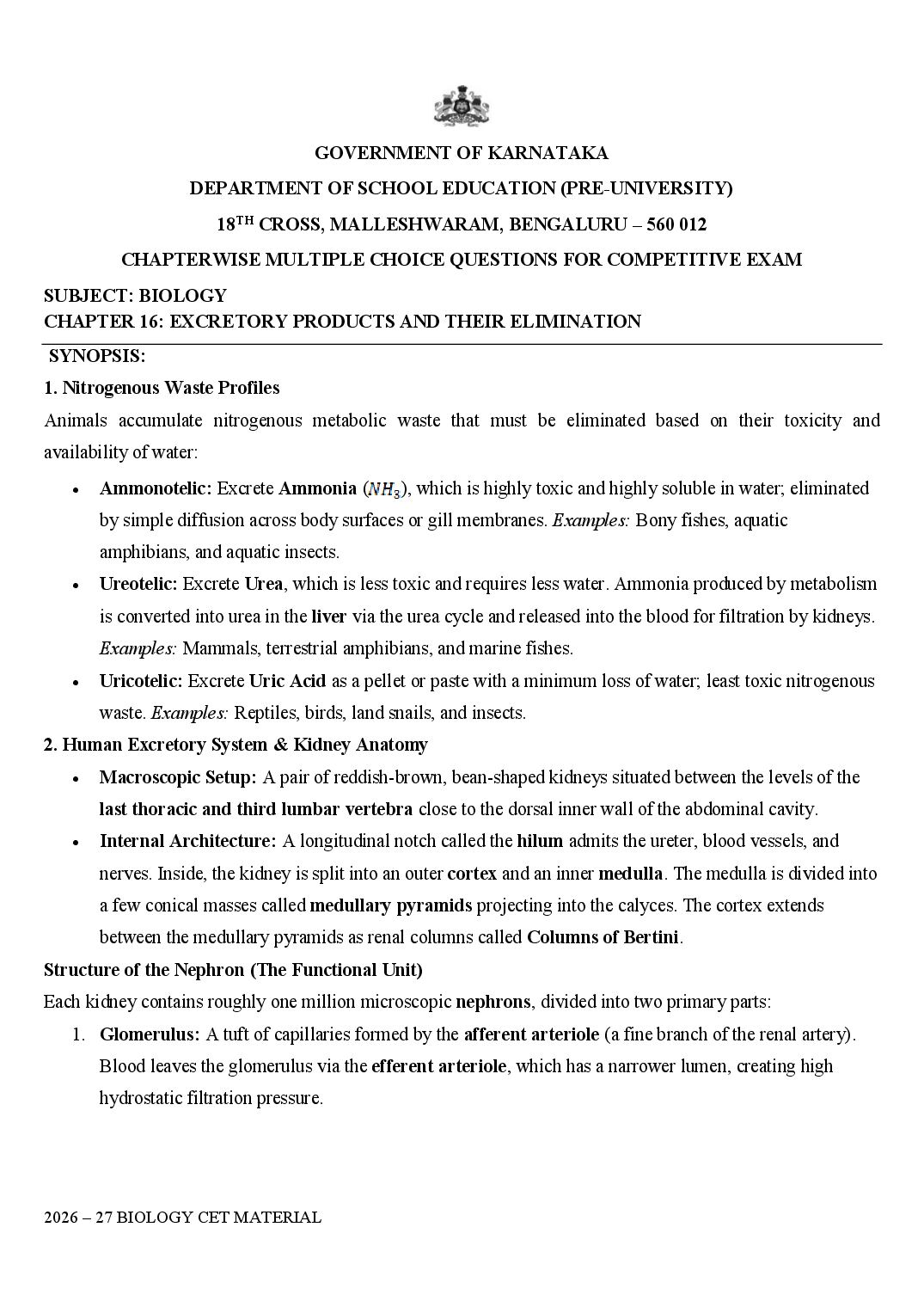
DEPARTMENT OF SCHOOL EDUCATION (PRE-UNIVERSITY)
18TH CROSS, MALLESHWARAM, BENGALURU – 560 012
CHAPTERWISE MULTIPLE CHOICE QUESTIONS FOR COMPETITIVE EXAM
SUBJECT: BIOLOGY
CHAPTER 16: EXCRETORY PRODUCTS AND THEIR ELIMINATION
SYNOPSIS:
1. Nitrogenous Waste Profiles
Animals accumulate nitrogenous metabolic waste that must be eliminated based on their toxicity and
availability of water:
• Ammonotelic: Excrete Ammonia ( ), which is highly toxic and highly soluble in water; eliminated
by simple diffusion across body surfaces or gill membranes. Examples: Bony fishes, aquatic
amphibians, and aquatic insects.
• Ureotelic: Excrete Urea, which is less toxic and requires less water. Ammonia produced by metabolism
is converted into urea in the liver via the urea cycle and released into the blood for filtration by kidneys.
Examples: Mammals, terrestrial amphibians, and marine fishes.
• Uricotelic: Excrete Uric Acid as a pellet or paste with a minimum loss of water; least toxic nitrogenous
waste. Examples: Reptiles, birds, land snails, and insects.
2. Human Excretory System & Kidney Anatomy
• Macroscopic Setup: A pair of reddish-brown, bean-shaped kidneys situated between the levels of the
last thoracic and third lumbar vertebra close to the dorsal inner wall of the abdominal cavity.
• Internal Architecture: A longitudinal notch called the hilum admits the ureter, blood vessels, and
nerves. Inside, the kidney is split into an outer cortex and an inner medulla. The medulla is divided into
a few conical masses called medullary pyramids projecting into the calyces. The cortex extends
between the medullary pyramids as renal columns called Columns of Bertini.
Structure of the Nephron (The Functional Unit)
Each kidney contains roughly one million microscopic nephrons, divided into two primary parts:
1. Glomerulus: A tuft of capillaries formed by the afferent arteriole (a fine branch of the renal artery).
Blood leaves the glomerulus via the efferent arteriole, which has a narrower lumen, creating high
hydrostatic filtration pressure.
Page 2
glomerulus. The glomerulus along with Bowman's capsule is designated the Malpighian corpuscle or
Renal corpuscle.
o Proximal Convoluted Tubule (PCT): Highly coiled structure located in the cortex.
o Henle's Loop: Hairpin-shaped loop extending down into the medulla; features a descending limb
and an ascending limb.
o Distal Convoluted Tubule (DCT): Highly coiled tubular part located in the cortex.
o Collecting Duct: A straight tube where the DCTs of multiple nephrons open. It extends deep into
the medullary pyramids to empty into the renal pelvis.
• Vascular Bundles: The efferent arteriole forms a fine capillary network around the renal tubule called
peritubular capillaries. A minute vessel of this network runs parallel to Henle's loop, forming a U-
shaped loop called the Vasa Recta.
• Nephron Categories:
o Cortical Nephrons (85%): Loop of Henle is very short and extends only a little way into the
medulla; vasa recta is highly reduced or absent.
o Juxtamedullary Nephrons (15%): Loop of Henle is very long and runs deep into the medulla;
drives high concentration parameters.
3. The Mechanism of Urine Formation
Urine formation involves three distinct physiological processes: Glomerular Filtration, Reabsorption, and
Secretion.
Step 1: Glomerular Filtration (Ultrafiltration)
• Driven across the filtration membrane (endothelium of glomerulus + podocyte epithelium of Bowman's
capsule + their shared basement membrane). Podocytes leave intricate slit pores or filtration slits.
• Rate Parameters: The kidneys process of blood per minute. The amount of filtrate
formed per minute by both kidneys is the Glomerular Filtration Rate (GFR)
( ).
Step 2: Tubular Reabsorption
Since a human eliminates only of urine per day out of of filtrate, nearly 99% of the filtrate is
reabsorbed by the renal tubules.
• Active Reabsorption: Glucose, amino acids, and are reabsorbed actively.
• Passive Reabsorption: Water and nitrogenous wastes move across the cells passively.
Step 3: Tubular Secretion
Cells secrete hydrogen ions ( ), potassium ions ( ), and ammonia ( ) into the filtrate. This is a crucial
step in urine formation that helps maintain the ionic balance and pH of body fluids.
Page 3
• PCT: Lined by simple cuboidal brush border epithelium with extensive microvilli to maximize surface
area. Reabsorbs 70–80% of all electrolytes and water. It selectively secretes , , and into the
filtrate while absorbing to maintain pH.
• Henle's Loop (Concentration Zone):
o Descending Limb: Permeable to water but virtually impermeable to electrolytes. As filtrate
moves down, water is drawn out into the hypertonic medullary interstitium, concentrating the
filtrate.
o Ascending Limb: Impermeable to water but allows active/passive transport of electrolytes
( ). As filtrate moves up, electrolytes escape, diluting the filtrate once again.
• DCT: Conditional, facultative reabsorption of and water occurs here under hormonal control. It
also reabsorbs and selectively secretes , , and to maintain the sodium-potassium
balance in blood.
• Collecting Duct: Large amounts of water can be reabsorbed here to produce highly concentrated urine.
It also allows small amounts of urea to diffuse into the medullary interstitium to maintain high
osmolarity.
5. Mechanism of Concentration of the Filtrate: Counter-Current System
Mammals possess the unique ability to produce concentrated urine using a counter-current mechanism
involving the Loop of Henle and Vasa Recta. The flow of filtrate in the two limbs of Henle's loop runs in
opposite directions, forming a counter-current, mirrored by the opposite flow of blood in the two limbs of the
vasa recta.
• Gradient Generation: Proximity and counter-current flow establish an increasing osmotic gradient in
the medullary interstitium, rising from in the cortex to deep in the inner
medulla.
• The Exchange Loop: cut off by the ascending limb of Henle's loop is transferred directly into the
descending limb of the vasa recta. As blood flows up the ascending vasa recta, this is returned to
the medullary interstitium. Similarly, small amounts of urea exit the collecting duct to enter the thin
ascending limb segment.
• Yield: This continuous trapping of solutes maintains high medullary interstitial hypertonicity, allowing
water to pass smoothly out of the collecting duct via osmosis. Human kidneys can produce urine nearly
four times concentrated than the initial filtrate ( vs. ).
6. Regulation of Kidney Function
Kidney function is closely monitored and regulated by feedback loops involving the Hypothalamus, JGA, and
the Heart.
Page 4
An excessive loss of fluid triggers body osmoreceptors, stimulating the hypothalamus to release Antidiuretic
Hormone (ADH) or Vasopressin from the neurohypophysis.
• ADH acts on the late tubule segments (DCT and Collecting Duct), driving extensive water reabsorption
to stop further fluid loss (diuresis).
• When body fluid volumes return to normal, osmoreceptors turn off, suppressing ADH release. ADH
also acts as a vasoconstrictor, raising blood pressure and enhancing GFR.
II. Juxtaglomerular Apparatus (RAAS Pathway)
The JGA is a specialized cellular zone formed by modifications of the DCT cells and afferent arteriole smooth
muscle at their point of contact.
• A fall in glomerular blood pressure or GFR activates JG cells to secrete the enzyme Renin into the
blood.
• Renin converts plasma Angiotensinogen into Angiotensin I, which is quickly converted to
Angiotensin II (a powerful vasoconstrictor that raises glomerular blood pressure).
• Angiotensin II also stimulates the adrenal cortex to release the hormone Aldosterone.
• Aldosterone drives the reabsorption of and water from the distal parts of the tubule (DCT),
increasing blood volume and blood pressure. This multi-tiered cascade is the Renin-Angiotensin-
Aldosterone System (RAAS).
III. Atrial Natriuretic Factor (ANF - The Check Balance)
An increase in blood flow and pressure into the atria of the heart stimulates the secretion of Atrial Natriuretic
Factor (ANF).
• ANF causes vasodilation (dilation of blood vessels), which lowers blood pressure.
• Note: The ANF mechanism operates as a direct check-and-balance system to counter the
vasoconstrictive RAAS pathway.
7. Micturition and Accessory Excretory Organs
• Micturition: The process of release of urine. As the urinary bladder fills, stretch receptors send signals
to the Central Nervous System (CNS). The CNS passes motor signals to initiate contraction of smooth
muscles of the bladder and simultaneous relaxation of the urethral sphincter. A human adult normal
voids of urine/day, which is slightly acidic ( ) and averages 25–30 grams of urea
excreted per day.
• Lungs: Eliminate massive volumes of ( ) and water vapor.
• Liver: Excretes bile containing bilirubin, biliverdin, cholesterol, degraded steroid hormones, vitamins,
and drugs via digestive wastes.
Page 5
cool the body surface. Sebaceous glands eliminate hydrocarbons, sterols, and waxes through sebum,
providing protective oily covering.
8. Disorders of the Excretory System
• Uremia: Accumulation of high amounts of urea in the blood due to kidney malfunction; highly toxic
and can lead to kidney failure.
o Hemodialysis: Patient's blood is drained from a convenient artery, mixed with an anticoagulant
like heparin, and passed through a dialyzing unit containing a coiled cellophane tube bathed in
dialyzing fluid. The fluid contains the same mineral configurations as plasma but lacks
nitrogenous wastes. Wastes diffuse out down the gradient across the porous cellophane sheet,
clearing the blood, which is then pumped back via a vein after adding anti-heparin.
• Renal Calculi: Stones or insoluble masses of crystallized salts (e.g., oxalates) formed within the
kidney.
• Glomerulonephritis: Inflammation of the glomeruli of the kidney.
CLASSROOM DISCUSSION QUESTIONS:
1. Which of the following statements are correct?
(i) Glucose has high threshold value
(ii) Urine is concentrated in Henle’s loop
(iii) Haemodialyser removes urea, uric acid, glucose and plasma proteins
(iv) In glomerulus, urea, uric acid, water, glucose and plasma proteins are filtered out
(A) (i), (iii) and (iv) (B) (ii), (iii) and (iv) (C) (i) and (ii) (D) (i) and (iii)
2. Match Column - I with Column - 11 and select the correct option from the codes given below.
Column-I Column-II
(a) PCT (i) Concentrated urine formation
(b) DCT (ii) Filtration of blood
(c) Loop of Henle (iii) Reabsorption of 70-80% electrolytes
(d) Counter-current mechanism (iv) Ionic balance
(e) Renal corpuscle (v) Maintenance of concentration gradient in
medulla
(A) (a) → (iii), (b) → (iv), (c) → (i), (d) → (v), (e) → (ii)
(B) (a) → (iii), (b) → (v), (c) → (iv), (d) → (ii), (e) → (i)
(C) (a) → (i), (b) → (iii), (c) → (ii), (d) → (v) (e) → (iv)
(D) (a) → (iii), (b) → (i), (c) → (iv), (d) → (v), (e) → (ii)
3. Which one of the following does not constitute a part of single uriniferous tubule?
(A) Distal convoluted tubule (B) Collecting duct
Page 6
4. If Henle’s loop were absent from mammalian nephron, which one of the following is to be expected?
(A) There will be no urine formation.
(B) There will be hardly any change in the quality and quantity of urine formed.
(C) The urine will be more concentrated.
(D) The urine will be more diluted.
5. What will happen if the stretch receptors of the urinary bladder wall are totally removed?
(A) Micturition will continue
(B) Urine will continue to collect normally in the bladder
(C) There will be no micturition
(D) Urine will not collect in the bladder
6. Refer to the given figure of human urinary system and select the option that correctly identifies the labelled
parts A to E.
A B C D E
(A) Superior vena cava Inferior vena cava Dorsal aorta Urethra Pelvis
(B) Inferior vena cava Superior vena cava Dorsal aorta Urinary bladder Cortex
(C) Ureter Inferior vena cava Dorsal aorta Urethra Pelvis
(D) Dorsal aorta Inferior vena cava Superior vena cava Urinary bladder Cortex
7. Which of the following is an incorrect match?
(A) Bowman’s capsule – Glomerular filtration (B) DCT – Absorption of glucose
(C) Henle’s loop – Concentration of urine (D) PCT – Absorption of Na+ and K+ ions
8. Excretion of potassium is governed primarily by
(A) potassium reabsorption in proximal convoluted tubule
(B) potassium secretion in proximal convoluted tubule
(C) potassium secretion in distal convoluted tubule
(D) potassium reabsorption in distal convoluted tubule.
9. Which of the following statements is correct?
(A) Water reabsorption in descending limb of loop and collecting duct occur under similar conditions
(B) Sodium reabsorption in ascending limb of loop and collecting duct occur under similar conditions
(C) Water reabsorption in descending limb of loop and collecting duct occur under different conditions
(D) Water reabsorption in descending limb and sodium reabsorption in ascending limb of loop occur
under similar conditions
Page 7
The kidneys have built-in mechanisms for the regulation of glomerular filtration rate. One such efficient
mechanism is carried out by (i). It is a special sensitive region formed by cellular modifications in the
(ii) and the (iii) at the location of their contact. A fall in GFR can activate the JG cells to release
(iv) which can stimulate the glomerular blood flow and thereby the GFR back to normal.
(i) (ii) (iii) (iv)
(A) ANF PCT Efferent arteriole Angiotensin
(B) ANF DCT Afferent arteriole Renin
(C) JGA PCT Efferent arteriole Angiotensinogen
(D) JGA DCT Afferent arteriole Renin
11. An X-ray of the lower abdomen shows a shadow in the region of the ureter suspected to be an ureteric
calculus. A possible clinical symptom would be
(A) acute renal failure (ARF) (B) anuria and haematuria
(C) motor aphasia (D) chronic renal failure (CRF)
12. A large quantity of fluid is filtered every day by nephrons in the kidneys. Only about 1% of it is excreted as
urine. The remaining 99% of the filtrate
(A) is stored in the urinary bladder (B) is reabsorbed into the blood
(C) gets collected in the renal pelvis (D) is lost as sweat
13. The characteristic(s) common to urea, uric acid and ammonia is/are
(i) They are nitrogenous waste
(ii) They all need very large amount of water for excretion
(iii) They are all equally toxic
(iv) They are produced in the kidneys
(A) (i), (iii) and (iv) (B) (i) only (C) (i) and (iii) (D) (i) and (iv)
14. Which one of the following statements in regard to the excretion by the human kidneys is correct?
(A) Descending limb of loop of Henle is impermeable to water.
(B) Distal convoluted tubule is incapable of reabsorbing Na+ ions.
(C) Nearly 99 per cent of the glomerular filtrate is reabsorbed by the renal tubules.
(D) Ascending limb of loop of Henle is impermeable to electrolytes.
15. Match Column - I with Column - II and select the correct option from the codes given below.
Column-I Column-II
(a) Nephridia (i) Hydra
(b) Malpighian tubules (ii) Leech
(c) Protonephridia (iii) Shark
(d) Kidneys (iv) Round worms
Page 8
(A) (a) → (i), (b) → (iv), (c) → (v), (d) → (i) (B) (a) → (v), (b) → (i), (c) → (iv), (d) → (iii)
(C) (a) → (iv), (b) → (i), (c) → (ii), (d) → (v) (D) (a) → (ii), (b) → (v), (c) → (iv), (d) → (iii)
16. Which one of the following organisms is correctly matched with its excretory organs?
(A) Humans – Kidneys, sebaceous glands and tear glands
(B) Earthworm – Pharyngeal, integumentary and septal nephridia
(C) Cockroach – Malpighian tubules and enteric caeca
(D) Frog – Kidneys, skin and buccal epithelium
17. Read the given statements and select the correct option.
Statement 1: The final reabsorption of water from the urine into the blood occurs through the collecting
duct of a mammalian nephron resulting in the production of hyperosmotic urine.
Statement 2: The loop of Henle creates a sodium gradient in the interstitial fluid.
(A) Both statements 1 and 2 are correct and statement 2 is the correct explanation of statement 1
(B) Both statements 1 and 2 are correct but statement 2 is not the correct explanation of statement 1
(C) Statement 1 is correct and statement 2 is incorrect
(D) Both statements 1 and 2 are incorrect
18. Read the given statements and select the correct option.
Statement 1: When the urine moves through the descending limb, it become hypertonic and as it passes
through the ascending limb of Henle’s loop it becomes hypotonic.
Statement 2: The descending limb is permeable to sodium ions, while the ascending limb is impermeable
to sodium ions.
(A) Both statements 1 and 2 are correct and statement 2 is the correct explanation of statement 1
(B) Both statements I and 2 are correct but statement 2 is not the correct explanation of statement 1
(C) Statement us correct and statement 2 is incorrect
(D) Both statements 1 and 2 are incorrect
19. Waste products of adenine and guanine metabolism are excreted by man as
(A) Ammonia (B) Urea (C) Uric acid (D) Allantois
20. In man, the urea is mainly produced in
(A) Liver (B) Kidney (C) Gall bladder (D) Spleen
21. Aquatic reptiles are
(A) Ammonotelic (B) Ureotelic (C) Uricotelic (D) None of these
22. The major nitrogenous waste(s) in the respective animals is/are
(A) Urea and uric acid in cow, frog and lion.
(B) Uric acid in parrot, cockroach and garden lizard.
(C) ammonia in elephant, sea horse and turtle.
(D) Urea in Scorpio, earthworm and shark.
Page 9
(A) Fats (B) Amino acids (C) Glucose (D) Ketones
24. In glomerulus of rabbit (RATIOINALISED)
(A) Afferent glomerular capillary is wider than efferent glomerular capillary.
(B) Afferent glomerular capillary is narrower than efferent glomerular capillary.
(C) Afferent glomerular arteriole is narrower than the efferent glomerular arteriole.
(D) Afferent glomerular arteriole is wider than the efferent glomerular arteriole.
25. Correct order of excretory organs in cockroach, earthworm and rabbit respectively are
(A) Skin, Malpighian tubules, kidney. (B) Malpighian tubules, nephridia, kidney
(C) Nephridia, Malpighian tubule, kidney. (D) Nephridia, kidney, green gland.
26. " Columns of Bertini " in the kidney of mammals are formed as the extension of
(A) Medulla into cortex (B) Cortex into medulla
(C) Medulla into pelvis (D) Pelvis into ureter
27. The kidneys resemble the contractile vacuoles of protozoans in
(A) Expelling out excess of water. (B) Expelling out glucose.
(C) Expelling out urea and uric acid (D) Pelvis into ureter
28. The Bowman's capsule is
(A) A part of uriniferous tubule and is the site of filtration of various blood constituents during the
formation of urine
(B) A part of uriniferous tubule and is the site of reabsorption of water and glucose.
(C) Present in the liver and is the site of secretion of the bile juice.
(D) Associated with liver and is the site of the storage of the bile juice.
29. What is the characteristic of metanephric kidney?
(A) Hypotonic urine production (B) Excess secretion of uric acid
(C) Loop of Henle (D) Hormone production
30. When a person suffering from poor renal reabsorption then which of the following will not help in the
maintenance of blood volume?
(A) Decreased glomerular filtration (B) Increased ADH secretion
(C) Decreased arterial pressure in kidney (D) Increased arterial pressure in kidney
31. Filtration into the kidney tubule is accomplished by means of
(A) Active transport by renal tubule. (B) Hydrostatic blood pressure in glomerulus.
(C) An osmotic potential gradient. (D) Secretion by renal tubule.
32. In distal convoluted tubule of the nephrons
(A) Na ions reabsorption requires energy. (B) Secretion of k ions does not require energy.
(C) Water reabsorption requires energy. (D) Ammonia is secreted.
Page 10
(A) CO2 and urea (B) Ammonia and urea
(C) CO2 and ammonia (D) Urea and sodium salt
34. The glomerular filtrate contains
(A) Blood minus cells and proteins (B) Blood minus cells
(C) Blood minus proteins. (D) Plasma minus cells and proteins.
35. Reabsorption of useful substances back into the blood from the filtrate in a nephron occurs in
(A) Proximal convoluted tubule (B) Loop of Henle
(C) Distal convoluted tubule (D) Collecting duct
36. Ornithine is converted into citrulline by an enzyme
(A) Glutamic dehydrogenase (B) Aspartic glutamic transaminase
(C) Carbamyl phosphate synthetase (D) Ornithine carbamyl transferase
37. In which of the following ways does the blood leaving the glomerulus of a mammalian kidney tubule differ
from the blood entering the glomerulus?
(A) It has a lower concentration of plasma proteins.
(B) It contains fewer corpuscles per unit volume.
(C) It has a lower concentration of crystalloids.
(D) It has a higher concentration of crystalloids.
38. In excessive bleeding, profuse sweating or prolonged delay in fluid intake
(A) Glomerular filtration increases. (B) Glomerular filtration slows down.
(C) Glomerular filtration remains constant. (D) None of the above.
39. Which of the following is correct?
(A) Afferent arteriole is narrower than efferent arteriole.
(B) afferent venule is narrower than efferent venule.
(C) Efferent arteriole is narrower than afferent arteriole.
(D) Efferent venule is narrower than afferent venule.
40. In micturition
(A) Urethra relaxes. (B) Ureter contracts
(C) Ureter relaxes. (D) Urethra contracts.
41. Choose the correct statement for biosynthesis of urea.
(A) Uric acid is starting material for biosynthesis of urea.
(B) Urea is synthesized inside lysosomes.
(C) Urea cycle enzyme are located inside mitochondria.
(D) Urea is synthesized in kidney
42. ADH controls water permeability of
Page 11
(C) Proximal convoluted tubule (D) Bowman's capsule.
43. Which one is component of ornithine cycle?
(A) Ornithine, citrulline and alanine (B) Ornithine, citrulline and arginine
(C) Amino acid are not used. (D) Ornithine, citrulline and fumaric acid.
44. Which of the following amino acids is present in ornithine cycle?
(A) Valine and cystine (B) Arginine and citrulline
(C) Glycine and methionine (D) None of the above
45. the main function of Henle's loop is
(A) Conservation of water. (B) filtration of blood.
(C) Passage of urine. (D) Formation of urine.
46. The main function of pyramids of kidney is to
(A) Contain collecting tubules of kidney. (B) direct the urine to flow in ureter.
(C) Support the openings of collecting canals. (D) Store fats and protein.
47. Due to insufficient filtration in the bowman's capsule, all are likely to happen except
(A) Accumulation of fluid in the body. (B) Increase in blood pressure.
(C) Increase in blood urea level. (D) Loss of glucose through urine.
48. Longest loop of Henle is found in
(A) Kangaroo rat (B) Opossum (C) Rhesus monkey (D) All of these
49. Match the following Columns.
Column I Column II
(Function) (Part of excretory system)
(a) Ultra filtration 1 Henle's loop
(b) Concentration of 2 Ureter
urine
(c) Transport of urine 3 Urinary bladder
(d) Storage of urine 4 Malpighian corpuscle
5 Proximal convoluted
tubule
Codes
(a) (b) (c) (d)
(A) 4 1 2 3
(B) 4 3 2 1
(C) 5 4 1 3
(D) 5 4 1 2
Page 12
(A) Duodenum (B) Kidney (C) Liver (D) Pancreas
51. Blackening of urine, when exposed to air is a metabolic disorder in human beings. This is due to
(A) Phenylalanine (B) Tyrosine
(C) Valine replacing glutamine (D) Glutamine replacing valine
52. The maximum number of electrolytes and water (70 – 80%) from the glomerular filtrate is reabsorbed., in
which part of the nephron?
(A) Ascending limb of loop of Henle (B) Distal convoluted tubule
(C) Proximal convoluted tubule (D) Descending limb of loop of Henle
53. The structural unit of human kidney is
(A) nephron (B) Ureter (C) Loop of Henle (D) Bowman's capsule
54. The correct match is
I. DCT – Secretion of H+ and K+ ions
II. Henle's loop – Reabsorption of glucose, water and Na+ ions
III. Podocytes – Attached to parietal layer of Bowman's capsule
IV. JGA – Rise is glomerular blood pressure activates it to release rennin
(A) III (B) II (C) I (D) IV
55. While urine formation progresses, which of the following process takes place in the region labeled as A, B,
C and D in the given diagram.
(A) A – Collection of urine, B – Secretion, C – Reabsorption, D – Pressure filtration
(B) A – Pressure filtration, B – Reabsorption, C – Secretion, D – Collection of urine
(C) A – Pressure filtration, B – Secretion, C – Reabsorption, D –Collection of urine
(D) A – Reabsorption, B – Secretion, C – Pressure filtration, D – Collection of urine
56. Podocytes are the cells present in
(A) Cortex of nephron (B) Inner wall of Bowman's capsule
(C) Outer wall of Bowman's capsule (D) Wall of glomerular capillaries
57. Which one of the following groups of structures organs have similar functions?
(A) Typhlosole in earthworm, intestinal villi in rat and contractile vacuole in Amoeba
(B) Nephridia in earthworm, Malpighian tubules in cockroach and urinary tubules in rat
(C) Antennae of cockroach, tympanum of frog and clitellum of earthworm
Page 13
58. The region of the nephron found in the renal medulla is
(A) Malpighian corpuscle (B) Proximal Convoluted Tubule (PCT)
(C) Distal Convoluted Tubule (DCT) (D) Henle's loop
Practice questions:
1. The following substances are the excretory products in animals. Choose the least toxic form among them?
(A) Urea (B) Uric acid (C) Ammonia (D) Carbon dioxide
2. Filtration of the blood takes place at
(A) PCT (C) DCT
(C) Collecting ducts (D) Malpighian body
3. Which of the following statements is incorrect
(A) ADH− prevents conversion of angiotensinogen in blood to angiotensin
(B) Aldosterone−facilitates water reabsorption
(C) ANF− enhances sodium reabsorption
(D) Renin−causes vasodilation
4. A large quantity of one of the following is removed from our body by lungs.
(A) CO2 only (B) H2O only (C) CO2 and H2O (D) ammonia
5. The pH of human urine is approximately
(A) 6.5 (B) 7 (C) 6 (D) 7.5
6. Different types of excretory structures and animals are given below. Match them appropriately and mark the
correct answer from among those given below:
Excretory structure/organ Animals
(a) protonephridia (i) Prawn
(b) Nephridia (ii) Cockroach
(c) Malpighian tubules (iii) Earthworm
(d) Green gland or Antennal gland (iv) Flatworms
(A) (d) → (i); (c) → (ii); (b) → (iii) and (a) → (iv) (B) (b) → (i); (c) → (ii); (a) → (iii) and (b) → (iv)
(C) (d) → (i); (c) → (ii); (a) → (iii) and (b) → (iv) (D) (b) → (i); (c) → (ii); (b) → (iii) and (d) → (iv)
7. Which one of the following statements is incorrect?
(A) Birds and land snails are uricotelic animals.
(B) Mammals and frogs are ureotelic animals
(C) Aquatic amphibians and aquatic insects are ammonotelic animals
(D) Birds and reptiles are urotelic
8. Which of the following pairs is wrong?
Page 14
(C) Ammonotelic → Tadpole (D) Ureotelic → Elephant
9. Which one of the following statements in incorrect?
(A) the medullary zone of kidney is divided into a few conical masses called medullary pyramids
projecting into the calyces
(B) Inside the kidney the cortical region extends in between the medullary pyramids as renal pelvis.
(C) Glomerulus along with Bowman’s capsule is called the renal corpuscle.
(D) Renal corpuscle, proximal convoluted tubule (PCT) and distal convoluted tubule (DCT) of the nephron
are situated in the cortical region of kidney
10. The condition of accumulation of urea in the blood is termed as
(A) Renal Calculi (B) Glomerulonephritis (C) uremia (D) Ketonuria
11. Which one of the following is also known as antidiuretic hormone?
(A) Oxytocin (B) Vasopressin (C) Adrenaline (D) Calcitonin
12. Match the abnormal conditions given in Column A with their explanations given in Column B and Choose
the correct option
Column I Column II
(a) Glycosurea (i) Accumulation of uric acid in joints
(b) Renal calculi (ii) Inflammation in glomeruli
(c) Glomerular (iii) Mass of crystallised salts within the
nephritis kidney
(d) Gout (iv) Presence of glucose in urine
Options:
(A) (a) → (i); (b) → (iii); (c) → (ii); (d) → (iv) (B) (a) → (iii); (b) → (ii); (c) → (iv); (d) → (i)
(C) (a) → (iv); (b) → (iii); (c) → (ii); (d) → (i) (D) (a) → (iv); (b) → (ii); (c) → (iii); (d) → (i)
13. We can produce a concentrated/ dilute urine. This is facilitated by a special mechanism. Identify the
mechanism.
(A) Reabsorption from PCT
(B) Reabsorption from Collecting Duct
(C) Reabsorption/ Secretion in DCT
(D) Counter current mechanism in Henle’s loop/ Vasa recta
14. Dialysing unit (artificial kidney) contains a fluid which is almost same as plasma except that it has
(A) High glucose (B) High urea
Page 15
Directions: In the following questions, a statement of Assertion (A) is followed by a statement of Reason (R).
Mark the correct choice as:
(A) If both Assertion and Reason are true and Reason is the correct explanation of Assertion
(B) If both Assertion and Reason are true but Reason is not the correct explanation of Assertion
(C) If Assertion is true but Reason is false
(D) If both Assertion and Reason are false.
15. Assertion: When water has to be conserved in the body, ADH is secreted from the posterior pituitary.
Reason: ADH renders the walls of DCT collecting duct and tubule impermeable to water.
16. Assertion: Renal threshold of glucose is said to be 180 mg per 100 ml.
Reason: Glucose starts appearing in the urine when its blood level exceeds 180 mg per 100 ml of blood.
17. Assertion: Death ensues if waste products are not removed from the body.
Reason: Excretory system removes the nitrogeneous waste products from the body.
18. Assertion: Sharks are said to be ammonotelic animals.
Reason: Sharks can retain considerable amounts of ammonia in their blood.
19. Assertion: In vertebrates, the liver is also referred as an accessory excretory organ.
Reason: Liver helps kidneys in the secretion of urine.
20. Assertion: Urinary bladder and ureters are lined by transitional epithelium.
Reason: Ureters carry the urine to urinary bladder where it is stored temporarily.
21. Assertion: The glomerular filtrate resembles the protein free plasma in composition and osmotic
Pressure
Reason: The glomerular capillary wall and inner membrane of Bowman's capsule are impermeable to
large molecules.
22. Assertion: During micturition, urine is prevented from flowing back into the ureters.
Reason: Urethral sphincters relax during micturition.
23. Assertion: Uric acid and creatinine can be detected in the normal urine of an adult man.
Reason: Uric acid and creatinine are the chief components of human urine.
24. Assertion: Kidneys maintain the osmotic concentration of the blood.
Reason: Kidneys eliminate either hypotonic or hypertonic urine according to the need of the body.
25. Assertion: Birds can considerably reduce water loss in the urine.
Reason: Birds store urine along with faeces in the cloaca.
26. Assertion: Hemodialysis can save and prolong the life of uremic patients.
Reason: Waste products like urea can be removed from the blood by the process of hemodialysis.
27. Assertion: Some water is eliminated from the body.
Reason: Water elimination from body is only necessary to prevent the body from oedema
Page 16
Reason: Ammonia is insoluble in water.
29. Assertion: Excretion of urea is much helpful than ammonia.
Reason: The synthesis of urea requires energy.
30. Assertion: If human urine is allowed to stand for some time, it smells strongly of ammonia.
Reason: Main constituent of human urine is ammonia.
31. Which one of the following options given the correct categorization of six animals according to the type of
nitrogenous wastes, they give out?
Ammonotelic Ureotelic Uricotelic
(A) Pigeon, humans Aquatic amphibian and lizards Cockroach ad frog
(B) Frog, lizards Aquatic amphibia and humans Cockroach and pigeon
(C) Aquatic amphibia Frog and humans Pigeon, lizards and cockroach
(D) Aquatic amphibian Cockroach and humans Frog and pigeon
32. Green glands present in some arthropods help in
(A) respiration (B) excretion
(C) digestion (D) reproduction
33. In 24 hrs, total glomerular filtrate formed in the human kidney is
(A) 1.7 L (B) 7 L (C) 17 L (D) 170 L
34. Many freshwater animals cannot live for long in sea water and vice versa mainly because of the
(A) change in N levels (B) change in the levels of thermal tolerance
(C) variations in light intensity (D) osmotic problems
35. Consider the following statements.
I. Flame cells are excretory structure in flatworms.
II. Green glands are excretory organs in annelids.
III. Columns of Bertini are the conical projections of renal pelvis into renal medulla between the renal
pyramids.
Which of the following statements are incorrect?
(A) I and II (B) II and III (C) I and III (D) I, II and III
36. A person who is on a long hunger strike and is surviving only on water, will have
(A) more sodium in his urine (B) less amino acids in his urine
(C) more glucose in his blood (D) less urea in his urine
37. Refer to the following diagram and identify the parts of a kidney labelled as (A – E)
Page 17
(A) Cortes Nephron Pelvis Medulla Ureter
(B) Cortex Medulla Nephron Pelvis Ureter
(C) Nephron Cortex Medulla Ureter Pelvis
(D) Nephron Cortex Medulla Pelvis Ureter
38. Duct of Bellini opens in
(A) ureter (B) renal papilla (C) duodenum (D) DCT
39. A child has single kidney since birth. This variation is
(A) hybridization (B) negative meristic (C) blastogenic (D) substantive
40. Juxtaglomerular cells of renal cortex synthesise an enzyme called
(A) ADH (B) oxytocin (C) renin (D) urochrome
41. Solenocytes are used for
(A) Elimination of nitrogenous excretory wastes (B) Respiration
(C) Digestion (D) All of the above
42. Almost all the aquatic animals excrete ammonia as the nitrogenous waste product. Which of the following
statements is not in agreement with this situation?
(A) Ammonia is easily soluble in water
(B) Ammonia is released from the body in the gaseous state
(C) Ammonia is highly toxic and needs to be eliminated as and when formed
(D) Ammonia gets converted into a less toxic form called urea
43. Which of the following causes an increase in sodium reabsorption in the distal convoluted tubule?
(A) Increase in aldosterone levels (B) Increase in antidiuretic hormone levels
(C) Decrease in aldosterone levels (D) Decrease in antidiuretic hormone levels
44. Which one of the following is not a part of a renal pyramind?
(A) Convoluted tubules (B) Collecting ducts
(C) Henle's loop (D) Peritubular capillaries
45. The urine is
(A) Hypotonic to blood and isotonic to medullary fluid
(B) Hypertonic to blood and isotonic to medullary fluid
Page 18
(D) Isotonic to blood and hypertonic to medullary fluid
46. Identify the correct statement regarding urine formation.
(A) Countercurrent mechanism works around the glomerulus and PCT
(B) To prevent dieresis, ADH facilitates water reabsorption from the latter parts of the tubules
(C) Maximum absorption of electrolytes occurs in Henle's loop
(D) A decrease in blood pressure can increase the glomerular filtration rate
47. RAAS secretes which of the following hormone?
(A) Mineralocorticoids` (B) Glucocorticoids (C) Both (A) and (B) (D) None of the above
48. Juxtaglomerular apparatus is made up of
(A) Juxtaglomerular cell, macula densa and lacis cell
(B) Juxtaglomerular cell, Purkinje cell and chief cell
(C) Juxtaglomerular cell, lacis cell and myoepithelial cell
(D) Juxtaglomerular cell, macula densa and argentaffin cell
49. Which one of the following correctly explains the function of a specific part of a human nephron?
(A) Henle's loop – Most reabsorption of the major substances from the glomercular filtrate.
(B) Distal convoluted tubule – Reabsorption of ions into the surrounding blood capillaries
(C) Afferent arteriole – Carries the blood away from the glomerulus towards renal vein
(D) Podocytes – Create minute spaces (slit pores) for the filtration of blood into the Bowman's capsule
50. Refer to the given figure showing urinary system of human beings. Identify the parts labelled as A, B, C and
D.
A B C D
(A) Cortex Medulla Renal pelvis Inferior vena
cava
(B) Adrenal Cortex Renal pelvis Dorsal aorta
gland
(C) Kidney Renal pelvis Cortex Inferior vena
cava
(D) Kidney Cortex Medulla Dorsal aorta
Page 19
option from the codes given below
I. The bile salts absorbed from intestine are transported by hepatic portal vein back to the liver via the
enterohepatic circulation.
II. The liver excretes heavy metals like lead, arsenic and bismuth.
III. One of the major routes for excreting chlorine from the body is secretion by the liver into the bile, which
passes into the gut and is lost in the faeces.
IV All the steroid hormones such as oestrogen, cortisol and aldosterone are excreted by the liver.
Codes
(A) II and III (B) I, II and III (C) I, II and IV (D) Only IV
52. The given figure is showing the three-layer filtration harrier of the renal corpuscle. The figure is followed
by some statements regarding these filtration harriers. Read them and identify the correct option from the
codes given below
I. The first barrier is the capillary endothelium Glomerular capillaries are fenestrated capillaries.
II. Glomerular mesangial cells that lie between and around the glomerular capillaries, have cytoplasmic
bundles of actin-like filaments.
III. The second filtration barrier, i.e. basal lamina consists of positively charged glycoproteins
Page 20
several unique proteins including nephrin and podocin
Codes
(A) Statements I and II are correct while statements III and IV are incorrect
(B) Statements II and III are correct while statements I and IV are incorrect
(C) Statements II and IV are correct while statements I and III are incorrect
(D) Statements I, II and IV are correct while statement III is incorrect
53. Match the organisms given in Column I with the type of excretion shown by them, given in Column II.
Choose the correct option from the codes given below
Column I Column II
(a) 1 Ureotelism
(b) 2 Ammontelism
(c) 3 Uricotelism
(d) 4 Aminotelism
Codes
(a) (b) (c) (d)
(A) 1 2 4 3
(B) 1 3 3 4
(C) 2 2 1 3
(D) 2 3 1 3
54. The given figure is showing approximate pressures at different points in the vessels and tubule of the
functional nephron. Calculate the Net Filtration Pressure (NFP) and choose the correct option from the
codes given below.
Codes
(A) 20 mm Hg (B) 18 mm Hg (C) 10 mm Hg (D) 60 mm Hg
55. Given figure is showing differences between juxtameduallary nephron and cortical nephron. From the codes
given below choose the option that correctly identifies the A, B, C and D.
Page 21
(A) Juxtamedullary Cortical nephron Cortex Medulla
nephron
(B) Cortical nephron Juxtamedullary Cortex Medulla
nephron
(C) Juxtamedullary Cortical nephron Medulla Cortex
nephron
(D) Cortical nephron Juxtamedullary Medulla Cortex
nephron
56. Match the organisms given in Column I with their excretory organs given in Column II. Choose the correct
option from the codes given below.
Column I Column II
(a) 1 Nephridia
(b) 2 Coxal glands
(c) 3 Malpighian
tubules
(d) 4 kidney
Codes
(a) (b) (c) (d)
(A) 1 2 3 4
(B) 2 1 4 3
(C) 4 2 3 2
Page 22
57. Refer to the given figure showing autoregulation of Glomerular Filtration Rate (GFR). Choose the option
from the codes given below that correctly identifies the sequence of events occurring at steps mentioned
as 1, 2, 3 and 4 in the figure
Codes
Step 1 Step 2 Step 3 Step 4
(A) GFR increases After macula densa Secretion of renin by Afferent arteriole
flow increases JG cells constricts
(B) GFR After macula densa Secretion of renin by Afferent arteriole
decreases flow increases JG cells dilates
(C) GFR increases After macula densa Secretion of Afferent arteriole
flow decreases angiotensin II by JG dilates
cells
(D) GFR After macula densa Secretion of renin by Afferent arteriole
decreases flow increases JG cells constricts
58. Refer to the given figure showing LS of human kidney. Identify the parts labelled as A, B, C and D
A B C D
(A) Medullary pyramid Major calyx Minor calyx Benal
papillia
(B) Renal column of Renal papilla Major calyx Minor calyx
Page 23
(C) Medullary pyramid Renal papilla Major calyx Minor calyx
(D) Renal column of Major calyx Minor calyx Renal papilla
Bertin
59. Refer to the given figure showing structure of Malpighian corpuscle. Read the following statements about it
and choose the correct option from the codes given below
I. Blood enters the glomerulus through an efferent arteriole and leaves it through an afferent arteriole
II. Bowman’s capsule consists of two layers, and outer parietal layer and inner visceral layer
III. The parietal layer consists of cuboidal cells.
IV. The spaces between pedicles of podocytes are called filtration slits
Codes
(A) I and III (B) II, III and IV (C) II and III (D) II and IV
Classroom discussion questions Keys
1. (C) 7. (B) 13. (B) 19. (C) 25. (B) 31. (B) 37. (C) 43. (B) 49. (A) 55. (B)
2. (A) 8. (A) 14. (C) 20. (A) 26. (B) 32. (A) 38. (B) 44. (B) 50. (C) 56. (B)
3. (B) 9. (A) 15. (D) 21. (B) 27. (A) 33. (C) 39. (C) 45. (A) 51. (E) 57. (B)
4. (D) 10. (D) 16. (B) 22. (B) 28. (A) 34. (A) 40. (A) 46. (A) 52. (C) 58. (D)
5. (A) 11. (B) 17. (A) 23. (D) 29. (C) 35. (A) 41. (C) 47. (D) 53. (A)
6. (C) 12. (B) 18. (C) 24. (D) 30. (D) 36. (D) 42. (B) 48. (A) 54. (C)
Practice question Keys
1. (B) 7. (D) 13. (D) 19. (C) 25. (B) 31. (C) 37. (D) 43. (A) 49. (D) 55. (A)
2. (D) 8. (B) 14. (B) 20. (B) 26. (A) 32. (B) 38. (B) 44. (A) 50. (B) 56. (B)
3. (A) 9. (B) 15. (C) 21. (B) 27. (C) 33. (D) 39. (B) 45. (B) 51. (C) 57. (A)
4. (C) 10. (C) 16. (A) 22. (B) 28. (C) 34. (D) 40. (C) 46. (B) 52. (D) 58. (D)
5. (C) 11. (B) 17. (B) 23. (C) 29. (B) 35. (B) 41. (A) 47. (A) 53. (C) 59. (D)
6. (A) 12. (C) 18. (D) 24. (A) 30. (C) 36. (D) 42. (B) 48. (A) 54. (C)
Document Details
| Board / Org | Karnataka Board |
| Exam | Class 11 |
| Type | Question Bank |
| Pages | 23 |
| Updated | 24 Sep 2026 |