Karnataka 1st PUC Biology Neural Control and Coordination MCQ with Answers
Finished viewing? Save it for later —
Download Karnataka 1st PUC Biology Neural Control and Coordination MCQ with Answers (PDF · 17 pages)About Karnataka 1st PUC Biology Neural Control and Coordination MCQ with Answers
Karnataka 1st PUC Biology Neural Control and Coordination MCQ with Answers is available here for free download. Published by Karnataka Board for Class 11, this question bank can be viewed online or downloaded as a PDF (17 pages). Candidates preparing for Class 11 can use Karnataka 1st PUC Biology Neural Control and Coordination MCQ with Answers to understand the exam pattern, the type of questions asked, and the overall difficulty level.
Frequently Asked Questions
How can I download Karnataka 1st PUC Biology Neural Control and Coordination MCQ with Answers?
Open this page and click the Download button to save Karnataka 1st PUC Biology Neural Control and Coordination MCQ with Answers as a PDF. It is completely free on AglaSem Docs.
Is Karnataka 1st PUC Biology Neural Control and Coordination MCQ with Answers free to download?
Yes. Karnataka 1st PUC Biology Neural Control and Coordination MCQ with Answers can be viewed online and downloaded as a PDF free of cost on AglaSem Docs.
How many pages does Karnataka 1st PUC Biology Neural Control and Coordination MCQ with Answers have?
Karnataka 1st PUC Biology Neural Control and Coordination MCQ with Answers contains 17 pages, which you can read online or download together as a single PDF.
Where can I find more Class 11 study material?
You can find more Class 11 question papers, sample papers, syllabus, and answer keys on AglaSem Docs.
Karnataka 1st PUC Biology Neural Control and Coordination MCQ with Answers – Text
Read the full text of this question bank below — useful to quickly search, copy and reference the content online without downloading the PDF.
📄 View text version (17 pages)
Page 1
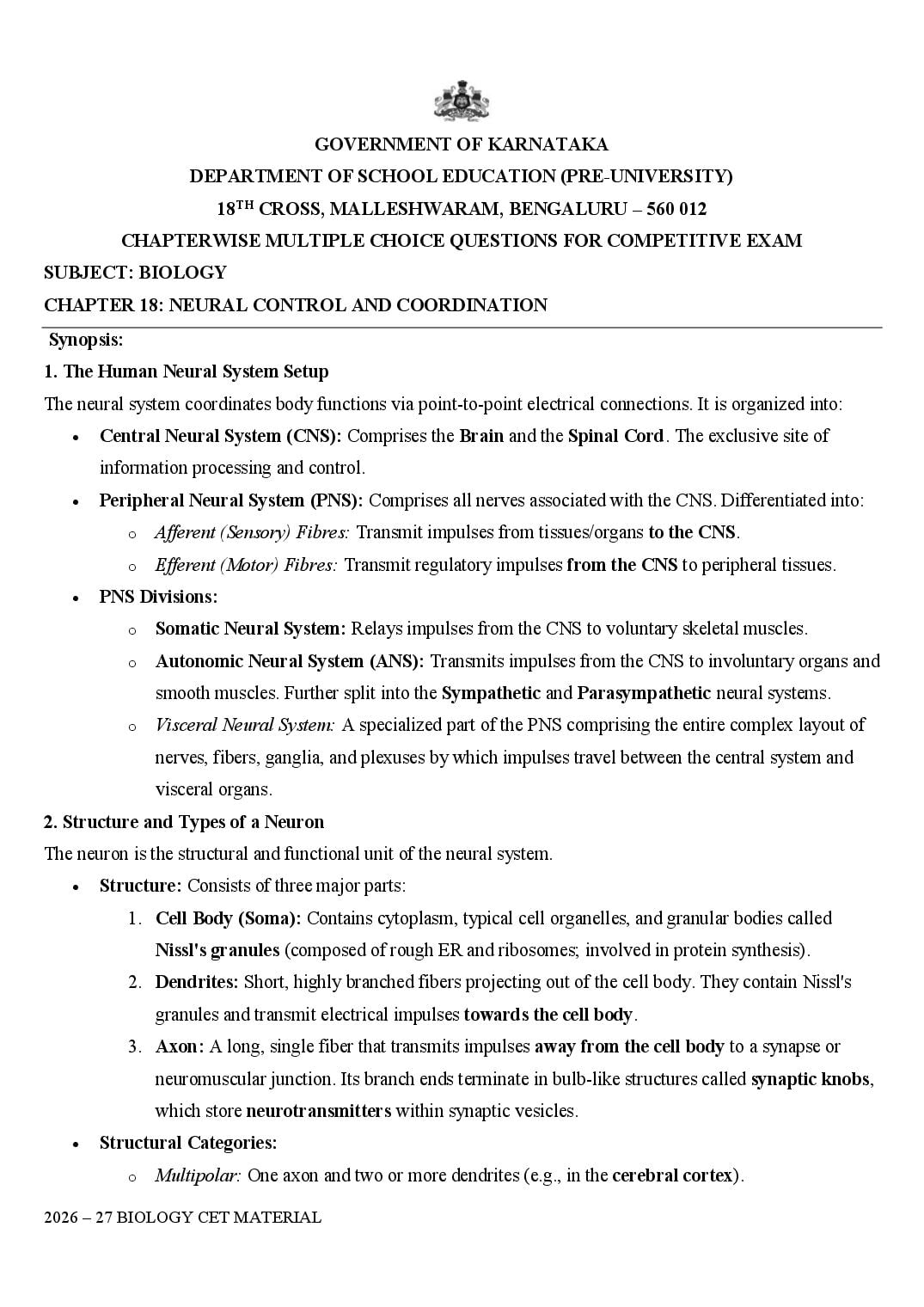
DEPARTMENT OF SCHOOL EDUCATION (PRE-UNIVERSITY)
18TH CROSS, MALLESHWARAM, BENGALURU – 560 012
CHAPTERWISE MULTIPLE CHOICE QUESTIONS FOR COMPETITIVE EXAM
SUBJECT: BIOLOGY
CHAPTER 18: NEURAL CONTROL AND COORDINATION
Synopsis:
1. The Human Neural System Setup
The neural system coordinates body functions via point-to-point electrical connections. It is organized into:
• Central Neural System (CNS): Comprises the Brain and the Spinal Cord. The exclusive site of
information processing and control.
• Peripheral Neural System (PNS): Comprises all nerves associated with the CNS. Differentiated into:
o Afferent (Sensory) Fibres: Transmit impulses from tissues/organs to the CNS.
o Efferent (Motor) Fibres: Transmit regulatory impulses from the CNS to peripheral tissues.
• PNS Divisions:
o Somatic Neural System: Relays impulses from the CNS to voluntary skeletal muscles.
o Autonomic Neural System (ANS): Transmits impulses from the CNS to involuntary organs and
smooth muscles. Further split into the Sympathetic and Parasympathetic neural systems.
o Visceral Neural System: A specialized part of the PNS comprising the entire complex layout of
nerves, fibers, ganglia, and plexuses by which impulses travel between the central system and
visceral organs.
2. Structure and Types of a Neuron
The neuron is the structural and functional unit of the neural system.
• Structure: Consists of three major parts:
1. Cell Body (Soma): Contains cytoplasm, typical cell organelles, and granular bodies called
Nissl's granules (composed of rough ER and ribosomes; involved in protein synthesis).
2. Dendrites: Short, highly branched fibers projecting out of the cell body. They contain Nissl's
granules and transmit electrical impulses towards the cell body.
3. Axon: A long, single fiber that transmits impulses away from the cell body to a synapse or
neuromuscular junction. Its branch ends terminate in bulb-like structures called synaptic knobs,
which store neurotransmitters within synaptic vesicles.
• Structural Categories:
o Multipolar: One axon and two or more dendrites (e.g., in the cerebral cortex).
Page 2
o Unipolar: Cell body with one axon only; commonly found during the embryonic stage.
• Myelination Variants:
o Myelinated Nerve Fibres: Enwrapped by Schwann cells, which form a lipid-rich myelin sheath
around the axon. Gaps between adjacent myelin segments are called Nodes of Ranvier (typical
of cranial and spinal nerves).
o Non-myelinated Nerve Fibres: Enclosed by a Schwann cell that does not form a myelin sheath;
lacks Nodes of Ranvier (typical of autonomic and somatic neural fibers).
3. Mechanism of Nerve Impulse Conduction
Nerve fibers conduct impulses via dynamic alterations in the electrical potential across their axonal membranes.
Phase 1: Resting Potential (Polarized State)
When a neuron is not conducting any impulse, its axonal membrane displays distinct permeability preferences:
• Permeability: Highly permeable to Potassium ions ( ), nearly impermeable to Sodium ions ( ),
and completely impermeable to negatively charged proteins inside the axoplasm.
• Ion Concentration: The axoplasm inside the axon contains a high concentration of and negatively
charged proteins, but a low concentration of . The fluid outside the axon contains a high
concentration of and a low concentration of .
• The Sodium-Potassium Pump: This concentration gradient is actively maintained by the electrogenic
pump, which transports 3 outwards for every 2 transported inwards at the cost of 1
ATP.
• Result: The outer surface of the membrane possesses a positive charge, while the inner surface
possesses a negative charge. The membrane is polarized. The electrical potential difference across the
resting membrane is the Resting Potential ( ).
Phase 2: Action Potential Generation (Depolarization)
• When a stimulus is applied at a specific site (Site A) on the polarized membrane, the membrane at that
site suddenly becomes highly permeable to .
• This triggers a rapid influx of into the cell, reversing the polarity at that site: the inner side
becomes positively charged and the outer side becomes negatively charged.
• The membrane at Site A is depolarized. The electrical potential difference across the membrane at this
active point is the Action Potential, which acts as the functional nerve impulse.
Phase 3: Propagation of the Impulse
• At an adjacent area further down the axon (Site B), the membrane remains polarized (outer surface
positive, inner negative).
Page 3
Site A, completing a circuit loop. This reverses the polarity at Site B, shifting the action potential
forward.
• Concurrently, the extreme rise in permeability at Site A is short-lived. Within fractions of a
millisecond, channels open, driving a rapid efflux of outside the membrane to restore the
resting potential (repolarization). The neuron is now reset to respond to the next stimulus.
4. Synaptic Transmission
An impulse travels from one neuron to another across specialized junctions called Synapses, formed by the
membranes of a pre-synaptic neuron and a post-synaptic neuron, separated or not by a gap called the synaptic
cleft.
• Electrical Synapses: The membranes of pre- and post-synaptic neurons are in very close proximity.
Electrical current flows directly from one neuron into the next across the junction. Conduction is
extremely rapid and does not involve neurotransmitters. These are rare in the human system.
• Chemical Synapses: Neurons are separated by a distinct, fluid-filled synaptic cleft. They rely on
chemical messengers called neurotransmitters for signal transmission.
1.Impulse Arrival:Synaptic knob activation.
The action potential travels down the axon and reaches the terminal axon branch, depolarizing the synaptic
knob.
2.Neurotransmitter Release:Vesicle migration.
Depolarization drives synaptic vesicles to migrate towards the pre-synaptic membrane, where they fuse and
release neurotransmitters into the synaptic cleft via exocytosis.
3.Binding to Post-Synaptic Receptors:Receptor binding.
The released neurotransmitters diffuse across the cleft and bind to specific, matching receptor sites located on
the post-synaptic membrane.
4.Potential Generation:Ion channel opening.
This binding triggers the opening of ion channels on the post-synaptic cell, letting ions flow in. This generates a
new electrical potential, which can be excitatory (EPSP) or inhibitory (IPSP).
5. Central Neural System: The Human Brain
The brain is the central information processing organ of our body, well-protected inside the cranium (skull
cavity). It is covered by three layers of connective tissue membranes called cranial meninges: an outer Dura
mater, a middle thin Arachnoid mater, and an inner Pia mater (which remains in direct contact with brain
tissue).
The human brain is divided into three fundamental structural zones:
I. Forebrain
Comprises the Cerebrum, Thalamus, and Hypothalamus:
Page 4
hemispheres, which are structurally connected by a thick tract of nerve fibers called the Corpus
Callosum.
o Cerebral Cortex: The outer layer of cells covering the hemispheres, folded into prominent
ridges. It is referred to as grey matter because of the high concentration of neuron cell bodies.
o Functional Zones: Contains defined motor areas, sensory areas, and large un-differentiated
regions called association areas (responsible for complex interrelations like memory,
communication, and learning).
o White Matter: The inner region of the cerebrum, composed of myelinated axonal tracts that give
it an opaque white appearance.
• Thalamus: A structure around which the cerebrum wraps; acts as a major relay center for sensory and
motor signaling.
• Hypothalamus: Positioned at the base of the thalamus.
o Functions: Controls body temperature, urge for eating and drinking, and secretes
hypothalamic hormones.
o Limbic System: The inner parts of the cerebral hemispheres along with deep associated structures
like the amygdala and hippocampus form the limbic system. Along with the hypothalamus, it
regulates sexual behavior, expression of emotional reactions (excitation, pleasure, rage, fear),
and motivation.
II. Midbrain
Located between the thalamus/hypothalamus of the forebrain and the pons of the hindbrain. A narrow canal
called the cerebral aqueduct passes through the midbrain. The dorsal portion of the midbrain consists of four
rounded swelling lobes called the corpora quadrigemina (involved in visual and auditory reflexes).
III. Hindbrain
Comprises the Pons, Cerebellum, and Medulla Oblongata:
• Pons: Consists of fiber tracts that interconnect different regions of the brain.
• Cerebellum ("Little Brain"): Features a highly convoluted surface to provide additional space for
many more neurons; plays a critical role in modulating posture, balance, and motor coordination.
• Medulla Oblongata: Connects directly to the spinal cord. It houses vital autonomic centers controlling
respiration, cardiovascular reflexes, and gastric secretions.
• Note: The Brain Stem is formed by the structures of the midbrain, pons, and medulla oblongata. It
establishes the core connection loop between the brain and the spinal cord.
Classroom discussion questions:
1. Sense of smell is perceived by
Page 5
2. Which one of the following transmits impulses to central nervous system?
(A) Abducen nerve (B) Trochlear nerve (C) Oculomotor nerve (D) Auditory nerve
3. How many pairs of cranial nerves are mixed nerves?
(A) 3 (B) 5 (C) 4 (D) 6
4. In the accompanying diagram of a part of the human body, the structures belonging to the central nervous
system are labelled as
(A) A and C (B) B and C (C) A and D (D) C and D
5. A typical value of resting membrane potential is
(A) –90 mv (B) –70 mv (C) –40 mv (D) –60 mv
6. Cell bodies of neurons bringing afferent information into the spinal cord are located in
(A) Dorsal root ganglia (B) ventral root ganglia
(C) Gray matter of the spinal cord (D) white matter of the spinal cord
7. A touch on the right hand stimulates neurons in the
(A) Left somatic sensory area (B) left occipital lobe
(C) Right somatic sensory area (D) right occipital lobe
8. Tree of life is
(A) Branchial tree (B) lymphatic system (C) arbor vitae (D) loop of Henle
9. A list of steps involved in mechanism of vision is given below in a random order.
(i) Neural impulses are analyzed and image formed on retina is recognized by visual cortex
(ii) Membrane permeability changes (iii) Ganglion cells are excited
(iv) Bipolar cells are depolarized
(v) Action potentials (impulse) are transmitted by optic nerves to visual cortex (vi) Potential differences are
generated in the photoreceptor cells
(vii) Light energy causes a change in shape of rhodopsin, leading to the dissociation of retinal
(an aldehyde of vitamin A) from opsin (a protein)
(viii) Structure of opsin is changed
Which of the following options represents these events in a correct order?
(A) (i), (ii), (iii), (iv), (v), (vi), (vii), (viii) (B) (viii), (vii), (vi), (v), (iv), (iii), (ii),(i)
(C) (i), (iv), (iii), (ii), (vii), (viii), (vi), (v) (D) (vii), (viii), (ii), (vi), (iv), (iii), (v), (i)
10. Human body temperature is maintained by
Page 6
(C) pituitary (D) cerebral cortex
11. Which of the following options illustrates the distribution of Na+ and K+ ions in a section of non myelinated
axon which is at resting potential?
(A) (B) (C) (D)
12. The vagus nerve is the _______cranial nerve.
(A) 7th (B) 5th (C) 10th (D) 9th
13. The junction between the axon of one neuron and the dendrite of the next is called
(A) Constant bridge (B) junction point (C) joint (D) synapse
14. Sympathetic nervous system induces
(A) Secretion of digestive juices (B) heartbeat
(C) Secretion of saliva (D) all of these
15. Which of the following cranial nerves has the highest number of branches?
(A) Vagus nerve (B) Trigeminal nerve (C) Facial nerve (D) None of these
16. Identify the parts labelled A, B, C and D in the figure and match the correct names from the list (i - viii)
given below. (RATIONALISED)
A
B
D
C
(i) Reissner’s membrane (ii) Basilar membrane (iii) Tectorial membrane
(iv) Organ of Corti (v) Hair cells (vi) Otolith organ
(vii) Scala media (viii) Scala vestibule
A B C D
(A) (ii) (v) (iii) (i)
(B) (vii) (vi) (ii) (iii)
(C) (vii) (vi) (i) (ii)
(D) (viii) (vi) (i) (iii)
17. Following is a list of the events (in a random order) that lead to the formation of an auditory impulse.
(i) Vibration is transferred from the malleus to the incus to the stapes
Page 7
(iii) Nerve impulse is transmitted in cochlear nerve to auditory cortex of brain for impulse analysis and
recognitions
(iv) Sound waves pass through ear canal
(v) Stereocilia of hair cells of organ of Corti rub against tectorial membrane
(vi) Sound waves cause ear drum to vibrate
(vii) Nerve impulse is generated
(viii) Vibrations move from fluid of vestibular canal to the fluid of tympanic canal
(ix) Membrane at oval window vibrates
Which of the following options represents these events in a correct order?
(A) (iv), (vi), (i), (ix), (viii), (ii), (v), (vii), (iii) (B) (i), (ii), (iii), (iv), (v), (vi), (vii), (viii), (ix)
(C) (ix), (viii), (vii), (vi), (v), (iv), (iii), (ii), (i) (D) (iv), (vi), (i), (viii), (ix), (ii), (v), (vii), (iii)
18. One of the examples of the action of the autonomous nervous system is
(A) Swallowing of food (B) pupillary reflex
(C) Peristalsis of the intestine (D) knee-jerk response
19. Which one of the following does not act as a neurotransmitter?
(A) Cortisone (B) Acetylcholine (C) Epinephrine (D) Norepinephrine
20. During the transmission of nerve impulse through a nerve fibre, the potential on the inner side of the plasma
membrane has which type of electric charge?
(A) First positive, then negative and continue to be negative
(B) First negative, then positive and continue to be positive
(C) First positive, then negative and again back to positive
(D) First negative, then positive and again back to negative
21. During the propagation of a nerve impulse, the action potential results from the movement of
(A) K+ ions from intracellular fluid to extracellular fluid
(B) Na+ ions from extracellular fluid to intracellular fluid
(C) K+ ions from extracellular fluid to intracellular fluid
(D) Na+ ions from intracellular fluid to extracellular fluid
22. Read the following five statements (i) to (v) regarding left cerebral hemisphere and select the option that
correctly states the true (T) and false (F) statements.
(i) It receives most modalities of sensory information from the right side of the body.
(ii) It is usually larger than the right cerebral hemisphere.
(iii) It is the dominant cerebral hemisphere in most individuals.
(iv) It is connected to the right by the corpus callosum.
(v) It contains the main areas for the understanding and production of speech in most individuals.
Page 8
(A) T T F F F
(B) F T T F T
(C) T F F T T
(D) F F T T t
23. Which of the following is an example of conditioned reflex?
(A) Hand withdraws when pierced with a needle
(B) Eyes close, when anything enters into them
(C) During digestion, food goes forward in alimentary canal
(D) Trained dog salivates when you ring a bell
24. Excessive stimulation of vagus nerve in humans may lead to
(A) Hoarse voice (B) peptic ulcers
(C) Efficient digestion of proteins (D) irregular contractions of diaphragm.
25. Unidirectional transmission of a nerve impulse through nerve fibre is due to the fact that
(A) Nerve fibre is insulated by a medullary sheath
(B) Sodium pump starts operating only at the cyton and then continues into the nerve fibre
(C) Neurotransmitters are released by dendrites and not by axon endings
(D) Neurotransmitters are released by the axon endings and not by dendrites.
26. Which of the following options correctly identifies the effect of sympathetic and parasympathetic nervous
system on given features or organs?
Feature/organ Sympathetic nervous system Parasympathetic nervous system
(A) Salivary glands Stimulates secretion Inhibits secretion
(B) Pupil of the eye Dilates Constricts
(C) Heart rate Decreases Increases
(D) Intestinal peristalsis Stimulates Inhibits
27. Each spinal nerve in a mammal arises from the spinal cord by two roots, a dorsal and a ventral. Of these the
ventral root is composed of
(A) Somatic sensory and visceral sensory fibres (B) Somatic sensory and visceral motor fibres
(C) Somatic motor and visceral motor fibres (D) Somatic motor and visceral sensory fibres
28. The 3rd, 6th and 11th cranial nerves are respectively
(A) Oculomotor, Abducen and spinal accessory (B) Oculomotor, trigeminal and spinal accessory
(C) optic, facial and spinal accessory (D) trochlear, Abducens and vagus
29. Which one of the following is responsible for the control of reflex action?
(A) Sensory nerves (B) Motor nerves
(C) Sympathetic nervous system (D) Central nervous system
Page 9
(A) Pons + cerebellum (B) Hypothalamus + cerebellum
(C) Medulla oblongata + cerebellum (D) Medulla oblongata + cerebellum + pons
31. Which of the following cranial nerves are involved in the movement of eye?
(A) Optic, occulomotor, abducens (B) Occulomotor, abducens, trochlear
(C) Trochlear, abducens and optic (D) Abducens, vagus, trochlear, occulomotor
32. The smallest cranial nerve in human being is
(A) Trochlear (B) Opthalamic (C) Abducens (D) Vagus
33. Foramen of monro is an aperture between
(A) 2 nd and 3 rd ventricle (B) Diocoel and metacoel
(C) Rhinocoel and diocoel (D) 3 rd and 4th ventricle
34. Olfactory lobe of rabbit is
(A) Fused and solid (B) Fused and hollow
(C) Free and solid (D) Free and hollow
35. Which one of the following occurs without the help of brain?
(A) Cranial reflex (B) Spinal reflex
(C) Efferent reflex (D) Afferent reflex
36. The nervous strip connecting both the cerebral hemisphere in the rabbit is
(A) Corpus callosum (B) Corpus albicans (C) Corpus striatum (D) Corpus spongiosum
37. Space between the two adjoining neurons where the chemical transmitter is released known as
(A) Synaptic vesicle (B) Synapse (C) Synaptic cleft (D) Terminal button
38. IV, V and IX cranial nerves are
(A) Olfactory, spinal accessory and vagus. (B) Trigeminal, vagus and glossopharyngeal
(C) Occulomotor, trigeminal and hypoglossal. (D) Pathetic trigeminal and glossopharyngeal.
39. The innermost meninx surrounding the central nervous system in frog and man respectively are
(A) Paiamater and paimater (B) Arachnoid and piamater
(C) Piamater and duramater (D) Arachanoid and duramater
40. The spinal cord extends from the brain through
(A) Foramen magnum (B) Iter
(C) Anterior commissure (D) Foramen of monro
41. Bell experiment on dog for salivation is associated with
(A) Simple reflex (B) Conditioned reflex
(C) Voluntary action (D) None of these
42. The trigeminal nerve (V cranial nerve) arises from brain in the region of
(A) Cerebellum and divides into palatine, chorda tympani and hyomandibular.
Page 10
(C) Cerebellum and divides into ophthalmic, maxillary and mandibular.
(D) Medulla and divides into opthalamic, maxillary and mandibular.
43. One common example of simple reflexes is
(A) Tying your shoe laces while talking to another person and not looking at them.
(B) Watering of mouth at the sight of a favourite food.
(C)Climbing up a stairs in dark without stumbling.
(D) Closing of eyelids when an object suddenly approaches the eye.
44. Cerebral aqua is
(A) A cavity in the ventricle of a brain. (B) A fluid filled in the posterior chamber of eye.
(C) A fluid filled in the sacculus of ear. (D) An aperture in the auricle of heart.
45. Cranial nerves originating from medulla oblongata are
(A) III, VII, IX (B) IX, X, XI, XII, III
(C) I, VIII, IX, X (D) VII, IX, X, XI, XII
46. Increase in gastro - intestinal secretion and movement after ingestion of food is mainly brought about by
(A) Sympathetic nervous system. (B) Parasympathetic nervous system.
(C) Central nervous system. (D) Hormone secreted by thyroid.
47. Secretion of which of the following is under neurosecretory nerve axons?
(A) Pineal (B) Adrenal cortex (C) Anterior pituitary (D) Posterior pituitary
48. Each spinal nerve in a mammal arises from the spinal cord by two roots, a dorsal and a ventral. Of these the
ventral root is composed of
(A) Somatic motor and visceral motor fibres. (B) Somatic sensory and visceral motor fibres
(C) Somatic motor and visceral sensory fibres (D) Somatic sensory and visceral sensory fibres
49. In a man, abducens nerve is injured. Which one of the following functions will be affected?
(A) Movement of eye ball (B) Swallowing
(C) Movement of the tongue (D) Movement of the neck
50. Four healthy people in their twenties got involved in injuries resulting in damage and death of few cells of
the following. Which of the cells are least likely to be replaced by new cells?
(A) Osteocytes (B) Malpighian layer of the skin
(C) Liver cells (D) Neurons
51. Which one of the following statements in regard to nerve activity is true?
(A) The synaptic cleft does not prevent direct propagation of action potential from presynaptic neuron to
post synaptic cell.
(B) Information across the synaptic cleft is transmitted by means of a chemical neurotransmitter in small
vesicle.
Page 11
membrane potentiality.
(D) In tetanus the excitatory impulse to muscles are inhibited leading to lock jaw.
52. When a neuron is stimulated to generate nerve impulse, the electrical potential on the inside of the nerve
membrane changes
(A) From negative to positive and remains positive. (B) From negative to positive and
back to negative.
(C) From positive to negative and remains negative. (D) From positive to negative and
back to positive.
53. During the transmission of nerve impulse, which of the following takes place?
(A) Flux of Na+ in wards and K + outwards. (B) Flux of K + inwards and Na+ outwards.
(C) Flux of K + inwards and Na+ inwards. (D) Flux of K + outwards and Na+ outwards
54. When an impulse passes, the membrane is depolarized and the charge of the cells is
(A) Outside positive and inside negative. (B) Inside positive and outside negative.
(C) Both sides have zero potential. (D) Both sides are electronegative.
55. The potential difference between outside and inside of a nerve before excitation is known as
(A) Resting potential (B) Action potential (C) Spike potential (D) Reaction potential
56. The action potential of a nerve cell is
(A) 60 mV (B) 55 mV (C) 80 mV (D) 75 mV
57. Unidirectional transmission of a nerve impulse through nerve fibre is due to the fact that
(A) Nerve fibre is insulated by a medullary sheath.
(B) Sodium pump starts operating only at the cyton and then continues into the nerve fibre
(C) Neurotransmitters are released by dendrites and not by axon endings.
(D) Neurotransmitters are released by the axon endings and not by dendrites.
58. Parkinson's disease (characterized by tremors and progressive rigidity of limb ) is caused by degeneration of
brain neurons that are involved in movement control and make use of neurotransmitter
(A) Acetylcholine (B) Nor epinephrine (C) Dopamine (D) GABA
Practice questions
1. Chemicals which are released at the synaptic junction are called
(A) Hormones (B) Neurotransmitters
(C) Cerebrospinal fluid (D) Lymph
2. Potential difference across resting membrane is negatively charged. This is due to differential distribution
of the following ions
(A) Na+ and K+ ions (B) CO3++ and CI− ions
Page 12
3. Resting membrane potential is maintained by
(A) Hormones (B) Neurotransmitters
(C) Ion pumps (D) None of the above
4. The function of our visceral organs is controlled by
(A) Sympathetic and somatic neural system
(B) Sympathetic and parasympathetic neural system
(C) Central and Somatic nervous system
(D) None of the above
5. Which of the following is not involved in Knee-jerk reflex?
(A) Muscle spindle (B) Motor neuron (C) Brain (D) Inter neurons
6. An area in the brain which is associated with strong emotions is
(A) Cerebral cortex (B) Cerebellum (C) Limbic system (D) Medulla
7. Mark the vitamin present in Rhodopsin
(A) Vit A (B) Vit B (C) Vit C (D) Vit D
8. Human eyeball consists of three layers and it enclose
(A) Lens, iris, optic nerve (B) Lens, aqueous humor and vitreous humor
(C) Cornea, lens, iris (D) Cornea, lens, optic nerve
9. Wax gland present in the ear canal is called
(A) Sweat gland (B) Prostate gland
(C) Cowper’s gland (D) Sebaceous gland/ ceruminous gland
10. The part of internal ear responsible for hearing is
(A) Cochlea (B) Semicircular canal (C) Utriculus (D) Sacculus
11. The organ of Corti is a structure present in
(A) External ear (B) Middle ear (C) Semi-circular (D) Cochlea
12. The posterior part of retina, which is just opposite to the lens is
(A) cornea (B) yellow spot (C) fovea contralis (D) Both (B) and (C)
13. Which foramen is paired in mammalian brain?
(A) Foramen of Luschka (B) Foramen of Magendie
(C) Foramen of Monro (D) Interventricular foramen
14. In the cross-section of spinal cord A, B, C, D and E represent.
Page 13
(B) A – White matter; B – Gray matter; C – Ventral root; D – Dorsal root; E-Spinal nerve
(C) A-Gray matter; B – White matter; C – Ventral root; D – Dorsal root; E – Spinal nerve
(D) A – Gray matter; B – White matter; C-Dorsal root; D-Ventral root; E – Spinal nerve
15. Match the following Columns.
Column I Column II
(a) Fovea 1 Provides opening for entry of light
(b) Iris 2 Transduces RGB light
(c) Pulpil 3 Transmits information of CNS
(d) Lens 4 Controls amount of light entering
(e) Optic nerve 5 Focuses light on the retina
Codes
(a) (b) (c) (d) (e)
(A) 4 1 5 2 3
(B) 5 1 4 3 2
(C) 5 1 4 5 3
(D) 1 2 3 4 2
16. Which one of the following statements is true?
(A) Saltatory conduction is seen in non-myelinated nerve fibres
(B) Nissl’s granules are found in muscles fibres
(C) None-myelinated never fibres do not possess nodes of Ranvire
(D) Non-myelinated nerve fibres are completely enclosed y myelin sheath
17. Dreaming occurs in
(A) α- sleep (B) REM sleep
(C) Deep sleep (D) slow wave sleep
18. Injury to vagus nerve in human is not likely to affect
(A) tongue movements (B) gastrointestinal movements
(C) pancreatic secretion (D) cardiac movements
19. Which one of the following statements is correct?
(A) Neurons regulate endocrine activity but not vice versa
(B) Endocrine glands regulate neural activity and nervous system regulates endocrine glands
(C) Neither hormones control neutral activity nor the neurons control endocrine activity
(D) Endocrine glands regulate neural activity, but not vice versa
20. Given below is a table comparing the effects or sympathetic and parasympathetic nervous system for four
features (a – d), which one feature is correctly described?
Page 14
nervous system nervous system
(A) Salivary Stimulates secretion Constricts
(B) Pupil of the eye Dilates
(C) Heart rate Decreases Increases
(D) Intestinal peristalsis Stimulates Inhibits
21. Match the following Columns
Column I Column II
(a) Secral nerves 1 1 pair
(b) Thoracie nerves 2 8 pairs
(c) Coccygeal nerves 3 7 pairs
(d) Cervical nerves 4 12 pairs
5 5 pairs
Codes
(a) (b) (c) (d)
(A) 4 1 3 2
(B) 5 3 1 2
(C) 3 4 2 1
(D) 2 5 3 1
22. In the diagram of the lateral view of the human brain, parts are indicated by alphabets. Choose the answer in
which these alphabets have been correctly matched with the part which they indicate.
(A) A-Temporal lobe, B- Parietal lobe, C-Cerebellum, D- Medulla oblongata, E – Frontal lobe
(B) A-Frontal lobe, B- Temporal lobe, C- cerebrum, D- Medulla oblongata, E- Occipital lobe
(C) A- Temporal lobe, B- Parietal lobe, C- Cerebrum, D- Medulla oblongata, E- Frontal lobe
(D) A- Frontal lobe, B- Temporal lobe, C-Cerebellum, D-Medulla oblongata, E- Parietal lobe
23. Which one of the following is an example of negative feedback loop in humans?
(A) Constriction of skin blood vessels and contraction of skeletal muscles when it is too cold
(B) Secretion of tears after falling of sand particles into the eyes
Page 15
(D) Secretion of sweat glands and constriction of skin blood vessels when it is too hot
24. During the transmission of never impulse through a nerve fibre, the potential on the inner side of the plasma
membrane has which type of electric charge?
(A) First negative, then positive and again back to negative
(B) First positive, then negative and continue to be negative
(C) First negative, then positive and continue to be positive
(D) First positive, then negative and again back to positive
25. Broca’s area is connected with
(A) learning an reasoning (B) speech function
(C) receiving the impulses form eyes (D) sensation of smell
26. A 22 years old student goes to his ophthalmologist. He has problem in reading books because he is not able
to contract his
(A) suspensory ligament (B) pupil (C) iris (D) ciliary muscles
27. Which one of the following statements is correct about the nodes of Ranvier?
(A) Axolemma is discontinuous
(B) Myelin sheath is discontinuous
(C) Both neurilemma and myelin sheath are discontinuous
(D) Covered by myelin sheath
28. Static equilibrium is maintained by
(A) utriculus (B) sacculus
(C) Both (A) and (B) (D) semicircular canals
29. The one way or unidirectional transmission of nerve impulse in nerve cells is due to the presence of
(A) synapses (B) myelin sheath (C) membrane polarity (D) interneurons
30. Examine the diagram of the cell types A and B given below and select the correct option.
(A) Cell- A is the rod cell found evenly all over retina
(B) Cell-A is the cone cell more concentrated in the fovea contrails
(C) Cell-B is concerned with colour vision in bright light
(D) Cell-A is sensitive to low light intensities
31. Which one of the following statements is correct regarding receptors in the skin?
(A) All skin receptors are encapsulated
(B) The receptive fields of touch receptors are uniform in area
Page 16
(D) All sensory information from the skin reaches the brain via the dorsal column pathway
32. Old age far sightedness is a defect of eye which
(A) lens becomes opaque (B) eyeball becomes small
(C) eyeball becomes long (D) lens loses its elasticity
33. Post-ganglionic nerve fibres of sympathetic system are
(A) adrenergic (B) cholinergic (C) Both (A) and(B) (D) None of the above
34. If dorsal nerve of spinal cord is broken down then
(A) no impulse is transmitted (B) impulse is transmitted but slowly
(C) impulse is transmitted fast (D) no effect on impulse
35. Match the following Columns
Column I Column II
(a) Neuron 1 Ossein
(b) None matrix 2 Nissl’s bodies
(c) RBCs of man 3 Antibodies
(d) Lymphocytes 4 Non-nucleated
Codes
(a) (b) (c) (d)
(A) 4 2 3 1
(B) 4 1 3 2
(C) 4 2 1 3
(D) 2 1 4 3
36. By which nervous system and of what type the blood is supplied into visceral organs?
(A) Sympathetic nervous system, voluntary
(B) Sympathetic nervous system, involuntary
(C) Parasympathetic nervous system, involuntary
(D) Both SNS and PNS involuntary
Classroom discussion question Keys
1. (C) 7. (A) 13. (D) 19. (A) 25. (D)
2. (D) 8. (C) 14. (B) 20. (D) 26. (B)
3. (C) 9. (D) 15. (A) 21. (B) 27. (C)
4. (C) 10. (A) 16. (B) 22. (C) 28. (A)
5. (B) 11. (A) 17. (A) 23. (D) 29. (D)
6. (A) 12. (C) 18. (C) 24. (B) 30. (D)
Page 17
32. (A) 38. (D) 44. (A) 50. (D) 56. (A)
33. (A) 39. (A) 45. (D) 51. (B) 57. (D)
34. (D) 40. (A) 46. (B) 52. (B) 58. (C)
35. (B) 41. (B) 47. (C) 53. (A)
36. (A) 42. (D) 48. (A) 54. (B)
Practice question Keys
1. (B) 11. (C) 21. (E) 31. (C)
2. (A) 12. (D) 22. (D) 32. (D)
3. (C) 13. (A) 23. (A) 33. (A)
4. (B) 14. (A) 24. (A) 34. (A)
5. (C) 15. (E) 25. (B) 35. (D)
6. (C) 16. (C) 26. (D) 36. (D)
7. (A) 17. (B) 27. (B)
8. (B) 18. (A) 28. (C)
9. (D) 19. (A) 29. (A)
10. (A) 20. (B) 30. (B)
Document Details
| Board / Org | Karnataka Board |
| Exam | Class 11 |
| Type | Question Bank |
| Pages | 17 |
| Updated | 24 Sep 2026 |