Karnataka 1st PUC Biology Photosynthesis in Higher Plants MCQ with Answers
Finished viewing? Save it for later —
Download Karnataka 1st PUC Biology Photosynthesis in Higher Plants MCQ with Answers (PDF · 22 pages)About Karnataka 1st PUC Biology Photosynthesis in Higher Plants MCQ with Answers
Karnataka 1st PUC Biology Photosynthesis in Higher Plants MCQ with Answers is available here for free download. Published by Karnataka Board for Class 11, this question bank can be viewed online or downloaded as a PDF (22 pages). Candidates preparing for Class 11 can use Karnataka 1st PUC Biology Photosynthesis in Higher Plants MCQ with Answers to understand the exam pattern, the type of questions asked, and the overall difficulty level.
Frequently Asked Questions
How can I download Karnataka 1st PUC Biology Photosynthesis in Higher Plants MCQ with Answers?
Open this page and click the Download button to save Karnataka 1st PUC Biology Photosynthesis in Higher Plants MCQ with Answers as a PDF. It is completely free on AglaSem Docs.
Is Karnataka 1st PUC Biology Photosynthesis in Higher Plants MCQ with Answers free to download?
Yes. Karnataka 1st PUC Biology Photosynthesis in Higher Plants MCQ with Answers can be viewed online and downloaded as a PDF free of cost on AglaSem Docs.
How many pages does Karnataka 1st PUC Biology Photosynthesis in Higher Plants MCQ with Answers have?
Karnataka 1st PUC Biology Photosynthesis in Higher Plants MCQ with Answers contains 22 pages, which you can read online or download together as a single PDF.
Where can I find more Class 11 study material?
You can find more Class 11 question papers, sample papers, syllabus, and answer keys on AglaSem Docs.
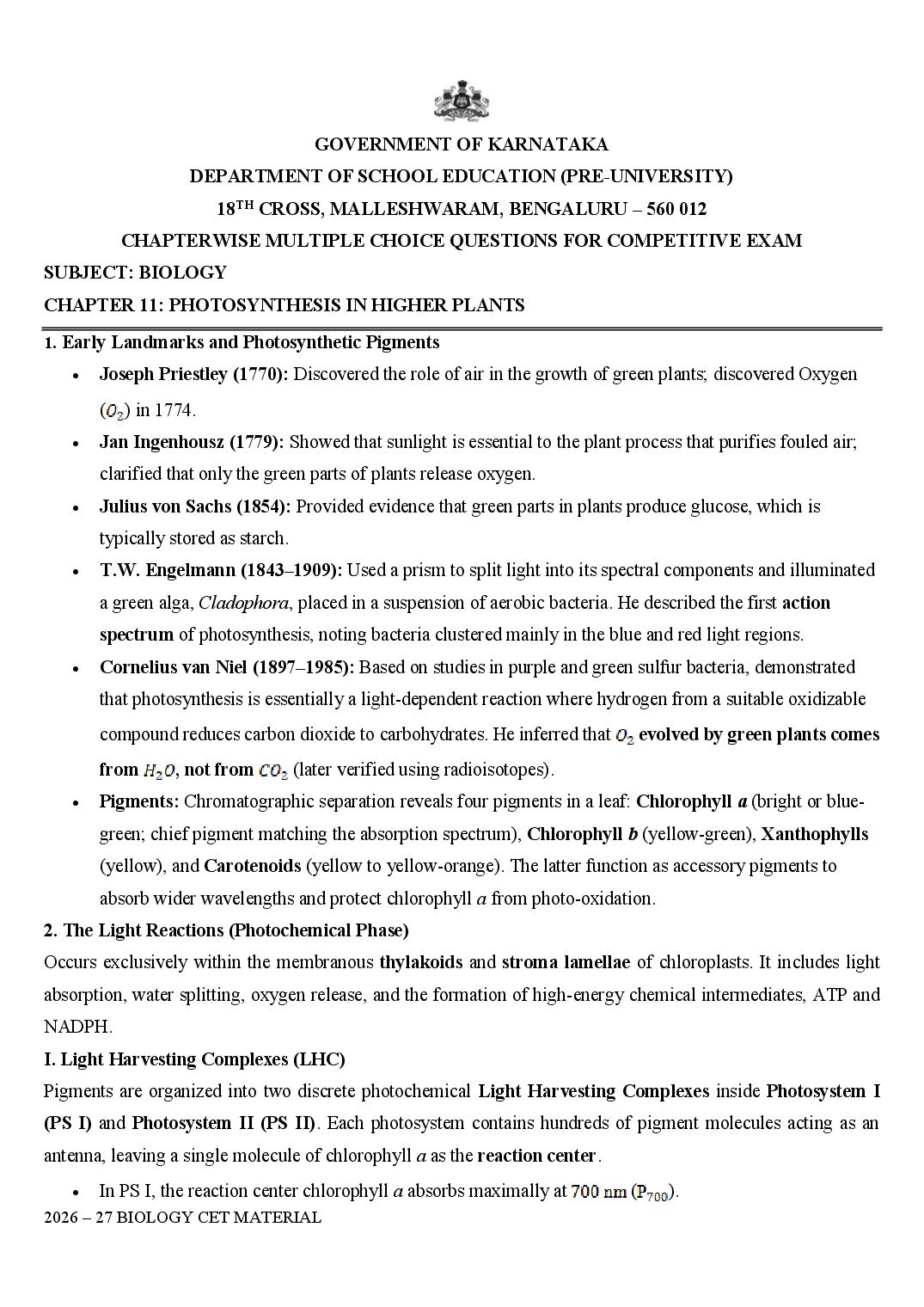
Karnataka 1st PUC Biology Photosynthesis in Higher Plants MCQ with Answers – Text
Read the full text of this question bank below — useful to quickly search, copy and reference the content online without downloading the PDF.
📄 View text version (22 pages)
Page 1
DEPARTMENT OF SCHOOL EDUCATION (PRE-UNIVERSITY)
18TH CROSS, MALLESHWARAM, BENGALURU – 560 012
CHAPTERWISE MULTIPLE CHOICE QUESTIONS FOR COMPETITIVE EXAM
SUBJECT: BIOLOGY
CHAPTER 11: PHOTOSYNTHESIS IN HIGHER PLANTS
1. Early Landmarks and Photosynthetic Pigments
• Joseph Priestley (1770): Discovered the role of air in the growth of green plants; discovered Oxygen
( ) in 1774.
• Jan Ingenhousz (1779): Showed that sunlight is essential to the plant process that purifies fouled air;
clarified that only the green parts of plants release oxygen.
• Julius von Sachs (1854): Provided evidence that green parts in plants produce glucose, which is
typically stored as starch.
• T.W. Engelmann (1843–1909): Used a prism to split light into its spectral components and illuminated
a green alga, Cladophora, placed in a suspension of aerobic bacteria. He described the first action
spectrum of photosynthesis, noting bacteria clustered mainly in the blue and red light regions.
• Cornelius van Niel (1897–1985): Based on studies in purple and green sulfur bacteria, demonstrated
that photosynthesis is essentially a light-dependent reaction where hydrogen from a suitable oxidizable
compound reduces carbon dioxide to carbohydrates. He inferred that evolved by green plants comes
from , not from (later verified using radioisotopes).
• Pigments: Chromatographic separation reveals four pigments in a leaf: Chlorophyll a (bright or blue-
green; chief pigment matching the absorption spectrum), Chlorophyll b (yellow-green), Xanthophylls
(yellow), and Carotenoids (yellow to yellow-orange). The latter function as accessory pigments to
absorb wider wavelengths and protect chlorophyll a from photo-oxidation.
2. The Light Reactions (Photochemical Phase)
Occurs exclusively within the membranous thylakoids and stroma lamellae of chloroplasts. It includes light
absorption, water splitting, oxygen release, and the formation of high-energy chemical intermediates, ATP and
NADPH.
I. Light Harvesting Complexes (LHC)
Pigments are organized into two discrete photochemical Light Harvesting Complexes inside Photosystem I
(PS I) and Photosystem II (PS II). Each photosystem contains hundreds of pigment molecules acting as an
antenna, leaving a single molecule of chlorophyll a as the reaction center.
• In PS I, the reaction center chlorophyll a absorbs maximally at ( ).
Page 2
II. Electron Transport: The Z-Scheme
When PS II absorbs light, electrons become excited and shift to an orbit further from the atomic nucleus. These
electrons are picked up by a primary electron acceptor and passed down an Electron Transport System (ETS)
consisting of cytochromes.
• Water Splitting Complex: Physically associated with PS II on the inner side of the thylakoid
membrane. Water splits into protons, electrons, and oxygen:
The electrons replace those lost by the reaction center of PS II.
• Non-cyclic Photophosphorylation: Both photosystems work in a series. Electrons ejected from PS II
pass down the transport chain to PS I. Concurrently, light excites electrons in PS I, which travel to an
acceptor molecule that reduces to . This continuous flow creates both ATP and
NADPH.
• Cyclic Photophosphorylation: Occurs only in the stroma lamellae membrane because it lacks both
the PS II complex and the reductase enzyme. Ejected electrons cycle purely within PS I,
resulting only in the synthesis of ATP, but no NADPH or evolution. It occurs when only light
wavelengths beyond are available.
III. Chemiosmotic Hypothesis (ATP Synthesis)
Proposed by Peter Mitchell; explains how ATP synthesis is linked to the development of a proton gradient
across the thylakoid membrane.
• Gradient Generation: Protons accumulate inside the lumen because:
1. Water splitting happens on the inner side of the membrane (releasing into the lumen).
2. As electrons move through the photosystems, primary acceptors transport protons from the
stroma into the lumen.
3. The reductase enzyme sits on the stroma side, removing protons from the stroma to
reduce .
• ATP Generation: This creates a high proton concentration in the lumen and a low concentration in the
stroma. The gradient breaks down when protons move through the transmembrane channel of
ATPase via facilitated diffusion. The conformational changes induced in the catalytic head particle
drive the synthesis of ATP from ADP and inorganic phosphate.
3. The Dark Reactions (Biosynthetic Phase)
Occurs in the stroma of the chloroplast. It does not directly require light but depends strictly on the products of
the light reactions (ATP and NADPH) to fix into sugars.
Page 3
Used by all photosynthetic plants. The primary acceptor is a 5-carbon ketose sugar, Ribulose-1,5-
bisphosphate (RuBP). The first stable product is a 3-carbon compound, 3-phosphoglyceric acid (PGA),
catalyzed by the enzyme RuBisCO.
The cycle progresses through three highly coordinated stages:
1. Carboxylation: Fixation of into two molecules of 3-PGA via RuBP. This is the most crucial step
of the cycle.
2. Reduction: A series of reactions utilizing ATP for phosphorylation and NADPH for reduction to form
triose phosphates (precursors to glucose). Fixing one molecule of requires 2 ATP and 2 NADPH.
3. Regeneration: Uninterrupted cycle operations require regenerating the acceptor RuBP, which costs
1 ATP.
Net Balance Sheet for every 1 Molecule of Glucose ( ):
• In: | |
• Out: | |
II. The Hatch-Slack Pathway ( Pathway)
Plants adapted to dry tropical regions display this pathway (e.g., Maize, Sugarcane). They exhibit a unique leaf
anatomy called Kranz Anatomy ("wreath" arrangement): bundle sheath cells form multiple thick layers around
vascular bundles, lacking intercellular spaces and possessing large chloroplasts without grana.
• Mechanism:
o The primary acceptor is Phosphoenolpyruvate (PEP), a 3-carbon molecule present in
mesophyll cells. The reaction is catalyzed by PEP carboxylase (PEPcase). Mesophyll cells
entirely lack the RuBisCO enzyme.
o PEPcase fixes into the 4-carbon stable acid Oxaloacetic acid (OAA).
o OAA converts to Malic acid and is transported to the bundle sheath cells, where it undergoes
decarboxylation to release and a 3-carbon pyruvate molecule.
o The released enters the standard Calvin ( ) Cycle inside the bundle sheath cells, where
RuBisCO is highly abundant. The pyruvate returns to the mesophyll cells to regenerate PEP.
• Energetic Cost: Because transporting acids across cells costs extra energy, a plant requires 30 ATP
and 12 NADPH to produce one molecule of glucose. However, because PEPcase does not bind oxygen,
plants completely avoid photorespiration, making them far more productive than plants under high
temperature and light intensities.
4. Photorespiration (The Cycle)
Page 4
concentrations rise (under high temperatures and light), RuBisCO functions as an oxygenase.
• Instead of producing two molecules of PGA, it binds to RuBP to form one molecule of
Phosphoglycerate ( ) and one molecule of Phosphoglycolate ( ).
• This pathway does not synthesize sugars, ATP, or NADPH. Instead, it consumes ATP and releases ,
making it a wasteful process found exclusively in plants.
5. Factors Affecting Photosynthesis
• Blackman’s Law of Limiting Factors (1905): If a chemical process is affected by more than one
factor, its rate is determined by the factor closest to its minimal value; it is the factor that directly affects
the process if its quantity is changed.
• Light: Light saturation occurs at 10% of full sunlight. Except in dense forests or shaded areas, light is
rarely a limiting factor in nature.
• Carbon Dioxide: The major limiting factor in nature. plants show saturation at around
( ), whereas plants saturate only beyond . Thus, greenhouse crops like tomatoes and
bell peppers are grown in -enriched atmospheres to achieve higher yields.
• Temperature: Dark reactions are enzymatic and highly temperature-sensitive. plants have a much
higher temperature optimum ( ) than plants ( ).
CLASSROOM DISCUSSION QUESTIONS
1. Synthesis of complex organic substances from simple inorganic raw materials in the presence of sunlight
and chlorophyll is called as ________, which is a ________ process.
(A) Photosynthesis, anabolic (B) photosynthesis catabolic
(C) Respiration, anabolic (D) respiration, catabolic
2. Which one of the following correctly depicts the biochemical reaction for photosynthesis?
(A) C6 H12O6 + 6O2 ⎯⎯⎯⎯
Enzymes
→6CO2 + 6H2O + energy
(B) C6 H12O6 + 6O2 + 6H2O ⎯⎯
→6CO2 + 12H2O + energy
(C) 6CO2 + 6H2O ⎯⎯⎯⎯
Sunlight
Chlorophyll
→ C6 H12O6 + 6O2
(D) 6CO2 + 12H2O ⎯⎯⎯⎯
Sunlight
Chlorophyll
→ C6 H12O6 + 6O2 + 6H2 O
3. Which one of the following equations suggests that O2 released during photosynthesis comes from water?
(A) 6CO218 + 12H2O ⎯⎯
→6O218 + C6 H12O6 + 6H2O18
(B) 6CO2 + 12H2O18 ⎯⎯
→6O2 + C6 + C6 H12O6 + 6H2O18
(C) 6CO218 + 12H2O ⎯⎯
→6O218 + C6 H12O6 + 6H2O
Page 5
→6O218 + C2 H12O6 + 6H2O
4. Visible part of electromagnetic spectrum consists of radiations having a wavelength in the range of
(A) 400 – 800 nm (B) 300 – 2600 nm
(C) 390 – 760 nm (D) 650 – 760 nm
5. Indigo and red regions of VIBGYOR, respectively fall in the range of wavelength
(A) 430 – 470 nm and 660 – 760 nm (B) 300 – 390 nm and 600 – 650 nm
(C) 390 – 760 nm and 430 – 470 nm (D) 660 – 760 nm and 430 – 470 nm
6. Moll’s half-leaf experiment proves that _________ is essential for photosynthesis to take place.
(A) Chlorophyll (B) CO2 (C) Light (D) H2O
7. Who demonstrated that green plants purify the foul air produced by breathing animals and burning candles?
(A) Priestley (B) Ingenhousz (C) Sachs (D) Engelmann
8. Which of the following scientists concluded by his experiments that green plants parts play a role in
purifying the noxious air only in the presence of sunlight?
(A) Priestley (B) Ingenhousz (C) Sachs (D) Engelmann
9. Ingenhousz in an experiment showed that in bright sunlight, small bubbles were formed around the green
parts of plant, while in that dark, they did not. He identified these bubbles to be of
(A) CO2 (B) H2O (C) O2 (D) H2
10. Who provided the evidence that glucose is formed during photosynthesis and is then stored in the form of
starch?
(A) Sachs (B) Engelmann (C) Van Niel (D) Blackmann
11. Who used prism, green alga Cladophora, and aerobic bacteria and plotted the first action spectrum for
photosynthesis?
(A) Sachs (B) Arnon (C) Arnold (D) Engelmann
12. Photosynthetic pigments such as chl a, chl b, xanthophylls and carotene can be separated by which of the
following techniques?
(A) Paper chromatography (B) Gel Electrophoresis
(C) X-ray diffusion (D) ELISA test
13. Who, after conducting experiments on purple and green sulphur bacteria, inferred that O2 evolved during
photosynthesis comes from H2O not from CO2?
(A) Sachs (B) Engelmann (C) Van Niel (D) Blackmann
14. Which range of wavelength (in nm) is called as photosynthetically active radiation (PAR)?
(A) 100 − 390 (B) 390 − 430 (C) 400 − 700 (D) 760 − 100
15. Study the following statements regarding chl a molecule.
(i) Molecular formula of chl a is C55H72O5N4 Mg
Page 6
(iii) In pure state, it is red in colour and thus it absorbs more blue wavelength of light than the red
wavelength.
(iv) It is soluble in water as well as petroleum either
(A) (i) and (iii) (B) (iii) and (iv) (C) (iii) only (D) (iv) only
16. Given graph represents the absorption spectra of three photosynthetic pigments, chl a, chl b and -carotene.
(A) The curve showing the amount of absorption of different wavelengths of light by a photosynthetic
pigment is called as absorption spectrum.
(B) Chl a and chl b absorb maximum light in blue and red wavelengths of light.
(C) Rate of photosynthesis is maximum in blue and red wavelengths of light
(D) All of these
17. Which of the following serves as the source of energy for chemosynthetic bacteria?
(A) Sun (B) Infra-red rays
(C) Organic substances (D) Inorganic chemicals
18. PEP (Phosphoenol pyruvic acid) is primary CO2 acceptor in
(A) C4 plants (B) C3 plants
(C) C2 plants (D) both C3 and C4 plants
19. During the different processes of photosynthesis, splitting of water is associated with
(A) Photosystem I (B) lumen of thylakoid
(C) Both photosystem I and II (D) inner surface of thylakoid membrane.
20. Read the following statements and select the correct option
Statement 1: Photorespiration interferes with the successful functioning of Calvin cycle.
Statement 2: Photorespiration oxidizes ribulose-1, 5 biphosphate which is an acceptor of CO2 in Calvin
cycle.
(A) Both statements 1 and 2 are correct and statement 2 is the correct explanation of statement 1.
(B) Both statements 1 and 2 are correct but statement 2 is not the correct explanation of statement 1.
(C) Statement 1 is correct and statement 2 is incorrect\
(D) Both statements 1 and 2 are incorrect.
21. The reaction that is responsible for the primary fixation of CO2 is catalysed by which of the following
enzymes in C4 plants?
(A) RuBP carboxylase (B) PEP carboxylase
Page 7
22. When CO2 is added to PEP, the first stable product synthesised is
(A) Pyruvate (B) glyceraldehyde-3-phosphate
(C) Phosphoglycerate (D) oxaloacetate
23. Which of the following is produced during the light phase of photosynthesis?
(A) ATP (B) NADPH2
(C) Both ATP and NADPH2 (D) Carbohydrates
24. The law of limiting factors for photosynthesis was enunciated by
(A) Blackman (B) Hill (C) Ruben (D) Kalmen
25. Discovery of Emerson effect has clearly shown the existence of
(A) Two distinct photochemical reactions or processes.
(B) Light and dark reactions in photosynthesis.
(C) Photophosphorylation.
(D) Photorespiration.
26. "The amount of CO2 absorbed and O2 released during photosynthesis are in equal volumes" was proved by
(A) Engleman (B) Robert Mayer (C) Priestley (D) Bousingault
27. The experimental material that has largely been responsible for making rapid advances in research on
photosynthesis is
(A) Chlamydomonas (B) Spinach leaf (C) Chlorella (D) Hydrilla
28. The first experiment on photosynthesis in flashing light were carried out by
(A) F.F. Blackman (B) Robert Meyer (C) Melvin Calvin (D) Robert Hill
29. Moll's experiment shows
(A) Unequal transpiration from two surfaces of leaf.
(B) Relation between transpiration and absorption.
(C) CO2 is required for photosynthesis.
(D) Chlorophyll is essential for photosynthesis.
30. Blackman demonstrated that increasing illumination increased the photosynthetic rate up to a point when
CO2 becomes limiting. If light was not limiting, temperature becomes limiting. Emerson found that
maximum CO2 fixation could be achieved with brief flashes of light. Mark the correct statement in the
following.
(A) Only one factor can be limited in photosynthesis.
(B) Photosynthesis consists of a light and dark reaction.
(C) The trapping of light by chloroplast in temperature dependent.
(D) The trapping of light by chloroplast can occur only if CO2 is present.
31. The core metal of chlorophyll is
Page 8
32. In presence of light, green plants convert carbon dioxide and water into food stuffs. Which of the following
is likely to be the first substance that a green plant makes in photosynthesis?
(A) A simple sugar (B) Starch (C) Cellulose (D) Fat
33. Grana refers to
(A) Stacks of thylakoids in plastids of higher plants. (B) A constant in quantum equation.
(C) Glycolysis of glucose. (D) Byproduct of photosynthesis.
34. Photosynthesis is a
(A) Exothermic process (B) Exergonic process
(C) Anabolic process (D) Catabolic process
35. Quantasomes contain
(A) 200 chlorophyll molecules. (B) 230 chlorophyll molecules.
(C) 250 chlorophyll molecules. (D) 300 chlorophyll molecules.
36. For the process of photosynthesis all except one of the following items are essential. Point out the
exception.
(A) Water, minerals (B) Light, chlorophyll
(C) CO2, optimum temperature (D) Oxygen, sucrose
37. Algae float in the water during daytime and sink during night time because
(A) They become buoyant due to consumption of food materials in respiration.
(B) They lose weight at night.
(C) They come up to enjoy sunshine.
(D) They become buoyant in light due to accumulation of oxygen bubbles released in photosynthesis.
38. Photosynthesis is a process in which
(A) CO2 is reduced to carbohydrate. (B) NADH is reduced to NAD.
(C) ATP is generated. (D) Oxidative photophosphorylation occurs.
39. How many molecules of water are needed by a green plant to produce one molecule of hexose/ reduce 6
molecules of CO2
(A) 6 (B) 12 (C) 24 (D) One only
40. The full expansion of NADP is
(A) Nicotinamide adenine diphosphate (B) Nicotinamide adenosine diphosphate
(C) Nicotinamide adenine dinucleotide phosphate (D) Nicotinamide adenosine
dinucleotide phosphate
41. Emerson effect explains the phenomenon of
(A) Transpiration (B) Absorption of water by roots
(C) Photosynthesis (D) Respiration
Page 9
(A) ATP formation (B) Glucose formation
(C) Photolysis of water (D) Activation of chlorophyll by sunlight
43. Photosynthetic pigments in chloroplast are embedded in membrane of
(A) Thylakoids (B) Photoglobin
(C) Matrix (D) Envelope of chloroplast
44. Which of the following pigments is yellow in colour?
(A) Chlorophyll 'a' (B) chlorophyll 'b' (C) Carotene (D) Xanthophyll
45. Which of the following wavelength occur in red part of the spectrum?
(A) 470 nm (B) 390 nm (C) 680 nm (D) 830 nm
46. NADPH2 is generated through
(A) Glycolysis (B) Photosystem - I
(C) Photosystem - II (D) Anaerobic respiration
47. In cyclic photophosphorylation which one of the following is formed?
(A) ATP (B) NADP and ATP
(C) NADH2 and O2 (D) NADPH2 ATP and O2
48. Where does the primary photochemical reaction occur in chloroplast
(A) Stroma (B) Endoplasmic reticulum
(C) Quantasomes or thylakoids (grana) (D) Inner membrane of chloroplast
49. Photophosphorylation is a process in which
(A) Light energy is converted into chemical energy in the form of ATP
(B) NADP is formed.
(C) Chemical energy is used to produce ATP.
(D) CO2 is reduced to carbohydrate.
50. During photochemical reactions of photosynthesis
(A) Liberation of oxygen takes place.
(B) Formation of ATP and NADPH2 takes place.
(C) Liberation of O2 and formation of ATP and NADPH2 takes place.
(D) Assimilation of CO2 takes place.
51. The main difference between the molecules of chlorophyll a and b is
(A) Chlorophyll a has an aldehyde group while chlorophyll b has a methyl group.
(B) Chlorophyll a has a methyl group while chlorophyll b has an aldehyde group.
(C) The phytol tail is absent in chlorophyll a and is present in chlorophyll b.
(D) The porphyrin group in chlorophyll b has no binding site but a binding site is present in chlorophyll a
Page 10
higher plants?
(A) Violet and blue (B) Blue and green (C) Green and red (D) Red and violet
53. Which of the following occurs first in the light reaction?
(A) Oxidation of chlorophyll. (B) Photolysis of water.
(C) Evolution of ATP and O2. (D) Production of O2 and NADPH2.
Practice Questions
1. Which metal ion is a constituent of chlorophyll?
(A) Iron (B) Copper (C) Magnesium (D) Zinc
2. Which pigment act directly to convert light energy to chemical energy?
(A) Chlorophyll a (B) Chlorophyll b
(C) Xanthophyll (D) Carotenoid
3. Which rage of wavelength (in nm) is called photosynthetically active radiation (PAR)?
(A) 100 – 390 (B) 390 − 430 (C) 400 − 700 (D) 760 −100,00
4. Which light range is most effective in photosynthesis?
(A) Blue (B) Green (C) Red (D) Violet
5. Chemosynthetic bacteria obtain energy from
(A) Sun (B) Infrared rays
(C) Organic substances (D) Inorganic chemicals
6. Energy required for ATP synthesis in PSII comes from
(A) Proton gradient (B) Electron gradient
(C) Reduction of glucose (D) Oxidation of glucose
7. During light reaction in photosynthesis the following are formed:
(A) ATP and sugar (B) Hydrogen, O2 and sugar
(C) ATP, hydrogen donor and O2 (D) ATP, hydrogen and O2 donor
8. Dark reaction in photosynthesis is called so because
(A) It can occur in dark also (B) It does not depend on light energy
(C) It cannot occur during day light (D) It occurs more rapidly at night
9. PEP is primary CO2 acceptor in
(A) C4 plants (B) C3 plants
(C) C2 plants (D) Both C3 and C4 plants
10. The correct sequence of flow of electrons in the light reaction is
(A) PSII, plastoquinone, cytochromes, PSI, ferredoxin
(B) PSI, plastoquinone, cytochromes, PSII, ferredoxin
(C) PSI, ferredoxin, PSII,
Page 11
11. The enzyme that is not found in a C3 plant is
(A) RuBP Carboxylase (B) PEP Carboxylase
(C) NADP reductase (D) ATP synthase
Assertion: and Reason: type questions
(A) If both Assertion and Reason are true and Reason is the correct explanation of Assertion
(B) If both Assertion and Reason are true but Reason is not the correct explanation of Assertion
(C) If Assertion is true but Reason is false
(D) If both Assertion and Reason are false.
12. Assertion: PS I and PS II are reaction centre of photosynthesis.
Reason: PS I composed of P700 and PS II composed of chlorophyll P680.
13. Assertion: In oxidative phosphorylation, the electrons flow from NADH to O2
Reason: In photosynthesis, the electrons flow from H2O to NADPH.
14. Assertion: Plastoquinones act as link between two photosystems.
Reason: The donor of electrons for both photosystems is water.
15. Assertion: Two photosystems are connected by electron transport chain.
Reason: Electron transport chain in chloroplasts is a fixed structure.
16. Assertion: Chloroplast are semiautonomous and contain ribosomes.
Reason: Chloroplasts synthesize all protein which they require for photosynthesis.
17. Assertion: Chlorophyll a and chlorophyll b are structurally different.
Reason: Chlorophyll a contain methyl group while chlorophyll b contain formyl group.
18. Assertion: Chlorophylls show Kutusky effect.
Reason: Chlorophyll a shows most of fluorescence.
19. Assertion: The photocentre requires the help of harvesting molecules in the absorption of light.
Reason: The energy by antenna molecules hand over the energy directly to the photocentre
20. Assertion: O2 are liberated in the noncyclic photophosphorylation.
Reason: Liberation of oxygen is due to photolysis of water.
21. Assertion: Cyclic photophosphorylation synthesizes ATP.
Reason: ATP synthesise in cyclic photophosphorylation in associated with NADPH formation.
22. Assertion: Quantum conversion occurs during light reaction.
Reason: Light reaction generates energy-rich compounds.
23. Assertion: RuBP is one of the most abundant enzyme.
Reason: RuBP is a six-carbon compound.
24. Assertion: In light, both 3-PGA and RuBP are found in plants.
Reason: A decrease in PGA was observed, when the plant moves from light to dark.
Page 12
Reason: Plants showing Hatch-Slack pathway are called C4 plants.
26. Assertion: Leaves of C4 plants show Kranz anatomy.
Reason: C4 plants possess two types of chloroplast.
27. Assertion: C4 plants also show CO, fixation by Calvin-Benson cycle.
Reason: Mesophyll cells in C4 plants show Calvin cycle CO2 fixation.
28. Assertion: RuBP is called final acceptor of CO2 in C4 plants.
Reason: CO2 is transported from mesophyll cells to bundle sheath of chloroplasts in C4 plants.
29. Assertion: Photorespiration does not take place in C4 plants.
Reason: C4 plants do not show CO2 fixation by Calvin cycle.
30. Assertion: RuBP is the most abundant protein.
Reason: 2 molecules of PGA are formed from one molecule of RuBP.
31. Assertion: Photosynthetic bacteria are poisoned by oxygen.
Reason: Photosynthetic bacteria are anaerobes.
32. Assertion: All eukaryotic photosynthetic organisms contain chlorophyll a.
Reason: Photosynthetic bacteria contain chlorophyll a.
33. Assertion: Quantasome is a structural and functional unit of photosynthesis.
Reason: Quantasomes are present in thylakoids.
34. Assertion: To form a hexose, six molecules of CO2 are fixed.
Reason: One molecule of CO2 is fixed to give 686 kcal in photosynthesis.
35. Assertion: Carotenoids are called accessory pigments.
Reason: Carotenoids occur only in chromoplasts.
36. Assertion: Reducing power is utilised in photorespiration.
Reason: Photorespiration is a highly wasteful process.
37. Assertion: In the formation of one glucose, 686,000 calories of energy are produced.
Reason: The energy is provided by a total of 12 NADPH and 18 ATP.
38. Assertion: Peroxisome contain all enzymes to carry out photorespiration.
Reason: Peroxisomes alone can carry the photorespiration.
39. Assertion: A plant growing in complete dark will show only dark reactions.
Reason: "Dark reactions" occur in dark.
40. Assertion: Blue-violet and red light are most absorbed light by chlorophylls.
Reason: In case of both light, photosynthetic products are always carbohydrates.
41. Assertion: Plants utilize 5-10% of the absorbed water in photosynthesis.
Reason: Reduced leaf hydration decrease the photosynthesis.
42. Assertion: CAM plants lack structural compartmentation of leaf, as found in C4 plants.
Page 13
43. Assertion: Low temperature inhibits photosynthesis.
Reason: Low temperature inactivates the enzymes of plants.
44. Assertion: Plants utilizing first RuBP in CO2-fixations are called C3 plants.
Reason: Plants utilizing first PEP in CO2-fixations are called C4 plants.
45. Assertion: Photosynthesis is an anabolic process.
Reason: Photosynthesis occurs inside the chlorophyll.
46. Assertion: Chlorophylls usually show red fluorescence though they absorb blue radiations as well.
Reason: In fluorescence, long wave radiations are emitted.
47. Photosynthesis is a
(A) catabolic process (B) anabolic process
(C) amphibolic process (D) catalytic process
48. Who proved that the organic matter is synthesized from carbon dioxide and water during the
photosynthesis?
(A) Liebig (B) Priestley (C) Ingen Housz (D) Von Mayer
49. Which of the following is true for photosynthesis?
(A) Reduction of CO2 and H2O (B) Oxidation of CO2 and H2O
(C) Reduction CO2 and oxidation of H2O (D) Oxidation of CO2 and reduction of H2O
50. In C3 – plants, what is the quantum yield of photosynthesis?
(A) 33% (B) 9% (C) 12% (D) 8%
51. In chloroplasts, chlorophyll is present in
(A) outer membrane (B) inner membrane (C) stroma (D) thylakoids
52. Head portion of the chlorophyll is called ….. A…. Tail portion of the chlorophyll is called …B….Fill in
the with respect to A, B and tick the appropriate option.
(A) A – phytol, B-porphyrin (B) A –porphyrin, B-phytol
(C) A-pyrrole ring, B-phytol (D) A – porphyrin, B-pyrrole ring
53. What is the wavelength of radiations in visible spectrum?
(A) 400-700 nm (B) 400-800 nm (C) 390 – 760 nm (D) 760 – 390 nm
54. Match the following columns and choose the correct combination from the option given below.
Column I Column II
(a) Visible light 1 0.1 to 1 nm
(b) Ultra viole 2 400 to 700 nm
(c) x-rays 3 Longer than 740
nm
Page 14
5 < 0.1 nm
Codes
(a) (b) (c) (d)
(A) 1 3 5 5
(B) 2 4 3 1
(C) 4 3 2 1
(D) 2 4 1 3
55. The first action spectrum was studied by
(A) Von Helmont (B) Engelmann (C) Emerson (D) Lavoisier
56. Within the chloroplast, the chlorophyll pigments are organized in the form of
(A) PS – I (B) PS – II (C) PS – III (D) Both (A) and (B)
57. PS is made up of which of the following?
(A) Reaction center (B) Antenna molecule
(C) Both (A) and (B) (D) Reaction center and H2O
58. During light reaction of photosynthesis
(A) ADP is phosphorylated and NADPH oxidized (B) ADP is phosphorylated and
NASP reduced
(C) ADP is phosphorylated and NADPH reduced (D) ATP is phosphorylated and
NADPH reduced
59. If green plants are incubated with O18 labelled water, which molecule (photosynthesis product) will become
radio from the given options.
(A) O2 (B) H2O (C) CO2 (D) ATP
60. Statement I Water splitting complex is associated with PS-II.
Statement II Water splitting complex and PS-II both are physically located on the outer side of the
membrane of thylakoikd.
Choose the correct statement.
(A) Statement I is incorrect, II is correct (B) Statement II is incorrect, I is correct
(C) Both statements are incorrect (D) Both statements are correct
61. Photophosphorylation in chloroplast is most similar to the
(A) mitochondrial substances level phosphorylation
(B) mitochondrial oxidative phosphorylation
(C) mitochondrial oxidative phosphorylation
(D) All of the above
62. ATPase has
Page 15
(B) has channel that allows electron diffusion
(C) channel that allows diffusion O2 molecule diffusion
(D) channel that allows CO2 molecule
63. First reaction of photosynthesis is
(A) photolysis of water (B) excitation of chlorophyll molecule
(C) formation of ATP (D) fixation of CO2
64. The energy required to hydrolyses water during photosynthesis comes from
(A) reduced chlorophyll (B) proton gradient
(C) oxidized chlorophyll (D) ATP
65. RuBisCo is found in
(A) cytoplasm (B) nucleus (C) mitochondria (D) chloroplast
66. In calvin cycle, if one molecule of RuBP is carboxylated than how many PGA molecule will be formed?
(A) 2 (C) 3 (C) 4 (D) 5
67. Activator of ribulose biphosphate carboxylase oxygenase is
(A) Mg2+ (B) Zn2+ (C) Ca2+ (D) SO24−
68. I. In biosynthetic phase (C3 – cycle), enzymes are present in the matrix of Golgi body.
II. C3 and C4 –cycle are two parts of biosynthetic phase of photosynthesis in C3 –plants. Identify whether
the given statement are correct or incorrect and choose the option accordingly.
(A) Both I and II are correct (B) Both I and II are incorrect
(C) I is correct, II is incorrect (D) II is correct, I is incorrect
69. Fixation of one molecule of CO2 requires how much (in C4 – plants). ATP and NADPH respectively.
(A) 5/2 (B) 2/5 (C) 2/3 (D) 3/2
70. Photosynthesis in C4 –plants is relatively less limited by atmospheric CO2 level because
(A) four carbon acids are the initial carbon dioxide acceptors
(B) the primary fixation of carbon dioxide is mediated via PEP carboxylase
(C) effective pumping of CO2 into bundle sheath cells
(D) rubisco in C4 plants has higher effinity for CO2
71. Study the following columns and choose the correct option.
Column I Column II
(a) Oxygen evolving 1 Potassium ferric oxalate
complex
(b) Proton gradient 2 High oxygen
concentration
Page 16
(d) Photorespiration 4 Pheophytin
5 Photolysis of water
Codes
(a) (b) (c) (d)
(A) 5 3 1 2
(B) 1 2 4 5
(C) 5 1 4 2
(D) 3 4 5 1
72. C4 – plants are more efficient than C3 due to
(A) higher leaf area
(B) presence of larger number of chloroplast in the leaf cells
(C) presence of thin cuticle
(D) lack or lower rate of photorespiration
73. In sugar cane plant, 14CO2 is fixed in a malic acid, in which the enzyme that fixes carbon dioxide is
(A) Ribulose phosphate carboxylase (B) Frucotose phosphate
(C) Ribulose biphosphate carboxylase (D) Phosphoenol pyruvic acid carboxylase
74. Plant adapted to low light intensity have
(A) larger photosynthetic unit size than sun plants (B) higher rate of CO2 fixation than
sun plants
(C) more extended root system (D) lower modified to spines
75. Match the following columns.
Column I Column II
(Optimum Temperature) (Plant / organisms)
(a) 10°C to 25C 1 C4
(b) 30° C to 45° C 2 C3
(c) 55° C 3 Desert plants
(d) –20°C 4 lichens
Codes
(a) (b) (c) (d)
(A) 1 2 3 4
(B) 4 3 2 1
(C) 3 4 2 1
(D) 2 1 3 4
Page 17
Column I Colum II
(a) Increase the rate of photosynthesis 1 Cytokinin
(b) Decreases the rate of 2 Abscisic acid
photosynthesis
3 Gibberellin
Codes
(a) (b)
(A) 1,2 3
(B) 3 2
(C) 3 1,2
(D) 2 1,3
77. Match the following columns.
Column I Column II
(a) Chloroplast 1 Storage of starch
(b) Chromoplast 2 Storage of lipid
(c) Leucoplast 3 Storage of protein
Codes
(a) (b) (c)
(A) 1 2 3
(B) 3 1 2
(C) 3 2 1
(D) 1 3 2
78. Match the following columns.
Column I Column II
(a) Oxygenic photosynthesis 1 Blue-green algae
(b) Anoxygenic 2 Angiosperm
Photosynthesis
3 Photosynthetic purple Sulphur
bacteria
Codes
(a) (b)
(A) 1,2 3
Page 18
(C) 1 2,3
(D) 2,3 1
79. Photosynthesis and respiration are similar because
I. In eukaryotes, both process occur in specialized organelles.
II. ATP synthesis in both is explained by chemiosmotic theory
III. Both use ETC.
Select the correct option
(A) I and II (B) II and III (C) I and II (D)I, II and III
80. Select the correct pathway for electron transport during photosynthesis.
(A) CO2 → RuBP → Gl (B) H2O → PS – I → PS – II → NADPH + H+
(C) H2O → PS – II → PS – I → NADPH + H+ (D) H2O → PS – II → PS – I → ATP
81. The light reaction of photosynthesis end up in the formation of
(A) NADH2 (B) ATP (C) Sugar (D) NADPH2
82. I. Intial CO2 acceptor.
II. Extent of photorespiration
III. Enzyme catalyzing reaction that fixes CO2
IV. Presence of Calvin cycle.
V. Leaf anatomy.
Which one does not differ in a C3 and C4 – plants?
(A) I and V (B) Only IV (C) II and III (D) Only II
83. If photosynthesising, green algae are provided with Co2 labelled with an isotope of oxygen (O18), later
analysis showed that all of the following compounds produced by the algae contains 18O except
(A) PGA (B) RuBP (C) Glucose (D) O2
84. In the given schematic diagram, which is plastocyanin? Choose the correct option.
(A) C (B) D (C) A (D) B
85. Which of the following is the first product in photorespiration?
(A) Glycolic acid (B) Serine (C) Phosphoglycolate (D) Glycine
86. In CAM plants, CO2 required for photosynthesis enters the plant body during
(A) Night through the stomata which are kept open (B) Daytime through the lenticels
(C) Night when the hydathodes are open (D) Daytime when the stomata are open
Page 19
acidic by soaking them in a solution at pH 4. After the thylakoid space reached pH 4, the chloroplasts were
transferred to a basic solution at pH 8. The chloroplasts are then placed in the dark. Which of these
compounds would you expect to be produced
(A) ATP (B) NAD (C) G3P (D) C6H12O6
88. The diagram given below shows ATP synthesis through chemiosmosis
Which option shows the correct labelling of A, B, C and D in the diagram
(A) A – F1, B – Thylakoid membrane ; C – Photosystem (1), D- Photosystem (II)
(B) A – F0, B –Thylakoid membrane ; C – Photosystem (I), D – Photosystem (II)
(C) A – F1, B – Thylakoid membrane ; C – Photosystem (II), D – Photosystem (II)
(D) A – F0 B – Thylakoid membrane ; C – Photosystem (II), D – Photosystem (I)
89. Given below is the pathway (2- scheme) of light reaction. Identify the blanks indicated by A, B, C and D
A B C D
(A) P 700 H+ Acceptor P680 NADP+
(B) Photosystem e–acceptor Photosystem NADPH2 +
II ATP
(C) Photosystem H+ Acceptor P 700 NADPH
II
(D) Photosystem e– acceptor Photosystem I NADP+ H+
II
Page 20
a. identify A and B in graph
A B
(A) Rate of respiration Action spectrum
(B) Rate of respiration Absorption
(C) Rate of Action spectrum
photosynthesis
(D) Rate of Absorption
photosynthesis
91. The given figure shows diagrammatic representation of section of chloroplast. Few plants are marked as A,
B, C, D and E.
Combination of which parts is responsible for trapping the light energy and also the systhesis of ATP ad
NADPH
(A) A, B, C (B) B, C, D (C) C, D, E (D) A, D, E
92. Which one of the following correctly identifies X and Y and their functions in the given figure of
chloroplast
X Y
Structure Function Structure Function
(A) Grana Photolysis of water Stroma CO2 fixation
(B) Grana CO2, fixation Stroma Photolysis of water
(C) Stroma Photolysis is of Grana CO2 fixation
Page 21
(D) Stroma CO2 fixation Lamellae Photolysis of water
Classroom discussion Keys
1. (A) 12. (A) 23. (C) 34. (C) 45. (C)
2. (D) 13. (C) 24. (A) 35. (B) 46. (B)
3. (D) 14. (C) 25. (A) 36. (D) 47. (A)
4. (C) 15. (B) 26. (D) 37. (D) 48. (C)
5. (A) 16. (D) 27. (C) 38. (A) 49. (A)
6. (B) 17. (D) 28. (B) 39. (B) 50. (C)
7. (A) 18. (A) 29. (C) 40. (C) 51. (B)
8. (B) 19. (D) 30. (B) 41. (C) 52. (A)
9. (C) 20. (A) 31. (B) 42. (D) 53. (A)
10. (A) 21. (B) 32. (A) 43. (A)
11. (D) 22. (D) 33. (A) 44. (D)
Practice question Keys
1. (C) 19. (C) 37. (A) 55. (B) 73. (D)
2. (A) 20. (A) 38. (D) 56. (D) 74. (A)
3. (C) 21. (B) 39. (C) 57. (C) 75. (D)
4. (C) 22. (B) 40. (C) 58. (B) 76. (B)
5. (D) 23. (D) 41. (C) 59. (A) 77. (D)
6. (A) 24. (C) 42. (C) 60. (B) 78. (A)
7. (C) 25. (B) 43. (A) 61. (B) 79. (B)
8. (A) 26. (A) 44. (B) 62. (A) 80. (C)
9. (A) 27. (C) 45. (C) 63. (B) 81. (D)
10. (A) 28. (C) 46. (A) 64. (C) 82. (B)
11. (B) 29. (C) 47. (B) 65. (D) 83. (D)
12. (B) 30. (B) 48. (A) 66. (A) 84. (B)
13. (B) 31. (A) 49. (C) 67. (A) 85. (C)
14. (C) 32. (C) 50. (C) 68. (D) 86. (D)
15. (C) 33. (B) 51. (D) 69. (A) 87. (A)
16. (C) 34. (C) 52. (B) 70. (B) 88. (D)
17. (A) 35. (C) 53. (C) 71. (A) 89. (D)
18. (B) 36. (A) 54. (D) 72. (D) 90. (D)
Page 22
Document Details
| Board / Org | Karnataka Board |
| Exam | Class 11 |
| Type | Question Bank |
| Pages | 22 |
| Updated | 24 Sep 2026 |