Karnataka 1st PUC Biology Plant Kingdom MCQ with Answers
Finished viewing? Save it for later —
Download Karnataka 1st PUC Biology Plant Kingdom MCQ with Answers (PDF · 16 pages)About Karnataka 1st PUC Biology Plant Kingdom MCQ with Answers
Karnataka 1st PUC Biology Plant Kingdom MCQ with Answers is available here for free download. Published by Karnataka Board for Class 11, this question bank can be viewed online or downloaded as a PDF (16 pages). Candidates preparing for Class 11 can use Karnataka 1st PUC Biology Plant Kingdom MCQ with Answers to understand the exam pattern, the type of questions asked, and the overall difficulty level.
Frequently Asked Questions
How can I download Karnataka 1st PUC Biology Plant Kingdom MCQ with Answers?
Open this page and click the Download button to save Karnataka 1st PUC Biology Plant Kingdom MCQ with Answers as a PDF. It is completely free on AglaSem Docs.
Is Karnataka 1st PUC Biology Plant Kingdom MCQ with Answers free to download?
Yes. Karnataka 1st PUC Biology Plant Kingdom MCQ with Answers can be viewed online and downloaded as a PDF free of cost on AglaSem Docs.
How many pages does Karnataka 1st PUC Biology Plant Kingdom MCQ with Answers have?
Karnataka 1st PUC Biology Plant Kingdom MCQ with Answers contains 16 pages, which you can read online or download together as a single PDF.
Where can I find more Class 11 study material?
You can find more Class 11 question papers, sample papers, syllabus, and answer keys on AglaSem Docs.
Karnataka 1st PUC Biology Plant Kingdom MCQ with Answers – Text
Read the full text of this question bank below — useful to quickly search, copy and reference the content online without downloading the PDF.
📄 View text version (16 pages)
Page 1
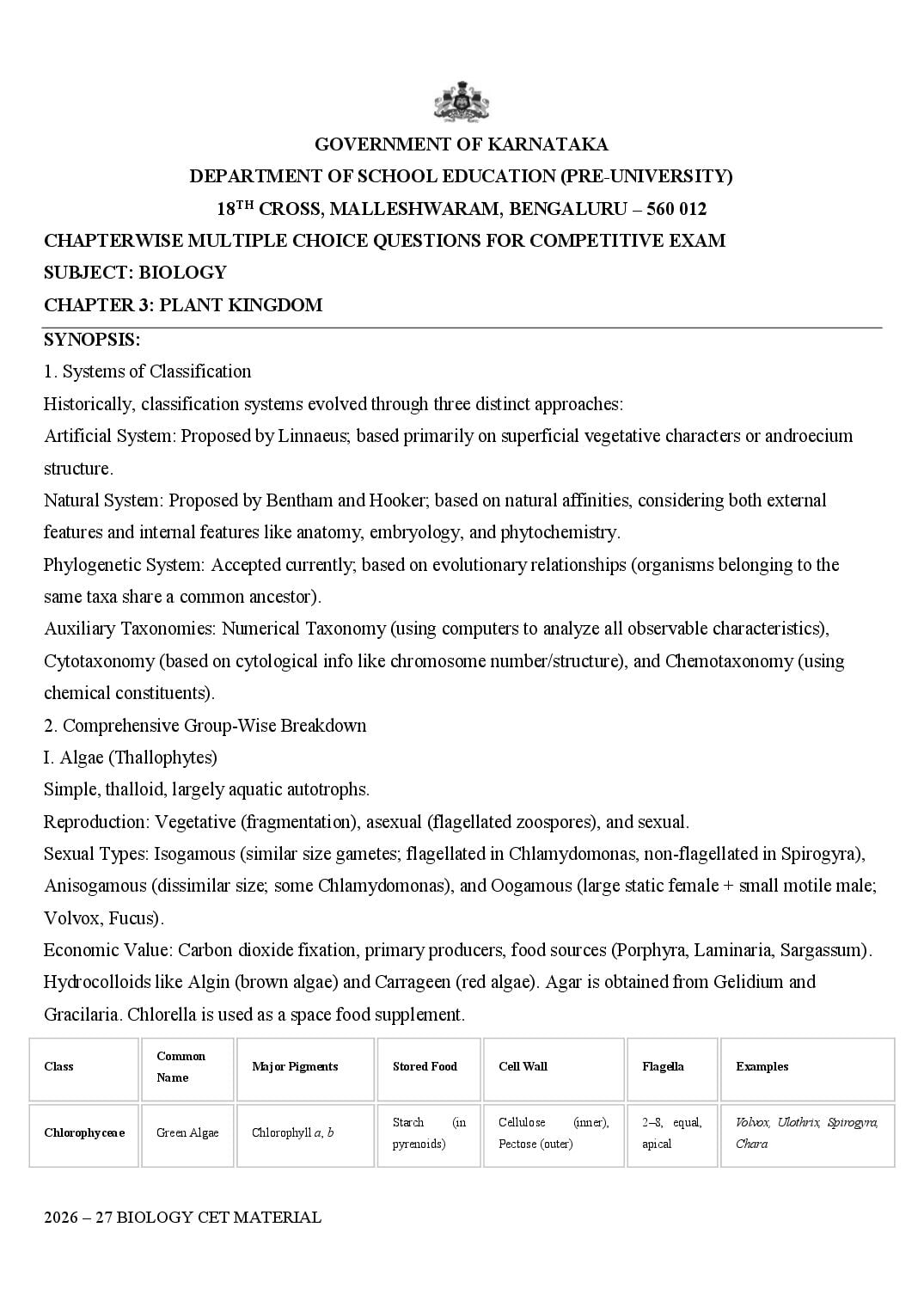
DEPARTMENT OF SCHOOL EDUCATION (PRE-UNIVERSITY)
18TH CROSS, MALLESHWARAM, BENGALURU – 560 012
CHAPTERWISE MULTIPLE CHOICE QUESTIONS FOR COMPETITIVE EXAM
SUBJECT: BIOLOGY
CHAPTER 3: PLANT KINGDOM
SYNOPSIS:
1. Systems of Classification
Historically, classification systems evolved through three distinct approaches:
Artificial System: Proposed by Linnaeus; based primarily on superficial vegetative characters or androecium
structure.
Natural System: Proposed by Bentham and Hooker; based on natural affinities, considering both external
features and internal features like anatomy, embryology, and phytochemistry.
Phylogenetic System: Accepted currently; based on evolutionary relationships (organisms belonging to the
same taxa share a common ancestor).
Auxiliary Taxonomies: Numerical Taxonomy (using computers to analyze all observable characteristics),
Cytotaxonomy (based on cytological info like chromosome number/structure), and Chemotaxonomy (using
chemical constituents).
2. Comprehensive Group-Wise Breakdown
I. Algae (Thallophytes)
Simple, thalloid, largely aquatic autotrophs.
Reproduction: Vegetative (fragmentation), asexual (flagellated zoospores), and sexual.
Sexual Types: Isogamous (similar size gametes; flagellated in Chlamydomonas, non-flagellated in Spirogyra),
Anisogamous (dissimilar size; some Chlamydomonas), and Oogamous (large static female + small motile male;
Volvox, Fucus).
Economic Value: Carbon dioxide fixation, primary producers, food sources (Porphyra, Laminaria, Sargassum).
Hydrocolloids like Algin (brown algae) and Carrageen (red algae). Agar is obtained from Gelidium and
Gracilaria. Chlorella is used as a space food supplement.
Common
Class Major Pigments Stored Food Cell Wall Flagella Examples
Name
Starch (in Cellulose (inner), 2–8, equal, Volvox, Ulothrix, Spirogyra,
Chlorophyceae Green Algae Chlorophyll a, b
pyrenoids) Pectose (outer) apical Chara
Page 2
Class Major Pigments Stored Food Cell Wall Flagella Examples
Name
Ectocarpus, Dictyota,
Brown Chlorophyll a, c, Mannitol, 2, unequal,
Phaeophyceae Cellulose and Algin Laminaria, Sargassum,
Algae Fucoxanthin Laminarin lateral
Fucus
Chlorophyll a, d, r- Floridean Cellulose, pectin, Polysiphonia, Porphyra,
Rhodophyceae Red Algae Absent
Phycoerythrin Starch polysulphate esters Gracilaria, Gelidium
II. Bryophytes ("Amphibians of the Plant Kingdom")
Non-vascular plants living in damp, shaded areas. They require water for sexual reproduction. The dominant
phase is a haploid gametophyte.
Liverworts (e.g., Marchantia): Thalloid body. Asexual reproduction occurs via fragmentation or green,
multicellular asexual buds called gemmae located in gemma cups.
Mosses (e.g., Funaria, Polytrichum, Sphagnum): Gametophyte consists of two stages: the creeping, green
protonema stage (develops from spore) and the erect, leafy leafy stage (develops from lateral bud).
Life Cycle Dynamics: The multicellular diploid sporophyte (divided into foot, seta, capsule) is physically
dependent on the gametophyte for nutrition. Sphagnum provides peat, used as fuel and packing material.
III. Pteridophytes
The first terrestrial plants to possess vascular tissues (Xylem and Phloem). The dominant plant body is a diploid
sporophyte.
Structure: Differentiated into true roots, stem, and leaves. Leaves can be small (microphylls in Selaginella) or
large (macrophylls in ferns).
Spore Formation: Sporangia are borne on leaf-like appendages called sporophylls, which sometimes form
distinct compact structures called cones or strobi (Selaginella, Equisetum).
Spore Types:
Homosporous: Producing similar kinds of spores (majority of pteridophytes).
Heterosporous: Producing two kinds of spores—macro (female) and micro (male) spores (Selaginella and
Salvinia). This condition is a crucial precursor to the seed habit.
Classification: Divided into four classes: Psilopsida (Psilotum), Lycopsida (Selaginella, Lycopodium),
Sphenopsida (Equisetum), and Pteropsida (Dryopteris, Pteris, Adiantum).
IV. Gymnosperms ("Naked Seeds")
Plants in which the ovules are not enclosed by an ovary wall and remain exposed both before and after
fertilization.
Adaptations: Roots are often taproots. They may form symbiotic associations: fungal associations form
mycorrhiza (Pinus) or specialized roots form coralloid roots with nitrogen-fixing cyanobacteria (Cycas). Leaves
Page 3
sunken stomata in conifers).
Reproduction: Heterosporous, producing haploid microspores and megaspores.
Male strobili produce pollen grains (highly reduced male gametophyte).
Female strobili bear megasporophylls with ovules.
Crucial Note: The male and female gametophytes do not have an independent, free-living existence; they
remain retained within the sporangia on the sporophyte. Examples include Cycas, Pinus, and Cedrus.
V. Angiosperms (Flowering Plants)
Note: The detailed life cycle of Angiosperms is briefly mentioned here in NCERT but extensively covered in
the reproduction chapters.
Seeds are enclosed inside fruits. They are uniquely characterized by double fertilization (syngamy + triple
fusion), producing a triploid (3n) endosperm.
3. Plant Life Cycles and Alternation of Generations
Plants alternate between a haploid gametophyte (n) phase and a diploid sporophyte (2n) phase.
Haplontic Life Cycle: Sporophytic generation is represented only by the single-celled zygote. Meiosis in the
zygote results in haploid spores, which form the dominant free-living gametophyte.
Examples: Volvox, Spirogyra, and some species of Chlamydomonas.
Diplontic Life Cycle: The diploid sporophyte is the dominant, photosynthetic, independent phase. The
gametophytic phase is represented by single to few-celled haploid gametes.
Examples: All seed-bearing plants (Gymnosperms and Angiosperms) and the brown alga Fucus.
Haplo-diplontic Life Cycle: Both phases are multicellular and often intermediate in dominance.
Examples: Bryophytes (dominant gametophyte) and Pteridophytes (dominant sporophyte).
Algal Exceptions: Ectocarpus, Polysiphonia, and Kelps are haplo-diplontic.
Class room discussion questions
1. Read the given statements about algae and select the correct option.
(i) Plant body is thalloid.
(ii) Largely aquatic
(iii) Reproduction by vegetative, asexual and sexual methods.
(iv) Chlamydomonas, Volvox and Ulothrix are the multicellular algae
(A) Statement (i) and (ii) are true (B) Statement (ii) and (iii) are true
(C) Statements (i), (ii) and (iii) are true (D) All statements are true
2. Match Column-I with Column-II and select the correct option from the codes given below.
Column-I Column-II
(a) Artificial system of classification (i) Bentham and
Page 4
(b) Natural system of classification (ii) Linnaeus
(c) Phylogenetic system of (iii) Engler and Prantl
classification
(A) (a) → (ii), (b) → (i), (c) → (iii) (B) (a) → (i), (b) → (ii), (c) → (iii)
(C) (a) → (iii), (b) → (ii), (c) → (i) (D) (a) → (iii), (b) → (i), (c) → (ii)
3. At least half of the total CO2 fixation on earth is carried out through photosynthesis by
(A) Angiosperms (B) Gymnosperms (C) Algae (D) Bryophytes
4. __________ and ________ are unicellular algae, rich in proteins, which are used as food supplements even
by space travelers.
(A) Chlorella, Spirulina (B) Gelidium, Gracilaria
(C) Porphyra, Spirogyra (D) Laminaria, Spirogyra
5. Match Column-I with Column-II and select the correct option from the codes given below.
Column-I Column-II
(a) Food (i) Brown algae
(b) Agar (ii) Porphyra,
Laminaria
(c) Algin (iii) Gelidium,
Gracilaria
(d) Carrageenin (iv) Red algae
(A) (a) → (ii), (b) → (iii), (c) → (i), (d) → (iv) (B) (a) → (ii), (b) → (iii), (c) → (iv), (d) → (i)
(C) (a) → (iii), (b) → (ii), (c) → (iv), (d) → (i) (D) (a) → (iii), (b) → (ii), (c) → (i), (d) → (iv)
6. Artificial systems of classification were based upon
(A) Vegetative characters (B) Androecium structure
(C) Habit and habitat (D) All of these
7. Major photosynthetic pigments in green algae are
(A) Chl a and b (B) Chl a, c and fucoxanthin
(C) Chl a, d and phycoerythrin (D) Chl a and c
8. The algae shown in figure belong to the class
(A) Chlorophyceae (B) Phaeophyceae
(C) Rhodophyceae (D) Cyanophyceae
Page 5
________.
(A) cellulose, cellulose (B) pectose, pectose
(C) pectose, cellulose (D) cellulose, pectose
10. Which of the following is a correct match of algal class with its characteristic reserve food?
(A) Chlorophyceae - Starch
(B) Phaeophyceae - Mannitol,
laminarin
(C) Rhodophyceae - Floridean starch
(D) All of these
11. In most green algae, pyrenoids represent the storage bodies located in ________.
(A) Chloroplasts (B) Mitochondria (C) Cytoplasm (D) Nucleus
12. Cup-shaped chloroplast is present in
(A) Spirogyra (B) Chlamydomonas (C) Ulothrix (D) Chara
13. Fusion of two gametes which are dissimilar in size is termed as
(A) Oogamy (B) Isogamy
(C) Anisogamy (D) both (A) and (C)
14. Holdfast, stipe and frond constitute the plant body in case of
(A) Rhodophyceae (B) Chlorophyceae (C) Phaeophyceae (D) all of these
15. A plant shows thallus level of organization. It shows rhizoids and is haploid. It needs water to complete its
life cycle because the male gametes are motile. It may belong to
(A) Pteridophytes (B) Gymnosperms (C) Monocots (D) Bryophytes
16. A prothallus is
(A) A structure formed before the development of thallus in pteridophytes
(B) A sporophytic structure formed in pteridophytes
(C) A gametophytic structure formed in pteriophytes
(D) A primitive structure formed after fertilization in pteridophytes
17. If the diploid number of a flowering plant is 36, what would be the chromosome number in its endosperm?
(A) 36 (B) 18 (C) 54 (D) 72
18. Protonema is
(A) Haploid and is found in mosses (B) Diploid and is found in liverworts
(C) Diploid and is found in pteridophytes (D) Haploid and is found in pteridophytes
19. Sequoia sempervirens is a/an
(A) Angiosperm (B) Bryophyte (C) Pteridophyte (D) Gymnosperm
20. Which of the following pigments are found in brown algae?
Page 6
(C) Chl a, Chl c and fucoxanthin (D) Chl a, phycoerythrin
21. ________ Systems of classification were based on natural affinities among the organisms.
(A) Artificial (B) Natural (C) Phylogenetic (D) Sexual
22. Laminarin and manitol, the reserve food of brown algae, are
(A) lipids (B) complex carbohydrates
(C) proteins (D) lipoproteins
23. Identify the given figures of algae and select the correct option.
A B
(A) Fucus Polysiphonia
(B) Dictyota Polysiphonia
(C) Dictyota Porphyra
(D) Porphyra Polysiphonia
24. Which out of the following does not belong to brown algae?
(A) Gelidium, Batrachospermum (B) Ectocarpus, Dictyota
(C) Laminaria, Fucus (D) Sargassum, Ectocarpus
25. Which one of the following statements is incorrect?
(A) Algae increase the level of dissolved oxygen in the immediate environment
(B) Algin is obtained from red algae and carrageenan from brown algae
(C) Agar- agar is obtained from Gelidium and Gracilarial
(D) Laminaria and Sargassum are used as food
26. An alga which can be employed as food for human beings is
(A) Ulothrix (B) Chlorella (C) Spirogyra (D) Polysiphonia
27. Which one of the fowling is incorrect about Chara?
(A) Upper oogonium and lower round antheridium (B) Globule and nucule present on
the same plant
(C) Upper antheridium and lower oogonium (D) Globule is male reproductive structure
28. Which one of the following shows isogamy with non-flagellated gametes?
(A) Sargassum (B) Ectocarpus (C) Ulothrix (D) Spirogyra
29. Select the incorrect statement
(A) Isogametes are similar in structure, function or behavior
(B) Anisogametes differ either in structure, function or behavior
(C) In oogamous reproduction female gamete is smaller and motile, while male gamete is larger and non-
motile
(D) Chlamydomonas exhibits both isogamy and anisogamy and Fucus shows oogamy
Page 7
(A) Chlamydomonas (B) Spirogyra (C) Vovox (D) Fucus
31. Monoecious plant of Chara shows occurrence of
(A) antheridiophore and archegoniphore on the same plant
(B) stamen and carpel on the same plant
(C) upper antheridium and lower oogonium on the same plant
(D) upper oogonium and lower antheridium on the same plant
32. Which of the following groups of algae belongs to class – Rhodophyceae?
(A) Laminaria, Fucus, Porphyra, Volvox (B) Gelidium, Porphyra, Dictyota, Fucus
(C) Gracilaria, Gelidium, Porphyra, Polysiphonia (D) Volvox, Spirogyra, Ulothrix,
Sargassum
33. Match the following Columns and choose the correct option from the codes given below
Column I Column II
(Algae type) (Example)
(a) Green alga 1 Dictyota
(b) Brown alga 2 Porphyra
(c) Red alga 3 Spirogyra
Codes
(a) (b) (c)
(A) 3 2 1
(B) 3 1 2
(C) 2 3 1
(D) 1 2 3
34. Alga, which forms motile colony is
(A) Volvox (B) Nostoc (C) Spirogyra (D) Chlamydomonas
35. From which of the following algae, agar-agar is commercially extracted?
I. Gracilaria II. Fucus III. Sargassum IV. Gelidium V. Turbinaria
Choose the correct option
(A) III and IV (B) II and III (C) IV and V (D) I and IV
36. The alga rich in protein is
(A) Chlorella (B) Ulothrix (C) Laminaria (D) Nostoc
37. Chloroplasts of Spirogyra have
(A) toothed margin (B) waxy margin
(C) smooth margin (D) none of the above
Page 8
(A) Spirogyra (B) Ulothrix (C) Nostoc (D) Anabaena
39. Consider the following statements regarding the major pigments and stored food in the different groups of
algae and select the correct option
I. In Chlorophyceae, the stored food material is starch and the major pigments are chlorophyll – a and d.
II. In Phaeophyceae, laminarin is the stored food and major pigments are chlorophyll- a and b
III. In Rhodophyceae, Floridian starch is the strode food and major pigments are chlorophyll – a, d and
phycoerythrin.
(A) I is correct, but II and III are incorrect (B) I and II are correct, but III is incorrect
(C) I and III are correct, but Ii is incorrect (D) III is correct, but I and II are incorrect
40. Find out the miss- matched pair
(A) Agar - Polymer of glucose and Sulphur containing carbohydrates
(B) Chitin - Polymer of glucosamine
(C) Peptidoglycan - Polysaccharide linked to peptides
(D) Lipopolysaccharides - A complex of lipid and polysaccharide
41. If you are asked to classify the various algae into distinct groups, which of the following characters you
should choose?
(A) Types of pigments present in the cell (B) Nature of strode food materials in the cell
(C) Structural organization of thallus (D) Chemical composition of the cell wall
42. Which one of the following, formed in Spirogyra is different based on its nucleus?
(A) Zygospore (B) Azygospore (C) Aplanospore (D) Akinete
43. Which one of following is a parasitic algae?
(A) Volvox (B) Ulothrix (C) Porphyra (D) Cephaleuros
44. The given figures are showing the thallus and sex organs of Chara. Read the following statements about it
and choose the correct option.
I. Chara can be used as manure
II. Mosquito larvae do not occur in Chara waters
III. A in the given figure is male sex organ called antheridium or globule
IV. B in the given figure is female is female sex organ called oorgonium or nucule
(A) I and II (B) III and IV (C) I and III (D) II and IV
Page 9
(A) Diplontic life cycle (B) Members of kingdom 0 Plantae
(B) Mode of nutrition (D) Multiplication by fragmentation
46. Archegoniphore is present in
(A) Chara (B) Aliantum (C) Funaria (D) Marchantia
47. Choose the correct statement
(A) Bryophytes can live in soil, but are dependent on water for sexual reproduction
(B) The sex organs in bryophytes are unicellular
(C) In bryophytes the main plat body is a gametophyte which is differentiated into true root, stem and
leaves
(D) Common example of liverworts is Polytrichum
48. Elaters are absent in
(A) Funaria (B) Marchantia (C) Pellia (D) Porella
49. Which of the following is known as ‘bog moss’?
(A) Polytrichum (B) Funaria (C) Sphagnum (D) Porella
50. In bryophytes, the sporophytic phase is represented by
(A) spores (B) antheridium (C) spore mother cell (D) egg
51. Calyptra develops from
(A) venter wall of archegonium (B) outgrowth of gametophyte
(C) neck wall of archegonium (D) paraphysis of the archegonial branch
52. Gametophyte is dominant stage in the life cycle of
(A) Bryophyta (B) Pteridophyta (C) Angiosperms (D) Gymnosperms
53. Protonema is the stage in the life cycle of
(A) Cycas (B) Funaria (C) Selaginella (D) Mucor
54. In capsule of moss, shock absorbers are
(A) trabeculae (B) peristome teeth (C) seta (D) annulus
55. At the base of seta of capsule, there is a haploid brownish growth called
(A) calyptra (B) perigonium (C) vaginula (D) perichaetial
56. Spore dissemination in some liverworts is aided by
(A) elaters (B) indusium (C) calyptra (D) peristome teeth
57. Chloroplasts with pyrenoid – like structures are found in the leaves of
(A) Funaria (B) Cycas (C) Selaginella (D) Zea mays
58. The positive evidence of aquatic ancestory of bryophytes is indicated by
(A) ciliated sperms (B) gametophytic body
(C) flagellated sperms (D) peristomical teeth
Page 10
(A) it is easily available (B) it is hygroscopic
(C) it reduces transpiration (D) it serves as a disinfectant
60. Mosses are attached to substratum by
(A) roots (B) capsule (C) rhizoids (D) main axis
Practice questions
1. Cyanobacteria are classified under
(A) Protista (B) Plantae (C) Monera (D) Algae
2. Fusion of two gametes which are dissimilar in size is termed as
(A) Oogamy (B) Isogamy (C) Anisogamy (D) Zoogamy
3. A plant shows thallus level of organization. It shows rhizoids and is haploid. It needs water to complete its
life cycle because the male gametes are motile. Identify the group to which it belongs to
(A) Pteridophytes (B) Gymnosperms (C) Monocots (D) Bryophytes
4. Plants of this group are diploid and well adapted to extreme conditions. They grow bearing sporophylls in
compact structures called cones. The group in reference is
(A) Monocots (B) Dicots (C) Pteridophytes (D) Gymnosperms
5. The embryo sac of an Angiosperm is made up of
(A) 8 cells (B) 7 cells and 8 nuclei
(C) 8 nuclei (D) 7 cells and 7 nuclei
6. If the diploid number of a flowering plant is 36. What would be the chromosome number in its endosperm
(A) 36 (B) 18 (C) 54 (D) 72
7. Protonema is
(A) Haploid and is found in mosses (B) Diploid and is found in liverworts
(C) Diploid and is found in pteridophytes (D) Haploid and is found in pteridophytes
8. The Plant Redwood tree (sequoia sempervirens) is a/an
(A) Angiosperm (B) Free fern
(C) Pteridophyte (D) Gymonosperm
9. Protonema is formed in
(A) moss (B) liverworts (C) ferns (D) Cycas
10. Mosses occur in moist places because
(A) they cannot grow on land (B) their gametes fuse in water
(C) they lack vascular tissue (D) they lack root and stomata
11. Have capacity of absorbing water, used to replace cotton and as a fuel is
(A) marchantia (B) Riccia
Page 11
12. In a moss, the sporophyte
(A) is partially parasitic on the gametophyte
(B) produces gametes that give rise to the gametophyte
(C) arises from a spore produced from the gametophyte
(D) manufactures food for itself as well as for the gametophyte
13. In hydrophytes and pteridophytes, transport of male gametes requires
(A) insects (B) birds (C) water (D) wind
14. Which one of the following is a correct statement
(A) Pteridophytic gametophyte has a protonemal and leafy stage
(B) In gymnosperms, female gametophyte is free-living
(C) Antheridiophores and archegoniophores are present in pteridopytes
(D) Origin of seed habit can be traced in pteridophytes
15. Most primitive living vascular pteridophytes
(A) cycads (B) mosses (C) red algae (D) ferns
16. Match the following Columns and choose the correct option from the codes given below
Column I Column II
(a) Coleorhiza 1 Development of sporophyte directly from gametophyte without
intervention of gametes
(b) Apogamy 2 Development of gametophyte directly from sporophyte without the
involvement of reduction division
(c) Indusium 3 An unbranched columner stem with a crown of leaves
(d) Caudex 4 Protective covering of radicle
5 Protective structure of a sorus
Codes
(a) (b) (c) (d)
(A) 5 2 4 1
(B) 4 1 5 3
(C) 3 5 2 4
(D) 2 3 2 1
17. ‘Sanjeevani booti’ is
(A) Selaginella kraussiana (B) Selaginella chrysocaulos
(C) Selaginella bryopteris (D) None of the above
18. Match the following Columns and choose the correct option from the codes given below
Page 12
(a) Rhynia 1 heterosporous
(b) Adiantum 2 Homosporous
(c) Selaginella 3 Found in fossil state
(d) Pteris 4 Walking fern
Codes
(a) (b) (c) (d)
(A) 1 2 3 4
(B) 4 3 1 2
(C) 3 4 1 2
(D) 4 3 2 1
19. The peristome of sporophyte of Funaria consists of 32- acellular teeth which remain arranged in two
whorls,
(A) outer hygroscopic and inner non- hygroscopic (B) outer non- hygroscopic and inner
hygroscopic
(C) Both hygroscopic (D) Both non-hygroscopic
20. Dispersal of spores in fern takes place through
(A) swimming archegonia (B) swimming antherozoids
(C) independent gametophytes (D) independent sporophytes
21. A fern differs from a moss in having
(A) swimming archegonia (B) swimming antherozoids
(C) independent gametophytes (D) independent sporophytes
22. In Selaginella, Trabeculae are the modification of
(A) epidermal cells (B) cortical cells (C) endodermal cells (D) pericycle cells
23. In ferns and mosses, movement of antherozoids towards female component is called
(A) phototaxis (B) chemotaxis (C) hydrotropism (D) thigmotropism
24. In the prothallus of a vascular cryptogam, the antherozoids and eggs mature at different times. As a result
(A) there is no change in success rate of fertilization (B) there is high degree of sterility
(C) one can conclude that the plant is apomictic (D) self- fertilization is prevented
25. Which one of the following is considered important in the development of seed habit
(A) Dependent sporophyte (B) Heterospory
(C) Haplontic life- cycle (D) Free – living gametophyte
26. Which of the following propagates through leaf-tips?
(A) Walking fern (B) Sprout – leaf plant (C) Marchantia (D) Moss
Page 13
(A) Equisetum (B) antheridia (C) sporangia (D) Both (A) and (B)
28. Fern gametophyte bears
(A) archegonia (B) antheridia (C) sporangia (D) Both (A) and (B)
29. Indusium is found in
(A) algae (B) ferns (C) moss (D) Cycas
30. The kidney-shaped covering of sorus in Dryopteris is called
(A) placenta (B) ramentum (C) sporophyll (D) indusium
31. Seed habit is linked to
(A) homospory (B) heterospory (C) parthenogenesis (D) parthenocarpy
32. Meiosis in Dryopteris takes place during
(A) Gamete formation (B) spore germination
(C) zygote formation (D) spore formation
33. Select the correct statement
(A) Salvinia, Ginkgo and Pinus are all gymnosperms
(B) Sequoia is one of the tallest trees
(C) The leaves of gymnosperms are not well adapted to extremes of climate
(D) Gymnosperms are both homosporous and heterosporous
34. Conifers are adapted to tolerate extreme environmental conditions because of
(A) broad hardy leaves (B) superficial stomata
(C) thick cuticle (D) the presence of vessels
35. Gymnosperms are also called soft wood spermatophytes because they lack
(A) cambium (B) phloem fibers
(C) thick-walled tracheids (D) xylem fibers
36. Cycas and Adiantum resemble each other in having
(A) seeds (B) motile sperms (C) cambium (D) vessels
37. The gametophyte is not an independent, free- living generation in
(A) Adiantum (B) Marchantia (C) Pinus (D) Polytrichum
38. A prokaryotic autotrophic nitrogen- fixing symbiont is found in
(A) Cycas (B) Cicer (C) Pisum (D) Alnus
39. Choose the incorrect statement
(A) Gymnosperms lack vessels in their xylem
(B) The cell wall of collenchyma is made up of cellulose and pactin
(C) The first formed primary xylem elements are called protoxylem
(D) The cell wall of pears a large number of
Page 14
(A) ligules (B) anthers
(C) microsporophyll’s (D) megasporophylls
41. Pinus belongs to the class
(A) Gnetopsida (B) Cyacadopsida (C) Coniferopsida (D) Sphenopsida
42. Living fossil is
(A) Ginkgo (B) Gnetum ula
(C) Pinus roxburghii (D) Cycas revoluta
43. In gymnosperms, the pollen chamber represents
(A) a cell in the pollen grain in which the sperms are formed
(B) a cavity in the ovule in which pollen grains are stored after pollination
(C) an opening in the megagametophyte through which the pollen tube approaches the egg
(D) the microsporangium in which pollen grains develop
44. Flagellated male gametes are present in all the three of which one of the following sets?
(A) Anthoceros, funaria and Spirogyra (B) Zygnema, Saprolegnia and Hydrolase
(C) Fucus, Marselea and calotropis (D) Riccia, Dryopte is and Cycas
45. Among the following which possesses the largest sperms?
(A) Pinus (B) cycas (C) Ephedra (D) Gnetum
46. Coralloid roots are found in
(A) Cycas (B) Pinus (C) Ginkgo (D) Ephedra
47. Match the following Columns and choose the correct option from the codes given below
Column I Column II
(a) Apospory in Pteris takes place 1 Sporophyte
in
(b) Endosperm in Cycas 2 Gametophyte
(c) Calyptra in Funaria 3 Sporophyte
(d) Nucellus in Cycas 4 Gametophyte
Gametophyte
Codes
(a) (b) (c) (d)
(A) 1 4 5 3
(B) 1 5 3 4
(C) 4 1 5 3
(D) 3 2 1 4
Page 15
(A) multiflagellated and very large (B) small and biflagellated
(C) multiflagellated and small (D) large and biflagellated
49. In Pinus, the third tier of embryonal cells formed below is known as
(A) rosette tier (B) suspensor tier
(C) embryonal tier (D) free – nuclear tier
50. Consider the following statements regarding gymnosperms and choose the correct option
I. In gymnosperms, the male and female gametophytes have an independent existence
II. The multicellular female gametophyte is retained within the megasporangium
III. The gymnosperms are heterosporous
(A) I and II are correct, but III is incorrect (B) I and III are correct, but II is incorrect
(C) II and III are incorrect, but I is correct (D) II and III are correct, but I is incorrect
51. Number of archegonia in Cycas is / are
(A) 8 (B) 4 (C) 1 (D) 2
52. Gymnosperms lack fruits, why
(A) Seeds absent (B) Ovule absent
(C) Ovary absent (D) Ovary fused
Classroom discussion Keys
1. (C) 11. (A) 21. (B) 31. (D) 41. (A) 51. (A)
2. (A) 12. (B) 22. (B) 32. (C) 42. (A) 52. (A)
3. (C) 13. (D) 23. (B) 33. (B) 43. (D) 53. (B)
4. (A) 14. (C) 24. (A) 34. (A) 44. (A) 54. (A)
5. (A) 15. (D) 25. (B) 35. (D) 45. (D) 55. (C)
6. (D) 16. (C) 26. (B) 36. (A) 46. (D) 56. (A)
7. (A) 17. (C) 27. (C) 37. (A) 47. (A) 57. (A)
8. (A) 18. (A) 28. (D) 38. (A) 48. (A) 58. (C)
9. (D) 19. (D) 29. (C) 39. (D) 49. (C) 59. (B)
10. (D) 20. (C) 30. (B) 40. (A) 50. (C) 60. (C)
Practice question Keys
1. (A) 4. D) 7. (A) 10. (B) 13. (C) 16. (B) 19. (A) 22. (C)
2. (C) 5. (B) 8. (D) 11. (C) 14. (D) 17. (C) 20. (C) 23. (B)
3. (D) 6. (C) 9. (A) 12. (A) 15. (D) 18. (C) 21. (D) 24. (D)
Page 16
26. (A) 30. (D) 34. (C) 38. (B) 42. (A) 46. (A) 50. (D)
27. (A) 31. (B) 35. (D) 39. (B) 43. (B) 47. (A) 51. (A)
28. (D) 32. (D) 36. (B) 40. (C) 44. (D) 48. (A) 52. (C)
Document Details
| Board / Org | Karnataka Board |
| Exam | Class 11 |
| Type | Question Bank |
| Pages | 16 |
| Updated | 24 Sep 2026 |