Karnataka 1st PUC Biology Plant Growth and Development MCQ with Answers
Finished viewing? Save it for later —
Download Karnataka 1st PUC Biology Plant Growth and Development MCQ with Answers (PDF · 19 pages)About Karnataka 1st PUC Biology Plant Growth and Development MCQ with Answers
Karnataka 1st PUC Biology Plant Growth and Development MCQ with Answers is available here for free download. Published by Karnataka Board for Class 11, this question bank can be viewed online or downloaded as a PDF (19 pages). Candidates preparing for Class 11 can use Karnataka 1st PUC Biology Plant Growth and Development MCQ with Answers to understand the exam pattern, the type of questions asked, and the overall difficulty level.
Frequently Asked Questions
How can I download Karnataka 1st PUC Biology Plant Growth and Development MCQ with Answers?
Open this page and click the Download button to save Karnataka 1st PUC Biology Plant Growth and Development MCQ with Answers as a PDF. It is completely free on AglaSem Docs.
Is Karnataka 1st PUC Biology Plant Growth and Development MCQ with Answers free to download?
Yes. Karnataka 1st PUC Biology Plant Growth and Development MCQ with Answers can be viewed online and downloaded as a PDF free of cost on AglaSem Docs.
How many pages does Karnataka 1st PUC Biology Plant Growth and Development MCQ with Answers have?
Karnataka 1st PUC Biology Plant Growth and Development MCQ with Answers contains 19 pages, which you can read online or download together as a single PDF.
Where can I find more Class 11 study material?
You can find more Class 11 question papers, sample papers, syllabus, and answer keys on AglaSem Docs.
Karnataka 1st PUC Biology Plant Growth and Development MCQ with Answers – Text
Read the full text of this question bank below — useful to quickly search, copy and reference the content online without downloading the PDF.
📄 View text version (19 pages)
Page 1
DEPARTMENT OF SCHOOL EDUCATION (PRE-UNIVERSITY)
18TH CROSS, MALLESHWARAM, BENGALURU – 560 012
CHAPTERWISE MULTIPLE CHOICE QUESTIONS FOR COMPETITIVE EXAM
SUBJECT: BIOLOGY
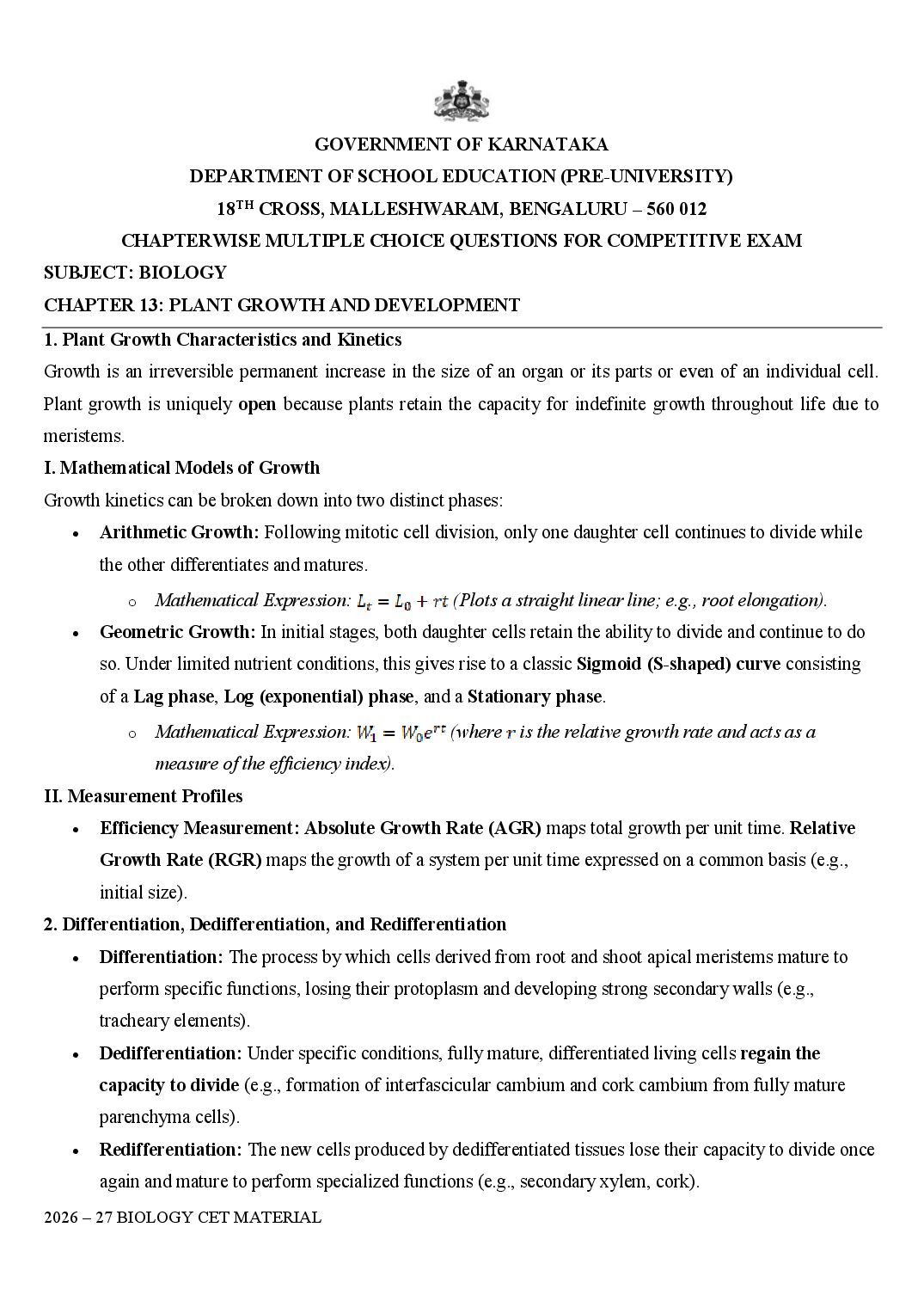
CHAPTER 13: PLANT GROWTH AND DEVELOPMENT
1. Plant Growth Characteristics and Kinetics
Growth is an irreversible permanent increase in the size of an organ or its parts or even of an individual cell.
Plant growth is uniquely open because plants retain the capacity for indefinite growth throughout life due to
meristems.
I. Mathematical Models of Growth
Growth kinetics can be broken down into two distinct phases:
• Arithmetic Growth: Following mitotic cell division, only one daughter cell continues to divide while
the other differentiates and matures.
o Mathematical Expression: (Plots a straight linear line; e.g., root elongation).
• Geometric Growth: In initial stages, both daughter cells retain the ability to divide and continue to do
so. Under limited nutrient conditions, this gives rise to a classic Sigmoid (S-shaped) curve consisting
of a Lag phase, Log (exponential) phase, and a Stationary phase.
o Mathematical Expression: (where is the relative growth rate and acts as a
measure of the efficiency index).
II. Measurement Profiles
• Efficiency Measurement: Absolute Growth Rate (AGR) maps total growth per unit time. Relative
Growth Rate (RGR) maps the growth of a system per unit time expressed on a common basis (e.g.,
initial size).
2. Differentiation, Dedifferentiation, and Redifferentiation
• Differentiation: The process by which cells derived from root and shoot apical meristems mature to
perform specific functions, losing their protoplasm and developing strong secondary walls (e.g.,
tracheary elements).
• Dedifferentiation: Under specific conditions, fully mature, differentiated living cells regain the
capacity to divide (e.g., formation of interfascicular cambium and cork cambium from fully mature
parenchyma cells).
• Redifferentiation: The new cells produced by dedifferentiated tissues lose their capacity to divide once
again and mature to perform specialized functions (e.g., secondary xylem, cork).
Page 2
form different kinds of structures.
• Heterophylly due to growth phases: Cotton, Coriander, Larkspur (juvenile leaves differ completely from
adult leaves).
• Heterophylly due to environment: Buttercup (Ranunculus—submerged leaves differ from terrestrial
ones).
3. Plant Growth Regulators (Phytohormones)
Divided into Plant Growth Promoters (Auxin, Gibberellin, Cytokinin) and Plant Growth Inhibitors/Stress
Hormones (Abscisic Acid, Ethylene).
I. Auxin (Indole Compounds)
• Discovery: First isolated from human urine. Charles Darwin and Francis Darwin observed phototropism
in canary grass coleoptiles. F.W. Went isolated it from the tips of oat (Avena) coleoptiles.
• Types: Natural (IAA, IBA) and Synthetic (NAA, 2,4-D).
• Physiological Roles:
o Initiates rooting in stem cuttings (used in propagation).
o Promotes flowering in pineapples.
o Prevents premature fruit and leaf drop, but promotes abscission of older leaves.
o Causes Apical Dominance: The growing apical bud inhibits the growth of lateral buds.
Removing the shoot tips (decapitation) widely triggers lateral sprouting in tea plantations.
o Induces Parthenocarpy (seedless tomatoes) and functions as a selective herbicide (2,4-D kills
dicotyledonous weeds without harming monocot crops).
II. Gibberellins (Terpenes)
• Discovery: Identified via the "Bakanae" (foolish seedling) disease of rice caused by the fungus
Gibberella fujikuroi, characterized by E. Kurosawa.
• Physiological Roles:
o Causes axis elongation, increasing the length of grape stalks and elongating/improving the
shape of apples.
o Delays senescence, allowing fruits to stay on trees longer.
o Speeds up the malting process in the brewing industry.
o Increases sugarcane yields by up to 20 tonnes per acre by elongating the internodes.
o Promotes bolting (internode elongation just prior to flowering) in rosette plants like beet and
cabbage.
III. Cytokinins (Adenine Derivatives)
Page 3
supplemented with extracts of vascular tissue, yeast, or DNA. Miller isolated the active crystalline
substance, naming it Kinetin. Zeatin was later isolated from corn kernels.
• Physiological Roles:
o Promotes cytokinesis (cell division).
o Helps produce new leaves, chloroplasts in leaves, lateral shoot growth, and adventitious shoot
formation.
o Overcomes apical dominance.
o Promotes nutrient mobilization, directly delaying leaf senescence.
IV. Ethylene (Gaseous Regulator)
• Discovery: H. Cousines confirmed that ripening oranges released a volatile gas that accelerated the
ripening of stored unripened bananas.
• Physiological Roles:
o Promotes horizontal growth of seedlings, swelling of the axis, and apical hook formation in
dicot seedlings.
o Promotes senescense and abscission of plant organs (leaves, flowers).
o Highly effective in fruit ripening; dramatically enhances respiration rate during ripening, a
phenomenon called the respiratory climacteric.
o Breaks seed and bud dormancy; initiates germination in peanut seeds and sprouting of potato
tubers.
o Promotes rapid internode/petiole elongation in deep-water rice plants, keeping the leaves above
water.
o Promotes root growth and root hair formation to increase absorption surface.
o Ethephon (aqueous source) hastens fruit ripening in tomatoes and apples, accelerates abscission
in cotton/walnuts, and promotes female flowers in cucumbers to increase yield.
V. Abscisic Acid (ABA - Carotenoid Derivative)
• Discovery: Discovered independently as inhibitor-B, abscission II, and dormin.
• Physiological Roles:
o Acts as a general plant growth inhibitor and an inhibitor of plant metabolism.
o Inhibits seed germination.
o Stimulates closure of stomata in the epidermis; increases the tolerance of plants to various
kinds of stresses, hence widely designated the stress hormone.
o Plays an essential role in seed development, maturation, and induction of dormancy (helping
seeds withstand desiccation).
o Note: ABA acts as an absolute antagonist to Gibberellins (GAs).
Page 4
1. An irreversible or permanent increase in size, mass or volume of a cell, organ or organism is called as
______
(A) Growth (B) differentiation (C) dedifferentiation (D) development
2. ______ includes all the changes that an organism undergoes during its life cycle, from seed germination to
senescence.
(A) Growth (B) Differentiation (C) Dedifferentiation (D) Development
3. Identify the different regions of root and select the correct option.
A B C
(A) Meristematic
Maturation zone Differentiation zone
zone
(B) Meristematic
Elongation zone Maturation zone
zone
(C) Elongation zone Maturation zone Differentiation zone
(D) Elongation zone Differentiation zone Maturation zone
4. Increased vacuolation, cell enlargement and new cell wall deposition are the characteristics of cells in
______ phase of growth.
(A) Meristematic (B) elongation (C) maturation (D) differentiation
5. Read the following statements regarding arithmetic growth and select the correct answer.
(i) Rate of growth is constant
(ii) One daughter cell remains meristematic while the other one differentiates and matures
(iii) Mathematical expression is Lf = L0 + rt
(A) Statements (i) and (ii) are correct (B) Statements (ii) and (iii) are correct
(C) Statements (i) and (iii) are correct (D) All statements are correct
6. Select the incorrect statement among the following.
(A) Increase in growth per unit time is growth rate.
(B) A sigmoid growth curve is a characteristic of most living
organisms in their natural environment.
(C) Rate of growth is constant during geometrical growth.
(D) Exponential phase is also called as log phase.
Page 5
option regarding it.
A B
(A) Geometric phase Arithmetic phase
(B) Arithmetic phase Geometric phase
(C) Arithmetic phase Exponential phase
(D) Exponential
Stationary phase
phase
8. The exponential growth can be mathematically expressed as
(A) L1 = L0 + rt (B) W1 = W0 + ert (C) W1 = W0 ert (D) L1 = L0 − rt
9. Fastest phase of S-shaped growth curve is
(A) Lag phase (B) log phase (C) stationary phase (D) both (A) and (B)
10. Growth at cellular level, is principally a consequence of increase in the amount of
(A) Protoplasm (B) DNA (C) cell wall (D) cell organelles.
11. Read the given statements and select the correct option.
(i) One maize root cell can give rise to more than 17,500 cells.
(ii) A cell in watermelon can increase in size up to 350000 times
(iii) The growth of pollen tube is measured in terms of length
(iv) The growth of the leaf is measured in term of surface area
(A) Statements (i) and (ii) are correct (B) Statements (iii) and (iv) are correct
(C) Statements (I) and (iii) are correct (D) Statements (i), (ii), (iii) and (iv) are correct
12. Which one is the correct graph for arithmetic growth?
(A) (B) (C) (D)
13. The given figure shows growth of two leaves over the period of one day. If, AG = absolute growth and
Growth in plants is (a) only determinate (c) mostly determinate
AG for leaf RGR for leaf AG for leaf RGR for leaf
A A B B
(A) 1% 1 2% 2
(B) 100% 5 10% 5
(C) 5 100% 5 10%
(D) 5 100% 5 100%
Page 6
(A) Only determinate (B) only indeterminate
(C) Mostly determinate (D) both determinate and indeterminate.
15. Given graph is drawn on the parameters of growth versus time. Here, A, B and C respectively, represent
(A) Exponential phase, log phase and steady state phase
(B) Steady state phase, lag phase and log phase
(C) Log phase, steady state phase and logarithmic phase
(D) Log phase, lag phase and steady state phase.
16. The given diagram shows different stages of seed germination.
Identify A, B, C and D and select the correct option.
A B C D
(A) Plumule Cotyledons Epicotyl Hypocotyl
(B) Radicle Cotyledons Epicotyl Hypocotyl
(C) Mesocotyl Cotyledons Epicotyl Hypocotyl
(D) Root hair Cotyledons Hypocotyl Epicotyl
17. Increase in girth (diameter) of plant as a result of the
activities of lateral meristems is called
(A) Primary growth (B) secondary growth
(C) Open form of growth (D) diffuse growth.
18. Vascular cambium and cork cambium are
(A) Lateral meristems (B) intercalary meristems
(C) Primary meristems (D) secondary meristems.
19. Secondary growth occurs in
(A) Monocots (B) dicots
(C) gymnosperms (D) both (B) and (C)
20. Meristematic cells are characterized by
(A) Thin cellulosic cell walls (B) dense protoplasm
(C) Prominent nuclei (D) all of these.
21. Cells of trachery elements (tracheids and vessels) become dead at maturity and lose their protoplasm due to
the deposition of lignocellulosic cell wall thickenings. This is an example of
(A) Growth (B) differentiation (C) Dedifferentiation (D) Redifferentiation
22. Which of the following is an example of differentiation?
(A) Lignocellulosic wall thickenings of tracheids
(B) Loss of nucleus, vacuolisation and end wall perforations in sieve tube elements
Page 7
(D) All of these
23. Living differentiated cells which have otherwise lost the capacity to divide, can regain the power of division
under certain conditions. This phenomenon is termed as
(A) Differentiation (B) dedifferentiation (C) Redifferentiation (D) development
24. ______are the examples of tissues, formed by dedifferentiation.
(A) Interfascicular cambium (B) Cork cambium
(C) Both (A) and (B) (D) Tracheary elements
25. The dedifferentiated cells mature to form some specific cells to perform specific functions, this is referred
to as
(A) Differentiation (B) dedifferentiation
(C) Redifferentiation (D) development.
26. Examples of tissues that are formed by Redifferentiation are
(A) Secondary xylem (B) secondary phloem
(C) Cork cell (D) all of these.
27. Plant tissue culture experiments are based on ________ of cells, which results in the formation of an
undifferentiated mass of cells called callus.
(A) Growth (B) differentiation
(C) Dedifferentiation (D) Redifferentiation
28. The factors which influence growth are
(A) Nutrients (B) water, oxygen
(C) light, temperature (D) all of these.
29. Different kinds of structures develop in plants in different phases of growth or in response to environment.
This ability is called_______
(A) Plasticity (B) elasticity (C) heterophylly (D) differentiation
30. Plants which require an exposure to light for a period greater than critical day length are
(A) Long day plants (B) short day plants
(C) long-short day plants (D) short-long day plants.
31. In aquatic plant Ranunculus flabellaris (buttercup), submerged leaves are highly dissected whereas the
emerged leaves are broad and lobed. This is an example of
(A) Heterophylly (B) environmental plasticity
(C) Phenology (D) both (A) and (B)
32. Where would you look for active cell division in plants?
(A) In the pith cells. (B) In the cells of cortex.
(C) In the intermodal region. (D) At the tip of root and shoot.
Page 8
(A) Are grown in dark (B) Have mineral deficiency.
(C) Are grown in intense light. (D) Are grown in blue light.
34. Legume seeds exhibit dormancy because of
(A) Undeveloped embryos. (B) Hard seed coat.
(C) Absence of cytokinins. (D) Absence of gibberellic acid.
35. The correct sequence of cellular growth stages is
(A) Division → Differentiation → Elongation. (B) Division → Elongation → Differentiation
(C) Differentiation → Division → Elongation (D) Elongation → Differentiation → Division
36. To remove seed dormancy by mechanical removing of seed coat is called
(A) Stratification (B) Scarification (C) Vernalization (D) Photoperiodism
37. Why do the newly harvested potato tubers not germinate even when placed in favourable conditions?
(A) Due to dormancy. (B) Due to lack of water absorption.
(C) Due to difficulty of light penetration. (D) Due to lack of photosynthetic apparatus.
38. Leaf fall occurs on abscission layer is formed when the content of
(A) Auxin increases. (B) Auxin decreases
(C) Abscisic acid decreases (D) Gibberellic acid decreases.
39. Which of the following movements is not related to change in auxin levels?
(A) Nyctinastic leaf movement.
(B) Movement of roots towards soil.
(C) Movement of sunflower tracking the direction of the sun.
(D) Movement of shoot towards light.
40. Which of the following is not naturally occurring plant hormone?
(A) 2, 4 –D (B) GA2 (C) Gibberellin (D) IAA
41. Bioassay for auxin is
(A) Avena curvature test (B) Green leaf test
(C) Dwarf maize test (D) Cell division test
42. Flowering in pineapple is promoted by
(A) NAA (B) GA3 (C) Ethylene (D) Cytokinin
43. Differentiation of shoot is controlled by
(A) High gibberellins : cytokinin ratio. (B) High cytokinin : auxin ratio.
(C) High auxin : cytokinin ratio. (D) High gibberellins : auxin ratio.
44. Specific property attributed to gibberellins is
(A) Shortening of genetically tall plants. (B) Elongation of genetically dwarf plant.
(C) Promotion of rooting. (D) Yellowing of young leaves.
Page 9
(A) Green leaf test / Richmond – Lang effect. (B) Cell division / bud induction test.
(C) Dwarf maize / Barley aleurone test. (D) Avena curvature test.
46. The activity of – amylase in the endosperm of barley germinating seed is induced by
(A) Ethylene (B) Cytokinin (C) IAA (D) Gibberellin
47. An excised leaf does not turn yellow if it is induced to root. This is attributed to synthesis in root of or Leaf
ageing is retarded by
(A) Ethylene (B) Cytokinins (C) Gibberellins (D) Auxins
48. Senescence is inhibited by
(A) Ethylene (B) Gibberellic acid (C) Cytokinin (D) Abscisic acid
49. Which one of the following responses of plants to growth hormones is true for ethylene?
(A) Increase in cell elongation.
(B) Decrease in the formation of female flowers.
(C) Increase in ripening of fruits.
(D) Decrease in abscission of flowers.
50. Which combination of gases is suitable for fruit ripening?
(A) 80 % C2H4 and 20 % CO2 (B) 80 % CO2 and 20 % CH2
(C) 80 % CH4 and 20 % CO2 (D) 80 % CO2 and 20 % O2
51. Which of the following in seed is associated with dormancy?
(A) Starch (B) Abscisic acid (C) Ethylene (D) Gibberellic acid
52. ABA is involved in
(A) Dormancy of seeds (B) Root elongation
(C) Shoot elongation (D) Increased cell division
53. Abscisic acid (ABA) is a stress related hormone and it also
(A) Aids in fruit development. (B) Accelerates fruit ripening.
(C) Stimulates mitosis. (D) Mediated stomatal closure.
54. Pigment phytochrome is involved in
(A) Phototropism (B) Photorespiration
(C) Photoperiodism (D) Geotropism
55. The pgment involved in red - far red light interconversion is
(A) Cytochrome (B) Xanthophyll (C) Lycopene (D) Phytochrome
56. When the dark period of short day plants is interrupted by brief exposure of light, then the plant
(A) Will not flower at all. (B) Flower immediately.
(C) Give more flowers. (D) Turn into a long day plant.
Page 10
in the flowering is
(A) gibberellins (B) Kinetin (C) Indole acetic acid (D) Florigen
58. In SDP flowering does not occur
(A) When intermediate light is given red → far red → red.
(B) When interrupted by a flash of far light.
(C) When interrupted by a flash red → far light.
(D) All of the above.
59. A potted plant placed near the window bends outwardly due to
(A) Greater oxygen availability to the tip. (B) More auxin content on the shaded side.
(C) Greater light availability to tip. (D) Availability of necessary warmth to the tip.
60. On touching' the leaves of Mimosa pudica droop down because of
(A) Seismonasty (B) Hydrotropism (C) Chemonasty (D) Thigmotoropism
61. Example of positive geotropism is
(A) Closing of flowers (B) Upward growth of stem.
(C) downward growth of root. (D) Lateral growth of root.
Practice questions
1. Ethylene is used for
(A) Retarding ripening of tomatoes (B) Fastening of ripening of fruits
(C) Slowing down ripening of apples (D) Both (B) and (C)
2. Coconut milk contains
(A)ABA (B) Auxin (C) Cytokinin (D) Gibberellin
3. The effect of apical dominance can be overcome by which of the following hormone:
(A) IAA (B) Ethylene (C) Gibberellin (D) Cytokinin
4. Match the following :
Column I Column II
(a) IAA (i) Herring sperm DNA
(b) ABA (ii) Bolting
(c) Ethylene (iii) Stomatal closure
(d) GA (iv) Weed-free lawns
(e) Cytokinin (v) Ripening of fruits
(A) (a) → (iv); (b) → (iii); (c) → (v); (d) → (ii); (e) → (i)
(B) (a) → (v); (b) → (iii); (c) → (iv); (d) → (ii); (e) → (i)
(C) (a) → (iv); (b) → (i); (c) → (v); (d) → (iii); (e) → (ii)
Page 11
5. Apples are generally wrapped in waxed paper to
(A) Prevent sunlight for changing its colour
(B) Prevent aerobic respiration by checking the entry of O2
(C) Prevent ethylene formation due to injury
(D) Make the apples look attractive
6. Growth can be measured in various ways. Which of these can be used as parameters to measure growth
(A) Increase in cell number (B) Increase in cell size
(C) Increase in length and weight (D) All the above
7. The term synergistic action of hormones refers to
(A) When two hormones act together but bring about opposite effects
(B) When two hormones act together and contribute to the same function.
(C) When one hormone affects more than one function
(D) When many hormones bring about any one function
8. Plasticity in plant growth means that
(A) Plants roots are extensible (B) plant growth is dependent on the environment
(C) Stems can extend (D) none of the above
9. To increase sugar production in sugarcanes, they are sprayed with
(A) IAA (B) Cytokinin (C) Gibberellic acid (D) IAA
10. ABA acts antagonistic to
(A) Ethylene (B) Cytokinin (C) Gibberellic acid (D) IAA
11. Monocarpic plants are those which
(A) Bear flowers with one ovary (B) Flower once and die
(C) Bear only one flower (D) All of the above
12. The photoperiod in plants is perceived at
(A) Meristem (B) Flower (C) Floral buds (D) Leaves
13. The type of growth where new cells are always being added to plant body by the activity of meristem is
called
(A) closed form of growth (B) diffused form of growth
(C) open form of growth (D) discontinuous form of growth
14. Primary growth of the plant is characterized by ….A….and secondary growth of the plant is charaterised by
…B….
Complete the given statement by filling appropriate options in the given blanks.
(A) A-increase in girth; B-elongation of plant (B) A- elongation of plant; B-decrease in girth
(C) A-elongation of plant; B- increase in girth (D) A- increase in girth; B- decrease in girth
Page 12
(A) four phases (B) three phases (C) two phases (D) five phases
16. Phase of maturation is characterized by
I. Cells attaining their maximal size.
II. Proper wall thickening and protoplasmic modification.
III. Rapid cell division.
Select the correct option.
(A) I and II (B) II and III (C) I, II and III (D) I and III
17. In ….A…. growth, following mitotic cell division, only one daughter cell continues to divide, while other
….B….. and matures.
Fill A and B with appropriate option.
(A) A-arithmetic; B-divide (B) A – geometrical; B –
differentiate
(C) A – arithmetic; B –differentiate (D) A-geometrical; B-divide
18. Exponential growth can’t be sustained for much time due to
I. limited space and nutrient. II. accumulation of toxic agent
III. unlimited spaces and nutrient IV. Accumulation of nutrient agent.
Choose the correct combination of options
(A) I and III (B) III and IV (C) I and II (D) IV and II
19. Quantitative comparison between the growth of living system can be made in
(A) two ways (B) three ways (C) one ways (D) four ways
20. Water is required in plant growth for
(A) enzymatic reactions (B) cell enlargement (C) extension growth (D) All of the above
21. Identify, A, B, C and D from the given figure and choose the correct option accordingly.
(A) A- Hypocotyl, B- Cotyledons, C-Seed coat, D- Epicotyl
(B) A – Epicotyl, B – Cotyledons, C – Hypocotyl, D – Seed coat
(C) A- Epicotyl, B – Seed coat, C-Hypocotyl, D- Cotyledon
Page 13
22. In the given diagram, what does A and R indicates?
(A) A- Mitosis; B-Meiosis (B) A-Arithmetic growth; B-
Geometric growth
(C) A- Geometric growth; B – Arithmetic growth (D) A – multiplicative phase; B-
Replicative growth
23. Among the following given graphs, which show the linear growth curve?
(A) A and B (B) B and C (C) A and C (D) Only A
24. Auxanometer is used to measure
(A) growth in the length of plant organ (B) growth in the breadth of plant organ
(C) Both (A) and (B) (D) Population of the pest – attacking plants
25. During differentiated of tracheary elements,
(A) the cells lose its protoplasm
(B) cells develop very strong elastic lignocellulosic secondary cells walls
(C) Both (A) and (B)
(D) the cell increase its protoplasm
26. The final structure at maturity of a cell / tissue is determined by
(A) type of cells (B) type of cell division
(C) location of cell within tissue (D) nutrient in cells
27. Match of the following columns.
Column I Column II
(a) Differentiation 1 Act of again losing cell division capacity and mature to
perform
(b) Redifferentiation 2 Special function act of gaining cell division after
Page 14
(c) Dedifferentiation 3 Act of gaining cell division after differentiation
Codes
(a) (b) (c)
(A) 1 3 2
(B) 3 2 1
(C) 1 2 3
(D) 3 1 2
28. The ability of plants to follow different pathway to from different structure in response to environment is
called
(A) plasticity (B) elasticity (C) growth (D) development
29. Diagram A and B indicate the shape of leaves in larkspur and buttercup respectively, choose the correct
option.
(A) The juvenile and adult leaf of larkspur differ in size due to genetic and plant growth regulator factors
(B) Both leaf of buttercup differ in size due to genetic and intercellular factors
(C) Both larkspur and butterbur leaf size variation is due to habit plasticity
(D) None of the above
30. The study of different aspects or appearance of plants in different seasons of the year is called
(A) Ecology (B) Ecosystem (C) Phonology (D) Demography
31. If shoot cutting are treated with auxin then
(A) root production takes place (B) shoot elongation take place
(C) Both (A) And (B) (D) lateral dominance takes place
32. I. Leaf abscission is …A…. by auxin in younger leaves and fruits.
II. Apical dominance is …B… by auxin
Complete the given statement by choosing appropriate options for the given blanks.
(A) A-inhibited; B- promoted (B) A- promoted; B- inhibited
(C) A- inhibited; B-inhibited (D) A- promoted; B- promoted
Page 15
Which of the above mentioned PGA are acidic in nature? Choose the correct option accordingly.
(A) I and II (B) I, III and IV
(C) I, II and III (D) I, II, III and IV
34. In coleoptile tissue, auxin is
(A) not transported because it is used where it is made
(B) transported by diffusion
(C) transported from the base to tip by osmosis
(D) produced by growing apices of stem, which migrate to the region of its action
35. Which organelle synthesise the abscisic acid?
(A) Golgi body (B) ER (C) Lysosome (D) Chloroplast
36. Which of the following functions is / are not the function / s of cytokinin?
I. New leaves formation. II. Chloroplast formation in leaves
III. Lateral shoot formation. IV. Adventitious shoot formation.
V. Rooting on stem cuttings.
Choose the correct option.
(A) Only I (B) II and III (C) Only IV (D) Only V
37. Which plant growth regulator is responsible for triple response?
(A) C2H4 (B) IAA (C) IBA (D) ABA
38. Movement of auxin is
(A) basipetal (B) acropetal (C) Both (A) and (B) (D) centripetal
39. Choose the incorrect pair.
(A) Auxin − To grow
(B) Gibberellin − Gibberellin fujikuroi
(C) Cytokinin − Herring sperm DNA
(D) ABA − Flowering hormone
40. Match the following columns.
Column I Column II
(a) SDP 1 Wheat
(b) LDP 2 Chrysanthemum
(c) DNP 3 Maize
Codes
(a) (b) (c)
(A) 1 2 3
Page 16
(C) 2 3 1
(D) 3 1 2
41. Plants requiring low light intensity for optimum photosynthesis are called
(A) heliophytes (B) chlorophyll (C) cytochrome (D) anthocyanin
42. Stimulus of vernalisation is perceived by
(A) shoot tips (B) mature tissues
(C) embryo tips (D) Both (A) and (C)
43. Examples of plants which requires vernalisation
(A) pea (B) beet
(C) cabbage (D) All of these
44. Florigen is produced in
(A) leaves (B) flower (C) fruits (D) seeds
45. In the given figure find out the absolute and relative growth rate and choose the correct option.
Absolute growth Relative growth
Rate Rate
(A) 1 cm2 1 cm2
(B) 100 cm2 5 cm2
(C) 5cm2 100 cm2
(D) 0.5 cm2 100 cm2
46. Match the following column.
Column I Column II
(a) Zeatin 1 Flowering hormone
(b) Florigen 2 Synthetic auxin
(c) IBA 3 Cytokinin
(d) NAA 4 Natural auxin
Codes
(a) (b) (c) (d)
Page 17
(B) 2 1 4 2
(C) 1 2 3 4
(D) 3 1 4 2
47. Four coleoptile for experiment. Which coleoptile bend toward the light?
Choose the correct option.
(A) A and B (B) C and D
(C) A and D (D) C and B
48. Match the following column.
Colum I Column II
(a) Human urine 1 Cytokinin
(b) Gibberella fujikuroi 2 Auxin
(c) Herring fish DNA 3 Ethylene
(d) Ripening fruit 4 Ethylene
(e) Aged leave of plants 5 GA
Codes
(a) (b) (c) (d) (e)
(A) 2 3 4 5 1
(B) 2 5 1 3 4
(C) 1 2 3 4 5
(D) 5 4 3 2 1
49. Richmond Lang effect is concerned with
(A) delay in senescence (B) breaking dormancy
(C) suppression of apical dominance (D) cell elongation
50. Match the following columns
Column I Column II
(a) Crocus 1 Earlier and
(b) Millet 2 Growth regulator obtained from
endosperm
Page 18
Codes
(a) (b) (c)
(A) 1 2 3
(B) 3 2 1
(C) 3 1 2
(D) 1 3 2
51. ‘Bakane’ disease is related to (hormone and plant)
Harmone Plant
(A) Auxin Wheat
(B) Cytokinin Corn
(C) Gibberellin Rice
(D) Ethylene tomato
Classroom discussion question Keys
1. (A) 14. (D) 27. (C) 40. (A) 53. (D)
2. (D) 15. (B) 28. (D) 41. (A) 54. (C)
3. (B) 16. (B) 29. (A) 42. (C) 55. (D)
4. (B) 17. (B) 30. (A) 43. (B) 56. (A)
5. (D) 18. (A) 31. (D) 44. (B) 57. (D)
6. (C) 19. (D) 32. (D) 45. (C) 58. (A)
7. (A) 20. (D) 33. (A) 46. (D) 59. (B)
8. (C) 21. (B) 34. (B) 47. (B) 60. (A)
9. (B) 22. (D) 35. (B) 48. (C) 61. (C)
10. (A) 23. (B) 36. (B) 49. (C)
11. (D) 24. (C) 37. (A) 50. (A)
12. (A) 25. (C) 38. (B) 51. (B)
13. (C) 26. (D) 39. (A) 52. (A)
Practice question Keys
1. (B) 7. (B) 13. (C) 19. (A) 25. (C) 31. (A)
2. (C) 8. (B) 14. (C) 20. (D) 26. (C) 32. (A)
3. (D) 9. (C) 15. (B) 21. (A) 27. (C) 33. (D)
4. (A) 10. (C) 16. (A) 22. (C) 28. (A) 34. (D)
5. (B) 11. (B) 17. (C) 23. (A) 29. (D) 35. (D)
6. (D) 12. (D) 18. (C) 24. (A) 30. (A) 36. (D)
Page 19
38. (C) 41. (C) 44. (A) 47. (B) 50. (C)
39. (D) 42. (D) 45. (C) 48. (B) 51. (C)
Document Details
| Board / Org | Karnataka Board |
| Exam | Class 11 |
| Type | Question Bank |
| Pages | 19 |
| Updated | 24 Sep 2026 |