Karnataka 1st PUC Biology The Living World MCQ with Answers
Finished viewing? Save it for later —
Download Karnataka 1st PUC Biology The Living World MCQ with Answers (PDF · 13 pages)About Karnataka 1st PUC Biology The Living World MCQ with Answers
Karnataka 1st PUC Biology The Living World MCQ with Answers is available here for free download. Published by Karnataka Board for Class 11, this question bank can be viewed online or downloaded as a PDF (13 pages). Candidates preparing for Class 11 can use Karnataka 1st PUC Biology The Living World MCQ with Answers to understand the exam pattern, the type of questions asked, and the overall difficulty level.
Frequently Asked Questions
How can I download Karnataka 1st PUC Biology The Living World MCQ with Answers?
Open this page and click the Download button to save Karnataka 1st PUC Biology The Living World MCQ with Answers as a PDF. It is completely free on AglaSem Docs.
Is Karnataka 1st PUC Biology The Living World MCQ with Answers free to download?
Yes. Karnataka 1st PUC Biology The Living World MCQ with Answers can be viewed online and downloaded as a PDF free of cost on AglaSem Docs.
How many pages does Karnataka 1st PUC Biology The Living World MCQ with Answers have?
Karnataka 1st PUC Biology The Living World MCQ with Answers contains 13 pages, which you can read online or download together as a single PDF.
Where can I find more Class 11 study material?
You can find more Class 11 question papers, sample papers, syllabus, and answer keys on AglaSem Docs.
Karnataka 1st PUC Biology The Living World MCQ with Answers – Text
Read the full text of this question bank below — useful to quickly search, copy and reference the content online without downloading the PDF.
📄 View text version (13 pages)
Page 1
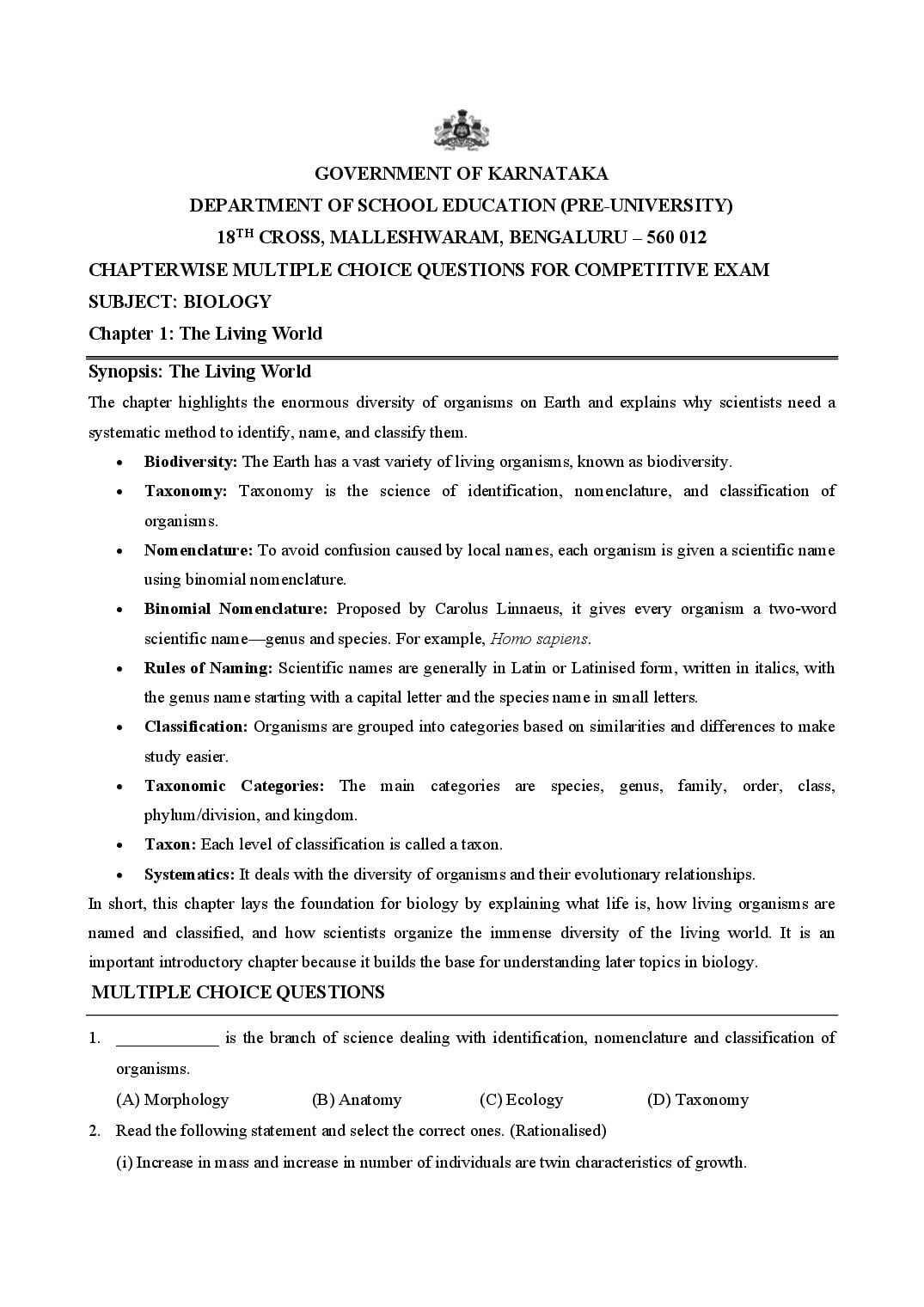
DEPARTMENT OF SCHOOL EDUCATION (PRE-UNIVERSITY)
18TH CROSS, MALLESHWARAM, BENGALURU – 560 012
CHAPTERWISE MULTIPLE CHOICE QUESTIONS FOR COMPETITIVE EXAM
SUBJECT: BIOLOGY
Chapter 1: The Living World
Synopsis: The Living World
The chapter highlights the enormous diversity of organisms on Earth and explains why scientists need a
systematic method to identify, name, and classify them.
• Biodiversity: The Earth has a vast variety of living organisms, known as biodiversity.
• Taxonomy: Taxonomy is the science of identification, nomenclature, and classification of
organisms.
• Nomenclature: To avoid confusion caused by local names, each organism is given a scientific name
using binomial nomenclature.
• Binomial Nomenclature: Proposed by Carolus Linnaeus, it gives every organism a two-word
scientific name—genus and species. For example, Homo sapiens.
• Rules of Naming: Scientific names are generally in Latin or Latinised form, written in italics, with
the genus name starting with a capital letter and the species name in small letters.
• Classification: Organisms are grouped into categories based on similarities and differences to make
study easier.
• Taxonomic Categories: The main categories are species, genus, family, order, class,
phylum/division, and kingdom.
• Taxon: Each level of classification is called a taxon.
• Systematics: It deals with the diversity of organisms and their evolutionary relationships.
In short, this chapter lays the foundation for biology by explaining what life is, how living organisms are
named and classified, and how scientists organize the immense diversity of the living world. It is an
important introductory chapter because it builds the base for understanding later topics in biology.
MULTIPLE CHOICE QUESTIONS
1. ____________ is the branch of science dealing with identification, nomenclature and classification of
organisms.
(A) Morphology (B) Anatomy (C) Ecology (D) Taxonomy
2. Read the following statement and select the correct ones. (Rationalised)
(i) Increase in mass and increase in number of individuals are twin characteristics of growth.
Page 2
(iii) ‘Response to stimuli’ is a defining property of living organisms.
(A) (i) and (ii) (B) (ii) and (iii) (C) (i) and (iii) (D) (i), (ii) and (iii)
3. Which of the following statements is not correct?
(A) Biodiversity is the occurrence of variety of life forms differing in morphology, anatomy, habitats and
habits.
(B) Systematics is the branch of Biology that deals with cataloguing plants, animals and other organisms
into categories that can be named, remembered, compared and studied.
(C) Classification is the branch of Biology that deals with principles and procedures of identification and
nomenclature of organisms.
(D) None of these
4. In a taxonomic hierarchy, family is interpolated between
(A) Kingdom and Class (B) Class and Order (C) Order and Genus (D) Class and Genus
5. Select the correctly written botanical/zoological name.
(A) Homo Sapiens (B) Panthera tigris
(C) Pisum Sativum (D) MANGIFERA INDICA
6. The given flowchart represents the hierarchy of various taxonomic categories.
Identify the missing categories (i), (ii) and (iii) and select the correct statements
regarding these.
(i) A is the taxonomic category which contains a number of related genera.
(ii) Examples of category B are Monocotyledoneae, Dicotyledoneae, Mammalia, etc.
(iii) C represents the basic unit of taxonomic hierarchy.
(iv) Examples of category C are Fungi, Monera, Protista, etc.
(A) (i) and (ii) (B) (iii) and (iv)
(C) (i), (ii) and (iv) (D) (i), (ii), (iii) and (iv)
7. Floral features are commonly used commonly used for identification of angiosperms
because
(A) reproductive parts are more conservative (B) flowers can be safely preserved
(C) flowers are nice to work with (D) flowers have various colours and scents.
8. Which one of the following has least similar characters?
(A) Family (B) Class (C) Genus (D) Species
9. The ascending or descending arrangement of taxonomic categories is called as
(A) Classification (B) Taxonomy (C) Hierarchy (D) Key
10. Select the correct classification for the given plant.
Page 3
(A) Plantae Angiospermae Asterales Asteraceae
(B) Angiospermae Dicotyledonae Asterales Asteraceae
(C) Angiospermae Dicotyledonae Polymoniales Compositae
(D) Dicotyledonae Asteraceae Asterales Compositae
11. First step in taxonomy is
(A) description of the organism (B) identification of the organism
(C) nomenclature of the organism (D) classification of the organism
12. What of the following represent the correct sequence of various taxonomic categories?
(A) Class-Phylum-Tribe-Order-Family-Genus-Species
(B) Division-Class-Family-tribe-Order-genus-Species
(C) Division-Class-order-Family-Tribe-Genus-Species
(D) Phylum-order-Class-tribe-Family-genus-Species
13. Nomenclature is governed by certain universal rules. Which one of the following is contrary of the rules
of nomenclature?
(A) The first word in a biological name represents the genus name and the second is a specific epithet
(B) The names are written in Latin and are ltalicised
(C) When written by hand, the names are to be underlined
(D) Biological names can be written in any language
14. Study the four statements (I – IV) given below and select the two correct ones out of them.
I. Definition of biological species was given by Ernst Mayr.
II. Photoperiod does not affect reproduction in plants
III. Binomial nomenclature system was given by RH Whittaker
IV. In unicellular organisms, reproduction is synonymous with growth
The two correct statements are
(A) II and III (B) III and IV (C) I and IV (D) I and II
15. Read the statements given below and identify the incorrect statement
(A) Scientific names favour multiple naming for an organism
(B) Scientific names are used all over the world
(C) Scientific names are often descriptive and tell us some important character of an organism
(D) Scientific names indicate relationship between species
16. The term ‘New Syqtematics’ was given by
(A) Julian Huxley (B) Bateson (C) Linneaeus (D) Darwin
Page 4
(A) the relationship between sub-species and species
(B) relationship between two most forward races
(C) relationship between endangered and surviving species
(D) method of classification that attempt to interfere phylogenetic relationship
18. ‘Systema Naturae’ was written by
(A) Ernest Mayr (B) Carolus Linnaeus
(C) RH Whittaker (D) WM Stanley
19. ICBN stands for
(A) Indian Congress of Biological Name (B) International code of Botanical Nomenclature
(C) International Congress of Biological Name (D) Indian Code of Botanical Nomenclature
20. Read the following statements about growth in plants and choose the correct option from the cods given
below
I. In higher animals and plants, growth and reproduction are mutually exclusive
II. Internal growth in living organisms is known as accretion
III. Chemically growth is a result of difference between anabolism and catabolism
IV. Degrowth or negative growth can occur when anabolism exceeds catabolism
(A) II and IV are correct (B) I and II are correct
(C) I and III are correct (D) II and III are correct
21. Nomenclature given by Linnaeus is
(A) binomial (B) trinomial (C) phylogenetic (D) natural
22. Among the following which one is the defining property of living organisms?
(A) Reproduction (B) Growth
(C) Consciousness (D) Death
23. Match the following columns and choose the correct option from the codes given below
Column I Column II
(a) Theophrastus 1 Historia Naturalis
(b) Pliny the Elder 2 Systema Naturae
(c) John Ray 3 Historia Plantarum
(d) Linnaeus 4 Historia Generalis Plantarum
Codes
Page 5
(A) 4 2 3 4
(B) 3 1 4 2
(C) 4 3 2 1
(D) 3 4 1 2
24. Scientific names are either derived from Latin languages or are latinised because
(A) Other languages do not possess a different and specific name
(B) Linnaeus used Latin language and this tradition is followed till date
(C) Latin names comparatively look more scientific
(D) Latin is a dead language therefore it will not change in form or spellings with the passage of time
25. Another name of new systematic is
(A) population systematics (B) classical systematics
(C) biosystematics (D) Both (A) and (C)
26. Read the following statements about the advantages of scientific names and choose the incorrect option
I. Every species has a single and specific name consisting of two words
II. The names are of universal application for all the countries and the languages
III. The spelling of generic name never changes, but that of specific name can change as it is derived
from the dead Latin language
IV. The names are very specific and does not indicate any relationship of a species with others present in
the same genus.
(A) III and IV (B) I and IV (C) II and III (D) II and IV
27. Which scientific name is correctly written?
(A) Mangifera Indica (B) Mangifera indica
(C) mangifera indica (D) mangifera Indica
28. The label of a herbarium sheet does not carry information on
(A) date of collection (B) name of collector (C) local names (D) height of the plant
29. Which one of the following is not a correct statements?
(A) Herbarium houses dried, pressed and preserved plant specimens
(B) Botanical gardens have collection of living plants for reference
(C) A museum has collection of photographs of plants and animals
(D) Key is taxonomic aid for the identification of specimens
30. The term ‘Taxonomy’ was introduced by
(A) de Candolle (B) Bentham and Hooker
Page 6
31. Which one of the taxonomic acids can give comprehensive account of complete compiled information of
any one genus or family at a particular time?
(A) Taxonomic key (B) Flora
(C) Herbarium (D) Monograph
32. Select the incorrect statements
I. Lower the taxon, more are the characteristics that the members within the taxon share
II. Order is the assemblage of genera which exhibit a few similar characters
III. Cat and dog are included in the same family- Felidae
IV. Binomial nomenclature was introduced by Carolus Linnaeus
(A) I, II and III (B) II, III and IV (C) I and IV (D) II and III
33. Which of the following taxonomic ranks contain organisms most similar to one another?
(A) Class (B) Genus (C) Family (D) Species
34. National Botanical Research Institute is situated at (Rationalized)
(A) Lucknow (B) Kolkata (C) Mumbai (D) Chennai
35. Taxonomic hierarchy refers to
(A) the step-wise arrangement of all categories for classification of plants and animals
(B) a group of senior taxonomists, who decide the nomenclature of plants and animals
(C) a list of botanists or zoologists, who have worked on taxonomy of a species or group
(D) classification of a species based on fossil records
36. The taxonomic category showing correct hierarchical arrangement in ascending order is
(A) Kingdom → Order → Division → Class → Genus → Species
(B) Species → Genus → Division → Class → Order → Kingdom
(C) Kingdom → Division → Class → Order → Family → Genus → Species
(D) Species → Genus → Family → Order → Class → Division → Kingdom
37. The largest collection of herbarium in India is (beyond the scope of the chapter)
(A) General National Herbarium, Kolkata (B) Southern Circle Herbarium, Coimbatore
(C) Central Circle herbarium, Allahabad (D) Blatter Herbarium, Mumbai
38. Taxon is a
(A) group of same species (B) any rank in taxonomic hierarchy
(C) group of similar genera (D) sub- division of kingdom
Page 7
(Rationalised)
Column I Column II
(a) Flora 1 Contains list of all species of a particular place
(b) Monograph 2 Contains information about habitat, seasonal changes and
plants of a specific area
(c) Catalogue 3 Contains list of characters and their alternates
(d) Key 4 Contains information about a particular taxon
Codes
(a) (b) (c) (d)
(A) 3 1 4 2
(B) 1 2 2 4
(C) 2 4 1 3
(D) 2 4 3 1
40. Read the following statements about taxonomic categories and choose the correct option
I. Correlated characters the those similar features which are used in delimitation of a taxon above the
rank of species.
II. In order tom make taxonomic position of species more precise, intermediate categories have been
added to the list of obligate categories
III. The taxon represents an abstract term while category represents the real organisms
IV. The number of similar characters of categories increases form lowest rank to high rank
(A) I and III (B) I and II (C) III and IV (D) II and III
41. Herbarium is a place where dried and pressed plant specimens, mounted on sheets are kept
systematically according to a widely accepted system of classification. Herbarium (Rationalised)
(A) provides information only about the local flora
(B) is used for correct and authentic identification of unknown plants
(C) provides information about the ecology of different places
(D) Both (B) and (C)
42. Match the following columns and choose the correct option from the codes given below (Beyond the
scope of the chapter)
Column I Column II
(a) Royal Botanical Gardens 1 Boston, USA
Page 8
(c) Lloyed Botanical Garden 3 Moscow
(d) Main Botanical Garden 4 Darjeeling
Codes
(a) (b) (c) (d)
(A) 1 2 4 3
(B) 2 1 4 3
(C) 3 4 2 1
(D) 1 2 3 4
Practice questions
1. As we go from species to kingdom in a taxonomic hierarchy, the number of common characteristics
(A) Will decrease (B) Will increase
(C) Remain same (D) May increase or decrease
2. Which of the following ‘suffixes’ used for units of classification in plants indicates a taxonomic category
of ‘family’
(A) − Ales (B) − Onae (C) − Aceae (D) − Ae
3. The term ‘systematics’ refers to:
(A) Identification and classification of plant and animals
(B) Nomenclature and identification of plants and animals
(C) Diversity of kinds of organisms and their relationship
(D) Different kinds of organisms and their classification
4. Genus represents
(A) An individual plant or animal
(B) A collection of plants or animals
(C) Group of closely related species of plants or animals
(D) none of these
5. The taxonomic unit ‘Phylum’ in the classification of animals is equivalent to which hierarchial level in
classification of plants
(A) Class (B) Order (C) Division (D) Family
6. Botanical gardens and zoological parks have
(A) Collection of endemic living species only (B) collection of exotic living species only
(C) Collection of endemic and exotic living species (D) Collection of only local plants and animals
Page 9
animals. It is used in the preparation of (Rationalised)
(A) Monographs (B) Flora (C) Both (A) and (B) (D) None of these
8. All living organisms are linked to one another because (Rationalised)
(A) They have common genetic material of the same type
(B) They share common genetic material but to varying degrees
(C) All have common cellular organization
(D) All of above
9. Which of the following is a defining characteristic of living organisms? (Rationalised)
(A) Growth (B) Ability to make sound
(C) Reproduction (D) Response to external stimuli
10. Match the following and choose the correct option:
Column I Column II
(a) Family (i) Tuberosum
(b) Kingdom (ii) Polymoniales
(c) Order (iii) Solanum
(d) Species (iv) Plantae
(e) Genus (v) Solanacea
Options:
(A) (i) → (d); (ii) → (c); (iii) → (e); (iv) → (b); (v) → (a)
(B) (i) → (e); (ii) → (d); (iii) → (b); (iv) → (a); (v) → (c)
(C) (i) → (d); (ii) → (e); (iii) → (b); (iv) → (a); (v) → (a)
(D) (i) → (e); (ii) → (c); (iii) → (b); (iv) → (a); (v) → (d)
11. The most important feature of all living system is to
(A) utilize oxygen to generate energy (B)replicate the genetic information
(C) produce gametes. (D) utilize solar energy for metabolic activities
12. First life on earth was
(A) cyanobacteia (B) chemoheterotrophs
(C) autotrophs (D) photoautotrophs
13. Which of the following is not true for a species?
(A) Members of a species can interbreed.
(B) Gene flow does not occur between the populations of a species.
Page 10
(D) Variations occur among members of a species.
14. Classification given by Bentham and Hooker is
(A) artificial (B) natural (C) phylogenetic (D) numerical
15. Basic unit or smallest taxon of taxonomy/ classification is
(A) species (B) kingdom (C) family (D) variety
16. A taxon is a
(A) group of related families. (B) group of related species
(C) type of living organisms (D) taxonomic group of any tanking
17. An important criterion for modern day classification is
(A) resemblances in morphology (B) anatomical and physiological traits
(C) breeding habits (D) presence or absence of notochord.
18. The term phylum was given by
(A) Cuvier (B) Haeckel (C) Theophrastus (D) Linnaeus
19. Sequence of taxonomic categories is
(A) Class – Phylum – Tribe – Order – Family – Genus – Species
(B) Division – Class – Family – Tribe – Order – Genus – Species
(C) Division – Class – Order – Family – Tribe – Genus – Species
(D) Phylum – Order – Class – Tribe – Family – Genus – Species
20. Binomial nomenclature means
(A) One name given by two scientists
(B) One scientific name consisting of a generic and specific epithet
(C) Tow names, one latinised, other of a person
(D) Two names of same plant.
21. Linnaeus is credited with
(A) binomial nomenclature (B) theory of biogenesis
(C) discovery of microscope (D) discovery of blood circulation
22. Species is
(A) unit of classification (B) unit in the evolutionary history of a free
(C) specific class of evolution (D) not related to evolution.
23. Taxonomy without phylogeny is similar to bones without flesh” is the statement of
(A) Oswald Tippo (B) John Hutchinson
(C) Takhtajan (D) Bentham and Hooker
Page 11
(A) explain the origin of living organisms
(B) trace the evolution of living organisms
(C) name of the living organisms
(D) facilitate identification of unknown organisms
25. The book ‘Genera Plantarum’ was written by
(A) Bessy (B) Hutchinson (C) Engler and Prantl (D) Bentham and Hooker
26. Which of the following is less general in characters as compared to genus?
(A) Species (B) Division (C) Class (D) Family
27. Genus is a group of similar and related
(A) order (B) genera (C) families (D) species
28. Founder of “Taxonaomy” is
(A) Aristotle (B) John Ray (C) Haeckel (D) Linnaeus
29. Which one of the following is the species?
(A) Carnivora (B) Canis (C) Familiaris (D) Canis familiaris
30. Naming of which of the following is incorrect?
(A) Apis indica (B) Trypanosoma gambiense
(C) Ficus Bengalensis (D) Mangifera indica
31. Which of the following covers the largest number of organisms?
(A) Genus (B) Family (C) Phylum (D) Class
32. Which one of the following statement is correct regarding ‘L’ in the scientific name of Mangifera indica
L.?
(A) Letter L. signifies latin language
(B) The name is reverse with Indica preceeding mangifera
(C) Latter L. signifies taxonaomist Linnaeus
(D) Letter L. is superfluous
33. A species is defined as “the group of actually or potentially inter –breeding natural population producing
fertile offspring and reproductively isolated from such other groups”. The above statement is given by
(A) Carolus Linnaeus (B) Mayr (C) J. B. Lamarck (D) Charles Darwin
34. Specimen used for original publication by the author is
(A) holotype (B) isotype (C) syntype (D) lactotype
35. The complete name of a plant in binomial nomenclature has
Page 12
(C) five parts (words) (D) one part (word)
36. The term ‘New systematics’ was introduced by
(A) Adolf Engler (B) Karl Prantl (C) George Bentham (D) Julian Huxley
37. Biosystematics aims at
(A) identification and arrangement of organisms on the basis of their cytological characters.
(B) the classification of organisms based on broad morphological characters.
(C) delimiting various taxa of organisms and establishing their relationships.
(D) the classification of organisms based on their evolutionary history and establishing their phylogeny
on the totality of various parameters from all fields of studies.
38. In a hierarchical system of plant classification, which one of the following taxonomic ranks generally
ends ‘ceae’?
(A) Family (B) Genus (C) Order (D) Class
39. Branch connected with nomenclature, identification and classification is called
(A) ecology (B) taxonomy (C) morphology (D) physiology
40. The science of naming the plant is known as
(A) classification (B) identity (C) nomenclature (D) taxonomy
Guidance Keys
1. (D) 8. (B) 15. (A) 22. (C) 29. (C) 36. (D)
2. (D) 9. (C) 16. (A) 23. (B) 30. (A) 37. (A)
3. (C) 10. (B) 17. (D) 24. (D) 31. (D) 38. (B)
4. (C) 11. (B) 18. (B) 25. (D) 32. (D) 39. (C)
5. (B) 12. (C) 19. (B) 26. (A) 33. (D) 40. (B)
6. (C) 13. (D) 20. (C) 27. (B) 34. (A) 41. (D)
7. (A) 14. (C) 21. (A) 28. (D) 35. (A) 42. (B)
Practice Keys
1. (A) 3. (C) 5. (C) 7. (C) 9. (D) 11. (A) 13. (B) 15. (A)
2. (C) 4. (C) 6. (C) 8. (D) 10. (A) 12. (B) 14. (B) 16. (C)
Page 13
18. (A) 21. (A) 24. (D) 27. (D) 30. (C) 33. (B) 36. (D) 39. (B)
19. (C) 22. (A) 25. (D) 28. (A) 31. (C) 34. (A) 37. (D) 40. (C)
Document Details
| Board / Org | Karnataka Board |
| Exam | Class 11 |
| Type | Question Bank |
| Pages | 13 |
| Updated | 24 Sep 2026 |