Karnataka 1st PUC Chemistry Chemical Bonding MCQ with Answers
Finished viewing? Save it for later —
Download Karnataka 1st PUC Chemistry Chemical Bonding MCQ with Answers (PDF · 9 pages)About Karnataka 1st PUC Chemistry Chemical Bonding MCQ with Answers
Karnataka 1st PUC Chemistry Chemical Bonding MCQ with Answers is available here for free download. Published by Karnataka Board for Class 11, this question bank can be viewed online or downloaded as a PDF (9 pages). Candidates preparing for Class 11 can use Karnataka 1st PUC Chemistry Chemical Bonding MCQ with Answers to understand the exam pattern, the type of questions asked, and the overall difficulty level.
Frequently Asked Questions
How can I download Karnataka 1st PUC Chemistry Chemical Bonding MCQ with Answers?
Open this page and click the Download button to save Karnataka 1st PUC Chemistry Chemical Bonding MCQ with Answers as a PDF. It is completely free on AglaSem Docs.
Is Karnataka 1st PUC Chemistry Chemical Bonding MCQ with Answers free to download?
Yes. Karnataka 1st PUC Chemistry Chemical Bonding MCQ with Answers can be viewed online and downloaded as a PDF free of cost on AglaSem Docs.
How many pages does Karnataka 1st PUC Chemistry Chemical Bonding MCQ with Answers have?
Karnataka 1st PUC Chemistry Chemical Bonding MCQ with Answers contains 9 pages, which you can read online or download together as a single PDF.
Where can I find more Class 11 study material?
You can find more Class 11 question papers, sample papers, syllabus, and answer keys on AglaSem Docs.
Karnataka 1st PUC Chemistry Chemical Bonding MCQ with Answers – Text
Read the full text of this question bank below — useful to quickly search, copy and reference the content online without downloading the PDF.
📄 View text version (9 pages)
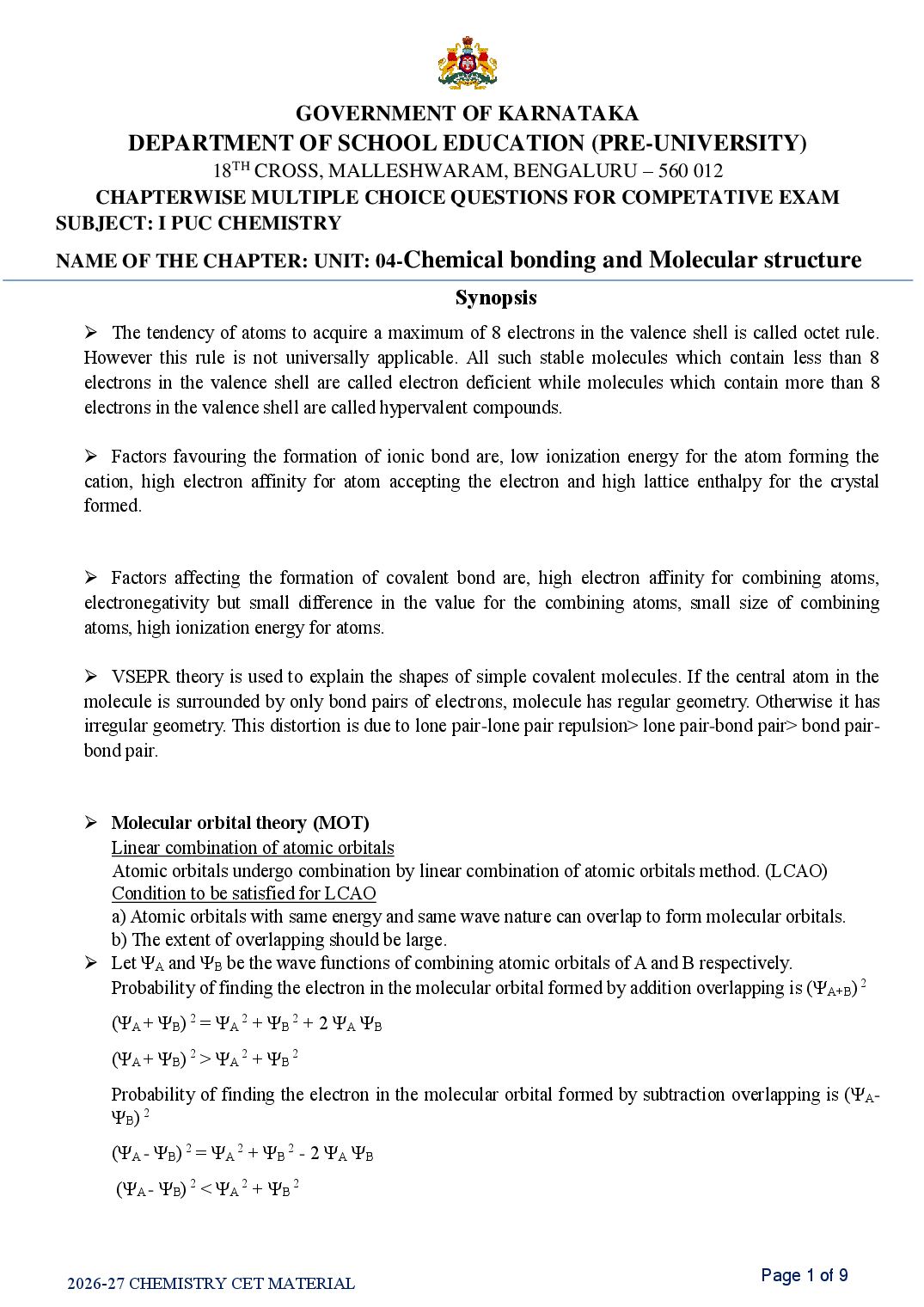
Page 1
DEPARTMENT OF SCHOOL EDUCATION (PRE-UNIVERSITY)
18TH CROSS, MALLESHWARAM, BENGALURU – 560 012
CHAPTERWISE MULTIPLE CHOICE QUESTIONS FOR COMPETATIVE EXAM
SUBJECT: I PUC CHEMISTRY
NAME OF THE CHAPTER: UNIT: 04-Chemical bonding and Molecular structure
Synopsis
➢ The tendency of atoms to acquire a maximum of 8 electrons in the valence shell is called octet rule.
However this rule is not universally applicable. All such stable molecules which contain less than 8
electrons in the valence shell are called electron deficient while molecules which contain more than 8
electrons in the valence shell are called hypervalent compounds.
➢ Factors favouring the formation of ionic bond are, low ionization energy for the atom forming the
cation, high electron affinity for atom accepting the electron and high lattice enthalpy for the crystal
formed.
➢ Factors affecting the formation of covalent bond are, high electron affinity for combining atoms,
electronegativity but small difference in the value for the combining atoms, small size of combining
atoms, high ionization energy for atoms.
➢ VSEPR theory is used to explain the shapes of simple covalent molecules. If the central atom in the
molecule is surrounded by only bond pairs of electrons, molecule has regular geometry. Otherwise it has
irregular geometry. This distortion is due to lone pair-lone pair repulsion> lone pair-bond pair> bond pair-
bond pair.
➢ Molecular orbital theory (MOT)
Linear combination of atomic orbitals
Atomic orbitals undergo combination by linear combination of atomic orbitals method. (LCAO)
Condition to be satisfied for LCAO
a) Atomic orbitals with same energy and same wave nature can overlap to form molecular orbitals.
b) The extent of overlapping should be large.
➢ Let ΨA and ΨB be the wave functions of combining atomic orbitals of A and B respectively.
Probability of finding the electron in the molecular orbital formed by addition overlapping is (ΨA+B) 2
(ΨA + ΨB) 2 = ΨA 2 + ΨB 2 + 2 ΨA ΨB
(ΨA + ΨB) 2 > ΨA 2 + ΨB 2
Probability of finding the electron in the molecular orbital formed by subtraction overlapping is (ΨA-
ΨB ) 2
(ΨA - ΨB) 2 = ΨA 2 + ΨB 2 - 2 ΨA ΨB
(ΨA - ΨB) 2 < ΨA 2 + ΨB 2
2026-27 CHEMISTRY CET MATERIAL Page 1 of 9
Page 2
orbital. The molecule is quite different from the combining atomic orbitals. Molecule is polycentric.
Electron moves in the field of more than one nucleus. Electrons are delocalized.
➢ Bonding molecular orbital has lesser energy than the anti-bonding molecular orbital.
➢ Molecular orbitals are filled in accordance with Aufbau principle, Pauli’s Exclusion principle and
Hund’s rule of maximum multiplicity.
➢ Bond order = ½ (No. of e- in BMO - No. of e- in ABMO)
➢ 1. Molecule is stable if the value of bond order is positive. It is unstable if the value is zero or
negative.
2. Stability molecule is directly proportional to bond order.
➢ Order of filling of molecular orbitals is
σ1s< σ*1s< σ2s< σ*2s< σ2pz< ∏2px = ∏2py< ∏*2px = ∏*2py < σ*2pz
➢ Hydrogen bond is an attractive between hydrogen atom and highly electronegative atoms like N or O
or F belonging to the same or different molecule. It is weaker than covalent bond.
4.1 Kossel-Lewis approach to chemical bonding
1. According to Lewis, the nucleus plus the inner electrons of an atom refer to
(a) Kernel (b) valence shell
(c) non bonded electrons (d) lone pair of electrons
2. The bond formed as a result of the electrostatic attraction between the positive and negative ions was
termed as the
(a) covalent bond (b) metallic bond
(c) coordinate bond (d) electrovalent bond
3. Kossel assigned electrovalence to ions. Calcium is assigned
(a) positive electrovalence of one (b) positive electrovalence of two
(c) negative electrovalence of two (d) negative electrovalence of one.
4. In the Lewis dot structure of water, duplet and octet of electrons are attained respectively by the atoms
(a) O and O (b) O and H
(c) H and O (d) H and H
5. Read the following statements and select the correct option from the choices given:
Statement I : The total number of electrons required for writing the Lewis dot structure are obtained by
adding the valence electrons of the combining atoms.
Statement II : In general , the least electronegative atom occupies the central position in the molecule.
(a) statements I and II are correct
(b) statements I and II are incorrect
(c) statement I is correct and statement II is incorrect
(d) statement I is incorrect and statement II is correct.
6. Which of the following atom attains the electronic configuration of helium in the compounds mentioned
with it?
(a) O in H2O (b) H in H2O
(c) N in NH3 (d) Cl in HCl
7. The total number of lone pair of electrons in the Lewis dot structure of carbon monoxide is
2026-27 CHEMISTRY CET MATERIAL Page 2 of 9
Page 3
(c) three pairs (d) four pairs.
8. The formal charge on central oxygen atom in ozone is
(a) 0 (b) +2
(c) +1 (d) -1 (KCET 2020)
9. The difference between the number of valence electrons and of the atom in an isolated state and the
number of electrons assigned to that atom in the Lewis structure of a polyatomic molecule or ion is
(a) anionic charge (b) cationic charge
(c) formal charge (d) number of atoms
10. In which of the following compounds the central atom fails to satisfy the octet rule?
(a) BCl3 (b) H2O
(c) NH3 (d) CH4
11. The compound without expanded octet for the central atom is
(a) PF5 (b) SF6
(c) H2SO4 (d) CH4
12. Which of the following is TRUE for the octet rule?
(a) it explains the shape of molecules
(b) it explains the relative stability of the molecules
(c) it explains the structures of most of the organic compounds
(d) it is applicable to molecules with an odd number of electrons.
13. The electronic configuration of X and Y are given below:
X : 1s2 2s2 2p6 3s2 3p3
Y : 1s2 2s2 2p6 3s2 3p5
Which of the following is the correct molecular formula and the type of bond formed between X and Y?
(a) X3Y, ionic bond (b) X2Y3, coordinate bond
(c) XY3 , covalent bond (d) X2Y, covalent bond. (KCET 2025)
14. With respect to resonance structures of CO32- ion, which of the following statements are correct?
A) AllC-O bonds in CO32- are equivalent
B) There are three resonance structures possible for CO32- ion.
C) The position of carbon and oxygen should change in every resonance structure.
D) The formal charge on carbon atom is -2.
(a) A, B and C (b) A and B only
(c) B and D only (d) A, B and D . (KCET 2026)
4.2 ionic or electrovalent bond:
15. The type of bond which is formed easily between elements with comparatively low ionization enthalpy
and elements with comparatively high negative value of electron gain enthalpy is
2026-27 CHEMISTRY CET MATERIAL Page 3 of 9
Page 4
(c) coordinate bond (d) covalent bond
16. The stability of an ionic compound is mainly provided by its
(a) octet of electrons (b) ionization enthalpy
(c) electron gain enthalpy (d) enthalpy of lattice
17. The lattice enthalpy of NaCl is 788 kJ mol-1. The quantity of energy required to separate half mole of solid
NaCl into half mole of gaseous sodium ions and half mole of gaseous chloride ions to an infinite distance
is
(a) 1576 kJ (b) 3940 kJ
(c) 394 kJ (d) 788 kJ.
18. HCl gas is covalent and NaCl is an ionic compound . This is because
(a) sodium is highly electropositive
(b) hydrogen is a non-metal
(c) HCl is a gas
(d) electronegativity difference between H and Cl is less than 2.1. (KCET 2016)
4.3 Bond parameters:
19. Which of the following is a correct statement?
(a) In a covalent molecule of the type AB, bond length is the average of covalent radii of atoms A and B.
(b) Bond length can be measured by spectroscopic, X-ray diffraction and electron diffraction techniques.
(c) H-H bond length in H2 is greater than that of F-F bond length in F2.
(d) H-O-H bond angle in water is 1800.
20. The unit of bond enthalpy is
(a) kJ mol (b) kJmol-1.
(c) kJ mol3 (d) kJ mol2
21. Read the following statements and select the correct option from the given choices:
Statement-I : Larger the bond dissociation enthalpy, stronger will be the bond in the molecule.
Statement II : In water molecule, the enthalpy required to break the two O-H bonds is the same.
(a) statements I and II are correct
(b) statements I and II are incorrect
(c) statement I is correct and statement II is incorrect
(d) statement I is incorrect and statement II is correct
22. F2 and 𝑂22− are isoelectronic. They have the same
(a) bond angle (b) bond order
(c) bond length (d) number of protons
23. Experimentally determined oxygen-oxygen bond lengths in ozone are same. This indicates,
(a) structure of ozone is best represented by the resonance hybrid of the two canonical structures.
2026-27 CHEMISTRY CET MATERIAL Page 4 of 9
Page 5
(c) canonical structures are the best structures for ozone.
(d) oxygen – oxygen bonds are single bonds.
24. Which of the following cannot be represented by resonance structures?
(a) carbonate ion (b) ozone
(c) carbon dioxide (d) Hydrogen chloride
25. The number of canonical forms in carbonate ion is
(a) 1 (b) 2
(c) 0 (d) 3
26. Which of the following is correct with respect to the property mentioned with it?
(a) energy: O3 resonance hybrid < canonical form of O3
(b) bond length : HI < HF
(c) bond enthalpy : O2 > N2
(d) bond order : O2 > N2
27. The product of the magnitude of the charge and the distance between centres of positive and negative
charge in a bond is called
(a) magnetic moment (b) dipole moment
(c) bond length (d) bond enthalpy
28. For a non-polar molecule, the net dipole moment is equal to
(a) 1 (b) zero
(c) 1.5 (d) 2.3
29. Which one of the following is not same for NH3 and NF3 molecules?
(a) shape (b) number of covalent bonds
(c) resultant dipole moment (d) central atom
30. The covalent character of a bond is increased when
(a) the size of cation is large (b) the size of anion is small
(c) the charge on cation is large (d) the charge on cation is small
31. Which has maximum covalent character?
(a) LiF (b) LiCl
(c) LiI (d) LiBr.
32. Match List-I with List-II and select the correct option:
List-I (Molecule /ion) List-II (Bond order)
1. NO i. 1.5
2. CO ii. 2.0
3. 𝑂2− iii. 2.5
4. O2 iv. 3.0
(a) 1-iii, 2-iv, 3-i , 4-ii (b) 1-i, 2-iv, 3-iii , 4-ii
(c) 1-ii, 2-iii, 3-iv , 4-i (d) 1-iv, 2-iii, 3-ii , 4-i. (KCET 2025)
2026-27 CHEMISTRY CET MATERIAL Page 5 of 9
Page 6
(a) bond length of O2 < bond length of O22- (b) bond length of O2 > bond length of O22-
(c) bond length of O2 > bond length of O22+ (d) bond length of O2 + < bond length of O22-
34. Which of the following possess net dipole moment?
(a) SO2 (b) BF3
(c) BeCl2 (d) CO2 (KCET 2019)
4.4 Valence shell electron pair repulsion theory:
35. According to VSEPR theory, the correct order of repulsive interaction of electron pairs : lone pair (lp)-
lone pair (lp), lone pair (lp)-bond pair (bp) and bond pair(bp)-bond pair(bp) is
(a) bp-bp > lp-bp >lp-lp (b) lp-lp >bp-bp > lp-bp
(c) lp-lp > lp-bp >bp-bp (d) lp-lp > bp-bp >lp-bp
36. Which of the following is a correct match with respect to the shape of the molecule?
(a) H2O - linear (b) BeCl2 - linear
(c) CH4 - pyramidal (d) NH3 – trigonal planar
37. The central atom of a molecule has four bonding pair of electrons and one lone pair of electrons. Predicted
geometry of the molecule is
(a) see saw (b) T-shape
(c) square planar (d) square pyramidal
38. ‘A’ is the central atom, ‘B’ is the atom bonded to ‘A’. E indicates the number of lone pair of electrons. The
molecules of the type AB2E2 and AB3E repectively have the geometry
(a) bent, see saw (b) bent, trigonal pyramidal
(c) trigonal pyramidal, bent (d) T-shape, linear.
39. The type of hybrid orbitals of nitrogen in 𝑁𝑂2+ , 𝑁𝑂3− and 𝑁𝐻4+ are
(a) sp, sp2 and sp3 (b) sp, sp3 and sp2
(c) sp2, sp and sp3 (d) sp2, sp3 and sp. (KCET 2026)
4.5 Valence bond theory:
40. s-s overlapping and s-p overlapping of atomic orbitals results in the formation of
(a) pi bond (b) sigma bond
(c) double bond (d) triple bond.
41. Which of the following is true about a sigma bond?
(a) sigma bond is formed by sideways overlapping of atomic orbitals
(b) sigma bond is always weaker than a pi bond
(c) sigma bond is stronger than pi bond
(d) s-s overlapping of atomic orbitals result in pi bond.
42. Which of the following structure of a molecule is expected to have three bond pairs and one lone pair of
electrons?
(a) trigonal planar (b) tetrahedral
(c) octahedral (d) pyramidal (KCET 2017)
2026-27 CHEMISTRY CET MATERIAL Page 6 of 9
Page 7
43. Which one of the following is not a salient feature of hybridisation?
(a) The hybridised orbitals are always equivalent in energy and shape
(b) The hybrid orbitals are more effective in forming the stable bonds than the pure atomic orbitals
(c) The type of hybridisation indicates the geometry of the molecule
(d) The number of hybrid orbitals is twice the number of atomic orbitals hybridised.
44. The molecule having sp hybridisation is
(a) BCl3 (b) BeCl2
(c) NH3 (d) CH4
45. The number of sp2-sp2 sigma bonds and sp2-s in ethene respectively are
(a) 1 and 3 (b) 4 and 1
(c) 3 and 2 (d) 1 and 4
46. A molecule has square planar geometry. The type of hybridisation is
(a) sp3 (b) sp2
(c) d2sp3 (d) dsp2
47. The number of equatorial and axial P-Cl bonds in PCl5 respectively are
(a) 3 and 2 (b) 2 and 3
(c) 3 and 5 (d) 3 and 1
48. SF6 molecule has
(a) a regular tetrahedral geometry (b) a regular octahedral geometry
(c) a distorted pyramidal geometry (d) a square planar geometry.
49. Which of the following conversion involve change in both hybridisation and shape?
(a) CH4 → C2H6 (b) NH3 → NH4+
(c) BF3 → BF4- (d) H2O → H3O+ (KCET 2015)
50. Hybridised states of carbon in graphite and diamond respectively are
(a) sp, sp3 b) sp3, sp2
(c) sp2, sp2 d) sp2, sp3 (KCET 2013)
51. The pair of compounds having identical shapes for their molecules is
(a) CH4, SF4 b) BCl2, ClF3
(c) XeF2, ZnCl2 d) SO2, CO2 (KCET 2014)
4.7 Molecular orbital theory:
52. The number of molecular orbitals formed by the combination of two atomic orbitals is
(a) 1 (b) 3
(c) 2 (d) 4
53. Antibonding molecular orbitals are formed
(a) by the addition overlapping of atomic orbitals
(b) by the constructive interference of electron waves
(c) by the subtraction overlapping of atomic orbitals
(d) with high electron density between the nuclei of combining atoms.
2026-27 CHEMISTRY CET MATERIAL Page 7 of 9
Page 8
(a) σ*1s (b) σ*2s
(c) σ1s (d) σ*2pz
55. Nb is the number of electrons in bonding molecular orbitls and Na is the number of electrons in the
antibonding molecular orbitals. The molecule is stable if
(a) Nb = Na (b) Nb > Na
(c) Nb < Na (d) Nb - Na = 0
56. Using MOT, compare 𝑂2+ and 𝑂2− species and choose the correct option.
(a) 𝑂2− is less stable
(b) both 𝑂2+ and 𝑂2− are paramagnetic
(c) 𝑂2+ has higher boiling point than 𝑂2−
(d) 𝑂2+ is diamagnetic whereas 𝑂2− is paramagnetic. (KCET 2015)
57. Main axis of diatomic molecule is z. The orbitals px and pz overlap to form
(a) ∏ molecular orbital (b) σ- molecular orbital
(c) δ-molecular orbital (d) no bond is formed. (KCET 2016)
4.8 Bonding in some homonuclear diatomic molecules:
58. Li2 molecule has a bond order of x . The number of unpaired electrons in the molecular orbitals of Li2 is
y. Then x and y respectively are
(a) 0 and 1 (b) 1 and 0
(c) 2 and 2 (d) 2 and 0
59. O2 molecule has unpaired electrons in
(a) σ*2pz orbital (b) σ 2pz orbital
(c) σ 2s orbital (d) ∏*2px and ∏*2py orbitals
60. C2 molecule consists of
(a) two sigma bonds (b) two pi bonds
(c) one sigma and one pi bonds (d) two sigma bonds
61. Which one of the following is paramagnetic?
(a) H2 (b) O2
(c) C2 (d) Li2
62. Arrange the following in the increasing order of their bond order for 𝑂2 , 𝑂2+ 𝑂2− and 𝑂22− .
(a) 𝑂22− , 𝑂2− 𝑂2+ , 𝑂2 . (b) 𝑂2+ , 𝑂2 𝑂2− , 𝑂22− .
(c) 𝑂2 , 𝑂2+ 𝑂2− , 𝑂22− (d) 𝑂22− , 𝑂2− 𝑂2− , 𝑂2+ . (KCET 2016)
63. Which of the following is diamagnetic?
(a) H2+ (b) He2+
(c) O2 (d) N2 (KCET 2013)
64. The number of antibonding electrons present in 𝑂2− molecular ion is
(a) 8 (b) 6
(c) 5 (d) 7 (KCET 2013)
2026-27 CHEMISTRY CET MATERIAL Page 8 of 9
Page 9
(a) O2 : 1σ , 1 ∏ ; C2 : 0σ, 2 ∏ (b) O2 : 0σ , 2 ∏ ; C2 : 2σ, 0 ∏
(c) O2 : 1σ , 1 ∏ ; C2 : 1σ, 1 ∏ (d) O2 : 2σ , 1 ∏ ; C2 : 0σ, 2 ∏ (KCET 2022)
4.9 Hydrogen bonding:
66. The attractive force which binds hydrogen atom of one molecule with the electronegative atom (F or O or
N) of another molecule is called
(a) covalent bond (b) metallic bond
(c) hydrogen bond (d) disulphide bond
67. The incorrect information about hydrogen bond is
(a) hydrogen bond is weaker than covalent bond
(b) the extent of hydrogen bond is maximum in the solid state
(c) the extent of hydrogen bond is maximum in gaseous state
(d) HF molecules have inter molecular hydrogen bond in them
68. In o-nitrophenol, intra molecular hydrogen bond is present between
(a) O and H atoms (b) N and H atoms
(c) O and N atoms (d) H and C atoms
69. The correct order of boiling point in the following compounds is
(a) HF > H2O > NH3 (b) H2O > HF >NH3
(c) NH3 > H2O > HF (d) NH3 > HF >H2O (KCET 2021)
70. The intermolecular hydrogen bond is present in
(a) phenol (b) o-nitrophenol
(c) p-nitrophenol (d) p-cresol. (KCET 2018)
Answer key
1 2 3 4 5 6 7 8 9 10
a b b c a b a c c a
11 12 13 14 15 16 17 18 19 20
d c c b b d c d b b
21 22 23 24 25 26 27 28 29 30
c b a d d a b b c c
31 32 33 34 35 36 37 38 39 40
c a d a c b a b a b
41 42 43 44 45 46 47 48 49 50
c d d b d d a b c d
51 52 53 54 55 56 57 58 59 60
c c c d b d a b d b
61 62 63 64 65 66 67 68 69 70
b d d d a c c a b c
*************
2026-27 CHEMISTRY CET MATERIAL Page 9 of 9
Document Details
| Board / Org | Karnataka Board |
| Exam | Class 11 |
| Type | Question Bank |
| Pages | 9 |
| Updated | 24 Sep 2026 |