Karnataka 1st PUC Chemistry Equilibrium MCQ with Answers
Finished viewing? Save it for later —
Download Karnataka 1st PUC Chemistry Equilibrium MCQ with Answers (PDF · 14 pages)About Karnataka 1st PUC Chemistry Equilibrium MCQ with Answers
Karnataka 1st PUC Chemistry Equilibrium MCQ with Answers is available here for free download. Published by Karnataka Board for Class 11, this question bank can be viewed online or downloaded as a PDF (14 pages). Candidates preparing for Class 11 can use Karnataka 1st PUC Chemistry Equilibrium MCQ with Answers to understand the exam pattern, the type of questions asked, and the overall difficulty level.
Frequently Asked Questions
How can I download Karnataka 1st PUC Chemistry Equilibrium MCQ with Answers?
Open this page and click the Download button to save Karnataka 1st PUC Chemistry Equilibrium MCQ with Answers as a PDF. It is completely free on AglaSem Docs.
Is Karnataka 1st PUC Chemistry Equilibrium MCQ with Answers free to download?
Yes. Karnataka 1st PUC Chemistry Equilibrium MCQ with Answers can be viewed online and downloaded as a PDF free of cost on AglaSem Docs.
How many pages does Karnataka 1st PUC Chemistry Equilibrium MCQ with Answers have?
Karnataka 1st PUC Chemistry Equilibrium MCQ with Answers contains 14 pages, which you can read online or download together as a single PDF.
Where can I find more Class 11 study material?
You can find more Class 11 question papers, sample papers, syllabus, and answer keys on AglaSem Docs.
Karnataka 1st PUC Chemistry Equilibrium MCQ with Answers – Text
Read the full text of this question bank below — useful to quickly search, copy and reference the content online without downloading the PDF.
📄 View text version (14 pages)
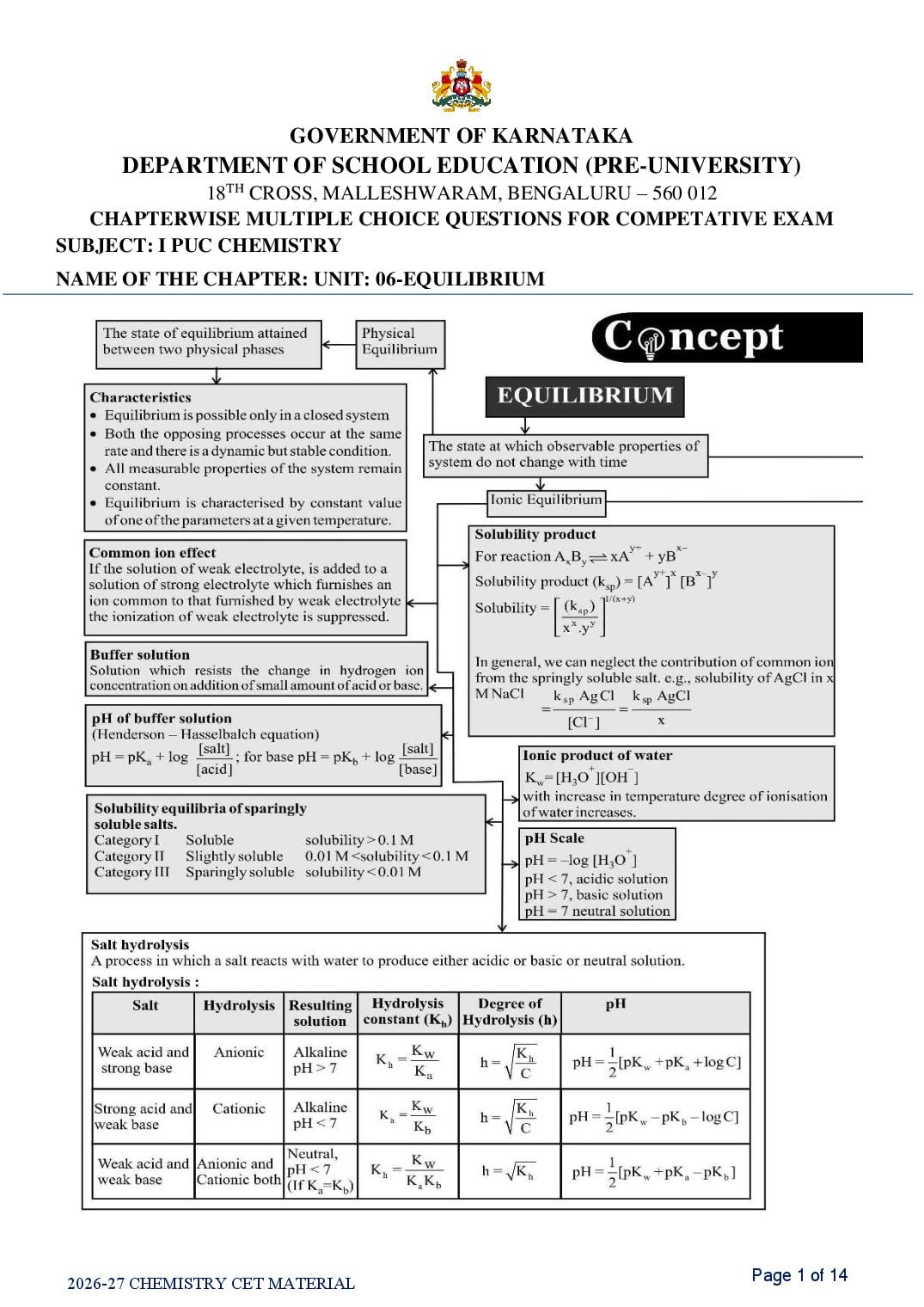
Page 1
DEPARTMENT OF SCHOOL EDUCATION (PRE-UNIVERSITY)
18TH CROSS, MALLESHWARAM, BENGALURU – 560 012
CHAPTERWISE MULTIPLE CHOICE QUESTIONS FOR COMPETATIVE EXAM
SUBJECT: I PUC CHEMISTRY
NAME OF THE CHAPTER: UNIT: 06-EQUILIBRIUM
2026-27 CHEMISTRY CET MATERIAL Page 1 of 14
Page 2
SOLUBILITY PRODUCT (Ksp)
The constant Ksp is known as solubility product. It is equal to the product of the concentration of ions
in saturated solution.
For general electrolyte Ax By
2026-27 CHEMISTRY CET MATERIAL Page 2 of 14
Page 3
Ksp = A + y B− x
Factors Affecting Equilibrium Concentrations: Temperature
• An increase in temperature for exothermic reactions decreases the concentration of products at
Equilibrium and vice-versa.
• An increase in temperature for endothermic reactions increases the concentration of products
at equilibrium and vice-versa.
Pressure
• An increase in pressure to an equilibrium favours the reaction where number of moles show a
decrease and vice-versa.
Effect or pressure (or volume)
MP
The density of one mole of gas is given by D =
RT
Consider dissociation of PCl5. Let x be degree of dissociation
D 1+ x D−d 1
= x = D
d 1 d moles
Where D is the theoretical vapour density and d is observed vapour density at temperature t °C.
1
D = Molecular mass
2
If nx moles of products are formed, then total number of moles after dissociation
1 – x + nx = 1 + x (n – 1)
D 1 + x ( n − 1) D−d
= x =
d 1 d ( n − 1)
Calculation of pH Value of Buffers
Acidic buffer pH = pK a + log
salt
acid
This is known as Henderson's equation
Basic buffer pOH = pK b + log
salt
base
A buffer has maximum buffer capacity when
salt or salt = 1
acid base
Variation of equilibrium constant with variation of the reaction equation (K = equilibrium constant
for original reaction) is given as below:
Moles of acid or a base added to 1 litre of buffer
Buffer capacity =
Change in pH
Calculation of Degree of Dissociation
Let us consider the following reaction:
2026-27 CHEMISTRY CET MATERIAL Page 3 of 14
Page 4
Initial pressure and temperature are P1 and T1. At equilibrium, pressure and temperature are P2 and
T2,
Respectively. The volume of vessel is constant, equal to ‘V’.
Alternate Method:
6.1 EQUILIBRIUM IN PHYSICAL PROCESSES
1. On applying pressure to the equilibrium ice ⇌ water, which phenomenon will happen?
(a) more ice will be formed (b) more water will be formed
(c) equilibrium will not be disturbed (d) Water will evaporate
2. Which one of the following statements does not describe the equilibrium state?
(a) The rate of forward reaction is equal to the rate of the reverse reaction.
(b) Equilibrium is dynamic and there is no net conversion to reactants and products.
(c) The concentration of the reactants is equal to the concentration of the products.
(d) The concentration of the reactants and products reach a constant level.
6.2 EQUILIBRIUM IN CHEMICAL PROCESSES – DYNAMIC EQUILIBRIUM
3. Which statement best describes dynamic equilibrium?
(a) The reaction stops completely. (b) Only forward reaction occurs.
(c) Forward and reverse reactions occur at equal rates. (d) Product concentration becomes zero.
6.3 LAW OF CHEMICAL EQUILIBRIUM AND EQUILIBRIUM CONSTANT
4. As a rule which of the following phases are not included in equilibrium constant expression?
i) pure liquids ii) pure solids iii) aqueous solutions iv) gases
(a) i and iii (b) i and ii
(c) ii and iii (d) i and iv
5. Which of the following statements about the equilibrium constant KP is false?
(a) Total pressures are used in the equilibrium equation in place of molar concentrations
2026-27 CHEMISTRY CET MATERIAL Page 4 of 14
Page 5
(c) Δn = the sum of the coefficients of the gaseous products - the sum of the coefficients of the gaseous
reactants.
(d) the relationship between KP and Kc is: KP = Kc RT Δn
6. One mole of 𝑃𝐶𝑙5 is introduced into a 2 L vessel at equilibrium. 𝑃𝐶𝑙5 (𝑔) ⇌ 𝑃𝐶𝑙3 (𝑔) + 𝐶𝑙2 (𝑔) If degree
of dissociation is 50%, then 𝐾𝑐 is
(a) 0.25 (b) 0.50
(c) 0.125 (d) 1
7. For the reaction N2 (g) + 3H2(g) ⇌ 2NH3(g) , N2 and H2 were taken in molar ratio of 1:3 up to the point of
equilibrium 50% each reactant has been reacted. If total pressure at equilibrium is P. The partial pressure
of ammonia would be-
(a) P/3 (b) P/6
(c) P/4 (d) P/8
8. For the isomerisation reaction: Butane ⇌ Isobutane Kp equals to 25 at 5000C. If the initial pressures
of butane and isobutane are 10 atm and 0.0 atm respectively, what are the pressures of two gases at
equilibrium?
(a) P(butane) = 10atm and P(isobutane) = 0.40atm
(b) P(butane) = 9.8atm and P(isobutane) = 0.38atm
(c) P(butane) = 0.46atm and P(isobutane) = 10atm
(d) P(butane) = 0.38atm and P(isobutane) = 9.6atm
9. In a reaction vessel of 2 litre capacity 3 moles of N2 reacts with 2 moles of O2 to produce 1 mole of
NO. What is the molar concentration of N2 at equilibrium?
(a) 1.25 (b) 1.50
(c) 0.75 (d) 2.0
10. 28g of N2 and 6g of H2 were mixed. At equilibrium 17g of NH3 was produced. The weight of N2 and H2
at equilibrium respectively,
(a) 11g, 0g (b) 1g, 3g
(c) 14g, 3g (d) 11g, 3g
6.4 HOMOGENEOUS EQUILIBRIA
11. In Haber’s process 30 litres of dihydrogen and 30 litres of dinitrogen were taken for reaction which yielded
only 50% of the expected product. What will be the composition of gaseous mixture under the aforesaid
condition in the end?
(a) 20 litres ammonia, 20 litres nitrogen, 20 litres hydrogen
(b) 10 litres ammonia, 25 litres nitrogen, 15 litres hydrogen
(c) 20 litres ammonia, 10 litres nitrogen, 30 litres hydrogen
(d) 20 litres ammonia, 25 litres nitrogen ,15 litre hydrogen
2026-27 CHEMISTRY CET MATERIAL Page 5 of 14
Page 6
(a) Homogeneous equilibrium (b) Heterogeneous equilibrium
(c) Dynamic equilibrium (d) Ionic equilibrium
13. Which of the following represents a homogeneous equilibrium?
(a) CaCO₃(s) ⇌ CaO(s) + CO₂(g) (b) H₂(g) + I₂(g) ⇌ 2HI(g)
(c) AgCl(s) ⇌ Ag⁺(aq) + Cl⁻(aq) (d) NH₄HS(s) ⇌ NH₃(g) + H₂S(g)
6.5 HETEROGENEOUS EQUILIBRIA
14. In a heterogeneous equilibrium, the equilibrium constant expression does not include:
(a) Gases (b) Solutes in solution
(c) Pure solids and pure liquids (d) Aqueous ions
6.6 APPLICATIONS OF EQUILIBRIUM CONSTANTS
15. Nitric oxide reacts with oxygen to form nitrogen dioxide 2NO(g) + O2(g) ⇌ 2NO2(g) . What is Kc for the
reverse reaction if the equilibrium concentration of NO is 0.300M, O2 is 0.200M, and NO2 is 0.530M at
250C?
(a) 0.1584 (b) 6.24
(c) 0.0641 (d) 1.641
16. Given the reaction: 2HI ⇌ H2 + I2
If Kc ′ for the reverse reaction is 1.85 × 10⁻² at 425∘ C, what is Kc for the forward reaction at the same
temperature?
(a) 58.1 (b) 64.2
(c) 54.1 (d) 5.41
17. At a certain temperature, bromine and nitric oxide react to form Nitrosyl bromide:
𝐵𝑟2 (𝑔) + 2NO(𝑔) ⇌ 2NOBr(𝑔) when initial amounts of Br2 , NO and NOBr are mixed the concentration
of NOBr increases which of the statement is true?
(a) Kc = Q
(b) Kc < Q
(c) Kc > Q
(d) More information is needed to make a statement about Kc
18. For a gaseous reaction,
𝐴(𝑔) + 2𝐵(𝑔) ⇌ 𝐶(𝑔), If 𝐾𝑝 = 8 at 500 K, (R = 0.082 L atm mol⁻¹ K⁻¹) then 𝐾𝑐 is
8
(a) 8 (b) 41
8
(c) (41)−2 (d) 328
19. The value of KP for the reaction. 2H2O(g) + 2Cl2(g) ⇌ 4 HCl(g) + O2(g) is 0.03 atm at 427 0C, when the
partial pressures are expressed in atmosphere the the value of Kc for the same reaction is-
(a) 5.23 × 10⁻⁴ (b) 7.34 × 10⁻⁴
(c) 3.2 × 10⁻³ (d) 5.43 × 10⁻⁵
2026-27 CHEMISTRY CET MATERIAL Page 6 of 14
Page 7
ENERGY.
20. For a reaction at 300 K, Δ𝐺 ∘ = −11.4 𝑘𝐽 𝑚𝑜𝑙 −1, (R = 8.314 J mol⁻¹ K⁻¹) The equilibrium constant is
closest to
(a) 10 (b) 50
(c) 100 (d) 1000
6.8 FACTORS AFFECTING EQUILIBRIA
21. Match list I with list II and select the correct option
LIST-I LIST-II
A. Kp > Q i) Non- spontaneous
B. ΔG0< RTln Q ii) Equilibrium
C. Kp = Q iii)Spontaneous and endothermic
∆𝐻 iv) Spontaneous
D.T > ∆𝑆
(a) A-(i),B-(ii), C-(iii), D-(iv) (b) A-(iii),B-(iv), C-(ii), D-(i)
(c) A-(iv),B-(i), C-(ii), D-(iii) (d) A-(ii),B-(i), C-(iv), D-(iii)
22. In a reaction A2 (g) + 4B2 (g) ⇌ 2AB4 (g); Δ𝐻 < 0. The formation of AB4 (g) will be favored by
(a) low temperature and high pressure (b) high temperature and high pressure
(c) low temperature and low pressure (d) high temperature and low pressure
23. A crude type of disappearing ink is based on the following endothermic equilibrium:
(Colourless) [Co(H2O)6]Cl2 (aq) ⇌ [Co(H2O)4 Cl2](aq) (Blue)+ 2 H2O(g). If the reactant solution is used
to write on a piece of paper and the paper is allowed to partially dry, what can be done to bring out the
the coloured handwriting.
(a) Put the paper in the oven (b) Add water
(c) Put the paper in the freezer (d) Decrease the volume
24. Aluminium bromide is a crystalline solid that decomposes endothermically when heated: NH4Br(s) ⇌
NH3 (g) + 𝐻𝐵𝑟(g). When solid ammonium bromide is added to an evacuated flask at 3000C, Which
change in reaction conditions below will cause the equilibrium to shift to the right?
(a) Decreases the temperature (b) double the volume of the container
(c) Add more NH3 (d) Add more NH4Br
25. The pink and blue species below form a violet-coloured mixture at equilibrium :
(Pink) [Co(H2O)6]2+(aq) + 4Cl- (aq) ⇌ [CoCl4]2- (aq) (Blue)+ 6H2O(g). As the concentration of
[Co(H2O)6]2+ is increased, what happens to the solution?
(a) No colour change is observed (b) The solution becomes colourless
(c) The concentration of [CoCl4]2- decreases (d) The concentration of [CoCl4]2- increases
26. The overall reaction of photosynthesis can be represented by the following equation
6H2O(l) +6CO2(g) ⇌ C6H12O6(s) +6O2(g) .The enthalpy change for this reaction is 2802kJ.Which of the
following changes in condition will shift the equilibrium right?
(a) Increase the temperature (b) Remove one half of C6H12O6
(c) Increase the pressure of O2 (d) Remove CO2 by reaction with CaO(s)
2026-27 CHEMISTRY CET MATERIAL Page 7 of 14
Page 8
𝑠𝑡𝑒𝑝−1 𝑠𝑡𝑒𝑝−2 𝑠𝑡𝑒𝑝−3
A2(g) + B2(g) → 4C(g) → 3D(g) → 2𝐸 (g) Which of the following statement is/ are correct
(a) Step-3 is favoured by low temperature and high pressure
(b) Step-1 is favoured by high temperature and low pressure
(c) Step-2 is favoured by low temperature and high pressure
(d) Step-3 is favoured by high temperature and low pressure
28. For the reaction:
PCl5(g)→ PCl3(g) + Cl2(g) the forward reaction at constant temperature is favored by
(a) Introducing inert gas at constant volume (b) Introducing Chlorine gas at constant volume
(c) Increasing the pressure of the system (d) Increasing the volume of the container
6.9 IONIC EQUILIBRIUM IN SOLUTION:
6.10 ACIDS, BASES AND SALTS
29. Which of the following salts are acidic?
(a) NH4Cl, CuCl2, AlCl3 (b) LiCl, NaCl, KCl
(c) NaCl, NH4Cl, Na2CO3 (d) NaCH3CO2, KCH3CO2, RbCH3CO2
30. If the acids HA and HB have dissociation constants 1 x 10⁻³ and 1 x 10⁻⁵ respectively, then
(a) HA is five times stronger than HB (b) HA is ten times stronger than HB
(c) HA is ten times weaker than HB (d) HA is five times weaker than HB
31. Which is the best choice for weak base-strong acid titration?
(a) Methyl acid (b) Phenolphthalein
(c) Litmus (d) Phenol acid
32. The aqueous solution of NH4CN is slightly alkaline because
(a) It is a salt
(b) CN- ion hydrolyses to a greater extent than NH4+ ion.
(c) NH4+ ion hydrolyses to a greater extent than CN- ion
(d) Both hydrolyses to an equal extent
33. The strongest Bronsted base among the following ions is
(a) CH3O- (b) C2H3O-
(c) (CH3)2CHO- (d) (CH3)3CO-
34. The best indicator for detection of end point in titration of a weak acid and a strong base is
(a) Methyl red (5 to 6) (b) Methyl orange (3 to 4)
(c) Phenolphthalein (8 to 9.6) (d) Bromothymol blue (6 to 7.5)
6.11 IONIZATION OF ACIDS AND BASES
35. Which of the following statements are correct?
1. The pH of 1.0 x 10⁻⁸ M solution of HCl is 8
2. The conjugate base of H2PO4- is HPO42-
3. Autoprotolysis constant of water increases with temperature
2026-27 CHEMISTRY CET MATERIAL Page 8 of 14
Page 9
point, pH = (1/2) pKa
(a) 2,3 (b) 1,2,3
(c) 3,4 (d) 2,3,4
36. The pH 0.1 M solution the following salts increases in the order
(a) NaCl < NH4Cl < NaCN < HCl (b) HCl < NH4Cl < NaCl < NaCN
(c) NaCN < NH4Cl < NaCl < HCl (d) HCl < NaCl < NaCN < NH4Cl
37. The pKa of acetylsalicylic acid (aspirin) is 3.5 x 10⁻⁵. The pH of gastric juice in human stomach is
about 2-3 and the pH in the small intestine is about 8. Aspirin will be
(a) Ionized to the stomach and almost unionized in the small intestine
(b) Ionized in the small intestine and almost unionized in the stomach
(c) Unionized in small intestine and in the stomach
(d) Completely ionized in the small intestine and in the stomach.
38. The compound whose 0.1 M solution is basic is
(a) Ammonium acetate (b) Ammonium sulphate
(c) Sodium acetate (d) Ammonium chloride
39. At 25oC, the pH of a vinegar solution is 2.60. What are the values of [H3O+] and [OH-] in the solution?
(a) 2.51 x 10⁻³ M, 3.99 x 10⁻¹² M (b) 2.30 M, 12.40 M
(c) 3.51 X 10⁻⁴ M, 3.99 X 10⁻¹⁰ M (d) 2.51 X 10⁻³ M, 1.28 X 10⁻⁴ M
40. The pKa of HCN is 9.30. The pH of a solution prepared by mixing 2.5 moles of KCN and 2.5 moles
of HCN in water and making up the total volume to 500 ml is
(a) 9.30 (b) 8.30
(c) 7.30 (d) 10.30
41. The pH of a 0.1 M aqueous solution of a weak acid (HA) is 3. What is its degree of dissociation?
(a) 1 % (b) 10 %
(c) 50 % (d) 25 %
42. Ammonium cyanide is a salt of NH4OH of Kb = 2.5 x 10⁻⁵ and HCN of Ka = 4.0 x 10⁻¹⁰. The hydrolysis
constant of NH4CN at 25oc is
(a) 4.6 (b) 4.4
(c) 2.4 (d) 1.0
43. HA is a weak acid. The pH of 0.1 M HA solution is 2. What is the degree of dissociation (α) of HA
(a) 0.1 (b) 0.2
(c) 0.4 (d) 0.51
44. In a 50 ml of 0.1 M HCl solution, 10 ml of 0.1 M NaOH is added and the resulting solution is diluted
to 100 ml. What is the change in pH of HCl solution?
2026-27 CHEMISTRY CET MATERIAL Page 9 of 14
Page 10
(c) 0.1 (d) 0.2
45. Para-aminobenzoic acid acid (PABA), H2NC6H4(COOH), is used in some sunscreens and hair
conditioning products. Calculate the pH of an aqueous solution with [PABA] = 0.030 M and Ka = 2.2
x 10-5.
(a) 2.09 (b) 4.98
(c) 6.18 (d) 3.09
46. 20 ml of 0.5 N HCl and 35 ml of 0.1 N NaOH are mixed. The resulting solution will
(a) Turn methyl orange red (b) Turn phenolphthalein solution pink
(c) Be neutral (d) Be basic
47. The dissociation constant of a substituted benzoic acid at 25oC is 1.0 x 10⁻⁴. The pH of a 0.01 M solution
of its sodium salt is
(a) 6 (b) 8
(c) 7 (d) 4
48. 100 cc of HCl of pH value 1 is mixed with 100 cc of distilled water. The pH of the resultant solution
(a) 1.3 (b) 7
(c) 2.3 (d) 1.9
49. The pKa of a weak acid, HA is 4.80. The pKb of a weak base, BOH is 4.78. The pH of an aqueous
solution of the corresponding salt, BA will be
(a) 9.58 (b) 4.79
(c) 7.01 (d) 9.22
50. 50 ml of 0.1 M HCl and 50 ml of 0.2 M NaOH are mixed. The pH of the resulting solution is
(a) 12.7 (b) 10.17
(c) 11.7 (d) 1.30
51. 0.365 g HCl gas was passed through 100 cm3 of 0.2 M NaOH solution. The pH of the resulting solution
would be
(a) 1 (b) 8
(c) 7 (d) 13
52. Which of the following solutions will have pH close to 1.0?
(a) 100 ml of (M/10) HCl + 100 ml of (M/10) NaOH
(b) 55 ml of (M/10) HCl + 45 ml of (M/10) NaOH
(c) 10 ml of (M/10) HCl + 90 ml of (M/10) NaOH
(d) 75 ml of (M/10) HCl + 25 ml of (M/5) NaOH
2026-27 CHEMISTRY CET MATERIAL Page 10 of 14
Page 11
an aqueous solution of pH 3, is
(a) 3.3 (b) 4.3
(c) 2.5 (d) 6.3
54. What is the correct relationship between the pHs of isomolar solutions of sodium oxide (pH1), sodium
sulphide (pH2), sodium selenide (pH3) and sodium telluride(pH4)?
(a) pH1 > pH2 = pH3 > pH4 (b) pH1 < pH2 < pH3 < pH4
(c) pH1 < pH2 < pH3 = pH4 (d) pH1 > pH2 > pH3 > pH4
55. 75 ml of 0.2 M HCl is mixed with 25 ml of 1 M HCl. To this solution, 300 ml of distilled water is
added. What is the pH of the reactant solution?
(a) 1 (b) 2
(c) 4 (d) 0.2
56. When rain is accompanied by thunderstorm, the collected rain water will have a pH value
(a) Slightly lower than that of rain water without thunderstorm
(b) Which depends on the amount of dust in air
(c) Slightly higher than that of rain water without thunderstorm
(d) Uninfluenced by the occurrence of thunderstorm
57. The following reactions are known to occur in the body
CO2 + H2O ↔ H2CO3 ↔ H+ + HCO3-1
If CO2 escapes from the system
(a) pH will decrease (b) Hydrogen ion concentration will diminish
(c) H2CO3 concentration will remain unchanged (d) The forward reaction will be favoured
58. Which of the following has the highest pH?
(a) 0.1 M NaOH (b) 0.1 M CH3COOH
(c) 0.01 M NaOH (d) 0.1 M HCl
59. The pH of a 10-8 molar solution of HCl in water is
(a) -8 (b) 8
(c) Between 6 and 8 (d) Between 7 and 8
60. At 25oC, the pH of pure water is 7. It dissociates as H2O(l) + H2O (l) ↔ H3O+ + OH-, ΔH0 = -13.7
Kcalmol-1. pH of water at 37oC is expected to be
2026-27 CHEMISTRY CET MATERIAL Page 11 of 14
Page 12
(c) < 7 (d) Cant be predicted
6.12 BUFFER SOLUTIONS
61. Addition of sodium acetate to 0.1 M acetic acid will cause
(a) Increase of pH (b) No change in pH
(c) Change in pH that cannot be predicted (d) Decreases in pH
62. The pH of a buffer solution, containing 0.2 mole per litre of CH3COONa and 1.5 mol L-1 of CH3COOH
is (Ka for acetic acid is 1.8 x 10⁻⁵)
(a) 3.45 (b) 4.87
(c) 5.48 (d) 9.23
63. Which of the following compound can form a buffer solution?
(a) Na2HPO4 and NaH2PO4 (b) HCl and NH4Cl
(c) CH3COOH and HCOOH (d) Na3PO4 and NaOH
64. A certain buffer solution contains equal concentration of X- and HX. The Kp for X- is 10-16. The pH of
the buffer is
(a) 6 (b) 10
(c) 4 (d) 14
65. A buffer solution has equal volume of 0.2 M NH4OH and 0.02 M NH4Cl. The pKb of the base is 5.
The pH is
(a) 4 (b) 10
(c) 7 (d) 9
66. 10 ml of 0.2 M acid is added to 250 ml of a buffer solution with pH = 6.34. The pH of the solution
becomes 6.32. The buffer capacity of the solution is
(a) 0.4 (b) 0.3
(c) 0.2 (d) 0.1
67. An acidic buffer solution can be prepared by mixing the solution of
(a) Sodium chloride and sodium hydroxide (b) Sulphuric acid and sodium sulphate
(c) Ammonium chloride and ammonium hydroxide (d) Ammonium acetate and acetic acid
68. 0.15 mole of pyridinium chloride has been added to 500 cm3 of 0.2 M pyridine solution. What is the
pH of the resulting solution assuming no change in volume? (Kb for pyridine = 1.5 x 10⁻⁹ M)
(a) 5 (b) 6
(c) 7 (d) 8
2026-27 CHEMISTRY CET MATERIAL Page 12 of 14
Page 13
69. Three sparingly soluble salts A2X, AX and AX3 have the same solubility product. Their solubilities
will be in the order
(a) AX3 > AX > A2X (b) AX3 > A2X > AX
(c) AX > AX3 > A2X (d) AX > A2X > AX3
70. Solubility product of Mg(OH)2 at ordinary temperature is 1.96 x 10⁻¹¹. pH of a saturated solution of
Mg(OH)2 will be
(a) 10.53 (b) 6.78
(c) 3.56 (d) 3.66
71. On adding 1M solution each of Ag+, Ba2+, Ca2+ ions in a Na2SO4 solution, species first precipitated
is (Ksp BaSO4 = 10-11, Ksp CaSO4 = 10-6, Ksp Ag2SO4 = 10-5)
(a) CaSO4 (b) Ag2SO4
(c) BaSO4 (d) All of these
72. The solubility product of AgI at 25oC is 1.0 x 10⁻¹⁶. The solubility of AgI in 10-4 N solution of KI at
25oC is approximately
(a) 1.0 x 10⁻⁶ (b) 1.0 x 10⁻⁸
(c) 1.0 x 10⁻¹² (d)1.0 x 10⁻¹⁶
73. H2S gas when passed through a solution of cations containing HCl precipitates the cations of second
group of qualitative analysis but not those belonging to the fourth group. It is because
(a) Solubility product of group II sulphides is more than that of group IV sulphides
(b) Presence of HCl increases the sulphide ion concentration
(c) Sulphides of group IV cations are unstable in HCl.
(d) Presence of HCl decreases the sulphide ion concentration
74. Amongst the following hydroxides, the one which has the lowest value of Ksp at ordinary temperature
(about 25oC) is
(a) Mg(OH)2 (b) Ca(OH)2
(c) Ba(OH)2 (d) Be(OH)2
75. The precipitate of CaF2 (Ksp = 1.7 x 10⁻¹⁰) is obtained when equal volumes of the following are
mixed
(a) 10-2 M Ca2+ + 10-3 M F- (b) 10-3 M Ca2+ + 10-5 M F-
(c) 10-4 M Ca2+ + 10-4 M F- (d) 10-5 M Ca2+ + 10-3 M F-
76. Out of Ca2+, Al3+, Cr3+, Mg2+ and Zn2+, the reagents NH4Cl and aqueous NH3 will precipitate
(a) Ca2+, Al3+ (b) Al3+, Cr3+
(c) Bi3+, Mg2+ (d) Mg2+, Zn2+
2026-27 CHEMISTRY CET MATERIAL Page 13 of 14
Page 14
1. 2. 3. 4. 5. 6. 7. 8. 9. 10.
b c c b a a a d a c
11. 12. 13. 14. 15. 16. 17. 18. 19. 20.
b a b c c c c c a c
21. 22. 23. 24. 25. 26. 27. 28. 29. 30.
c a a b d a b d a b
31. 32. 33. 34. 35. 36. 37. 38. 39. 40.
a b d c a b b c a a
41. 42. 43. 44. 45. 46. 47. 48. 49. 50.
a d a b d a b a c a
51. 52. 53. 54. 55. 56. 57. 58. 59. 60.
d d a d a a b a c c
61. 62. 63. 64. 65. 66. 67. 68. 69. 70.
a a a c b a d a b a
71. 72. 73. 74. 75. 76.
c c d d a b
************
2026-27 CHEMISTRY CET MATERIAL Page 14 of 14
Document Details
| Board / Org | Karnataka Board |
| Exam | Class 11 |
| Type | Question Bank |
| Pages | 14 |
| Updated | 24 Sep 2026 |