Karnataka 1st PUC Chemistry Redox Reactions MCQ with Answers
Finished viewing? Save it for later —
Download Karnataka 1st PUC Chemistry Redox Reactions MCQ with Answers (PDF · 10 pages)About Karnataka 1st PUC Chemistry Redox Reactions MCQ with Answers
Karnataka 1st PUC Chemistry Redox Reactions MCQ with Answers is available here for free download. Published by Karnataka Board for Class 11, this question bank can be viewed online or downloaded as a PDF (10 pages). Candidates preparing for Class 11 can use Karnataka 1st PUC Chemistry Redox Reactions MCQ with Answers to understand the exam pattern, the type of questions asked, and the overall difficulty level.
Frequently Asked Questions
How can I download Karnataka 1st PUC Chemistry Redox Reactions MCQ with Answers?
Open this page and click the Download button to save Karnataka 1st PUC Chemistry Redox Reactions MCQ with Answers as a PDF. It is completely free on AglaSem Docs.
Is Karnataka 1st PUC Chemistry Redox Reactions MCQ with Answers free to download?
Yes. Karnataka 1st PUC Chemistry Redox Reactions MCQ with Answers can be viewed online and downloaded as a PDF free of cost on AglaSem Docs.
How many pages does Karnataka 1st PUC Chemistry Redox Reactions MCQ with Answers have?
Karnataka 1st PUC Chemistry Redox Reactions MCQ with Answers contains 10 pages, which you can read online or download together as a single PDF.
Where can I find more Class 11 study material?
You can find more Class 11 question papers, sample papers, syllabus, and answer keys on AglaSem Docs.
Karnataka 1st PUC Chemistry Redox Reactions MCQ with Answers – Text
Read the full text of this question bank below — useful to quickly search, copy and reference the content online without downloading the PDF.
📄 View text version (10 pages)
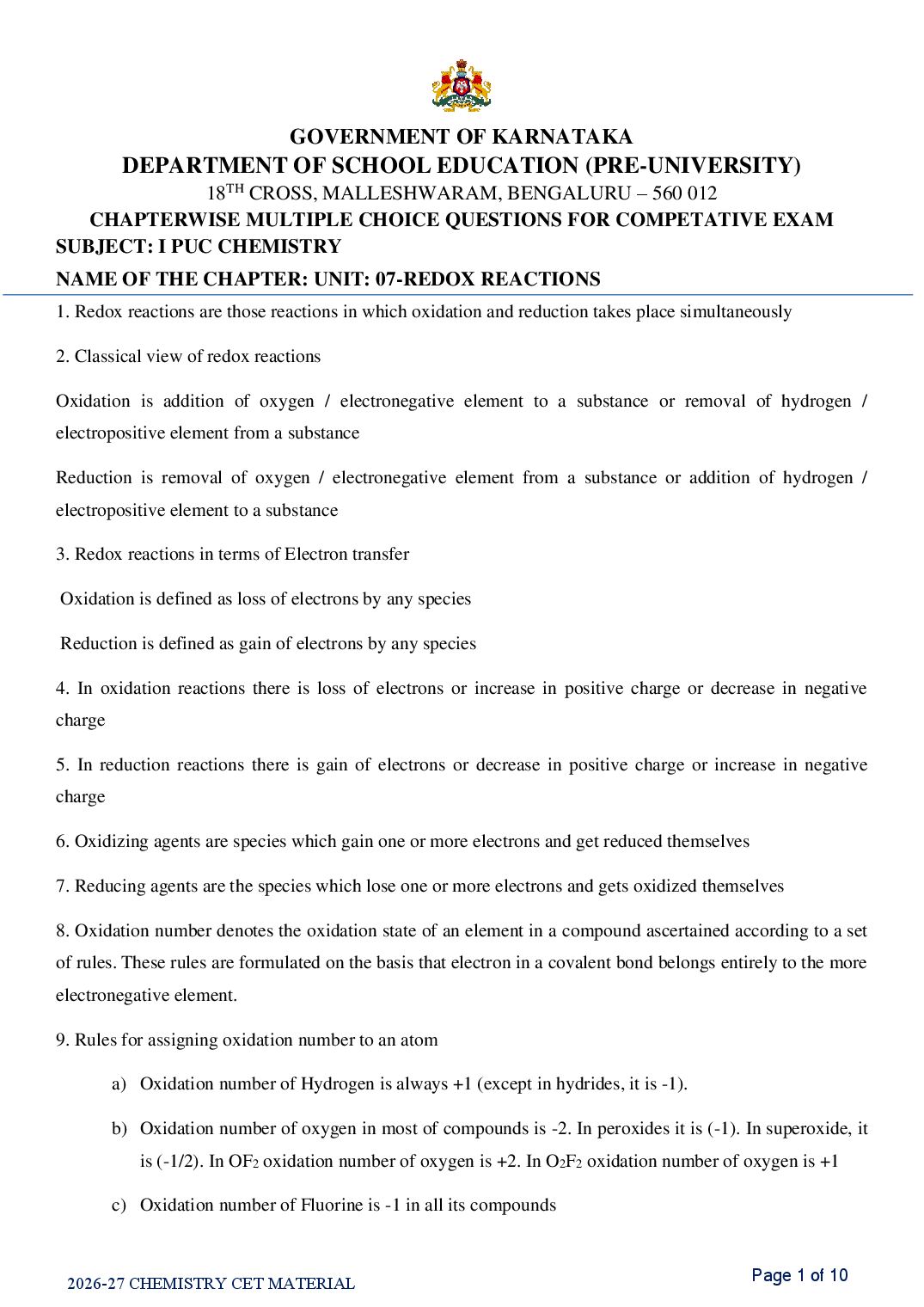
Page 1
DEPARTMENT OF SCHOOL EDUCATION (PRE-UNIVERSITY)
18TH CROSS, MALLESHWARAM, BENGALURU – 560 012
CHAPTERWISE MULTIPLE CHOICE QUESTIONS FOR COMPETATIVE EXAM
SUBJECT: I PUC CHEMISTRY
NAME OF THE CHAPTER: UNIT: 07-REDOX REACTIONS
1. Redox reactions are those reactions in which oxidation and reduction takes place simultaneously
2. Classical view of redox reactions
Oxidation is addition of oxygen / electronegative element to a substance or removal of hydrogen /
electropositive element from a substance
Reduction is removal of oxygen / electronegative element from a substance or addition of hydrogen /
electropositive element to a substance
3. Redox reactions in terms of Electron transfer
Oxidation is defined as loss of electrons by any species
Reduction is defined as gain of electrons by any species
4. In oxidation reactions there is loss of electrons or increase in positive charge or decrease in negative
charge
5. In reduction reactions there is gain of electrons or decrease in positive charge or increase in negative
charge
6. Oxidizing agents are species which gain one or more electrons and get reduced themselves
7. Reducing agents are the species which lose one or more electrons and gets oxidized themselves
8. Oxidation number denotes the oxidation state of an element in a compound ascertained according to a set
of rules. These rules are formulated on the basis that electron in a covalent bond belongs entirely to the more
electronegative element.
9. Rules for assigning oxidation number to an atom
a) Oxidation number of Hydrogen is always +1 (except in hydrides, it is -1).
b) Oxidation number of oxygen in most of compounds is -2. In peroxides it is (-1). In superoxide, it
is (-1/2). In OF2 oxidation number of oxygen is +2. In O2F2 oxidation number of oxygen is +1
c) Oxidation number of Fluorine is -1 in all its compounds
2026-27 CHEMISTRY CET MATERIAL Page 1 of 10
Page 2
e) In the free or elementary state, the oxidation n umber of an atom is always zero. This is
irrespective of its allotropic form
f) For ions composed of only one atom, the oxidation number is equal to the charge on the ion
g) The algebraic sum of the oxidation number of all the atoms in a compound must be zero
h) For ions the sum of oxidation number is equal to the charge on the ion
i) In a polyatomic ion, the algebraic sum of all the oxidation numbers of atoms of the ion must be
equal to the charge on the ion
10. Oxidation state and oxidation number are often used interchangeably
11. According to Stock notation the oxidation number is expressed by putting a Roman numeral representing
the oxidation number in parenthesis after the symbol of the metal in the molecular formula.
12. Types of Redox Reactions
a) Combination Reactions: Chemical reactions in which two or more substances (elements or
compounds) combine to form a single substance.
b) Decomposition Reactions: Chemical reactions in which a compound breaks up into two or more
simple substances
c) Displacement Reactions: Reaction in which one ion (or atom) in a compound is replaced by an
ion (or atom) of another element
a. Metal Displacement Reactions: Reactions in which a metal in a compound is displaced by another metal
in the uncombined state
b. Non-metal Displacement Reactions: Such reactions are mainly hydrogen displacement or oxygen
displacement reactions
d) Disproportionation Reactions: Reactions in which an element in one oxidation state is
simultaneously oxidized and reduced
13. Steps involved in balancing a Redox reaction by oxidation number method
a) Write the skeletal redox reaction for all reactants and products of the reaction
b) Indicate the oxidation number of all the atoms in each compound above the symbol of element
c) Identify the element/elements which undergo change in oxidation numbers
d) Calculate the increase or decrease in oxidation number per atom
2026-27 CHEMISTRY CET MATERIAL Page 2 of 10
Page 3
multiplying formula of oxidizing agent and reducing agents with suitable coefficients
f) Balance the equation with respect to all other atoms except hydrogen and oxygen
g) Finally balance hydrogen and oxygen. For balancing oxygen atoms add water molecules to the side
deficient in it. Balancing of hydrogen atoms depend upon the medium
a. For reactions taking place in acidic solutions add H+ ions to the side deficient in hydrogen atoms
b. For reactions taking place in basic solutions add H2O molecules to the side deficient in hydrogen atoms
and simultaneously add equal number of OH- ions on the other side of the equation
e) Finally balance the equation by cancelling common species present on both sides of the equation
14. Steps involved in balancing a Redox by Ion-Electron Method (Half reaction method)
a) Find the elements whose oxidation numbers are changed. Identify the substance that acts as an
oxidizing agent and reducing agent
b) Separate the complete equation into oxidation half reaction and reduction half reaction
c) Balance the half equations by following steps
i. Balance all atoms other than H and O
ii. Calculate the oxidation number on both sides of equation. Add electrons to whichever side is necessary to
make up the difference
iii. Balance the half equation so that both sides get the same charge
iv. Add water molecules to complete the balancing of the equation
d) Add the two balanced equations. Multiply one or both half equations by suitable numbers so that on
adding two equations the electrons are balanced
15. Application of Redox reactions: Redox Titrations
Potassium permanganate in redox reactions: Potassium permanganate (KMnO4) is very strong oxidizing
agent and is used in determination of many reducing agents like Fe2+, oxalate ions etc. It acts as self-
indicator in redox reactions.
Equation showing KMnO4 as an oxidising agent in acidic medium is:
MnO−4 + 8H+ + 5e− ⎯⎯
→ Mn2+ + 4H2O
2026-27 CHEMISTRY CET MATERIAL Page 3 of 10
Page 4
redox reactions. Titrations involving K2Cr2O7 uses diphenylamine and potassium ferricyanide (external
indicator).
Equation showing K2Cr2O7 as an oxidising agent in acidic medium is:
Iodine (I2) in redox reactions: I2 acts as mild oxidising agent in solution according to equation
16. Direct redox reaction: Redox reactions in which reduction and oxidation occurs in same solution (i.e.,
same reaction vessel). In these reactions transference of electrons is limited to very small distance.
17. Indirect redox reactions: Redox reactions in which oxidation and reduction reactions take place in
different reactions vessels and thus transfer of electrons from one species to another does not take place
directly
18. Electrochemical cell is a device that converts chemical energy produced in a redox reaction into
electrical energy. These cells are also called Galvanic cells or Voltaic cells
19. The electrode at which oxidation occurs is called anode and is negatively charged
20. The electrode at which reduction takes place is called cathode and is positively charged
21. In an electrochemical cell the transfer of electrons takes place from anode to cathode
22. In an electrochemical cell the flow of current is from cathode to anode
23. In the electrochemical cell, the electrical circuit is completed with a salt bridge. Salt bridge also
maintains the electrical neutrality of the two half cells
24. A salt bridge is a U-shaped tube filled with solution of inert electrolyte like sodium chloride or sodium
sulphate which will not interfere in the redox reaction. The ions are set in a gel or agar agar so that only ions
flow when inverted
25. Electrical potential difference developed between the metal and its solution is called electrode potential.
It can also be defined as tendency of an electrode in a half cell to gain or lose electrons
26. Oxidation potential is the tendency of an electrode to lose electrons or to get oxidized
27. Reduction potential is the tendency of an electrode to gain electrons or get reduced
28. In an electrochemical cell, by the present convention, the electrode potentials are represented as
reduction potential
2026-27 CHEMISTRY CET MATERIAL Page 4 of 10
Page 5
30. By convention, the standard electrode potential of hydrogen electrode is 0.00 volts
31. A redox couple is defined as having together oxidized and reduced forms of a substance taking part in an
oxidation or reduction half reaction
32. The difference between the electrode potentials of eth two electrodes constituting the electrochemical
cell is called EMF (Electromotive force) or the cell potential
33. EMF = Eo cathode - Eo anode
34. A negative Eo means that the redox couple is a stronger reducing agent
than the H+/H2 couple
35. A positive Eo means that the redox couple is a weaker reducing agent than
the H+/H2 couple
1. Which quantities are conserved in all oxidation reduction reaction?
(a) Charge only (b) Mass only
(c) Both charges and mass (d)Neither charge nor mass
2. In the reaction H 2S + NO2 → H 2O + NO + S.H 2S ion is oxidised to
(a) oxidised (b) reduced
(c) precipitated (d)None of these
3. The conversion of sugar C12 H 22 O11 → CO2 is following statements is false?
(a) oxidation (b) reduction
(c) Both oxidation and reduction (d) Neither oxidation nor reduction
4. The product of oxidation of I − with MnO−4 in alkaline medium is
(a) IO − (b) IO3−
(c) IO −4 (d) I 2
5. In the following reaction, which is the species being oxidized I–?
2Fe3+ ( aq ) + 2I− ( aq ) → I2 ( aq ) + 2Fe2+ ( aq )
(a) Fe3+ (b) I–
(c) I2 (d) Fe2+
6. The compound that can work both as an oxidising as well as a reducing agent is
(a) KMnO4 (b) H2SO4
(c) BaO2 (d)H2O2
7. Which of the following substances acts as an oxidising as well as a reducing agent?
(a) Na2O (b) SnCl2
2026-27 CHEMISTRY CET MATERIAL Page 5 of 10
Page 6
8. In the reaction 2FeCl3 + H 2S → 2FeCl 2 + 2HCl + S
(a) FeCl3acts as an oxidising agent. (b) Both H2S and FeCl3are oxidised.
(c) FeCl3is oxidised while H2S is reduced. (d) H2S acts as an oxidising agent.
9. When iron is rusted, it is
(a) oxidised (b) reduced
(c) evaporated (d)decomposed
10. Which of the following is not an intermolecular redox reaction?
(a) MgCO3 → MgO + CO 2 (b) O2 + 2H 2 → 2H 2O
(c) K + H2O → KOH + (1/ 2) H2 (d) MnBr3 → MnBr2 + (1/ 2) Br2
11. In the reaction 3Mg + N 2 → Mg 3 N 2
(a) magnesium is reduced (b)magnesium is oxidized
(c) nitrogen is oxidized (d)None of these
12. One gas bleach the colour of flowers by reduction, while the other by oxidation
(a) CO and Cl2 (b) SO2and Cl2
(c) H2S and Br2 (d)NH3and SO2
13. In reaction of KMnO4and Mohr’s salt, FeSO4is oxidised to
(a) Fe2+ (b) Fe3+
(c) Fe (d)All of these
14. Match the following Column-I with Column-II
Column-I Column-II
(1) 2Mg + O2 → 2MgO (p) Removal of hydrogen
(2) Mg + Cl2 → MgCl2 (q)Removal of electropositive element
(3) 2H 2S + O2 → 2S + 2H 2O (r) Addition of oxygen
(4) 2KI + H 2O + O3 → 2KOH + I 2 + O 2 (s) Addition of electronegative element, chlorine
(a) A – (s), B – (q), C – (p), D – (r) (b) A – (r), B – (s), C – (p), D – (q)
(c) A – (s), B – (r), C – (q), D – (p) (d) A – (r), B – (p), C – (s), D – (q)
TOPIC 2: Oxidation Number
15. The oxidation number of chromium in potassium dichromate is
(a) + 6 (b) – 5
(c) – 2 (d)+ 2
16. Phosphorus has the oxidation state of + 3 in
(a) phosphorous acid (b) orthophosphoric acid
(c) hypophosphorous acid (d)metaphosphoric acid.
2026-27 CHEMISTRY CET MATERIAL Page 6 of 10
Page 7
(a) NH3 + H2O → NH4+ + OH− (b) 2NO2 → N 2O4
(c) 2NO2 + H 2 O → HNO3 + HNO 2 (d) N 2O5 + H 2O → 2HNO3
18. The brown ring complex compound is formulated as [Fe(H2O)5(NO)]SO4. The oxidation state of iron is
(a) 1 (b) 2
(c) 3 (d) 0
19. The pair of compounds in which both the metals are in the highest possible oxidation state is
4− 3−
(a) Fe ( CN )4 , Co ( CN )6 (b) CrO2Cl2 , MnO 4−
3−
(c) TiO3 , MnO 2 (d) Co ( CN )6 , MnO3
20. The oxidation number of Sin S2O82− is
(a) +2 (b) +4
(c) +6 (d) +7
21. The oxidation number of oxygen in O2PtF6 is
(a) –0.5 (b) Zero
(c) +0.5 (d) +1
22. In which of the following compounds, iron has lowest oxidation state?
(a) K3[Fe(CN)6] (b) K4[Fe(CN)6]
(c) FeSO4.(NH4 )2SO4.6H2O (d)Fe(CO)5
23. In which of the following compounds does manganese exhibit the highest oxidation state?
(a) MnO2 (b) Mn3O4
(c) K2MnO4 (d)MnSO4
24. On reduction of KMnO4by oxalic acid in acidic medium, the oxidation number of Mn changes,
(a) From 7 to 2 (b)From 6 to 2
(c) From 5 to 2 (d)From 7 to 4
25. When SO2is passed into an acidified potassium dichromate solution, the oxidation numbers of
sulphur and chromium in the final products respectively are
(a) +6, +6 (b) +6, +3
(c) 0, +3 (d)+2, +3
26. In which of the following coordination compounds does the transition metal have an oxidation
number of +6?
(a) [Cr(H2O)5Cl]SO4 (b) Cr 6 − C6 H 6 2
(c) K 2 Cr ( CN )2 O2 ( O2 ) NH3 (d) Cr ( NH3 )4 (SCN )2 CR ( NH3 )2 (SCN )4
27. In which of the following transition metal complexes does the metal exhibit zero oxidation state?
(a) Co ( NH3 )6 Cl3 (b) Fe ( H2O )6 SO4
2026-27 CHEMISTRY CET MATERIAL Page 7 of 10
Page 8
28. Oxidation numbers of chlorine atoms in CaOCl2are
(a) 0, 0 (b) –1, –1
(c) –1, +1 (d)None of these
29. The oxide, which cannot act as a reducing agent, is
(a) NO2 (b) SO2
(c) CO2 (d)ClO2
30. Point out the correct statement of the following aboutNa2S4O6.
(a) Average oxidation number of S atom is +2
(b) Oxidation number of two S atoms is zero each and that of other two is +5 each
(c) Oxidation number of two S atoms is +1 each and that of other two is +4 each
(d)None of these
31. The oxidation state of the most electronegative element in the products of the reaction between
BaO2and H2SO4are
(a) 0 and –1 (b) –1 and – 2
(c) – 2 and 0 (d)– 2 and +1
32. When ethane is burnt in presence of excess of oxygen, the oxidation number of carbon changes by
(a) +8 (b) +7
(c) +3 (d) +4
TOPIC 3: Disproportionation and Balancing of Redox Reactions
33. Which of the following is not a redox reaction?
(a) 4KClO3 → 3KClO 4 + KCl (b) Na 2O + 2HCl → 2NaCl + H 2O
(c) SO2 + 2H 2S → 2H 2O + 3S (d) 2Na + O2 → Na 2O2
34. For the reaction: NH3 + OCl− → N2H4 + Cl− in basic medium, the coefficients of NH 3 , OCl − and
N 2 H 4 for the balanced equation are respectively.
(a) 2, 2, 2 (b) 2, 2, 1
(c) 2, 1, 1 (d)4, 4, 2
35. In the reaction, Cl2 + 2OH − → OCl− + Cl− + H 2O
(a) OH− is oxidising and Cl2 is reducing agent (b) Cl2 is oxidising and OH− is reducing agent
(c) OH− is both oxidising and reducing agent (d) Cl2 is both oxidising and reducing agent
36. When phosphorous reacts with caustic soda, the products are PH3and NaH2PO2. This reaction is an
example of
(a) oxidation (b) reduction
(c) disproportionation (d)none of these
2026-27 CHEMISTRY CET MATERIAL Page 8 of 10
Page 9
balanced equation is
(a) 10 (b) 8
(c) 6 (d) 3
38. Which of the following does not represent redox reaction?
(a) 2Ca ( OH)2 + Cl2 → Ca ( ClO)2 + CaCl2 + 2H2O
(b) Cr2O72− + 2OH− → 2CrO42− + H2O
(c) NaIO3 + NaHSO3 → NaHSO4 + Na 2SO4 + I 2 + H 2O
(d) 2Na 2S2O3 + I 2 → Na 2S4O6 + 2NaI
39. Amongst the following, the strongest oxidising agent is
(a) KMnO4 (b) K2Cr2O7
(c) H2O2 (d)O3
40. Number of moles of K2Cr2O7reduced by one mole of Sn2+ions is
(a) 1/3 (b) 3
(c) 1/6 (d)6
41. The reaction 3ClO− ( aq ) → ClO3− ( aq ) + 2Cl− ( aq ) is an example of -
(a) Oxidation reaction (b) Reduction reaction
(c) Disproportionation reaction (d)Decomposition reaction
42. The species that undergoes disproportionation in an alkaline medium are
(a) Cl2 (b) MnO 24 −
(c) NO2 (d)All of these
43. What products are expected from the disproportionation reaction of hypochlorous acid?
(a) HCl and Cl2O (b) HCl and HClO3
(c) HClO3and Cl2O (d)HClO2and HClO4
44. Amongst the following which can act as an oxidising as well as reducing agent?
(a) F2 (b) SO3
(c) H2O2 (d)H2O
45. The number of electrons lost in the following change is Fe + H 2 O → Fe3O 4 + H 2
(a) 2 (b) 4
(c) 6 (d) 8
46. In which of the following reactions, SO2behaves as an oxidising agent?
(a) 2MnO−4 + 5SO 2 + 2H 2O → 5SO 42− + 2Mn 2+ + 4H + (b) Cl2 + SO2 → SO2Cl2
(c) 2H 2S + SO2 → 3S + 2H 2O (d) SO 2 + H 2 O → H 2SO3
2026-27 CHEMISTRY CET MATERIAL Page 9 of 10
Page 10
47. The oxidation numbers of C-1, C-2 and C-3 in propyne CH3 C CH respectively are
(a) –1, 0, –3 (b) –1, 1, –4
(c) –2, 0, –3 (d) +1, -2, -3
TOPIC 4: Electrode Potential
48. Standard reduction potentials of the half reactions are given below:
The strongest oxidising and reducing agents respectively are:
(a) F2and I − (b) Br2and Cl−
(c) Cl2and Br − (d) Cl2 and I2
49. Standard electrode potentials of redox couples
A2+/A, B2+/B, C2+/C and D2+/D are 0.3 V, – 0.5 V, – 0.75 V and 0.9 V respectively. Which of these is
good oxidising agent and reducing agent respectively:
(a) D2+/D and B2+/B (b) B2+/B and D2+/D
(c) D2+/D and C2+/C (d)C2+/C and D2+/D
50. The standard electrode potentials of four elements A, B, C and D are –3.05, –1.66, –0.40 and +0.80.
The highest chemical reactivity will be exhibited by:
(a) A (b) B
(c) C (d) D
KEY ANSWERS
1 c 11 b 21 c 31 b 41 c
2 a 12 b 22 d 32 b 42 d
3 a 13 b 23 c 33 b 43 b
4 b 14 b 24 a 34 c 44 c
5 b 15 a 25 b 35 d 45 d
6 d 16 a 26 c 36 c 46 c
7 d 17 c 27 c 37 a 47 a
8 a 18 a 28 c 38 b 48 a
9 a 19 b 29 c 39 d 49 c
10 a 20 c 30 b 40 a 50 a
**************
2026-27 CHEMISTRY CET MATERIAL Page 10 of 10
Document Details
| Board / Org | Karnataka Board |
| Exam | Class 11 |
| Type | Question Bank |
| Pages | 10 |
| Updated | 24 Sep 2026 |